Editor's Choice

--------------------------------------------------------------------------------------------------------------------------
Featured Post
--------------------------------------------------------------------------------------------------------------------------
"Let us build Pakistan" has moved.
30 November 2009

All archives and posts have been transferred to the new location, which is: http://criticalppp.org

We encourage you to visit our new site. Please don't leave your comments here because this site is obsolete. You may also like to update your RSS feeds or Google Friend Connect (Follow the Blog) to the new location. Thank you.


"Let us build Pakistan" has moved.
30 November 2009

All archives and posts have been transferred to the new location, which is: http://criticalppp.org

We encourage you to visit our new site. Please don't leave your comments here because this site is obsolete. You may also like to update your RSS feeds or Google Friend Connect (Follow the Blog) to the new location. Thank you.


"Let us build Pakistan" has moved.
30 November 2009

All archives and posts have been transferred to the new location, which is: http://criticalppp.org

We encourage you to visit our new site. Please don't leave your comments here because this site is obsolete. You may also like to update your RSS feeds or Google Friend Connect (Follow the Blog) to the new location. Thank you.


--------------------------------------------------------------------------------------------------------------------------

Saturday, 28 February 2009

PML-N engaged in horse-trading in Punjab


PML-Q forward bloc to support PML-N: Maneka

LAHORE: Pakistan Muslim League-Quaid (PML-Q) forward bloc leader Ata Maneka claimed on Friday the support of 35 members, and said all of them would support the Pakistan Muslim League-Nawaz unconditionally. Addressing the media after meeting the Sharif brothers at their Raiwind farmhouse, Maneka said, “Not a single PML-Q leader, including Chaudhry Shujaat Hussain wants to support the Pakistan People’s Party (PPP), with the exception of Chaudhry Pervaiz Elahi – who, for certain reasons, is in favour of contacts with the ruling party.” He said, “As many as 33 members of the forward bloc have come to Raiwind to meet the Sharifs.” The Online news agency reported that 29 members met Shahbaz Sharif on Friday at his Raiwind residence. Replying to a question, he said that nobody could disqualify the forward bloc members. Maneka said Punjab was the major province of the country, and “if something goes wrong here, the entire country will suffer”. staff report

http://www.dailytimes.com.pk/default.asp?page=2009\02\28\story_28-2-2009_pg13_10


http://www.jang.com.pk/jang/feb2009-daily/28-02-2009/update.htm#105

Also read:

Who will lead a Long March against horse trading in Punjab?


Read more...

Moonis Elahi "should be" the next Chief Minister of Punjab...

Manipulations in full swing for top slot
Nasir Jamal
Saturday, 28 Feb, 2009 | 05:22 AM PST |
Former ruling party Pakistan Muslim League leader Chaudhry Shujaat Hussain (R) and Chaudhry Pervaiz Elahi.—Reuters/File

LAHORE: Three days after imposition of the governor’s rule in Punjab, the Pakistan People’s Party (PPP) is yet to come up with a feasible plan to form its government in the province.

All that it has been able to conjure up so far is meek voices that have been drowned by the emotional chorus whipped up by the Pakistan Muslim League-Nawaz (PML-N) on the disqualification of its leaders and fall of its government in the province.

Governor Salmaan Taseer, who had predicted formation of a PPP government in Punjab – the first in more than 30 years – long before the Supreme Court verdict against the Sharif brothers, never tired of giving controversial statements till taking charge as the chief executive of Punjab but he is nowhere to be seen or heard now.

His aides told Dawn that the governor was ‘busy in urgent administrative and other official matters relating to provincial government’.

PPP leader Tanvir Ashraf Kaira claimed at a press conference on Friday that his party was going to form the next provincial government. But he appeared to have no clue as to who was going to be the PPP’s candidate for the chief minister’s post. Nor did he say how the party planned to go about forming the government.

Earlier, PPP parliamentary party leader Raja Riaz had said that the party leadership was in contact with all political forces represented in the provincial assembly – including the PML-Q, some PML-N dissidents, the PML-F and the MMA.

If the former senior minister in the Shahbaz Sharif government were to be believed, the PPP should have finalised arrangements for forming a coalition with the PML-Q, the party holding the balance in Punjab.

PML-Q information secretary Tariq Azeem appeared to suggest to the contrary when he said a majority within his party felt that the PPP had violated the popular mandate by imposing the governor’s rule in the province.

‘The feeling in the party is that it would negate the spirit of democracy to side against the popular mandate,’ he said while talking to Dawn from Islamabad by telephone.

At the same time, he said it would be premature to say what position his party would take. ‘It’s a crucial issue and will be taken up by the party leadership at its central executive committee meeting next week. None of our leaders, including Chaudhry Pervaiz Elahi, has taken a definitive stance on whether to side with the PPP or the PML-N (when the provincial assembly elects the leader of the house).’

The PML-Q’s ‘indecisiveness’ is popularly being interpreted as its efforts to raise the stakes in the power game in Punjab. It is believed that the PML-Q is demanding chief minister’s post for Chaudhry Pervaiz Elahi’s son, Moonis Elahi, or Senate chairmanship for Chaudhry Shujaat Hussain and the defence ministry.

But Mian Atta Mohammad Maneka, the leader of dissident PML-Q members of the Punjab Assembly is supporting the PML-N ‘unconditionally’. ‘

We have no demands or conditions. If the need arises, the Unification Group (the name of the PML-Q forward block in the Punjab Assembly) will side by the PML-N for the formation of its government,’ he told reporters after attending the Punjab PML-N parliamentary party meeting at the Sharif’s Raiwind Estate.

Maneka claimed that 35 PML-Q legislators, out of a total of 85, were supporting the PML-N and 33 had attended the meeting. The remaining two could not come as one of them was in France and the other could not be informed about the meeting.

The claim, however, could not be verified independently. Some of the PML-Q dissidents later participated in the protest against the governor’s rule outside the Punjab Assembly under the leadership of Shahbaz Sharif.

He claimed that no PML-Q leader or legislator favoured an alliance with the PPP. ‘Only Pervaiz Elahi wants it to win chief minister’s post for his son.’

The dissident PML-Q leader, who was critical of the PPP for imposing the governor’s rule, said the survival of the federation without Punjab was difficult. To a question, he said the Unification Group was not afraid of the threats of disqualification for voting for the PML-N, ruling out the remotest possibility of going with his party if its leadership decided to cooperate with the PPP.

The participation of the PML-Q dissidents and PML-F legislators in a meeting led PML-N Rana Sanaullah to claim that his party had support of 217 legislators. It needed only 186 votes to win the election of the leader of the house.

‘We have numerical strength to form our government whenever the assembly session is convened. Nobody should doubt it,’ he said, adding the PPP would not have imposed the governor’s rule if it could muster the support of the required number of legislators to install its government.

It may be recalled that the PML-N’s candidate Saeeduz Zaman Siddiqui had secured 201 votes from Punjab in the presidential elections in September last year.

http://www.dawn.com/wps/wcm/connect/Dawn%20Content%20Library/dawn/news/pakistan/manipulations-in-full-swing-for-top-slot--bi

....

Abbas Ather's analysis and a 'free of charge advice'

....

A sincere advice by Ataul Haq Qasmi


Some relevant comments:

pakistanthinks said:

Sharif’s can’t sustain an agitation in absence of favorable govt, bureaucracy, army and courts. They have either shown their muscles when they had power behind them or have opted for fleeing out of country. This time it seems, they will fizzle out in months.
In all honesty, I see them marginalized in next elections to even fewer districts and vultures like Imran Khan will be happy in their heart at their demise. Their best bet to be flexible and be part of the system and negotiate a middle way with PPP. Else they will lose all…. They should be part of the system and wait for their moment - that’s the only chance they have…. Lawyers, Imran Khan etc have nothing to lose - Sharif’s have a lot to lose.

Vision said:

My sincere advice for PML(N) is that they should just not only say but show; first of all they must tell their followers that they should not destroy public and private property, they can protest but why should they damage their own assests, it is not AZ’s or someone else’s property.

Rampaging the courts and their disrespect, tradition has been started by no one but PML(N), and now no court seems to be the pillar of the state. When PML(N) comes in power they will do similar or worse. Both the parties have been well tried out.

doublepolitics said:

@Pakistanthinks

Sharifs have already lost all of what they have. Nawaz shahbaz cnnot contest elections, nawaz cannot become prime minister for third time, shahbaz has now by default lost the opportunity to become CM for third time.

If they want to be in the major helm of affairs now they will be needing a constitutional ammendment by the Parliament. This is the only way for which they are protesting too much and are trying to bring government to that.

Have not you heard Mian Nawaz sharief saying that If this issue is not resolved, they will extend the protests and de-stababilization all acroos the country. I think he gave his clear message to zardari.

doublepolitics said:

Nawaz sharif has played wrong. i agree with Zardari’s statemtent that if Sharief’s would have talked to him rather than going for turmoil, they could have sorted out some way to end this situation.

I dont know why Mian sb is playing in the hands of lawyers and Imran khan type of people. He must have realised that PML N has its own rules of the games and it must not be swayed by any of such elements who want a clash just for their own sake.

BY the way PML Q is playing a very mature role. They asked zardari to come to their home rather than chaudhries going to zardari. Mushahid is amazingly saying that they are just observors as they are not interested to form goverment and that the mendate of PML N must be respected. WOW :D

mediawatch said:

Nawaz must not play in the hands of those who even dont have a seat in any of the assemblies. They are playing at the hands of hidden forces and want Mian nawaz sharief to be out of the game of politics and Bhuttos are out of it.

Mian needs to recognize such people, good or bad but its the reality that Shariefs have to go with Zardari and Zardari has to go with Shariefs no matter either of them is in government or opposition.

Nawaz Sb hosh say kaam lain josh say nahin.

doublepolitics said:

By the way Mian sb is too innocent. IF the decision would have been in his favour for him Zardari would have been the best person on earth. Anyhow, its great to listen from him that he is ready to talk through Parliament. Now its time for Zardari to come forward as Sharif’s are the aggrieved party.

Faarigh Jazbati said:

The biggest loss of the current political crises is not the PLMN or PPP. It is Imran khan who has been pushed to the side completely. If you look into the demographic of the voters, IK is fighting for the same voters and the center right political views.

I think IK is in a political shock and does not know how to react to the current situation. This is what you get when oneswhole politics is based upon emotional subjects/issues and devoid of any political calculation of different political scenarios.

PLMN has taken the center stage of pakistani politics and they are the one who are dictating the events. IK is sitting on the sideline only to follow the events and unable to generate/create a political reality which will/can take the focus away from the PLNM/PPP politics.

Adonis said:

Behaviour of PTI diehards is really weird ……. If NS does not fully support Lawyers decisions, he is accused of betrayal, if he fully supports lawyers decisions he is accused of hijacking lawyer’s movement ……

So these guys should make up their mind about what they want NS to do …

But then we all know what they want…..they want NS to simply disappear some where… so that “mirza yaar can roam freely in deserted streets”…..

This reminds of an old joke …

—The son of village mirasi asked his father what would happen if the chaudhri of village dies. The elder mirasi replied that chaudhri’s son will become the next chaudhri. If chaudhri’s son also dies then, asked the junior mirasi. Then his nephew will become chaudhri, came the reply. What if the nephew also dies? asked mirasi’s son. Now the elder mirasi understood what the real question was and replied, “Son! even if the whole village dies, still you can never be a chaudhri”. —–

So my commiserations to these PTI diehards who are so used to day-dreaming….

Source: pk politics


Read more...

Yusuf Raza Gilani, Amjad Ali Chajra and the chrages of corruption - by Khalid Masud Khan

http://cache.daylife.com/imageserve/08YoeED0Eb6oi/610x.jpg


http://www.jang.com.pk/jang/feb2009-daily/28-02-2009/col6.htm

....

PM promises uplift of Jalalpur Pirwala

Later, the Prime Minister proceeded to the residence of Mian Amjad Ali Chajra at Manakwali village, some 10 kilometres away from Jalalpur Pirwala city, to express his heartfelt condolences to Amjad Chajra on the sad demise of his mother.

He also offered Fateha and prayed that may Almighty rest the departed soul in peace and give the bereaved family the courage to bear this loss.

MPA Malik Ahmad Hussain Dehar, Malik Salahuddin Dogar, tehsil nazim Shujabad Rana Suhail Noon, former Punjab minister Rana Qasim Noon and president Multan Chamber of Commerce and Industry (MCCI) Khawaja Jalaluddin Roomi besides a number of people were present on the occasion.

http://www.app.com.pk/en_/index.php?option=com_content&task=view&id=43574

...
Read more...

Tlaiban kill shia school children in ambush in Hangu, Update 28 February 2009


Pakistani school children killed in ambush
Fri, 27 Feb 2009 13:44:50 GMT


Unidentified assailants have reportedly ambushed a van carrying Shia children to school in the troubled tribal region of northwest Pakistan.

At least four students lost lives and five others sustained injuries as gunmen fired bullets at the school van outside the town of Hangu. The driver was also killed in the attack, Press TV's Muhammad Shafiq, reported.

The report added that seven students appear to have been kidnapped by the attackers.

The school van was traveling from Hangu to Kohat when it came under attack. The bodies and the wounded were shifted to Hangu's Civil Hospital.

Meanwhile, local police station chief Saeed Khan noted that authorities have closed all entry and exit points in the town, launching search operations in the nearby mountains to recover the kidnapped children and capture the attackers.

Hangu is located about 175 km (109 miles) west of Islamabad in Pakistan's North West Frontier Province, which borders Afghanistan and is plagued by sectarian, pro-Taliban and al-Qaeda-linked violence.

MP/MMN

http://www.presstv.ir/detail.aspx?id=86955&sectionid=351020401


The incident happened on Friday morning outside the town of Hangu in the troubled North West Frontier Province, state-run television PTV reported.

The driver of the minibus was also killed in the lethal attack.

The death toll is expected to rise as some of the injured children are said to be in critical condition, according to medics.

Hangu is located about 175 kilometers (110 miles) west of the capital Islamabad.

Taliban-linked militants in Parachinar, Hangu towns and the other areas of the Kurram tribal agency have killed 25 to 30 people on a daily basis during the last six months, local media reports say.

Some reports have cited grave human rights abuses against Shias in the northwestern Pakistani city of Parachinar.

Taliban has established its rule in the restive Swat valley and its influence is also rapidly increasing its grip on the major cities and even the so-called settled areas of the country.

Shia sources say that the community makes up one-third of Pakistan's 160 million-strong population. Since the 1980s, thousands of people have been killed in violence-related incidents in Pakistan by extremist groups.

Moderate Pakistani Sunni groups believe that leaving Shias at the mercy of the Taliban is a conspiracy against the country.

Earlier, Tehran cautioned Islamabad over the 'silent massacre' of its Shia community by the Taliban in the country.

"The incidents that have occurred against Pakistan's Shia community are a plot to create conflict between the region's Sunni and Shia population," said Iran's Parliament Speaker Ali Larijani.

"We have warned Islamabad over the incidents and we will pursue the matter," he added.

,,,,

4 students kidnapped in Hangu
By Abdul Sami Paracha
Saturday, 28 Feb, 2009

KOHAT, Feb 27: The driver of a college van was killed and four students were kidnapped in Hangu district on Friday.

Two students of Al Asr College were injured in the attack near Moebak Kandao. It was suspected to have been carried out by Taliban. They were sent home after treatment. Another student reached home after escaping from the van.

Abid Hassan, Asif Ali and Said Haleem Shah, all class XI students, and

Shahi Abbas of class VII, were taken by the kidnappers to Orakzai Agency.

Driver Asghar Hussain’s body was brought to Kohat for burial.

According to district police chief Sajjad Khan, a large-scale operation launched to recover the students and arrest the kidnappers ended in failure in the evening.

“We have asked the administration of Orakzai Agency to remain vigilant and help locate the missing students,” he said.

The official said helicopters were also being use to trace the kidnappers in mountains and thick jungle.

The Hangu bazaar was closed after the incident because of fear of sectarian clashes.

People in Bangash area of upper Kohat district took to the streets to vent anger over the incident.

The Bangash community threatened to block the highway if the students were not recovered by 10am on Saturday.

The deadline was given to the district administration, after a meeting held at a police station, by the chairman of the Ittehad Bainal Muslimeen group, Mahatabul Hassan, and a former chief justice of Peshawar High Court, Syed Ibne Ali.

The ambush took place at the scene of a firing incident on Ashura day when mourners who wanted to enter Hangu from Kohat amid curfew were targeted by unknown men.

A jirga formed after last year’s Muharram clashes in the area is yet to start negotiations. The government has asked the jirga to give its verdict by March 4 for restoring peace. (Dawn)

....

Pakistan Shia children 'attacked'

map

Taleban gunmen in north-west Pakistan have attacked a school bus, killing the driver and injuring three pupils in a sectarian attack, police say.

Some reports say several children were abducted in the attack in Hangu.

Police say the children in the bus were Shia Muslims. It follows the murder of a Shia lawyer in Hangu on Thursday.

The Taleban are active in Hangu - where there is tension between Shias and Sunnis - and have imposed their version of Sharia law in parts of the area.

Hangu - in North West Frontier Province - has seen especially violent clashes in the past between Shias and Sunnis during the Shia religious ceremony of Ashura.

The hardline Sunni Taleban say they consider the Shias heretical.

http://news.bbc.co.uk/1/hi/world/south_asia/7915323.stm

....

Letter by the Human Rights Commission of Pakistan

Shia killings on the rise again

The Chairperson of the Human Rights Commission of Pakistan, Ms Asma Jahangir, has written to The Friday Times, expressing her concerns of the rising trend of killing Shias in Quetta: “The killing of Shia notables in Quetta has sadly become a frequent occurrence. Some of the killings have been owned by an extremist organisation flying a religious standard. The number of the Shia community members killed there over the recent years has exceeded 300. The government’s failure to track down the culprits has understandably enraged the targeted community, and it has also emboldened the perpetrators to kill with impunity. Besides religious figures, liberal politicians, businessmen and government officials have been targeted”.
Quetta is an unlucky “frontline” city. It has received two sets of refugees from Afghanistan. The Shia Hazaras who have escaped sectarian prejudice in Afghanistan have been coming to the safe haven of Quetta over centuries. They became naturalised in the normal course because of the wonderfully tolerant environment of Balochistan and have arisen on the social ladder as useful citizens. Before 2001, the city was host to a large number of Afghans fleeing Taliban rule; after 2001, it was the Taliban commanders with their Al Qaeda links who were allowed to take shelter here. Sectarian violence has followed.

Quetta has additionally fallen victim to Baloch militant organisations that kill Punjabis and others seen by them as renegades to their cause. Taking advantage of the turmoil in Afghanistan and the ongoing Indo-Pak proxy war, they have taken on a sharp edge they never had before. They kill and kidnap at will and have weapons at their disposal they never had before. But Quetta is not alone in its vulnerability. In the tribal areas, Kurram has suffered Shia killing for the last two years or more. The roads coming down from there to the settled areas of Hangu, Kohat, Dera Ismail Khan and Peshawar in the NWFP have all seen their own share of killings.

The latest news from Hangu is that a van of school children was fired upon by sectarian terrorists, killing one and kidnapping six of the children. Kohat next door is not exempt from this bloodbath, so much so that the killers are now accepted as a part of the local administration. Ms Jahangir’s warning is timely. The wave of Shia-killing is not going to remain confined to Balochistan and the tribal areas. In fact, Dera Ghazi Khan and Bhakkar in Punjab are already feeling the pressure; and it is linked to Pakistan’s war against terrorism. (Daily Times)

http://www.dailytimes.com.pk/default.asp?page=2009\02\28\story_28-2-2009_pg3_1
Read more...

Friday, 27 February 2009

Cruelty with dog in Peshawar. A specimen of moral character of PML-N


Supporters of former premier Nawaz Sharif march during a protest in Lahore on February 26, 2009.


Is there any difference between the Taliban who draw pleasure from beheading innocent citizens in Swat and FATA and the PML-N /Jamaat-e-(Ghair) Islami and Imran Khan's PTI (Pakistan Taliban-e-Insaf) workers who draw pleasure from torturing an innocent dog in Peshawar?

http://www.featuringdave.com/images/beheading.jpg

Cruelty with dog in Peshawar.This cruelty reflects true character of PML-N, JI and PTI. They are an insensitive bunch of criminals, who lack civilized training and education at home. They probably know that animal feels the pain but they have no regard for ethics.

http://liberationbc.org/files/dog-res-01.jpg


Read more...

Ahmed Rashid: The Taliban has its own agenda for Pakistan

‘An Appendage Of The Al Qaeda, The Taliban Now Has Its Own Agenda For Pakistan’

Ahmed Rashid, author of a book on the Taliban, tells HARINDER BAWEJA (of Tehleka.com) that even India needs to worry enormously


Cover Story

How do you read the ceasefire pact with the Taliban?
It can be serious. We have had a spate of ceasefires, which have been very controversial. They have been opposed by a large section of the population because the ceasefires are only seen as a consolidation of the Taliban and their spread to other areas. On the other hand, other people are saying that it will bring peace and improve the justice system in the Swat valley. These may be short-term gains, but the longterm implications of this ceasefire are very very dangerous for the country. I think the fact that the state has been willing to change the legal system in Swat is a very bad precedent for the future. And something like that has not happened even in Afghanistan where the Taliban have controlled many provinces. But the state has never compromised with the Constitution and the legal system. So talking to the Taliban is one thing. It is necessary. But to talk to them and accede very hastily to accepting some of their demands regarding Sharia is a very serious risk.

Would you see it as a surrender? Some strategic experts are talking in terms of the Zardari dispensation having surrendered to the Taliban.
I wouldn’t say it is a surrender because it is still very much up in the air. Zardari hasn’t signed the agreement yet. He has to sign it in order for it to be enforced. And the agreement is still being negotiated both in Swat and Bajaur. But certainly, if it does go ahead and it holds for any length of time, it will be a serious infringement of the state’s authority.

Does the word balkanisation come to mind when you think of the ground situation?
What we are seeing is a growing state of anarchy rather than balkanisation. I don’t think the Taliban are in a position to separate the country or the northern part of the country. But certainly they are in a position to increase anarchy and law and order problems, and there are criminal elements who have joined up with them. There are robberies, beheadings and kidnappings taking place under their name. Some of which they are doing, and some of which is being done by criminal gangs. It is a very complicated situation.

Does it bother you that Pakistan and Afghanistan are now being mentioned together?
Well, I think it certainly bothers a lot of people, especially in the establishment. But I think it’s fair enough because neither country can deal with this issue alone. The fact is that there are Pakistani Taliban fighting in Afghanistan and there are Afghan Taliban fighting in Pakistan. I think it would very immature for us to be in a state of denial about that. The Afghans are not in denial about that but elements in Pakistan certainly are.

Would you say that the Taliban has succeeded in imposing their ideology and political agenda through the barrel of a gun?
That’s absolutely true. Through terror, fear, beheadings and hangings carried out in Swat. I don’t believe that the majority of the Swatis want the Taliban. As we know, something like 350,000 out of a population of 1.5 million have fled Swat. The educated liberal Swatis, teachers, doctors, policemen, and civil administrators have all fled.

Could you briefly describe life in the Swat valley in terms of the parallel judiciary, women in burqas, no music, no barber shops…
That is the situation. For example, the Taliban leader Maulvi Fazalullah has said that NGOs will not return to Swat. A lot of social, health, and education activity was being carried out by NGOs. It’s still uncertain whether girls will be allowed to go back to school and under what conditions. Will male teachers be allowed to teach them? The very fact that the state is having to negotiate these things is a huge sign of weakness.

Who would you say is in control? Is it the Prime Minister? Is it the President?
As far as this deal is concerned, it seems everyone has been on board. The lead was taken by the ANP in Peshawar and I think the ANP has lost a lot of ground because of this deal. I don’t think the lead was taken by the army. The army has followed with the ANP initiative. And the PPP and the President have also come on board. But within all these parties, even within the ANP and the PPP, these deals remain very controversial.

Was the army having a tough time handling the Taliban militarily, having played a role in its creation in the first place?
The phenomenon now is that the Pakistani Taliban have their own agenda for Pakistan. Before, there was a situation where they were an appendage of the Al Qaeda and the Afghan Taliban fighting in Taliban. Over the last two to three years they have developed their own agenda for northern Pakistan. And that is what is most worrying. I certainly don’t think that the army is on board with that. The army is very much opposed to that, but it has limited capacity to deal with it now that the spread of the Pakistani Taliban has become so vast.

They are literally 150km from Islamabad. Right?
Yes. And they are spreading south. And the danger is that they will use Swat as a base to spread south of the valley and then closer towards the capital.

So deal or no deal, ceasefire or no ceasefire, the situation remains pretty serious and alarming.
It is serious and alarming. And it is worrying people in Punjab. There have been Taliban attacks in Punjab also. South Punjab is filled with some of these Punjabi groups, who ally with the Taliban. Karachi is filled with both neo- Taliban and Punjabi groups. Certainly there is a big danger of this spreading to other parts of the country very rapidly.

Isn’t it ironic that the Zardari dispensation is on the verge of signing a pact with the Taliban, which includes Baitullah Mehsud, accused of masterminding Benazir Bhutto’s assassination?
Certainly. It’s very damaging to the prestige of the PPP Government, the ANP who opposed it and who have been facing death threats and attacks by Baitullah’s men. In fact, one MP of the ANP has been killed and the others ministers and MPs are being targeted. It’s difficult to imagine how we are going to be able to have a truce with such a person.

So what were the compulsions for going ahead with the ceasefire if one were to specifically see it from the PPP’s point of view?
I think there is an inherent weakness of the state at the moment. Both in political and military terms. I think the government and the army are exhausted by the heavy fighting that has taken place over the last six to nine months in Bajaur and Swat. At the moment, retaking Swat by the army is not an option because you would need perhaps as many as a hundred thousands troops to do that and the army can’t spare that at the moment.

The PPP has only just completed a year in power and they are already on the verge of a pact with the Taliban?
Well, there has been a steady weakening of the state’s response to this threat over the past year. And I don’t think the government has been properly focused on that. It’s been more focused on the political rankling inside Punjab and the Centre and Nawaz Sharif and the lawyers movement and other things rather than focusing on the threat of extremism.

So are you amazed a little by the US reaction to the ceasefire because they are not openly opposing it, saying the Sharia is part of Pakistan’s Constitution?
Well, I think the US has to work with the Pakistani Army. It doesn’t have a choice. I think they were surprised by what happened in Swat. I don’t think they were properly informed about it especially when Richard Holbrooke was visiting the region. But they still realise that they have to work with the army.

To what extent should India worry?
India needs to worry enormously about it because many of these groups who ally to the Taliban, have an agenda in India. The last thing you want to see is the Taliban actually reaching upto the Indian border. In which case India will be faced with having part of the Pakistan border under the control of the Taliban, which is not something India will like very much.


From Tehelka Magazine, Vol 6, Issue 9, Dated Mar 07, 2009

Source: http://www.tehelka.com/story_main41.asp?filename=Ne070309an_appendage.asp

Read more...

PPP protests against burning of Benazir, Zardari portraits


...


http://www.altmuslim.com/ee_images/demo_karachi.jpg
PPP protests against burning of Benazir, Zardari portraits
Friday, February 27, 2009
By By our correspondent
HYDERABAD: Activists of the ruling Pakistan Peopleís Party (PPP) on Thursday took out rallies and staged demonstrations against the burning and disgracing of portraits of Benazir Bhutto and Asif Ali Zardari in the Punjab cities.

Activists of the Sindh Peopleís Youth took out a rally, led by divisional president Ahsan Abro and others, with activists chanting slogans against the workers of the PML-N.

Another protest rally was brought to the Hyderabad Press Club, which was led by provincial minister Zahid Bhurguri, Amanullah Siyal, Aftab Khanzada and others. The protesters were carrying placards inscribed with slogans against the PML-N workers and demanding President Zardari to take action against those involved in damaging the portraits of the slain chairperson.

The protesters also set on fire the effigy of PML-N Quaid Nawaz Sharif. They said protesting against the decision of the apex court was the right of the PML-N but damaging the portraits of Benazir Bhutto and Asif Zardari had hurt the sentiments of millions of supporters of the PPP.

Large contingents of police and Rangers were deployed to prevent violence as the PML-N workers were staging a demonstration at the press club when the PPP workers arrived.

Our Khairpur correspondent adds: The students wing of the PPP protested against the destruction of the monument of Shaheed Benazir Bhutto in Rawalpindi by the PML-N workers.

The students of the Shah Abdul Latif University staged a demonstration and alleged that the PML-N was instigating the PPP workers but said the PPP was a party of democratic personalities. They said the Supreme Court had announced the disqualification decision on merit.

However, they said, the PML-N was accusing President Asif Ali Zardari for the verdict. The tone of the Sharif brothers towards the president of Pakistan was intolerable, they said. They said if the Sharifs did not change their tone of criticism, then they will react.

The PPP women wing protested against the disfiguring of portraits of Shaheed Benazir Bhutto. The women workers said the PPPP will not tolerate such acts of the PML-N.

Our Naushahro Feroze correspondent adds: Hundreds of activists of the PPP staged a protest and a sit-in outside the local press club against the disfiguring of portraits of Shaheed Benazir Bhutto in Rawalpindi and other cities of the Punjab.

The rally started from the PPP district office and went round the entire city before terminating at the local press club. The rally was led by Sadruddin Ujan, president PPP Lawyers Forum, Ubaidullah Rajpar, Shahnaz Ansar, district president PPP Women Wing, Bakhtawar Vistro and others.

The protesters raised slogans against the PML-N and the Chaudhry brothers. Speaking to a large gathering, the local leaders said Benazir Bhutto had sacrificed her life for democracy in Pakistan and its masses. (The News)

PML-N workers attack PPP office, Benazir memorial

Staff Report

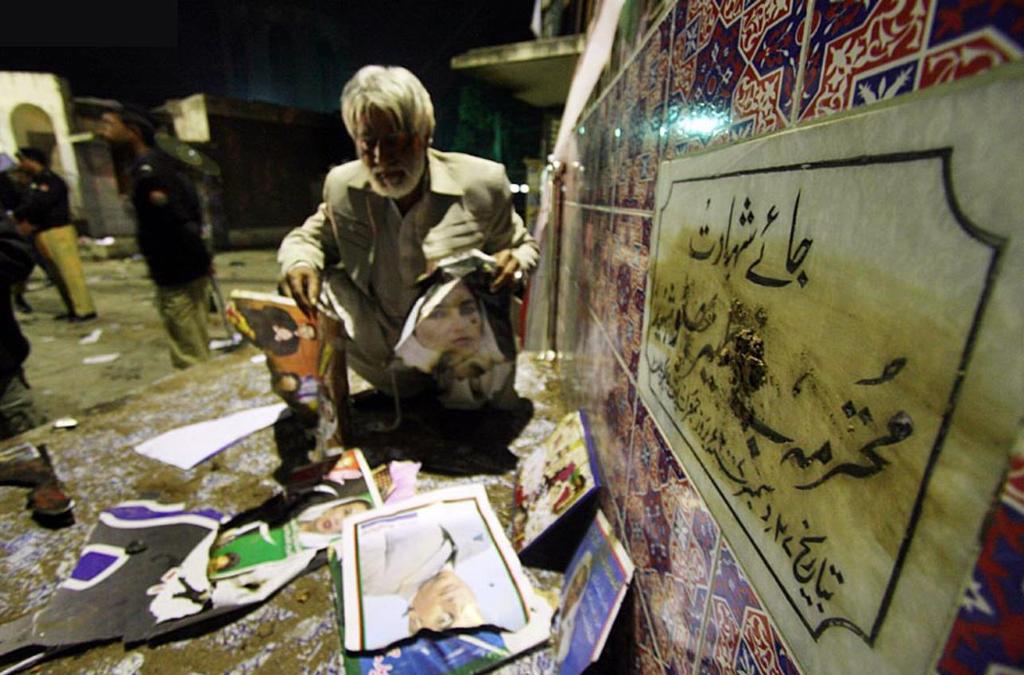
RAWALPINDI: Dozens of PML-N workers on Thursday pelted a PPP office and a memorial of Benazir Bhutto on Liaquat Road with stones during a demonstration against the disqualification of their leaders Nawaz Sharif and Shahbaz Sharif from contesting election. They also destroyed PPP hoardings and banners carrying pictures of Benazir Bhutto in the vicinity. There followed exchange of hot words and scuffle between the PML-N and the PPP workers. However, the police’s intervention led the mob’s peaceful dispersal. No damage to public life was reported. The PPP workers later turned up in front of the memorial and stayed put till night. They erected a large portrait of Benazir Bhutto at the site, lit candles and laid floral wreath there. PPP Central Executive Committee’s member Sultan Mehmood Qazi, PPP, Rawalpindi City, President Aamir Fida Paracha, Nargas Fayyaz Malik and other leaders visited the place. They announced an FIR would be lodged with police against the Benazir’s memorial and PPP office attackers.

FIR registered: According to APP, on the directive of higher authorities, the City Police Station on Thursday registered an FIR against 60 unidentified Pakistan Muslim League Nawaz (PML-N) workers allegedly involved in burning of Benazir Bhutto Shaheed’s monument at Liaquat Bagh.

PPP workers protest: A few dozen PPP workers on Thursday protested at Zero Point against the PML-N activists’ attack on a memorial of Benazir Bhutto outside Liaquat Bagh in Rawalpindi. They said the memorial attack was an attack on democracy. They said the PPP believed in peace and democratic process. (Daily Times)


Read more...

Talat Hussain: Nawaz Sharif's dream or reality?


http://www.buzzvines.com/files/images/talat%20joins%20express.jpg

[1100563718-2.gif]

Read more...

Lahore is the best - Funny pictures


Finally, a comment:

http://rlv.zcache.com/i_love_lahore_t_shirt-p235116381484462006y6eq_400.jpg
Read more...

Nawaz Sharif invites his followers to mutiny in Pakistan. Strike call fails.

The PMLN’s policy of not recognising the “PCO Supreme Court” anticipated its decision to reject the verdict the Supreme Court reached Wednesday to disqualify the Sharif brothers.

However, desperate to become the Prime Minister of Pakistan, Nawaz Sharif is trying to create law and order situation in the country, by encouraging his workers to break all laws and create chaos.

His call was widely neglected all over Pakistan. Only a few dozen law-breakers turned up in Lahore and Rawalpindi.

...

حکم ماننے سے انکار کر دو: نواز شریف

میاں نواز شریف
پاکستان مسلم لیگ ن کےسربراہ میاں نواز شریف نے شیخوپورہ میں ایک جلسہ عام سے خطاب کیا

پاکستان مسلم لیگ ن کےسربراہ میاں نواز شریف نے پنجاب کی انتظامیہ اور پولیس کے افسروں کو کہا ہے کہ وہ پنجاب کے موجودہ حکمرانوں کے احکامات ماننے سے انکار کردیں۔

یہ بات انہوں نے شیخوپورہ میں ایک جلسہ عام سے خطاب کرتے ہوئے کہی۔


http://www.bbc.co.uk/urdu/pakistan/story/2009/02/090226_nawaz_call_sen.shtml


....
* Mob attacks Lal Haveli, blocks Islamabad-Rawalpindi highway

Doezens of protesters rallied across the country on Thursday, setting cars ablaze to protest the Supreme Court decision disqualifying the Sharif brothers.

Rangers were called to control law and order in Rawalpindi and Lahore, a private TV channel reported.

Small crowds of PML-N, Jamaat-e-Islami and PTI clashed with police and closed the highway between Islamabad and Rawalpindi.

Supporters of the PML-N also attacked Lal Haveli – the residence of former federal minister Sheikh Rashid Ahmed, who was not at home at the time. The protesters dispersed when security guards inside the building fired gunshots in the air.

In Lahore, protesters stormed the barricades for a sit-in outside the Governor’s House, punching their fists in the air, witnesses said.

Protesters stoned a bank during a protest in Multan.

Dozens also rallied in Faisalabad, Rawalpindi, Muzaffarabad, Karachi, Quetta and Peshawar. agencies/daily times monitor

...

Speech invitation to mutiny: Sherry

LAHORE: Information Minister Sherry Rehman has said Pakistan Muslim League-Nawaz (PML-N) chief Nawaz Sharif’s speech in Sheikhupura is an open invitation to mutiny and his comments against President Asif Ali Zardari are regrettable, a private TV channel reported on Thursday. According to the channel, Sherry said provoking the government and law enforcement officials by Nawaz was akin to taking the country towards disaster and confrontation, and weakening state institutions. She appealed to the PML-N’s ‘responsible’ leadership to rein in their emotions and avoid making personal comments. She said Prime Minister Yousuf Raza Gilani had said the “review option” was still open, and the PML-N should avoid politics of confrontation. About governor’s rule in Punjab, she said it was imposed under Article 234 of the constitution, the channel quoted its sources. daily times monitor

...

Strike call fails

ISLAMABAD: The masses rejected the Pakistan Muslim League-Nawaz’s (PML-N) call for observing a strike on Thursday to protest against the Sharif brothers’ disqualification, Interior Adviser Rehman Malik said. Talking to reporters outside Marriott hotel on Thursday, the adviser said the country needed development, not strikes in the current crises. He said traffic plying on roads was a clear indicator of how successful the strike had been, adding the masses did not pay heed to the PML-N’s call. Malik was satisfied with the law and order situation in the country. “Everything is under control.” tahir niaz

....

Harris Khalique writes in The News:

What we may see in the months to come is the right-wingers, including the Jamaat-e-Islami and Tehrik-e-Insaf, rallying around the PML-N, pushing the Sharifs further to the right and the supporters of the PPP pitched against them, without sensing the betrayal of their leadership. The real issues, including terrorism, the struggle for rights in Balochistan, food and energy shortages, the breakdown of law and order and lack of basic services, will all be moved to the back burner. The military must not intervene at any cost, for its imminent failure in governance soon after taking over resurrects the old-timers, thus preventing them from becoming irrelevant. The otherwise incompetent and corrupt are absolved of their wrongdoings due to the illegitimacy of military rule. We mustn’t forget that the National Reconciliation Ordinance was passed by a military dictator when sand shifted under his feet.

...

Zardari is a cheater whereas Nawaz Sharif is a man of principles?


..

Remnants of General Zia-ul-Haq oblige by assuring Nawaz Sharif of their full support. The pro-Taliban politicians are re-uniting in Pakistan.


...

Hanif Abbasi, ex-Jamaat-e-Islami, and now PML-N goonda involved in creating law and order situation in Rawalpindi:


....


...

Column by Latif Chaudhry in Daily Express, 27 Feb 2009


Read more...

Hangu: Taliban attack a school van killing 3 Shia children, kidnapping 6 Shia children

Gunmen ambush Pakistan school minibus, 3 Shia students killed, 6 taken captive


Jang

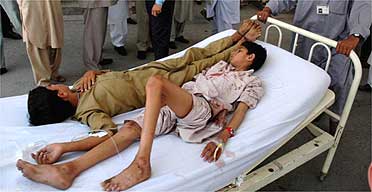
Children injured in a bombing at the Bari Imam shrine in Islamabad

Shia children injured in a previous bombing at the Bari Imam shrine in Islamabad. Photograph: AP


PESHAWAR, Pakistan (AFP) — Gunmen on Friday ambushed a minibus carrying children to school in remote northwest Pakistan, killing the driver, wounding two children and apparently kidnapping six others, police said.

The bus was ambushed outside the town of Hangu in the country's troubled North West Frontier Province, which borders Afghanistan and is plagued by sectarian violence as well as Taliban and Al-Qaeda-linked militants.

"Unknown gunmen fired at the school van carrying Shiite students. The driver was killed, two children were injured, while six appear to have been kidnapped by the attackers," local police station chief Saeed Khan told AFP.

"Police are searching for the attackers in the nearby mountains," he added, saying he had no further details about the missing students.

Hangu, which has been a flashpoint for sectarian violence in the past, is located about 175 kilometres (110 miles) west of the capital Islamabad.

Shiite and Sunni Muslim groups signed a peace accord in Hangu last month after days of sectarian clashes in which at least nine people were killed.

Shiites account for about 20 percent of Pakistan's 160-million-strong, Sunni-majority population.

The groups usually coexist peacefully but outbreaks of sectarian violence have claimed more than 4,000 lives across Pakistan since the late 1980s.


AFP 27 Feb 2009
http://blog.acumenfund.org/wp-content/uploads/2007/11/Pakistan%20-%20school%20children1.jpg

Meanwhile, gunmen opened fire on a school van near the northwestern town of Hangu on Friday, killing its driver and injuring three students before abducting six other children, police officer Arshad Khan said. Those abducted were between the ages of nine and 18, he said.

Pakistan's northwest is a violent, lawless region, where criminal gangs and Islamist militants take refuge.

Associated Press writer Hussain Afzal contributed to this report from Parachinar.

http://www.google.com/hostednews/ap/article/ALeqM5hkiMxbHNH0BqgpWA2ZG6VD6wVTmAD96JO5900

....

Driver killed in Hangu school van firing

Updated at: 0955 PST, Friday, February 27, 2009 HANGU: A driver was killed and two students sustained injuries when unknown persons opened fire at a school van in Hangu. The attackers also kidnapped six students.

Police sources said a school van travelling from Hangu to Kohat when unidentified persons opened fire at van near Merobik Banda area killing driver Asghar Ali on the spot and injuring two students Zafar and Farhan.

Eyewitnesses said the attackers also abducted six students. The body and injured were shifted to Civil Hospital. Heavy police contingents launched search operation for the recovery of the children.

http://www.thenews.com.pk/updates.asp?id=69844

...

12 men abducted in Hangu

HANGU: Unidentified armed men on Monday opened fire on a Peshawar-bound vehicle before abducting 12 of its passengers near Kurram Agency’s border with Hangu district, officials said. An official told Daily Times that the vehicle was on its way to Peshawar when the armed men intercepted it in Tootkas area and abducted 12 of its 15 passengers.Hangu District Police Officer Sajjad Khan confirmed the incident. He added that even though the Khasadar force was deployed in the area, the Taliban were openly operating there. saboor khan (Daily Times)

http://www.dailytimes.com.pk/default.asp?page=2009\02\24\story_24-2-2009_pg7_28

....

Kurram Agency Toori abducted persons couldn’t be recovered

The News, 27 Feb

PESHAWAR: Even after lapse of five days twelve abducted persons of Toori tribesmen could not be recovered.

Sources said that that some armed persons had abducted twelve persons of Toori tribesmen on way from Kuram Agency to Peshawar from Tootkas area and one trying to escape was shot dead. Despite lapse of five days, the kidnapped persons could not be recovered.

Toori tribesmen have demanded immediate release of the abductees and ensuring safe travel on the Peshawar-Kurram main highway.

....

سکول بس فائرنگ میں ڈرائیور ہلاک


ہنگو میں کشیدگی: فائل فوٹو
ضلع ہنگو سُنی شیعہ فسادت کے لحاظ سے انتہائی حساس ہے
صوبہ سرحد کے ضلع ہنگو میں پولیس کا کہنا ہے کہ نامعلوم مسلح افراد نے سکول کے بچوں کی ایک گاڑی پر فائرنگ کی ہے جس کے نتیجہ میں گاڑی کے ڈرائیور ہلاک جبکہ دو بچے زخمی ہوگئے ہیں۔زخمی بچوں کو ہنگو کے سول ہسپتال میں داخل کرا دیاگیا ہے۔

پولیس کے ایک اہلکار عمر حیات نے بی بی سی کو بتایا کہ جمعہ کو ہنگو شہر سے چار کلومیٹر دور جنوب کی جانب بہادر بانڈہ کے علاقے میروباک میں نامعلوم مسلح افراد نے سکول کے بچوں کی ایک گاڑی پر فائرنگ کی جس کے نتیجہ میں گاڑی کے ڈرئیور ہلاک جبکہ دو بچے زخمی ہوگئے ہیں۔

پولیس اہلکار کا کہنا تھا کہ اس واقعہ کے بعد ہنگو سے پولیس کی بھاری نفری علاقے میں پہنچ گئی اور مختلف راستوں میں ناکے لگا کر تلاشی شروع کر دی۔لیکن تاحال کسی قسم کی گرفتاری عمل میں نہیں آئی ہے۔انہوں نے کہا کہ فائرنگ کرنے والے مسلح لوگ پیدل تھے اور فائرنگ کے بعد فرار ہوگئے ہیں۔

علاقے میں موجود ایک مقامی صحافی نے بی بی سی کو بتایا کہ جمعہ کی صبح آٹھ بجے مسلح افراد نے سکول کے قریب ایک سپیڈ بریکر کے اوپر گاڑی پر فائرنگ کی جس کے نتیجہ میں گاڑی کے ڈرائیور اصغر خان ہلاک جبکہ دو بچے ظفر علی اور فرحان علی زخمی ہوگئے۔انہوں نے کہا کہ بچوں کا تعلق اہل تشیع سے بتایا جاتا ہے جو ایک گاؤں سے سکول جا رہے تھے۔انہوں نے کہا کہ علاقے میں سخت کشیدگی پائی جاتی ہے۔اور اس واقعہ کے بعد تمام راستے غیر اعلانیہ طور پر بند کر دیےگئے ہیں۔

http://www.bbc.co.uk/urdu/pakistan/story/2009/02/090227_schoolbus_attacked_as.shtml

SOS from Pakistan - Save Pakistani Shias Petition


Read more...

Thursday, 26 February 2009

In appreciation of Shahbaz Sharif's Danish Schools Project - Ataul Haq Qasmi


Notwithstanding our political differences, this noble project deserves our full support.
http://www.apakistannews.com/wp-content/uploads/2009/02/shahbaz-sharif-says-education-must-for-development.jpg

87 Danish schools being set up across Punjab: chief secretary
FAISALABAD (February 22, 2009): Chief Secretary, Punjab, Javed Mehmud said that on the directions of Chief Minister, Punjab, Muhammad Shahbaz Sharif, as many as 87 Danish schools for boys and girls were being established by the provincial government in the selected remote areas under Danish School System (DSS) for imparting quality education to the students.

Survey begins for Danish schools
Rawalpindi: Survey for construction of schools under Danish School Systems Project worth Rs 10 million has started in Rawalpindi district on directions of Punjab Chief Minister (CM) Shahbaz Sharif.

This was revealed in the first meeting of Board of Governors of Danish Schools System with Rawalpindi DCO Imdadullah Bosal in the chair. The meeting was informed that various committees had been constituted to look after procedural work.

Saeed Mehdi, advisor to the Punjab CM, told the meeting that these schools aimed to provide talented students with quality education without any discrimination. Daily Times


General survey of construction of Danish School Systems started

Under the directives of Chief Minister Punjab Muhammad Shahbaz Sharif initial work of conducting general survey of construction of new boys and girls school buildings of Danish School Systems has been started here. Funds amounting to Rs. 10. million so far have been released by the Punjab Government to start the construction work immediately.

Various committees have also been constituted to look after the procedural work as well as taking prompt decisions to completing primary formalities and extend all the required facilities in this regard. These residential centres of excellence would be set up in each district of the province.

These decisions were taken in the first meeting of Board of Governors of Danish Schools System held under the chairmanship of DCO Rawalpindi Imdadullah Bosal.

The meeting was attended by Advisor to Chief Minister Punjab Saeed Mehdi, Members Board of Governors Danish Schools System Dr. Jamal Nasir, Dr. Muhammad Ubaid, Aziz Ahmed Hashmi, Prof. Niaz Irfan, Mrs. Khalida Samar, Munir Ahmed, Zafar Ahmed, EDO (W&S) Asad Lodhi, EDO (Education) Ch. Muhammad Yousaf, EDO (F&P) Saqib Zafar and District Officer (Building) Mian Muhammad Arshad.

Advisor to Chief Minister Punjab Saeed Mehdi informed that prime objective of construction of Danish School System is to provide talented students proper opportunities of getting quality education without any discrimination. He said efforts were being made to complete all these projects without any delay so that classes should be started immediately.

DCO Imdadullah Bosal informed members Board of Governor that 300 acre of land has been selected at place Takhat Pari opposite Bahria Town Phase 8 for construction of Boys and Girls Danish School System buildings and services of well reputed firms and experts would be hired for supervision of project.

Member Board of Governors Dr. Jamal Nasir, Dr. Muhammad Ubaid, Aziz Ahmed Hashmi, Prof. Niaz Arfan, Mrs. Khalida Samar, Munir Ahmed, submitted various proposals for ensuring pace of progress of construction work, evolving methods for proper monitoring and evaluation of different on-going works pertaining to timely completion of this educational project.

It was also informed in the meeting that after soil investigation of sites layout plan and site plan would be prepared and considerations of educational experts would also be kept in view for making building plan according to the needs and requirements of educational institutions.

It was decided to acquire a full time Engineer to monitor the standard of construction work and till the recruitment, EDO (C&W) has been entrusted task to supervise the work.

A number of other related matters also came under discussion.


Read more...

Holbrooke: Only 5pc Afghan Taliban are hard-core militants


Only 5pc Afghan Taliban are hard-core militants: Holbrooke
By Our Correspondent
Thursday, 26 Feb, 2009

WASHINGTON, Feb 25: Only five per cent of the Taliban militants in Afghanistan are hard-core, others can be persuaded to abandon violence, says Richard Holbrooke, the US special envoy for Pakistan and Afghanistan.

Mr Holbrooke, appointed a special envoy on Jan 22, however, opposes a similar engagement with the militants in Pakistan. He strongly opposed an arrangement Pakistan reached with the Taliban militants in Swat earlier this month, saying that this would allow the militants to rearm and regroup.

In a television interview, Mr Holbrooke said he agreed with an assessment that divided the Taliban into three groups: the hard core, about five per cent, those frustrated with the Afghan government, about 25 per cent, and those who joined the Taliban movement for guns or cash, about 70 per cent.

The US envoy quoted a cousin of the Afghan president as describing the 70 per cent of the Taliban militants as “mostly young, unemployed men, who either get paid by the Taliban to take up guns or they just love guns”.

Mr Holbrooke said that while there could be no negotiations with the hard core five per cent, others could be engaged. “The 25 per cent who joined because of perceived injustice or corruption from the government — that is our mission, to help the Afghan government eliminate those issues,” said the US envoy while explaining how the US planned to win over the Taliban militants.

“And the other 70 per cent, the floating people who pick up guns in a culture where guns are very popular and it’s a long-standing historical tradition, that you have to deal with by a much better public information programme.”

Mr Holbrooke said the US needed to reach out to at least a portion of the Taliban to make real progress in Afghanistan. “We have to, because, as everyone has said, you don’t — you can’t defeat the Taliban by a military victory, World War II style.”The US envoy also urged Pakistan to withdraw most of its troops from the Indian border and use them for fighting militants. “If you were to ask me the biggest thing we could do that would help everyone, it would be to get the Pakistanis to redeploy more troops to the western border,” he said.

He noted that Pakistan had deployed 120,000 regular army and 50,000 Frontier Corps soldiers on the western area. And far more, double or triple that, on the eastern border. “If they could shift more to the west, that would be critically valuable. And not just shift them in regular army formations, but train them for counter-insurgency,” he said.

“They are a regular army trained since independence to defend against India. And like the American army in Vietnam, they’re looking backward to the past wars, and not forward.”(Dawn)

...

Taliban alliance only against US, says Maulvi Nazir

* Tells South Waziristan elders Taliban factions will remain independent
* Wana tribesmen fear deal with Baitullah may cause Uzbek influx

By Iqbal Khattak


PESHAWAR: The top three Taliban factions in Pakistan have unified “only to act together against the United States”, Taliban leader Maulvi Nazir told Ahmedzai Wazir elders in South Waziristan in a meeting earlier this week, a tribal elder told Daily Times on Wednesday.

A delegation of Ahmedzai Wazir elders met Maulvi Nazir, the Taliban chief in Wana, to ask him why he had formed the ‘United Council of Mujahideen’ without consulting them, a senior member of the delegation said. “Gul Bahadar (the Taliban chief in North Waziristan) and I have reached an understanding with Baitullah Mehsud (the chief of the defuct Tehreek-e-Taliban Pakistan) to fight the US together, because we are concerned over the surge in American troops in Afghanistan,” Nazir reportedly told the delegation. He denied the groups had joined hands against Pakistani troops.

US President Barack Obama has ordered 17,000 additional troops into Afghanistan and Washington is currently meeting top officials from Islamabad and Kabul to put together a new strategy on tackling the Afghanistan problem.

Maulvi Nazir told the Ahmedzai Wazir elders that the understanding with Baitullah did not mean a merger of the three groups. “Each group will have its own independent status and emirates, and each group will be sovereign in their territory,” the Taliban leader said. Maulvi Nazir did say who had helped them forge the alliance, the delegation member told Daily Times. “I think someone from across the border may have influenced the move,” he added. The understanding comes despite serious differences between Maulvi Nazir and Baitullah Mehsud over Uzbek fighters among the latter’s ranks. The Ahmedzai Wazirs and Maulvi Nazir had made a peace deal in April 2007 after the latter flushed out the Uzbek men from the area. The new understanding alarmed the tribesmen the foreigners might return to their land. “We told Maulvi Nazir if his understanding with Baitullah brings any harm to our areas, then the peace accord we reached with him will also be in jeopardy,” the delegation told the Taliban chief, the elder said. (Daily Times)


Read more...

Allama Iqbal, Bacha Khan and terrorists - Suroosh Irfani

Iqbal, Bacha Khan and terrorists —Suroosh Irfani

It might well be that the heartless war our homegrown jihadis and Afghan Taliban are waging against Pakistan exemplifies Islam’s dangerous inversion that Iqbal had warned against some three generations ago. Such inversion has virtually displaced Bacha Khan and Iqbal’s spiritual humanism by a jihadi extremism at war with humanity

“Muslims are at war with one another, in their hearts they only harbor schism. They cry out if someone else pulls a brick out of a mosque which they themselves shun” — Allama Iqbal, Armaghan e Hijaz (verse translated by Mustansir Mir)


When Muhammad Iqbal, the ‘spiritual founder of Pakistan’, wrote the above verses shortly before his death in 1938, the blowing up of mosques and beheadings of fellow Muslims had not yet become part of everyday Muslim life. Nor was the destruction of schools, or the ban on girls’ education and music part of a freedom struggle that led to the independence of India and Pakistan in 1947.

Indeed, by the 1930s when Iqbal’s Islamic rethink had earned him the appellations of ‘Poet of Islam’ and ‘Wiseman of the Ummah’, non-violence was shaping the freedom struggle against British rule in much of India. While Gandhi was emblematic of such a struggle, shades of non-violence also permeated Muslim political discourse. Such a discourse was as much in evidence in the ‘martial’ North West Frontier Province — the cradle of jihadi terror in Pakistan today — as the rest of India.

However, as Britain started discussing India’s future in a series of Round Table Conferences during the 1930s, Iqbal was apprehensive that Britain might “transfer political authority to the Hindus” for its “material benefits”, leaving Muslims marginalised in India. Such a development, he warned, could be “disastrous...You will drive the Indian Muslims to use the same weapon against the [Hindu] Government...as Gandhi did against the British Government.” (Iqbal’s Letter to Sir Francis Younghusband, The Civil and Military Gazette, July 31, 1931).

Clearly, his poetics of Muslim ascendancy notwithstanding, non-violence for Iqbal was integral to India’s democratic experiment as it “educated people...without destroying the structures of government itself”.

However, as the Round Table Conferences continued in London, the NWFP was swept by a populist upsurge for social reform and political rights never before seen in Muslim history: a non-violent movement led by Pashtun leader Khan Abdul Ghaffar Khan, just after his return from Haj in 1929. Called the Servants of God Movement (Khudai Khidmatgar Tehreek), it reflected the onset of a radical transformation in popular imagination in a tribal culture, where violence constituted mutual deterrence under the rubric of ‘badla’, or revenge.

Convinced that Pashtun would be denied their rightful place in the modern world so long as they remained mired in colonialism, poverty and violence, Ghaffar Khan struggled to undo the triple curse by invoking non-violence as “the weapon of the Prophet Muhammad [PBUH]” and the driving spirit of his movement. The Prophet’s [PBUH] non-violence, Khan argued, exemplified “patience and righteousness”, and so long as the Servants of God remained true to the Prophet’s [PBUH] example, no power on earth could subdue them.

Consequently, as social and educational reforms of the Servants of God began transforming lives, people hailed the saintly Khan as a ‘saviour king’ — Bacha Khan.

Indeed, one could say that the spiritual politics of servanthood that Bacha Khan invoked in the name of God and the Prophet [PBUH] was, at one level, the social corollary of an ideal that Iqbal espoused in his poetry. In Javid Nama, Iqbal’s magnum opus reflecting the creative imagination of a new Muslim consciousness, he expounds the mystical meanings of the concept of servanthood as a deepening of consciousness with diverse expressions, its high point being the Prophet Muhammad (PBUH) as His servant, abday’hu.

In a sense, while Bacha Khan and Iqbal stood at opposite ends of Indian politics — the former struggled for a united India, the latter for Muslim separation — they exemplified different facets of the same discourse of non-violence. This is borne out by an inner vision of Iqbal that inspired him to write Armaghan e Hijaz — his last poetic work composed in both Persian and Urdu.

In the vision late one night, a tall saintly figure appeared in Iqbal’s room, emphatically urged him to raise a grouping of 500 men, and then disappeared in the night, leaving the ‘Poet of the East’ deeply shaken. It is worth noting that Iqbal’s vision occurred in a political context, when several radical Indian Muslims were secretly crossing over to Afghanistan to organise armed struggle against the British Indian government. Given such context, did the vision imply that Iqbal, too, should raise an army of 500 holy warriors for jihad against the British?

Iqbal discussed the vision with his father, a Sufi of the Qadiriya order, who interpreted it as a call for writing a poetic work of 500 verses to educate Muslims and deepen their humanity. As Faqir Wahiddudin notes in his biography of Iqbal (Rozgar e Faqir, p.117), the truth of the father’s interpretation was borne out when Iqbal composed Armaghan e Hijaz. Comprising just over 500 verses, the work unfolds with an allusion to Iqbal’s vision: here Iqbal declares that he is “raising a new army of Love”, to counter a dangerous revolt that’s brewing against the heart of Islam from within.

It might well be that the heartless war our homegrown jihadis and Afghan Taliban are waging against Pakistan exemplifies Islam’s dangerous inversion that Iqbal had warned against some three generations ago. Such inversion has virtually displaced Bacha Khan and Iqbal’s spiritual humanism by a jihadi extremism at war with humanity.

Clearly, Pakistan’s survival as a modern democratic state is hinged on healing an inner Muslim split that has turned Iqbal’s dream state into a nightmare. Such healing entails, on the one hand, an urgent recovery of Iqbal and Bacha Khan’s spiritual politics; and on the other hand, rethinking of a flawed security outlook that sees India as mortal enemy and Taliban as strategic asset.

Indeed, the “strategic renaissance” the Pakistan Army needs for reclaiming the NWFP from Afghan and Pakistani Taliban, as Lt-Gen (retd) Talat Masood has pointed out, will remain elusive without Iqbal and Bacha Khan’s presence as a cultural force.

Suroosh Irfani is an educator and writer based in Lahore. He can be reached at suroosh@yahoo.com


Read more...

Sharif brothers: Nov 25, 2007 — Feb 25, 2008 - Timed out?

"Not a single tear was shed"

Font size


Not many protesters were visible in the streets of Lahore, Rawalpindi and other cities in Punjab. The Motorway party (PML-N) has its stronghold from Lahore to Rawalpindi but it seems that these 'choori khanay walay totay' are no match for the diehard supporters of the PPP. Except a few goons of Jamaat Islami, Taliban, Imran Khan's PTI who desecrated the Benazir Memorial in Rawalpindi, the situation was under control in all cities in Punjab. The largest 'demonstration' was seen within the provincial assembly in Punjab when about 100 MPAs belonging to PML-N protested in an unconstituional session of the Punjab Assembly; they were lamenting the loss of their lucrative ministries and positions.


Sharif brothers: Nov 25, 2007 — Feb 25, 2008

By Rana Tanveer

LAHORE: Despite having reservations over the judiciary’s legitimacy in the wake of the Provisional Constitutional Order (PCO), the Sharif brothers have been engaged with the ‘PCO courts’ since they arrived in Pakistan on November 25, 2007.

The next day, November 26, both Nawaz and Shahbaz Sharif filed their nomination papers with returning officers (ROs) for general elections, then scheduled on January 8, 2008.

On December 2, 2007, the ROs declared both Nawaz and Shahbaz ineligible to contest the general elections.

After then president Pervez Musharraf imposed emergency on November 3, the Sharif brothers announced on December 7 that they would not appeal against their ineligibility and would boycott the elections in protest against the judges performing under the PCO.

Instead of appealing against the ROs’ decisions before an election tribunal, they wrote letters to the Election Commission of Pakistan, saying they were being prevented from standing due to political reasons.

On December 10, the Sharifs said their party, the Pakistan Muslim League-Nawaz (PML-N), would contest the elections.

The party made the decision after it failed to achieve an understanding with Benazir Bhutto’s Pakistan People’s Party (PPP).

The two sides, however, maintained that elections under the emergency rule imposed by Musharraf would not be free and fair.

After Benazir’s assassination on December 27, Nawaz announced his party would boycott the general elections.

In the following few days, Nawaz met PPP Co-chairman Asif Ali Zardari to advise him to boycott the January elections.

Zardari refused, saying Nawaz take part in the elections, as both parties, the PPP and the PML-N, were favourites to win.

Nawaz accepted the offer and publicly announced that the PML-N would contest the general elections.

After the elections were held on February 18, 2008, Nawaz announced on the 26th that he and his brother Shahbaz Sharif would run in by-elections.

Their nomination papers were accepted on May 15, but a verdict by the Lahore High Court (LHC) on June 23 disqualified Nawaz from contesting the by-polls.

It also conditionally allowed Shahbaz to hold office of the Punjab chief minister, referring the petition against Shahbaz to the Election Commission of Pakistan, directing it to constitute an election tribunal to decide the chief minister’s eligibility.

The federal government, and a proposer and seconder of Nawaz’s candidature filed an appeal in the Supreme Court (SC) against the LHC verdict on Nawaz’s behalf, as he had declined to file an appeal himself, saying he did not accept the SC’s legitimacy.

Similarly, Khurram Shah challenged the qualification of Shahbaz before the SC, which on February 25, 2009, disqualified both PML-N leaders. (Daily Times)


Sharifs have been ‘timed-out’

By Amjad Warraich

LAHORE: The Pakistan Muslim League-Quaid (PML-Q) has become critical to the current political scenario, as the Pakistan People’s Party (PPP) government has to tread a fine line now that the Supreme Court has disqualified the Sharifs.

The future course of action chosen by the PML-Q will define the party’s outlook as the state of affairs take a dynamic turn. Not only that, the strategy they opt will also be crucial for the party’s own outlook as power politics enter a new phase. According to sources in the PML-Q, the Chaudhrys – Shujaat Hussain and his cousin Pervaiz Elahi – are finalising their strategy on how to avail the various opportunities that emerge from confrontation between the PML-Nawaz (PML-N) and the PPP. Recent political developments and especially the Sharif brothers’ disqualification have placed the Chaudhrys on the centre-stage of power politics. They hold a strategic strength in the Punjab and the National Assembly and their support will be very important for both the PPP and the PML-N. The Q League has three options: supporting a PPP-led coalition, remaining neutral as an independent political entity or perhaps joining hands with Nawaz. The Chaudhrys are currently examining the pros and cons of these options and the bargains therein. While they weren’t expecting an early lifeline, now that opportunity is knocking at their door, it seems they’re letting caution override emotion.

It seems that the Chaudhrys are not in the mood to trust the Sharifs again and hence the alliance or merger with the PML-N is more of a theoretical possibility than a practical reality. This is largely because the Sharifs’ track record does not encourage the Chaudhrys to trust them. The twice-shy Chaudhrys have bitter recollections of the past from the days when both families were together in the PML-N. Their split into two separate factions has only aggravated this bitterness. There is a strong feeling in the Chaudhrys’ camp that they personally accommodated Sharifs during their rule and even helped Hamza Shahbaz get NOC to set up industry but the Sharifs have made all-out efforts to implicate them in cases during last one year of their government in Punjab. The PML-Q also doubts the Sharifs’ sincerity. Most of its leaders believe that the Sharifs are approaching their party because of its numerical strength in the assemblies. If the gulf wasn’t wide enough, it’s being dubbed that some Nawaz leaguers, including those who flanked the Sharifs on their recent trip to Zahoor Elahi Palace, don’t want an alliance with the PML-Q. Conversely, only a few Quaid leaguers want alliance with the PML-N but they are too weak to influence decision-making process in the party. The PML-Q sources strongly negate the rumours that there are differences between both the Chaudhry brothers in this regard. Clearly, Shahbaz Sharif’s visit was too little too late for any form of damage control. Although nothing can be categorically ruled out in politics, it is widely believed that the chances of a deal between Chaudhrys and the Sharifs are remote.

It is the stubbornness of the Sharifs, observers believe, that has pushed the Chaudhrys towards the PPP. It is partly because of this that the PML-Q has been cooperating with the PPP for the last few months. Punjab Governor Salmaan Taseer is in constant contact with Elahi. The Chaudhrys are indebted to the PPP for saving them from the embarrassment of losing the support of the majority in their Punjab parliamentary party by helping them hold a successful show of strength during Ramazan at their Gulberg residence. The PPP has also supported them to protect their district nazims against attacks by the Punjab government. It is due to this cooperation that the Chaudhrys now hold a strategic position in the political scenario.

However, joining the PPP-led government might harm the Chaudhrys' image of a committed Muslim League family and their claim on right wing politics but there are many who believe that this theory has become irrelevant as their arch rival Bhuttos have now become a legacy. In the quest of a moral high ground, staying neutral is another theoretical possibility: a choice that may lead to defections within the Q ranks. Legislators and electoral candidates like to join a party that can add reasonably to their vote bank. With this seemingly idealistic approach, the PML-Q will be positioned with the likes of APDM and the post-SC verdict PML-N. Since the realistic options for PML-Q are few and far between, a fact that may also be doing the rounds in PPP quarters, it seems that the negotiations between the two parties will be more tactical than strategic in nature. This notion is further endorsed by the appointment of loyalists in the top two slots in the bureaucratic set-up. Enter Naguibullah Malik and Khawaja Khalid Farooq as Chief Secretary and Inspector General of Police, respectively, and one could say that it’s game, set and match for PPP-PMLQ lobbyists. While this “short order of sorts” hints at how the cookie would crumble, it doesn’t give away everything. As the Chaudhrys move towards the federal capital, it remains to be seen whether the bandwagon would take them to The Mall or the Constitution Avenue. Territorially speaking, The Mall is much closer to Zahoor Elahi Road. (Daily Times)

Profiles of disqualified PML-N leaders

By Nauman Tasleem

LAHORE: The Supreme Court decision to disqualify Pakistan Muslim League-Nawaz (PML-N) leaders Nawaz and Shahbaz Sharif is the latest event in the careers of two of the most powerful politicians in Punjab.


Nawaz Sharif rose to prominence as Punjab finance minister during the regime of General Ziaul Haq in 1981. He also served as sports minister under General Zia. Nawaz became Punjab chief minister on April 9, 1985. When Zia dissolved the assemblies of Muhammad Khan Junejo in May 1988, the general appointed Nawaz as caretaker CM of Punjab. During the general elections of 1988, Nawaz was again elected the CM. However, President Ghulam Ishaq Khan dissolved the assemblies in August 1990 and fresh elections were announced.


In November 1990, Nawaz became prime minister of Pakistan for the first time by contesting elections on the platform of an alliance of nine political parties – the Islami Jamhuri Ittehad. The government lasted for three years until it was dissolved in April 1993. However, the Supreme Court restored it in May 1993. The deadlock between Nawaz and Ishaq Khan resulted in the resignation of both the premier and the president in July 1993. The same year, Nawaz was elected president of his own faction of the Pakistan Muslim League, the PML-Nawaz (PML-N).
The PML-N was unable to gain majority during the October 1993 elections but Nawaz became the leader of the opposition in the National Assembly. However, the party achieved a two-thirds majority in February 1997 and Nawaz became premier for the second time. During this tenure, the PML-N chief took several controversial steps, including introducing the 13th Amendment that nullified the president’s powers to dismiss the prime minister. The regime is also remembered for PML-N party workers attacking the Supreme Court during a hearing.
The downfall of Nawaz Sharif’s administration started after the Kargil issue, with army chief General (r) Pervez Musharraf sacking the former in a bloodless coup on October 12, 1999. Following the coup, Nawaz was convicted of hijacking and terrorism for allegedly preventing Musharraf’s plane from landing in Karachi. However, a plea bargain and intervention of the Saudi royal family spared Nawaz from a prison term and he was exiled to Saudi Arabia in December 2000. After seven years, the PML-N chief returned in November 2007.
During the February 2008 elections, a returning officer disqualified Nawaz. Following Wednesday’s Supreme Court verdict, Nawaz can no longer contest either the national or provincial assembly elections.


Shahbaz: PML-N President Shahbaz Sharif started his career as special assistant to Punjab CM during Nawaz’s tenure in 1985. He then became a member of the provincial assembly and PML (Lahore) president in 1988. In 1990, he became a member of the national assembly. During the Pakistan People’s Party government in 1993, he was leader of opposition in Punjab Assembly. When the PML-N came into power in 1997, Shahbaz became Punjab CM for the first time. Like his brother, he was also exiled in 2000 and returned in 2007. He became Punjab CM for the second time in June 2008. Under the verdict, Shahbaz can no longer be elected to the chief minister’s seat.

Must read:

Stop Press: Punjab is free from Taliban Ministry

http://sherryx.wordpress.com/


Some relevant comments:

afzaalkhan said:


Well politically speaking, zardari has finished off Sharif bros, they can’t be PM or CM again, till constitutional amendment happens. As it stands this is what PPP gained.

1 - No sharif bros in asssembly.
2 - Solidified thier position in Punjab with civil beuracracy and Nazims.
3 - With MQM they have made sindh in thier corner, With PML - Q they have Baluchistanm With ANP and Mullah Diesel they have NWFP, add new deal with sofi Mohammad they have FATA.
4 - In Punjab PPP has a core support, albeit not majority but sizable that will stay with PPP, couple with minority core support of PML-Q that hates Sharif bro;s and Mushy era remannt i.e establishment they can have minority govt and can hold status co.
5 - Backing of USA, India and other foriegn govt who never wanteed Nawaz in.
6 - Awwam would protest only in Punjab for a while then inflation and law and order situation couple with strong handed techniques will eventually bring things to mangeable level.
7 - Lawyer movement will eventually be defeated due to same above reasons i.e inflation, law and order and strong hand techniques.
8 - Media is next.

Until unless whole Pakistan stands up all this will happen.
Read more...

Asha’ar Rehman: Punjab in a federation


Punjab in a federation
By Asha’ar Rehman
Thursday, 26 Feb, 2009

A: “Today I have everything… government, power (?), backing of the global masters (??). You…What do you have?”

B: “I have the people.”

If it weren’t for the solemnity that a still fresh Supreme Court verdict is required to be met with, we would be laughing all the way to Lahore’s Charing Cross. Governor rule has been imposed on Punjab. Get ready to celebrate the basant spring festival, we are living in the kingdom of Salman Taseer.

A and B have swapped roles one more time. Circumstances have placed the fate of the Sharif brothers in the hands of President Asif Zardari. Mian Nawaz Sharif and Shahbaz Sharif are dependent on Mr Zardari for their ‘re-entry’ into politics — dependent on the issuance of a Provisional Constitutional Order to get into the assemblies and getting the slots of the prime mister and chief minister for a third time? Unless they decide to bank on the people to gatecrash on their behalf.

Legal experts say the disqualified duo, or their ‘proposers’ and ‘seconders’, can ask for a review of Wednesday’s Supreme Court decision that has shaken the country but they do not expect a reprieve. If any kind of relief is to come to the Sharifs in the present set-up, it will have to accrue from the presidency or the parliament where Mr Zardari’s Pakistan People’s Party is in a majority. Even hopes of some kind of engagement within the parliament were dashed the moment Mr Nawaz Sharif came up with his reaction to the Supreme Court verdict. He is in no mood to connect to the president whom he accuses of stabbing him in the back. He does not want charity. He wants war and can do with lawyers while judges rule against him.

The Sharifs pointedly blame Zardari (and significantly not his party) for bringing this on the country. They say the president, who sports a far from perfect image in public, had offered them a deal which they turned down. At the press conference on Wednesday, Nawaz Sharif also questioned the wisdom of the people who advise Mr Zardari these days, basing his comment on the premise that the president has influenced the court in giving the verdict against him and his brother. That is open to inquiry. What doesn’t require a genius to figure out is that the decision will have calamitous effects on the affairs of the Punjab province.

The first part of this article was written in September 2008 in the wake of the presidential election. This today is the other side of the story. The September bit focussed on how the presidential election had isolated the biggest province from the three smaller units in the federation as the Pakistan Muslim League-N insisted on fielding its own candidate against Asif Zardari, a consensus candidate of Sindh, Balochistan and NWFP. It was argued that the PML-N achieved nothing by running counter to the wishes of the smaller provinces other than adding to the sense of acrimony that existed in the smaller federating units against Punjab’s alleged hegemony. If the PML-N wanted to reconfirm its support in Punjab, it could easily have done so by abstaining from the presidential poll, thereby symbolically showing its willingness to tag along the other three provinces.

The PML-N thus chastened, the belief among some circles in Lahore was that, contrary to some statements, the presidential poll was no epitaph for the PML-Q, that it only reasserted the importance of the League group led by Chaudhry Shujaat Hussain and Chaudhry Pervaiz Elahi. There was also a word of caution for the PPP that the time for it to lay a claim on ruling Punjab at the head of a coalition had long passed. Now the Supreme Court’s decision in the disqualification case may have been taken on merit; politically, it’s clear that the warnings sounded from time to time since the general election in February 2008 have gone unheeded.

The PPP (or more significantly the president) now seeks to control Punjab through the governor -- disregarding the mandate the people had given to the PML-N in the election. The imposition of the governor’s rule denies the PML-N an opportunity to immediately replace the disqualified chief minister Shahbaz Sharif with another man from within the party. The PML-Q stands resurrected, if it was ever dead, as its 80-odd members hold the balance if and when the governor rule is lifted and assembly members, the true representatives of the people of the province, are allowed to resume their term. Above all, the federal government is guilty of isolating Punjab, of naively thinking that it can go along wielding power merrily without stability in Punjab, amid powerful voices from NWFP and Balochistan that condemn the supposed sidelining of the Sharifs. The governor’s rule, the whole situation that has emerged following Wednesday’s court ruling, defies all logic. The Sharifs may have lost in the court, but publicly they seem to have stolen a march on a president bent upon jeopardising his existence. The indecisive period is over. Reconciliation is no more. (Dawn)

PML-N 50 MPAs short of simple majority

LAHORE: Members of the Punjab Assembly belonging to the PML-N called a session of the Punjab Assembly in an apparent show-of-strength move after the proclamation of governor’s rule late on Wednesday, but were 50 members short of a simple majority. There were 136 members in the House. The PML-N members passed a resolution protesting against the Supreme Court verdict declaring their leaders Nawaz Sharif and Shahbaz Sharif ineligible to be parliamentarians. staff report (Daily Times)


Read more...

Right wing alliance of PML-N, PTI and JI out in the open. Benazir Memorial desecrated in Rawalpindi.... Osama must be smiling.

Who killed Benazir Bhutto? Al Qaeda and their accomplices in the shape of Taliban and the ISI.

Who funded Nawaz Sharif in 1980s and early 1990s: Osama bin Laden

Who was the mentor and founding father of PML-N? General Zia ul Haq, the pioneer of extremism and terrorism in South Asia

Who are the allies of PML-N? Jamaat-e-(Ghair) Islami and PTI's Mullah Imran Khan.

Who desecrated the Benazir Bhutto memorial in Rawalpindi? Goondas, terrorists, sleeping cells of Al Qaeda and Taliban known as PML-N, PTI and Jamaat-e-(Ghair)Islami, headed by Hanif Abbasi, a joint product of PML-N and JI.


Strategy includes using street power, challenging Governor Rule in court and official protest in assemblies. - AP photo.
PML-N, though a bit encouraged by Wednesday’s spontaneous reaction against the verdict, was not fully satisfied with its magnitude. - AP photo.

Within hours of the SC's verdict to disqualify the Sharif brothers from contesting elections, President Asif Ali Zardari imposed direct central rule in the Punjab for two months. Defending the decision, a PPP spokesperson cited potential "anarchy" as angry activists took to the streets after Sharif in a press conference exhorted people to come out in protest.

The government wisely refrained from using police force to prevent the protests, as angry activists in various cities burned tyres, blocked traffic, and attacked property. In Rawalpindi, some even destroyed posters of former prime minister Benazir Bhutto and damaged the memorial at the public park where she was assassinated on Dec. 27, 2008.

‘Religious militants’ are widely believed to be behind her murder, barely two weeks before the scheduled polls which Bhutto had convinced her former rival Nawaz Sharif to contest, instead of boycotting them as he was planning to do.

http://www.ipsnews.net/news.asp?idnews=45893

BB portrait set on fire

RAWALPINDI: PML-N protestors on Wednesday burnt life-size portrait of Benazir Bhutto at the main gates of Liaquat Bagh where she was assassinated in a gun-bomb attack on December 27, 2007. The mob also burnt PPP banners and destroyed a monument built in Bhutto’s memory. In addition, they destroyed election office of PPP Rawalpindi President Aamir Fida Paracha near Waris Khan. The buildings decorated with PPP flags became target of stones.

Reply in same coin: Paracha told Daily Times that the PPP workers, who revered BB and her memories, would reply PML-N in the same coin. He said PML-N had spoiled political harmony in the city and forgot sacrifices of BB for the cause of democracy in a ‘shameful manner’. He said PML-N should remember that BB managed to bring it into parliamentary politics after it had announced boycott of the general elections. He said, “We will plan our next course of action in consultation with party leaders.” Two branches of Muslim Commercial Bank came under attack at Benazir Bhutto Shaheed Road. The attackers first tied policemen up with PML-N flags and then stoned the banks. City Police Officer (CPO) Rao Muhammad Iqbal said BB monument was near the main road, where the mob had an easy access, terming the act against ethics. He said the situation was under control and the hoodlums would not be spared. People’s life and property would be protected at any cost, he added. staff report (Daily Times)

http://www.dailytimes.com.pk/default.asp?page=2009\02\26\story_26-2-2009_pg11_3

Protesters also attacked a monument at Liaquat Bagh on the site of the assassination of Benazir Bhutto. They tore down and set ablaze posters with pictures of Benazir, and demolished a board showing pictures of those killed in the December 27, 2007 suicide attack. Protesters beat up the people visiting the site and broke the windows of vehicles passing by.

An angry mob of about 500 people gathered on The Mall in Lahore. Protesters attacked banners of the Pakistan People’s Party (PPP) and tore down hoardings carrying pictures of the president, prime minister and the Punjab governor.

A PML-N worker attempting to rob a shop during a demonstration in the Peer Wadhai area of Rawalpindi was shot dead by the shopkeeper. Police arrested four suspects after the killing, a private TV channel said.

http://www.dailytimes.com.pk/default.asp?page=2009\02\26\story_26-2-2009_pg1_13


Sindh Minister Rafiq Baloch and Advisor to the Sindh CM Rashid Rabbani denounced the PML-N for desecrating portraits of ZA Bhutto, Benazir Bhutto and Asif Ali Zardari. “This shameful act of the PML-N may stir tension,” they warned in a joint statement issued on Wednesday. They further warned that the Sharif Brothers must control their workers and supporters so that democratic process can continue smoothly. If they don’t do it, only undemocratic elements will benefit from tension, they added. irfan ali (Daily Times)


PPP leaders lodge FIR against Nawaz, others


Thursday, February 26, 2009

Mazhar Tufail

ISLAMABAD: Some Pakistan People's Party (PPP) leaders belonging to Rawalpindi on Wednesday submitted an application to local police for registration of FIR against Pakistan Muslim League-Nawaz Quaid Mian Muhammad Nawaz Sharif and some other leaders for allegedly burning the memorial of Benazir Bhutto and posters of President Asif Zardari at Liaquat Bagh.

According to the application submitted to SHO City Police, MPA Nargis Faiz Malik, Chaudhry Banaras, Chaudhry Asad and other PPP leaders nominated the PML-N Quaid, MNAs Pervez Khan, Hanif Abbasi and other activists in the FIR.

"The PPP leaders and activists have been putting immense pressure on the police for immediate action on their application," a police source told The News requesting anonymity. When contacted by this correspondent, Nargis Faiz Malik confirmed the submission of the application and claimed that the SHO concerned had assured them of registration of the report against the PML-N leaders and workers by Thursday morning.

"We warn Nawaz Sharif and company not to use the language he used on Wednesday against President Zardari and the PPP. I want to tell the PML-N leader to go only to such an extent to which they have tolerance," she said. (The News)

http://www.thenews.com.pk/top_story_detail.asp?Id=20593


Read more...

Talibanisation of Pakistan? Hardliners, moderates, liberals and the state


Hardliners, moderates, liberals and the state

Thursday, February 26, 2009
Kamila Hyat

http://im.sify.com/sifycmsimg/dec2008/News/14816911_pic9.jpg


It is a telling testimony to the plight of Pakistan that a man such as Maulana Sufi Muhammad Khan, who broke away from the Jamaat-e-Islami in 1989 to form his pro-Taliban, pro-Jihadi Tehrik-e-Nifaz-e-Shariah-e-Mohammadi (TNSM) is now seen as a relative moderate by the political forces who have negotiated a truce with him in Swat.

Sufi Muhammad believes: "Those opposing the imposition of Shariah in Pakistan are Wajibul Qatal (worthy of death)." He is also fervently opposed to democracy, and declared when he set up his TNSM that "There is no room for vote in Islam and the concept of democracy, which some religio-political parties are demanding, is wrong." The TNSM has used violence to further its cause since 1994, when it first made its demand for the imposition of Shariah rule in Swat, blocked highways to press this forward and abducted and killed a sitting member of the provincial assembly. The distinct, camouflage waistcoats and sinister black turbans of the TNSM have since become a feared symbol across Swat.

But there are hard facts to be faced in the Pakistan of today. Compared to his wild-eyed son-in-law, Maulana Fazlullah, who assumed growing influence and power after Sufi was imprisoned following his return from Afghanistan in 2002 where he had taken a force of 10,000 young fighters to stage jihad, the TNSM chief remains a relative moderate. Fazlullah has been eager to overtake his father-in-law – who in May 2008 in fact publically disowned him. Sufi had been freed from jail by the ANP at the time in an initial effort to broker a truce in Swat. That effort floundered. Direct talks with Fazlullah, who is said to be strongly inspired by the examples of inhumanity set by the Afghan Taliban – apparently aiming to improve on their performance when it comes to beheadings, whippings, rape and terror – quickly gave way to renewed violence.

The latest peace deal, to which Fazlullah has, over the illegal radio station he continues to run, given a perhaps reluctant ascent, has come under fierce attack – with good reason. Striking accords with militants is a dangerous and highly undesirable business. In the past such truce agreements have been used by them only to regroup and launch new, more powerful assaults on state control. Giving in to their demands encourages others to emulate their example and use similar tactics to drive the government to its knees. In the agreement on Shariah, we do not know what, if any, provisions are contained within it to safeguard the basic rights of people. This is especially relevant in the context of women, who have suffered the most severe atrocities under militant command. There is also no word on whether militants who committed numerous acts of crazed depravity are to go scot free or whether any plan is in place to bring them to justice. Moreover, a dual system of law within the same state is simply unacceptable, leading to all kinds of problems. It also sets a dangerous precedent – with militants in Bajaur now too demanding a similar settlement.

The problem though is that politics, in practice, deals with realities and not ideals. It had become apparent that the military was unable – or unwilling – to win back Swat. The reasons why a force of over 12,000 should have been so completely overwhelmed by some 5,000 militants are for tacticians to ponder. The issue of commitment and will have all been raised at many levels, in Swat, in Peshawar, in Islamabad and in Washington. The NWFP government's decision to arm 30,000 selected villagers and create an elite police force of 2,500 seems to be a bid to break free of complete dependence on the military. But given that, for whatever reason, the militants had won the war in Swat, seizing control even of Mingora with no prospect of their being pushed back, the question is what options remained open to the government. Surely no democratic set up can be expected to allow helpless people to be bullied, bludgeoned, maimed and killed at will or watch silently week after week, month after month as blood flowed in what had become known as 'khooni chowk' in Mingora. What are the options for a government when the military fails against armed insurgents? What does it do when people plead desperately for help? The horrors of life in Swat under the militants are easy to forget in Lahore or Islamabad or Karachi. They are impossible to put aside or reduce to the abstract in Mingora, or Saidu Sharif or Miandam or Besham. The truce has been welcomed by people across Swat. Their opinions cannot be ignored, nor should endless resilience be demanded of them. Sometimes pragmatism, for the sake of people, must over-ride passion.

But principle must not be neglected or shelved indefinitely. It must remain at the centre of strategy. The deal, advocates say, has already driven a wedge between the fanatical forces of Fazlullah, and the TNSM of Sufi Mohammad Khan. The emphatic welcome for Sufi as he arrived in Swat from his native Dir is said to have forced Fazlullah to give in and agree to a 'permanent' truce, apparently after a series of hectic consultations at the expansive madressah complex in his native village of Mamdheray. It seems unlikely that the agreement will hold. The question is if the government can move swiftly to follow up what must be a time-winning strategy with concrete measures to win back Swat. The fact is that, for all the claims made on their behalf, people there do not seek Shariah. Had they done so they would not have voted so overwhelmingly for ANP candidates who virtually swept polls in Swat just over a year ago. In many ways the truce with the TNSM is then a betrayal.

Confusion is created by the constant, strident orders issued to Islamabad from distant capitals. The advice is not based on the interests of the country or its people. But the fact is that even Washington seems to be realizing indefinite war cannot win back Afghanistan. There is talk of truce with the Taliban. The question in Swat is how periods of calm can be used to win back the loyalties of people who have no regard for a state that they believe has consistently failed to offer them anything at all. These feelings in that region are exacerbated by the deep rooted belief that militants work in close cooperation with agencies. The tragic death of journalist Musa Khankhel, in an area controlled by militants, is thought by many to be an attempt by this unholy alliance to dampen the impact of the welcome for Sufi Muhammad.

There are many complexities. The agreement on Shariah rule is terrifying in terms of the implications it has for the rest of the country. It is also an outcome of the failure to bring tracts across the country into the mainstream of nationhood and offer them the same rights offered – at least in theory – to the majority of its citizens under the Constitution. Till 1969, Swat, under it's Wali, was ruled by a code that incorporated elements of Shariah. Failed by a system that has been unable to deliver even basic justice, it is this era that people seem most nostalgic for. The PATA (Provincially Administered Tribal Areas) regulation in Swat, struck down in 1994 by the Supreme Court, also contained aspects of Islamic law.

Dichotomies exist everywhere. Seven out of 24 districts of the NWFP are situated in PATA. These include Upper and Lower Dir, Swat, Chitral, Buner, Shangla and Malakand. There are seven tribal agencies and six frontier regions in FATA (Federally Administered Tribal Areas). Absurdly, laws that protect people elsewhere do not extend to these territories. One example is the 2005 law banning 'Swara' or the handing over of women to settle a dispute between two parties. The unjust and dangerous precedent of permitting different legal codes to operate in different parts of the country is set by the state itself. The practice must be ended, people all over the country brought into a whole as equal citizens and an effort initiated to win back Swat as a part of Pakistan, not just in terms of control over its territory but also in terms of the loyalty and confidence of its 1.8 million people. (The News)

The writer is a freelance columnist and former newspaper editor

Email: kamilahyat@hotmail.com
Read more...

Saeed Siddiqi laments a sectarian attack on a funeral in D.I. Khan

Saeed Siddiqi laments a sectarian attack by Taliban / Sipah-e-Sahaba on a Shia funeral in D.I. Khan.


Read more...

Wednesday, 25 February 2009

An analysis of Sharif brothers' disqualification

EDITORIAL COMMENT | Double Trouble

http://cache.daylife.com/imageserve/0dk86YKgFG06C/610x.jpg

It's a double whammy in India's neighbourhood: A mutiny in Bangladesh and a judicial coup in Pakistan. Pakistan's supreme court has upheld an order banning opposition leader Nawaz Sharif and his brother Shahbaz Sharif from elected office. Shahbaz is the chief minister of Punjab province while Nawaz may be his country's most popular politician.

Meanwhile, shots have rung out in Dhaka as paramilitary units of the Bangladesh Rifles (BDR) have revolted against their officers, with the top brass feared killed while other officers are being held hostage. The saving grace is that the Bangladeshi army has held loyal and surrounded the mutineers. Both Bangladesh and Pakistan are badly in need of political stability at the moment. These events, therefore, couldn't have come at a worse time.

It's possible that the mutiny in Bangladesh may be contained soon, as prime minister Hasina Wajed's government has offered an amnesty to the rebels and said that their demands, which revolve around pay and perks rather than any large political issue, will be met.

In Pakistan, however, confrontations are playing out along the country's main political fault lines which make them cause for greater worry. The opposition Pakistan Muslim League-Nawaz (PML-N) has long backed the lawyers' movement calling for the reinstatement of judges sacked by former president Pervez Musharraf. But this has been resisted by the ruling Pakistan People's Party, one reason for which may be that President Asif Zardari fears that the sacked judges, if restored, may give harsh rulings in corruption cases against him.

The judgment by the current supreme court sets the cat among the pigeons as it prevents Nawaz from contesting elections and may force Shahbaz, head of a popularly elected government in Punjab, to step down from the chief ministership and resign from the provincial legislature. It's feared that this move will lead to widespread civil disobedience by opposition parties in Pakistan. It could be a rewind to the 1990s which witnessed ferocious infighting between Pakistan's mainstream political parties, which the military as well as Islamists can exploit. But with the Taliban making steady inroads and the Pakistani state ceding sovereignty in many areas, the situation's much worse now.

In Bangladesh, Wajed's landslide victory in recently concluded elections, after an interim phase of army rule, gave rise to hopes of political stability. We hope her government will be able to put a lid on the BDR mutiny and turn the corner on the country's violent past. But India needs to remain on guard while watching closely the developments in its neighbourhood.

Source: http://timesofindia.indiatimes.com/Editorial/ 25 Feb 2009

Qazi, Imran term SC decision unacceptable


اسلام آباد کے جڑواں شہر راولپنڈی میں، جسے لاہور کے بعد پاکستان مسلم لیگ نون کا گڑھ تصور کیا جاتا ہے، مظاہرین نے توڑ پھوڑ کی اور مری روڈ پر واقع دو بینکوں کو نقصان پہنچایا۔

اس کے علاوہ مظاہرین نے لیاقت باغ کے باہر پاکستان پیلز پارٹی کی چیئرپرسن بینظیر بھٹو کی ہلاکت کے مقام پر بنائی جانے والی یادگار کو بھی نقصان پہنچایا۔

Source: http://www.bbc.co.uk/urdu/pakistan/story/2009/02/090225_punjab_reshuffle_shehzad.shtml

ISLAMABAD: Jamaat-e-Islami chief, Qazi Hussain Ahmad has said that his party (JI) neither accepted the present Supreme Court nor its decision.

Talking to a private TV channel here on Wednesday, Qazi said that the decision of Supreme Court regarding the Sharifs’ brothers’ eligibility case proved that their participation in the general elections of 2008 was wrong.

The present Supreme Court is fake court of Pervez Musharraf and his party would continue struggle for the restoration of deposed judges.

He said these courts are unconstitutional, now the Shriff brothers have only one way to protest that is to join Lawyers movement and restore the constitution.

Meanwhile Chief of Pakistan Tehreek-i-Insaff, Imran Khan has said that the decision of Supreme Court regarding the Sharifs brothers’ eligibility case was a political decision.

Talking to a private TV channel, he said that the present government liked the Musharraf judges and such decision was expected from them.

"US and Zardari do not want free judiciary and fair decisions", he remarked.

He said Nawaz Sharif should not have taken part in the general elections of 2008.

Source: http://www.onlinenews.com.pk/details.php?id=141456


A page from recent history: Nawaz Sharif's Lwyers see light (noor) on the faces of judges

[1100566215-2.gif]

The impact of this decision ‘can undermine prospects of democracy in Pakistan.’ — AP

Some relevant comments:

Haqqi said:

Shaheed Benazir memorial in Rawalpindi destroyed by goonda of PML-N (50 goondas), JI (5 jihadis) and PTI (1 suicide bomber from FATA). Sharam karo bayghairato. Two used tyres were fatally hurt. Jihadi alliance revived.

Naveedk said:

I don’t understand what’s wrong with disqualifing NS/SS. Didn’t NS treated Zardari worst? I think NS needs more trainings like this to get mature. Disqualifing NS/SS is a storm in a tea cup. There won’t be much impact on the streets of Paksitan as PML(N) never organized their root structure. Though, the had the whole year after elections.

In my view NS / SS wanted to be disqualified. I won’t be surprised if NS/SS, along with Imran and Qazi, are even arrested before the long march. Isn’t this what the mature politicians do? Have the Lawyers do the dirty work of getting beaten up.

NS and SS are playing their cards very well. It’s poor Zardari in hot waters, who has to answer for every problem in Pakistan. For all you guys bashing Zardari and PPP, I will advise you … take it easy, Sharif brothers will be back after every thing comes back to Normal. Sharif brothers are simply businessmen adn they know the monetry worth of every situation.


Danial said:
Can’t argue with the decision, given that the Sharifs were involved in the hijacking of an airliner carrying many people, not just the COAS. That’s over a hundred counts of attempted murder right there. In a fair country, Sharif would be celebrating that he’s not in jail.

But at the same time, ALL OTHER politicians should also be held accountable. It is unfortunate that those with a stronger hold on power get away with their crimes. The same rules should apply to all.

Ajmal Khan said:

If Iftikhar Chudhry is hero although he also became CJ through the PCO of Musharraf ( I am against both Ifthikhar Ch and Doggar) then why they call Doggar as illegal. And again if the reconciliation with the Taliban is wellcomed although they donot accept the constitution of this country, call democracy as Kufr, have bloods of innocent people on their hands, human rights violation is their habit. I am surprised why there is a no for National reconciliation with those who were targetted by political revenge and least are not killers, anti-democracy, anti-human rights.

I donot support this decision but what NS did with Sajjad Ali shah that he is becoming a hero today. He likes the judge who favours him but is against those who donot give dicisions according to their wishes.

Fikarmand said:

Nawaz Sharif is Gen Zia Biaqiat and has never changed his mind. He only talks against Musharraf but never talks about Army and ISI who runs the country for the last 5o years. He only meets with Fazloo and Qazi from NWFP who are on the corrupt establishment Payroll. I don’t know when will he learn politics. He never spoke against Talibans but rather call them Mujhadeen ….

Believe it or not but PPP is the only democratic party with mass support. Z A Bhutto was the only leader produced by Ghareeb Awam. NZ and Choudry biradran are Zia biaqiat and PML party is always a king party…… PPP now has a chance to raise this nation. NWFP will become Pukhtwankhawa, Baluchistan will get its due share and Sind will take its due share from Karachi Revenue. Pakistan must be freed from thser Musam league and Army loterasssssssssss….
Also Paki Generals needs to be audited too. Most of the properties in Dubai belongs to Paki Generals, what a shame……
Mr Zardari will wash all his sins, if he could get rid of this Napak Faujaaaaaaaaaaa

democrate said:

nawaz shreef was given panjab government and ministeries in federal government by his worst victim but still he keep doing confrontational policies.


Read more...

Supreme Court declares Sharif brothers ineligible


Pakistan court bars opposition chief from election

http://cache.daylife.com/imageserve/06KL0LL3VW1K4/610x.jpg

ISLAMABAD (AP) — Pakistan's Supreme Court has barred opposition leader Nawaz Sharif from elected office, a move likely to raise political tensions in the country.

The decision deepens a rift between Sharif, the country's most popular politician, and the pro-Western government just as it struggles to contain rising Islamist violence.

Sharif's party holds power in the country's main province, Punjab, and has the power to destabilize the government. (Associated Press)

SC declares Sharif brothers ineligible


Updated at: 1225 PST, Wednesday, February 25, 2009

ISLAMABAD: Supreme Court three-member Bench, after prolonged hearing of Sharif brothers’ electoral eligibility case, finally declared here today the two brothers ineligible for contesting elections.

This case was under hearing of the SC three-member Bench headed by Justice Musa K. Laghari for the last eight months, in which, the Attorney General of Pakistan, Latif Khosa giving his arguments said that Punjab chief secretary and speaker were not the party in th case. Attorney General said that all the judges have taken oaths under the constitution and talking about the oath of the interim constitution was irrelevant.

He said that Nawaz Sharif’s proposer and seconder could become parties in the case if the court permits them and their becoming parties was not necessary. He further said that it was the discretion of the judge to withdraw from the Bench and no one could direct him to pull out.

On conclusion of the arguments, after a short break, the Bench disposing off the Sharif brothers’ eligibility case declared them ineligible.

ISLAMABAD: Former President of Supreme Court Bar Association and leader of lawyers movement Chaudhry Aitzaz Ahsan said ineligibility of Sharif brothers is seems to be a biased decision of PCO judges.

Talking to media here, Aitzaz expressed regrets over the verdict and said it would damage the goodwill of courts. He said long march would be held as per schedule.

(The News)

Message to Shahbaz Sharif: You can’t have your cake and eat it too


Qazi Hussain Ahmed celebrates?


Updated


Also read:

Pages from History: Nawaz Sharif versus the Supreme Court of Pa

kistan, Chief Justice Sajjad Ali Shah


Sharif Badmash: An Overview of Corruption of Nawaz Sharif and Shahbaz Sharif

Some Relevant Comments:

Socrates said:

Oh no, now what will happen to Pakistan !!! Some days back NS lawyer A K Dogar described SC’s bench as Noraani and honest!! Now i’m sure A K Dogar would be declaring them as Shaeetani and dishonest !!
Meetha Meetha hap hap
Karwa Karwa thuu thuu !! Long Live Hyopcrisy !! and
Long Live Pakistan !

awaukha said:
Gentlemen, what has happened is wrong and shouldn’t have happened. It is unfortunately the legal system of our country wherein getting absolved once conviction takes place makes it all the more difficult. Just get an FIR against a person and see that case remains there for the rest of a person’s life.


The Hijacking case must have been (surely) politically motivated by the Army in 1999. Unfortunately, MNS was sentenced and the appeals didnt go through. Afterwards, they got exiled in exchange of commuting their sentence (I may be wrong with the legal jargons, but they made a deal and went away for 10 years, returning after 7 only). If you all recall, MBB was convicted in absentia in the SGS Cotecna and some other case and because of that she was disqualified from contesting the 2002 general elections. She again went to the courts and got the conviction overturned.


MNS and SS should go to the courts, get the hijacking case reviewed and get a clean chit. His disqualification is wrong at all costs, but in the end he will be the eventual gainer.
And please, Justice Iftikhar Chaudhry cannot change the Pakistani legal system. It has to be changed in time and there is a lot of room for improvement.

Malek said:
@awaukha
you are missing an important point…..there are no courts in pakistran at the moment

awaukha said:
@MalekSir, qabza saccha, daawa jhoota! Even late BB used to call the courts Kangaroo Courts, yet she used the existing system to get her cases reviewed.

Ghost Of TK said:

I can already see the ill-advised and ill-constructed accusations of my support for Nawaz Sharif, But after the dumb ass antidemocratic step of “governers rule” … what else could be expected? Sharif brothers can`t go to courts they claim they don’t recognize. Even if someone else goes to court (Q .. which they won’t) and gets a stay order against gov. raj. … would that be acceptable? Heck, if the court had rule “in favor” .. should SS have stayed … or should he have resigned in protest against the court decision.????

to me it looks like both parties have gone precipitously to a confrontation and neither parties has learned a damn thing.

IMO, this is because national level political issues are being dealt with as if they were family feuds. Simply because both large parties are essently managed and led by two families.

So I guess Hamid Gul knew something a year ago that we didn’t. He kept calling 2009 ‘the year of the revolution’ and we all know the kind of revolutions this particular jurnail wants.

Source: pk politics


Read more...

Terrorist of Sipah-e-Sahaba arrested in Lahore. Well done Lahor Police


Read more...

Khurshid Nadeem: Are Muslim rulers American agents?


Read more...

How then can the Taliban be defeated? by Zafar Hilaly

Taking on the Taliban
Wednesday, February 25, 2009
Zafar Hilaly

The first battle of a war is psychologically an important one. Pakistan has lost not only the first battle, that for the control of Waziristan, but also the second, for Swat. Agreements cobbled together following both battles have attempted to mask what is a patent fact: the defeat of the army at the hands of the Taliban and the passing of these areas and their inhabitants into the Taliban fold. Further setbacks are likely unless the instruments of war are forged again and a leadership emerges that has the wisdom and will to confront the challenge.

But all is not lost. As they move further east, the Taliban will meet greater resistance from the populace, especially in the cities, where they are loathed. The Wahhabi brand of Islam that the Taliban espouse has never managed to gain traction beyond the deserts of Saudi Arabia, not even among the Arab Diaspora. Had Zia-ul-Haq not embraced it Pakistan too would have been spared. In the 30-or-so million Shias of Pakistan the Taliban face a determined enemy, as they do in Punjab and Sindh and beyond where Sufi Islam predominates. Hence, the danger that the murderous and fanatical cadres of the Taliban pose is less to the creed of the masses and more to the political and economic stability of the country and the institutions of the state.

Had the Taliban been willing to participate in the political life of the country by holding public meetings and jalsas, instead of having recourse to Qurbani Chowks to convey their bloody message or to project their agenda through the media, some sort of compromise might have been possible. (Although that too is doubtful, considering that even the moderates of their ilk, like Sufi Mohammed, believe that democracy is a pernicious Western import and balloting to choose leaders un-Islamic.) Instead, the Taliban are emphatic, as their actions over the course of six years proved in Afghanistan that only their concepts of governance, law, religion, justice and politics will prevail. Happily, their determination to inflict their credo on the country is no fiercer than that of the majority of Pakistanis to resist as the Swatis proved by their brave resistance before they were sold out by the ANP, whose leader remains in hiding in Islamabad. Fortunately, the Taliban by their actions have left few people in any doubt that Pakistan will not be rid of the presence of foreign forces, be able to attract foreign investment, become a hub for regional trade, avoid isolation, ridicule and contempt, and develop, unless they are repulsed. And, likewise, their terrorist ghettos recaptured and cleansed.

The Taliban wage war much as they guard their peace through acts of terror, rape, executions and murder like some other insurgencies such as the ongoing one in Somalia and that of the erstwhile Mau Mau in Kenya. They seek to engender hate and fear amongst the populace so that the government appears helpless, unable to afford protection to the citizenry and hence undeserving of loyalty or support. Specifically targeted are those essential to the functioning of an organised political society such as the police, teachers, health workers, district officials. Having driven away or killed them they create an alternative administration to which the hapless population turn for their needs. The insurgency meanwhile continues until a weak government capitulates or sues for peace which is what happened in Swat and FATA.

How then can the Taliban be defeated?

There is no prescription for certain success. Genocide or the relocation of the entire population, a tactic used by Stalin against the Chechens eight decades ago is unthinkable, for obvious reasons. The "nation building" advocated by counterinsurgency experts is a panacea presently in vogue, but given Pakistan's dismal record of nation building in peaceful areas, to say nothing of war zones, it is a tall order. "Killing every insurgent" is also not the answer because it is normally accompanied by the excessive use of force resulting in collateral damage which generates resentment, gives rise to cries for revenge and acts as a recruiting spur for fresh Taliban inductees. What the Americans term as "legitimation"--i.e., the creation of an authority comprising persons acceptable to both sides--is a more promising idea. As the Taliban refuse to recognise any authority but their own as legitimate and regard Pakistanis as foreigners, it is a non-starter. What therefore remains is to confront the Taliban politically and militarily, and to do so with gusto, imagination and skill, in other words, to fight fiercely when necessary and negotiate purposefully when so required in the hope that eventually reason and reality will win out.

Pakistan is doing neither at present. The fighting effort thus far has at best been half-hearted; and capitulation aptly depicts the current negotiation strategy. Sentiments such as "we cannot fight our own people" are excuses and explanations rather than reasons for the lack of determination in prosecuting the war. And irresolution is responsible for the haste to sue for peace. Surrender of the Swat type will no doubt bring peace. History shows that defeat and surrender do indeed usher in peace but that of the victor not the vanquished, which Pakistan cannot afford. We would do well to remember that when the Taliban conquered Afghanistan in 1996 we too celebrated the peace that ensued. But, as Afghans will confirm, the peace that the Taliban brought was that of the grave. And it is to the grave that our dreams of a progressive, tolerant Pakistan now seem consigned with each Taliban success. The government still has the time to prove its mettle; but if it fails to do so it is more than likely that the populace will take matters into their own hands to ward off the Taliban scourge. There are signs that this dreadful prospect is already happening in at least one of our major cities. The resulting civil war could be catastrophic for Pakistan's well being. (The News)


The writer is a former ambassador. Email: charles123it@hotmail.com

.....

Scot-free in Swat?
Scot-free in Swat?
Wednesday, February 25, 2009
Sufi Muhammad Khan has announced a ten-point peace plan for Swat, under which militants would not display arms, troops would withdraw from some key positions and schools would re-open. We have been told repeatedly that the truce and the agreement on the imposition of Sharia law mark big steps forward. But the whole issue leaves open questions that demand answers. There is nothing in the peace plan about punishment for those who committed all kinds of atrocities for months in Swat. Nor is there any mention of amnesty.

The extent of the depravity of these people is almost unparalleled. Dead bodies were dug out from graves and hung in public; women accused of being prostitutes were made to dance in streets before being killed; anyone who challenged the militants, including the elderly, was ridiculed, beaten and in some cases driven out of the valley.

Is there to be no accountability in Swat? Will those who carried out these atrocities walk away scot-free? Will the rapists of women walk gaily past their families in the streets of Mingora? Will the murderers of young men scoff at the parents of victims? The message such a situation would send out could have grave repercussions. These must be considered by the authorities. Do they really wish to give confidence to criminals that they have impunity for all kinds of horrible offences?

We have been told these people demanded Sharia. Many accounts are emerging to suggest nothing could be further from the truth. After all, just over a year ago, in the election of 2008, the people of Swat had voted out religious parties in favour of the ANP. They would hardly have done so had they wished for Sharia rule. Like their counterparts everywhere in the country, the people of Swat seek order in their lives and a just, efficient judicial system. This continues to be denied to them. Those who should be punished for the most grotesque acts of inhumanity have instead reaped rewards under the peace deal. They have made it clear they intend to stay in command in Swat, dictating terms under which girls can attend school. The omens are not good. The purpose of punishment, under the law, is of course to deter further crime. This deterrence has not been put in place in Swat and in the future we can expect the adverse consequences of this to be felt across a valley stained with unwashed blood. (The News, Editorial)

............
Malakand agreement: necessary but insufficient

..... there are three objectives the government will seek to achieve to actually demonstrate that the Malakand peace agreement has actually 'delivered.' One to not allow the TTP-Swat to implement its own interpretation of Shariah, within and beyond the public space in Swat. Two, the government should debilitate organizationally and resource-wise, through establishment of check-posts, terror and public trials etc of organized and armed militias in Swat and beyond. Three, to prevent the TTP from functioning as a deadly and armed militia which pursues the objective of forcing its own version of Shariah through terror.

The only viable effort to re-establish the writ of the state requires that the government does not compromise on these three objectives. The Malakand agreement is proving to be a first positive step, but clearly an insufficient one. (Nasim Zehra, The News)


Read more...

Kayani gets bashing by the US agencies, and the Taliban offer ceasefire. Coincidence?

Kayani visits NDUW; calls on heads of US agencies

WASHINGTON: Chief of Army Staff (COAS) General Ashfaq Parvez Kayani called on Mr Robert Gates, Secretary of Defence, Admiral Michael Mullen and General George Casey.

According to ISPR, General Kayani discussed matters of mutual interest with particular reference to security situation in the region. Chief of Army Staff also called on Lieutenant General Mapples, Director Defence Intelligence Agency.

During the day COAS also visited Pentagon and held a detailed meeting with Admiral Michael Mullen, CJCS in which they continued their discussions on regional strategic matters. Official bilateral round table talks were also held between the COAS and General George Casey, US Army Chief.

As a mark and in recognition of “his superb leadership qualities and for making Pakistan Army a robust and capable fighting force and also keeping with the finest traditions of military service, being great credit upon himself, the Pakistan Army and Pakistan”, General Ashfaq Parvez Kayani was awarded the Legion of Merit (Degree of Commander).

Earlier on arrival at Fort Mayer, an impressive welcome ceremony was held in which a smartly turned out contingent of US Army presented Guard of Honour. COAS also laid wreath at Arlington National Cemetery. (The News)

....

Taliban declare 4-day ceasefire in Bajaur
Tehreek-e-Taliban Pakistan (TTP) leader Maulvi Faqir Muhammad had declared a unilateral ceasefire in Bajaur late on Monday. He said in a radio broadcast his men had vacated Inayat Killay, a Taliban stronghold outside Bajaur’s main town of Khar. staff report/agencies

Fazlullah declares indefinite ceasefire

* Asks his men to stop displaying weapons, end attacks on military vehicles
* Warns against fresh troop deployment, orders NGOs out
* Security forces block Taliban chief’s radio channel during speech


MINGORA: Swat Taliban declared an indefinite ceasefire in the valley on Tuesday, and freed four policemen and three Frontier Constabulary troops.

The decision was made in a meeting of the Taliban shura (council) on Tuesday, Taliban spokesman Muslim Khan said.

Taliban chief Mullah Fazlullah announced the decision in a speech that was cut short when the security forces blocked the transmission of his FM radio channel.

He asked his men to stop displaying weapons, end their armed patrols and not to attack security convoys or abduct government officials, according to copies of the speech sent to the media.

He urged the government to restore all officials removed during the unrest in Swat.

A private TV channel said the security forces had imported equipment to jam the radio transmission and used it for the first time on Tuesday.

Fazlullah ordered his commanders to disband their checkpoints, which he said created “unnecessary problems” for residents.

Taliban had set up checkpoints in several areas of Swat where they checked all travellers. One security official expressed hope that the illegal checkpoints would be removed following the speech.

The Taliban chief also stopped all non-government organisations from operating in the valley until sharia law’s implementation.

“All NGOs should leave Swat because they are creating problems for peace,” Fazlullah said in the speech. But he added that emergency medical crews were exempt from the order.

It is not clear how many charities operate in the valley.

Fazlullah called on soldiers deployed in Swat to remain at their bases, vowing to retaliate against any troop increases. (Daily Times)

....

جنگجو ’قومی مفاد‘ میں جنگ بندی پر تیار

سوات
سوات میں امن معاہدے کے بعد کافی سکون نظر آ رہا ہے
پاکستان میں فضاء آج کل یکایک بدلی بدلی دکھائی دینے لگی ہے۔ ایک طویل عرصے سے پاکستانی سکیورٹی فورسز کے خلاف برسرے پیکار سوات اور باجوڑ کے شدت پسندوں کو اچانک ایسا کیا ہوا کہ وہ ایک ایک کر کے جنگ بندی پر تیار ہونے لگے ہیں جبکہ وزیرستان میں جنگجو سردار اپنے اختلافات بھلا کر اکھٹا ہوئے ہیں۔

یقیناً کبھی نرم اور کبھی گرم فوجی آپریشنوں سے شدت پسندوں دباؤ میں ضرور تھے لیکن کئی تجزیہ نگاروں کو اس بدلے بدلے موسم کا شک امریکہ میں آج کل جاری منصوبہ بندی پر ہے۔ ایک جانب اگر امریکہ پاکستان اور افغانستان کے اعلی حکام کی میزبانی کے فرائض انجام دے رہا ہے، ان کی مدد سے اس خطے کے لیئے اپنی پالیسی کا ازسرنو جائزہ لے رہا ہے تو دوسری جانب مزید سترہ ہزار تازہ دم فوجی روانگی کی تیاری بھی کر رہے ہیں۔

دوسری جانب امریکہ نے پاکستان کے اندر جاسوس طیاروں سے حملے بند کرنے کی بجائے اس میں شدت لانے کا عندیہ دیا ہے۔ سینیئر صحافی اور تجزیہ نگار سلیم صافی کہتے ہیں کہ طالبان سمجھتے ہیں کہ مستقبل قریب میں ان کے لیے ناصرف کام بڑھ رہا ہے بلکہ خطرات بھی بڑھ رہے ہیں تو شاید یہ اس کے لیے تیاری ہو رہی ہے۔

اس کے علاوہ وہ کہتے ہیں کہ اس صورتحال کے کئی اور عناصر بھی ہیں۔ ایک یہ کہ پاکستانی اسٹیبلشمنٹ اور خفیہ اداروں پر بھی عالمی دباؤ بڑھ گیا ہے کہ وہ شدت پسندوں کی مدد بند کر دے تو دوسری جانب اسے سوات میں عملی طور پر شکست ہوئی ہے

http://www.bbc.co.uk/urdu/pakistan/story/2009/02/090224_situationer_haroon_as.shtml


.....

US will not quit region, says Holbrooke
By Anwar Iqbal

Wednesday, 25 Feb, 2009 (Dawn)

WASHINGTON, Feb 24: Richard Holbrooke, the US special envoy for Pakistan and Afghanistan, has said that the United States will not quit the region and will stay as long as it takes to eradicate terrorism from there.

“Americans never quit,” said Mr Holbrooke in an interview to PBS television. “We’ve surmounted other things. We’ll survive, whatever happens. I believe in our strength.”

A transcript made available to the media on Tuesday quoted Mr Holbrooke as saying that a US intelligence chief could also discuss with the ISI chief the question of an alleged relationship between his agency and the militants.

“The degree of that continuing relationship is one of the things that need to be discussed openly and candidly between two friends, America and Pakistan,” he said.

“The US gives a lot of assistance to Pakistan. And most people, me included, feel that Pakistan does not do enough to stop the people who from bases in Pakistan cross into Afghanistan and attack American and allied forces.”

Ambassador Holbrooke described President Zardari as “critically important” for the US and said that Washington would help him expand his authority.

“The question of his degree of authority over elements of the government is a legitimate one, which he himself has talked about openly. And this government, American government -- wants to support civilian democratic rule in Pakistan,” he added.Mr Holbrooke said US President Barack Obama was forced to send additional 17,000 to Afghanistan now, and not after the review, because the situation on ground in both Afghanistan and Pakistan was serious.

“Some people said you should have waited for the end of the strategic review to send the troops. That option was not available given the situation that President Obama inherited on day one of his presidency,” he said.

Ambassador Holbrooke said the new US strategy would involve all of Afghanistan’s neighbours including Pakistan, China, India, Russia, Iran and even Saudi Arabia and Turkey, which were farther afield.

“Afghanistan would last longer than Iraq, that it would be more difficult … this is something else. This is a really difficult problem, because it involves so many different countries,” he added.

“And Afghanistan and Pakistan are completely interrelated in this regard. There is no way that the international effort in Afghanistan can succeed unless Pakistan can get its western tribal areas under control.”

Mr Holbrooke said even if Afghanistan had the best government in the world; it could not succeed in bringing normalcy to the country if Pakistan’s tribal areas remained out of control.

Mr Holbrooke said that while the US wanted to make sure that Afghanistan did not become a safe haven for terrorists who could deliver another 9/1; that’s not a final objective.

“It is an interim necessity as we work towards a basic strategic outcome, which covers an objective which involves Pakistan as well,” he added.

“Because if you deny Afghanistan to Al Qaeda, which American troops can do, but Al Qaeda remains in Pakistan, you remain at risk.”

The US officials indicated that drone attacks to destroy militants sanctuaries would continue.

Some relevant comments:

fanaticmulla said:

well i think Taliban do not do anything unless green signal is given by ISI, now ISI gave green signal to Mulla Commander Omer haji (to block the NATO transit) and he executed the task with success….

todays latest development that Mulla Faqeeru announced a cease fire and also siad that they will not go to Afghanistan for fighting…at the moment it seems that ISI has some sort of control over Talibans and as long as it stops mess and killings, its useful……


savage said:

@fanaticmulla

Your analysis could be 100% correct, look at the following news, looks like circus masters have finally decided to put this beast back in the cage.


Read more...

Al Qaeda / Taliban using sophisticated Web sites and sleeper cells. Some presence noticed on Pakistan related web site and blogs...

Al Qaeda was using sophisticated Web sites and sleeper cells across the Middle East, North Africa and Central Asia to enlist young fighters who are less patient or inclined to plan and carry out far-reaching global attacks and who have instead redirected their energies on more immediate targets and on fomenting insurgency in Pakistan, the officials said.

....

Attacks on Al Qaeda concentrate its threat to Pakistan


ISLAMABAD, Pakistan: American missile strikes and Pakistani military raids have reduced Al Qaeda's global reach but heightened the threat to Pakistan as the group disperses it cells here and fights to maintain its sanctuaries, Pakistani intelligence officials said.

The officials acknowledge that the strikes and raids are proving effective, killing as many as 80 Qaeda fighters in the past year. But they express growing alarm that the drone strikes in particular are having an increasingly destabilizing effect on their country.

They also voiced fears that the expected arrival of 17,000 American troops in Afghanistan this spring and summer will add to the stresses by pushing more Taliban fighters into Pakistan.

The assessment was provided during a two-hour briefing by senior analysts and officials of Pakistan's main spy service, the Inter-Services Intelligence, or ISI, who spoke on the condition of anonymity in keeping with the agency's policy.

The analysis reflected the increasing public pressure on the Pakistani government to oppose the drone attacks, which are deeply unpopular here for the civilian casualties they have inflicted.

But it also underscored ominous signs of Al Qaeda's resilience and pointed to new and unintended dangers for American policy in the region — a rapidly destabilized, nuclear-armed Pakistan, a state with a weak civilian government and a military struggling to fight an expanding insurgency.

The sobering Pakistani assessment was in contrast to the optimism voiced earlier this month by the new American director of national intelligence, Dennis Blair.

While the Pakistani analysis agreed with Blair's conclusion that Al Qaeda's ability to conduct large-scale attacks against the United States was likely degraded, it also signaled no cessation to the attacks by Al Qaeda and the Pakistani Taliban aimed at undermining Pakistan's government.

The Pakistani officials suggested that Al Qaeda was replenishing killed fighters and midlevel leaders with less experienced but more hard-core militants, who are considered more dangerous because they have fewer allegiances to local Pakistani tribes.

Al Qaeda was using sophisticated Web sites and sleeper cells across the Middle East, North Africa and Central Asia to enlist young fighters who are less patient or inclined to plan and carry out far-reaching global attacks and who have instead redirected their energies on more immediate targets and on fomenting insurgency in Pakistan, the officials said.

Qaeda leaders have also increased their financing and logistical support for the Taliban and other militant groups, having come to see the survival of Qaeda sanctuaries as dependent on the ability of the Taliban in Afghanistan and Pakistan to hold territory.

"It's morphing into a monster and growing uglier," said one senior Pakistani intelligence official.

The chief of the Pakistani Army, General Ashfaq Parvez Kayani, has indicated that the impact on Pakistan of more American troops in Afghanistan will be among the most important topics at his meetings in Washington this week, Pakistani officials say.

Pakistani intelligence and military officials say there is no argument that Qaeda fighters must be hunted down; they provide targeting information to the CIA, which remotely pilots the drones. But they complain that the missile strikes cause too many civilian casualties and that they hand the militants a propaganda windfall.

Pakistan says it has captured some 630 Qaeda fighters and senior leaders since 2001. But the assessment underscored the difficulties still faced by the Pakistan's security forces; in that time, more than 1,500 of its troops were killed and more than 3,700 were wounded.

The Pakistani intelligence assessment found that Al Qaeda had adapted to the blows to its command structure by shifting "to conduct decentralized operations under small but well organized regional groups" within Pakistan and Afghanistan.

American counterterrorism officials have long complained that Pakistan protects some militant groups like the Taliban as a proxy force, a charge that Pakistani officials say is no longer true.

American officials say the longstanding ties are coming back to haunt Pakistan.

"In Pakistan, the jihadist Frankenstein monster that was created by the Pakistani Army and the Pakistani intelligence service is now increasingly turning on its creators," Bruce Riedel, a former CIA analyst said in an interview on the Council on Foreign Relations' Web site on Jan. 28, two weeks before he was named a chairman of President Barack Obama's strategic review of Afghanistan and Pakistan.

There are other signs that Al Qaeda is under stress but adapting. Al Qaeda has given up training sites and shifted to mobile training teams, which Pakistani intelligence officials say are still effective.

They often consist of just a few bombmaking or tactical experts schooling a handful of fighters in a private house, according to a mid-level ISI agent who works in the tribal belt.


The flow of new recruits comes largely from countries like Saudi Arabia, Yemen, Somalia and Uzbekistan, Pakistani intelligence officials said. They often travel through Iran, enter Pakistan through Baluchistan Province and then move onto Waziristan for training, the agent said.

The impact of the new Qaeda emphasis on operations inside Pakistan was on full view in Swat, an area about 100 miles north of the capital, Islamabad, where the Pakistani Army agreed to a truce last week with the Pakistani Taliban, who control 70 percent of the territory, the agent said.

Uzbeks affiliated with Al Qaeda carried out the brunt of the militants' operations against civilians and the army in Swat, the agent and Pakistani military analysts said. The Uzbeks, who were driven across the border from Afghanistan with the Taliban and Qaeda after 2001, have been particularly ruthless as they helped their allies secure sanctuary in the tribal areas.

They have now been unleashed on Pakistani soldiers in Swat, the agent said.

In addition, Maulana Fazlullah, the leader of the Taliban in Swat, was backed by about a half dozen Arab fighters from Al Qaeda who served as the "main motivators," the agent said.

The Arabs who traveled from the Qaeda bases in Waziristan across the tribal belt to Swat are held in high esteem by Pakistani Taliban fighters, the agent said. "The Arabs motivate the local guys who see them as people who have forsaken all their money for jihad," the agent said.

The missile attacks by the American drones that have killed senior Qaeda figures had disrupted the lives of militants in North and South Waziristan, according to a fighter who goes by the name of Abdullah and who was interviewed in Peshawar, the capital of the North-West Frontier Province.

"We now often sleep in the river beds or under the eucalyptus trees," he said, adding that people were constantly on alert for the sound of the aircraft.

There was little doubt that the killing of Usama al-Kini, a Qaeda operative who was the senior commander for operations inside Pakistan, represented a setback to morale and operations, the fighter said. "He was very popular and very sociable with the ordinary people," the fighter said.

Al-Kini, a Kenyan, was killed in January near Wana, the capital of South Waziristan. He was described by Pakistani law enforcement officials as the mastermind of the terror attack against the Marriott Hotel in Islamabad last year.

But the Arab leaders of Al Qaeda were intent on promoting their fighters up through the ranks to overcome the loss of leaders like Al-Kini, the fighter said.

"The Arabs have a strategy to elevate people to a higher position," he said. "If someone is killed there is always a replacement. The training goes on."

Source: http://www.iht.com/articles/2009/02/25/asia/25drones.php?page=2


Read more...

Lashkar-e-Jhangvi claims responsibility for the attack on Jan Muhammad Dashti in Quetta

dashti

(SANA News): Bloch Student Organization (BSO) Islamabad Zone will hold protests demonstration on Wed, 25 February against the attack on Secretary of Mines and Minerals Jan Muhammad Dashti here on Wednesday (today) before National Press Club Islamabad.

He was attacked near Zarghoon Road on Monday when he was going to his office as a result he and his driver received severe injuries.

It may be noted that the Police Chief of Quetta Nawabzada Humayun Jogezai is allegedly the patron-in-chief of Sipah-e-Sahaba /Lashkar-e-Jhangavi / Taliban in Quetta.

....


Provincial secretary injured in Quetta firing

* Lashkar-e-Jhangvi says Dashti attacked because of his ‘anti-Islam’ views

QUETTA: Balochistan Secretary for Mines and Minerals Jan Muhammad Dashti and his driver were seriously wounded when unidentified gunmen attacked their vehicle at Sariab overhead bridge on Monday. The banned Sunni terrorist organisation, Lashkar-e-Jhangvi, accepted responsibility for the attack.

According to police sources, Jan Muhammad Dashti was on his way to his office when the gunmen intercepted his vehicle and opened fire at him. He was rushed to Civil Hospital and given first aid, and was then shifted to Agha Khan Hospital Karachi.

Sources in Civil Hospital told APP that he was shifted to Karachi by a special flight as there was little improvement in his condition due to heavy bleeding from a bullet wound on his forehead. Sources at Agha Khan have reported that he is now out of danger. The condition of his driver is stable.

Anti-Islam views: Lashkar-e-Jhangvi said it had attempted to kill Dashti because of his “anti-Islam” views.

Haider Jhangvi, a spokesman for the organisation, called various newspaper offices in Quetta and accepted responsibility for making an attempt on the life of the leading Baloch intellectual.

The LJ spokesman alleged that Dasti had written blasphemous content against Jesus Christ and Mary in one of his books, which was reproduced in Daily Asaap. He demanded the government of Balochistan immediately ban Dashti’s book, otherwise the religious elements would burn the office of the newspaper. The attempt on Dashti’s life was widely condemned in Balochistan.

The Balochistan National Party (BNP-Mengal) Secretary General Habib Jalib Baloch, while addressing an impromptu press conference, held the government agencies responsible for the attempt on the Baloch scholar’s life. He said the BNP would stage a demonstration in front of press clubs across Balochistan today (Tuesday). “The government is deliberately targeting the cream of Balochistan. The best of Baloch intellectuals and politicians are being killed one after the other,” he said. staff report/agencies (Daily Times)

Jan Muhammad Dashti is a poet, author of five books written in English and Balochi languages and is owner of an Urdu daily ‘Aasap’. He enjoys a good reputation for promotion of education and his literary works.
Read more...

Tuesday, 24 February 2009

5 Shia killed, three injured in Quetta: Time to arrest Police Chief Nawabzada Humayun Jogezai who is patron-in-chief of Sipah-e-Sahaba in Quetta

Father, three sons killed, two injured in target killing in Quetta

5 Shia killed, tthree injured in Quetta: Time to arrest Police Chief Nawabzada Humayun Jogezai who is patron-in-chief of Sipah-e-Sahaba / Taliban in Quetta

Protest after four shot dead in Quetta


QUETTA, Feb 24 (APP): Four welders, a father and his three sons were killed and their two colleagues were seriously injured when two armed assailants opened fire at them in their welding shop on Tuesday night, police officials told APP.

The incident occured on Munir Ahmed Khan Road near Balohistan University and Sariab Road.

They said that two armed men riding a motorcycle opened fire at the vehicle of welders in front of their shop killing father and his three sons at the spot while two others were seriously wounded.

They came under attack soon after closing their shop when they were about to leave for their homes.

The dead bodies and the injured were shifted to civil hospital.

The doctors said condition of the two wounded workers was critical and they had slim chance of survival.

The hospital sources identified the victims as Rahim Shah, Mehtab Shah, Gulab Shah and Jalil Shah and the injured as Syed Qadir and Syed Agha.

The assailants fled from the scene. A large number of police personnel were rushed to the locality for arresting the culprits.

Hundreds of protesters came to streets in various city`s areas when the news of the incident went public. Protesters also hurled stones on the vehicles and set tyres on blaze

Shops at the main commercial area Jinnah Road were closed soon after the incident.

http://www.app.com.pk/en_/index.php?option=com_content&task=view&id=69135&Itemid=2

.....

Shia trader, three sons killed in Quetta attack

By Malik Siraj Akbar

QUETTA: A Shia trader and three of his sons were shot dead in an apparent sectarian attack in Quetta on Tuesday.

Ghulab Shah, a hardware trader of Afghan origin, was travelling home with his six sons at about 8pm when four gunmen ambushed his car on the high-security Sariab Road. Shah and three of his sons died instantly, while two of them were injured. Officials in Quetta’s Civil Hospital said their condition was critical.

Police deployment on the road had been increased especially after an attack on Baloch intellectual and provincial Secretary for Mines and Minerals Jan Muhammad Dashti on Monday. Banned Sunni group Lashkar-e-Jhangvi had claimed responsibility for the attack saying Dashti was targeted because of his ‘anti-Islam’ opinions. The official was seriously hurt and flown to Karachi in Chief Minister Aslam Raisani’s aircraft.

According to police sources, Jan Muhammad Dashti was on his way to his office when the gunmen intercepted his vehicle and fired at him. He was rushed to Civil Hospital and given first aid, and was then shifted to Agha Khan Hospital Karachi.

No group has claimed Tuesday’s attack so far. Law enforcement agencies cordoned off the area and began a search.

Hazara Democratic Party Chairman Hussain Ali Yousafi and a police deputy superintendent have been killed recently in a wave of sectarian attacks on Shia Muslims in the city. (Daily Times)

....


Feb. 21: Hazaras in New York protested against the assassination of Shaheed Yousufi.

Feb. 21: Hazaras in New York protested against the assassination of Shaheed Yousufi.

Source: http://hazaranewspakistan.wordpress.com


...

Police / ISI personnel involved in sectarian terrorism in Quetta in order to protect the Quetta Shura of the Taliban

During the series of attacks on Hazaras and Shias in Quetta, the roles of some high-profile security officials have been controversial. Police Chief Nawabzada Humayun Jogezai is prominent among them. Mr. Jogezai, son-in-law to current Chief Minister Nawab Raisani, was the In charge of City Police Station. He ordered policemen to open fire on Hazara protesters on 6th July 1986 killing, about 25 Hazaras. Following this, Mr. Jogezai was transferred out of Quetta city. With his departure from the city, the situation calmed down and business of life got normal.

With the passage of time, Mr. Jogezai was promoted to Deputy Inspector General (DIG) Police. He came back to Quetta in 2003. With his arrival, terrorists once again attacked on Hazara police cadets, killing 12 on June 8, 2003. Mr. Jogezai, being the police chief of Quetta, could not make any success in arresting the culprits. Some Hazaras even suspected Mr. Jogezai was behind the attack on Hazara police cadets. With DIG Jogezai in Quetta, 2003 and 2004 proved the most tragic years in the history of Quetta. Suicide bombers attacked on Hazara Mosque 2003 and Ashura Procession in 2004, killing over 100 Hazaras. During the riots after the Ashura attacks, eyewitnesses claimed Anti Terrorists Forces (ATF) opened fire on Hazaras and, killing than a dozen mourners.

Here another name came on scene. Anti-Terrorist Force SP, Rahim Mandokhel, was said to have ordered ATF forces for targeting Hazara mourners. Later, the Judicial Tribunal Report of Balochistan High Court, probing the attack on Ashura Procession 2004, released on June 29, 2004, clearly said that Anti-Terrorist Force led by Rahim Mandokhel was involved in firing on mourners.

During the Ashura Procession attack riots, ATF forces killed about 40 Shias/Hazaras. Later on, after large protests by Hazaras, Humayun Jogezai and Rahim Mandokhel were transferred from Quetta. A new Police Chief, Shoaib Suddle (Now Director General of Intelligence Bureau, IB), played a vital role in breaking the circle of masterminds of target killings of Hazaras. During his appointment in Quetta, five masterminds of Lashkar-i-Jhangvi were arrested and later sentenced to death by a court. Mr. Shoaib Suddle, relative to former President General Musharraf, was transferred from Quetta. Security in Quetta remained calm till 2008.

Once again Nawabzada Jogezai came back to Quetta after the new Chief Minister Nawab Raisani’s government was formed. Right after his arrival, five masterminds of Lashkar-i-Jhangvi, having links with Ramzi Yousaf of Al-Qaeda, broke away from a high-security ATF Jail in Quetta last year. Regardless of the slow and corrupt system that failed to carry out the punishment, the escape was more serious question raising doubt on ATF and its jails. How could high-profile terrorists escape from a high-security Jail where a mosquito can’t fly?

With the beginning of 2009 and just months after Jogezai’s appointment in Quetta, several attacks were carried on Hazaras. In a riot after 2 Hazaras were gunned down in July 2008, police and ATF forces once again opened fire on Hazara protesters, killing 6 people in Hazara Town. Provincial Minister Jan Ali Changazi, talking to media, strongly condemned ATF for killing innocent citizens. The situation got severe when two weeks ago a Hazara Deputy Superintendent Police (DSP) Hassan Ali and 3 others were killed. Despite several target attacks on Hazaras in January, City Police Officer Humayun Jogezai failed to arrest any terrorists. We lost a great leader, Hussain Ali Yousufi, on Junuary 26. Mr. Yousafi had been critical of Police role in arresting the terrorists. Following the riots in which non-Hazaras burnt down private property, Mr. Jogezai warned to deal with with the protesters with iron hands.

This gang is not limited to CCPO Nawabzada Jogezai and SP ATF Mandokhel. Two other names are also taken by some sources. DIG Operations Wazir Khan Nasir and SP Investigation Ismail Lehri are also said be part of the gang. Sectarian elements such as Lashkar-i-Jhangvi are given free hand.

Source: http://letusbuildpakistan.blogspot.com/2009/01/police-chief-nawabzada-humayun-jogezai.html

SOS from Pakistan - Save Pakistani Shias Petition

SOS - please consider signing this petition: http://www.petitiononline.com/ShiaSOS/petition.html

Read more...

Remembering Wasif Ali Wasif

http://static.scribd.com/profiles/images/busmim99tvefu-full.jpg

Wasif Ali Wasif (15 January 1929 – 18 January 1993) was a writer, poet and sufi from Pakistan who was famous for his unique literary style. He used to write short pieces of prose on topics such as life, fear, expectations, happiness, and so on. He was the regular columnist of Pakistan Urdu Newspaper Nawa-i-Waqt. In his life most of his columns were combined to form books with his own selected title. He wrote potems in Urdu and Punjabi language. He used to answer questions about Islam and tasawwuf in specially arranged gatherings at Lahore attended by the notable community. Some of these sessions were recorded in audio and were later published as Guftago (talk) series.

Tair-e-Lahooti - Kalam of Wasif Ali Wasif - sung by Abida Perveen


طائرِ لاہوتی

میں نعرۂ مستانہ، میں شوخیِ رندانہ
میں تشنہ کہاں جاؤں، پی کر بھی کہاں جانا

میں طائرِ لاہوتی، میں جوہرِ ملکوتی
ناسوتی نے کب مجھ کو، اس حال میں پہچانا

میں سوز محبّت ہوں، میں ایک قیامت ہوں
میں اشکِ ندامت ہوں، میں گوہرِ یکدانہ

کس یاد کا صحرا ہوں، کس چشم کا دریا ہوں
خود طُور کا جلوہ ہوں، ہے شکل کلیمانہ

میں شمعِ فروزاں ہوں، میں آتشِ لرزاں ہوں
میں سوزشِ ہجراں ہوں، میں منزلِ پروانہ

میں حُسنِ مجسّم ہوں، میں گیسوئے برہم ہوں
میں پُھول ہوں شبنم ہوں، میں جلوۂ جانانہ

میں واصفِ بسمل ہوں، میں رونقِ محفل ہوں
اک ٹوٹا ہوا دل ہوں، میں شہر میں ویرانہ

شب چراغ - واصف علی واصف

Famous quotes of Wasif Ali Wasif:

* When the eye becomes the heart, the heart becomes the eye
* The world is ancient, but it has not lost its newness
* Remove the conflict between your desires and your duties, peace will come
* Fortunate is the person who remains pleased with his fortune
* A more fearful thing than death is the fear of death
* We earn to live but we live to earn.
* When the child is ill, the mother will know how to pray.
* If the roof begins to fall; flee but if the heavens are falling! Stay on!
* Some are dead in life and some are alive in death.
* He who has no light in his heart, what will he gain from the festival of lamps
* If you want to live long then die for nation and Islam
* He who survives dying dies after survive

Source: http://muhammad-waris.blogspot.com/2009/02/blog-post_20.html

Dedicated sites with works


Read more...

What exactly were the ex-servicemen doing while in service?

All the X-men
What exactly were the ex-servicemen doing while in service?
Shahzada Irfan Ahmed and Aziz Omar

Air Chief Marshal (R) Asghar Khan

Former Air Chief Martial Pakistan Air Force (PAF) Asghar Khan was the first politician to become famous for his remark in 1977 that Zulfiqar Ali Bhutto should be hanged by Kohala Bridge near Rawalpindi.

Asghar Khan's critics, though relatively small in number, call him a power-hungry person who entered politics in 1968 after resigning as chairman PIA. At that point in time, a movement against Ayub Khan had started paving way for new leadership eager to make its mark in the national politics. He is also criticised for accepting a one-year extension in his service from Field Marshal Ayub Khan.

He is known for his hawkish stance vis-a-vis an accord with Zulfikar Ali Bhutto, thereby limiting the scope of a political solution and paving the way for a martial law. In May 1977, he addressed a letter to the three services chiefs openly asking them to revolt against Bhutto. He had asked the addressed officers to differentiate between a lawful and an unlawful command and save Pakistan. This controversial letter is considered instrumental in encouraging Gen Ziaul-Haq, the then chief of army staff, to make a coup. Little wonder, Gen Ziaul-Haq offered him a slot in his cabinet after the imposition of martial law in 1977. To his credit he declined to accept this offer.

Lt Gen (R) Faiz Ali Chishti

The head of ex-servicemen society, Lt Gen (retd) Faiz Ali Chishti, had a main role in the military coup of 1977. He was the Corps Commander of Rawalpindi at that time and had worked out the details of the coup. Interestingly, he declares the imposition of martial law by Gen Zia-ul-Haq was right but rejects the way he tried to handle things afterwards.

Chishti says he was against the awarding of death sentence to Zulfikar Ali Bhutto. It has been reported that towards the end of Bhutto's tenure, he sat in one of the cabinet meetings with his feet facing Bhutto. It was again Chishti who reportedly overlooked/interfered in all the local bodies' elections held from 1979 to 1985 on the behest of Gen Ziaul-Haq. It is believed that Chishti advised Gen. Zia a lot on different matters. He has also confessed that though he could easily remove Gen. Zia he submitted his resignation to him which he tore apart. Gen Chishti (retd) also held the portfolio of Labour and Manpower in Gen Zia's first cabinet formed after the imposition of martial law.

Lt Gen (R) Asad Durrani

A former head of the ISI and now an active member of the ex-servicemen society, Durrani has confessed to having distributed millions of rupees among the politicians in the 1990 elections. During his career, he held the posts of Director General of the Military Intelligence (MI) and later the Inter Services Intelligence (ISI). His role in the formation of Islami Jamhoori Ittehad (IJI) is an open secret. PPP's former interior minister Lt-Gen Naseerullah Babar even announced on the floor of the National Assembly in 1996 that Durrani, then DG ISI, had distributed Rs 140 million among some politicians for this purpose. This amount, he said, had been withdrawn from Mehran Bank and given to Durrani by Mirza Aslam Beg to ensure that IJI was brought to power. Aslam Beg had submitted in the court that it had been routine for the ISI to support the favoured candidates in elections under the directives of successive chief executives. Durrani did not deny the allegations and submitted an affidavit listing the politicians to whom the money had been paid. The affidavit said: "It was in September 1990 that I had received instructions to provide 'logistic support' for disbursement of donations for the election campaign of the IJI."

Durrani has also enjoyed ambassadorial positions in Germany (1994 to 1997) and Saudi Arabia after the military coup of 1999. It was only after completing his term as ambassador during the Musharraf regime that Durrani started criticising Musharraf.

Lt Gen (R) Jamshed Gulzar Kayani

The outspoken Kayani was number two in the ISI at the time of coup led by Gen (retd) Pervez Musharraf in 1999. Soon afterwards, he was appointed commander of the 10th corps. He has also held the crucial slot of Corps Commander, Rawalpindi. His recent claim to fame was his interview conducted by Geo TV in which he disclosed that lethal chemical weapons were used in the Lal Masjid operation. He also claimed that Mian Nawaz Sharif was kept in the dark over Kargil operation and he (Nawaz) went to the United States to save Pak Army's integrity. Kayani has demanded Musharraf's immediate resignation and inquiry into the above-mentioned incidents.

The presidential camp has condemned him for remaining silent in the past and levelling 'baseless' allegations after retiring from service with full benefits.

After retiring from military service in 2003-04, Kayani was appointed chairman of Federal Public Service Commission (FPSC). Gen (retd) Kayani developed difference with Prime Minister Shaukat Aziz over postings of senior officials. He had to vacate his FPSC post prematurely on March 30, 2006 after the government reduced his tenure by two-and-a-half years through a presidential ordinance. He challenged the ordinance in Lahore High Court (LHC) but the court rejected his petition.

Lt Gen (R) Hameed Gul

The former head of ISI, Lt Gen (retd) Hameed Gul played prime role in Afghan War against the former Soviet Union. A die-hard supporter of mujahideen, he is often held responsible by many for the spread of heroine and klashnikov culture in the country. Hameed Gul is also blamed for planning the disastrous Jalalabad operation in 1989 in which mujahideen suffered a major loss. The defeat was imminent as mujahideen did not have the capacity to capture a major city.

Gul also boasts of having organised the IJI against the PPP and spearheading 'Operation Jackal,' a plot by the ISI to topple Benazir Bhutto's government in 1990. Gen (retd) Gul had great liking for Nawaz Sharif for being the head of the political organisation engineered by the ISI. On the other hand, he was one of the persons who were accused by Benazir Bhutto of conspiring to kill her after she returned to Pakistan on October 18, 2007. Gen (retd) served a legal notice on Bhutto for falsely levelling allegation against him.

It is said that for his liking for Nawaz Sharif, Gen Asif Nawaz developed differences with him and appointed him DG, Heavy Industries Taxila in 1991. Gul refused to take the assignment after which he was retired from the army.

Senior columnist Ardeshir Cowasjee criticises Gul for taking too much benefits from the army. He has especially talked about his transport business, making ample use of his army connections for the purpose.

These days, Gul speaks vehemently against American policies. But it is said that it was during his tenure as DG ISI that the US ambassador was allowed to attend the meetings of Afghan Cell of Benazir government. The very decision to launch Jalalabad offensive in 1989 is also said to have been made in one such meetings.

Gen (R) Aslam Beg

Some people are never directly in the spotlight but are just skirting the edges whilst influencing events. Mirza Aslam Beg, a retired army general and former Chief, is just one such figure. Having remained a controversial since his taking command of the Pakistan army upon Gen. Muhammad Zia-ul-Haq's death in a plane crash in August 1988, Beg has never laid out all his cards on the table.

A petition in the Supreme Court of Pakistan was filed involving General Aslam Beg in the misappropriation of Rs 140 million of public funds in the so called Mehran bank scandal. These funds were purportedly used for buying out 'for-sale' politicians through the then director general of Inter-Services Intelligence (ISI) in order to manipulate the 1990 general elections so as to bring about the defeat of Pakistan Peoples Party. Interestingly, Aslam Beg was dismissed as the army chief just three month short of his retirement by the then president Ghulam Ishaq Khan apparently to counter the political aspirations of the former.

The retired general Beg attempted to revamp his politically ambitious image by founding a policy think-tank just five days after his dismissal as army chief. Naming it The Foundation for Research on International Environment, National Development and Security (FRIENDS), Aslam Beg his used its platform to establish himself as a political and military analyst.

He has authored several articles in which he has asserted his views regarding the emerging power dynamic in the South and Middle East whilst maintaining that eventually peace is the only solution to the regional tension. Of late, the retired general Beg has come down hard on the trend of military dictators usurping power and has aligned himself with a group of several retired army generals who are asking for the immediate stepping down of President Musharraf.

Source: http://jang.com.pk/thenews/jun2008-weekly/nos-15-06-2008
Read more...

Militants in Swat: Can we negotiate with them from a position of weakness?

No, a thousand times no!

Tuesday, 24 Feb, 2009


Taliban militants holds several  men prisoner in Swat in this file photo. - Reuters
Taliban militants holds several men prisoner in Swat in this file photo. - Reuters


YOU never negotiate from a position of weakness: not in business; not in banking; not while making real estate deals; and certainly not when dealing with cold-blooded killers who think nothing of slaughtering defenceless old men and women and hanging their carcasses from electric poles in the main squares of the towns and villages which that night face their wrath.

The government of the Frontier, Pakhtunkhwa, call it what you will; and the Government of Pakistan, including their agencies both covert and overt, have cravenly given in to the murderous thugs who have brought so much pain and misery to Swat; who have made its once pristine rivers run red with innocent blood. They have given the mullah the proverbial inch; as said in this same space last week, just wait until he demands a thousand miles, and more.

Those that write that the situation was so bad in Swat that there was no other way but to make a deal with Maulvi Sufi Mohammad, who would in turn make a deal with his son-in-law Mullah Fazlullah (aka Mullah Radio), and that the crowds that came onto the roads to welcome Sufi’s caravan testified to the fact that the deal was a good thing, should think again. For the deal is unravelling before our very eyes.

On the very day after the so-called deal was signed young Musa Khankhel, a journalist, was brutally shot in broad daylight; three days later the newly appointed DCO of Swat was kidnapped along with his half-a-dozen guards and some hours later exchanged for two Taliban with a third release promised impendingly. Already, the Waziristan Taliban have formed a ‘Shura Ittehadul Mujahideen’, to wage jihad “in an organised manner”.

The Taliban commanders who have united under one banner are Hafiz Gul Bahadur of North Waziristan; Maulvi Nazir of Wana, and our old friend Baitullah Mehsud of South Waziristan. According to news from Miranshah the three have declared President Barack Obama, Hamid Karzai and Asif Zardari ‘infidels’. An aside: if this is not a wake-up call, Mr President, what will be, for you to make up with the other big political party, the PML-N, and face the country’s enemies, which includes the establishment, together?

This is not all. In a clear, and alarming, sign that it is in a state of utter denial, the agency which was given the responsibility for combating the now victorious insurgents, and which failed all ends up to do its duty, is once more flexing its muscles in another worthless show of fake bravado. The ISPR has the gall to say that the “military option was still open if the Swat peace deal failed”.

Nor is this all. It has the brass to say that it needs “modern equipment” which would not only “enhance the efficiency of the armed forces [read Pakistan Army!], but also help reduce collateral damage”. What absolute poppycock is this, sirs? Just WHAT modern equipment are you asking for? More artillery pieces and helicopter gunships that were your favourite weapons while you were making feeble attempts to ‘fight’ the Taliban? No artillery gun or helicopter gunship that will reduce collateral damage has yet been invented.

The only way to limit collateral damage is when you physically ‘contact’ the enemy at close quarters. Not once has this tactic been used by the army in Swat, or anywhere else in the Frontier.

The extent of the failure of the Pakistan state and its great army is frighteningly alarming. The ineptness shown defies description and the refusal to even now accept its shortcomings and improve is extremely disquieting, nay distressing.

Swat was/is not the only ‘theatre’ in which the army has shown it is unequal to the task. Please consider the daily attacks on the main supply route we have offered to the Americans/Nato through the Khyber Pass. Think back to the photographs of the bridge most recently blown up, in place of which army engineers quickly put up a temporary structure capable of handling the supply-carrying vehicles.

Clearly seen in the background and barely a few hundred feet away is a picket post: little fort-like buildings for accommodations for up to a platoon of soldiers that dot the Khyber Pass, indeed all the passes leading into the Frontier and Balochistan. It was once said that these pickets were so located that each of them either had a water source of its own or was near enough one from where donkeys or mules could carry the water up to it — therefore the term ‘mule-tank’. It was said too that using heliograms, messages could be relayed for hundreds of miles, from picket to picket, warning of impending danger.

I digress. The question to ask is if the picket seen behind the blown-up bridge was manned; and if it was not, why not? WHY this lackadaisical approach to everything, even tried and tested standard operating procedures? It is galling in the extreme to me as an old soldier when I see that the most basic tactics of operating in an insurrectional situation are not employed.

It angers me no end when I hear people who should know nothing of our country and its people’s ways, lecture us that our troops, particularly the Frontier Corps, don’t know how to fight an insurrection. If the Tochi Scouts don’t know tribal warfare who does, for God’s sake? If the Kurram Militia doesn’t know, who does? US Navy Seals?

If only our brass-hats gave more time to training their commands than they give to running housing colonies and factories and bakeries and tikka joints and tarting up their cantonments.

This deal should never have been made. It is the thin end of the wedge. Punjab is already under attack: Mianwali has had two police posts blown up and that poor Polish geologist who was then duly beheaded, was taken from Attock. We will rue the day. And now for the harsh words spoken by an increasingly distressed Nawaz Sharif.

Asif Zardari should even now do the right thing and, in keeping with the Charter of Democracy and his own promises, immediately ask his party to move the 18th Amendment removing all the undemocratic changes to our constitution made by the Commando. Who, by the way, has some gall too, smoking his fat Cohiba on television and lecturing us angrily. The man should be held to account for his many crimes, chief among which is the near destruction of the Pakistan Army.

Asif should also know that having Nawaz and Shahbaz Sharif disqualified through the courts will only make him look worse, and make them ever more popular.

P.S. The same crowds would have come out on to Swat’s roads had the Frontier government moved itself and all its minions to Saidu Sharif to govern from there. What good now to distribute 30,000 rifles among the villagers?! Poppycock again. (Dawn)


...


Militants in Swat

Tuesday, 24 Feb, 2009


TTP is looking to carve out a place for itself in the future set-up from which it can ensure its relevance and safety.—AP

The kidnapping of the Swat district coordination officer by the Tehrik-i-Taliban Pakistan is an indication of just how rocky the road to peace in the area is. Muslim Khan, the TTP’s spokesman in Swat, initially denied the DCO had been taken hostage but later admitted to having swapped the official and his bodyguards for militants in state custody.

This was not the only transgression by the TTP in recent days: several locals belonging to the ANP have also been kidnapped from Mingora. Given that Maulana Fazlullah’s militants have declared a 10-day ceasefire and are engaged in peace talks with Sufi Mohammad, the kidnappings suggest the militants remain conflicted about peace in the region.

At the very least, it can be surmised that Maulana Fazlullah has been wrong-footed by the government’s pledge to implement Sharia in the region more effectively. The TTP commander has acknowledged that the new regulation is in line with what the militants have been demanding, but what he can’t say is that their agenda goes beyond simply introducing a better legal system, and includes territorial control.

Having camouflaged their fight against the state as a quest for justice, now that the state has acted to strip away the militants’ fig leaf they are resorting to accusing the state of artifice and deceit. ‘The government violated the (ceasefire) agreement by arresting our men in Peshawar and killing one in Dir. Therefore, we had to do this,’ Muslim Khan has said, justifying the kidnapping of the DCO.

In the days ahead, the TTP may well keep upping its demands and imposing new conditions for peace that the state will find difficult to accept. Top of that list would be the withdrawal of all troops from Swat and the release of all militants in state custody.

From the TTP’s point of view there is an additional problem: ensuring their personal safety once normality returns to Swat. After beheading and killing and maiming with frightening savagery for the past two years, the militants have made many enemies among the locals; remaining there in peace time will almost certainly invite revenge attacks.

So if this is really the endgame of militancy in Swat, the TTP is looking to carve out a place for itself in the future set-up from which it can ensure its relevance and safety. Hence the mixed signals of talking peace while reminding everyone of their capacity for violence.

However, the state must remain firm: legitimate demands for a better justice system should be met but control of the area should be taken back and the terror infrastructure dismantled. Sufi Mohammad’s call yesterday for the militants to end their violence, not interfere in the administration of Swat and accept a phased introduction of legal changes is the way ahead. It remains to be seen if the TTP will acquiesce. (Dawn)


Read more...

Prisoners of a jihadi past and our hall of shame

Prisoners of a jihadi past
By Syed Irfan Ashraf & Faizullah Jan
Tuesday, 24 Feb, 2009

http://3.bp.blogspot.com/_jizSXMd6Xk4/RqABHa2rVoI/AAAAAAAAAT8/tlKBSVL9qRk/s400/IslamicJihada.jpg


http://graphics8.nytimes.com/images/2008/01/14/world/15isi_600.jpg

[aslam.jpg]http://2.bp.blogspot.com/_Vbc4oO2rGiw/SV3UrabZhZI/AAAAAAAAA2A/Cd10yr2ZfeM/s400/General_Zia-ul-Haq.jpg

[Gen_Hamid_Gul.jpg]http://www.globalsecuritynews.com/images/bio/durrani_bio.jpghttp://cache.daylife.com/imageserve/06wL81UbAGgyo/610x.jpg

http://pakistantimes.net/2005/04/20/sami_ul_haq.jpghttp://www.pakistanherald.com/ImgAdmin/Muhammad%20Ijaz-ul-Haq.jpghttp://netsafire.com/pics/imrankhan_mullahs.gif

http://www.roedadkhan.com/images/rk3.gifhttp://pakistankakhudahafiz.files.wordpress.com/2008/11/drshahidmasood.jpg
http://www.pakistanherald.com/ImgAdmin/Irfan%20Siddiqui.JPGSee full size imageJaved Chaudhry


Yeh fasl-i-gul keh jise nafroton ne seencha hay/ Agar phalee to shararon kay phool lai gee/ Na phal sakee to nai fasl-i-gul kay aane tak/ Zameer-i-arz may ik zehr ghol jai gee

— Sahir Ludhianvi


(This crop that has been sown with hatred/ If it grows, it will bloom flowers of fire/ If it fails to grow, till the sowing of a new crop/ It will make the heart of the soil poisonous.)


OVER a dozen militant groups of diverse geographical backgrounds are united in their aim to bring down state and society in Pakistan.

Unfortunately, the impression one gets from the corridors of power is that the wielders of authority have been completely nonplussed.

Distressingly, the issue is oversimplified as the theory is propagated of the involvement of a foreign hand in fomenting militancy in Pakistan. Does this oversimplification serve any purpose?

When President Asif Ali Zardari talked to an American television channel some time ago, he probably did not know how close he was to the truth about the insurgency in large swathes of the country. But still he fell short of completing the picture of the monster that has been eating into the vitals of Pakistan. “We have weaknesses and they [the Taliban] are taking advantage of that weakness,” Zardari told CBS in an interview. What are the weaknesses? How and who reared them in our backyard while the whole state apparatus looked the other way? These questions demand clear answers; mere half-confessions will lead us nowhere.

Some circles say that a small but well-entrenched part of the Pakistani establishment still looks upon the Mujahideen and their Taliban successors as Pakistan’s protectors. Consciously or subconsciously, they defend them as a strategic asset. These elements are remnants of the legacy of their Afghan war mentors — the very people who dreamt of gaining strategic depth in Afghanistan through a leadership like the Taliban’s to counter perceived Indian hegemony in the region and defend the western border against danger.

Former federal minister Sheikh Rashid on a visit to Peshawar last year admitted that he would not object to the Taliban if they brought with them a viable system of governance. Prisoners of their own jihadi past, many retired civil servants and military officials enjoyed a monopoly over security issues and are now constantly being invited to talk shows and seminars to impose their analysis in which their support for the militants’ standpoint is implicit.

A sordid tale to illustrate this point follows. During a heated debate on the Fata situation at the Area Study Centre of the University of Peshawar, former ISI head Gen (retd) Asad Durrani, after being cornered by discussants, suddenly said: “Leave all this discussion, let me ask the audience whether they want the Taliban to win or the US? Just raise your hand.” His words created a ruckus with many taken aback.

The root of the problem lies in the past when a network of intelligence agencies was set up to indoctrinate young and old alike during the days of the Afghan jihad. Lured by Saudi riyals, Kuwaiti dinars and US dollars, jihadists were brought in from all corners of the world to be trained physically and psychologically. Political leaders of religious parties prospered through contacts with state and non-state elements. Rubbing shoulders with mighty generals, jihad for them became an enterprise. Hence small evils were assembled to raise a jihadi industry aimed at the larger evil, the USSR.

Little did elements in the Pakistani establishment realise that while their efforts could win them the Afghan war, the frenzy of jihad would be directed elsewhere once the struggle against the Soviet Union was over. Pakistan’s civil and military establishment had opened ‘industries of indoctrination’ to produce jihadis at a mass level in order to achieve what it saw as strategic depth in Afghanistan. However, when the jihad in Afghanistan was nearing its end, many in the civil and military establishment had become more jihadist than the products of their policy. A new twist was given to the philosophy of ‘charity begins at home’ as jihadis and their ideologues turned on Pakistan whose government in their view was too pro-US and civil society too western in its outlook.

Today, the USSR does not exist anymore but jihadi elements have permeated the state apparatus and society in Pakistan to such an extent that they are now an integral part of them. A spirited jihadi school of thought has a strong influence on every sphere of life including the media and mainstream political parties. As the late Benazir Bhutto said, society has been “de-intellectualised”, with dissenting voices being silenced and the more outspoken being chased away.

It is also in this situation that indoctrination and education have become entangled. There appears to be no difference between students of universities and madressahs. Both churn out militancy-minded individuals. It is difficult to tell the mentor from the protégé because the process of indoctrination affects not only the target group but also the indoctrinators.

This complication is further weakening the resolve of anti-militant forces. In primitive societies,
warriors would never be allowed to interact with civil society without going through a series of rituals at a distance from the population. The wisdom in this was that they had shed blood and their war frenzy needed to be toned down lest they went berserk and behaved violently in their own settlements.

Today, Pakistan is suffering from the same malaise. Jihad became the profession and identity of the warriors of the Afghan jihad, but at the end of the day they were expected to shed their identity and become normal citizens. Just like detoxified drug addicts, these jihadis need to go through a process of reformation and reorientation.

There is an obvious need for a paradigm shift at the strategy level to quell the insurgency, especially in the light of the understanding that it is not a war against militants but a protracted crusade against militancy. Militants can eventually be eliminated through military means, but right now the state requires fighting a mindset that is weakening it from within. Only then can it wage a successful war against militancy. (Dawn)

Also read:

ISI and Our Corrupt Generals - An Analysis

The evidence of ISI's involvement in Pakistani politics. Asghar Khan's petition in the Supreme Court. By Ardeshir Cowasjee.

Partners in crime: Ex-Servicemen’s Association (the new face of ISI sponsored thugs): By Amir Mir


Read more...

Pakistani Taliban united against Al Qaeda’s three enemies: “Obama, Zardari and Karzai”

Taliban’s unity and our disunity

Under instructions from Mullah Umar and “sheikh” Osama bin Laden, the three feuding warlords of Waziristan have announced reconciliation and merger under the rubric of Shura Ittehad Mujahideen (SIM). Heretofore, known as the divided house of the Taliban movement, the three warlords, Baitullah Mehsud, Maulvi Nazir and Hafiz Gul Bahadur issued a pamphlet on Sunday that vowed the targeting of Al Qaeda’s three enemies: “Obama, Zardari and Karzai”.

Pakistan has been trying to take advantage of the rifts in Waziristan. It backed Maulvi Nazir against Baitullah Mehsud for a time but could not maintain the tactic for long because Nazir would not give up striking across the Durand Line and attracting America’s missiles. (It should be mentioned that while he went along with this policy from Islamabad he never stopped verbally maintaining his allegiance to Al Qaeda.) On the call from the two leaders of the infiltrated jihad, the three have closed ranks and the consequences for Pakistan from this may be dire.

On the other hand, the political map in Pakistan is subject to multiple splits. TV discussions have audiences asserting the Pakistan’s future is not threatened by Al Qaeda. This opinion emanates from powerful sections of the media that say the war against terrorism is not Pakistan’s war. National politics, far more Machiavellian than the popular consensus, has followed the pattern of national alienation from state policy. After the PMLN literally declared war against the ruling PPP last week, Prime Minister Yousaf Raza Gilani is making moves to postpone the coming armageddon.

The three-way split, represented by the two Leagues — “N” and “Q” — on the one hand, and the PPP on the other, is worsening. The PMLQ, after having acquiesced in President General Pervez Musharraf’s firing of the Chief Justice of Pakistan in 2007, is now ready to join the lawyers’ movement and stage a “dharna” against the PPP. The PMLQ had placed itself in the middle as the PMLN and PPP squared off for their predictable jousting. It tried the PPP on for size and then flirted with the PMLN but, not being offered the kind of deal it wanted, is threatening to plump for the lawyers who are not exactly cooing in delight.

Unity among the main stakeholders, the PPP and the PMLN, is not possible because of their flaws at birth. Votes have been won against each other mainly by the pledge of revenge for past wrongs. But to shore up strength against each other they need to make ill-fitting alliances. The most incongruous alliance that the PPP has had to make at the centre is the one with the JUI of Maulana Fazlur Rehman. Seeing the PPP government getting into trouble with all kinds of elements, including the army, it has decided to support the Long March indirectly by calling for the restoration of Chief Justice Mr Iftikhar Muhammad Chaudhry.

This means that the old MMA is coming together again. But under whose tutelage? Jama’at-e Islami is already with the lawyers and will most probably provide the cutting edge to the “dharna” with its most motivated cadres. Seeing the landscape change, the PMLN has moved in with clearer motivation: it first jolted the lawyers into recognising the PMLN as the power behind their movement, and then jolted a rather complaisant PPP with the prospect of a real showdown on the Lahore-Islamabad route in March. With MMA mullahs back in the fold, the PMLN then tried another splitting gambit.

It has made overtures to the MQM and the overtures have been readily accepted by Mr Altaf Hussain in London because he can never be sure how quickly the political scenario will change in Pakistan. With the ANP extremely uncomfortable dealing with policy from Islamabad, the coalition at the centre suddenly seems fragile. This is in contrast to the growing unity of response within the Taliban fold. Given this state of disunity, the peace deal in Swat will likely threaten the gains made by military operations elsewhere in the tribal areas. (Daily Times)
Read more...

SOS from Parachinar: Taliban adbuct 14 Shia in Hangua after attacking a Parachinar-bound passenger coach...

PARACHINAR: Unidentified armed men [belonging to Taliban/Al Qaeda/Sipah-e-Sahaba] first fired at the tyres of a Parachinar-bound passenger coach in the Tut Kas area on Monday and later kidnapped 14 travellers.

Sources said the kidnappers left behind three women travelling in the same vehicle while shifted the male passengers to an undisclosed location. The vehicle was on way to Parachinar from Peshawar and it was stopped at the place where four passengers of a Peshawar-bound coach were seriously wounded in a roadside explosion on Sunday.

Locals said people were being kidnapped on daily basis from the Thall-Parachinar road near the Tor Ghar area, while the administration was looking the other way. They said 38 people had been picked from the same area so far. The residents maintained that criminals in the garb of the militants were making travellers hostage and later released them after receiving hefty amounts as ransom.

http://paktribune.com/news/index.shtml?211807

HANGU: Unidentified armed men on Monday opened fire on a Peshawar-bound vehicle before abducting 12 of its passengers near Kurram Agency’s border with Hangu district, officials said. An official told Daily Times that the vehicle was on its way to Peshawar when the armed men intercepted it in Tootkas area and abducted 12 of its 15 passengers.Hangu District Police Officer Sajjad Khan confirmed the incident. He added that even though the Khasadar force was deployed in the area, the Taliban were openly operating there. saboor khan

http://dailytimes.com.pk/default.asp?page=2009\02\24\story_24-2-2009_pg7_28

For a detailed review of the plight of the Shia of Parachinar, read:

http://letusbuildpakistan.blogspot.com/2008/10/parachinar-massacre-of-innocent-shias.html

http://letusbuildpakistan.blogspot.com/search/label/Parachinar

Read more...

A resident of Swat writes: What the people of Swat really wanted

What the people of Swat really wanted
Tuesday, February 24, 2009
Lakhkar Khan

The writer is a resident of Swat who had to flee his home and is currently living in Lahore.

The Feb 16 agreement hasresulted in the planned promulgation of the Nizam-e-Adl regulation in Malakand division, in which Swat district is situated. The government's plea is that this is the demand of the people of Malakand division. However, those who made this announcement – in particular the ANP chief minister Amir Haider Hoti – should know that the people of Malakand division voted in favour not of Sharia but for secular, nationalist and democratic parties in the general elections of 2008.

The fact of the matter is that the ANP and the PPP contested the election on the stand that they would fight to eliminate terrorism and extremism, so it is a bit ironic that both parties have now done just the opposite. They failed to face the situation in Swat and have gone down on bended knees before the extremists.

The people of Buner, Shangla, Malakand, Lower and Upper Dir and Chitral never voted for the implementation of Sharia and did not rise up against the state for its implementation. In Buner people actually went after and killed some of the militants, and rose together as one against the extremists. And as a result of this, the militants killed over 40 people in one village of Buner alone as revenge. Despite this the people of the area never surrendered to the extremists, so they are going to be right in wondering that if they did not surrender, why has the government done just that? They ask why the state, despite having all the resources to nip this evil in the bud, chose to yield to the extremists.

Sufi Mohammad, someone who is responsible for the deaths of hundreds of young men of Malakand, was inexplicably released from prison and his crimes of the past were conveniently forgiven. He is the very person who in 1994 challenged the writ of the state to the extent that his followers killed security personnel and even an MPA. This happened in Swat and Dir but the then Sherpao government ruling the NWFP for some reason withdrew all charges against Sufi Mohammad and his colleagues. In 2001, he declared jihad against the US in Afghanistan and took several thousand of his followers there to fight. Sufi Mohammed led these young men to their deaths in Afghanistan, and was the first to leave the battlefield together with his close followers when the American B-52 bombers came. Hundred of the others who went with him lost their lives and hundreds are still missing. On his return, the political agent of Kurram Agency imprisoned him under the Frontier Crimes Regulations and that was when his son-in-law, Fazlullah, filled the gap and established a foothold in Swat.

Strange are the way of politics in this country because one day someone is a killer and the next day he is labelled as a hero – and this is done by parties that claim to be the most secular and democratic in the country.

As for Fazlullalh, we all know what he did and continues to do. He challenged the state's authority and his followed killed police constables, and army and paramilitary personnel in a most brutal manner. His group bombed schools and bridges, as well as the houses and hujras of many who tried to stand up to them. They deliberately targeted social, political and moderate religious figures and journalists in the district and many were killed and the rest compelled to leave Swat. Hundreds of thousands of people, like myself, were dislodged from their homes, and had to flee Swat. Most are now living a miserable life in other areas of Pakistan, and despite the so-called peace deal they are not sure if they can return to their homes. Not only were people's lives and property were destroyed, the region's whole economy was devastated by the terrorists. Fruit orchards went to waste because people were too afraid to work in the fields, and local businesses suffered immensely because tourism vanished. Over 2,000 innocent people, including many women and children, were killed and thousands were disabled and wounded in indiscriminate shelling and firing by security forces and the militants. As a result of the barbaric actions of Fazlullah and his followers, the centuries-old soft image of Swat and its inhabitants, based on its rich heritage dating back to its Buddhist and Swat-state eras, was lost forever. Did the government consider all this when it chose to capitulate to the extremists? What the people of Swat wanted was for the government to ensure that those behind all these murders and mayhem are held accountable for their crimes.

This brutality and carnage will not be forgotten easily by the people of Swat. It has taken its toll not just in physical terms but also on the mental wellbeing of the people of the area whose minds have been scarred. The mental health of women and children in particularly has been damaged by the actions of the militants and the incessant violence that they indulged in.

It is abominable that the government is actually now going to declare a general amnesty for Fazullah and his men, people who are directly responsible for all these deaths and atrocities that were inflicted on the people of Swat in the last two years. In this instance I would like to quote from one of this newspaper's recent editorials following the so-called peace deal. "Fazlullah's numerous acts of violence, his attempts to stifle learning and the way in which he targeted the most vulnerable citizens, show that he indeed cares nothing for Islam – a religion that advocates kindness for the oppressed, emphasises the significance of learning and lays down rules of respect for women, for minorities and even for enemies…. It seems obvious the ignorant forces of Fazlullah seek only power and are willing to use any means to obtain this." This is precisely what the people of Swat think of Fazlullah and his men, but for obvious reasons were not able to articulate or demonstrate in public.

And what is the end result now? What is one to make of this deal? That Fazlullah has emerged victorious. And that both the federal and provincial governments are taking credit for the promulgation of Sharia in Swat. As for the people, they see this as nothing but an abject surrender to the forces of obscurantism and darkness, a surrender which presents a bleak future for the people of the area.

Sufi Mohammed is now the officially-sanctioned saviour of the people, but what about the people themselves? They have lost everything and gained nothing. And I say this because the deal gives them nothing in terms of holding accountable all those who killed, butchered and slaughtered hundreds of Swatis. Who will heal their bleeding hearts and souls? Certainly not this agreement.

The fear is that the militants will not remain confined to Malakand but will demand the same deal in the settled areas of the NWFP and in FATA as well. And they will use the same tactics and brutal force against the security forces and the people as they did in Swat. What will our politicians do then? Will they bow before them again? Or will they exercise the state's authority? It shouldn't take too long to wonder what the likely option will be, keeping in mind the Swat experience.

The people of Swat ask why the state is silent, rather than ensuring their rights, and why it treats those who are murderers and criminals and those who took up arms against the state as born-again heroes. They ask why this is done. What message is sent to those who abide by the law and want to have nothing to do with these militants and born-again heroes?

The people of Swat also say that financial compensation as is being announced by the government will not help heal the wounds. But what will is an independent high-level judicial probe into what happened in Swat, followed by accountability of those involved in the killings and violence. This is what the agreement should really be providing them – not the space and the legitimacy to the militants which is what they think has happened. (The News)


Email: lakhkarkhan51@yahoo.com

Also read:

Dialogue with Taliban not an option - Farhat Taj

An analysis of drone / missile attacks on Al-Qaeda and Taliban hideouts in Pakistan's tribal areas. March-Nov 2008... Dawn, BBC, Daily Times Reports

Farhat Taj: A survey of Drone Attacks in Pakistan. What do the people of FATA think?


Read more...

Farrhat Taj responds to Shireen Mazari: FATA: some more fantasies

FATA: some more fantasies
Tuesday, February 24, 2009
Farhat Taj

This is in response to articles by Shireen Mazari on these pages on Feb 4 and 11. She has written that the Iranians are upset over the presence of Jundullah in Baluchistan. This outfit has been involved in terrorist activities in Iran and its presence in Pakistan is clearly damaging the country's relations with Iran. I completely agree. The government of Pakistan must make sure that no terrorist activity on Iranian soil is facilitated by or originates in our side.

But, often, Ms Mazari and most other analysts do not mention an equally if not more serious factor that has been creating bitterness in the relationship between the two countries for years: the targeting of Shias in Pakistan and the failure of the state to protect them. They are citizens as well and it is the intitutional responsibility of the state to protect the lives and properties of its Shia citizens. If the state fulfills its responsibility, a strong reason poisoning the relationship of Pakistan with Iran will be removed.

In NWFP and FATA the killers of Shias (and of course of Sunnis) are Taliban, especially those linked with the Punjab based sectarian outfits. Why have successive governments of Pakistan failed to protect its Shia citizens? There are two perceptions among Pakhtuns. One is that sectarian outfits (both Taliban and non-Taliban) are linked with powerful Wahabi elements in Saudi Arabia whom the government of Pakistan does not want to displease – by coming down hard on the outfits. To this, is added the perception among some that the military establishment does not want to eliminate these outfits either because they may be of use in jihad in Afghanistan and India. These Pakhtun are angry at governments in Pakistan for allowing both Iran and Saudi Arabia to fight their proxy ideological war on Pakistani soil.

Many Pakhtun argue there has never been any Shai- Sunni problem among them and what we saw were tribal rivalries which were given a sectarian color in the heat of the moment. They argue that they can manage their tribal or sectarian problems within the tribal code of Pakhtunwali, if both Saudis and Iranians leave them alone or the government of Pakistan fulfills its constitutional obligation and counters the deadly ideological interventions of the two countries in Pakistan.

Shireen Mazari says that existence of Al-Qaeda safe havens in FATA is just as much a 'reality' as were the weapons of mass destruction in Iraq that warranted the US invasion of the country. The fact of the matter is that Al Qaeda does not have pockets, so to speak, of safe havens in FATA but rather the whole of FATA's territory is a sanctuary for Al Qaeda and Taliban. FATA is now occupied territory – nothing less – and the occupiers (Arabs, Tajiks, Uzbeks, Punjabis and Pakhtuns) are hell bent upon writing off the Pakhtun culture of the area.

I recently interviewed a singer from Waziristan for my documentary film on the area. With tears in his eyes he told, it is his culture that is under harshest assault by the Al Qaeda and Taliban militants. His brother has been killed by the Taliban, because his brother, he said, was a brave man and challenged the high handedness of Al Qaeda and Taliban militants in his village. The singer has received many death threats for singing Pashto music. He lives as an internally displaced person in another place in Pakistan. He told me he will never give up singing. This, he said, is his 'cultural Jihad' with which he will continue to defy the Al Qaeda occupation of his homeland.

Ms Mazari has urged the prime minister and the president to go to Swat and FATA to see the fate of their people they have left unsecure against attacks by the US. What attacks? If she means drone attacks, there has never been any drone attack on Swat, although people of Swat have been praying for the US drones to attack the headquarters of the Swat Taliban. Moreover, I have already explained in my article of Feb 17 how the people of FATA see the drone attacks – not quite what is depicted in the mainstream media. I would urge Ms Mazari and other analysts as well to go to FATA to see the reality there.

As for her argument that the current approach of the government towards FATA is military-centric and that there should be a political framework, one is in agreement. However, there is a caveat to this, and that is that the political framework must be formed in consultations with the tribes, not Taliban or Al Qaeda. Also, it should be remembered that no political framework can function without a territory. The state has lost territory in FATA. Where shall the political framework be implemented when there is no territory in state control for the purpose? First the territory has to be retaken to be followed by a political framework to be implemented. Unfortunately the territory has to be retaken by force. Al Qaeda and Taliban are not going to give up the territory they have conquered or was willfully surrended to them. (The News)


The writer is a research fellow at the Centre for Interdisciplinary Gender Research, University of Oslo, and a member of Aryana Institute for Regional Research and Advocacy. Email: bergen 34@yahoo.com

Also read:

Shireen Mazari: Jinnah, democracy, shariah and our lies...

"Lady Taliban" Dr. Shireen Mazari, the latest addition into Imran Khan's pro-Taliban arsenal....

A specimen of Pakistani intellect - Khurshid Nadeem analyses a recent column by Shireen Mazari

Is Imran Khan the new choice of agencies (ISI) in Pakistan?


Read more...

Monday, 23 February 2009

Abdul's Interview with The Pakistani Spectator

تعميرپاکستان
The following interview was conducted by Ghazala Khan of "The Pakistani Spectator" regarding my journey as a blogger on "Let us build Pakistan".

Source:
http://www.pakspectator.com/interview-with-blogger-abdul-of-let-us-build-pakistan/


Interview with Blogger Abdul of 'Let us build Pakistan'

Abdul, Sarah and Paindoo are the three brains behind the “Let us build Pakistan” blog. The Pakistani Spectator invited Abdul for an interview on behalf of their blog.

Abdul is a research student in the field of social policy at a university in Lahore. Before that, and after his graduation, he worked as a waiter at a fiver start hotel in Islamabad. According to Abdul, “My father is a famous politician in Pakistan; he kicked me out of the house while I was 18 because of what I term as my non-conformist ideas and attitude.” Abdul joined the ‘Let us build Pakistan’ team in June 2008.


We are so happy to present this interesting as well as insightful interview to the TPS readers.


Could you tell us what made you decide to blog, and what was the inspiration behind it?

“Let us build Pakistan” was more an accidental than a planned project. One of our co-bloggers started this blog as a non-serious blog, kinda joke. Over time, he realized that some visitors were taking this joke seriously, and that there was considerable traffic. That’s when we decided to build upon this project as a meaningful contribution to the socio-political blog-sphere in Pakistan. The main inspiration was to provide critical, non-mainstream reflections on Pakistani politics and media.


What do you think sets Your blog apart from other blogs?

“Let us build Pakistan” does not claim to be neutral. We are a bunch of critical supporters of secular and left-wing parties in Pakistan, particularly the Pakistan People’s Party. At the same time, we are sympathetic to the more inclusive Sufi tradition of Islam. We however endeavour to maintain a balance in our critique and analysis of various social and political issues and news items pertaining to Pakistan. We believe that our blog offers a credible source of critical and non-right wing news items and analysis. This has been confirmed by various visitors who have provided feedback to us through emails and comments.


If you could choose one characteristic you have that brought you success in life, what would it be?

Personally, I have yet to meet something I might call ’success’ in my life. I can’t say this on behalf of my co-bloggers Sarah and Paindoo, who are much more successful in life I must say.


What was the happiest and gloomiest moment of your life?

The happiest moment is when I am with my family members. The gloomiest is…I am pretty optimistic generally, however, remembering a regrettable event of the past may be saddening once in a while.


Urdu Blogs have got huge potential, when do you think they will really take on the online horizon in Pakistan?

I don’t know much about Urdu blogs except only a few. However, I have immense respect for all Urdu bloggers. I think they are pursuing a very important and challenging project, a great service to Pakistan and the Urdu language.


If you could pick a travel destination, anywhere in the world, with no worries about how it’s paid for - what would your top 3 choices be?

Moon (if we consider it a part of our world);

Almost all countries in the Middle East;

Amazon.


What is your favorite book and why?

Divan-e-Ghalib; the best piece of Urdu poetry and philosophy.


What is your favorite meal, dress, and sport?

Aaloo Qeema; sports gear; squash.


What’s the first thing you notice about a person (whether you know them or not)?

The face, I think.


Whose Future is more bright in Pakistan; English blogs or Urdu Blogs?

Both have a long way to go, in my view.


How Pakistani bloggers can benefit from blogs financially?

Not sure. Our blog has not explored this option yet.


Do you think Pakistani bloggers tend to remain somewhat self-centered and really don’t go out of their shells? Is it the oriental style of blogging, or they are still unsure about it?

I don’t know much about the word ‘oriental’. However, by virtue of its very design, a blog seems to represent one’s true-self. I think bloggers should be commended for being brave enough to expose at least part of their inner shell to the outer space.


What do you think where the Pakistani blogosphere is right now?

Still budding; tightly superordinated by certain powerful mafia in the cyberspace. I will keep my further comments reserved.


Who are your top five favourite bloggers in Pakistan?

All those bloggers whose perspectives are closer to “Let us build Pakistan” are my favourites. Names such as Shaheryar Ali and Rabia Shakoor come to mind.


Have you ever become stunned by the uniqueness of any blogger in Pakistani blogosphere?

Many of them are unique in certain ways.


What is the future of blogging in Pakistan?

Will depend upon the capacity as well as commitment of Pakistani bloggers.


You have also got a blogging life, how has it directly affected both your personal and professional life?

I take blogging as a break from my professional life. My personal life remains unaffected.


What are your future plans?

I would like to forge an influential network of secular bloggers in Pakistan.


Any Message you want to give to the readers of The Pakistani Spectator?

Try to visit “Let us build Pakistan” once in a while. If you are a blogger, do consider providing a link to this blog on your blog roll.


Read more...

Radio Schools for children: Well done, Radio Pakistan...

http://upload.wikimedia.org/wikipedia/en/2/27/Radio_Pakistan_logo.jpgPakistani school assembly
Radio Pakistan takes a revolutionary step

After a three-day conference of its station directors, Radio Pakistan has decided to initiate some reforms that clearly promise to revolutionise its role in society. It has decided to launch a special project of “radio schools” for children with little or no access to schools “in restive NWFP”. It also plans to “establish an Educational Channel to help promote literacy and create greater awareness in society about security, social and economic challenges”.

The conference also approved the new “community broadcasting” initiative, requiring the stations to plan new programmes focusing on the needs of local communities. Above all, it decided to increase local language programming to 70 percent, lowering the Urdu content to 30 percent. Information Minister Ms Sherry Rehman is to be congratulated for allowing this very bold departure from the traditional notion of “nation-building” that has ruled the functioning of Radio Pakistan but could not be abandoned despite clear signs of failure.

Radio Pakistan is receiving a new impetus from its Director General Mr Murtaza Solangi, a VOA veteran who has firm views about the failed techniques of “social engineering” applied in the past to radio in Pakistan. Obsessed with “unity”, the state imposed Urdu on the population through the radio. Urban dominance led to the eclipse of this most effective medium till the Taliban usurped it through the FM system. Now Radio Pakistan has to fight the FM battle against terrorism. And it will have to move from all-Pakistan and all-province coverage to a focus on the community. If warlord Fazlullah can do it, Radio Pakistan can do it too.

The lesson will have to be learnt from the terrorists. A backup will have to be added to the community FM broadcasts, especially in the field of primary education and the children’s requirement of reading material. The innovation may not appeal to the radio bureaucracy but will be supported by donors outside Pakistan. If Radio Pakistan can’t change it might as well shut shop and go home. (Daily Times)
Read more...

Two divergent perspectives on the Swat deal with Taliban....

Two perspectives on the Swat agreement with Taliban. The first one is by a pro-Taliban right-wing journalist Ansar Abbasi. The second op-ed by Kamal Siddiqi offers a critical, dialectical analysis of the situation on ground.


Does the Swat deal promise peace or more conflict?
In the national interest

Monday, February 23, 2009
by Kamal Siddiqi

The writer is editor reporting, The News

The deal between the government and the Tehreek-e-Nifaz Shariat-e-Muhammadi has drawn a variety of responses from within the country and abroad. Stakeholders have welcomed the move in some quarters while in others there has been outright condemnation. Our well meaning but clueless politicians have hailed it as a major political initiative of the president. One wonders whether this is indeed the case.

Generally, many people in the valley have welcomed the deal. Most have done so not on the merit of the agreement but more in the hope that it will bring peace. The people of Swat are shaken. The daily toll of beheaded bodies in Green Chowk in Mingora, which has been renamed “Zibah-Khana Chowk,” continues. There are unsubstantiated stories of assault of women in parts of Swat, which only add to the sense of anger and frustration.

People do not talk against the Taliban or the extremists in public for fear of being targeted. The area has become a state within a state. Some allege that the army targets civilians more than it does the Taliban. These are things on which one cannot comment much, only wonder. There is fear and there is anger.

In reaction to the peace deal, many people not living in the valley have rejected it, saying that the government has capitulated to extremist elements. They say that this may have a snowballing effect on the area as more and more parts of the NWFP are given to the Taliban or other forces. The deal, they argue, will bring more violence in the long run.

While there can be much debate on the merits of entering into any such agreement, one thing that is clear is that the peace deal is not an open-and-shut affair. The government wants us to believe that it is the beginning of the state of normalcy to the area. One can only hope that this is so.

There are many questions that remain unanswered. The NWFP chief minister has said in a press conference in Peshawar that it was a historic deal and one that is the first step to normalcy. He was clearly upset with the questioning of the reporters. It seemed he too was not altogether convinced of the merits of this move. For his part, President Zardari has said that it should not be seen as a sign of weakness for the government. But some weeks back we had been told that there would be no compromise. And yet, now we seem to be seeing the same.

As things stand it seems that the answers are not forthcoming. For starters, why has the government entered into a deal with a group that has been advocating and allegedly practicing violence as a means to an end for so long? Were these persons part of the senseless killings that took place there over the past couple of years? Should we be negotiating with those who promoted violent means while all along we have said we will talk only to those who talk peace? What message are we giving to the peace-mongers?

In this deal that has come to be, the families of victims, and there are quite a few, are within their right to ask the government how those who killed someone’s near and dear ones will be brought to justice. They would like to know what the status of these murders will be and will they ever be investigated to bring the perpetrators to justice.

Take, for example, the killers of Shabana, a wedding dancer. Her throat was slit and her body left as an example to others. Will her murderers be allowed to go scot free? Hundreds of policemen, government servants and private citizens were shot, injured, terrorised or killed. What happens to those who did this?

This whole peace agreement sets a bad example for others if there is no provision to bring to justice those who bombed, killed, attacked and maimed. In this manner, it encourages others who are following the same violent path and who, inevitably, will also end up signing deals with the government. The deal gives them a clean slate.

The issue of killings and accountability for actions past and present should have featured in the final agreement. Another point is why the government negotiated from a position of weakness when all along it has been claiming that it was in a position of strength. The wording of the agreement clearly shows that the government has gone out of the way not to offend the other side and committed to things that should not have been conceded.

Another pertinent matter is whether the TNSM has the ability to deliver in the areas it has promised. Will Maulvi Sufi Mohommad be able to convince Maulvi Fazlullah to lay down his arms? Does the TNSM have the strength to silence the Taliban outfits in the valley, and, if not, how will it help the government do so?

From the tragic killing of our colleague, Musa Khankhel, and the other attacks and bombings following the signing of the agreement, what seems apparent is that not everyone is on board. The killing of Musa Khankhel is a clear signal to the government that there are still many within Swat who want to escalate the violence. Will we let them do so?

For the government, the biggest issue is not only whether the deal can be honoured but what happens if it breaks down. Who guarantees such deals and what are the penalties for violations? Even more pertinent is the question as to who would punish the parties that break the agreement and what would be the parameters of the punishment.

Then there is the issue of the implementation of the Islamic laws and the appointment of judicial officers. Merely changing the titles from Judge to Qazi will not satisfy the hardliners. Who will arrest, sentence and accord the punishment. This is all up in the air.

For Pakistanis, the more pressing issue is how the government has allowed a different system of justice within the country. One can only wonder at what this will do to further complicate the search for justice for the common man. It is clear that while the stipulation of a time frame will help ensure speedy justice, how will this judicial system work within the larger framework? These are questions that the people of Swat would want to ask.

Another logical worry for the people of Swat Valley is whether the peace will last. For most Western countries as well as regional powers, there is a fear that this deal is yet another attempt by the extremists to buy time and cut their losses. As a bonus, they have managed to secure a sweetheart deal from the government.

One can ask, and rightly so, what the long-term objectives of the militants and the religious extremists are. If we look at the history of these deals, it is clear that they are a stopgap arrangement, in many instances, a tactic to buy time or to focus on another operation. There are fears that this deal will allow the militants to focus once again on cross-border activities.

What we do know is that the army operation, despite the collateral damage, was hitting hard at the militants. But at the same time, there were many in Swat who were saying that things were not as clear as they are made out to be. Who do we believe and whose side are we on?

Finally, what is the game plan of the government? It says one thing but does another. We will continue to suffer from such ad hocism or will we follow a more long-drawn-out option which will give us results in many years, but these would be such that are long-lasting and durable. Maulana Fazlur Rehman, an important player on the NWFP political scene, says that the proposed implementation of Shariah laws in Swat conveys to the world that legislation is not acceptable through democratic process but through use of force. That seems to be the crux of the matter. (The News)

Email: kamal.siddiqi@thenews.com.pk

Read more...

Report: Kidnapped UNHCR official John Solecki killed in Pakistan

Update:

UNHCR official is alive: BLUF
Updated at: 1350 PST, Monday, February 23, 2009

QUETTA: The Balochistan Liberation United Front (BLUF) has denied the reports of making phone call to press club regarding killing of abducted United Nations High Commission for Refugees (UNHCR) provincial head John Solecki.

The spokesman of BLUF said rumors are false alarm and said that he is still alive and absolutely fine.

Earlier, unknown persons had phoned in Quetta Press Club and claimed that John has been killed and his body will be found after two hours.

However, government and independent sources could not confirm the reports of John’s killing.

John Solecki had kidnapped in Quetta on February 2. An unknown organization Baloch Liberation United Front (BLUF) had claimed the responsibility of kidnapping.


Unknown persons claimed killing of abducted UNHCR

Updated at: 1300 PST, Monday, February 23, 2009 (The News/Xinhua)

QUETTA: The unknown persons claimed killing of United Nations High Commission for Refugees (UNHCR) provincial head John Solecki.

According to reports, unknown persons phoned in Quetta Press Club on Monday and claimed that John has been killed and his body will be found after two hours.

Another TV channel, Express News, said the phone call was made from Nushki town, roughly 100 kilometers south-west of Quetta near the Afghan border.

A previously unknown group, the Baloch United Liberation Front, had claimed responsibility for the kidnapping. There is however a speculation that Tehreek-e-Taliban Pakistan (TTP) or their sister orgnaization Lashkar-e-Jhangavi camouflaged as Baloch nationalists abducted Solecki to terrorize the United Nations and the international community. (The UN has recently committed to institute a commission to probe the assassination of Benazir Bhutto, an investigation which might expose the possible role of the ISI-Taliban alliance.)

It may be noted that Solecki's driver, a Pakistani Shia Muslim was shot dead instead of being left or taken alive.

John Solecki, a US national who led the UN refugee agency's regional office, was kidnapped February 2 by gunmen in the provincial capital, Quetta, while he was on his way to work in a car carrying the UN emblem and registration plates.

However, government and independent sources could not confirm the reports of John’s killing. A UNCHR spokesman did not confirm the report, but said it might be a hoax call.


Also read:

Kidnapping of John Solecki: A joint act of terror engineered by Taliban and ISI, disguised as Baloch nationalists?

http://letusbuildpakistan.blogspot.com/2009/02/kidnapping-of-john-solecki-joint-act-of.html

and

Quetta: UNHCR senior official kidnapped, Shia driver killed

http://letusbuildpakistan.blogspot.com/2009/02/quetta-unhcr-senior-official-kidnapped.html

......

US worried about ‘Taliban shelters in Quetta’

* NYT says Taliban operations in Quetta different from FATA
* Intelligence officials say Afghan troop surge futile unless Taliban supply lines from Quetta are cut

Daily Times Monitor


LAHORE: There is growing concern among US officials, even as CIA drones pound targets in FATA, about alleged Taliban havens in Balochistan, The New York Times reported on Monday.

Americans are increasingly focusing on Quetta, from where Taliban leaders are alleged to stir violence in Afghanistan. Taliban operations in Quetta are different from operations in the Tribal Areas. As the United States prepares to pour as many as 30,000 additional troops into Afghanistan, military and intelligence officials say the effort could be futile unless there is a concerted effort to kill or capture Taliban leaders in Quetta to cut the group’s supply lines into Afghanistan.

Afghan and US commanders have long said Taliban leaders, including Mullah Muhammad Omar, guide commanders in southern Afghanistan from the city. “When their leadership is where you cannot get to them, it becomes difficult,” said Gen Dan K McNeill, who until June was the senior American commander in Afghanistan and recently retired. “You are restrained from doing what you want to do.”

Quetta is close to the provinces in southern Afghanistan where the war’s fiercest fighting has occurred. American intelligence officials said that the dozen or so militants who were thought to make up the Taliban leadership in the area were believed to be hiding either in Afghan refugee camps near Quetta or in some of the city’s Afghan neighbourhoods.

One former intelligence official with years of experience in Afghanistan and Pakistan likened the situation to America’s difficulties during the Vietnam War, when Vietnamese guerrillas used a haven in Cambodia. For the past year, the top American goal in Pakistan has been to press Islamabad for help elsewhere – in the Tribal Areas of Pakistan.

But NATO generals and diplomats have long complained that the command and control of Taliban fighters, distinct from Al Qaeda insurgents, may lie in southern Pakistan, and that Pakistani security services ignore the threat. “We’ve made progress going into the Tribal Areas and Northwest Frontier Province against Al Qaeda, but ... not ... against the Quetta shura,” said a senior Obama administration official.

Some current and former American intelligence officials are sympathetic to difficulties that the government in Islamabad faces in rounding up Taliban leaders. Balochistan has long been an area hostile to government control, and even Pakistani spies have difficulty building a network of sources there, they said.

The influence of the Taliban leadership over operations on the ground in Afghanistan is a matter of some debate among analysts.

“The Quetta shura is extremely important,” said Lt Gen David W Barno, a retired former commander of American forces in Afghanistan who is advising General Petraeus on a strategic review of this region, including Pakistan and Afghanistan. “They are the intellectual and ideological underpinnings of the Taliban insurgency.”

But Gen David D McKiernan, currently the top military commander in Afghanistan, said in a speech in Washington in November that any assessment that said the Quetta shura’s dictates were closely followed by field commanders “gives the Taliban far too much credit for coherency at the operational and strategic level.”

“They don’t have that,” the general added.

Still, diminishing the Taliban leadership in Quetta and weakening its influence over Taliban fighters in southern Afghanistan might also open the way to engaging more moderate Taliban politically. “The challenge has always been to exploit some cleavages between the top leadership, which we’ve ruled out of bounds in terms of reconciliation, and the layers one or two layers beneath them,” said Daniel Markey, a senior fellow at the Council on Foreign Relations.

In May 2007, Pakistani operatives tracked Mullah Dadullah as he crossed the Afghan border. He was later killed by American and Afghan troops. But most of the arrests in Pakistan have coincided with visits by senior American officials. The arrest of Mullah Obeidullah, the former Taliban defence minister, in February 2007 coincided with the visit of former US vice president Dick Cheney. It is unclear whether he is still in custody or was secretly released as part of a prisoner exchange to free Pakistan’s ambassador to Afghanistan, kidnapped last February and released three months later.

Mullah Rahim, the top Taliban commander in Helmand, was arrested two weeks after Admiral Mike Mullen and a top CIA officer visited Islamabad. But an American intelligence official said last week he was no longer in custody. “The dilemma at the moment,” said Seth Jones, a terrorism analyst at the RAND Corporation, “is that some elements of the Pakistani government continue to support the Taliban as a proxy organisation in Afghanistan.” (Daily Times)


Read more...

Sunday, 22 February 2009

Taliban, Khmer Rouge and the Shining Path - By Wusatullah Khan

An interesting, thought provoking article by Wusatullah Khan, on BBC Urdu dot com, in which he compares the Taliban with Khmer Rouge of Cambodia and the Shining Path movement of Peru.

کہنے کا مقصد یہ ہے۔۔۔


کہنے کا مقصد یہ ہے کہ طالبان کسی مخصوص علاقے میں کسی خاص مذہبی تحریک کا نہیں بلکہ ایک ذہنیت کا نام ہے جو دنیا کے کسی بھی حصے میں کبھی بھی کسی نام سے بھی سر اٹھا سکتی ہے۔


Read more...

SOS from Pakistan - Save Pakistani Shias Petition


Please consider signing this petition.

SOS from Pakistan - Save Pakistani Shias Petition

http://www.petitiononline.com/ShiaSOS/petition.html


We request all pro-human rights visitors to:

  1. Read and sign this petition;
  2. Circulate and publish the contents of the petition through all ethical and legal means;
  3. Send a copy of the petition to political leaders and opinion leaders in your respective country;
  4. Send a copy of the petition to international organizations such as the United Nations, UNESCO, UNHCR, European Union, and OIC;
  5. Send a copy of the petition by email or by post to embassies and consulates of various countries;
  6. Send a copy of the petition to editors and columnists of English and Urdu newspaper within and outside Pakistan; write Letters to the Editors in various newspapers based on this petition;
  7. Send emails to various TV programs and channels;
  8. Provide a link to this petition on various websites and internet groups.

Some Comments:
Source: BBC Urdu dot com, 27 Feb 2009
http://newsforums.bbc.co.uk/ws/ur/thread.jspa?sortBy=1&forumID=8211&start=120&tstart=0#paginator

فرقہ وارانہ تشدد کی نئی لہر

فرقہ وارانہ لحاظ سے انتہائی حساس قرار دیے جانے والے صوبہ سرحد کے ضلع ڈیرہ اسماعیل خان میں جمعہ کو ایک جنازے پر ہونے والے خود کش حملے میں کم از کم پچیس افراد ہلاک اور ڈیڑھ سو سے زائد زخمی ہو گئے ہیں جس کے بعد شہر میں کرفیو لگا دیا گیا ہے۔

ایک مقامی پولیس افسر اسد اللہ خان مروت نے بی بی سی کو بتایا کہ یہ حملہ امام بارگاہ کوٹلی امام حسین کے سامنے اہل تشیع سے تعلق رکھنے والے ایک شخص کے جنازے پر ہوا۔

خیال رہے کہ اسی ماہ کے اوائل میں ضلع ڈیرہ اسماعیل خان کی ایک مسجد میں اس وقت بم دھماکہ ہوا تھا جب لوگ مغرب کی نماز پڑھنے میں مصروف تھے۔

آپ کے خیال میں پاکستان میں فرقہ وارانہ تشدد کی اس نئی لہر کا ذمہ دار کون ہے اور اس صورتحال پر کس طرح قابو پایا جاسکتا ہے؟ اگر آپ اس علاقے میں رہتے ہیں تو آپ کی روز مرہ زندگی کیسے متاثر ہو رہی ہے؟


خدا تعالی نے پاکستان کو بہت سی قدرتی نعمتوں سے نوازا ہے اور اللہ کا ديا سب کچھ ہے اس ملک کے پاس عوام جس کی دعائيں قبول کر کے اللہ نے يہ ملک عطا فرمايا اور عوام ہی کی دعاوں سے آج تک بچايا ہوا ہے اس ملک کے وجود ميں آنے ميں تمام فرقوں کی دعائيں اور کوششيں تھيں۔ تمام فرقے آپسی بھائی چارے اور اخوت سے رہنا جانتے ہيں يہ تشدت کی لہريں جن کو فرقہ وارانہ قرار ديا جا رہا ہے يہ اصل ميں پاکستان کے بيرونی دشمنوں اور ان کے اندرونی ايجنٹوں کا کام اور ان کے ذاتی مفادات کی جنگ ہے۔

نثار احمد جاويد، لندن، برطانیہ


آج تک شيعہ بمبار کيوں نہيں پيدا ہوا۔ سوچنے کی بات ہے۔

Ali Khan، New York، ریاست ہائے متحدہ امریکہ


صدر پاکستان اور آرمی چيف صاحب، تم جو حکومتی رٹ قائم کرنے ميں ناکام رہے ہو۔ اور کر لو شدت پسندوں سے سمجھوتے۔ سانپوں کو کب تک دودھ پلاتے رہو گے۔ خدا کے لیے اب بس بھی کر دو اور کتنی زندگيوں کا نذرانہ لو گے۔

Muneer Gill، Lahore، پاکستان

یہ اسلام پر بہت بڑا احسان ہوگا اگر ہم ملا کو اسلام سے الگ کر لیں۔
انیس احمد ندیم، ناگویا، جاپان

آداب ! اسلام اور ملا لازم و ملزوم ہيں انہيں کسی بھی صورت جدا کرنا ممکن نہيں۔ ہاں سياست ميں البتہ ان کا کوئی کردار نہيں ہونا چاہيے، مخلص۔
وزيراسلم خٹک

جی ہاں، سچ کہا جو اسلام کا نام بیچ کر کھاتا ہے وہ اس کا نام کیسے چھوڑے گا۔ اب مسلمانوں کو ان نام نہاد ملا کو چھوڑنا ہوگا۔

علی احمد، برطانیہ

فرقہ وارانہ تشدد کی نئی لہر
ان نوجوان اور پُر اُمنگ لوگوں کو نفرت کی راہ کون دکھا رہا ہے؟ حکومت کو اس کی روک تھام کے لیے جامع پاليسی اپنانی ہوگی۔

مريم فائزہ

طالبانيوں کے راہ راست پر نہ آنے کی ايک بڑی وجہ يہ بھی ہے کہ انہوں نے جھوٹ کو مذہب کا حصہ بنا رکھا ہے اور اسے کار ثواب سمجھتے ہيں، پاکستان ميں دہشت گردی شروع ہی جنرل ضيا کے افغانی انقلاب سے ہوئی۔ اگر ایران نے شروع کرائی ہوتی تو 81 ميں پاکستان کی تاريخ کی پہلی فرقہ وارنہ دہشت گردی خود شيعوں کے خلاف نہ ہوئی ہوتی اور اس لہر کے نتيجے ميں مرنے والے 99 فيصد کا تعلق اہل تشيع سے نہ ہوتا لہذا يہ جھانسہ کسی اور کو دينا۔

akhtar nawaz، croydon، برطانیہ

واقعے کی ذمہ دار تنظيم کے مطابق يہ حملہ ايک ايسے شخص پر کيا گيا جو صحابہ کرام کی برملا توہين اور ان کے بارے ميں قابل اعتراض زبان استعمال کرنے کا عادی تھا۔۔شمائلہ چوہدري
يہ بہانے اب پرانے ہو چکے ہيں، اقليتون کا قتل عام کرنا ہو تو توہين رسالت کا الزام لگا دو، شيعوں پہ حملہ کرنا ہو تو توہين صحابہ کا الزام، سرکاری اہلکاروں کا سر قلم کرنا ہو تو امريکہ کی غلامی کا الزام، ويسے صحابہ کرام کا سب سے بڑا گستاخ وہ ہے جو خود کو ان کا ہم پلہ سمجھ کے اپنے آپ اميرالمومنين قرار دے اور پھر زبردستی بيعت بھی مانگے۔

akhtar nawaz، croydon، برطانیہ

وضاحت طلب بات يہ ہے کہ ان کرائے کے مولويوں کو وسائل کون مہيا کرتا ہے۔ ايک عام مسجد کا مولوی خود کش جيکٹ تو تيار نہیں کر سکتا۔ ان کے پيچھے ايک منظم گروہ کا ہاتھ ہے۔ حکومت ايسے گروہ کو بے نقاب کرنے ميں کيوں ناکام ہے۔ جب بھی کوئی دہشت گردی ميں ملوث گروہ پکڑا جاتا ہے تو حکومت ان سے منظم گروہ کے بارے ميں حاصل کی گئی معلومات کا کيا کرتی ہے۔ کہيں ايسا تو نہيں کہ پاکستانی ايجنسياں خود اس ميں شامل ہيں؟

Muneer Gill، Lahore، پاکستا

مدرسے کا پہلا سبق ہی يہی ہوتا ہے کہ ’شيعہ بدترين دشمن‘ نہ امريکہ نہ۔۔۔۔۔
sana khan، karachi

ہندو اور غير مسلم ہندوستان ميں مزے ميں تھے۔
قاسم زیدی، toronto، کینیڈا
آپ کے خيال ميں مسلمان پاکستان ميں مزے ميں ہيں؟ جنازے تک تو محفوظ نہيں يہاں ۔ کم از کم ہندوستان يا کسی بھی ملک ميں جنازوں کو تو بخش ديا جاتا ہے مگر اس اسلامی ملک ميں ۔ ۔ ۔ ۔ ۔ !!!!!

مرينہ، کراچی

افسوس سے کہنا پڑتا ہے کہ ہمارا ميڈيا ايسے واقعات کے چند گھٹوں بعد ہی دہشت گردوں کے لیے جواز ڈھونڈنا شروع کرديتا ہے۔ چاند نکلنے پر بے شمار فتوے دينے والے بے گناہ کی جان نکلنے پر فتووں سميت حجروں ميں گھس جاتے ہيں۔


anas raza، karachi

فرقہ وارانہ تشدد کی نئی لہر
ڈیرہ اسماعیل خان میں حکومت کی رٹ کہاں ہے۔

مريم فائزہ

مجلس عمل میں جب ہم لوگ کام کرتے تھے تو ماحول اچھا ہو گیا تھا لیکن دیوبندی مولوی عوام کو ٹھیک نہیں ہونے دیتے۔

جنازے پر خود کش حملہ --
کيا ابھی بھي دنيا کو شک ہے کی يزیدیت کيا اور کدھر ہے ؟ طالبان کہتے ہيں يہ لوگ ہمارے راستے ميں رکاوٹ ہيں۔ جی بالکل يزيديت کے راستے کی سب سے بڑی رکاوٹ ہونا ہی عين انسانيت و شرافت ہے۔

حسن عسکری، اسلام آباد

فرقہ وارانہ تشدد کی نئی لہر
مدارس ميں تعليمی نصاب کا جائزہ لينا ہوگا۔

مريم فائزہ

یہ فرقہ واریت نہیں مگر ایک مخصوص فرقے کی نسل کشی ہے۔ ان طالبان کو پیسہ کہاں سے آتا ہے، کیا عرب دنیا اس کے پیچے نہیں؟

ظہور احمد سولنگی، اسلام آباد، پاکستان


اپنا الزام امريکہ اور انڈيا کے سر ڈالنا ہماری قوم کی پرانی عادت ہے۔
Pretty Shaz

آخر کِيوں یہ لوگ پاکستان اور اسلام کو بدنام کرنے پے تلے ہوئے ہیں۔ باہر کے ممالک میں پاکستان اور اسلام کا امیج دن بہ دن خراب ہو رہا ہے۔ اور آئے دن خود کش حملے ۔۔۔۔۔۔دل خون کے آنسو روتا ہے۔

عثمان محمد، ste genevieve des bois، فرانس

جب پہلی کلاس سے ہی بچے کے ذہن ميں يہ بات ٹھونس دی جاتی ہو کہ عربی پڑھنے سے ’ثواب‘ ملتا ہے۔ اور اگر بچہ يہ سوال کرے کہ اگر کسی کو عربی پڑھنی نہ آتی ہو تو يہ جواب ملے کہ انگلی پھيرنے سے بھی ’ثواب ‘ حاصل ہوتا ہے تو کوئي کيونکر سمجھ کر پڑھنے کی زحمت اٹھائے؟ اس بات سے بڑھ کر ہماری بدبختی کيا ہوگی کہ ہم جس بات پر سر دھن رہے ہوں اس بات کا معنی و مفہوم ہی ہميں معلوم نہ ہوں! نجيب الرحمان سائکو، *لاہور* [P@KI$T@N]

فرقہ وارانہ تشدد کی نئی لہر
دعا ہے۔ ملاؤں سے اسلام کو بچا

مريم فائزہ

ایجنسیاں اپنے کام میں فیل ہو چکی ہیں۔ اب اللہ ہی ہمارا وارث ہے۔ خدارا ان مولویوں کو کوئی پڑھائے۔

محفوظ رانا، لاہور

ملا صوفی محمد نے جمہوریت پر ’غیر اسلامی‘ کا فتوی عائد کر کے خلافت کو ہی باطل قرار دے دیا ہے۔
محمد ہارون
جناب کی بات کو آگے بڑھانے کی جسارت پر معزرت کے ساتھ
اسی کو کہتے ہيں جاہليت وہ اپنے جيسے جاہلوں کو تو قائل کر سکتے ہيں مگر ہميں نہيں۔ جمہوريت کی بنياد ہی اسلام ميں ہے ان کے علم کے مطابق جمہوريت مغرب کی ايجاد ہے اور مغرب کی ہر چيز بری ہے تو جناب گاڑيوں و ہوائی جہازوں بجلی و ريڈيو ٹی وی پر کيوں اچھلتے ہو؟ ان کو بھی حرام قرار دو يہ بھی کفر؟ ملا صوفی صاحب!

محمد سرفراز، پيرس، فرانس

مدرسے کا پہلا سبق ہی يہی ہوتا ہے کہ ’شيعہ بدترين دشمن‘ نہ امريکہ نہ اسرائیل۔ جب مولوی شروع سے بچے کا ذہن گندہ کريگا تو انجام يہی ہونا ہے۔
sana khan، karachi


جناب جب تک ہم حقائق کو تسليم نہ کريں گے يہ سلسلہ چلتا رہے گا۔ دہشت گردی آج شروع نہيں ہوئی۔ اس کی ابتداء اسلام کے بالکل شروع ميں ہی ہو گئی تھی۔ اگر يقين نہ آئے تو جنگ جمل اور جنگ صفين کی تاريخ پڑھ ليں کہ کس طرح بے گناہوں اور راہ چلتے لوگوں کی گردنيں کٹتی تھيں۔ سو يہ ايک تسلسل ہے اور صديوں سے يکطرفہ قتل عام ہو رہا ہے اور يہ رکنے والا نہيں جب تک کہ ہمارے رول ماڈل قاتلوں کی بجائے انسانيت کے ہمدرد نہ بنيں۔ پھر مسلمان بھی علاقے فتح کرنے کی بجائے دل فتح کرے گا جو حقيقی اسلام ہے۔

حسن عسکری، اسلام آباد

ہم اسلام کو ایک مکمل ضابطہ حیات کہتے ہیں لیکن ان مولویوں کی تنگ نظر توجیحات پر عمل کریں تو جمہوریت باطل، سیاحت ناجائز، غیر مذاہب سے تعلقات ممنوع، عورت کی تعلیم حرام، داڑھی کے بغیر ایمان نامکمل جیسے تصورات اسلام کی اعلیٰ فکری اور اخلاقی تعلیمات پر غور کرنے کا موقع ہی نہیں دیتے۔

انیس احمد ندیم، ناگویا، جاپان

مساجد اور مدارس علم و ادب کے مراکز ہیں، لیکن ان سفید مناروں سے جب نفرت کی صدائیں اٹھیں گی، امن وسلامتی کی جگہ تشدد کا پیغام عام کیا جائےے گا اس کے نتایج پھر اسی طرح نکلتے ہیں۔

انیس احمد ندیم، ناگویا، جاپا

سوات ميں امن معاہدہ تو صرف بہانہ تھا اصل وجہ تو يہ تھی کہ انسانی جانوں سے کھيلنے والےجانوروں کا دل بھر گيا وہاں سے اور اب وہ اس نئے شہر ميں ڈيرہ ڈالنے آگئے ہيں اور يہ تو صرف شروعات ہے۔ اب حکومت صرف تماشا ديکھتی رہے گی اور لواحقين کے لیے چند پيسوں کا اعلان کرے گی جو ہمارے وزيروں کے اکاؤنٹ ميں جائیں گےگ يہ دہشت گرد جو صرف پاکستان ميں پائے جاتے ہيں جنہيں جتنا ماريں اتنے ہی پيدا ہوں گے اور يہ گفٹ ہميں مشرف حکومت سے ملا ہے۔

وہ تمام علماء جو فرقہ واریت کی تعلیم دیتے رہے، تشدد پر اکساتے رہے، جہاد کی غلط تشریحات کرتے ہیں، اگر آج وہ ملک وقوم کو تباہی سے بچانا چاہتے ہیں تو با جماعت عوام کے سامنے آکر اپنی غلطیوں کا اقرار کر لیں اور امن کے پیغام کو عام کریں۔۔۔۔۔۔۔۔۔۔۔۔۔۔۔۔۔۔۔یہیں سے ترقی کا سفر شروع ہوگا۔

انیس احمد ندیم، ناگویا، جاپان

کوئی عمل اچھا يا برا نہيں ہوتا بلکہ اس کے نتائج اچھے يا برے ہوتے ہيں۔ حضرت قائداعظم کو کيا معلوم تھا کہ 1948 ميں جو لڑائی قبائليوں اور کشميريوں نے کشمير ميں لڑی پاک فوج اس کو مستقبل ميں اپنے ’سٹريٹیجک پلان‘ ميں شامل کر لے گی۔ سنہ 1965 پھر 79 سے آج تک کی افغان جنگ اس کے علاوہ کارگل کی لڑائی سب ميں يہی طريقہ استمعال ہوا اور آج بھی طالبان کو ’سٹريٹیجک پارٹنر‘ يا اثاثہ اقرار ديا جاتا ہے۔ موجودہ فسادات يا آنے والے جھگڑے سب اسی منصوبہ بندی کے ثمرات ہيں۔

Ghalib ali، Prague، جمہویہ چیک

یہ سب لا تعداد مذہبی مدرسوں کا کمال ہے۔

Ali Jan، Lahore

فرقہ وارانہ تشدد کے خاتمے کے لیے حکومت کو فوری طور پر ہر قسم کے جلوسوں اور لاؤڈ اسپيکرز پر پابندی عائد کر دينی چاہيے۔ دونوں فرقوں سے مذاکرات کے بعد ايک ضابطہ اخلاق طے ہونا چاہيے اور اس کی خلاف ورزی پر حکومت فوری سخت کارروائی اس شخص کے خلاف کرے تاکہ کسی فرقہ کی دل آزاری نا ہو کيونکہ دہشتگردی کو حمايت نا انصافی کے احساس سے ہی ملتی ہے۔

انور حسين

شريعت کے ليےجدوجہد کرنے والےلوگ اسلام کی بنيادی تعليمات سے ہی عاری ہيں۔
رياض احمد فاروقی

فرقہ وارانہ تشدد کے ذمہ دار مولوی ہيں جو کہ دن بدن تعداد ميں بڑھتے جا رہے ہيں۔ يہ مولوی مدرسوں کی پيداوار ہيں اور ان کو دنياوی علوم و امور کا کچھ پتا نہيں ہوتا۔ اس ليے يہ سوائے امام مسجدی وغيرہ کے کچھ اور کرنے کے قابل نہيں ہوتے اور اتنی مساجد بھی نہيں کہ ان کو امامت وغيرہ مل جائے چنانچہ شر پسند تنظيموں کے ہتھے چڑھ کر انتہا پسندی اختيار کر ليتے ہيں۔ کچھ مدرسوں ميں انتہا پسندی کی تربيت بھی دی جاتی ہے جو ان کو بے رحم قاتل بنا ديتی ہے۔ اس صورت حال پر قابو پانے کے لیے ضروری ہے کہ عوام ميں شعور اجاگر کيا جائے۔

Ali Jan، Lahore

جمعہ کےمبارک روز ہونے والا دھماکہ اور اس کے نتيجےميں 25 بيگناہوں کا جان سے جانا اور کئی خواتين کو بيوہ اور بچوں کو يتيم کرجانا، حاليہ شرعی عدالتی نظام کےمعاہدے پر اظہار اطمينان کرنےوالوں، نيز خوشي کا اظہار کرنے والوں کے لیے طالبان کے ترجمان مسلم خان کا يہ بيان آنکھيں کھولنے کے لیے کافی ہونا چاہيے:
’جب تک نظام عدل ریگولیشن کومکمل طور پر لاگو نہیں کیا جاتا تب تک اسلحہ نہیں پھینکا جا سکتا‘۔ کاش پاکستانی اس وقت سے پہلے ہوش ميں آجائيں جب ہوش ميں آنے کی وقت ہی ختم ہو جائے۔

وحید عبدالوحید

آداب ! انسانوں کے گلے کٹنا، جنازوں پر خودکش حملے، مردوں کو قبروں سے نکال کر لٹکايا جانا، بنا تميزمسجدوں، سکولوں اور ہسپتالوں کا ڈھايا جانا، لگتا ہے شيطانوں کی فوج ہم پر حملہ آور ہوئی ہے۔ اگر ايسا نہيں تو بلاشبہ ہم ہی ’شيطانوں کی بستی‘ ميں رہ رہے ہيں۔

وزيراسلم خٹک

فرقہ وارانہ تشدد کی لہر نئی ہو يا پرانی وجہ وہی سلسلہ ہے جو قيام پاکستان کے کچھ دير بعد سے ہی شروع ہوگيا۔ ايک کے بعد دوسرے فرقہ پر کفر کا فتوی اور اب نوبت يہاں تک کہ طالبان نے اپنے علاوہ سب کو کافر قرار دے ديا ہے۔ اس مسئلہ کے حل کے ليے اب تمام پاکستانيوں کو اس بات پہ اکھٹے ہونا چاہيے کہ ايک دوسرے کو کفر اور اسلام کی نظر سے ديکھنے کی بجائے معاشرے کے ليے خدمت کے معيار پہ پرکھا جائے۔ تب مذہبی انتہا پسندی کی نفی بھی ہوگی اور معاشرے کی خدمت کرنے کا جزبہ بھی اجاگر ہوگا۔

Ahsan، Wimbledon
پاکستان کی تباہی امريکہ کے بغیر ممکن نہیں تھی جس نے آمر ضیاء کی مدد سے نام نہاد جہادیوں کی سستی فوج تیار کی اپنا کام نکلوایا پھر پاکستان کو میدان جنگ کے طور پر ان جہادیوں کے حوالے کر دیا۔

علی احمد، برطانیہ

اکستان جیسے تیسے بن گیا سو بن گیا اب مسئلہ پاکستان کے بننے سے زیادہ اس کی بقاء کا ہے۔ اگر یہ ملک صرف ایک خاص طبقہ کے واسطے بنا ہوتا تو تحریک پاکستان کے قائد، محمد علی نہ ہوتے
اس وقت جس جس جماعت نے پاکستان کی تشکیل کے مخالفت کی تھی اب وہ اس کے سب سے زیادہ ’سگے‘ ہیں۔ ہر دور میں حکومت کا حصہ ہوتے ہیں اور مخالف بھی۔

علی احمد، برطانیہ

يہ کونسے مسلمان ہيں جو دوسروں کو اس لیے قتل کر رہے ہيں کيونکہ يہ خود صحيح مسلمان ہيں۔ طالبان نے تو ظلم وتشدد ميں چنگيز خاں کو بھی پيچھے چھوڑ ديا ہے۔ اب پاکستان خاص کر اہل تشيع کيلیے رہنے لائق نہيں۔ طالبان اسے امن کہتے ہيں۔ اب ميڈيا کو چاہيے اپنی بريکنگ نيوز کی بھوک چھوڑ کر فرقہ واريت پر توجہ دے جو ہر طرف ہے۔

sana khan، karachi

سوال يہ ہے کہ ايک مخصوص طبقے کے خلاف ہی دہشت گردانہ کارروائياں کيوں ہوتی ہيں؟
محمدعارف سعيد، سليماني بازار جہانياں، پاکستان
اس سے بڑا سوال يہ کہ عيد میلاد کے جلسوں سے لے کر محرم کے جلوسوں تک دہشت گردی صرف ايک مخصوص طبقے کی طرف سے ہی کيوں ہوتی ہے؟

akhtar nawaz، croydon، برطانی

صرف ایک ہی جماعت ہر طرح کی دہشت گردی میں کیوں ملوث ہے۔ ضیاء نے ان کو اتنے ہتھیار تھما دیے تھے کہ ہر محاذ پر لڑ رہے ہیں ۔ اللہ کرے فتویٰ دینے والوں کو عقل سلیم آ جائے۔

محفوظ رانا، لاہور

رسول پاک کی اصل تعليم تو يہ ہے کہ يہودی تک کے جنازے کے لیے احترام کے جذبات اور يہ مولوی جنازوں پر خودکش حملے کروائيں يہ کس شريعت پر عمل کر رہے ہيں؟

محمود بٹ.، بلنسيا ، ہسپانیہ

اس تشدد کے وہی ذمہ دار ہیں جو لوگ اپنے مفاد کے لیے کچھ بھی کرتے ہیں، مفاد پرست انسان کو انسانیت سے کوئی غرض نہیں ہوتی ہے۔ اب رہی بات فرقہ پرستی کی کچھ انتہا پسند اور بنیاد پرست لوگ ہوتے ہیں جو کسی بھی بات کو سختی سے لیتے ہیں اور وہ جاہلانہ پن استعمال کرتے ہیں۔ ہر مسئلے کا حل بات چیت سے ہوتا ہے جو قرآن و حدیث سے بھی ثابت ہے۔ ’پیغمبر اسلام کے پاس جب کوئی مسئلہ آتا تھا چاہے وہ جنگ کا ہو یا اور کسی کا وہ پہلے اس پر غور و خوض کرتے تھے اس کے بعد ہی اس پر عمل کرتے تھے‘ ۔

ZAHID BASHIR، GOOL JAMMU AND KASHMIR INDIA

جن کے مدرسوں میں یہ دہشت گرد تیار ہوتے ہیں وہ تو حکومت کا حصہ ہیں، دہشت گردی کیسے ختم ہو سکتی ہے۔ حد سے زیادہ دکھ کی بات تو یہ ہے کہ ان صاحبان کے منہ سے طالبان یا ان دہشت گردوں کے خلاف آج تک ایک بیان بھی نہیں آیا۔

علی احمد، برطانیہ

انتہائی معزز قارئين کو آداب! فرقہ وارانہ دہشتگردی سے ايک بات تو واضح ہے کہ ’مسلم قوميت‘ کا کوئی وجود نہيں ہے۔ نيز قوميں مذہب سے نہيں بنتي، مذہب ايک ذاتي وانفرادی معاملہ ہے جبکہ قومييں ہميشہ تہذيبی، سياسي، معاشي، تاريخی و جغرافيائی عوامل کے تحت وجود ميں آتی ہيں اور يہ ايک لطویل عمل ہے۔ ’مسلم قوميت‘ کا صرف نعرہ لگايا گيا تھا تاکہ پاکستان جلد بن سکے۔ صرف سياسی و معاشی تحفظ کی خاطر پاکستان بنايا گيا نہ کہ اسلام کےنام پر۔

نجيب الرحمان سائکو، *لاہور* [P@KI$T@N]

فرقہ وارايت کی موجودہ لہر کا ذمہ دار جنرل ضیاء بھی ہے جس نے ان ملاؤوں کے ہاتھ ميں کلاشنکوف تھما دي اور خود اميرالمومنين کے خواب اپنی آنکھوں ميں سجائے گزرگيا۔ پاکستان کوايک ايسے انقلاب کی ضرورت ہے جو اسلام کے نام لیے بنا ہی برپا ہو۔

محمود بٹ.، بلنسيا ، ہسپانیہ

گزشتہ چند سالوں سے اہل تشیح کی ٹارگٹ کلنگ میں اتنا اضافہ ہوا ہے کہ اب انتہا پسند جنازوں میں بھی خودکش حملے کرنے لگ گئے ہیں۔ ڈیرہ میں پچھلےمہینوں میں اسی طرح کے واقعات ہوئے تھےجس کے بعد انتظامیہ کو چاہیے تھا کہ وہ اس طرح کےموقعوں پر سیکورٹی کے انتظامات کرتے لیکن ڈیرہ اور سرحد حکومت نے کچھ نہ کیا۔ جس سے ہمیں شک پڑتا ہے کہ کہیں انتظامیہ کا بھی ان خودکش حملوں میں ہاتھ نہ ہو۔

سردارذیشان حیدرخان، پاکستان

آخر ان علماء کے نزدیک جہاد ہو رہا ہے۔ کوئی ایک فتح عرصہ چار سو سال میں، کیا ہو گیا ہے؟ سوچو غور کرو۔ وقت ہاتھ سے نکلا جا رہا ہے بلکہ میں کہوں گا کہ ساٹھ فیصد نکل چکا ہے۔ آگے آپ کی مرضی نام نہاد علماء کے پپچھے چل کر مار ہی کھانی ہے کہ امن سے سب کے ساتھ مل کر پیار محبت سے زندگی گزارنی ہے؟ یہ تو اپنے بچے مغربی ممالک میں علم نہیں عیاشی کے لیے بھیج دیتے ہیں اور غریب کے بچے قتل کرواتے ہیں۔ اگر جہاد ہے تو سب سے پہلے اپنے بچوں کو جنت دلواؤ۔

atif chohdry، erfurt، جرمنی

فرقہ ورانہ تشدد کی يہ نئی نہيں، بہت پرانی لہر ہے، البتہ جنازوں پر خودکش حملوں کی روايت نئی ہے، جس کی اميد، بد ترين مجرم سے بھی نہيں کی جا سکتي۔ جمہوريت اور اليکشن کو کفر کہنے والوں نے يہ روايت شروع کی ہے۔

Nadeem Ahmed، Weston

اسلام جس کا اصل پيغام انسانيت کا احترام اور امن ہے اس مذہب کو ان مولويوں نے اپنے جيسا بنانے ميں کوئی کثر نہيں چھوڑي۔

محمود بٹ.، بلنسيا ، ہسپانیہ

سوال يہ نہيں کون ذمہ دار ہے۔ سوال يہ ہے کہ اربابِ اختيار آخر کيا چاہتے ہيں۔ جتنے پکڑ رکھے ہيں ان ميں سے کسی ايک کو بھی لٹکايا ہوتا تو دوسروں کو عبرت ہوتی۔ آخر کب تک مار کھائيں گے يہ لوگ۔ ايک دن اٹھ کھڑے ہوں گے۔ کيا اس ملک کو بھي عراق بنا کر ہي دم لينا ہے؟

اے رضا

ڈیرہ کے عوام جنازے اٹھا اٹھا کر تھک گئے ہیں کوئی گھر ایسا نہیں بچا جہاں سے کوئی جنازہ نہ اٹھا یا گیا ہو یا زخم نہ اٹھائے ہوں آخر کب تک ظلم کی یہ داستان جاری رہے گی؟ حکومت بھی ان جان لیوا مصائب کو دیکھتے ہوئے نہ صرف خاموش ہے بلکہ مظلوموں کی زخم پاشی میں مشغول ہے۔ کیا حکومت یا یہ شدت پسند فرقہ اس بات کے منتظر ہیں کہ یہ ہر روز جنازے اٹھانے والے اب اپنے جسموں سے بم باندھیں اور قصاص کے لیے ان پر ٹوٹ پڑیں اور پھر یہ لوگ سینکڑوں جنازے اٹھائیں اور پھر مذاکرات کی میز پر آئیں کہ ہم تو آپ کے بھائی ہیں؟

ali، lahore

جو واقعات آج اور کل ہوئے ہيں يہ دونوں داماد سسر ہيں اس کے پيچھے۔ مولانا برادران لال مسجد والوں نے تو سو دو سو بندے کھا کر ہتھيار پھينک ديے تھے يہ جوڑی پتہ نہيں کتنی جانوں کا نذرانہ مانگتی ہے۔ ابھی تو دوسروں کو آگے کيا ہوا ہے جب اپنے سر پر پڑے گی تو يہ دونوں بھی برقعے سے برآمد ہوں گے۔ انشاء اللہ کيوں کپاڈيا صاحب؟

اسماء، پيرس

پچھلي دو دہائيوں ميں بيس ہزار فرقہ وارنہ قتل گزشتہ چھ سالوں ميں 31 ہزار قتل، اب جنازوں اور ہسپتالوں ميں قتل عام، ميرا سوال يہ ہے کہ آل سعود کے سپانسرڈ عناصر کا پاکستان نے کيا بگاڑا تھا؟ کيا پاکستان کا جرم يہ ہے کہ اس نے نے اپنے قيام کے بدترين مخالفين کو بھی اپنی دھرتی پر پناہ دي؟ اپنے تبليغی مراکز چلانے مدرسے قائم کرنےکی جتنی آزادي ان کو ملی کسی اور کو ملی؟ پاکستان کا قصور کوئی مجھے بتائے۔ رضا صاحب کيا پبلک سب نہيں جانتی يا راتوں رات تائيدوں کی دھاندلی کو ہی قسمت سمجھ کے چپ سادھ لی جائے؟ ہلاکو خان اب فرشتہ کيوں لگتا ہے؟

akhtar nawaz، croydon، برطانیہ

معاہدے کے بعد صحافی کا قتل اور پھر جنازے پر حملہ اور پھر واضح الفاظ ميں ملاقات کا نچوڑ کہ ہم ہتھيار نہيں پھينکيں گے سے پتہ چلتا ہے کہ بيرونی ڈالر کوئی موٹی ماڑی نہيں بلکہ اچھی خاصی مقدار ميں ملتے ہيں۔ داماد سسر کو، نيز يہ کہ يہ لاتوں کے بھوت ہيں۔ پتہ نہيں کون لوگ ہيں اور ان کی کيا مجبورياں ہيں جو ان دہشت گردوں کو جلوس کی شکل ميں ايک جگہ سے دوسری جگہ پہنچاتے ہيں۔

اسماء، پيرس

طالبان کے ترجمان نے اپنے ايک حاليہ ٹی وی انٹرويو ميں کہا کہ ’چونکہ اس مسلک کے لوگ ان کے راستے ميں رکاوٹ ہيں اس لیے انہيں قتل کرنا وہ جائز سمجھتے ہيں‘... يہ سب کچھ سننے کے بعد ايک سچا مسلمان يہی دعا کرسکتا ہے کہ اللہ تعالی اپنے دين کو ان خونخوار بھيڑيوں سے محفوظ رکھے اور ان کے حاميوں کو عقل سليم عطا فرمائے۔

محمد انس علی رضا، پاکستان


Read more...

A Shia backlash in the offing in Pakistan?

A Shia backlash in the offing?

suicide bomb dera ismail khan

After a suicide bomber killed at least 30 Shias and injured another 157 who were attending the funeral of an already murdered Shia leader in the southern district of Dera Ismail Khan in the NWFP, the victimised Shia community has staged protests in all the big and small cities of the country. The Shia youth organised under the Imamia Students Organisation (ISO), and led by their local clerics, clearly manifested signs of disquiet that may give rise to more widespread sectarian violence.


For some years now, the ISO has been lying low after realising that avenging Sunni violence is counterproductive. It was formed in 1972, and in the 1980s it aimed to protect the Shia community against a freewheeling spree of Shia-killing on the part of the politico-sectarian militias created by the state to fight jihad in Kashmir against India. Today, that policy of low-profile reaction could be coming under pressure simply because the state is not capable of giving them the protection they deserve under the Constitution.


The problem the Shia face is in the nature of extremist Sunni violence. These terrorists kill indiscriminately and target innocent people. This requires not much planning and the victims are easy to reach. On the other hand, when the Shia organisations reacted to violence in the 1980s, they had to seek specific targets. They had to ascertain the sectarian identity of the targeted Sunnis, which made the war unequal for the Shia. The other consideration which stayed the Shia hand was the general reactive Sunni hatred of the Shia community in the aftermath of a battle.


In due course, the Shia religious leadership adopted a new strategy of moving closer to the Sunni clergy in the hope of persuading the sectarian extremists to exempt them. They joined the Mutahidda Majlis-e Amal (MMA) electoral alliance before the 2002 elections and sat in the councils of the great Sunni clerics to see if protection would be given to them. Unfortunately, no protection was forthcoming and the Shia went on dying while being allies of the big Sunni religious parties in the country. The MMA did not give them a single seat in the assemblies in the provinces or the centre.

Our neighbour and brotherly country Iran, whom we keep referring to as our energy lifeline, came to the help of the Shia of Pakistan in the beginning, but later agreed to the “lie-low” strategy adopted by the Shia leaders in Pakistan. It toned down its routine protests in Tehran in front of the Pakistan embassy every time a Shia pogrom was carried out in Pakistan. It pocketed the humiliation of the killings of its military personnel sent to Pakistan for training. It took in stride the destruction of its cultural centres in Lahore and Multan, and the killing of its two diplomats. An Iranian diplomat kidnapped from Peshawar last year has not yet been recovered. Greater restraint could not have been demonstrated in the face of such provocation. And yet our state has done nothing to protect the life and dignity of Iranian diplomats in Pakistan.

The Iranian protests have now restarted. Earlier this week, a crowd of youths attacked Pakistan’s embassy in Tehran, protesting the killing of the Shia in Parachinar in the Kurram Agency of the tribal areas of Pakistan. The crowd desecrated the Pakistani flag and broke windowpanes and shouted slogans against America. The Shia are under siege in Parachinar for the past many years. The massacres in Kurram Agency have seen regular trickles of Shias migration. Over the years, cities like Thal, Hangu and Kohat have developed significant pockets of migrant Shia population. All this area is also the target of the Afghan refugees who have leaked out of the Afghan refugee camps and don’t plan on going home because becoming a part of the Al Qaeda fighting machine is more lucrative. They take the identity of Taliban and do a lot of Shia-killing on the side. An informally named ghetto, Shiagarh, is an obvious target, located just 10 miles from Kohat going to the city of Hangu.

Recently, Dera Ghazi Khan and Bhakkar in Punjab too have seen Shia massacres with the government standing helplessly by. The latest Shia protest all across Pakistan may be signalling a change of policy through sheer desperation. If this happens, Pakistan will see more bloodshed than it can take and survive. (Daily Times, Editorial, 22 Feb 2009)

.....

Sectarian violence

Sunday, 22 Feb, 2009 | 09:31 AM PST

Residents gather near the bodies of bomb blast victims during a funeral ceremony in the city of Dera Ismail Khan.— Reuters


FROM afar, the breakout of sectarian fighting in D.I. Khan may appear as yet another depressing phase in an internecine local conflict. But that would be misleading. The devastating suicide bombing of the funeral procession of a slain Shia local carries all the hallmarks of imported violence. Looming large over all sectarian violence in Pakistan in recent times is the figure of Qari Hussain. A militant commander based in South Waziristan, Hussain, who is also known by the nom de guerre Ustad-i-Fidayeen (teacher of militants), is believed to be a recruiter and trainer of suicide bombers and has infused his ideology with a virulent stream of sectarianism. In January, a 40-minute video recording handed out in Peshawar by Hussain’s group contained a disturbing series of images. In addition to claiming responsibility for a number of high-profile attacks, including the truck bombing of the FIA centre in Lahore last year and an attack on an ISI office in Rawalpindi in 2007, the video showed indoctrinated boys and young men swearing to launch more attacks. What was hard to miss was the overtly sectarian nature of the propaganda.

Adding credibility to the Qari Hussain connection to the attack in D.I. Khan on Friday was the use of a suicide bomber described by eyewitnesses to be around 20 years old. A report by the Institute for Social Policy and Understanding has highlighted the use of young men from the two Waziristan agencies as suicide bombers: “Analysing the 2007 database of 26 cases of suicide attacks in Pakistan (out of a total of 61) where [the] Special Investigative Unit of Pakistan’s FIA recovered crucial evidence, [the FIA] concluded: ‘More than 80 per cent of suicide bombers belong to [the] Mehsud tribe (residing in South and North Waziristan) and were aged 15 to 20’.”

Only an investigation into the D.I. Khan bombing can determine if the circumstantial evidence pointing in the direction of Waziristan and Qari Hussain is in fact true. But, as we have stressed before, the different strains of militancy in Pakistan have overlapped to the point where it makes little sense to treat sectarian violence as separate from Al Qaeda attacks and militancy in Punjab as different from that in Fata and northern Pakistan. Qari Hussain is the embodiment of those overlaps, and some continuing contradictions: he has targeted the state, attacked Shias in Punjab and the NWFP, and fought with fellow Mehsud tribesman, leader of the Tehrik-i-Taliban Pakistan, Baitullah Mehsud. Defeating the hydra of militancy does require different tactics at the local level, but there must be overall strategic coherency too. Currently, Pakistan is fighting the militants piecemeal in different areas of the country. That must change; the militants must be pursued across the length and breadth of the country simultaneously. (Dawn, 22 Feb 2009)

Please consider signing this petition.

SOS from Pakistan - Save Pakistani Shias Petition

http://www.petitiononline.com/ShiaSOS/petition.html

Read more...