Editor's Choice

--------------------------------------------------------------------------------------------------------------------------
Featured Post
--------------------------------------------------------------------------------------------------------------------------

"Let us build Pakistan" has moved.
30 November 2009

All archives and posts have been transferred to the new location, which is: http://criticalppp.com

We encourage you to visit our new site. Please don't leave your comments here because this site is obsolete. You may also like to update your RSS feeds or Google Friend Connect (Follow the Blog) to the new location. Thank you.


--------------------------------------------------------------------------------------------------------------------------
Showing posts with label Literature. Show all posts

Thursday, 19 November 2009

Kidhray naan paindiyan dassaan: In memory of Faiz Ahmed Faiz

vs

Faiz Ahmed Faiz (February 13, 1911-November 20, 1984)

Faiz Ahmed Faiz and Zulfiqar Ali Bhutto

The poem Meray dil meray musafir ("My heart, my traveller") was written in 1977 when Faiz left Pakistan after the overthrow of Bhutto. He was to stay in exile for many years. The poem Kya Karain ("What should we do") was written when Faiz was in Beirut, where he missed his friends and family terribly. He was in distress about the repressive rule of Zia-ul-Haq. This poem, which I have in Faiz's hand, was written at the end of a letter he sent me from Beirut to Vienna: Meri teri nigha mein/jo laakh intizar hain ("Countless yearnings/ Petrified/In your eyes and mine"). Faiz was still in exile when Bhutto was executed, plunging him in grief. Faiz was a man of few words but when he was mourning, he would become very, very quiet, something I witnessed myself when I told him in London that his beloved teacher and friend Sufi Ghulam Mustafa Tabussum had died in Lahore.

The ghazal he wrote over Bhutto's death contains the verse: Aabad kar kai sheher-e-khamoshaan hur aik soo; Kis khoj mein hai tegh-e-sitmgar laggi hui ("In every direction, there now lies the city of silence/So who does the sword of the oppressor seek now?"). Another of Faiz's celebrated couplets was written during Zia's dark rule: Challo aao tum ko dikhayain hum jo bachha hai maqtil-e-sheher mein/Ye mazar ahl-e-safa kai hain ye hain ahl-e-sidq ki turbatain ("Let me show you what has survived in the murder yard of the city/Here lie those who were pure of heart and there are the graves of the truthful ones").

But I would like to end this with one of the most beautiful love poems that can be said to exist in any language. Agha Nasir, quoting the late Dr Aftab Ahmed Khan, a close Faiz friend, also lifts the veil on the one who inspired the poem. It was a woman Faiz was smitten with in his youth and years later, when she was married and living in Karachi, Faiz went to see her. This poem immortalises that meeting with all its longing and sadness. It begins " Gulshan-e-yaad mein gar aaj dum-e-baad-e-saba. " This is how I translated it: "If the breeze wants to blow today in the garden of memories/If it wants the flowers to bloom again, let it do so/The pain that lies in a forgotten corner of days past/If it wants to rise again, let it do so."

We who have lived in the times of Faiz should forever be grateful for that privilege.
(Khalid Hasan, Friday Times, 12 Sep 2008)

Faiz is and remains the most outstanding Urdu poet of the second half of the last century. During the last few years of his life, however, he wrote some Punjabi poetry as well which can be found in his last two books namely Shaam-e-Shehryaraan and Mairay Dil Mairay Musaafir. The following is one of his most famous Punjabi poems, which is the lamentation of a beloved for her lover who had become a prisoner of war in India:

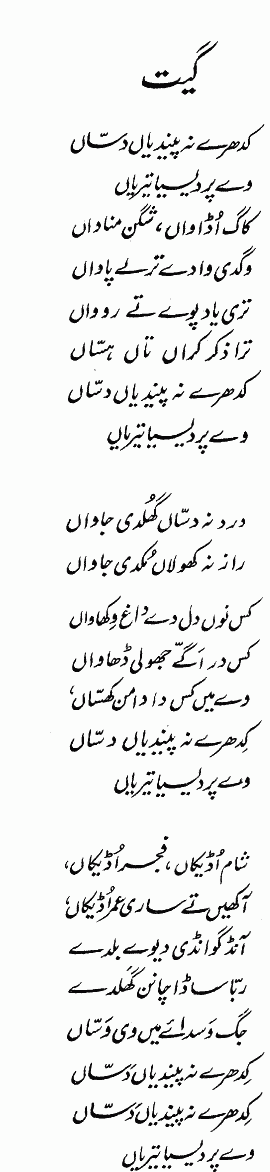
Kidhray naan paindiyan dassaan
Pardesia vay tairian

(I don't hear anything about you
My lover, living far away)

These very simple lines reflect the agony and suffering of the Punjabi woman in the most effective words possible.

Shaam udikaan, fajarudikaan
Aakhain tay sari umar udikaan
Ahand gawandi deevay balday
Rabba sada chanan ghalday
Jug vasda ay main vi vassaan

(I am waiting in the evenings and mornings
If you so desire I can wait the whole of my life
There are lights everywhere in the neighborhood
O God, Send my light also
The whole world is living and I might also live)
(Source)


Read more...

Sunday, 8 November 2009

From the Jihadi Missile to the Crimson Gharara

Dozens killed ... women outside a Rawalpindi hospital react to the news of a family member’s  death in the bomb blast.

Crimson Gharara
A poem on Rawalpindi bomb blast

(By Foqia Sadiq Khan and Q Isa Daudpota)

I queuing at the Bank,
for my monthly salary.
Image of crimson gharara, its goata lace,
dancing before my eyes.

My four year old Sara in my arms,
I saw it in the market a week ago.
Am waiting for new bank notes,
their smell of freshness, welcome to this clerk’s nose.

The sound of them being counted a break
from my mundane life of office sounds,
The thought of buying groceries for Eid,
And then a thundering jolt broke me into pieces,

My body scattered hundred yards,
What will it wear now but a shroud,
The Crimson ‘gharara’ hangs for another buyer in a small shop in downtown Saddar
(Source)

Rawalpindi attack death toll rises to 34

On 2 November 2009, at least 30 people were killed in a bombing near the military headquarters in Rawalpindi, with army and defence ministry personnel believed to be among the victims.

The blast at a small shopping centre may have targeted army officers drawing their salaries out from a bank branch on the ground floor of the building.

Witnesses said that the bodies of the dead and injured were lying across the car park and road in front of the shopping centre, with women and children among them.

The site of the explosion is within a few hundred metres from the military headquarters complex and the bank may have been the nearest for soldiers to use. The Ministry of Defence is also located nearby. Given it was the first working day of the month, many people will have just had their wages and pensions paid into their account. The capital, Islamabad, is a 25 minute drive away. (Source)

One panicked father near the bank when the explosion occurred said he was unable to find his son in the aftermath.

"I parked my car in the bank car park, and my child was sitting inside," Mohammad Saleem told AP Television News. "Now they're not giving me permission to go and look, and I don't know where my child is." (Source)

The Tehreek-e-Taliban, or Pakistan Taliban, claimed responsibility for that attack and is suspected of having staged yesterday's blast.

A wave of attacks in Pakistan since the middle of last month has killed about 300 people and injured hundreds more. The attacks have been interpreted as retaliation against the Pakistani Government for an offensive against the Pakistan Taliban in the group's stronghold of South Waziristan, a lawless mountainous region. (Source)

Why are Muslims killing Muslims in Pakistan? Some questions from Israel

پاکستان کے خودکُش حملے اور اسرائیلیوں کی ہمدردیاں
شاہ زیب جیلانی

کل رات کا ڈنر یروشلم سے باہر ایک یہودی فیملی کے گھر کھایا۔ وہ پہلے کبھی کسی پاکستانی سے نہیں ملے۔

مجھے لگا کہ جتنی میری اُن کے طور طریقے جاننے میں دلچسپی تھی اُتنی ہی دلچسپی انہیں مجھ میں اور پاکستان میں تھی۔

ذکر پاکستان میں آئے دن کے خودکُش حملوں کا ہوا۔ انہوں نے کہا کہ ہم اسرائیلوں کو پاکستانیوں سے پوری ہمدردی ہے کیونکہ ہم سے بہتر کون جانتا ہوگا کہ خودکُش حملے روکنا کتنا مشکل ہوتا ہے۔

ایک حد تک ان کی بات سہی بھی تھی۔ پاکستان میں خودکُش حملوں کا رواج نائن الیون کے بعد سے پڑا۔ لیکن اسرائیلی ایک لمبے عرصے سے انہیں بھگتے آئے ہیں۔

کبھی فلسطینی خودکُش حملہ آوروں نے یروشلم میں عام مسافروں سے بھری بسوں کو نشانہ بنایا تو کبھی تل ابیب میں ریستوران اور ڈسکوز اُن کی کاروائیوں کا نشانہ بنے۔

ایک زمانہ تھا اسرائیل آئے دن اس قسم کی خبروں میں رہتا تھا لیکن اب یوں لگتا ہے جیسے پاکستان اور خودکُش حملے لازم و ملزوم ہو چکے ہیں۔
میں نے اپنے پُر خلوص اسرائیلی میزبانوں سے پوچھا کہ آپ نے کیسے خودکش حملوں پر بظاہر خاصا کنٹرول کر لیا ہے؟ ان کا کہنا تھا کہ دنیا کو شاید یہ بات پسند نہ آئے لیکن حقیقت یہ ہے کہ جب سے اسرائیل نے فلسطینوں کی نقل و حرکت روکنے کے لئے جگہ جگہ سکیورٹی رکاوٹیں کھڑی کیں اور دیوار بنائی، اُن کا یہاں آ کر حملے کرنا ناممکن نہیں تو بے حد مشکل ضرور ہوگیا ہے۔

مسئلہ یہ ہے کہ اسرائیل رقبے کے اعتبار سے پاکستان سے کئی گناہ چھوٹا لیکن مال کے اعتبار سے کافی امیر ملک ہے اس لئے وہ اس قسم کے سکیورٹی اقدامات کر سکتا ہے۔

پاکستان خودکش حملہ آوروں کو روکنے کے لئے اگر دیوار کھڑی کرنے کا سوچے بھی تو آخر کہاں کہاں؟

آخر میں چلتے چلتے میرے یہودی میزبانوں نے کہا کہ اسرائیلی شہریوں کو جان سے مارنے والے تو اکثر فلسطینی خودکش حملہ آور رہے ہیں لیکن انہیں یہ سمجھ نہیں آتا کہ پاکستان میں مسلمان مسلمانوں کو کیوں مار رہے ہیں؟

میں نے کہا اس کا جواب خاصا مشکل ہے۔ بس یوں سمجھ لیجیئے کہ جب کوئی ملک اپنے پڑوسی حریف ملکوں سے نمٹنے کے لئے بیرونی امداد سے جہادی میزائیل تیار کرنے میں لگ جاتے ہیں تو وہ کبھی کبھی بھول جاتے ہیں کہ بعض اوقات جہادی فیکٹریوں سے نکلنے والے میزائل آپ کے اپنے گلے پڑ جاتے ہیں۔
http://www.bbc.co.uk/blogs/urdu/2009/11/post_535.html

Read more...

Allama Iqbal in the eys of Jon Elia

جون نے اقبال کی شاعرانہ عظمت کے مداح شمس الرحمان فاروقی سے کہا وہ شاعر عظیم کیسے ہوسکتا ہے جس نے متضاد کرداروں کی مدح سرائی کی ہو۔

جیسے ؟؟ شمس الرحمان فاروقی نے استفسار کیا۔

جون نے اپنے بالوں کی لٹ پیچھے کرتے ہوئے کہا مثلاً ڈاکٹر اقبال کا ہیرو بیک وقت اورنگ زیب بھی ہے اور سرمد بھی۔ ایک ہی شاعر بیک وقت قاتل اور مقتول دونوں کو بلند کردار کہہ رہا ہے۔۔ مسولینی میں عظیم انسان کی کون سی خوبیاں تھیں؟ وہ ڈاکٹر اقبال کا ہیرو کیسے ہوگیا ؟ برٹش امپائر کے شہنشاہ کے سامنے اقبال نے سرِ تسلیم کیسے خم کردیا؟ کیا عظیم شاعر کا یہی کردار ہوتا ہے کہ وہ ہر طبقے کے لوگوں کو خوش کرنے کی کوشش کرے؟ اور شاہین ایک ایسا خونخوار طائر ہے جس میں رحم کا جذبہ ہرگز نہیں ہوتا۔ کیا اقبال نے شاہین کو علامت بنا کر انسان کو خونخوار بننے کی تعلیم نہیں دی ؟؟

اس گرما گرمی کے سبب محفل پر کچھ دیر کے لیے خاموشی طاری ہوگئی اور پھر ہربندر سنگھ وقت نے ماحول کو ہلکا کرنے کے لیے گفتگو فراق گور کھپوری کی شاعرانہ عظمت کی طرف موڑ دی۔

Here is the link to the complete article on BBC Urdu dot com

Read more...

Wednesday, 14 October 2009

A Pashto Poem - by Ajmal Khattak


This site has moved to http://criticalppp.com, click this link if you are not redirected
Read more...

Wednesday, 25 March 2009

Shafeeq-ur-Rahman: the inimitable humorist

By Rauf Parekh
Tuesday, 24 Mar, 2009 (Dawn)

Despite having not written for such a long time, Shafeeq-ur-Rahman did not fade out and new editions of his books were published every few years. –File Photo

Mushtaq Ahmed Yousufi, one of the most celebrated humorists of the Urdu language, said in an interview early in his literary career that he had decided to quit writing humour. Reason? He thought it was useless to write humour if one could not write it the way Shafeeq-ur-Rahman did. (Though, luckily enough, Yousufi Sahib later decided that he could write humour the way he himself did.)

Such was the influence of Shafeeq-ur-Rahman, a humorist who ruled the world of Urdu humour for about 60 years, and is still doing so.

Shafeeq-ur-Rahman began writing and established himself in the pre-independence era like his contemporaries, such as Ibrahim Jalees, K.L. Kapoor, Krishan Chandr, Shaukat Thanvi and Rasheed Ahmed Siddiqi.

His first book ‘Kirnen’ (1942) was a collection of quasi-romantic and quasi-humorous short stories. His early stories did not show any signs of a great humorist. But in his second book, ‘Shagoofe’ (1943), romanticism gave way to humour and it was his later books, ‘Lehren’ (1944) and ‘Parwaz’ (1945), which established him as a pure humorist. ‘Himaqaten’ (1947) and ‘Mazeed Himaqaten’ (1948) earned him more accolades but the flow of his books shrank to a trickle of articles and then for almost 25 years he wrote nothing.

Zameer Jafri, in one of his columns titled ‘Kuchh na likhne ki silver jubilee’, ‘commemorated’ in his peculiar style Shafeeq’s literary hibernation.

Some believe that for writers it is a must to keep on writing or run the risk of being forgotten and that the adage ‘publish or perish’ is not true of publishers alone, but of writers as well. (In my personal opinion, most of the writers of our times ‘publish and perish’.)

Strangely enough, despite having not written for such a long time, Shafeeq-ur-Rahman did not fade out and new editions of his books were published every few years. The copies of his books that I preserve like a treasure were published mostly in the early 1970s.

So, what are the factors that have kept him very much ‘in’ for such a long time? First, his humour has such a vigour and freshness that it has not wilted even today. Some of his essays in his early books are timeless. His wit and repartee put him way ahead of some of his contemporaries who, for example Shaukat Thanvi, depended more on playfulness or situational comedy.

Azeem Baig Chughtai (though hardly his contemporary, as he died in 1941), like Shaukat Thanvi, relished pranks and his humour consists largely of cheery boisterousness.

Though Shafeeq Sahib’s humour is not shy of practical jokes, he uses it sparingly and his playfulness stops just in time to save the humour from becoming tragedy, which sometimes is the case with Chughtai.Secondly, Shafeeq is the master of parody.

Hardly any humorist in Urdu can match his satire and bubbling wit when it comes to parodies. His five parodies — ‘Qissa-i-chahaar dervesh’, ‘Qissa-i-Hatim Tai bai tasweer’, ‘Qissa Professor Ali Baba ka’, ‘Tuzk-i-Nadri urf Siyahat nama-i-Hind’ and ‘Safar nama Jahazbad Sindhi ka’ — are fine satires on our history and culture.

For instance, in his ‘Tuzk-i-Nadri’, probably the most successful of all parodies in Urdu, he not only mocks the kings and their ‘tuzks’ (memoirs), but our political system is also his target when he writes (in the words of Nadir Shah) that: ‘In those days Delhi was in the grip of election fever. Ulloo Shanaas submitted that I had become so popular in Delhi that I could win election from any constituency, no matter on whose ticket I contest it…Out of my seven opponents, two withdrew when they were presented with large amounts of cash, the third was coerced into withdrawal, the fourth had to be made an ambassador to a country, two turned out to be a bit too obstinate and one of them had to be beaten black and blue and the other died in mysterious circumstances. When polling began, the entire population of the city was invited for a feast and presented with money and valuables. And if there happened to be any impudent voter who did not admit to my popularity, he was made to accept it with the help of a stick.’ (Mazeed himaqaten, p37).

Another factor that contributed a lot to Shafeeq Sahib’s public acclaim was his popularity among the adolescent. The main character in most of his humorous short stories is a young and witty college boy who is fond of cricket and movies.

Also, Shafeeq often portrays infatuations. This gives the youth a vicarious feeling. And his characters appear kind of flirtatious, too. His most famous character, Rufi alias Shaitaan, once quips: ‘Sonny! Don’t be sulky if you miss a bus or a girl, another one will be just round the corner.’ (Himaqaten, p121).

Then he often philosophises about joys and sorrows, sweeping the young readers with the bouts of optimism and pessimism, giving semi-philosophical, semi-romantic explanations to the queries that haunt the youth.

In addition, his many essays are nothing but a collection of jokes and the essay itself is only the thread that binds them together. His characters, novel and funny, such as Rufi or Shaitaan, Maqsood Ghora, Hukoomat Aapa and Buddy, make reading joyful.

All this put together is enough to hook young readers. I don’t know exactly which way the wind is blowing these days, but in my late teens and early twenties, I had read each and every book by Shafeeq-ur-Rahman many times over.
Shafeeq-ur-Rahman was born on Nov 9, 1920, in a small town near Rohtak. He was educated at Bahawalpur, as described by Muhammad Khalid Akhter, Shafeeq’s classmate at Sadiq Dean High School and a humorist in his own right.

Shafeeq-ur-Rahman did his MBBS in 1942 from Lahore’s King Edward Medical College. Having joined the Indian Medical Service as a lieutenant, Shafeeq-ur-Rahman was posted, according to Khalid Akhter, at different war fronts during the Second World War.

He then joined Edinburgh University and London University to further his education. It certainly broadened his perspective. But both Shafeeq-ur-Rahman and Khalid Akhter were already immersed in English literature and it had definitely influenced their writings.

On Shafeeq’s style one can trace the influence of western humorists such as Stephen Leacock and Mark Twain, but he is among those writers of Urdu who are well-grounded in their own literature and culture and have a peculiar style of their own.

After independence, Shafeeq-ur-Rahman held high positions in the Pakistan Army and Navy and in December 1980 was made chairman of the Pakistan Academy of Letters, a post he held till December 1986. His other books include ‘Madd-o-jazar’ (1946), ‘Pachhtawe’ (1948), ‘Dajla’ (1980) and ‘Dareeche’ (1989).

The irreplaceable and inimitable Shafeeq-ur-Rahman died in Rawalpindi on March 19, 2000.

drraufparekh@yahoo.com

.....

The Legend That Was Shafiq-ur-Rehman

By Dr. Zeba Hasan Hafeez

Dr Shafiq-ur-Rehman was one of our most illustrious writers of extraordinary humor. Like P.G. Woodhouse he has given enduring pleasure to his readers. The similarity between him and Mushtaq Ahmed Yusufi, is also striking. Both did justice to their careers, the former serving in the armed forces and the latter in the banking sector, and also reached the heights of literary excellence.

Early in his career as a writer, Shafiq-ur-Rehman became a household name. I recall the words of Akhtar Mahmud Faruqui, a former assistant editor of Dawn: “My dear father had wanted me to become an engineer but I used to spend most of my time reading Shafiq-ur-Rehman and learning his afsanas by heart. That was also true of my cousins and college friends. Even ahmaq in Maddojazar fascinated us and we readily identified ourselves with the character. I was entranced by his writings when I was 15. I found his afsanas equally absorbing forty years later. Perhaps more. Pachtawaey sounded so familiar. So did Himaqataen. ‘Shaffoo bhai’ (Kirnaey or Shagoofae?) was, of course, my ideal, my hero.”

Dr Shafiq-ur-Rehman began writing humorous stories during his school days. His stories were published in a literary monthly magazine called Khayyam. Kirneyn was completed before he joined the medical college and was published in 1938 while he was still a medical student. It was followed by Shagoofay , Lehrain, Maddojazar, Parvaaz, Himaqatain, Mazeed Himaqatain, Dajla (a travalogue), Insaani Tamasha (a translation of “a human comedy”) and lastly Dareechay. His unforgettable characters include Razia, Shaitaan, Hukoomat Aapa, Maqsood Ghora, Buddy, Nannha and others. His work added a new dimension to humor in Urdu literature. He created a world for us that was very real with all its joys, pains and anguish. It was an affirmation of life and of human values: empathy, compassion and respect. Even the seemingly frivolous and trivial situations had hidden meanings that probed deep into the human psyche. His language was simple, spontaneous and expressive.

After passing his MBBS in 1942, Dr Shafiq-ur-Rehman joined the Indian Army Medical Corps. He completed his post-graduation in tropical medicine and public health from Edinburgh, in 1952.

As his niece, I had the rare pleasure and privilege of being close to him. He was always my hero. I found everything about him extraordinary: his literary genius, his conversation, his stature, his handsomeness, his handwriting… I don’t think, I have seen anyone more becoming in an army or naval uniform. We all called him uncle. There was an ancient timepiece on the sideboard in the dining room which he only was able to adjust. When I met my aunt recently, she sadly said that no one manipulated it now. They had many common interests and a great companionship. Dr Shafiq-ur-Rehman was a friend of her brother, Shaukat Hasan. They were classmates at King Edward Medical College, which was the beginning of a life-long friendship. In Barsaati, the “friend” accompanying the author in Spain, is him. Lieutenant General Shaukat Hasan has served as consultant surgeon to the Pakistan armed forces for about twenty years.

Dr Shafiq-ur-Rehman had many nieces and nephews. He had committed to memory some act or conversation of each child in the family. Whenever he met me after an interval, he would say that years ago, I had asked him to wear a suit for an occasion and he had found my suggestion so appropriate that he had quickly gone in and changed. I always felt important when he mentioned this incident. Our families had the opportunity to spend a lot of quality time together in Karachi, from 1972 to 1975 when he was posted as Director Medical Services, Navy with the rank of commodore and later as rear admiral. When he reverted to the army, he became Major General. My aunt took a long leave from her post as professor of English at the Government College, Rawalpindi to join him. He adored his sons and spent a great deal of time with them, playing cricket, swimming and engaging in other activities. Dr Shafiq-ur-Rehman was very much of an outdoor person. He was tall, athletic and slim; strenuous exercise being a daily ritual for him. Every Sunday, he would wear his hat and go for a long walk to the bazaar of used books. He returned with an interesting assortment and gave each one of us a book to read .

Whenever we went to Dr Shafiq-ur-Rehman’s house, we knew that depending upon the time, he would either be at work, outdoors for his daily exercise or in his study. If it was one of the meal times, we would have the memorable opportunity of being in his company. I always felt honored to sit at the dining table with him. He spoke most of the time and we listened, mesmerized. He had an amazing memory and his conversation would mostly be about books, poetry and jokes. His jokes were endless and he never repeated a single one. He had a special way of telling a joke which threw us all into fits of laughter while he sat with a straight face. Later, I found out that most people who had met him shared this impression. It was an unwritten law in their house that meal times were a reunion of the family and that anything unpleasant, including illness, was not to be discussed.

Every time I visited the family in Rawalpindi, my aunt and I took turns in reading out passages from his books. She told me the background of many situations too. I always made it a point to go through all their old picture albums. Dr Shafiq-ur-Rehman was very fond of photography. Each photograph seemed to have a historical perspective to it. My aunt had a story to tell about each one. They seemed to open a gateway to a dreamland of romanticism, youth; a glimpse into life, as he had lived it and as it had inspired him. His room was quite bare. He was an extraordinarily simple and private person. I sometimes caught a glimpse of him while he worked. There was a newspaper stand in his room where he stood for hours, barefoot, reading. He even wrote while standing. His library comprised thousands of books. These were all stacked neatly in steel trunks which were kept locked. He seemed to have a working catalogue in his mind and knew where each book was placed, even the pile and row down to the last detail.

Dr Shafiq-ur-Rehman had given me an autographed set of his books. Somehow Mazeed Himaqatain was missing from this collection. When I went to Rawalpindi after his passing away, I requested my aunt to autograph it for me. She wrote,

Barey shauq saye suun raha tha zamana

Hameey soo gayae dastaan sunaatey sunaatey.

I have tried to translate a few lines from Barsaati that have always moved me. “Alhamra seems like the home of fairies. Every pillar, arch, wall and their beautiful engravings, every inch seems magical. In this solitude, the only sign of life seems to emerge from the sound of these fountains. These springs have never been silent. They have been flowing since the era of the Arabs. The limitedness of human life, the vicissitudes of time, philosophy, creation and destruction; all seem to have become absorbed into the sound of these fountains.”

After retiring from the army, General Shafiq-ur-Rehman, served as Chairman of the Academy of Letters from 1980 to 1985. During his tenure, the Academy of Letters acquired a new dimension as a prominent literary institution of Pakistan. He continued to write till his end in March 2000. He was the only Major General to be awarded the Hilal e Imtiaz for his military and civilian services. He was bestowed the latter honor after his death and his son, Atiq-ur-Rehman, received it on his behalf on 23 March, 2001.
Dr Shafiq-ur-Rehamn is a legend in Urdu literature and lives on in our hearts. His books have been appreciated and read so widely that had he belonged to any other country, he would have been a millionaire. However, he never asked for any royalties and never made any kind of monetary agreement with his publishers. His lifestyle was always simple. On an occasion, a thief tried to break into their house and in the process damaged a door whose repair caused the family considerable inconvenience. I recall uncle saying that a sign should be posted outside for thieves, “The door is open, you don’t have to break it.”

http://www.pakistanlink.com/letters/2002/Dec/06/04.html

....

An excerpt from Shafiq-ur-Rehman’s ‘lehreN’
Owais Mughal

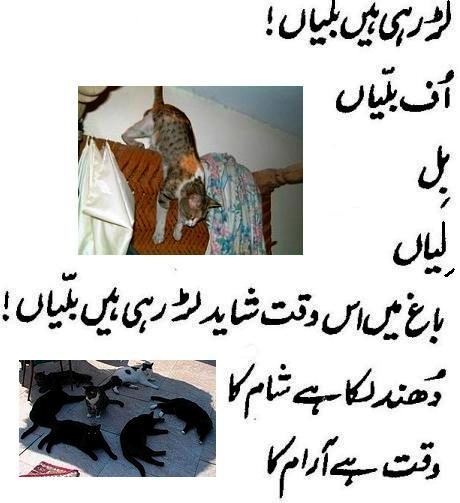
Following ‘azad’ poem is by one of my favourite writers, Shafiq-ur-Rehman and it comes from his book ‘lehreN’. The poem is actually a satire on modern day poets who write ‘azad’ Urdu poem by using all the ‘azadi’ they can get. The poem describes a situation of fighting cats in a garden. I hope it brings a smile to you just like it has been bringing smiles to me for the past 20 years.
Here is my attempt at an approximate translation for our English readers:

Cats are fighting
Oh Cats
Caaaa…
…tsss
May be cats are fighting in garden now
There is the haze of dusk
It is time to rest
to work
to
get rewarded
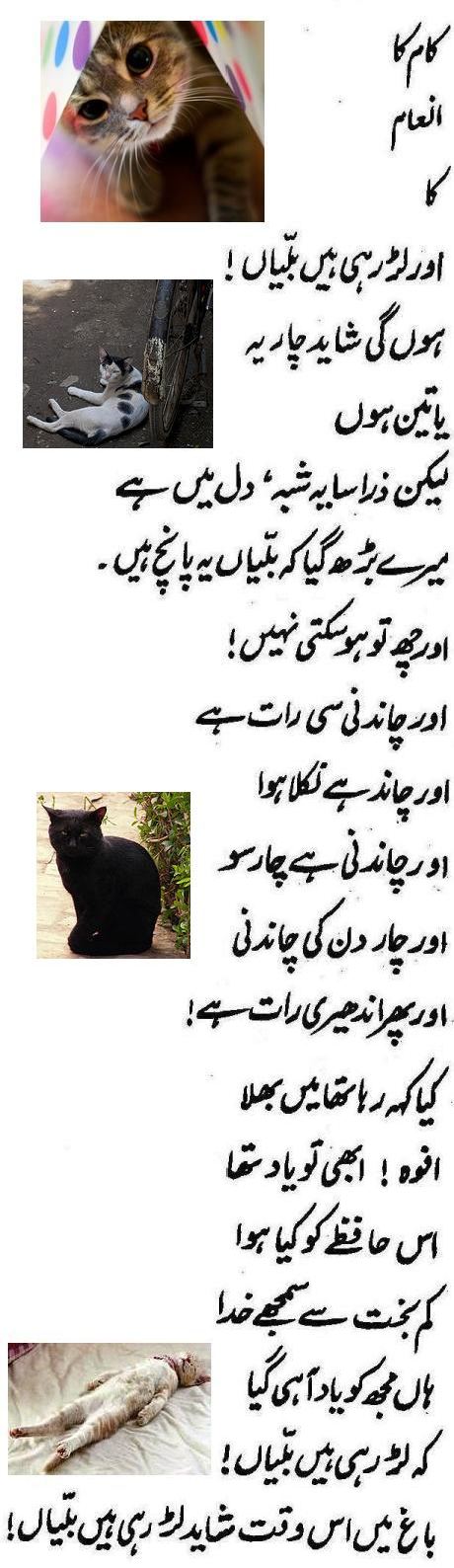
And cats are fighting
May be they are 4 in number
or may be 3
But this little doubt has made house in my heart
that the cats are 5 in number
and definitely they cannot be 6
and the night is glowing in moonlight
and the moon is shining bright
and the moonlight is ubiquitous
and this moonlight will only last for a little while
and then there is a pitch dark night ahead
What was i saying?
Aah, it just slipped out of my mind
What happened to my memory?
Only God can fix it
Oh Yes, I just remembered!
the cats are fighting
Cats are probably finghting in the garden now!

Photo Credits: Flickr.com

Source: http://pakistaniat.com/2008/02/09/billi-cat-pakistan/

List of his books

  • Kirnein (Rays of Light)
  • Shagoofey
  • Lehrein (Waves)
  • Maddojazar (Ebb and Flow)
  • Parvaaz (Flight)
  • Himaqatain
  • Mazeed Himaqatain
  • Dajla (a travalogue)
  • Insaani Tamasha (a translation of “a human comedy”)
  • Dareechay
  • Pachtaway (Regrets)

Read more...

Tuesday, 17 March 2009

Benazir Bhutto: Mein Baghi Hoon - I am a rebel


This site has moved to http://criticalppp.com/archives/1111, click this link if you are not redirected
Read more...

Saturday, 14 March 2009

Habib Jalib: Benazir Bhutto - Darte hain bandooqon walay....


This site has moved to http://criticalppp.com, click this link if you are not redirected
Read more...

Sunday, 8 March 2009

Aakar Patel: Let's sing Iqbal's Tarana-e-Hind-o-Pak to fight religous extremism in our society. Indo-Persian sufi heritage versus Taliban's sharia.

Mr Zardari, tear down this wall
Sunday, March 08, 2009
Aakar Patel

http://taheny.com/2006_12_28_sufi_concert_attendees_520x293.JPG

Allama Iqbal imagined Pakistan as a utopia in northwest India where Punjabis would do ijtihad and read Nietzsche. The Quaid-e-Azam ordered a Pakistan where religion would cease to be a matter for the state. But both men saw something magnificently dormant in the character of India’s Muslims, which would flower in isolation.

Iqbal returned from Europe in 1908 ashamed by the fall of Islam. He thought its return to glory could come through expelling the polluting influence of Indian culture. Iqbal understood our culture. In 1904, he wrote the song that still defines our culture best (Tarana-e-Hindi), and he translated Gayatri Mantra, the talismanic chant of the Upanishad, from Sanskrit. But Europe taught him that our culture was unable to compete. Muslims needed to break out. In 1910, he wrote Tarana-e-Milli.

Jinnah didn’t understand our culture much, but he thought that Muslims were a separate nation from Hindus, and could become modern once they were separated from India’s archaic culture. Both the poet and the lawyer thought that the solution to progress was to stop being Indian.

Iqbal died in 1938, Jinnah died in 1948. It would be illuminating to see their reaction as they flipped through a current issue of Nawa-i-Waqt (would have to be translated for Jinnah), the guardian of the ideology of Pakistan.

The Pakistan of Iqbal won against the Pakistan of Jinnah. Jinnah’s imaginary Pakistan was sent into the night with a pat on the head by Liaquat and the peerless Shabbir Usmani chanting their Qarardad-e-Maqasid, 60 years ago this month.

Now full-dress Sharia is upon Swat and the Punjabi’s head is cocked towards the frontier in curiosity. The world holds its breath.

The danger of Talibanisation to Punjab does not come from the Pakhtun and his gun. Pakistan is 60 per cent Punjabi. Pakhtuns are only 15 per cent of its population and 20 per cent of its army. The danger to Pakistan comes from its inability to resist the pure ideas of the Pakhtun, of whom the Punjabi especially is enamoured. Talibanisation is happening in the mind. There is no resistance to it for two reasons: one is the lyrical call of Sharia which Muslims are drawn to in their quest for utopia. This will not change.

The second is the deliberate amputation of its own culture by the Pakistani state. This can change. Those who think Pakistan can resist the Taliban intellectually should look at the sequence on culture that unfolded after 1947.

Jinnah, one could say, stifled the voice of culture by giving Urdu a monopoly in 1948. Those who followed him beheaded it by banning freedom of religion (Liaquat in 1949), Indian cinema (Ayub in 1965), alcohol (Bhutto in 1977) and immorality (Zia in 1979). Under Nawaz Sharif in 1992, Pakistan banned the economy citing Riba, but the deranged state saved itself by lying, acting on the instinct of self-preservation, which by now was in short supply. The jihad in Kashmir under Benazir and then Musharraf completed the project of India as foreign and enemy and Indian culture as ‘kufr’, in the Pakistani mind.

But what is the culture of Pakistan? Do Pakistanis own a tradition of music and dance that is separate from India’s?

Mehdi Hasan and Ghulam Ali (who told me this on a flight to Bombay from Ahmedabad) enjoy performing in India because Pakistan’s middle-class is mostly illiterate about raag and taal. But this is our inheritance from the Sam Ved and from Amir Khusro. Why should it be disowned by Pakistanis?

High culture is rooted in tradition, and that is the first thing the religious state attacks. There is no culture of north Indian classical dance, Kathak, in Pakistan. Dance in general is absent (though apparently it is quite popular with Mehsud men, presumably grooving to the rhythm of pop-popping Kalashnikovs) because physical expression tends to be sensual and therefore deemed un-Islamic.
http://blog.tilos.hu/alap/archives/nusrat.jpg

Culture is expression: the expending, the release of emotion that is drawn out through the desire for expression. Through words, through movement, through emotion, through music. Its expression is unique to cultures and in north India and Pakistan we have our unique culture: Indo-Persian (with stress on Indo).

Culture does not directly resist extremism; it only makes extremism difficult to penetrate by diverting the mind. The only way to fight extremism is through reason, but South Asians are not particularly good at reason because we don’t understand its vocabulary. Culture softens us, not in a bad way, and makes us less suicidal, which is a state where pristine religion leads us through its demand of purity.

We have no capacity to soften religion through reason because of our dependence on the great jurists of the 8th and 9th centuries. Iqbal spoke of the possibility of ijtihad, but how much ijtihad can happen in Pakistan, and for that matter in India, in defiance of Imam Azam?

The BBC carried a report last month titled ‘Can Pakistan’s Sufi tradition resist the Taliban?’ No, it can’t. Sufism can no more fight the Taliban than Mickey Mouse. Sufism is flight. It is escape. Those of us who have watched the ecstasy unfold at Nizamuddin Awliya and Baba Shah Jamal and a million heretical shrines in India, Hindu and Muslim, know that most of us can only be weekend Sufis. Sufism’s message of wahdat ul-wajood leads us away from doctrine, and that is an intellectual journey.

Sufism cannot fight because it makes no demands, and it has no daily ritual. It also respects Sharia, and can live besides it quite comfortably. The great Chishti Sufis of Delhi were namazis.

But the Talib cannot live beside Sufism. He will bomb the shrine of Rahman Baba. And now he has brought his war to Lahore’s Liberty Chowk. The message will come through to Punjab as it did in Swat: peace through Sharia.

How will Pakistanis resist the Talib’s hypnotic call? The problem in Pakistan is not that the Sri Lankan team got attacked; terrorism is truly global and affects us all. The problem is that Pakistanis are the only people in the world still unconvinced about who did it. Even intellectuals who are published in its newspapers convinced themselves through a convoluted or paranoid logic that ‘Muslims cannot do this’.

What should be said instead is: this is not us. And it really isn’t.

We have one of the world’s richest cultures of literature, music and dance. Pakistanis need to embrace it; it lies across the border. Bollywood is not just a film industry; it is the dispenser of Indo-Persian culture, and its voice; it is not in Bombay by accident. Shahrukh Khan and Kareena Kapoor would spend more time in Lahore’s courts defending themselves against fahashi, as did Manto, than on sets shooting. This difference in environment is not limited to cinema.

Pakistan can legitimately claim to have produced better classical poetry than India. But why? Independent Pakistan’s great poets, Faiz and Faraz, sang of protest, because they had much to protest about. Independent India’s great poets, Gulzar and Javed Akhtar, Shailendra and Anand Bakshi sing of love, because they operate in the natural cultural environment of South Asia. Pakistan’s poets do not. But its being across the border doesn’t mean that what’s produced in Bollywood is not Pakistani culture. It was before 1965.

Musharraf opened up Pakistan’s media, Zardari should open up India’s media to Pakistan. Not the news channels, the entertainment ones. He should leave in place the ban on India’s news channels (for that matter, being deprived of their news channels for a while would benefit Indians also). And he should open the borders more generally.

Pakistan should not wait for this to be reciprocal. After the savage attacks in Bombay, India will not immediately let Pakistanis freely onto its soil. But Pakistan should open itself up to India’s people, culture, tourists (they will come in droves) and trade. This does not mean surrender. Pakistan should remain a strong, sovereign Muslim nation.

But it must let loose its secret weapon on the Taliban. And that is our culture, our Indo-Persian heritage. We built it. We own it; we should own up to it.

Forget Tarana-e-Milli. Let’s sing Tarana-e-Hind-o-Pak. Allama Iqbal would approve, and so, I suspect, would Jinnah.


The writer is a former newspaper editor who lives in Bombay. Email: aakar. patel@ gmail.com

.....

Also read:

Taliban attack the tomb of Rahman Baba in Peshawar...

Can Sufi Islam counter the Taleban?

Attack on Rehman Baba is attack on Pashtun identity

William Dalrymple on Rahman Baba tomb's attack: Wahhabi radicals are determined to destroy a gentler, kinder Islam


Read more...

Saturday, 7 March 2009

Zikr-e-Shahab: Remembering Qudrat Ullah Shahab


This site has moved to http://criticalppp.com/archives/26595, click this link if you are not redirected
Read more...

Attack on Rehman Baba is attack on Pashtun identity

Bombing shrine

Saturday, 07 Mar, 2009 (Dawn)

Pakistani worshipers gather next to the mausoleum of Sufi poet Rehman Baba, after an explosion that damaged one corner of the shrine, in Peshawar - AP Photo/Mohammad Sajjad
Pakistani worshipers gather next to the mausoleum of Sufi poet Rehman Baba, after an explosion that damaged one corner of the shrine, in PeshawarAP Photo/Mohammad Sajjad

THURSDAY’S bombing in Peshawar was not the first time a Sufi shrine has been targeted by militants.

In March last year, Mangal Bagh’s Lashkar-i-Islam destroyed the four-centuries-old Abu Saeed Baba shrine near Peshawar, in the process killing at least 10 villagers who tried to save the monument.

Later in December, suspected Taliban militants attacked and damaged the shrine of Abdul Shakoor Malang Baba, also located near the NWFP capital. But the biggest outrage in terms of symbolic value was yet to come. Thursday’s attack was directed against the final resting place of perhaps the greatest and most revered Pakhtun poet, mystic and Sufi saint of all time.

Rehman Baba is still quoted widely and is a household name in many Pakhtun homes some 300 years after his death. He is a legend on both sides of the Durand Line and the desecration of his shrine has been condemned by both the Pakistani and Afghan governments.

Unlike the vision espoused by the merchants of death now operating in the garb of ‘Islam’, his was a message of love, peace and tolerance. He was not only a mystic and a poet but a cultural commentator of his time.

It would be incorrect to describe the Taliban as ultra- orthodox in their religious views. There are countless people in this country who subscribe to rigid interpretations of Islam but are not in the least inclined to bend others to their will, let alone kill them.

But the Taliban specialise in barbarity and aim to destroy everything they cannot abide. They hate music, clean-shaven men and education for girls, so they blow up CD shops and schools and attack barbers. Since they consider Sufis and their followers to be heretics, the Taliban feel it is their ‘religious’ duty to destroy shrines and kill devotees.

They cannot tolerate Sufi music, dance or mysticism, or the intermingling of the sexes in shrines, or what they see as intercession between the individual and the Creator. It is believed Thursday’s bombing could be linked to the fact that women used to visit Rehman Baba’s shrine.

Sufism with its message of peace, simplicity and equality, and tradition of charity, played a leading role in the spread of Islam in the subcontinent. It is still followed by millions who want little more than to be left alone to pray or rejoice as they please. But bombs and guns do the talking these days and a small minority bent on violence calls the shots.

The people are helpless and the government appears incapable of stemming the rot. Rehman Baba’s words still apply, ‘Contemplate the frantic efforts of the age/ Countless are its antics, boundless is its rage.’

.....

Attack on Rehman Baba is attack on Pashtun identity


http://khyberwatch.com/nandara/images/stories/journalists/pictures/places/rahman%20baba%20tomb.jpg

On Thursday, terrorists from Khyber Agency blew up the mausoleum of the great poet of the Pashtun and put the state of Pakistan on notice once again about their intent against Pakistani culture. The tomb of Rehman Baba was rebuilt as a complex in 1994 and it included other tombs of great Pashtun cultural icons, such as Akhund Darweza. The Taliban had come to the mausoleum and told the devotees that saying namaz at the mosque attached to the grave was “haram”. The administration knew that a strike would take place but did nothing.

Rehman Baba (1632-1707), who appeared on a Pakistani postage stamp in 2005, is an acknowledged cultural symbol of the Pashtun and Afghan people. While Khushal Khan Khattak (1613–1689) stands together with him as a classical foil, Rehman Baba has moved the soul of the Pashtun far more. He also stands at the root of Pashtun nationalism and has been adopted in the past by all kinds of secular and conservative movements. He marks a significant phase in the development of Pashto language and his lines are often quoted spontaneously by the speakers of the language. The various schools of thought in the Sufi tradition like the Naqshbandiya, Chishtiya and Qadiriya have claimed him as their own, so great was his appeal among the masses.

In Pakistan, religious culture has been traditionally represented by the Sufi tradition. The culture of the elite, represented by painting, architecture and calligraphy, doesn’t touch the masses whose way of life is reflected more accurately in the collective celebration of Islam’s mystical heritage. The Sufi taught the people how to link their faith with their entertainment and imbue their culture with their religious belief. It is often said that many of the Muslims of the region of Pakistan were brought inside the pale of Islam by the Sufi who sang of Allah’s divinity in the music and dance he inculcated among them, composed in the classical tradition.

It is this culture of the masses that has been targeted by Talibanisation, a new faith born out of the terrorist coercion of Al Qaeda which is steeped in the anti-mystical Saudi-Wahhabi Islam. The trend towards anti-culture extremism, however, is seen across the Islamic world, much aided in the 1990s by Saudi investment in the spread of the Wahhabi faith. Pakistan’s culture has also been under assault from the Taliban who target the dominant Barelvi school of Pakistani Hanafi jurisprudence as representing the “impure” faith. In 2006, a large congregation of Barelvi clerics and leaders was suicide-bombed in Karachi where, too, scores of Barelvi mosques have been grabbed by the more powerful Deobandis.

Pakistan committed cultural suicide when it allowed a purely Deobandi jihad in Afghanistan after 1996, empowering jihadi militias increasingly under the influence of Al Qaeda. Those who planned this strategy were devoid of any sense of culture. This was helped by the fact that Pakistan’s Constitution is silent on culture, most probably because the framers, bedevilled by clashing linguistic and regional identities, were unwilling to define it. Today, the violence of terrorism is expressed through its assault on culture, on entertainment in general, on female education, and the destruction of cultural landmarks.

In Khyber Agency, the Sufi tradition was defeated and ousted by the Taliban as the state stood by and watched. The Sufi leaders fled the agency and left the field open to the extremists. In Swat, a Sufi leader was killed and later exhumed from his grave and made to hang in the city square. Without the refinement of culture, Pakistan is a rudderless society characterised by extremism. The masses are deprived of all collective celebration and are losing their male children to the Taliban as suicide-bombers. The Sindhi, whose mysticism-based culture is still intact in the interior of the province, is yet to appear as a suicide-bomber in the service of Al Qaeda. But even that could change in the face of relentless assault by the Taliban and the desperate secession of the writ of the state. (Daily Times, 7 March 2009)

Also read:

Taliban attack the tomb of Rahman Baba in Peshawar...

William Dalrymple on Rahman Baba tomb's attack: Wahhabi radicals are determined to destroy a gentler, kinder Islam

Can Sufi Islam counter the Taleban?

Aakar Patel: Let's sing Iqbal's Tarana-e-Hind-o-Pak to fight religous extremism in our society. Indo-Persian sufi heritage versus Taliban's sharia.

Other relevant links:

Grand Trunk Road: The nightingale’s torment…

Pashtun Voice: http://zarqurban.blogspot.com/2009/03/rahman-babathe-pashtuns-most-revered.html
Read more...

Thursday, 5 March 2009

Taliban attack the tomb of Rahman Baba in Peshawar...


This site has moved to http://criticalppp.com/archives/1073, click this link if you are not redirected
Read more...

Thursday, 26 February 2009

Allama Iqbal, Bacha Khan and terrorists - Suroosh Irfani

Iqbal, Bacha Khan and terrorists —Suroosh Irfani

It might well be that the heartless war our homegrown jihadis and Afghan Taliban are waging against Pakistan exemplifies Islam’s dangerous inversion that Iqbal had warned against some three generations ago. Such inversion has virtually displaced Bacha Khan and Iqbal’s spiritual humanism by a jihadi extremism at war with humanity

“Muslims are at war with one another, in their hearts they only harbor schism. They cry out if someone else pulls a brick out of a mosque which they themselves shun” — Allama Iqbal, Armaghan e Hijaz (verse translated by Mustansir Mir)


When Muhammad Iqbal, the ‘spiritual founder of Pakistan’, wrote the above verses shortly before his death in 1938, the blowing up of mosques and beheadings of fellow Muslims had not yet become part of everyday Muslim life. Nor was the destruction of schools, or the ban on girls’ education and music part of a freedom struggle that led to the independence of India and Pakistan in 1947.

Indeed, by the 1930s when Iqbal’s Islamic rethink had earned him the appellations of ‘Poet of Islam’ and ‘Wiseman of the Ummah’, non-violence was shaping the freedom struggle against British rule in much of India. While Gandhi was emblematic of such a struggle, shades of non-violence also permeated Muslim political discourse. Such a discourse was as much in evidence in the ‘martial’ North West Frontier Province — the cradle of jihadi terror in Pakistan today — as the rest of India.

However, as Britain started discussing India’s future in a series of Round Table Conferences during the 1930s, Iqbal was apprehensive that Britain might “transfer political authority to the Hindus” for its “material benefits”, leaving Muslims marginalised in India. Such a development, he warned, could be “disastrous...You will drive the Indian Muslims to use the same weapon against the [Hindu] Government...as Gandhi did against the British Government.” (Iqbal’s Letter to Sir Francis Younghusband, The Civil and Military Gazette, July 31, 1931).

Clearly, his poetics of Muslim ascendancy notwithstanding, non-violence for Iqbal was integral to India’s democratic experiment as it “educated people...without destroying the structures of government itself”.

However, as the Round Table Conferences continued in London, the NWFP was swept by a populist upsurge for social reform and political rights never before seen in Muslim history: a non-violent movement led by Pashtun leader Khan Abdul Ghaffar Khan, just after his return from Haj in 1929. Called the Servants of God Movement (Khudai Khidmatgar Tehreek), it reflected the onset of a radical transformation in popular imagination in a tribal culture, where violence constituted mutual deterrence under the rubric of ‘badla’, or revenge.

Convinced that Pashtun would be denied their rightful place in the modern world so long as they remained mired in colonialism, poverty and violence, Ghaffar Khan struggled to undo the triple curse by invoking non-violence as “the weapon of the Prophet Muhammad [PBUH]” and the driving spirit of his movement. The Prophet’s [PBUH] non-violence, Khan argued, exemplified “patience and righteousness”, and so long as the Servants of God remained true to the Prophet’s [PBUH] example, no power on earth could subdue them.

Consequently, as social and educational reforms of the Servants of God began transforming lives, people hailed the saintly Khan as a ‘saviour king’ — Bacha Khan.

Indeed, one could say that the spiritual politics of servanthood that Bacha Khan invoked in the name of God and the Prophet [PBUH] was, at one level, the social corollary of an ideal that Iqbal espoused in his poetry. In Javid Nama, Iqbal’s magnum opus reflecting the creative imagination of a new Muslim consciousness, he expounds the mystical meanings of the concept of servanthood as a deepening of consciousness with diverse expressions, its high point being the Prophet Muhammad (PBUH) as His servant, abday’hu.

In a sense, while Bacha Khan and Iqbal stood at opposite ends of Indian politics — the former struggled for a united India, the latter for Muslim separation — they exemplified different facets of the same discourse of non-violence. This is borne out by an inner vision of Iqbal that inspired him to write Armaghan e Hijaz — his last poetic work composed in both Persian and Urdu.

In the vision late one night, a tall saintly figure appeared in Iqbal’s room, emphatically urged him to raise a grouping of 500 men, and then disappeared in the night, leaving the ‘Poet of the East’ deeply shaken. It is worth noting that Iqbal’s vision occurred in a political context, when several radical Indian Muslims were secretly crossing over to Afghanistan to organise armed struggle against the British Indian government. Given such context, did the vision imply that Iqbal, too, should raise an army of 500 holy warriors for jihad against the British?

Iqbal discussed the vision with his father, a Sufi of the Qadiriya order, who interpreted it as a call for writing a poetic work of 500 verses to educate Muslims and deepen their humanity. As Faqir Wahiddudin notes in his biography of Iqbal (Rozgar e Faqir, p.117), the truth of the father’s interpretation was borne out when Iqbal composed Armaghan e Hijaz. Comprising just over 500 verses, the work unfolds with an allusion to Iqbal’s vision: here Iqbal declares that he is “raising a new army of Love”, to counter a dangerous revolt that’s brewing against the heart of Islam from within.

It might well be that the heartless war our homegrown jihadis and Afghan Taliban are waging against Pakistan exemplifies Islam’s dangerous inversion that Iqbal had warned against some three generations ago. Such inversion has virtually displaced Bacha Khan and Iqbal’s spiritual humanism by a jihadi extremism at war with humanity.

Clearly, Pakistan’s survival as a modern democratic state is hinged on healing an inner Muslim split that has turned Iqbal’s dream state into a nightmare. Such healing entails, on the one hand, an urgent recovery of Iqbal and Bacha Khan’s spiritual politics; and on the other hand, rethinking of a flawed security outlook that sees India as mortal enemy and Taliban as strategic asset.

Indeed, the “strategic renaissance” the Pakistan Army needs for reclaiming the NWFP from Afghan and Pakistani Taliban, as Lt-Gen (retd) Talat Masood has pointed out, will remain elusive without Iqbal and Bacha Khan’s presence as a cultural force.

Suroosh Irfani is an educator and writer based in Lahore. He can be reached at suroosh@yahoo.com


Read more...

Wednesday, 25 February 2009

Lashkar-e-Jhangvi claims responsibility for the attack on Jan Muhammad Dashti in Quetta

dashti

(SANA News): Bloch Student Organization (BSO) Islamabad Zone will hold protests demonstration on Wed, 25 February against the attack on Secretary of Mines and Minerals Jan Muhammad Dashti here on Wednesday (today) before National Press Club Islamabad.

He was attacked near Zarghoon Road on Monday when he was going to his office as a result he and his driver received severe injuries.

It may be noted that the Police Chief of Quetta Nawabzada Humayun Jogezai is allegedly the patron-in-chief of Sipah-e-Sahaba /Lashkar-e-Jhangavi / Taliban in Quetta.

....


Provincial secretary injured in Quetta firing

* Lashkar-e-Jhangvi says Dashti attacked because of his ‘anti-Islam’ views

QUETTA: Balochistan Secretary for Mines and Minerals Jan Muhammad Dashti and his driver were seriously wounded when unidentified gunmen attacked their vehicle at Sariab overhead bridge on Monday. The banned Sunni terrorist organisation, Lashkar-e-Jhangvi, accepted responsibility for the attack.

According to police sources, Jan Muhammad Dashti was on his way to his office when the gunmen intercepted his vehicle and opened fire at him. He was rushed to Civil Hospital and given first aid, and was then shifted to Agha Khan Hospital Karachi.

Sources in Civil Hospital told APP that he was shifted to Karachi by a special flight as there was little improvement in his condition due to heavy bleeding from a bullet wound on his forehead. Sources at Agha Khan have reported that he is now out of danger. The condition of his driver is stable.

Anti-Islam views: Lashkar-e-Jhangvi said it had attempted to kill Dashti because of his “anti-Islam” views.

Haider Jhangvi, a spokesman for the organisation, called various newspaper offices in Quetta and accepted responsibility for making an attempt on the life of the leading Baloch intellectual.

The LJ spokesman alleged that Dasti had written blasphemous content against Jesus Christ and Mary in one of his books, which was reproduced in Daily Asaap. He demanded the government of Balochistan immediately ban Dashti’s book, otherwise the religious elements would burn the office of the newspaper. The attempt on Dashti’s life was widely condemned in Balochistan.

The Balochistan National Party (BNP-Mengal) Secretary General Habib Jalib Baloch, while addressing an impromptu press conference, held the government agencies responsible for the attempt on the Baloch scholar’s life. He said the BNP would stage a demonstration in front of press clubs across Balochistan today (Tuesday). “The government is deliberately targeting the cream of Balochistan. The best of Baloch intellectuals and politicians are being killed one after the other,” he said. staff report/agencies (Daily Times)

Jan Muhammad Dashti is a poet, author of five books written in English and Balochi languages and is owner of an Urdu daily ‘Aasap’. He enjoys a good reputation for promotion of education and his literary works.
Read more...

Tuesday, 24 February 2009

Remembering Wasif Ali Wasif


This site has moved to http://criticalppp.com, click this link if you are not redirected
Read more...

Tuesday, 10 February 2009

Taliban killing laughter and music in Pakistan


* Displaced Pashtun comedian feels lucky to be alive, as others falling foul of Taliban morality squad have been killed instantly


PESHAWAR: Pashtun comedian Alamzeb Mujahid had bad news for his fans after being freed by suspected Taliban who kidnapped him in Peshawar last month.

“I'm retiring from showbiz,” Mujahid, whose stage name is Janaan, told a news conference without going into details about either the kidnapping or his reasons for quitting the stage.

His friends and colleagues were less circumspect. They say Mujahid was kidnapped by vigilantes hell-bent on imposing Taliban-style values in the North West Frontier Province (NWFP), a region bordering Afghanistan.

A veteran of hundreds of theatre and television plays, the slim, clean-shaven 38-year-old actor has begun growing a beard for his life after comedy.

Reluctant to speak about his life-changing experience, Mujahid told Reuters he was joining a tablighi jamaat, a missionary group, to preach religion. “God has fed me before and will continue to feed me now,” he said solemnly.

Lucky one: Mujahid was lucky. Others who have fallen foul of the Taliban morality squads did not get a second chance.

In January, a woman dancer, Shabana, was dragged onto the street and shot in the centre of Mingora, a town in Swat, a valley about 130 kilometres north of Islamabad where the Taliban are virtually in complete control.

Gunmen tried to kill Pashtun singer Sardar Yousafzai in Dir district as he returned home after performing at a wedding party in December. He escaped but his harmonium player, Anwar Gul, was killed and four other people were wounded in the attack.

The climate for anyone associated with the entertainment industry in the region turned hostile after extremist parties rode to power in the NWFP on a wave of anti-American sentiment following the Unite States-led invasion of neighbouring Afghanistan in late 2001.

The disapproving parties banned music on public transport and had movie posters featuring women torn down. The Taliban went a lot further.

At first, music shops in the Tribal Areas such as Waziristan were blown up and then attacks spread across the northwest as the Taliban tide radiated outwards, towards cities and towns.

Last June, gun-totting Taliban fighters roamed Peshawar in pick-up trucks, warning music shop owners to close their businesses or face the consequences.

The sight of them sent a shock wave through Pakistan three months after a civilian government had come to power, and security forces were ordered to launch an operation.

Since then, more tribal regions and districts of the NWFP have become the stomping grounds of the Taliban.

The army has conducted offensives in the tribal regions such as Bajaur and Mohmand. While advances are made in some areas, insecurity worsens in others. Peshawar is no exception.

The defeat of extremist parties in the NWFP following an election a year ago raised hopes that the northwest would again become a safe place to sing, dance and make people laugh. But the secular Pashtun party now heading the provincial government has been unable to deliver despite good intentions.

NWFP Minister for Sports and Culture Syed Aqil Shah said everyone needed to stand up against the Taliban. “It's wrong to assume that only the government can handle it,” said Shah. “The entire population and the civil society have to confront these threats.”

People don't want to wind up dead, though. Several singers and musicians have already fled abroad, and others plan to follow. “I'm scared of leaving my home. Even if I go out, my wife keeps calling to check on me,” said one singer, who asked for his name to be withheld for fear of reprisal by the Taliban. “We are very scared. That's why I am planning to go abroad.”

Others have simply found safer ways to earn money for their families. “Ninety percent of the music is dead,” said a musician, reduced to selling fruit and vegetables for a living. Beside him lay his harmonium gathering dust. reuters (Daily Times)
Read more...

Wednesday, 4 February 2009

A beautiful Naat

Beautiful Turkish Naat with Daff - Şefaat Ya Rasulallah (S.A.W.W.)


Read more...

Monday, 2 February 2009

Fighting Taliban and Stereotyping through Pakhtun Culture - In support of Eqbal Ahmad and Shaheryar Ali

In a Land Without Music

Eqbal Ahmad

[Dawn, 23 July 1993]

I have seen the future as envisioned by contemporary Islamists. It horrifies and does not work – anywhere. Today we look at two towns in Afghanistan.

Qandahar, an old city and monument in many ways to Afghan aesthetics, is a vast architectural ruin; its forbidden soul hides perhaps in the rubble. The town's physical destruction was caused largely during the war between the communist regime and its Russian patron, and their Mujahideen opponents. After their 'victory' the latter have robbed it, as they have most of Afghanistan, of hope and proscribed the pursuit of happiness. Music is banned in historic Qandahar which had once been famous for its bards and story?tellers. Play is forbidden.

Several among the Taliban who rule Qandahar marched a boy through the bazaar; a rope around his neck, hands on his shaven head. He had broken 'Islamic law'. He had been caught red?handed, l was told – playing ball. Football is forbidden under Taliban rule as are basketball, volleyball and other games involving the movement of body. I did not meet any of the Talib leaders. So I do not know what they claim as the reason for this prohibition. People, including those who should know, say that the Taliban's concern is morality, sexual morality to be exact, and its logic by analogy – qiyas – is the same that prohibits women from appearing unveiled in public: boys playing ball can constitute undue temptation to men.

In Islamabad and Lahore, friends told local stories to suggest that what l had encountered in Afghanistan is not the iceberg but only its tip. One of these had a well-known Maulana object to Imran Khan polishing his cricket ball against the thigh on the ground that it was sexually provocative. The Maulana's should have been entered into the Playboy's list of kinky kicks.
In any case, the mention of cricket reminds that in the matter of sexuality there may be a comparison of sorts between the English public schools and our religious madaris. In both there is a deeply suppressed dimension of guilt and anxiety about sexuality; in both an excess of fantasy and a culture of denial; in both a presumption that suppression and secrecy can yield a moral community.

There are of course many differences between Harrow and the deeni madarsah. In context, one contrast is fundamental: in the English public school the enforced prudishness is viewed as transitional, a necessary harnessing of adolescent drive although it does leave lasting scars on many grown-up 'boys' as John Le Carre's novels have brilliantly portrayed. In the madarasah, on the other hand, it aims at lasting socialisation in an ideology, a way of life. I spoke to a couple of Taliban who sat in the bazaar, kalashnikovs cradled in their laps. Tihara and Ta'zeer, purity and punishment, had constituted a core of their studies. They learned in Peshawar. The Taliban are products largely of our madaris, especially those run by the Jamiat-i-Ulema-i-lslam.

I counted a dozen persons clad head to foot in burqa but in three days did not see a single woman in Qandahar. Women are forbidden from working in offices. The few who worked for foreign agencies were ordered to stay home. A similar order was enforced in JaIalabad. The day alter I arrived there in June, heads of all the foreign agencies were called in by the Shura, given a long lecture in Pashto which they did not comprehend but which was summarised by an interpreter: you are not to employ an Afghan woman in your offices, nor in your projects if that entails any contact with a non-family male (namahram). A Pashtun lady doctor, who worked for a foreign agency, shook her head sadly, stoically.

Jalalabad's authorities are liberal compared with Qandahar’s. The Shura is drawn from various parties among which the Hizb Islami of Maulavi Yunus Khalis is dominant. Its governor Haji Qadeer is a brother of Abdul Haq, Khalis group's most powerful commander. Together, the governor and the Shura have permitted schools to remain open; only a limited number are. The Taliban, on the other hand, have banned all schools for teaching corrupt knowledge. Fortunately or otherwise, they have not provided alternatives. Foreign women work in JaIalabad, and can be seen moving in cars. More Afghan women in burqa are seen shopping than in Qandahar.

It is an eerie experience to walk through the bazaars of Qandahar. Shops are shacks on the ruins of what had been a distinctive architecture of red clay over brick, reminiscent of Marrakesh where l had once spent restful, music-filled days. They are stacked with small electronic products, including transistor radios. Yet, none is playing. These bazaars are devoid of music which is banned in Qandahar, in homes no less than in public. Television is similarly banned. Homes are regularly raided, and people are harshly punished for listening to music. The chowkidar in the house next door to mine was caught in the act, and badly mauled. He misses his recorder and the tapes of "sweet Afghan Naghma." By contrast, Jalalabad's rulers frown upon music but do not enforce their antipathy with much zeal. Several times l heard the contraband played discreetly in Jalalabad, but never in Qandahar. "There are levels of hell,” remarked an international expert from a Muslim country.

Smuggling is clearly not a sin. In both towns its evidence is open and abounds. In Qandahar you can see truckloads of tires, electronics and glassware from Iran moving toward Quetta. From Jalalabad the volume to Torkham is greater and the trade is apparently mutual though by no means balanced or equitable. Nearly all food, wearable and household items in Jalalabad are from Pakistan. Car smuggling is apparently brisker from Jalalabad than from the Qandahar side. I visited four 'parks' in Jalalabad, and found only one near Qandahar's Pakistan border. Each had hundreds of new cars; some bore Kuwait, Emirate licence plates. Pricing suggested that one can get a Civic delivered In Pakistan with a Pakistani licence plate for about one and half lakhs, less than the standard Pakistan price. On larger cars one saves more. "Traders support the Taliban", says an informed relief worker, "as they do the Jalalabad Shura. They respect commerce and protect property."

Drugs remain the largest single item of trade but beyond hearsay and evidence of much unearned wealth concentrated in a few hands, it is not visible. In fact Afghanistan offers a most bleak picture of a country denuded of ail material, moral, and human resources. Nearly all of Eastern and Southern Afghanistan's intelligentsia has left the country. The few educated men l met in Jalalabad and Qandahar worked for a foreign agency, lived in hostels, and on weekends returned to their families in Peshawar or Quetta. Friends and families l knew had moved to Europe or North America.

Yet, the two towns are viewed as havens of sorts by thousands of hapless victims of unholy warfare among the Mujahideen. They have moved from Kabul and its environs to the parched, sun-scorched inhospitality of the areas around Jalalabad and Qandahar. You see their dismal camps along the road to Pakistan. Leave your car; you stand upon a stark, burning earth, surrounded under the hot sun by very beautiful children. Grimy, ill-clad, obviously undernourished, yet with sparks of intelligence in their eyes, and enough pride to refrain from begging. Some, forlorn-looking men eye the scene from a distance without interfering, But there are no women in sight. They are obviously inside those small ovens made of tin and mud. Salam alaikum, and the children light up. "Do you want water?" asks one boy.

Their positive disposition is an inheritance of a gentler past, an Islam not rigid like the one projected by contemporary Islamists, and also less given to profit and consumerism. So what future awaits those children who must grow in the harshest possible circumstances, without the 'corrupting' influence of modern education, without play, and without music? I am haunted by what an old man in a mosque had said about the Taliban: "They have grown in darkness, amidst death. They are angry and ignorant, and hate all things that bring joy and peace in life."

http://www.bitsonline.net/eqbal/articles_by_eqbal_view.asp?id=29&cid=6

....

Now you may like to read this excellent post by Shaheryar Ali


Pakhtoon Music:Fighting Taliban and Stereotyping


My memories and understanding of Taliban come from Eqbal Ahmad’s paper “Land Without Music” . Ahmad has truly captured the horror of post Taliban Kandahar. Taliban are forcing a culture which is totally alien to Pakhtoon tradition. A tradition which is rich in Art and Music. With War on Terror the misguided liberals and modernists who are nohthing but United State’s drum beaters have spoken about “barbaric tribalism”, “backwardness” and “religios fanaticism of Pakhtoons. With this a new stereotype of Pakhtoon is being built in Pakistan and in the world, a bearded suicide bomber who is a savage. Pakhtoons are fighting at two fronts. This lovely song in Pushto is one such act of people’s resistance. A mix crowd of young Pakhtoon boys and girls singing and enjoying is defying the Talibani ban on Music and also exprssing the cultural side of Pakhtoons. I dont understand a single word of Pushto but i enjoyed this song immensely, it was like a breath of fresh air. The joy on the faces of the crowd , their participation , the interaction of boys and girls. The song is a treat to watch...


Read more...

Monday, 15 December 2008

How can I shoot my brother in India? Remembering Shaikh Ayaz...


Shaikh Ayaz (1923-1997) was one of the major Sindhi poets of Pakistan. He was one of very few brave writers who wrote against the tyrannical rulers of Pakistan and the wars they waged against their own people.

In one of his early poems, he writes of the two deities from classical India: Saraswati, the goddess of knowledge and music sitting together with Kali, the wanton goddess of blood and violence, the two of them sipping nectar in a moon-lit temple. "How have the two come together?" the poem contemplates and then comes up with the answer: Perhaps a great poet has been born. Ayaz's poetry must have been born in such an instant since it represents the coming together of diverse elements --- beauty and the shadow of death.

During the Indo-Pak war of 1965, he wrote a poem about another progressive Sindhi poet, Suragwasi Narain Shayam, who had migrated to India after independence. It goes like this:

He sangram!
samhoon Aa
Narayan Shayam!
hina ja munhinja
Qola bi saGya
Boola bi saGya
hoo kavita jo kaaka-dharni, para
munhinja ranga-ratola bi saGya
DHatu bi saGyo
DHolu bi saGyo
hanou bi saGyo
hola bi saGya
huna tay keean bandooka KhaRNa maan!
hina Khay golee keean haRNa maan!
keean haRNa maan!
keean haRNa maan!
keean haRNa maan!

Translation:

This sangram!
in front is
Narain Shayam!
His and mine
tales are the same
promises are the same
He is the king of poetry, but
my colorful ways are also same
land also same
beloved also same
heart also same
horrors also same
How can I point a gun to him!
How can I shoot him!
How can I shoot!
How can I shoot!
How can I shoot!
Read more...

Tuesday, 28 October 2008

Iftikhar Arif - By Ataul Haq Qasimi

[col3.gif]
Read more...