Editor's Choice

--------------------------------------------------------------------------------------------------------------------------
Featured Post
--------------------------------------------------------------------------------------------------------------------------

"Let us build Pakistan" has moved.
30 November 2009

All archives and posts have been transferred to the new location, which is: http://criticalppp.com

We encourage you to visit our new site. Please don't leave your comments here because this site is obsolete. You may also like to update your RSS feeds or Google Friend Connect (Follow the Blog) to the new location. Thank you.


--------------------------------------------------------------------------------------------------------------------------
Showing posts with label Radical Islam. Show all posts

Wednesday, 25 November 2009

Mata Hari of Al Qaeda: The mystery of Dr Aafia Siddiqui

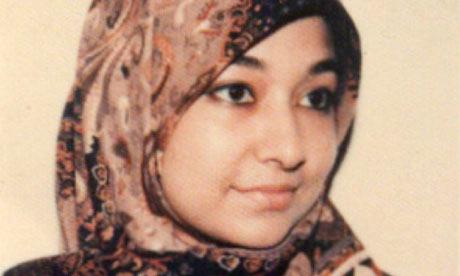
Aafia Siddiqui

Pakistani Taliban Union of Journalists (also known as Mullah Media Alliance), including Dr Shahid Masood, Irfan Siddiqui, Ansar Abbasi and Hamid Mir, often present a partial, one sided picture of the ordeal and 'mazloomiat' of Dr Aafia Siddiqui. In the following article, The Guardian's Declan Walsh offers a comprehensive, impartial account of Dr Aafia Siddiqui's life and her involvement with Al Qaeda. Our readers will appreciate that this kind of objective information will be never made available to them through the commercially populist oriented (riding the pro-Taliban and anti-USA waves) Geo TV. (Abdul Nishapuri)

The mystery of Dr Aafia Siddiqui
Declan Walsh
The Guardian, Tuesday 24 November 2009

On a hot summer morning 18 months ago a team of four Americans – two FBI agents and two army officers – rolled into Ghazni, a dusty town 50 miles south of Kabul. They had come to interview two unusual prisoners: a woman in a burka and her 11-year-old son, arrested the day before.

Afghan police accused the mysterious pair of being suicide bombers. What interested the Americans, though, was what they were carrying: notes about a "mass casualty attack" in the US on targets including the Statue of Liberty and a collection of jars and bottles containing "chemical and gel substances".

At the town police station the Americans were directed into a room where, unknown to them, the woman was waiting behind a long yellow curtain. One soldier sat down, laying his M-4 rifle by his foot, next to the curtain. Moments later it twitched back.

The woman was standing there, pointing the officer's gun at his head. A translator lunged at her, but too late. She fired twice, shouting "Get the fuck out of here!" and "Allahu Akbar!" Nobody was hit. As the translator wrestled with the woman, the second soldier drew his pistol and fired, hitting her in the abdomen. She went down, still kicking and shouting that she wanted "to kill Americans". Then she passed out.

Whether this extraordinary scene is fiction or reality will soon be decided thousands of miles from Ghazni in a Manhattan courtroom. The woman is Dr Aafia Siddiqui, a Pakistani neuroscientist and mother of three. The description of the shooting, in July 2008, comes from the prosecution case, which Siddiqui disputes. What isn't in doubt is that there was an incident, and that she was shot, after which she was helicoptered to Bagram air field where medics cut her open from breastplate to bellybutton, searching for bullets. Medical records show she barely survived. Seventeen days later, still recovering, she was bundled on to an FBI jet and flown to New York where she now faces seven counts of assault and attempted murder. If convicted, the maximum sentence is life in prison.

The prosecution is but the latest twist in one of the most intriguing episodes of America's "war on terror". At its heart is the MIT-educated Siddiqui, once declared the world's most wanted woman. In 2003 she mysteriously vanished for five years, during which time she was variously dubbed the "Mata Hari of al-Qaida" or the "Grey Lady of Bagram", an iconic victim of American brutality.

Yet only the narrow circumstances of her capture – did she open fire on the US soldier? – are at issue in the New York court case. Fragile-looking, and often clad in a dark robe and white headscarf, Siddiqui initially pleaded not guilty, insisting she never touched the soldier's gun. Her lawyers say the prosecution's dramatic version of the shooting is untrue. Now, after months of pre-trial hearings, she appears bent on scuppering the entire process.

During a typically stormy hearing last Thursday, Siddiqui interrupted the judge, rebuked her own lawyers and made strident appeals to the packed courthouse. "I am boycotting this trial," she declared. "I am innocent of all the charges and I can prove it, but I will not do it in this court." Previously she had tried to fire her lawyers due to their Jewish background (she once wrote to the court that Jews are "cruel, ungrateful, back-stabbing" people) and demanded to speak with President Obama for the purpose of "making peace" with the Taliban. This time, though, she was ejected from the courtroom for obstruction. "Take me out. I'm not coming back," she said defiantly.

The trial, due to start in January, is just one piece of a much larger puzzle. It is a tale of spies and militants, disappearance and deception, which has played out in the shadowlands of Pakistan and Afghanistan since 2001. In search of answers I criss-crossed Pakistan, tracking down Siddiqui's relatives, retired ministers, shadowy spy types and pamphleteers. The truth was maddeningly elusive. But it all started in Karachi, the sprawling port city on the Arabian Sea where Siddiqui was born 37 years ago.

Her parents were Pakistani strivers – middle-class folk with strong faith in Islam and education. Her father, Mohammad, was an English-trained doctor; her mother, Ismet, befriended the dictator General Zia ul-Haq. Aafia was a smart teenager, and in 1990 followed her older brother to the US. Impressive grades won her admission to the prestigious Massachusetts Institute of Technology and, later, Brandeis University, where she graduated in cognitive neuroscience. In 1995 she married a young Karachi doctor, Amjad Khan; a year later their first child, Ahmed, was born.

Siddiqui was also an impassioned Muslim activist. In Boston she campaigned for Afghanistan, Bosnia and Chechnya; she was particularly affected by graphic videos of pregnant Bosnian women being killed. She wrote emails, held fundraisers and made forceful speeches at her local mosque. But the charities she worked with had sharp edges. The Nairobi branch of one, Mercy International Relief Agency, was linked to the 1998 US embassy bombings in east Africa; three other charities were later banned in the US for their links to al-Qaida.

The September 11 2001 attacks marked a turning point in Siddiqui's life. In May 2002 the FBI questioned her and her husband about some unusual internet purchases they had made: about $10,000 worth of night-vision goggles, body armour and 45 military-style books including The Anarchist's Arsenal. (Khan said he bought the equipment for hunting and camping expeditions.) Their marriage started to crumble. A few months later the couple returned to Pakistan and divorced that August, two weeks before the birth of their third child, Suleman.

On Christmas Day 2002 Siddiqui left her three children with her mother in Pakistan and returned to the US, ostensibly to apply for academic jobs. During the 10-day trip, however, Siddiqui did something controversial: she opened a post box in the name of Majid Khan, an alleged al-Qaida operative accused of plotting to blow up petrol stations in the Baltimore area. The post box, prosecutors later said, was to facilitate his entry into the US.

Six months after her divorce, she married Ammar al-Baluchi, a nephew of the 9/11 mastermind, Khalid Sheikh Mohammed, at a small ceremony near Karachi. Siddiqui's family denies the wedding took place, but it has been confirmed by Pakistani and US intelligence, al-Baluchi's relatives and, according to FBI interview reports recently filed in court, Siddiqui herself. At any rate, it was a short-lived honeymoon.
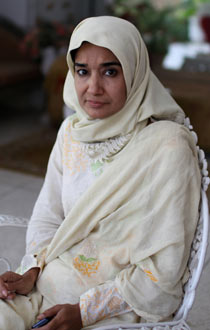
Fowzia Siddiqui
Fowzia Siddiqui is the elder sister of Aafia Siddiqui. Photograph: Declan Walsh

In March 2003 the FBI issued a global alert for Siddiqui and her ex-husband, Amjad Khan. Then, a few weeks later, she vanished. According to her family, she climbed into a taxi with her three children – six-year-old Ahmed, four-year-old Mariam and six-month old Suleman – and headed for Karachi airport. They never made it. (Khan, on the other hand, was interviewed by the FBI in Pakistan, and subsequently released.)

Initially it was presumed that Siddiqui had been picked up by Pakistan's Inter-Service Intelligence (ISI) spy agency at the behest of the CIA. The theory seemed to be confirmed by American media reports that Siddiqui's name had been given up by Mohammed, the 9/11 instigator, who was captured three weeks earlier. (If so, Mohammed was probably speaking under duress – the CIA waterboarded him 183 times that month.)

There are several accounts of what happened next. According to the US government, Siddiqui was at large, plotting mayhem on behalf of Osama bin Laden. In May 2004 the US attorney general, John Ashcroft, listed her among the seven "most wanted" al-Qaida fugitives. "Armed and dangerous," he said, describing the Karachi woman as a terrorist "facilitator" who was willing to use her education against America. "Al-Qaida Mom" ran the headline in the New York Post.

But Siddiqui's family and supporters tell a different story. Instead of plotting attacks, they say, Siddiqui spent the missing five years at the dreaded Bagram detention centre, north of Kabul, where she suffered unspeakable horrors. Yvonne Ridley, the British journalist turned Muslim campaigner, insists she is the "Grey Lady of Bagram" – a ghostly female detainee who kept prisoners awake "with her haunting sobs and piercing screams". In 2005 male prisoners were so agitated by her plight, she says, that they went on hunger strike for six days.

For campaigners such as Ridley, Siddiqui has become emblematic of dark American practices such as abduction, rendition and torture. "Aafia has iconic status in the Muslim world. People are angry with American imperialism and domination," she told me.

But every major security agency of the US government – army, FBI, CIA – denies having held her. Last year the US ambassador to Islamabad, Anne Patterson, went even further. She stated that Siddiqui was not in US custody "at any time" prior to July 2008. Her language was unusually categoric.

To reconcile these accounts I flew to Siddiqui's hometown of Karachi. The family lives in a spacious house with bougainvillea-draped walls in Gulshan Iqbal, a smart middle-class neighbourhood. Inside I took breakfast with her sister, Fowzia, on a patio overlooking a toy-strewn garden.

As servants brought piles of paratha (fried bread), Fowzia produced photos of a smiling young woman whom she described as the victim of an international conspiracy. The US had been abusing her sister in Bagram, she said, then produced her for trial as part of a gruesome justice pageant. "As far as I'm concerned this trial [in New York] is just a great drama. They write the script as they go. I've stopped asking questions," she said resignedly.

But Fowzia, a Harvard-educated neurologist, was frustratingly short on hard information. She responded to questions about Aafia's whereabouts between 2003 and 2008 with cryptic cliches. "It's not that we don't know. It's that we don't want to know," she said. And she blamed reports of al-Qaida links on a malevolent American press. "Half of them work for the CIA," she said.

The odd thing, though, was that the person who might unlock the entire mystery was living in the same house. After being captured with his mother in Ghazni last year, 11-year-old Ahmed Siddiqui was flown back to Pakistan on orders from the Afghan president, Hamid Karzai. Since then he has been living with his aunt Fowzia. Yet she has forbidden him from speaking with the press – even with Yvonne Ridley – because, she told me, he was too traumatised.

"You tell him to do something but he just stands there, staring at the TV," she said, sighing heavily. But surely, I insisted, after 15 months at home the boy must have divulged some clue about the missing years?

Fowzia's tone hardened. "Ahmed's not allowed to speak to the press. That was part of the deal when they gave him to us," she said firmly.

"Who are they?" I asked.

She waved a finger in the air. "The network. Those who brought him here."

Moments later Fowzia excused herself. The interview was over. As she walked me to the gate, I was struck by another omission: Fowzia had barely mentioned Ahmed's 11-year-old sister, Mariam, or his seven-year-old brother, Suleman, who are still missing. Amid the hullabaloo about their imprisoned mother, Aafia's children seemed to be strangely forgotten.

That night I went to see Siddiqui's ex-husband, Amjad Khan. He ushered me through a deathly quiet house into an upstairs room where we sat cross-legged on the floor. He had a soft face under the curly beard that is worn by devout Muslims. I recounted what Fowzia told me. He sighed and shook his head. "It's all a smokescreen," he said. "She's trying to divert your attention."

The truth of the matter, he said, was that Siddiqui had never been sent to Bagram. Instead she spent the five years on the run, living clandestinely with her three children, under the watchful eye of Pakistani intelligence. He told me they shifted between Quetta in Baluchistan province, Iran and the Karachi house I had visited earlier that day. It was a striking explanation. When I asked for proof, he started at the beginning.

Their parents, who arranged the marriage, thought them a perfect match. The couple had a lot in common – education, wealth and a love for conservative Islam. They were married over the phone; soon after Khan moved to America. But his new wife was a more fiery character than he wished. "She was so pumped up about jihad," he said.

Six months into the marriage, Siddiqui demanded the newlyweds move to Bosnia. Khan refused, and grew annoyed at her devotion to activist causes. During a furious argument one night, he told me, he flung a milk bottle at his wife that split her lip.

After 9/11 Aafia insisted on returning to Pakistan, telling her husband that the US government was forcibly converting Muslim children to Christianity. Later that winter she pressed him to go on "jihad" to Afghanistan, where she had arranged for them to work in a hospital in Zabul province. Khan refused, sparking a vicious row. "She went hysterical, beating her hands on my chest, asking for divorce," he recalled.

After Siddiqui disappeared in March 2003, Khan started to worry for his children – he had never seen his youngest son, Suleman. But he was reassured that they were still in Pakistan through three sources. He hired people to watch her house and they reported her comings and goings. His family was also briefed by ISI officials who said they were following her movements, he said. (Khan named an ISI brigadier whom I later contacted; he declined to speak).

Most strikingly, Khan claimed to have seen his ex-wife with his own eyes. In April 2003, he said, the ISI asked him to identify his ex-wife as she got off a flight from Islamabad, accompanied by her son. Two years later he spotted her again in a Karachi traffic jam. But he never went public with the information. "I wanted to protect her, for the sake of my children," he said.
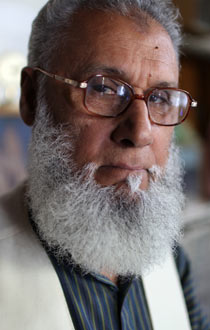
Shams ul-Hassan Faruqi
Shams ul-Hassan Faruqi, a geologist and uncle of Dr Aafia Siddiqui, at his home in Islamabad, Pakistan Photograph: Declan Walsh

Khan's version of events has enraged his ex-wife's family. Fowzia has launched a 500m rupees (£360,000) defamation law suit, while regularly attacking him in the press as a wifebeater set on "destroying" her family. "Marrying him was Aafia's biggest mistake," she told me. Khan says it is a ploy to silence him in the media and take away his children.

Khan's explanation is bolstered by the one person who claims to have met the missing neuroscientist between 2003 and 2008 – her uncle, Shams ul-Hassan Faruqi. Back in Islamabad, I went to see him.

A sprightly old geologist, Faruqi works from a cramped office filled with coloured rocks and dusty computers. Over tea and biscuits he described a strange encounter with his niece in January 2008, six months before she was captured in Afghanistan.

It started, he said, when a white car carrying a burka-clad woman pulled up outside his gate. Beckoning him to approach, he recognised her by her voice. "Uncle, I am Aafia," he recalled her saying. But she refused to leave the car and insisted they move to the nearby Taj Mahal restaurant to talk. Amid whispers, her story tumbled out.

Siddiqui told him she had been in both Pakistani and American captivity since 2003, but was vague on the details. "I was in the cells but I don't know in which country, or which city. They kept shifting me," she said. Now she had been set free but remained under the thumb of intelligence officials based in Lahore. They had given her a mission: to infiltrate al-Qaida in Pakistan. But, Siddiqui told her uncle, she was afraid and wanted out. She begged him to smuggle her into Afghanistan into the hands of the Taliban. "That was her main point," he recalled. "She said: 'I will be safe with the Taliban.'"

That night, Siddiqui slept at a nearby guesthouse, and stayed with her uncle the next day. But she refused to remove her burka. Faruqi said he caught a glimpse of her just once, while eating, and thought her nose had been altered. "I asked her, 'Who did plastic surgery on your face?' She said, 'nobody'."

On the third day, Siddiqui vanished again.

Amid the blizzard of allegations about Siddiqui, the most crucial voice is yet to be heard – her own. The trial, due to start in January, has suffered numerous delays. The longest was due to a six-month psychiatric evaluation triggered by defence claims that Siddiqui was "going crazy" – prone to crying fits and hallucinations involving flying infants, dark angels and a dog in her cell. "She's in total psychic pain," said her lawyer, Dawn Cardi, claiming that she was unfit to stand trial.

But at the Texas medical centre where the tests took place, Siddiqui refused to co-operate. "I can't hear you. I'm not listening," she told one doctor, sitting on the floor with her fingers in her ears. Others reported that she refused to speak with Jews, that she manipulated health workers and perceived herself to "be a martyr rather than a prisoner". Last July three of four experts determined she was malingering – faking a psychiatric illness to avoid an undesirable outcome. "She is an intelligent and at times manipulative woman who showed goal-directed and rational thinking," reported Dr Sally Johnson.

Judge Richard Berman ruled that Siddiqui "may have some mental health issues" but was competent to stand trial.

Back in Pakistan Siddiqui has become a cause celebre. Newspapers write unquestioningly about her "torture", parliament has passed resolutions, placard-waving demonstrators pound the streets and the government is spending $2m on a top-flight defence. High-profile supporters include the former cricketer Imran Khan and the Taliban leader Hakumullah Mehsud who has affectionately described Siddiqui as a "sister in Islam".

The unquestioning support is a product of public fury at US-orchestrated "disappearances", of which there have been hundreds in Pakistan, and deep scepticism about the American account of her capture. Few Pakistanis believe a frail 5ft 3in, 40kg woman could disarm an American soldier; fewer still think she would be carrying bomb booklets, chemicals and target lists.

But there are critics, too, albeit silent ones. A Musharraf-era minister with previous oversight of Siddiqui's case told me it was "full of bullshit and lies".

Two weeks ago the Obama administration introduced a fresh twist, when it announced that next year (or in 2011) five Guantanamo Bay detainees will be tried in the same New York courthouse, a few blocks from the World Trade Centre. One of them is Siddiqui's second husband, Ammar al-Baluchi, also known as Ali Abd al-Aziz Ali, who stands accused of financing the 9/11 attacks.

But while the Guantanamo detainees will be tried for their part in mass terrorism, Siddiqui's case focuses on a minor controversy – whether she fired a gun at a soldier in an Afghan police station. And so the big questions may not be probed: whether the ISI or CIA abducted Siddiqui in 2003, what she did afterwards, and where her two missing children are now. In fact the framing of the charges raises a new question: if Siddiqui was such a dangerous terrorist five years ago, why is she not being charged as one now? A senior Pakistani official, speaking on condition of strict anonymity, offered a tantalising explanation.

In the world of counter-espionage, he said, someone like Siddiqui is an invaluable asset. And so, he speculated, sometime over the last five years she may have been "flipped" – turned against militant sympathisers – by Pakistani or American intelligence. "It's a very murky world," he said.

"Maybe the Americans have no charges against her. Maybe they don't want to compromise their sources of information. Or maybe they don't want to put that person out in the world again. The thing is, you'll never really know." Source

Read more...

Monday, 23 November 2009

Paranoia, perversion, and hypocrisy of Pakistan's middle class

Nauseous mumblings

Nadeem F. Paracha

Sunday, 22 Nov, 2009

RECENTLY I was fortunate enough to be a part of an excellent ten-minute news video prepared by the New York Times’ reporter, Adam Ellick. Tastefully called ‘Tuning out the Taliban,’ the video has created the right buzz amongst young middle-class Pakistanis.

Adam treats his report as a way to understand why many educated, westernised and modern Pakistani pop/rock stars and their fans are all gung-ho about anti-Americanism in their songs and beliefs but at the same time keeping quiet about matters such as religious extremism, terrorism and the Taliban.

The funny thing is, this is happening even when there are disturbingly tangible and physical examples of the ubiquitous carnage and mayhem being caused by so-called jihadis; whereas conspiratorial notions such as the ever-present explanation of a ‘foreign hand’ — mainly the idea of an unholy alliance of America, India and Israel out to destroy Pakistan and Islam — remains to be a largely unsubstantiated and somewhat air-headed perception.

According to my own experience as a journalist covering the Pakistan music scene in the 1990s, it is never a good idea to encourage pop musicians to start making political statements. As an idea it can be exciting and relevant, but since much of the modern pop music scene in Pakistan originates from middle-class settings, one can thus expect nothing more than self-righteous droning and quasi-reactionary drawing-room demagoguery usually found in the urban bourgeoisie and petty-bourgeois sections of society.

Surveys and studies of these two classes in Pakistan show them to be two of the most conservative, with a history of economically and politically backing assorted military dictators (especially Ziaul Haq and Pervez Musharraf). Of course, there have been clear exceptions in this context, but it is also true that over the years the overall conservatism of these classes has seen certain sections from within become both supporters and financiers of the more extreme strains of Islamic thought.

There have been recorded cases against many petty-bourgeois shop-owners and traders of financing jihadi organisations; whereas many sections among the more ‘modern’ bourgeois class have largely exhibited their own version of extreme beliefs by passionately patronising (as supporters and clients), a number of Islamic televangelists and drawing-room preachers whose number has grown two-fold from 1990 onwards.

Consequently, there has been a dramatic increase in the number of young men and women from the middle-class now preferring to adorn beards and hijabs, and taking religious rituals a lot more seriously (compared to the situation till the late 1970s). But this class still constitutes a large number of westernised youth as well.

However, compared to their more socially conservative class contemporaries — who have been seen to follow right-wing groups from the Jamat-i-Islami, to defunct Sipah-i-Sehaba to Sunni Threek and the Tableeghi Jamaat and individuals such as Dr Israr Ahmed, Farhat Hashmi and Zakir Naik — the more ‘modern’ lot in this respect have not exactly fallen to the left as a reaction (like they did between the 1950s and the early 1970s). Instead, in spite of whole-heartedly embracing the economic, aesthetic and cultural fruits of secularism, they have retained their classes’ inherent political conservatism.

Adam Ellick’s interviews with former rock star and animated TV personality, Ali Azmat, and bubblegum-rock poster boy, Ali Noor, are the cases in point. Both hail from modern, middle-class settings and represent the more westernised sections of Pakistani bourgeoisie. In spite of mimicking the aesthetic, cultural and linguistic strains of western pop culture, both refused to see any contradiction whatsoever in conveniently attacking ‘western imperialism’ as the reason behind the terror attacks in Pakistan.

Azmat is seen in a T-Shirt and shorts, with an expensive Apple laptop by his side, sitting in a room decorated like an arty version of an American college dude’s bachelor pad, and the following is what he had to say: ‘It (suicide bombing) is the agenda of neocons to de-Islamise Pakistan…’

In his astute and recently acquired wisdom (mainly inspired by Azmat’s newfound guru, celebrated conspiracy theorist Zaid Hamid), the Taliban are not behind the bombings of girls’ schools, but ‘foreign forces (CIA, RAW and Mossad),’ are to be blamed! Where else but in Pakistan can one find a hip rock star with a lucrative history of being proudly sponsored by various western multinationals, also become a shameless apologist of men who in the name of faith not only blow themselves up in public, but are also known to have used three-to-six-year-old children for the same deed.

Then, in the same documentary, we see yet another scion of the increasingly warped Pakistani bourgeoisie, Ali Noor, the long-haired, guitar-slinging lead vocalist of Noorie. Amidst terrifying and tragic footage of blown up cars, shops and body limbs, he announces that ‘the Taliban only constitute a tiny problem.’ While spouting this profound insight, Noor gestures the ‘tiny’ part of his grand statement with his hand and you wonder, shouldn’t that gesture be explaining the size of his brain? Is this symptomatic of mere delusion, or of some unprecedented form of collective psychosis? Source

Read more...

Sunday, 22 November 2009

Saudi-sponsored terrorism: Instead of standing up, Saudi ambassador bolts from the scene


Wahabism linked with terrorism; Saudi envoy stages walkout

NEW DELHI: Saudi Ambassador to India Faisal Al-Trad walked out of an international conference of jurists in protest after noted Indian jurist Ram Jethmlani’s accusation that the Wahabi sect of Islam was responsible for terrorism. The conference was attended by Indian President Pratibha Patil, Chief Justice KG Balakrishnan and Law Minister Veerapa Moily. Jethmalani said “Wahabi terrorism” indoctrinated “rubbish” in the minds of young people to carry out terrorist attacks. He lamented that India was friends with a country that supported Wahabi terrorism. The event’s organiser, Adesh Aggarwala, said the ambassador had walked out but returned after Moily’s statement that Jethmalani’s views were not supported by the government or the organisers. Moily said terrorism could not be attributed to any particular religion. iftikhar gilani Source
Read more...

Thursday, 19 November 2009

People's Republic of Pakistan?

vs

By Abdul Nishapuri

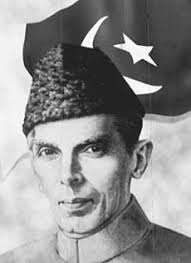
According to the vision of the founder of Pakistan, Quaid-e-Azam Muhammad Ali Jinnah, Pakistan was to be country in which everyone including Muslims and non-Muslims would be free to exercise their beliefs and practices and where the state had nothing to do with any one's religious beliefs.

In his presidential address to the first constituent assembly of Pakistan on 11 August 1947, Jinnah said:

"I cannot emphasize it too much. We should begin to work in that spirit and in course of time all these angularities of the majority and minority communities, the Hindu community and the Muslim community, because even as regards Muslims you have Pathans, Punjabis, Shias, Sunnis and so on, and among the Hindus you have Brahmins, Vashnavas, Khatris, also Bengalis, Madrasis and so on, will vanish. Indeed if you ask me, this has been the biggest hindrance in the way of India to attain the freedom and independence and but for this we would have been free people long long ago. No power can hold another nation, and specially a nation of 400 million souls in subjection; nobody could have conquered you, and even if it had happened, nobody could have continued its hold on you for any length of time, but for this. Therefore, we must learn a lesson from this. You are free; you are free to go to your temples, you are free to go to your mosques or to any other place or worship in this State of Pakistan. You may belong to any religion or caste or creed that has nothing to do with the business of the State." Source

The founder of Pakistan, Jinnah and later his successor, Liaqat Ali Khan, were sincere to the cause of a progressive Pakistan free of religious theocratic elements. Thus, they did not resort to exploiting the name of Islam for short-termed political expediency. From 1947 until 1956, the official title of the country was "Pakistan".

It was only in the era of civil and military dictatorship in Pakistan, when a dictator Major General Iskandar Mirza, helped by General Ayub Khan, proclaimed Pakistan as an Islamic Republic in the 1956 constitution. That was the official proclamation and institutionalization of the Mullah-Military Alliance in Pakistan.

vs

While it is a fact that Pakistan is a Muslim majority country, it is not an Islamic country because it is not governed by Islamic sharia. The reason is quite obvious; there are numerous schools of thought and sects in Islam. In Pakistan, Muslims are divided into Barelvi, Deobandi, Shia, Ahl-e-Hadith and other numerous groups. All of these groups and sub-groups have different interpretations in terms of principles and practices of Islamic sharia. Also, many Pakistanis do not want to be governed by theocracy or Mullahs.

Therefore, it will be well advised that Pakistan should dissociate itself from the Talibanic legacy of the first military dictatorship in Pakistan, and instead of its official title "Islamic Republic of Pakistan", it must adopt "Pakistan" as its name. This step will be consistent with the vision and the legacy of Jinnah and Liaqat Ali Khan.

From Islamic to Peoples Republic of Pakistan?

ISLAMABAD (The Nation) – Awami National Party (ANP) during the deliberations of Parliamentary Reforms Committee had proposed to change the name of Islamic Republic of Pakistan as Peoples Republic of Pakistan, while Muttahida Qaumi Movement (MQM) and Pakistan People’s Party (PPP) supported the move, the sources close to these political parties disclosed to The Nation.

The idea was, however, dropped due to strong opposition from the rest of the members of the committee, the sources added.

MQM Deputy Convener and Federal Minister Dr. Farooq Sattar confirmed it to the media in an informal chat on Wednesday and said that MQM along with PPP members of the committee supported the idea of renaming Islamic Republic of Pakistan as Peoples Republic of Pakistan.

On the other hand, ANP member of the committee Haji Adeel denied having proposed the name of Peoples Republic of Pakistan to replace Islamic Republic of Pakistan. However, some members of the committee on condition of anonymity confirmed it to TheNation that ANP had proposed the said change in the name of the country and MQM and PPP members had supported it.

During chat with media, Dr. Farooq Sattar also proposed making Gilgit-Baltistan as the fifth province of the country and its chief minister should also be included in the National Finance Commission (NFC). The government should take appropriate steps in this regard to remove the constitutional and international hurdles, he added. He said if the Parliamentary Committee on Constitutional Reforms would finish with its deliberation on provincial autonomy by mid of December, they would be in a position to give the nation a new year’s gift in the shape of constitutional reforms package.

Read more...

The Zionist prism of Zaid Hamid and Ahmed Quraishi


It's the stupidity, stupid

Thursday, November 19, 2009
Zafar Khalid Farooq

Whilst it is common to hear, or read, the unenlightened ramblings of various 'experts' in the media these days, it's strange to find examples of anti-intellectualism in a bookshop. One would hope that these establishments would attract people interested in expanding their minds and developing critical thinking. But, not so in Pakistan.

I was in Liberty Books when I spied a comment card nestling inside the Perspex comment box. The angry opinion read as follows: "'Mother of God' by Miri Rubin. I don't think that this book should be sold or displayed in a prestigious store like yours. You have a social responsibility."

Yes, they do have a social (and financial) responsibility to sell books. What could be so odious about this book that it could produce such an angry tirade, I wondered? So I did what any normal person would do, I immediately asked for a copy of the book. Sadly, it had sold out. However, a quick Google search showed that this book was a history of the perceptions of Mary, mother of Jesus, in European societies from the Middle Ages to the 21st century, and how these perceptions varied from country to country. Different countries used the role of Mary in differing ways to make sense of a range of human experience -- virginity, motherhood, family life, poverty and humility. What aspects these societies focused on in their representation of Mary, in turn, reflected the broader concerns of that society.

It sounded like a serious and interesting work. So what could have caused someone to question the book store's social responsibility for carrying it? In fact, wasn't it being socially responsible by offering this book for public consumption? Then it struck me. It was the title: Mother of God. That had been the objection. They had simply disliked the association of mother with God. Now you and I may not believe that Mary was the mother of God, and probably the Jewish sounding author, Miri Rubin, doesn't believe she is either, but that's not the point. This was a serious historical study of the continuing evolution of Mary in those Christian societies where they consider her the mother of God.

Would it be fair for a western bookshop to ban a biography on the Prophet (PBUH) called The Last Prophet? Of course not. Muslims would be rightly angry. So too would many non-Muslims be upset, for they would be interested in a scholarly work on the Prophet (PBUH). So why do we Muslims demand tolerance and plurality of beliefs when it comes to the west, but become intolerant when it comes to our societies?

Perhaps it shouldn't be a surprise to see this reaction in a bookshop. After all, we are a nation that kowtows to the ignorant and plain stupid. Yes, let's revel in our ignorance. We are a nation where our city centres are inundated with jewelry and clothes shops, but lack a single decent Urdu bookshop. We are a nation whose middle class, although in possession of a disposable income, will only have one book in their house -- and that too on a very high shelf, and often unread. Bigotry prospers over intellectual rigour, innuendo over fact, and conspiracy theory over credible reporting.

After all we have become a nation where a national newspaper can endanger the life of a Wall Street Journal journalist, Matthew Rosenberg, by claiming that he is an Israeli agent, an American agent, and a contractor for Blackwater. Either he is a busy man, or this is bunkum. The report in the newspaper provided no credible sources.

We are a nation that unquestionably swallows the unsubstantiated rants of Zaid Hamid, Ahmed Quraishi and their ilk. Zaid Hamid sees the world through a Zionist prism, while I advise you to check out ahmedquraishi.com to check out the quality of his 'photo journalism'.

We are a nation where pop stars like Ali Azmat believe that "we know for a fact that all this turbulation (not a world, Ali) in Pakistan it's not us, but outside hand" and who says that the Taliban is not responsible for blowing up 200 girls schools, but it's the work of an unidentified foreign hand. Show me the evidence, Ali? Where are the 'facts' you talk about?

Ironically, it is these very people who hark back the loudest, and bemoan the most, the loss of the Islamic world's glory days -- when Muslims were pioneers at the forefront of scientific, architectural, astronomical, and mathematical advances in the world. But you only can be pioneers when using knowledge, reason, logic and a factually supporting argument. The Taj Mahal was not built on a conspiracy theory or by obtaining a forged website doctoral degree. Yet, we listen to and follow the stupid?

Please note, I am not talking about education here. The stupid are often so called 'educated' people. Nor am I attacking right-wing commentators, per se. There are some who use the supporting evidence to reach a conclusion that could be described as right wing, which is perfectly acceptable. No, I am attacking those who make accusations using the flimsiest evidence, that's if they provide evidence at all, to back their claims. A mere cursory look at the 'proof' and it quickly disintegrates upon inspection. A little knowledge is a dangerous thing, indeed.

How's this for a conspiracy theory: Perhaps, the Jews, Americans and Indians are funding all these cranks, right-wing conspiracy theorists, hyper nationalist and loonies that populate the airwaves in Pakistan. By listening to their claptrap and proportioning blame to hidden hands, the Pakistani people remain in perpetual denial about the encroaching problems in their country, therefore causing further erosion of the state. Maybe, THIS IS the evil Zionist, Capitalist, Hindu plot to destroy Pakistan. They are keeping us dumb and stupid. Pappu yaar, have you thought about that?

Email: zkfarooq@gmail.com and www.zafarkhalidfarooq.blogspot.com

Read more...

Tuesday, 17 November 2009

We support Sardar Khosa's fling at the Scandinavian mujra


From the editorial team of Let Us Build Pakistan

Many readers of this blog have drawn our attention to PML-N's senior leader Sardar Zulfiqar Khosa’s participation in a Scandinavian mujra recently. We support the Sardar’s participation. By gracing the mujra party through his such a prominent and for-the-entire-world-to-see presence, the Sardar has made a very timely political statement. In Pakistan where the Taliban have made all forms of entrainment and cultural expressions haram, we need more and more political leaders to come forward and patronize culture. PML (N) leaders can make more contribution than any other leaders because they have more influence on the Punjabi middle class than any other party.


This video is a big slap on the faces of the Hamid Mirs, Shahid Masoods, and Ansar Abbasis of the Talibanic media of Pakistan. Had it been a People’s Party leader in place of Sardar Khosa, they would have gone mad with anger and demonized him in no uncertain terms. But these princes of darkness of Pakistani media kept silent over this video. This is the reason we want more and more non-PPP leaders to come forward and emulate Sardar Khosa. Nawaz Shairf’s talent for singing Hindi songs is no secret. He can raise a lot of money for charity through his God-given singing talent.

Meanwhile, enjoy the show!

Read more...

Monday, 16 November 2009

International tolerance day


Posted by: Jarri Mirza
Guest blog: Humza Ikram

Today world is celebrating International tolerance day but sadly Pakistani society is getting more and more intolerant. Our right wing media is spreading a lot of hatred in our society and the beauty of our pluralistic society is now sadly a memory of the past. One of my young cousins ,who is an avid Zaid Hamid viewer, has sent me a picture of a map showing India to be a part of Pakistan. He urged me to make it my face book display picture. The following is a post by Nadeem Paracha highlighting the importance of tolerance in social life. Also, checkout the following video and see how Zaid Hamid is spreading hatred towards Hindus. I'm wondering how insecure Hindu community living in Sindh might feel in their own country.


Blow Daddy

By Nadeem Paracha

Daddy?
Yes, son.
Are we going to have a war with India?
Perhaps.
Oh, goody. We will thrash them, right? Like we did in 1857!
It wasn't in 1857, son.
Oh, okay. But whom did we thrash in 1857?
The British, son …
And the Hindus too, right?
Well …
Did Quied-e-Azam fight in that war along
with Muhammad bin Qasim and Imran Khan?
No, son. The Quied and Imran were born much later and Muhammad bin Qasim died many years before.
Then who ruled Pakistan in those days?
There was no Pakistan in those days, son.
But there was always a Pakistan! It has been there for 5000 years!
Whom have you been talking to, son?
No one. I've just been watching TV.
It figures.
Daddy, why are all these people against us Arabs?
Arabs? But we aren't Arabs, son.
Of course we are because our ancestors were Arabs!
No, son. Our ancestors were sub-continental.
Sub-what?
Never mind.You seem to like wars, son.
Yes. I like to watch them on TV.
But real wars are fought outside the TV, son.
Really? How is that possible? What sort of a war is that?
Never mind.
Daddy you look worried.
Of course, I am, you little warmongering punk!
Daddy. Why are you scolding me?
Because TV is talking rot and so are you!
Daddy, are you turning into a Hindu?
No!
Daddy, have you become a kafir?
Keep quiet! No more TV for you! Go watch a movie on the DVD player, or listen to a CD.
Can't do that.
But we have so many DVDs and CDs, son.
Not any more.
What do you mean?
I burned them all.
What?!
I burned them all.
I heard that! But why?
They spread obscenity.
Oh, God. Son, go do your homework. What happened to that science project you were working on?
It's almost complete.
Good boy. What are you making?
A bomb.
What?!
A bomb.
I heard that! But why?
Because I am a true Muslim mujahid who hates America.
But only last week you wanted to go to Disney Land.
That's different.
How come?
Mickey Mouse is a Muslim.
No he isn't.
Is so. He converted when he heard the azaan on the moon.
On the moon?
Yes. Because the Earth is flat and …
What??
The Earth is …
I heard that!
Daddy, do you want to see my science project, or not?
Gosh, that bomb? But your science teacher will fail you.
No she wont.
Really …?
Yes. I plan to blow her up as well.
God, what is wrong with you? Go call your mother!
She can't come.
Why not?
I've locked her in the kitchen.
But what for?
A woman's place is in the kitchen. I will not let her out until she starts wearing a hijab!
But she's your mother!
No. She's a woman!
So?
So she should be hidden.
Hidden from whom?
You, me, the whole world and Tony.
Tony?
Yes, Tony.
But Tony's a cat.
Yes. But he's a male cat.
Son, have you gone mad?
No. By the way, I've made sure Kitto starts wearing a hijab as well.
Kitto?
Yes, Kittto.
But Kitto's also a cat!
Yes. But a female cat.
But she'll suffocate.
Oh, she's already dead.
What?
She's already dead.
I heard that! But how?
I buried her alive.
You what??
Yes. To avenge Tony's honor. But now I will behead Tony.
But why?
To save mom's honor!
Oh, God!
Don't say that. Always say Allah Hafiz instead of Khuda Hafiz.
What's the difference?
Daddy, do you want to be beheaded too?
No!
Do you want to be stoned to death?
No!
Do you want to be flogged?
No!
Do you want to get your arms chopped off?
No!
Then stop asking stupid questions. By the way, I won't call you daddy anymore.
What will you call me then?
Whatever is Arabic for daddy.
I don't know any Arabic, son.
That's because you are a kafir.
Who the heck are you to tell me who I am, you little fascist twit!
What's a fascist?
An irrational, violent, self-righteous mad man!
WAAAAAAA!!
Why are you crying?
You scolded me.
Okay, I'm sorry. You have to be tolerant and rational, son. Now be a good boy and go read a book instead of watching TV.
I have no books.
Of course, you do. I bought you so many books.
I burned them all.
What?!
I burned them all.
I heard that! But why?!
They were all in English.
So?
Christians speak English.
But we are speaking English as well, aren't we?
WAAAAAAAAAAAA …!!
What now?
Zionists made me forget Arabic!
But you never knew any Arabic, son.
WAAAA … yes I did until you and mommy gave me polio drops … WAAAA …
Okay, tell me, can you do me a favor?
Sure, dad. (*sniff*).
Can you blow up something for me?
Oh, goody! Of course, dad. What should I blow? A CD shop, a hotel, a school …?
No, no, something a lot more sinister.
Mom?
No, no …
What then?
The TV set!
What?!
Blow the TV Set.
I heard that! But why?
Just do it!
I see. Dad?
Yes.
You're so unconstitutional.

...


source


Read more...

Sunday, 15 November 2009

Pakistan politics and media: The abuse of Islam for political gains?


Smokers’ Corner: Speaking fire
Nadeem F. PARACHA
Sunday, 15 Nov, 2009

A blogger makes a valid point in a recent blog on dawn.com. He suggests that the reason why recent election rallies in Gilgit-Baltistan are so diagonally different from those held in the rest of Pakistan is perhaps due to the lack of militant madressahs and the concept of political Islam in that area.

He is also right to note that the language and the overall content of the recent rallies by almost all the leading political parties there are squarely concentrated on various economic and development issues; whereas political rallies held by the same parties elsewhere in Pakistan are usually studded with impassioned sloganeering and jingoistic takes on Islam, India, Jews and America. The general aura of these rallies also smacks of a xenophobic and chauvinistic exhibition of ‘patriotism.’

Till about the late 1960s, political rallies, rather their content, were largely different in Pakistan. The people’s economic wellbeing and the country’s economic progress used to be the focus of the speakers at these rallies. However, things in this respect began to change with the consolidation of Zulfikar Ali Bhutto (as an opposition leader) in 1967.

Already a gifted orator, Bhutto took his cue from the celebrated speakers of the 1960s’ leftist student leaders who in their passionate outbursts addressed economic issues using rhetorical Marxist lingo and revolutionary bravado.

In his speeches at the time, Bhutto too addressed economic issues faced by the people, but he began to use more and more revolutionary symbolism and lingo trying to work the crowds into a captivated frenzy, just like Mao Tse Tung was doing during the Chinese Cultural Revolution. Aggressive vocal posturing became a hallmark of the Bhutto rallies, but this aggression got its first physical manifestation when during the 1970 election campaign, hoards of Jamat-i-Islami (JI) and its student wing, the Islami Jamiat Taleba (IJT) activists, started to attack Bhutto rallies.

In his book, Pakistan People’s Party: Rise to Power, Phillip E. Jones states that PPP rallies became a target of the JI and IJT activists who, incensed by Bhutto’s leftist rhetoric, labelled him as ‘anti-Islam’ and a ‘kafir.’ Till then political rallies were usually attacked and dispersed by government-hired hooligans and the police, so this was perhaps the first time one political party was attacking another party’s rally.

Jones further writes that to counter these attacks by the JI and IJT, the PPP formed the ‘People’s Guards.’ These were groups of tough young men picked from various leftist student organisations, especially the National Students’ Federation (NSF) that was supporting Bhutto. A number of clashes took place between the ‘People’s Guards’ and the JI activists during the 1970 election campaign.

The tone of Bhutto’s speeches became a lot more aggressive after he came to power in 1972 — especially from 1974 onwards, when smitten by the sudden turn that the ideology of Pakistan took after the East Pakistan debacle, both Bhutto and his political-religious opponents began using ‘Islam’ a lot more frequently. It was the Bhutto government which presided over the change of direction Pakistan’s history and school books took after the 1971 civil war in the former East Pakistan. It was also Bhutto who had Ahmadis declared as non-Muslim.

Suddenly, Islam took centre-stage like never before, even to the extent that these books were infused with half-baked truths and historical distortions, mainly so that the ‘two nation theory’ that helped originate the concept of a separate Muslim country in the subcontinent could be defended, especially after the theory had actually collapsed with the creation of Bangladesh (on the basis of ethnicity) in 1971. As Bhutto’s opponents raised the bar of fiery Islamic rhetoric, by the 1977 election campaign, Bhutto too was heard using Islamic symbolism and promises more than revolutionary socialist idioms. General Ziaul Haq who arrived as a military dictator in 1977, soon turned political speechmaking into a calculated expression in which, for the first time, a modern-day political leader was heard using Quranic terms, verses and sometimes whole hadiths. Days of speeches addressing economic and development issues in secular terms became history.

As radical/militant Islam took root in Pakistani society during the Afghan civil war in the 1980s; pro-Zia politicians and religious parties began doing the same. By the 1990s speeches heard at PML-N and JI rallies were usually studded with heavy Islamic symbolism and terms. The trend has continued, so much so, that today, even the more secular parties such as the PPP, ANP and the MQM can’t escape from using Islamic symbolism in their speeches to constantly reinforce their spiritual credentials.

What’s more, the trend has now infested the electronic media as well, where supposedly ‘objective’ newscasters and talk show hosts punctuate their speech and tirades with Islamic terms like Allah, Sharia, Shaheed, etc., as if trying to give their obvious vocal diabolism a righteous sheen. What is being sacrificed is cohesive speech based on facts and a practical vision of the future, a dialogue that is actually a rational discourse on politics, economics and terrorism, instead of an ‘I am holier than you’ clash of bloated egos. Source

Read more...

Saturday, 14 November 2009

Do Dr Aafia Siddiqui and Major Nadal Hasan represent Islam?

By Abdul Nishapuri

Islam is a religion of peace and tolerance. Any one who aims to exploit Islam to resort to violence against innocent human beings is neither a friend of Islam nor humanity. Unfortunately, acts of terror and violence committed by ill-informed and ill-minded persons such as Dr Aafia Siddiqui and Major Nadal Hasan serve to defame Islam and Muslims, something which must be condemned unconditionally.

Major Nadal Hasan
Recently, I read the following letter by a Muslim, published in a newspaper. According to this letter:

Treachery is abhorrent in any culture or religion. One has to be blinded by hate to find anything decent about the heinous crime and treacherous act of Maj. Nidal Hasan’s mass shooting at Fort Hood. Hasan violated many constant Islamic principles.

He violated the principle that contracts are binding and should be respected and fulfilled by Muslims, for they are the foundation of civilization. “O you who believe, fulfill your contracts.” (Quran 5.1). His reward for those who honored him and were good to him with the ultimate evil of stabbing them in the back is against Islamic teachings. “Is there any reward for good other than good?” (Quran 55.60). He violated the principle of not committing acts that cause harm to Islam and Muslims.

“No direct or indirect act of harm is permissible.” His lunatic rampage actually harmed Islam, Muslims and his own family. If he meant to weaken Americans, it actually helped strengthen their resolve and united them against whatever Hasan is standing for. He betrayed his medical oath to protect and safeguard human life, a noble Islamic principle. “And whoever safeguards a life, it is as if he saved all humanity.” (Quran 5.32). Muslims are once again tormented by the shameful act of a fellow Muslim, who helped to injure the reputation of Muslims and distorted the image of Islam. Source

Dr Aafia Siddiqui
The case of Dr Aafia Siddiqui is not much different. According to a Times report:

An American-educated neuroscientist who is the only woman accused of working for al-Qaeda’s top leadership appeared in court in New York last night after her capture in Afghanistan.

The US Government alleges that Aafia Siddiqui, a Pakistani mother of three with a biology degree from Massachusetts Institute of Technology and a doctorate in behavioural neuroscience from Brandeis University, near Boston, is married to the nephew of Khalid Sheikh Mohammed, the man who claims to have organised the September 11 terror attacks in 2001.

She is charged with attempted murder and assault for allegedly trying to kill an American interrogator in a gun battle after she was arrested outside an Afghan government compound with a handbag full of chemicals and information on chemical, biological and radiological weapons, as well as descriptions of “various landmarks” in the United States.

After completing her doctoral thesis she married a Pakistani anaesthesiologist and lived in a flat in Boston that also served as the headquarters of an Islamic charity called the Institute of Islamic Research and Teaching. In 2002 the couple were questioned by the FBI after Ms Siddiqui’s husband allegedly purchased night-vision goggles and body armour on the internet. Within months the couple moved back to Pakistan but soon separated.

The US alleged that Ms Siddiqui has links to at least two of the 14 high-level al-Qaeda suspects who were moved to Guantanamo in September 2006. American prosecutors said that Ms Siddiqui opened a post office box in Maryland for Majid Khan, a former Baltimore resident now being held at the US detention centre in Guantanamo Bay.

Ms Siddiqui later married Ali Abd al-Aziz Ali, known as Ammar alBaluchi, a nephew of Khalid Sheikh Mohammed and a cousin of Ramzi Yousef, who was convicted of the 1993 bombing of the World Trade Centre in New York. Ms Siddiqui faces up to 20 years in prison on each count if convicted. The judge set a bail hearing for Monday. Source

What has emerged in the Pakistani media in recent past suggests that Aafia Siddiqui's plight is in part a product of her own internal family politics, as it is of whatever her jihadist inclinations may or may not have been. Her ex-husband, Dr Muhammad Amjad Khan, has spoken on the record for the first time since her reappearance in Afghanistan last year, and what he has to say suggests a different scenario to that which is currently in circulation.

He suggests that far from spending years as the Grey Lady of Bagram, tortured and abused, weeping and crying in the darkness, she was lying low either in Afghanistan or Pakistan. He also alleges that Dr Aafia and her children were seen in the vicinity of their family house in Karachi on several occasions over the years of her disappearance; and that for at least five years she had lived under the assumed name – 'Saliha' – possibly in both countries. For full details read the following article: http://letusbuildpakistan.blogspot.com/2009/02/dr-afia-siddiqui.html

Read more...

General Zia-ul-Haq's legacy: The axis of evil in Pakistan

Crime in the name of conspiracy
—Mehmal Sarfraz

Conspiracy theory is the only industry in Pakistan that runs round the clock and the production quality as well as product variety are absolutely out of this world

Conspiracy theory is the only industry in Pakistan that runs round the clock and the production quality as well as product variety are absolutely out of this world. The whole school of conspiracy theory reflects a certain mindset, which comes up with half-baked stories based on little or no evidence.

Just like former US President George W Bush had his axis of evil, a lot of Pakistanis have their own axis of evil — India, Israel and the US. If anybody so much as sneezes in the land of the pure, any one of these three countries or all of them are behind it. This is exactly what Mr Ijazul Haq did in his two articles, ‘A criminal conspiracy’ and ‘Punish the Bahawalpur conspirators’ published in this newspaper on September 8 and 9, 2009.

He has not only blamed Pakistan’s own ‘axis of evil’ but he has blamed everyone and his uncle for General Ziaul Haq’s death: Russia, Afghanistan, Al-Zulfiqar, the Pakistani military and many others.

First, let us examine why the Russians may not be responsible for this misadventure. The Soviets had signed the Geneva Accords in Spring 1988 and were engaged in pulling out their troops from Afghanistan. That they were earnest in their commitment was borne out by their scrupulous adherence to the pullout schedule. It would have been nothing but an act of petulance on their part if they were involved in the plane crash. If it is ever proved that the Soviets were involved in this conspiracy, it would greatly affect their credibility. Further, what material evidence can Mr Haq or anyone for that matter adduce to substantiate his allegation? Blaming this on the Soviets takes us away from the real truth.

Al-Zulfiqar too had almost abandoned its operations after the murder of Shahnawaz Bhutto in 1985; so to lay the blame at its doorstep is too far-fetched. Al-Zulfiqar did not have any sympathisers in the Pakistani military and therefore it could not have pulled off such an enormous coup, the logistics as well as actual conduct of which would have required an outlay that was definitely beyond the resources of a hounded and battered outfit like Al-Zulfiqar. Again, the question remains what material evidence can Mr Ijazul Haq show to prove the complicity of Al-Zulfiqar in the crash at Bahawalpur? But then, empirical evidence probably is not what Mr Haq is after. It is fine to spout a few trite albeit patently flimsy statements as long as the same sit well with a heavily indoctrinated public.

Israel would not have gained much from Zia’s death either. After the release of the much-touted book ‘Charlie Wilson’s War’ by George Crile, it is no secret that Israel helped General Zia in the Afghan war. Had Zia remained alive, things might have improved between Israel and Pakistan, much to the chagrin of the Arabs and most Pakistanis, but since the General had no one to answer to, this could have been achieved. Even in General Musharraf’s time, there were backdoor channels working on improving relations between Israel and Pakistan. It was the Lebanon war in 2006 that placed a few spanners in the wheels of these back-channel negotiations.

As for India, killing Zia and Pakistan’s top military brass would have been an open invitation to war. Had India actually been involved, our military would have done everything to prove this to the world and launched a military offensive with international support. Further, Pak-India relations had been rather smooth under Zia as well as Musharraf. It is the political leadership that fails to deliver vis-à-vis relations with India because their decision-making space is severely limited. India would have relished Zia’s longevity rather than cut the chord that held things in balance.

Mr Ijazul Haq has wagged a finger of suspicion at the Americans too for good measure, again without an iota of proof. Some people are of the view that after the end of the Cold War, the world wanted Pakistan to move forward, which meant getting rid of the military dictatorship and bringing in its place a genuine democratic government. It is also said in some quarters that Zia’s pan-Islamic ambitions were not approved of by the US. Twenty years down the road, we Pakistanis know only too well how robust were the democratic governments in the decade that followed Zia’s death. Further, Charlie and his aunt in Pakistan never get tired of blaming the US for abandoning the region after 1989 and thus allowing Islamic jihad to flourish. Strange that the Americans were so naïve as to kill Zia for the imaginary proliferation of jihad and not stir a finger while jihad descended from the mountains of Afghanistan till a brace of planes struck a pair of towers in New York.

When scrutinising the death of General Zia and the top military brass, with the exception of General Beg, one cannot stop wondering whether there was an internal motivation behind this. Who would benefit the most from the elimination of Zia and his entire coterie of military officers? Without local collaboration at the highest echelons of power, this could not have been pulled off. It has been rumoured that General Beg met with resistance from the Corps Commanders in Rawalpindi after Zia’s death, but we have no evidence of this as General Beg completed his tenure without any problems.

The Shafiur Rahman Commission report on the plane crash has never been made public, like so many such sensitive reports in our history.

One would like to ask Ijazul Haq why he never tried to reopen his father’s case when he was in power during Nawaz Sharif’s time or during Musharraf’s regime. Mr Haq is a former federal minister. He failed as a politician when he tried to follow in his father’s footsteps by supporting jihadi elements. Chaudhry Shujaat is on record as saying that it was because of Ijazul Haq that Maulana Aziz of Lal Masjid was given a safe passage.

People of my generation are often called ‘Zia’s children’ because we were born during General Ziaul Haq’s era — the darkest period in the history of Pakistan. Military dictatorship is inherently bad for a country but General Zia proved to be a particularly rotten specimen of military dictator. In his article titled ‘Punish the Bahawalpur conspirators’ (Daily Times, September 9, 2009), Ijazul Haq writes, “...he [Zia] was a benign dictator. He ruled not only Pakistanis but also their hearts and minds. He worked very hard for the betterment of his people.”

On the contrary, General Ziaul Haq was undoubtedly one of the most hated men in Pakistan. He only ruled the ‘hearts and minds’ of those who wreaked havoc with the country’s polity. When Mr Ijazul Haq wrote that “ever since his [Zia’s] departure, the country has been in a constant state of crisis”, he should have realised that Zia’s legacy is haunting Pakistan and that is why the country has not been able to get out of the quagmire he left behind even though more than two decades have passed since he died. Pakistan is in this whole mess because of General Zia who stoked sectarianism in Pakistan; who persecuted the Ahmadis to the extent that there was a mass exodus of Ahmadis from Pakistan; who introduced the Blasphemy Law, which to date is misused against the religious minorities; who promulgated the Hudood Ordinance, an outright anti-women legislation. His myopic shot at piety led to the death of the political discourse, cultural diversity and economic potential of this country.

Mehmal Sarfraz is a freelance journalist and Joint Secretary South Asian Women in Media (SAWM). She can be reached at mehmal.s@gmail.com

Read more...

Friday, 6 November 2009

Pampering the mullah

Friday, November 06, 2009

Talat Farooq

After the government crackdown on certain madrassas in Islamabad recently, the representatives of the Wafaq-ul-Madaris aired their indignation on TV channels. They criticised the action on the grounds that madrassas have always been weapon/terror-free -- including, if you please, the Lal Masjid -- and, as such, cannot be held responsible for any anti-state activities The went on to add thatif the government officials wish to visit any of the premises, they must do so with the permission of Wafaq-ul-Madaris. In answer to such defiant outbursts, the interior minister meekly assured the Wafaq that the government never meant to violate the sanctity of these great places of learning and knowledge, and is only looking for some foreign Imams residing in some madressahs illegally. One fails to understand why the government has to be apologetic in carrying out such actions against any institution in Pakistan if it has reports of illegal activity there, especially when we are in a state of war. Madressahs, even if registered, are not sacrosanct or above the law. Unfortunately, it is this obsequiousness of our rulers toward the mullah since the creation of Pakistan that has emboldened the extremists over the last six decades.


The Muslim struggle for Pakistan did not include the Deoband or the Jamiat-e-Ulema-e-Hind who opposed the idea of Pakistan tooth and nail. Nonetheless, once Pakistan became a reality the Wahabi-Deobandi groups made gradual inroads as our leaders acquiesced to their demands within a few years of independence. Since then their influence has remained unchecked by the state as it focused on short-term political goals, it is therefore not surprising that they have eventually assumed the mantle of our self-proclaimed saviours and architects of the national identity of Pakistan.

Be it the Objectives Resolution or the timing of the Anti-Ahmadiyya movement in the 50s that facilitated the first martial law; the ban on alcohol and declaration of Friday as a weekly holiday by Zulfikar Ali Bhutto, Naseerullah Babar's Taliban idea during Benazir's government, or Nawaz Sharif's Shariah Bill of the 90s, staying on the right side of Maulana Fazl ur Rahman by successive governments or the on-going pampering of Wafaq-ul-Madaris by the incumbent administration, the political players of Pakistan have always put their own narrow interests before the interests of the nation.

The military dictatorships on the other hand have used the mullah to further their own specific interests. From Ayub Khan to Musharraf, all military regimes have sought the cooperation of one religious sect or the other. Zia in particular played the mullah card to promote American interests and Arab culture simultaneously, destroying national institutions in the process while Musharraf's post-9/11 two-faced strategy ensured the continuity of extremism. Jointly, the politicians and the military dictators, with help from America and Saudi Arabia, have managed to create a monster that feeds on violence and bloodshed.

The religious clerics, whether Muslim or non Muslim, derive their political power from exploiting the insecurities of the masses by focusing on differences in religious and socio-cultural beliefs, thus leading to social divisions. In a multi-ethnic Pakistani society with a sizeable non-Muslim population, this has spelled disaster. Over the last three decades, the Deobandi/Wahabi mindset has transmuted ideological divisions into militant sectarianism that has been duly exploited by the Taliban and their domestic sympathisers that include mainstream religious-political parties.

Muslim states like Turkey, in keeping with the Ottoman tradition, have managed to keep their clerics under state control to ensure social order. In Pakistan, they have been given a free hand; what we are witnessing today in the shape of violence is the dark side of religiosity infused by religious extremists into the psyche of both the uneducated masses and the unsuspecting educated elite. This has transpired due to the manipulation of religious sentiments by vested interests and festering socio-economic and governance issues all rolled into one. But above all, this is due to the deliberate omission of critical thinking skills and philosophical knowledge from the national curricula, thus rendering a large majority of Pakistani population incapable of objective assessment. This omission is largely attributable to the direct or indirect influence of the mullah especially during and after the Zia era.

Today the same extremist elements continue to spread their hatred of one another as well as propagate against Pakistan's national interests by promoting conspiracy theories and blind anti-Americanism from the pulpit. And while doing so, they fail to mention the negative influence of certain policies of the Saudi government toward Pakistan. The anti-American and anti-government slogans after the Islamic University bombing would have sounded more genuine had they been accompanied with anti-Taliban slogans. Pakistan will never become a self-respecting nation unless it disengages itself from not only American shackles but also the ones imported from Saudi Arabia. This requires a mature political leadership that believes in impartial analyses and practical strategies, not to mention courage and wisdom.

The Waziristan operation is in full swing and if the religious parties cannot support it for fear of life, they can at least remain quiet. By stoking the fire of anti-Americanism to garner support for the Taliban through ill-timed rallies and referendums, they are doing no service to Pakistan. The nation is being driven into a frenzy that can only spread more intolerance and spawn fear and anxiety. Furthermore, it serves as a diversion because it deflects people's attention from the real issue of good governance and allows religious and secular leaders, whether in the government or opposition or outside the parliament, to play their petty games without having to shoulder the required responsibilities to steer the country out of the present quagmire.

Religion is a strong social phenomenon and has been employed by many in human history to serve political ends. Muslim history is no exception. The mullahs of Pakistan have employed the same dispensation since 1947 to gain political power. This has eventually led to the rise of a ferocious militant element never known in Muslim history. Not even the Hashashins of Hassan Sabah killed with such merry abandon. It is high time for the state to check the spread of unbridled hatred. It is time to stop pampering the mullah.

The writer is executive editor of Criterion, Islamabad.
Email: talatfarooq11@gmail.com (The News)

Read more...

Sunday, 1 November 2009

‘Bring back Jinnah’s Pakistan’ - By Ardeshir Cowasjee and Munno Bhai


By Ardeshir Cowasjee
Sunday, 01 Nov, 2009 (Dawn)
Had the Mideast and S.Asia heeded Jinnah’s advice on religion and state the world may have been in better shape today. —Photo by AFP


Of late, amidst the murder and mayhem accompanied by an absence of government or any signs of governance, a group of citizens has been circulating an email message exhorting whoever to ‘bring back Jinnah’s Pakistan’.

Now, to bring back something that existed for a mere moment in the life of this nation is more than difficult at a time when the national mindset is what it is.

Mohammad Ali Jinnah’s Pakistan was denounced six months after his death when the Objectives Resolution was passed, negating the words he had so eloquently spoken to his constituent assembly on Aug 11 1947: ‘... You may belong to any religion or caste or creed — that has nothing to do with the business of the state.’ Thus, willy-nilly, the state was made the custodian of religion.

In the early 1950s, the British writer Hector Bolitho was commissioned by the government to write an official biography of Jinnah. It was published in 1954. Such was the moral dishonesty and hypocrisy that had taken a firm hold and rooted itself in the country’s psyche that the ruling clique of the day perverted Jinnah’s words, and printed in the book was this version of the quoted sentence: ‘You may belong to any religion or caste or creed — that has nothing to do with the fundamental principle that we are all citizens and equal citizens of one state.’

In April 1962, the days of President Gen Ayub Khan, came a lessening of the prevailing hypocrisy and the government press department published a collection of Jinnah’s speeches as governor general of Pakistan. The Aug 11, 1947 speech was printed in full in its original version. (These speeches were reprinted by the government of Benazir Bhutto and released for sale in 1989.)

In 1984, when wily Ziaul Haq ruled, came the finest biography of Jinnah so far written. Prof Stanley Wolpert’s well-researched book, Jinnah of Pakistan, was published in the US by Oxford University Press and 500 copies were sent to Pakistan to be released for sale.

Prior to its release, two copies were sent by OUP to the information ministry seeking permission to reprint locally. The minions of this pernicious ministry, which should not exist, took exception to certain passages in the book in which our founder-maker’s personal tastes and habits were mentioned.

The 498 copies of the book lying with OUP were removed from their storeroom and reprinting of course denied. To top this crass idiocy, Wolpert was approached and asked to delete the offending passages so that it could be reprinted and sold. Naturally, Wolpert’s response was that as a scholar he was unable to compromise on basic principles and any deletion/amendment was out of the question.

Thus the book effectively remained banned in Pakistan until in 1989, when, to give full credit to Benazir and her government, permission was given to OUP to reprint and the book was released for sale. Zia’s was an exercise in pure futility.

Our large neighbour also has blinkered intolerant elements in its midst. There is a long list of books that are banned in India, amongst them Stanley Wolpert’s ‘factional’ novel on the assassination of Gandhi, Nine Hours to Rama, which was banned by the government in 1962. And now, this August, two days after its release the government of the Indian state of Gujarat saw fit to issue a notification ‘forfeiting’ and ‘prohibiting’ Jaswant Singh’s Jinnah: India-Partition-Independence (Mr Singh was also expelled by his party, the BJP).

The book was banned with immediate effect and in the wider public interest because it was alleged that its contents are highly objectionable, against the national interest, misleading, distort historical fact and that it is defamatory in regard to Sardar Vallabhbhai Patel, who is largely regarded as the architect of modern India.

Mr Singh swiftly approached the Indian Supreme Court challenging the ban on the grounds of the violation of fundamental rights. The court issued a notice to the Gujrat government. In the meantime, an appeal was submitted to the Gujrat High Court which struck down the ban. With the Gujrat government prevaricating, the matter remains before the supreme court.

Now, to the bringing back in totality of Jinnah’s Pakistan — that we can never do as half of his Pakistan was shorn by the collusion of our politicians and army generals, the deadly mixture of Zulfikar Ali Bhutto and Gen Yahya Khan who threw away East Pakistan through a lust for power coupled by incompetence and insensitivity. What can be saved, if we had the leadership to do so, is the spirit of Jinnah’s Pakistan as expressed by him on that distant August day.

Had a large part of the Middle Eastern region and parts of South Asia been able to heed Jinnah’s words that religion, caste and creed ‘has nothing to do with the business of the state’ the world may well have been in better shape today. It is possible that the extremism that has galloped away in these areas would not have taken root had various states not been allowed to force upon the world their dangerously distorted version of a religion.

As for Pakistan, the Objectives Resolution forms the preamble to ZAB’s constitution and was additionally inserted as an annex by Ziaul Haq. Then we have ZAB’s second amendment to his constitution which reinforces bigotry and intolerance. No government has been strong enough to take on the mullah fraternity whose grip has strengthened with the years. To bring us back to Jinnah’s Pakistan, we must have a revolution — a revolution of the national mindset and a latter-day Ataturk to ensure that it is successful.

arfc@cyber.net.pk


Part II (Cowasjee)

There has to be something seriously wrong with a country in which many of its citizens are still arguing as to whether it should or should not have been made, or debating as to whether it came into being by accident, intent, design or even intrigue. All possible accusations have been levied against the logic of Pakistan’s making.

The fact is that Pakistan exists and has existed for 62 years — in what shape is quite another matter. Arguments on that score will never cease, and they should not as it failed initially to take off in the right direction.

A valid argument has been made by a few of the many who responded to last week’s column against the exhortation ‘bring back Jinnah’s Pakistan’ — that we should be looking and moving forwards rather than retreating.

A counter argument to this is that from shortly after its birth the nation retreated 300 years placing itself in mindset and religious-political intent back in the age of the Emperor Aurangzeb. (Had it chosen to retreat 400 years to the age of Akbar the Great it would have been on the correct and proper path.)

With the relatively recent advent of the Taliban we have retreated even further in time, back to the 11th century and the Hashishi who considered murder a religious duty and who dreamed up ecstatic visions of paradise before setting out to face martyrdom.

Having retreated and firmly embedded itself, if the country is put at the take-off point of Jinnah’s Pakistan we will have in fact advanced. There is no latter day Mohammad Ali Jinnah to lead us but we do have his words and his example to look to. The fact is that, for whatever reasons and through whatever circumstances, Mr Jinnah managed to do what few men have done — he created a country and in doing so changed the course of history. Professor Stanley Wolpert’s opens the preface to his book Jinnah of Pakistan with this reminder.

All great men are controversial, so Jinnah, is highly controversial both in his own land and particularly in the country out of which Pakistan was carved (some 940,000 sq.km.). He learnt his politics from Dadabhoy Naoroji, Phirozshaw Mehta, Motilal Nehru, Gopal Gokhale and other men of substance. His alleged motives for having done what he did vary from the simple accusation of a grab for power to the suggestion that he was caught in a vice of his own making and against his inner will the creation of Pakistan was forced upon him. My belief and that shared by many is, knowing what we all know, that the Muslims of undivided India were a subjugated minority, Jinnah’s feeling was that in an independent India they would become even more downtrodden and face even more discrimination and thus have difficulty as a community in making much of themselves.

Jinnah’s intent was to create a homeland turning the minority into a majority, not subject to discrimination and challenges. He expected the Muslims of his country to rise above themselves, to join the modern world, work and prosper, in a land free from bigotry, imbued with tolerance for their fellow human beings of no matter what creed or race. Such was his intent, of this I have no doubt. What he subsequently had to work with after the birth of Pakistan caused him grief. His motive and intent being honourable, no blame can attach to him for where Pakistan find’s itself today.

He may have failed, as all others did, to anticipate the horrors of partition, and the mass migration and slaying that took place, but three days prior to the birth of his country he was still optimistic, he still had hopes that he could sway the hearts and minds of the men who would be the future law makers.

Apart from that most famous of quotations from his Aug 11, 1947 speech to the constituent assembly, when he made it abundantly clear that religion, caste or creed have nothing to do with the business of the state, a passage that most fortuitously is quoted with frequency in our press and media and in all books written about Jinnah, we must also remember the words he spoke back in February 1935 to the Central Legislative Assembly when he told the members that “religion should not be allowed to come into politics … religion is merely a matter between man and God”.

A year later, he announced at a Muslim League session that the question of constitutional safeguards for Muslims “was not a religious question, but purely a political problem”. All this was put paid to in March 1949 by the men who followed him.

What else did he tell these men to whom he was bequeathing a country? He told them that the first duty of a government is to impose and maintain law and order to protect the lives, properties and religious beliefs of the citizens. Not an impossible task, but one which successive governments have failed to achieve. We are today paying heavily for their corruption and incompetence.

Jinnah came down hard on bribery and corruption — he called them “a poison”. Again he was thwarted. In his very lifetime the men who would lead the country were scheming and stealing, falsely declaring properties owned in India so that they could grab what was left abandoned by the Hindus who had fled. Dishonesty, graft and robbery were part of Pakistan’s birth pangs and with the years they have blossomed exponentially.

The rot and ruin can only be retrieved if we have the will and ability to heed the words of the man who made us.

arfc@cyber.com
Read more...

Friday, 30 October 2009

An analysis of Takfiri thought and actions in Pakistan

Wusatullah Khan of BBC Urdu offers an analysis of the Takfiri (Khariji ) thought and actions in Pakistan.

Some renowned (notorious) Takfiris (Kharijis) include (some of them are hidden Takfiris):

Ayman-al-Zawahiri
Osama Bin Laden
Mullah Omar
Qazi Hussain Ahmed
Munawar Hassan
Imran Khan
Dr Shahid Masood
Irfan Siddiqi
Javed Chaudhry
Hafiz Saeed Ahmed
General Hamid Gul
General Aslam Beg
Fazl-ur-Rehman
Sami-ul-Haq
Shirin Mazari
Ansar Abbasi

ایک سو تیرہ جائز ہلاکتیں!

اصناف: ,

وسعت اللہ خان | 2009-10-29 ،16:38

تکفیر کی اصطلاح کفر سے نکلی ہے۔ تکفیری ایسے شخص کو کہتے ہیں جو دیگر مسلمانوں کو عقیدے کی کمزوری یا خرابی کے سبب کافر یا مرتد سمجھے اور ایسے مسلمانوں کے قتل کو جائز جانے۔

کسی بھی مسلمان کو مرتد یا کافر قرار دینے کا ایک شرعی طریقہ کار ہے جس کی روشنی میں صاحبِ علم اور مجاز علما ہی کسی کے عقیدے کا فیصلہ کرنے کے اہل ہیں۔ لیکن بہت سے گروہ جن میں سے غالب اکثریت سلفی نظریے سے متاثر ہے خود کو اس کا اہل گردانتے ہیں کہ وہ کسی فرد یا گروہ کے ایمان کے بارے میں فیصلہ دے سکیں۔ یہ وہ گروہ ہیں جو سلفی نظریے کی مذید انتہا پسندانہ شکل کے نمائندے ہیں۔ ان کے نزدیک جو شخص یا گروہ یا مسلمان حکومت اسلام کے بارے میں ان کی تشریح سے متفق نہیں وہ ایک خالص اسلامی معاشرے کے قیام کی راہ میں اپنی بدعقیدگی کے سبب ایک رکاوٹ ہے جسے ہٹانے کے لیے تشدد سمیت کوئی بھی طریقہ جائز اور شرعی ہے۔

تاریخ میں اس سے ملتا جلتا نظریہ خارجی فرقے کے ہاں ملتا ہے۔ اور تکفیری عقیدے کی جدید شکل طالبان، القاعدہ، مصر اور الجزائر میں متحرک جماع الاسلامیہ جیسے شدت پسند گروہ سمجھے جاتے ہیں۔

اسامہ بن لادن کا ذاتی نظریہ یہ ہے کہ نتیجہ اہم ہے اس تک پہنچنے کے لیے کوئی بھی راستہ اختیار کیا جاسکتا ہے۔ بقول ان کے'ضروری نہیں ہے کہ جو بھی اس جہاد کا حصہ بنے وہ اسلامی اصولوں پر اپنی ذات کی حد تک پوری طرح سے عمل پیرا ہو۔ اسکی نیت زیادہ اہم ہے۔'

جب امریکی ٹائم میگزین نے مصر کی شدت پسند تنظیم جماع الاسلامیہ کے فکری قائد شیخ عمر عبدالرحمان سے انٹرویو میں پوچھا کہ جو عام شہری کار بم کے دھماکوں میں بے گناہ مارے جاتے ہیں ان کے بارے میں آپ کیا کہتے ہیں۔ شیخ عمر کا جواب تھا کہ اگر یہ ایکشن دورانِ جنگ لیا گیا ہے اور اس کے نتیجے میں عام لوگ مارے جاتے ہیں تو یہ تشدد کے بدلے تشدد کا عمل ہے اور اس کی ذمہ داری تشدد کا جواب دینے والے پر عائد نہیں کی جاسکتی۔

تکفیری اسے بھی جائز سمجھتے ہیں کہ اگر دشمنوں کو مارنے کے لیے ایک شخص جان بوجھ کر خود کو ہلاک کرتا ہے تو وہ شہید ہے۔

ڈاکٹر ایمن الزواہری تکفیری سوچ کا ایک سرکردہ نشان ہیں۔ جب وہ سن اسی کے عشرے میں صدر انور سادات کے قتل کے بعد قاہرہ کی جیل میں تھے تو ان کے بقول وہ لوگ جو ایک فاسق و فاجر حکومت کے ہوتے ہوئے چپ رہتے ہیں یا مزاحمتی اسلامی قوتوں کی مدد نہیں کرتے تو وہ بھی فاسق و فاجر حکومت کے مددگار اور واجب القتل ہیں۔ اسی دور میں قاہرہ میں دھماکوں کی ایک مختصر لہر بھی آئی جس میں عام شہریوں کے ساتھ غیر ملکی سیاح بھی ہلاک ہوئے۔

پشاور میں ایک سو تیرہ عورتوں، بچوں اور عام مردوں کی ہلاکت آپ کے نزدیک درندگی ہو، لیکن تکفیری نظریے کی روشنی میں ان کی ہلاکت ایک شرعی اور جائز عمل ہے۔۔

http://www.bbc.co.uk/blogs/urdu/2009/10/post_524.html
Read more...