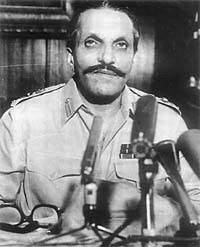
A criminal conspiracy —Ijaz Ul Haq
 Ten months after the crash, an FBI team arrived, comprising only three members and without any assistance from an air-accident or forensic expert. The team only recorded verbal statements of a few concerned individuals without any worthwhile effort to conduct a detailed investigation
21 years ago, on August 17, a Pakistan Air Force C-130, an aircraft known for its established safety and reliability records, crashed near Bahawalpur. Through the process of elimination, it was established by the Board of Inquiry that the cause of the crash was, without doubt, sabotage.
In addition to 29 martyrs from the military, two US nationals were also killed: US Ambassador to Pakistan Arnold Raphel and Brigadier-General Herbert Wassom. Pakistan’s top military hierarchy was eliminated.
The mystery was that the Vice Chief of the Army Staff General Aslam Beg, having himself hovered over the crash site, preferred to fly back to Rawalpindi. Major General Mehmud Durrani, the host of the entire episode, moved to Multan for a comfortable sleep.
Now claiming credit for democracy and decorated with a Democracy Medal, then General Beg did not feel obliged to care for his fallen comrades. Without inquiring about the survivors, and with the urge to take over, he rushed to Rawalpindi where in a high level meeting, he faced stiff resistance from powerful personalities.
The mortal remains were shifted to CMH Multan. Doctors performed a post-mortem on Brig-Gen Wassom, which revealed that he had died before the plane hit the ground. Doctors were stopped from conducting post-mortems on the rest of the victims. If done, it could have determined their cause of death. The Board of Inquiry had confirmed the presence of sulphur, antimony and other lethal chemical agents in the wreckage. It is also suspected that odourless poisonous gases were leaked inside the cockpit, rendering the crew unconscious or paralysed. This is why, it is deduced, no mayday signals were received at the control tower.
US law requires mandatory FBI investigation into the killing of any US national in any part of the world. In this case, when an FBI team was about to leave for Pakistan, mysteriously, it was stopped by the US secretary of state. It was also surprising that the team that had already arrived to assist in the investigation had done so without any formal request by the government of Pakistan.
Ten months after the crash, an FBI team arrived, comprising only three members and without any assistance from an air-accident or forensic expert. The team only recorded verbal statements of a few concerned individuals without any worthwhile effort to conduct a detailed investigation.
By then, the Pakistan People’s Party had come to power and it was futile to expect any cooperation from its government. Colonel Ghulam Sarwar Cheema (retd), minister of state for defence, in response to a question about the outcome, said that anyone interested in the outcome of the investigations should make a direct telephone call to Allah, who alone can reveal the outcome of the investigations. This was the callous attitude of the government functionaries responsible for conducting the investigations!
The FBI team that had arrived as mentioned above was found to be without any explicit mandate by either the government of the United States or Pakistan. It was handed over a list of 25 individuals who should have been questioned/interrogated for their possible involvement in the conspiracy. No one on that list was confronted. After a trip to Taxila and Murree, the team left at its leisure.
In 1979, Zulfikar Ali Bhutto, in one of his writings, had threatened that “if I am assassinated, my sons will take revenge”. Even before his execution, his sons and siblings had formed a terrorist group — Al Zulfikar — which carried out a series of terrorist attacks in the country. Die-hard political workers and estranged youth were recruited by Al Zulfikar and taken to India, Afghanistan, Libya and Syria for terrorist training. One such draft, on its way to Indian shores, was arrested by the Pakistan Navy.
Al Zulfikar gained strength and capabilities, and effectively joined hands with the enemies of Pakistan — RAW, Mossad, the KGB, Afghan intelligence, and any other outfit willing and working to weaken Pakistan.
It fired a missile on the then president’s aircraft at Rawalpindi, which missed the target. Another aircraft, a PIA airliner, was hijacked and taken to Damascus via Kabul. From the flight manifest, Murtaza Bhutto singled out Major Tariq Rahim, had him killed and threw his body on the tarmac at Kabul airport. This ill-fated young officer was the son of a retired general and served as ADC to Zulfikar Ali Bhutto, Murtaza’s father. While travelling together in a car, Chaudhry Zahoor Elahi and Justice Molvi Mushtaq were ambushed in Lahore. Justice Mushtaq was the Chief Justice of the Lahore High Court, had presided over the trial of Mr Bhutto and awarded him the death sentence. In the attack, Chaudhry Zahoor Elahi was killed, while Justice Mushtaq suffered serious injuries.
Soon after the destruction of Pak 1, Murtaza Bhutto claimed that his organisation was responsible for the crime, but retracted his claim when he came to know about the killing of US citizens. Similarly, an earlier caller to a local newspaper, hours before the crash, wanted to know if the president’s plane had crashed or not. A credible story is that the plane was hit with a missile, causing inward impact and damaging its cargo door.
The criminal act had been executed with completely sophistication and accuracy to ensure that the target was achieved through multi-layered employment and execution.
General Zia-ul Haq lived and died for Islam. Having defeated and disintegrated the Soviet Union, he was dreaming of an Islamic renaissance and of transforming the Muslim world into a united ummah. This could have caused alarm in those opposed to this idea. The plant at Kahuta, still in its infancy, needed to be fertilised with bloody; for his patriotism, commitment and aspirations, General Zia-ul Haq was a willing donor. Pakistan under him could not be deterred from pursuing the nuclear path. The Soviet Union, through its Friendship and Defence Treaty with India, had broken Pakistan in two. Zia-ul Haq paid the Soviets back in the same coin, and was determined to pay back the Indians.
The Soviets had resolved to punish Pakistan for the defeat it had suffered in Afghanistan. Pakistan under Mr Bhutto during his last days in office was about to be annexed into the Soviet bloc. There was a strong nexus with Syria, Libya and Palestinian leaders, who were trying to woo Pakistan towards the Soviet Union. This game plan was reversed under General Zia-ul Haq. That could not have pleased the Soviets, given their status as a global hegemonic power.
Rajiv Gandhi had threatened Pakistan that it should stop interfering in the Khalistan movement or else it will repent for generations. Israel also could not remain aloof and unconcerned from the emerging threat of Islamic revival.
The relevant quarters, interested and anguished, could not just sit back in this fast changing global scenario. John H Dean, a Jew and then US Ambassador to India, testified to Israel’s involvement in the crash. He was later declared insane and sent to Switzerland for recovery and recuperation. Israel’s involvement, by logic, means American consent and Indian connivance and collaboration.
An interesting yet mysterious fact about Mr Dean is that he suspects Israeli agents may have also been involved in the C-130 crash. That probably led to a decision in Washington to declare him mentally unfit, forcing his resignation from the Foreign Service after a 30-year career. Later he was rehabilitated by the State Department, given a distinguished service medal and the insanity charge was confirmed to be phoney by a former head of the department’s medical service.
Various commissions were formed by the government to investigate the disaster without pinpointing the criminals who had destabilised Pakistan via sabotage — under FK Bandiyal, Chaudhry Shujaat, and later Justice Shafiur Rehman. No discreet inquiry or criminal investigations were ordered by the then COAS, who instead was fast enough to cover up the tragedy and not preserve the evidence. Justice Shafiur Rehman himself mentioned to me that the debris of the ill-fated C-130 had been removed and disposed of, thus denying any examination.
General Zia-ul Haq was a human, and all humans have friends and foes; and some friends-turned-foes. Carrying and concealing his knife, through centuries, Brutus is always in attendance in the court of Caesar. What services, for example, rendered endeared Major General Mehmud Durrani to Benazir Bhutto to the extent that even after her death, he could not be left unrewarded and was made the National Security Advisor?
This is the first article in a two-part series. The concluding article will appear tomorrow. The writer is a former federal minister for religious affairs
Punish the Bahawalpur conspirators —Ijaz Ul Haq
 On behalf of all those millions, I demand that the government of the day bring to book the enemies of Pakistan who by their act of subversion and sabotage executed the Bahawalpur conspiracy. By targeting Zia-ul Haq, they targeted the soul and spirit of Pakistan
It was a conspiracy. And it was an International conspiracy too. But it could not have been carried out in practical terms without active and acquired assistance from local sources. The crime could not have been committed without the cooperative involvement of local hands.
A young officer of the Pakistan Air Force, Pilot Officer Akram Awan, arrested May 1988, was under investigation by the ISI for being an agent of RAW and Mossad. This officer was working in collaboration with enemy agencies to plan and execute an air strike on the Kahuta Nuclear Plant. He was arrested a few months before the C-130 crash and was in perfect incommunicado custody. He had not known any thing about the Bahawalpur crash.
Awan was shown footage of the C-130 crash. When he came to know that among those killed with General Zia-ul Haq was Maj-Gen MH Awan, he suffered an emotional breakdown and started crying. It is mentioned that General Awan had helped Akram Awan in his education and career. He had thus developed a deep emotional attachment. Experts confirmed that this reaction was instant, genuine, natural and unfeigned. In this instant reaction, he uttered, “Sir, I never knew these bastards would do it.”
Akram Awan stated that he had been handed over some matchbox-like device of chemical material by a Mossad operative in New Delhi to be delivered to Air Martial Agha Zulfiqar Ali Khan (retd) in Pakistan. The device once placed in the cockpit would render the crew incapacitated in less than 25 seconds. He deposed that meetings took place at the residence of the said retired air marshal and were attended by an Indian envoy, a US Army colonel and a Mossad agent who had travelled to Pakistan on an American passport.
Photographic and video evidence, along with other confessional material, was handed over by the ISI to General Aslam Beg. Akram Awan was eventually imprisoned and is currently serving his jail sentence. However, the case with solid leads is pending. Where are these case files now? When the person involved is alive and available, why can’t investigations be carried out? Why the retired air marshal not questioned is a mystery. Instead he was allowed total access to the intelligence agencies to further destroy the evidence.
The event scheduled at Bahawalpur did not require presidential participation. Munitions pieces are put to test and trial before induction into the armed forces. Why was the VCOAS so keen to have the president present at this particular point in time and location? Why did Gen Mehmud Durrani insist so much, almost prevailing on the president to attend the event? Why and who persuaded the Chairman JCSC to join the presidential entourage? Why were doctors not allowed to carry out post-mortems on the dead bodies? Why were those with an inkling about the details of the incident transferred to far off places? Why was a military inquiry not ordered?
The then VCOAS insists that an inquiry was ordered and conducted. If so, where are the findings and results of said inquiry? What are the results of the Punjab Police investigation?
Who benefited the most is the fundamental lead to any commission of crime. Those who killed Zia-ul Haq could have done so at any time much earlier. Why was this moment selected to eliminate him? Had the dismissed government of Mr Junejo been in place, none could have gained by this crime. Both the ISI and the IB had informed in advance of a possible threat to the president and the president was cautious enough not to have left Rawalpindi after May 29, 2009, i.e. after the dismissal of the Junejo government. Our frequent approaching the Americans in connection with the investigations irked them to the extent that they blatantly told us that if we have to play any positive role in the service of our country, then we would have to bear with this personal loss. These and other such countless questions remain yet un-answered.
Disappointed, we contacted a well-known American law firm F Lee Bailey for legal assistance. They opined that if we sue Lockheed Inc, the manufacturer of the C-130 aircraft, the onus would be upon them to prove that the crash was not due to any mechanical failure or any such technical reasons. This in turn would strengthen our plea that this was a conspiracy and an act of subversion, sabotage and terrorism. The lawyers were thrilled and exclaimed that they have got the case of the century. They informed me that the head of Civil Aviation in the US had invited him to lunch for a discussion on the issue. But having met the said gentleman, he expressed his inability to further pursue the case for unexplained reasons. Another mystery.
Throughout her life, Ms Benazir Bhutto had been talking of a Truth and Reconciliation Commission to uncover and examine our national history. I agree and echo that demand. The Commission should examine and investigate national disasters, like the deaths in misery of the Quaid-e-Azam and Madar-e-Millat, the murder of Liaquat Ali Khan and the Rawalpindi Conspiracy, the secession of East Pakistan, Ojhri Camp, the Bahawalpur conspiracy, the Kargil Crisis, Lal Masjid and the killings of Akbar Bugti and Benazir Bhutto.
It is strange that Mr Zardari has claimed that he knows the killers of his wife, and yet millions of dollars are being spent from the state exchequer to take her case to the United Nations. Similarly President Pervez Musharraf is alive and kicking, enjoying the luxuries of life in London; while some of those that tried to assassinate him have been sentenced to various punishments, with at least one executed. Interestingly, he himself would not know the exact number of his killers and the names of cities/towns and the types of courts where those accused of his murder are being tried. Similarly in the case of the attempted assassination of Mr Shaukat Aziz, the alleged murderers have been tried and stand convicted. Conversely, not a single individual involved in the case of the Shuhada-e Bahawalur or other such incidents has been caught.
I had much earlier warned that if the murder of the top military hierarchy is not investigated and its planners and perpetrators not accounted for, such and similar incidents would continue recur. It has since happened in the case of Benazir Bhutto while Pervez Musharraf and Shaukat Aziz had narrow escape.
In my own capacity, I would not wish to point an accusing finger in any direction. It is for the government (which otherwise keeps contemplating the re-opening of the court case after which ZA Bhutto was executed) to fulfil its obligations by investigating this national loss and the broad daylight murder of so many senior military leaders.
Being the son of Shaheed General Zia-ul Haq, I am proud that he died with his boots on, in full military fatigue and in the performance of his duty to the country.
I alone do not represent his legacy. There are millions in the country and outside who stand by his ideals, achievements, services and sacrifice. They admire and adore him. He died a hero’s death. His funeral was unprecedented, with millions of his fellow countrymen from every stratum of society paying homage and mourning the loss of their hero.
On behalf of all those millions, I demand that the government of the day bring to book the enemies of Pakistan who by their act of subversion and sabotage executed the Bahawalpur conspiracy. By targeting Zia-ul Haq, they targeted the soul and spirit of Pakistan.
He was a dictator. Yes, I concede that he was a dictator. But dictionary meanings apart, it is the mentality of a person that defines him. Anyone can be a Dictator. A down to earth democrat can turn into the worst dictator. We have already experienced this in Pakistan. People knew that General Zia-ul Haq was a dictator; but they also knew that he was a benign dictator. He ruled not only Pakistanis but also their hearts and minds. He worked very hard for the betterment of his people. And ever since his departure, the country has been in a constant state crisis.
This is the concluding article in a two-part series. The first article appeared yesterday. The writer is a former federal minister of religious affairs
Commentary: Ijaz-ul Haq and Bahawalpur crash
The well known politician and son of General Muhammad Zia-ul-Haq, Mr Ijaz-ul-Haq, has written in some detail about the way his father’s air crash in Bahawalpur in 1988 has been obfuscated and made a mystery like other “national” mysteries that eliminated Pakistan’s leaders. He has pointed his finger at a number of elements who could have killed him.
It is a measure of his confusion about his “enemies” that he has named an array of candidates for Zia’s assassination without regard to the mutual hostility among some of them. There is no longer disagreement over the fact that the Bahawalpur crash was not an accident. After that, however, there is a conspiracy of silence. Saying that it was an international plot is washing your hands of the responsibility to find out who did it in Pakistan.
Mr Haq says the Americans acted suspiciously and therefore could have killed him. He also suspects India and Israel. All the three parties he names are outside the jurisdiction of Pakistan and cannot be indicted. Why throw this red herring when it is accepted on all hands that “internal elements” too were involved? When roping in India, he relies on the testimony of a highly unreliable Pakistani spook who has lately become “activated”.
Ex-army chief Aslam Beg and a number of other senior officers have faced accusations in the past. But the Shafiur Rehman Commission Report on the crash was shelved and categorised “secret” by others who succeeded Aslam Beg. What is clear is that someone inside Pakistan got rid of General Zia. You can’t accuse a pathologically America-hating Aslam Beg of doing the dirty job for America. By naming too many possible killers, Mr Haq may actually have buried the Bahawalpur crash forever. (Daily Times, Editorial)