Editor's Choice

--------------------------------------------------------------------------------------------------------------------------
Featured Post
--------------------------------------------------------------------------------------------------------------------------

"Let us build Pakistan" has moved.
30 November 2009

All archives and posts have been transferred to the new location, which is: http://criticalppp.com

We encourage you to visit our new site. Please don't leave your comments here because this site is obsolete. You may also like to update your RSS feeds or Google Friend Connect (Follow the Blog) to the new location. Thank you.


--------------------------------------------------------------------------------------------------------------------------
Showing posts with label Zulfiqar Ali Bhutto. Show all posts

Thursday, 19 November 2009

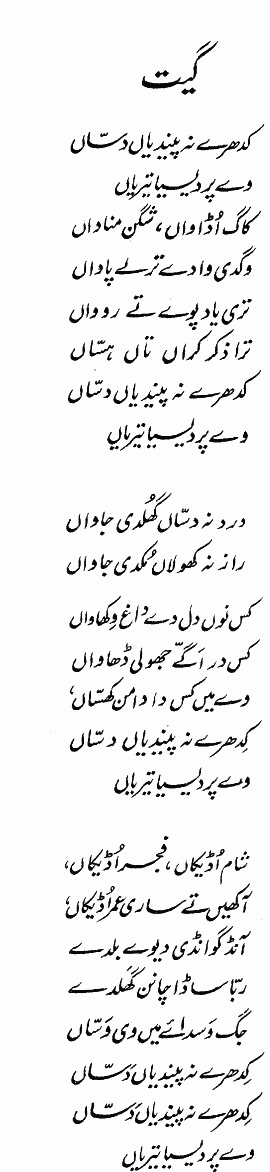
Kidhray naan paindiyan dassaan: In memory of Faiz Ahmed Faiz

vs

Faiz Ahmed Faiz (February 13, 1911-November 20, 1984)

Faiz Ahmed Faiz and Zulfiqar Ali Bhutto

The poem Meray dil meray musafir ("My heart, my traveller") was written in 1977 when Faiz left Pakistan after the overthrow of Bhutto. He was to stay in exile for many years. The poem Kya Karain ("What should we do") was written when Faiz was in Beirut, where he missed his friends and family terribly. He was in distress about the repressive rule of Zia-ul-Haq. This poem, which I have in Faiz's hand, was written at the end of a letter he sent me from Beirut to Vienna: Meri teri nigha mein/jo laakh intizar hain ("Countless yearnings/ Petrified/In your eyes and mine"). Faiz was still in exile when Bhutto was executed, plunging him in grief. Faiz was a man of few words but when he was mourning, he would become very, very quiet, something I witnessed myself when I told him in London that his beloved teacher and friend Sufi Ghulam Mustafa Tabussum had died in Lahore.

The ghazal he wrote over Bhutto's death contains the verse: Aabad kar kai sheher-e-khamoshaan hur aik soo; Kis khoj mein hai tegh-e-sitmgar laggi hui ("In every direction, there now lies the city of silence/So who does the sword of the oppressor seek now?"). Another of Faiz's celebrated couplets was written during Zia's dark rule: Challo aao tum ko dikhayain hum jo bachha hai maqtil-e-sheher mein/Ye mazar ahl-e-safa kai hain ye hain ahl-e-sidq ki turbatain ("Let me show you what has survived in the murder yard of the city/Here lie those who were pure of heart and there are the graves of the truthful ones").

But I would like to end this with one of the most beautiful love poems that can be said to exist in any language. Agha Nasir, quoting the late Dr Aftab Ahmed Khan, a close Faiz friend, also lifts the veil on the one who inspired the poem. It was a woman Faiz was smitten with in his youth and years later, when she was married and living in Karachi, Faiz went to see her. This poem immortalises that meeting with all its longing and sadness. It begins " Gulshan-e-yaad mein gar aaj dum-e-baad-e-saba. " This is how I translated it: "If the breeze wants to blow today in the garden of memories/If it wants the flowers to bloom again, let it do so/The pain that lies in a forgotten corner of days past/If it wants to rise again, let it do so."

We who have lived in the times of Faiz should forever be grateful for that privilege.
(Khalid Hasan, Friday Times, 12 Sep 2008)

Faiz is and remains the most outstanding Urdu poet of the second half of the last century. During the last few years of his life, however, he wrote some Punjabi poetry as well which can be found in his last two books namely Shaam-e-Shehryaraan and Mairay Dil Mairay Musaafir. The following is one of his most famous Punjabi poems, which is the lamentation of a beloved for her lover who had become a prisoner of war in India:

Kidhray naan paindiyan dassaan
Pardesia vay tairian

(I don't hear anything about you
My lover, living far away)

These very simple lines reflect the agony and suffering of the Punjabi woman in the most effective words possible.

Shaam udikaan, fajarudikaan
Aakhain tay sari umar udikaan
Ahand gawandi deevay balday
Rabba sada chanan ghalday
Jug vasda ay main vi vassaan

(I am waiting in the evenings and mornings
If you so desire I can wait the whole of my life
There are lights everywhere in the neighborhood
O God, Send my light also
The whole world is living and I might also live)
(Source)


Read more...

Fazail-e-martial law wa khabais-e-jamhooriat


Here is a column by the unofficial spokesperson of the Ziaist (military) establishment in Pakistan, Haroon-ur-Rasheed in defence of the military establishment and against democracy. Mr Haroon-ur-Rasheed has in the past written an official history of Islam, titled 'Fateh', a biography of General Akhtar Abdur Rehman.


Read more...

Sunday, 15 November 2009

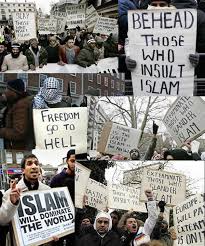
Pakistan politics and media: The abuse of Islam for political gains?


Smokers’ Corner: Speaking fire
Nadeem F. PARACHA
Sunday, 15 Nov, 2009

A blogger makes a valid point in a recent blog on dawn.com. He suggests that the reason why recent election rallies in Gilgit-Baltistan are so diagonally different from those held in the rest of Pakistan is perhaps due to the lack of militant madressahs and the concept of political Islam in that area.

He is also right to note that the language and the overall content of the recent rallies by almost all the leading political parties there are squarely concentrated on various economic and development issues; whereas political rallies held by the same parties elsewhere in Pakistan are usually studded with impassioned sloganeering and jingoistic takes on Islam, India, Jews and America. The general aura of these rallies also smacks of a xenophobic and chauvinistic exhibition of ‘patriotism.’

Till about the late 1960s, political rallies, rather their content, were largely different in Pakistan. The people’s economic wellbeing and the country’s economic progress used to be the focus of the speakers at these rallies. However, things in this respect began to change with the consolidation of Zulfikar Ali Bhutto (as an opposition leader) in 1967.

Already a gifted orator, Bhutto took his cue from the celebrated speakers of the 1960s’ leftist student leaders who in their passionate outbursts addressed economic issues using rhetorical Marxist lingo and revolutionary bravado.

In his speeches at the time, Bhutto too addressed economic issues faced by the people, but he began to use more and more revolutionary symbolism and lingo trying to work the crowds into a captivated frenzy, just like Mao Tse Tung was doing during the Chinese Cultural Revolution. Aggressive vocal posturing became a hallmark of the Bhutto rallies, but this aggression got its first physical manifestation when during the 1970 election campaign, hoards of Jamat-i-Islami (JI) and its student wing, the Islami Jamiat Taleba (IJT) activists, started to attack Bhutto rallies.

In his book, Pakistan People’s Party: Rise to Power, Phillip E. Jones states that PPP rallies became a target of the JI and IJT activists who, incensed by Bhutto’s leftist rhetoric, labelled him as ‘anti-Islam’ and a ‘kafir.’ Till then political rallies were usually attacked and dispersed by government-hired hooligans and the police, so this was perhaps the first time one political party was attacking another party’s rally.

Jones further writes that to counter these attacks by the JI and IJT, the PPP formed the ‘People’s Guards.’ These were groups of tough young men picked from various leftist student organisations, especially the National Students’ Federation (NSF) that was supporting Bhutto. A number of clashes took place between the ‘People’s Guards’ and the JI activists during the 1970 election campaign.

The tone of Bhutto’s speeches became a lot more aggressive after he came to power in 1972 — especially from 1974 onwards, when smitten by the sudden turn that the ideology of Pakistan took after the East Pakistan debacle, both Bhutto and his political-religious opponents began using ‘Islam’ a lot more frequently. It was the Bhutto government which presided over the change of direction Pakistan’s history and school books took after the 1971 civil war in the former East Pakistan. It was also Bhutto who had Ahmadis declared as non-Muslim.

Suddenly, Islam took centre-stage like never before, even to the extent that these books were infused with half-baked truths and historical distortions, mainly so that the ‘two nation theory’ that helped originate the concept of a separate Muslim country in the subcontinent could be defended, especially after the theory had actually collapsed with the creation of Bangladesh (on the basis of ethnicity) in 1971. As Bhutto’s opponents raised the bar of fiery Islamic rhetoric, by the 1977 election campaign, Bhutto too was heard using Islamic symbolism and promises more than revolutionary socialist idioms. General Ziaul Haq who arrived as a military dictator in 1977, soon turned political speechmaking into a calculated expression in which, for the first time, a modern-day political leader was heard using Quranic terms, verses and sometimes whole hadiths. Days of speeches addressing economic and development issues in secular terms became history.

As radical/militant Islam took root in Pakistani society during the Afghan civil war in the 1980s; pro-Zia politicians and religious parties began doing the same. By the 1990s speeches heard at PML-N and JI rallies were usually studded with heavy Islamic symbolism and terms. The trend has continued, so much so, that today, even the more secular parties such as the PPP, ANP and the MQM can’t escape from using Islamic symbolism in their speeches to constantly reinforce their spiritual credentials.

What’s more, the trend has now infested the electronic media as well, where supposedly ‘objective’ newscasters and talk show hosts punctuate their speech and tirades with Islamic terms like Allah, Sharia, Shaheed, etc., as if trying to give their obvious vocal diabolism a righteous sheen. What is being sacrificed is cohesive speech based on facts and a practical vision of the future, a dialogue that is actually a rational discourse on politics, economics and terrorism, instead of an ‘I am holier than you’ clash of bloated egos. Source

Read more...

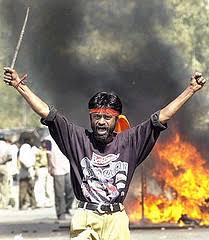
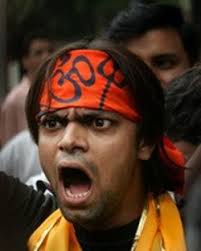
Guest blog: Sangh Privar - The Hindu Taliban of India

SANGH PARIVAR- THE FAR RIGHT FRINGE


By Qudrat Ullah

Launched by the inspired volunteers of Rashtriya Swayamsevak Sangh (RSS) with the sole purpose of attaining Gandhian Swaraj, the loose conglomerate of a total of 31 zealot organizations called Sangh Parivar has emerged as the multi headed hydra of the Hindu far right In India to frighten its minorities. It represents popular movement for the establishment of a ‘Greater India’ with total Brahminical hegemony, to be comprising of Pakistan, Afghanistan and other neighbors in the immediate periphery, with the socio-political status of non-Hindus to be limited to serfs only. These assorted organizations within Sangh Parivar particularly include Vishwa Hindu Parishad, Rashtriya Sevika Samiti, Akhil Bharatiya Vidyarthi Parishad, Vanavasi Kalian Ashram, Bharatiya Mazdoor Sangh, Vidya Bharti, Sewa Bharati and many more. Although, the different organizations within the Sangh Parivar run independently and peruse dissimilar policies and activities, but the stated mission of these activities has been attaining the 'Saravangeena Unnati' (all-round development) of India.

More preferably termed as the ‘Hindu Taliban of democratic India’ Sangh Parivar uses Hindu mythology and various hate symbols for the propagation of its political motives and to mutilate non Hindu minorities to an extent where they discontinue to grow up as an independent identity.

It was during Vajpayee’s time that relations and contacts of Sangh Parivar’s Dharam gurus and Hindutva leaders with Israel increased manifold. Hindutvadis got support and motivation from Israeli secret agency, Mossad’s operations against Arab and Muslim countries. It was during the rule of BJP’s Atal Bihari Vajpayee that a strong foundation was laid for the visits of Hindutvadis, especially the Sadhus and dharam gurus of Sangh Parivar to Israel. These visits are increasing now as Indian army chief Gen Deepak Kapoor has also recently gone to Israel. It is important to note that involvement of army officers, Bhonsla Military School of Maharashtra run by central Hindu military education society and the members of different wings of Sangh Parivar, in various terrorist activities in different states should not be a surprise as terror tactics are a forte of Sangh Parivar to achieve goals.

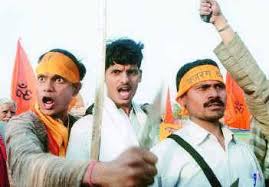
Among Sangh Parivar's connected organizations, active training of martial arts is given to RSS's women branch (Rashtriya Sevika Samiti), Bajrang Dal and its women's branch, Durga Vahini. Training camps and physical trainings are not new for these organizations; they have now started arming their volunteers in a military pattern as well. Volunteers’ indoctrination is carried out in such a way that they start viewing Muslims as an enemy to be fought with. Arms training camps are regularly organized by them in different parts of the country, where young men and women are trained in the use of guns as well as trishuls, sword and other martial arts. This trained cadre is then used against minorities and for other terror related activities.

Since 1947, RSS has been indoctrinating and creating more and more organizations to carry out its objective of one Hindu nation, to work for the modern version of Brahminical system and to get annexed border countries. Its trained swayamsevaks, have already made inroads in various political formations like Bharatiya Janata Party, Akhil Bhartiya Vidyarhti Parishad, Vanvasi Kalyan Ashrma, Vishwa Hindu Parishad, Hindu Munnani, Bajrang Dal, Samajik Samrasta Manch and also created subsidiary women organizations like Rashtra Seviak Samiti and Durga Vahini etc. Their second strategy is to infiltrate in the different wings of state machinery including police, bureaucracy, Judiciary, education and media and their major strength comes from infiltration in all spheres of socio-political life. RSS’s vicious grip on society cannot just be assessed by the electoral strength of BJP alone. That’s why Atal Bihari Vajpayee once declared that first he is the swayam sevak of RSS and then the prime minister of India. This is the control of Hindu right that even a prime minister could not dare to denounce his RSS identity.

In modern day India, which projects itself to be a secular democracy and claims to be politically neutral towards all religions, with no constitutional role of any religion in government affairs; the political Hindutva has been successfully manipulated by this tiny, yet most powerful, Hindu fundamentalists, as a tool to attract more and more Hindu zealots and then, exploit their clout to lynch minorities, of which Muslims and Christians are the main targets. Sangh Parivar’s political jingoism is based on selected teachings and the culture of elite Hindus, which give priority to the Brahminical values of caste and gender based inequality in the society in which all other non Hindus are required to live as apartheid creatures with no future prospects.

It is noteworthy that one of the most powerful media in India i.e. state television network has been used to spread the message of Hindu militancy. According to one political observer, ‘the forces of Hindutva see the Indian people as a vast mass which is waiting to find, or rediscover, its common culture and identity. The catalyst in the process was television. Although Ramanand Sagar's epic was screened by Doordarshan, it spawned several variants in regional languages as the state monopoly over television was withdrawn. The telecast of the Ramayan was the precursor of the Ram Janam bhoomi movement which in turn, saw the ascendancy of the BJP to the status of the single largest party.’

Sangh Parivar’s profile proves that its every action is aimed at subverting Pakistan or hurting Muslims. We should, therefore, remain vigilant as Indian sponsored Taliban terrorism has already done too much havoc with our country as Pakistan is facing the defining moment of its history when our fiend neighbor is bent upon to obliterate its most terrific neighbor Pakistan.

In the given circumstances, Pakistan’s populist Prime Minister ZA Bhutto’s epiphany that ‘all wars of our age have become total wars... It would be dangerous to plan for less, and our plans should include the nuclear deterrent’ must be our most conspicuous agenda.

qudratulla@gmail.com

Read more...

Thursday, 12 November 2009

Jihadi literature - an analysis by Hamid Akhtar


Hamid Akhtar offers a detailed analysis of the jihadi literature, the role of religio-political parties in Pakistan and Afghanistan in the propagation of this literature and its implications for Muslim societies.

..

Read more...

Monday, 7 September 2009

The Saudi Factor, Nawaz Sharif and Musharraf's trial


Analyses by Asadullah Ghalib and Tanvir Qaiser Shahid


Read more...

Wednesday, 19 August 2009

In defence of (and against) General Zia-ul-Haq


Haroon-ur-Rasheed, famous (or notorious) for his appreciation of the ISI (right from General Akhtar Abdur-Rehman to Brigadier Imtiaz to Major Aamir, from General Zia-ul-Haq to General Hamid Gul to General Ashfaq Kayani) writes a column in praise of General Zia-ul-Haq in Jang on 18 August 2009:


....

...

Here is a counter perspective:

Zia’s decade of darkness
By Iqbal Ahmad Khan

Tuesday, 18 Aug, 2009

Both Pakistan and Pakistanis continue to be haunted by Zia’s dark decade. — File Photo World
‘Al-Qaeda has shifted bases to Pakistan’ THE DISPOSABLE ALLY

Pakistan highest foreign policy priority: US The unenviable position of the most invidious of Pakistan’s rulers, among democrats and dictators alike, is occupied by Ziaul Haq, the dictator-general who died 21 years ago on Aug 17.

The outward display of humility and affection masked a duplicitous and vengeful personality. These were reflected in the retrogressive and punitive measures the general unleashed on the benighted nation during more than a decade of unmitigated dictatorship.

Whether it was the knotty Article 58-2(b), the much-exploited blasphemy laws or the promotion of a misogynous mindset, Pakistan and Pakistanis continue to be haunted by Zia’s dark decade.

Ziaul Haq was a usurper. He overthrew an elected and arguably Pakistan’s most popular prime minister. As justification he cited danger of civil war as a possible consequence of an impasse in talks between the government and the opposition. This was a lie. It is now fully documented that by July 4, 1977, both protagonists — the PPP and the Pakistan National Alliance or PNA — had reached an agreement to be announced by the prime minister the next day. The general could not have been unaware of this development. His move was purely and simply a power-grab.

The second deception was his avowal of not having any political ambitions, his sole aim being to hold elections within three months in October 1977. But when it dawned upon him that the premier he had ousted continued to enjoy widespread public support, he, not for the first time, conveniently retracted on his promise. He announced that it was neither in the Quran, nor was it revealed to him to hold elections on Oct 18. The promised elections were postponed. The people were provided an insight into his real plans when he pronounced that the country could only be kept together by the armed forces and not by politicians. Obviously, the fact that barely six years ago Pakistan had disintegrated under the watch of a military junta did not seem to bother him.

The sinister general continued to dangle the election bait before the public, while proceeding simultaneously to transform Pakistan into an authoritarian, nay totalitarian state. The constitution was amended beyond recognition in a bid to further empower himself. The notorious Article 58-2(b) corrupted the parliamentary form of government by transforming it into a semi-presidential system. The president now had the power to dissolve the National Assembly. (This power was used to dismiss the prime minister in 1988 while he was on an official visit abroad.)

He arrogantly proclaimed that he was here to stay and would not allow anybody else to rise. So much for the humility and selflessness that some of his apologists were attributing to him. On April 4, 1979, amidst curses from the masses and condemnation from the international community he hanged the legitimately elected and the most accomplished of Pakistan’s prime ministers. Soon thereafter elections were cancelled and political parties banned.

Military courts, armed with massive powers by the chief martial law administrator, spread terror among the people. Political activists and journalists were incarcerated. Some were even flogged in consonance with the punitive punishments that martial law orders had prescribed.

Responding to criticism on the dismissal of certain journalists for demanding restoration of democracy, the general angrily shot back that the punishment was too lenient. They should have been hanged in order to teach others a lesson. The press was muzzled and students and trade unions banned. The right of habeas corpus was annulled for the first time in the history of Pakistan. The judiciary could no longer review the legality and constitutionality of executive decisions.

Despite the comprehensive use of force to quell dissent, the question of legitimacy continued to stalk the regime. It was decided to give an ideological underpinning to Zia’s authoritative rule. In messianic mould the general told BBC that God had entrusted him with the mission to bring Islamic order to Pakistan. A referendum asking the people whether they supported Islamisation resulted in an embarrassing 10 per cent turnout. The ban on political parties was kept intact.

Islam, it was claimed, did not provide either for political parties or for western democracy. The Council of Islamic Ideology was entrusted with the task of preparing a blueprint for an Islamic ideological state. Primitive punishments including amputation of limbs, public lashings and stoning to death were promulgated. Blasphemy laws were introduced which have since become an exploitative instrument in the hands of militants and extremists to manipulate public sentiment and to target minorities.

A raft of retrogressive measures was directed at women. The evidence of two women was made equal to that of one man and the amount of compensation payable for a murdered woman was half that for a murdered man. Women appearing on TV were required to cover their heads and female dancing on TV was prohibited. The regime’s sinister plan involved the establishment of a theocratic-authoritarian state where Gen Zia backed by the military would reign supreme over a fearful populace. It was completely at variance with Quaid’s vision of Pakistan, which was neither theocratic nor authoritarian.

This then is Gen Ziaul Haq’s dark legacy. Lack of space does not permit a chronicle of his foreign policy failures. The roots of all major problems facing Pakistan today lie in Gen Zia’s dark era. To name only a few — the habitual interference of the armed forces in civilian affairs, weakening of state institutions, democracy deficit, rise of intolerance and militant extremism, sectarianism, problems of the Afghan refugees, drugs and the Kalashnikov culture and perennial constitutional problems. To roll all this back is the unenviable task of the present democratically elected government. (Dawn)

....


Read more...

Tuesday, 18 August 2009

‘Zulfikarabad’: A great gift to the nation by the PPP government


This site has moved to http://criticalppp.com/archives/1334, click this link if you are not redirected
Read more...

Monday, 6 July 2009

Nadeem Paracha: Secular Blunders


Secular blunders
Nadeem F. Paracha
Sunday, 05 Jul, 2009 | 01:44 AM PST

Instead of containing the Islamist parties, ZABs constitutional concessions only emboldened them. — File Photo

The late President Anwar El-Sadat of Egypt was assassinated in 1981 by a faction of Egypt’s leading Islamist organisation, the Muslim Brotherhood. The irony is that this was the same organisation that Sadat had purposefully patronised.


He had replaced the charismatic Egyptian leader, Gamal Abdul Nasser as the President of Egypt after Nasser died in 1970. Nasser had ruled the country as a popular president between 1952 and 1970, leaving behind a legacy of staunch secular/socialist Arab nationalism.


Though Nasser remained popular till his death, the glow of his influence across assorted Muslim and Third World countries was somewhat dimmed when Egyptian and Syrian armed forces backed by the Soviet Union were decimated in the 1967 war against Israel. Though Sadat had helped Nasser in toppling the Egyptian monarchy in 1952, and was also an integral part of Nasser’s socialist/secular policies, he initiated a shift. In Sadat’s view, Nasser’s socialist model could not sustain the new sombre realities that had surfaced after the 1967 war.

Sadat’s move towards the western economic model was welcomed by the country’s urban bourgeoisie, but it was vehemently challenged by the pro-Nasser and left-wing student groups and the Arab media. To neutralise the pro-Nasser and left-wing challenge to his shifting policies on campuses and in the print media, Sadat brought back to life one of the staunchest anti-Nasser and anti-left forces in Egypt: the Muslim Brotherhood.


The Brotherhood had been greatly radicalised by its second generation leadership led by the teachings of Syed Qutb. He had posed the biggest challenge to Nasser’s socialism and the regime’s pro-Soviet and secular make-up. However, after Nasser’s death, Sadat tactfully let loose the Brotherhood, using state power to help the organisation infiltrate campuses and the media.


To appease the organisation, Sadat instructed the state-owned radio and TV channels to not only start regular religious programmes, but to also show as many images as possible of him saying his prayers at a mosque. Sadat also lifted the ban on various Muslim Brotherhood magazines and newspapers. All this was done to soften Egypt’s pro-Soviet and Nasserite image and to mollify concerns of the West and Egypt’s new allies such as the oil-rich Saudi Arabia.


Immediately after Egypt’s 1973 war with Israel — in which Sadat (falsely) claimed to have defeated the enemy — he completely pulled Egypt out from the Soviet camp. However, in 1977 when Sadat, in an unprecedented move, agreed to make formal peace with Israel, the Brotherhood became Sadat’s biggest enemy. Eventually, in 1981, he was assassinated by members of the Brotherhood — ironically the very organisation he had encouraged to nullify the perceived communist threat to his regime.


Something similar happened in Pakistan as well. In the 1970 elections, Zulfikar Ali Bhutto’s Pakistan People’s Party had routed the Islamic parties. But by 1973 Bhutto was under pressure from the PPP’s leading ideologues, asking him to hasten the regime’s socialist agenda. In response, Bhutto purged the PPP of its radical founding members. He then came under the influence of the party’s ‘conservative wing’ that encouraged him to appease his staunchest opponents, the Islamists, (especially the Jamat-i-Islami), which had declared the PPP’s socialism as 'un-Islamic.'


Though in private, Bhutto accused the Islamic parties of being 'anti-socialist American stooges,' in public he went along with some of his advisers’ counsel and declared the Ahmaddiyya community non-Muslim, naively believing this concession would appease and contain his Islamist opponents. The truth is, the Islamists were only emboldened by this gesture.


Also, while purging the left-wing radicals in the PPP (from 1974 onwards), Bhutto is also said to have ‘allowed’ the student-wing of the Jamat, the IJT, to establish a strong foothold on campuses which, till then, were mostly dominated by radical left-wing student groups such as the NSF.


Bhutto, like Sadat, had ignored the Islamist challenge to his regime, and seemed more concerned about imaginary 'Soviet/ Indian-backed groups.' His pragmatic indulgence in this regard had the reverse effect. Instead of containing the Islamist parties, his constitutional concessions only emboldened them. Not surprisingly, he was toppled by a reactionary general whom he had handpicked himself, shortly after the Islamist parties unleashed a countrywide movement against the PPP regime in 1976, calling for Sharia rule.


These are just two brief examples of the blunders committed by certain leading secular Muslim leaders that annihilated the over-blown left-wing and secular challenges by regenerating and using Islamist forces against them. This created daunting political and ideological vacuums in societies that were eventually filled by reactionary military regimes, rejuvenated Islamist forces and, eventually, a new breed of extremism — the sort that now worked towards grabbing state power and carving out a theological hegemony, based on mythical and Utopian illusions about an eternal ‘Islamic State.’


Pakistan and Egypt are prime examples; two of the many Muslim republics now desperately trying to reinvigorate moderate and secular forces to open a consensual front against extremism that was once state-sanctioned, to bludgeon opposing secular forces.


One wonders if it is already too late to do that; or if there are any worthwhile progressive sections in society today, in these countries, who can once again demonstrate the same boldness and imagination that they exhibited in the construction of their respective countries’ nationalism before their downfall. (Dawn, 5 July 2009)


Read more...

Saturday, 4 April 2009

Irfan Husain: Living with Bhutto’s ghost


Saturday, 04 Apr, 2009

Zulfiqar Ali Bhutto and his family pose for a photograph - AP/File photo.
EXACTLY 30 years ago today, I was driving back with friends from a weeklong fishing trip in Azad Kashmir.

We did not have much luck with the fish: locals told us army officers had decimated entire streams by using explosives to stun all aquatic life, and scooping up the fish that floated to the top. But we had a lot of fun exploring the upper reaches of Neelum Valley with its fast-flowing river, and its snow-covered peaks.

That afternoon, we stopped for lunch at a roadside restaurant and learned that Zulfikar Ali Bhutto, ex-prime minister of Pakistan, had been hanged in the dead of night by Gen Zia and his henchmen. A pall of gloom descended on our small party, and the drive back to Lahore was very subdued. The next morning, I was back at work, and was appalled and furious when a colleague offered me mithai to celebrate Bhutto’s judicial murder. In my anger, I almost bit his head off.

Looking back, I can see that many others shared, and continue to share, his hatred of Bhutto. Indeed, the degree of personal antipathy towards the dead politician can be directly correlated to a person’s wealth: the rich can be heard running Bhutto down for his real and perceived flaws three decades after his death. But for millions of poor Pakistanis, his name still evokes hope, and above all, an abiding devotion.

The Urdu word ‘jiyala’ does not translate easily into English. It has connotations of spiritual ecstasy and passion bordering on madness. Ever since its foundation in 1969, the term has come to be applied to younger members of the Pakistan People’s Party. In particular, it applies to the followers of the Bhuttos, the founders and hereditary leaders of the party. These jiyalas tend to be youthful, enthusiastic and totally committed. Mostly they live in the villages and slums of Sindh and southern Punjab, and look to the PPP to lift them out of their poverty and give them some self-respect. This is the party’s core constituency and the vote-bank the Bhuttos have relied on to bring them to power.

When Zulfikar Ali Bhutto was elected in a landslide on a socialist manifesto in 1970, he ushered in a wave of nationalisation that transformed Pakistan’s economic scenario overnight. Scores of factories and banks were taken over and many powerful business families found themselves suddenly marginalised. A succession of pro-worker laws empowered and emboldened industrial labour and peasant farmers, leading to a series of strikes and lockouts. Simultaneously, Bhutto fired hundreds of civil servants on charges of corruption and inefficiency.

Opposition politicians and journalists were often targets of his ire, and he soon became a hate figure for large swathes of Pakistani society. Accused of employing fascistic methods, Bhutto made many enemies during his term, especially among the well-to-do. But the poor of Pakistan revered him for his employment-generation projects and his pro-labour policies and rhetoric.

When he was toppled in an army coup in July 1977, thousands of rich and middle-class Pakistanis cheered, and many were delighted when he was hanged after a farcical murder trial in 1979. Over the next decade, the army and bureaucracy proceeded to erase all vestiges of his legacy.

Strikes were brutally put down and the PPP’s progressive policies rolled back. A secular curriculum was replaced with an Islamic one. The army, earlier chastened by its defeat at India’s hands in 1971, now blamed Bhutto for its humiliation, even though Gen Yahya Khan was president then, and the country was under martial law. Two generations of students and military cadets have grown up on this self-serving myth.

Zulfikar Ali Bhutto had infuriated his class because he threatened to make a fundamental change in the status quo. By weakening the business and bureaucratic elites and empowering workers and peasants, it seemed he might overturn the natural order of things, leading Pakistan to a social revolution. And nobody can be as ferocious as a bourgeois whose sense of privilege and position in society is imperilled. Members of the social elite closed ranks against Bhutto and made common cause with the army. Opposition politicians begged the generals to take over. Finally, Bhutto was brought down and killed.

There are today in Pakistan a large number of educated, middle-class people who support the status quo and are comfortable with their privileged place in society. They educate their children privately in Pakistan and abroad, receive medical attention in excellent private hospitals and own generators to be independent of a ramshackle public power grid.

For these people, life is good, and they do not want their comfortable boat to be rocked. But for the vast majority of Pakistanis, life is hard and getting harder all the time. The state educational system is terrible and millions of children are denied a meaningful education. Most people do not have access to clean drinking water, electricity and paved roads. Government hospitals are grossly under-funded, and medical care is a privilege few can afford.

This is the Pakistan Bhutto wanted to transform. And while most Pakistani politicians talk of wanting change, they are basically conservatives who want to improve the economy without wishing to transform society. For them, the role model is Saudi Arabia, a rich country where an anachronistic social order is still in place. Bhutto, on the other hand, stood for fundamental social change based on secularism and equality. This was — and is — anathema to the establishment, as well as to much of the rising middle class. And to prevent such a social order from coming into being, they are prepared to go to any length.

Who today remembers Shaukat Aziz, our prime minister only two years ago? Bhutto was in power for just over five years three decades ago. Yet his name continues to resonate in Pakistan’s collective memory. A hate figure for the elite, he has entered popular folklore as a symbol of hope. Long after lesser figures who followed him have been consigned to the dustbin of history, Bhutto will continue to define the battle lines between the haves and the have-nots. (Dawn)
Read more...

The Bhutto Archive: The day Bhutto was hanged.

On this day: Bhutto Hanged

Saturday, 04 Apr, 2009

Zulfikar Ali Bhutto.-Whitestar
Ex-PM buried in family graveyard of Nau Dero

Four others await decision on mercy petitions

RAWALPINDI, April 4, 1979: Mr Zulfikar Ali Bhutto was hanged to death at two o clock this morning in the Rawalpindi district jail.

An official handout released nine hours later in the day said his ‘dead foody was flown in a special aircraft from Rawalpindi and handed over to the elders of his family who buried him, after Namaz-i-Janaza in the ancestral graveyard at Garhi Khuda Bakhsh near Nau Dero, Larkana, at 10.30 a.m. in accordance with the wishes of the family.

The funeral was attended by relatives, including his two uncles, Nawab Nabi Bakhsh Bhutto and Sanlar Peer Bakhsh Bhutto, his first wife Shirin Ameer Begum, friends and residents of the area’.

Begum Nusrat Bhutto and their daughter Miss Benazir, who are detained at Sihala, about 16 miles from Rawalpindi, had been informed that all the mercy petitions, which had been made to President Genera) Mohammad Zia-ul-Han, had been rejected. They had a three-hour meeting with him yesterday in jail.

Mian Monanimad Abbas and three other federal security force officials, who were also

awarded death sentence in the Nawab Mohammad Ahmed Khan murder case, are still awaiting decision on their mercy petitions.

Mr Mumtaz Bhutto, Mr Z.A. Bhjutto's cousin, told newsmen this morning that he met him last on April 1, Mr Bhutto was sure a that a decision to hang him had been taken. He told him he knew that his life was going to be over but be did not know what awaited the people of Pakistan. He did not want the people to come out on the streets and litter them with their blood.

He asked Mumtaz not to give a call to the people because that would ‘reopen River Indus’. He said he was ready to die but wished that the people should live.

According to one of the officials, who was present at the hanging, Mr Bhutto was approached in his cell about an hour before the execution and told to prepare for the final act. He was told to have a bath if he wished. He replied in the negative and said that he had already had bath during the day.

However, he wanted to shave his face. Permission was granted and he shaved his face by himself.

Then he was told to recite some Quranic verses. The Superintendent, and Deputy

Superintendent of Jail came to his cell where the Superintendent read out to him his death warrant.

A senior Army officer and Magistrate were also present on the occasion. Thereafter the Superintendent went away to supervise the gallows while the Deputy Superintendent stayed on to see his two hands tied together at his back.

He was then told that his cell was about a furlong and half from he gallows, a distance which may be difficult for him to walk, and he should, therefore, lie down in a waiting stretcher to be carried by the jail warders. He protested and said that he would like to walk the distance himself. But he was made to lie down on the stretcher and carried to the gallows by the warders.

Mr Bhutto was unloaded from the stretcher and he climbed up the stairs himself.

Several prisoners were reciting Quran in their cell.

No Written Will

Earlier in the evening he was contacted by a jail official with a query if he wanted to make a will. He said that he would like to write it down. Writing material was supplied to him and he busied himself in writing. But later before the hanging when a magistrate came and asked him to hand over his will so that it could be counter-signed by the Magistrate, Mr Bhutto said he had no will in writing and that he had already conveyed his wish to his wife.

Perhaps he had destroyed the will that he had been writing in the evening.

Before being taken to the gallows he had a 'Tasbih' in his hand and he was turning its beads reciting something quietly. The Tasbih had not been seen with him before. It was either hidden in his luggage or handed over to him by Begum Nusrat Bhutto yesterday.

When contacted by the jail authorities he still had the Tasbih in his hand. He was completely calm and quiet thereafter.

He did not misbehave or talk loudly till the end. He placed his Tasbih round his neck when his hands were tied at his back.

The Superintendent of Jail, a Magistrate and Medical Officers were present near the gallow. The Superintendent registered his formal recognition of Mr Bhutto and then Mr Bhutto was handed over to the hangman who tied his legs with a cord, placed the traditional veil on his face and fixed the hanging cord round his neck. His body remained hanging for half an hour.

Before it was removed the Medical Officer checked it and certified that it was lifeless.

One of the jail officials contacted this correspondent; later in the day and said Begum Nusrat Bhutto and Miss Benazir were informed of the rejection of the mercy petitions when they came to meet Mr .Bhutto at 11 in the morning yesterday. A Jail official, who accompanied them to Mr Bhutto's cell was asked by Mr Bhutto what was being done to him. Mr Bhutto was told that the mercy petitions had been rejected.

Hs asked when the hanging was planned. He was informed that it would take place on Wednesday morning. Thereupon, he said he would like to get longer time than the usual half an hour with his wife and daughter which was allowed.

Then they remained together upto 2 o'clock in the afternoon. Since last evening the jail was heavily guarded on all sides by armed police which continued to be on duty today also. Parties of police were also guarding vantage points in the city.

The news of the hanging spread the city like wild fire early in the morning. People switched on their radios. The Voice of America was the first to broadcast it.

The BBC had nothing in its morning Urdu bulletin or in the 7 o'clock English broadcast. Radio Pakistan came out with the news in the city like wild fire early in that time two local Urdu dailies had already sold thousands of their special supplements.

Begum Nusrat Bhutto and Miss Benazir were the last to see Mr Bhuttp among his family members or friends. Mr Mumtaz Bhutto was called by him through the jail authorities yesterday but the meeting could not take place.

Mumtaz Bhutto and Abdul Hafeek Pirzada left for the airport to catch the morning flight for Karachi after hearing the news. Before the flight they were told that instructions had been received not to let them leave.

They came back to the Paracha House in Islamabad — the bungalow where Begum Nusrat Bhutto and Benazir were detained before being shifted to Sihala and where Pirzada has been staying since his arrival here last week.

Foreign diplomatic circles were taken by surprise. Many of them had believed that some last minute development would save Mr Bhutto's life. The British Prime Minister's third appeal for mercy which was relayed by the BBC in its Urdu broadcast in the morning and the official spokesman's statement last evening that the mercy petitions were

still under consideration did not make them feel that the hanging had already been scheduled for this morning.

However, several local newsmen got, the clue later in the night, three pf them who got too near the jail to see the atmosphere were caught by the guards and detained for the night.

Later in the day about 40 persons gathered in the house of ‘Dr Niazi, family friend of Bhutto, and offered Namaa-i-Janaza, They included Abdul Hafeez Pirzada and Mumtaz Bhutto.

Larkana Burial

Our Correspondent adds from Sukkur: The dead body of Mr Bhutto was brought to Jacobahad airport in an official plane. Mr Mumtaz Bhutto's father, Nabi Bukhsh Bhutto and the first wife of Mr Bhutto came with the body. The body was given a bath and wrapped in a coffin at Rawalpindi.

From Jacobabad the body was taken to Garni Khuda Bakhsh by a helicopter. The body was taken to a corner where arrangements had been made for showing the face to the male and female members of the family separately.

Afterwards Namiaz-i-Janaza was offered. It was led by Maulvi Mahinud in the old mosque at Janazgabr Mr Nabi Bakhsh Bhutto, Sardar Peer Bakhsh Bhutto, Mr Ali Gauhar Bhutto and Muzaffar Bhutto were prominent members of tile Bhutto family who attended the Janaza prayer.

In the family graveyard where Mr Z A. Bhutto has been buried, are also buried his father, Sir Shahnawaz Bhutto, his two stepbrothers Sikandar Bhutto and Imadad Ali Bhutto and his mother.

The situation in Larkana is quiet and peaceful. Agency reports add; As, a mark of respect all the shops in the village remained closed but life was normal in the rest of the Larkana district.

There was no reaction over the execution of Mr Bhutto throughout the district. The situation was reported to be normal. After the burial a number of people came to Naudero to sympathise with the family of Mr Bhutto.

At the time of burial strict precautionary measures were taken in and around Garhi Khuda Bakhsh by the administration. A Press note issued by the Interior Ministry said the mercy petitions filed on behalf of Mr Bhutto were rejected by the President of Pakistan ‘after they had been processed in accordance with the normal procedure’.

Mr Bhutto, last arrested on Sept 17, 1977, remained confined in Rawalpindi Jail's death cell since April 1978 when the Supreme Court started hearing of the appeals filed by him and from former officials of the disbanded Federal Security Force who were also sentenced to death in the case by the Lahore High Court.

After a seven-month-long hearing, the Supreme Court rejected the appeals on Feb 6 last. Mr Bhutto filed a review petition which was also dismissed by the Supreme Court on March 24 last.

The other four sentenced to death were Mian Mohammad Abbas, Mr Ghulam Mustafa, Mr Arshad Iqbal and Rana Iftikhar Ahmad. Former FSF Director-General Masood Mahmud and another FSF official Ghulam Hussain were also accused in the case but they were pardoned on becoming approvers.

Mr Bhutto was charged with conspiring with the FSF officials to assassinate former National Assembly member Ahmad Rasa Kasuri. But in the shooting on Mr Kasurt's car in Lahore on the night of Nov 10, 1974, Mr Kasuri escaped unhurt while his father, Nawab Mohamad Ahmad Khan, was killed.

On this day: 'I have done the right thing.'
'I have done the right thing.'
Saturday, 04 Apr, 2009

Zulfikar Ali Bhutto is seen here with Gen Zia in this photo dated Nov 4, 1974.-Dawn Archive.

LONDON, April 6, 1979: President Gen. Mohammad Ziaul- Haq said in a telephone interview broadcast last night that he felt he had done the right thing in allowing the execution of ex-Premier Zulflkar Ali Bhutto to go ahead.

In an Interview with British Commercial Television, the president was asked whether he felt vindicated by his decision and whether he had any regrets. ‘I have a very strong conviction and feeling that I have done the right thing and done what is in the interest of Pakistan, he told the interviewer.

In last night's interview, the President was asked why he did not grant clemency following worldwide appeals to spare Mi Bhutto's life. ‘I am of the opinion that the higher you go the harder you fall. An ex-Prime Minister, who is supposed to safeguard life and property and respect of the common individual, once he indulges in criminal acts — I do not see the justification of the chief executive using his prerogative of clemency’.

He added: ‘Those who sent clemency appeals were only concerned about one man's life. What about the other four people. There was a total of five men — and they are as good human beings as Mr Bhutto’.

On the interviewer's suggestion that by hanging Mr Bhutto Pakistan might be divided in a very dangerous way and that sparing his life would have been in the country's best interest, President Zia replied: ‘No, that's absolutely wrong. There is nobody indispensable for a country. Nobody, whether high or low, is above the law. And this should be a unifying factor rather than a factor for the division of the country’.-Reuters

Bhutto: the end of a great promise
Dawn Editorial April 7, 1979
Saturday, 04 Apr, 2009

Zulfikar Ali Bhutto.-White Star

TIME alone can provide the necessary detachment for an objective assessment of the life, achievements and failures of the former Prime Minister, Mr. Zulfikar Al: Bhutto, who was executed or Wednesday last.

No one — not even the most impenitent of his political foes could have wished Mr. Bhutto to have ended as tragically as he did. But, such a fate was made almost inevitable by the fact that he was found guilty as charged and the death sentence passed on him was finally upheld by the highest judicial forum in the land.

The judicial verdict notwithstanding, concern over the fate of a man of Mr. Bhutto's political stature and importance was only to be expected. There were appeals from foreign heads of State and governments and other dignitaries for show of mercy on humanitarian grounds, just as there were pleas within the country for executive clemency from a large cross-section of people—and not only from the ranks of Mr. Bhutto's partymen and admirers.

These pleas were in no way a reflection on the judicial verdict in the Nawab Mohammad Ahmad Khan murder case as such, nor could they all in reason be interpreted as attempts to obstruct the operation of the course of justice in the country.

For the most part they were motivated by humanitarian concern which is a natural impulse. Legitimate political considerations having a bearing upon the country's internal situation and stability as well as those flowing from developments in Pakistan's immediate neighbourhood, too, must have weighed with a section of foreign dignitaries and local leaders of opinion in making a plea for clemency.

Such considerations cannot entirely be ruled out in the particular context that presented itself when the judicial process in Mr. Bhutto's case finally ended and the ultimate decision whether to implement the verdict as pronounced, or to commute the sentence if warranted by extenuating circumstances or other factors, rested with the President because extra-judicial considerations and factors, including the larger interest of the community, are often involved in implementing judicial decisions in criminal cases, almost all constitutions in the world have provisions for clemency vesting the executive authority with the discretionary power to grant pardon or commute a sentence on grounds other than judicial.

In the case of Mr. Bhutto, the question of extenuation and other pertinent considerations must surely have been taken into account In such matters, the perspective for decisions cannot but be of the widest range and if, in that context, the weight of arguments tilted against Mr. Bhutto, one hopes that those arguments will prove right and the final decision to let Mr. Bhutto pay the forfeit of his life will come to be accepted as well-judged.

It is possible to have more than one opinion on Mr. Bhutto — not just because he was the country's Prime Minister during one of the most fateful periods of its crisis-ridden existence. The main reason lies in the complex make-up of his personality and leadership and his style of government which were unique in many respects.

The key to a proper understanding of this highly gifted and dynamic political figure perhaps lies in his utterly feudal background; which was often at odds with his modern vision and outlook, his populist brand of politics, and his penchant for change and modernisation. As many events and developments spanning his long political career from 1958 clearly showed, often enough he failed to resolve the conflicts rooted in that fact and mad mistakes which were other wise not possible to make.

Some of his outstanding qualities as a leader — his brilliance, his capacity to sway the masses and his enormous capacity for work — must be weighed against some of his glaring weaknesses — his despotic manner, his lack of scruples and, most of all, his total intolerance of any dissent.

He set out to bring about fundamental and far reaching socio-economic changes — without a coherent philosophy or a propel scheme of priorities and without having the necessary cadre or any denned concept of social control. As a result, while no worthwhile success was achieved in the promised direction, in the process, the nation's economy was gravely impaired and suffered jolts and dissipation it is still trying to recover from. The same story of ineptitude and serious gaps between promise and performance is true of many other reforms and changes that Mr Bhutto's Government introduced during its tenure in office.

Perhaps the most tragic of Mr. Bhutto's failures — and in a way the country's — was the historic opportunity he missed for giving Pakistan a viable and well-adjusted democratic system which was, and still remains, the country's foremost need. The time for it was most propitious in 1971 when he came to power as an elected leader with wide mass support, a comfortable majority in the House and, what is more, against the dark background of repeated failures and bunglings of successive dictatorial regimes.

But he spoilt it all by his autocratic method and policies and by smothering all criticism and dissent. Even within his own party he would demand complete conformity and obeisance, so that the party itself remained a helpless creature of his own will.

His last fatal blow to the nation's democratic prospects was the rigging of 1977 elections which sparked off countrywide turmoil and unrest and led to yet another democratic derailment. It was perhaps in the area of external relations that the former Prime Minister was at his best. He was eminently qualified for the job, having seen the country's Foreign Minister for a number of years under the Ayub Government.

In that capacity he played a crucial role in the shaping of some of the fundamental aspects of the country's foreign policy which have since remained more or less unchanged. During his Prime Ministership, too, he generally pursued a correct policy, except that his drive for a leadership role in the Third World was overambitious, with its target greatly transcending the limitations of the country's political, economic and diplomatic potential. No less important, the fact needs to be acknowledged that there was a positive aspect to the populism that he reached.

To be sure, he promised too many things to too many people and could not deliver the goods. But the fact that as head of government he confirmed the people, the correctness and legitimacy of their aspirations for a better life gave the ordinary people a sense of power and dignity they did not possess before. Many people rightly or wrongly, thought it to be a gift from him and were willing to cherish a most-dated cheque that they knew could not be encashed in the immediate future. The trend is an important and, in a historical perspective, irreversible development. It is a material force and will not disappear with, Mr Bhutto. Political leaders with vision and prudence will do well to recognise this change and seek to absorb this populism into the democratic polity that we seek to build.

We are yet too close to the events and emotions of the last phase of Mr. Bhutto's life to be able to make a balanced assessment of him as a person and as a politician. It will be quite some time before people can overcome the hold of extreme emotions that he and his actions always generated among his critics and admirers and begin to appraise him in an objective frame. How history will judge him is difficult to visualise. But when it does, it will be possible to have a complete picture of the man, who dominated Pakistan's political scene for long years and who, with all his drawbacks and failures, remained a towering figure till the end of his life.
Read more...

Sherry Rehman: What Bhutto can still teach us

Mourners gather at Zulfiqar Ali Bhutto's grave to pay their respects - AP/File photo.

HISTORY as it is taught in the schoolrooms of Pakistan is very different from our collective, and often contested, memories. To an entire generation born after April 4, 1979, the name Shaheed Zulfikar Ali Bhutto is in many ways an abstraction.

Yet his tale, no matter, how brief, bears telling. Many tributes will be paid to him all over the world, and hundreds of thousands will grieve at his tomb in Garhi Khuda Bux, where he lies next to his equally iconic daughter.

The fact of the matter is that he was so much more than the grainy footage we will see of him all day today on sombre television channels.

On April 4, the day of his traumatic extra-judicial murder at the hands of a rapacious Ziaul Haq, like most people, even his detractors, the whole nation wept. I was only 18, but I remember our final year class at the Karachi Grammar School being allowed to quietly go home. We could not read history that day. We all knew it had been brutalised forever. Now, more than ever before, this nation needs to hold its icons in high esteem, because we have so few to model our lives on. Shaheed Benazir Bhutto was another such leader. Both father and daughter had one thing in common: they pursued policies that could and did steer their country out of crisis. Both were ahead of their time. Both adapted their party’s policies to changing global exigencies while retaining core social values. Shaheed ZAB rode into power on the crest of a wave that people in Pakistan had not seen before in electoral or mainstream politics. He chose to create a vehicle that would reinvent politics in modern Pakistan, and his PPP was the first progressive party with a mass-based philosophy.

Shaheed ZAB did the one thing that no one in Pakistan has ever been able to do: he grafted a social contract for a heterogeneous and regionally disparate nation, through the consensus he built around the famous 1973 Constitution. This is the contract that has been defiled many times over, but survived each attack, each marauder on democracy, as the only document with the moral legitimacy to hold Pakistan together.

This is the foundation that kept the country and the state from falling down like a house of cards, because its memory, even in its defilement, served as a signpost in history, where Pakistan stood up to all pressures, both economic and regional, to start all over again after its very core was shaken by the fall of Dhaka in 1971.

Social and economic justice lay at the heart of Shaheed Z.A. Bhutto’s 1973 Constitution. So did protection of the rights of women and minorities, as the lowest of the underprivileged. His vision prioritised the flattening of social pyramids and the empowerment of labour, the privileging of politics as a solution, not as an end in itself. It had outlined a roadmap for provincial autonomy that for its times would have addressed regional grievances in ways to serve the federation better. It saw parliament as the fountain of representative government and public accountability.

The persecution of the PPP that followed its founder’s death is now the stuff of political legend. The party that Bhutto Shaheed founded in November 1967 is the only force that still unites the federation. Many times it was pushed underground, but it is still the PPP that evokes strong emotions and an unmatchable symbolism of hope in Pakistan’s deeply chequered and star-crossed political life.

The challenges that confront Pakistan today have only one match in history: the trauma of a broken Pakistan in 1971.

SZAB steered the country out of its blackest period, when public morale had hit rock bottom and the dream of a stable, prosperous country for the Muslims of South Asia floundered on the rock of missed opportunities and political realities that had spun out of control. The state stood sundered and the nation in shock. At that point, crisis produced a statesman who extracted the state from the paralysis of despair and inaction.

To this day, when we as a nation-state are faced with unprecedented international, economic and domestic pressures, Shaheed Zulfikar Ali Bhutto’s party and principles can take us towards the renewal of hope and the institutionalisation of parliamentary democracy. The clear and present danger that Pakistan faces today, that of a rising storm of militancy and terrorism, is not going to go away by pretending that the battle against these trends is someone else’s war. It won’t go away by an emotional call to arms against regional neighbours or by forces that hold undisputed sway over global military resources.

It may have arisen from a series of interventions in the region, but what we face today is a massive, existential threat. The threat no longer exists in our tribal areas, it no longer holds the border regions hostage, it strikes at the heart of our cities.

Our economy needs time, space and support to survive the global recession, to provide jobs, to mobilise resources to uniformalise education and deliver on social services, but for all of the above, two things are critical. And those were identified by Shaheed Mohtarma Benazir Bhutto as national reconciliation and political stability. Well before she returned to Pakistan on October 18, 2007, to face a sea of humanity that welcomed her, she had pioneered the agenda for national reconciliation. For many years in exile, she worked with us on the Charter of Democracy as the means to rebuilding a new Pakistan. Despite the threats to her person she rushed back to Pakistan the day emergency was imposed by Gen Musharraf.

Her message was very clear: she knew that political forces that stood for a united, stable and progressive Pakistan were the only answer. She had the foresight to see that the very survival of modern Pakistan as her father had reinvented, was at stake. And she, like Shaheed Zulfikar Ali Bhutto, gave her life for a cause. He had tutored her well.

So on April 4, we should give pause, and reflect on what we as citizens can do for this country, not just what Pakistan can do for us. There is hope amongst all the challenges, and a renewal of faith in our ordinary people, who lead the way today. It is time to make history again, or its relentless march will consume us all as accomplices to inaction.


Saturday, 04 Apr, 2009 (Dawn)

The writer is a parliamentarian, a former federal minister and former PPP information secretary.


Read more...