Editor's Choice

--------------------------------------------------------------------------------------------------------------------------
Featured Post
--------------------------------------------------------------------------------------------------------------------------

"Let us build Pakistan" has moved.
30 November 2009

All archives and posts have been transferred to the new location, which is: http://criticalppp.com

We encourage you to visit our new site. Please don't leave your comments here because this site is obsolete. You may also like to update your RSS feeds or Google Friend Connect (Follow the Blog) to the new location. Thank you.


--------------------------------------------------------------------------------------------------------------------------
Showing posts with label latif chaudhry. Show all posts

Wednesday, 18 November 2009

Pakistan after President Zardari

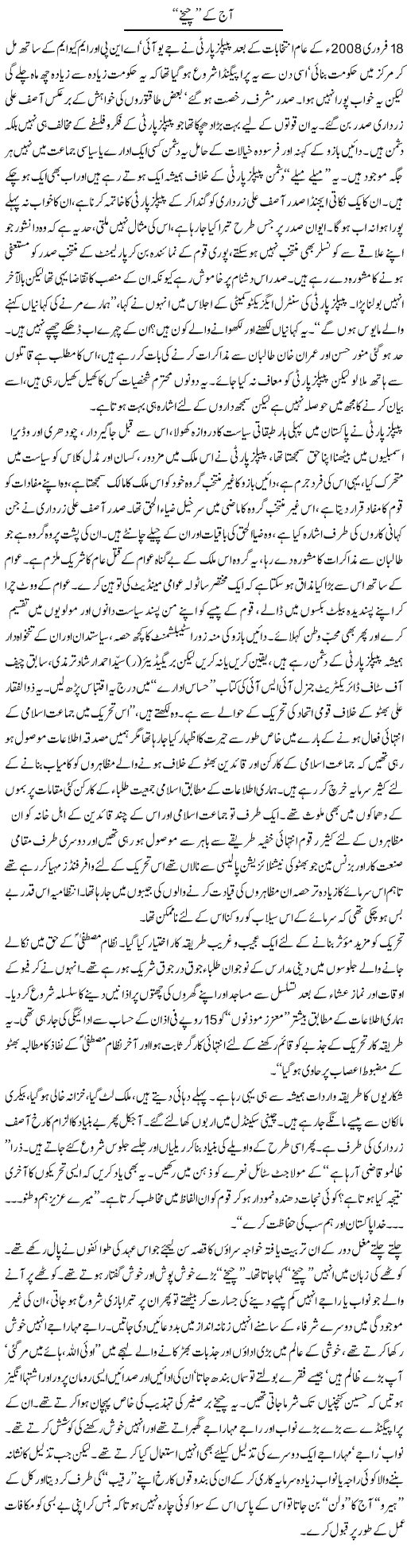
Hasan Nisar presents a realistic picture of a scenario even if the minus-one (minus-Zardari) formula of the pro-Taliban and anti-democracy establishment is implemented in Pakistan. Next is a column by Latif Chaudhry in which he compares certain senior members of the Mullah Media Alliance (Pakistani Taliban Union of Journalists) with the eunuchs (cheekhay) of the Mughal era. Only if wishes were horses...


Read more...

Wednesday, 4 November 2009

How did MQM foil PML-N's anti-democratic plans on NRO - An analysis

MQM denies ever pressing for Zardari’s resignation


November 3rd, 2009 - 2:30 pm ICT by ANI
Islamabad, Nov.3 (ANI): The Muttahida Quami Movement (MQM) has denied issuing any statement which asked for President Asif Ali Zardari’s resignation.

According to reports, a delegation of MQM leaders led by the leader of the party in parliament Dr. Farooq Sattar met Prime Minister Yousuf Raza Gilani to clarify its stance over the issue.

The delegation, which included Parliamentary Affairs Minister Dr Babar Awan, Petroleum Minister Syed Naveed Qamar and other senior party leaders, rejected media reports that the MQM president Altaf Hussain has asked Zardari to step down, The Nation reports. Earlier, it was reported that Hussain while asking his party leaders to oppose the National Reconciliation Ordinance (NRO) in parliament had advised Zardari to tender his resignation. Hussain, during an interview with a private television channel, said that he has directed his party members to oppose the NRO in parliament, and that he had also told the President that the ordinance was a ‘black law’.

Hussain said the government should not table the ordinance in the House as the people of the country have already rejected it. He, however, later clarified that he never asked for Zardari’s resignation. “I did not talk about Zardari’s resignation in the entire interview. We are not against the Pakistan People’s Party or Zardari. The MQM is not responsible if our advice is misunderstood. Neither can the MQM become a party to legalising corruption through the assembly,” Hussain said. (ANI)

....


By Latif Chaudhry


A day of reconciliation in NA
Wednesday, November 04, 2009
By By our correspondent

ISLAMABAD: It was a day of reconciliation in the National assembly after the government’s decision not to present the controversial National Reconciliation Ordinance (NRO) in parliament and the treasury benches received accolades from the opposition for bowing to the parliament’s demand.

Tuesday’s proceedings coincided with the second anniversary of the emergency and the PCO imposed by Musharraf and the House echoed with demand of his trial under the Article 6 of the Constitution. Interestingly, the PML-Q members, who were part of Musharraf’s dispensation, were also critical of the Nov 3 acts, but some of them, including Marvi Memon and Akram Gill, had a word of praise for him.

Kicking off the debate on a point of order, Leader of the Opposition Chaudhry Nisar Ali lauded the government for its decision not to table the NRO in the National Assembly. He asked the government to try Musharraf under the Article 6. “It is time to take concrete measures to make parliament a truly sovereign institution and the centre of power,” he added.

He announced that the PML-N would hold a rally outside the Parliament House today to condemn the November 3 action and to express solidarity with the judiciary. He appealed to all the political forces to join them.

Ahsan Iqbal said that after the Supreme Court’s verdict, the government was bound to proceed against Musharraf. Interior Minister Rehman Malik described the decision of not tabling the NRO in the House as ‘political wisdom’. Responding to a point of order, he agreed to give an in-camera briefing to parliamentarians about national security issues. Responding to Ahsan’s comment that US Secretary of State Hillary Clinton had said Pakistan provided no evidence on Indian interference in the country, Malik said foreign dignitaries gave such statements and “we are not supposed to respond.” Meanwhile, Speaker National Assembly Dr Fehmida Mirza clarified that neither she nor her husband ever took benefit under the NRO. (The News)

Also read: The Project IJI - Second Edition

Read more...

Wednesday, 2 September 2009

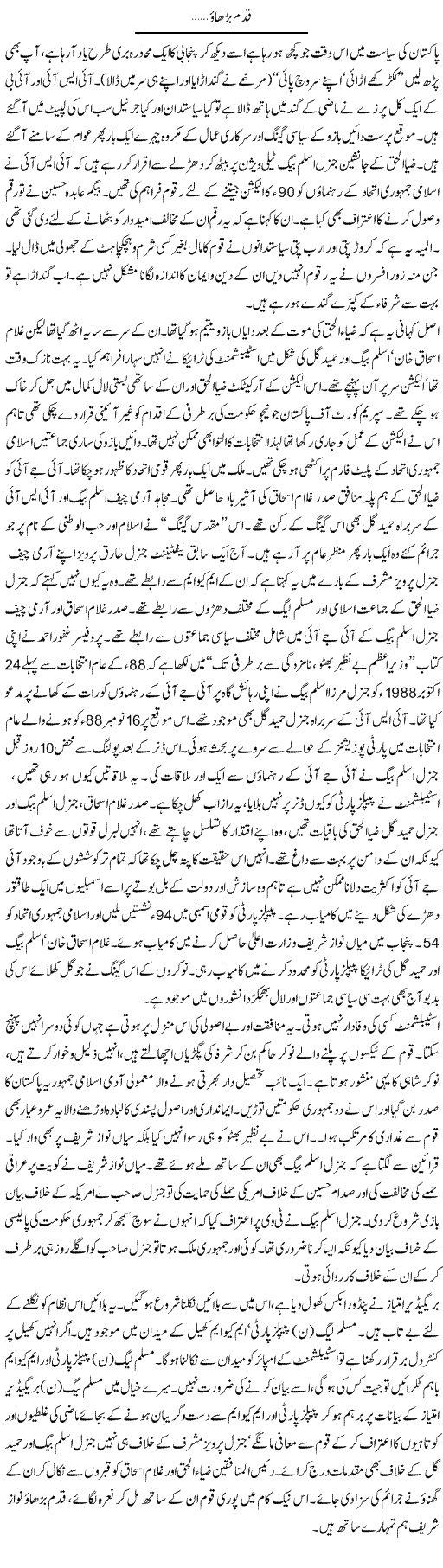
Qadam barhao Nawaz Sharif: Not only against Musharraf but also against Hamid Gul and Zia


An interesting analysis by Latif Chaudhry. Also watch a video clip of Nawaz Sharif praising General Zia-ul-Haq and contrast that vidoe with his today's stance against Musharraf.


Read more...

Wednesday, 19 August 2009

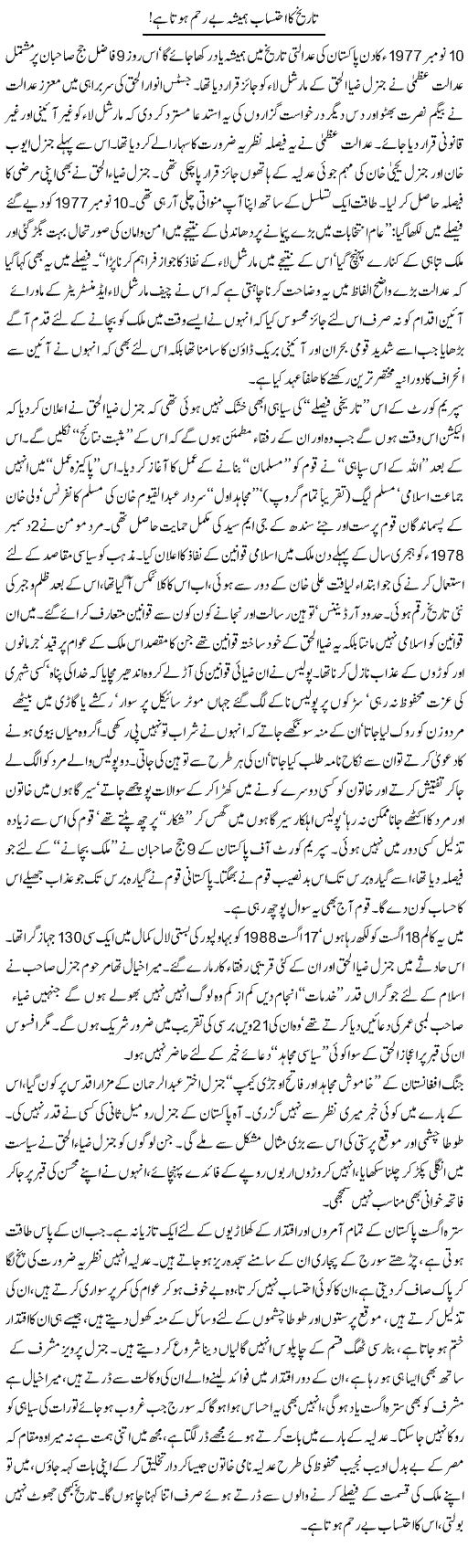
In defence of (and against) General Zia-ul-Haq


Haroon-ur-Rasheed, famous (or notorious) for his appreciation of the ISI (right from General Akhtar Abdur-Rehman to Brigadier Imtiaz to Major Aamir, from General Zia-ul-Haq to General Hamid Gul to General Ashfaq Kayani) writes a column in praise of General Zia-ul-Haq in Jang on 18 August 2009:


....

...

Here is a counter perspective:

Zia’s decade of darkness
By Iqbal Ahmad Khan

Tuesday, 18 Aug, 2009

Both Pakistan and Pakistanis continue to be haunted by Zia’s dark decade. — File Photo World
‘Al-Qaeda has shifted bases to Pakistan’ THE DISPOSABLE ALLY

Pakistan highest foreign policy priority: US The unenviable position of the most invidious of Pakistan’s rulers, among democrats and dictators alike, is occupied by Ziaul Haq, the dictator-general who died 21 years ago on Aug 17.

The outward display of humility and affection masked a duplicitous and vengeful personality. These were reflected in the retrogressive and punitive measures the general unleashed on the benighted nation during more than a decade of unmitigated dictatorship.

Whether it was the knotty Article 58-2(b), the much-exploited blasphemy laws or the promotion of a misogynous mindset, Pakistan and Pakistanis continue to be haunted by Zia’s dark decade.

Ziaul Haq was a usurper. He overthrew an elected and arguably Pakistan’s most popular prime minister. As justification he cited danger of civil war as a possible consequence of an impasse in talks between the government and the opposition. This was a lie. It is now fully documented that by July 4, 1977, both protagonists — the PPP and the Pakistan National Alliance or PNA — had reached an agreement to be announced by the prime minister the next day. The general could not have been unaware of this development. His move was purely and simply a power-grab.

The second deception was his avowal of not having any political ambitions, his sole aim being to hold elections within three months in October 1977. But when it dawned upon him that the premier he had ousted continued to enjoy widespread public support, he, not for the first time, conveniently retracted on his promise. He announced that it was neither in the Quran, nor was it revealed to him to hold elections on Oct 18. The promised elections were postponed. The people were provided an insight into his real plans when he pronounced that the country could only be kept together by the armed forces and not by politicians. Obviously, the fact that barely six years ago Pakistan had disintegrated under the watch of a military junta did not seem to bother him.

The sinister general continued to dangle the election bait before the public, while proceeding simultaneously to transform Pakistan into an authoritarian, nay totalitarian state. The constitution was amended beyond recognition in a bid to further empower himself. The notorious Article 58-2(b) corrupted the parliamentary form of government by transforming it into a semi-presidential system. The president now had the power to dissolve the National Assembly. (This power was used to dismiss the prime minister in 1988 while he was on an official visit abroad.)

He arrogantly proclaimed that he was here to stay and would not allow anybody else to rise. So much for the humility and selflessness that some of his apologists were attributing to him. On April 4, 1979, amidst curses from the masses and condemnation from the international community he hanged the legitimately elected and the most accomplished of Pakistan’s prime ministers. Soon thereafter elections were cancelled and political parties banned.

Military courts, armed with massive powers by the chief martial law administrator, spread terror among the people. Political activists and journalists were incarcerated. Some were even flogged in consonance with the punitive punishments that martial law orders had prescribed.

Responding to criticism on the dismissal of certain journalists for demanding restoration of democracy, the general angrily shot back that the punishment was too lenient. They should have been hanged in order to teach others a lesson. The press was muzzled and students and trade unions banned. The right of habeas corpus was annulled for the first time in the history of Pakistan. The judiciary could no longer review the legality and constitutionality of executive decisions.

Despite the comprehensive use of force to quell dissent, the question of legitimacy continued to stalk the regime. It was decided to give an ideological underpinning to Zia’s authoritative rule. In messianic mould the general told BBC that God had entrusted him with the mission to bring Islamic order to Pakistan. A referendum asking the people whether they supported Islamisation resulted in an embarrassing 10 per cent turnout. The ban on political parties was kept intact.

Islam, it was claimed, did not provide either for political parties or for western democracy. The Council of Islamic Ideology was entrusted with the task of preparing a blueprint for an Islamic ideological state. Primitive punishments including amputation of limbs, public lashings and stoning to death were promulgated. Blasphemy laws were introduced which have since become an exploitative instrument in the hands of militants and extremists to manipulate public sentiment and to target minorities.

A raft of retrogressive measures was directed at women. The evidence of two women was made equal to that of one man and the amount of compensation payable for a murdered woman was half that for a murdered man. Women appearing on TV were required to cover their heads and female dancing on TV was prohibited. The regime’s sinister plan involved the establishment of a theocratic-authoritarian state where Gen Zia backed by the military would reign supreme over a fearful populace. It was completely at variance with Quaid’s vision of Pakistan, which was neither theocratic nor authoritarian.

This then is Gen Ziaul Haq’s dark legacy. Lack of space does not permit a chronicle of his foreign policy failures. The roots of all major problems facing Pakistan today lie in Gen Zia’s dark era. To name only a few — the habitual interference of the armed forces in civilian affairs, weakening of state institutions, democracy deficit, rise of intolerance and militant extremism, sectarianism, problems of the Afghan refugees, drugs and the Kalashnikov culture and perennial constitutional problems. To roll all this back is the unenviable task of the present democratically elected government. (Dawn)

....

Read more...

Wednesday, 12 August 2009

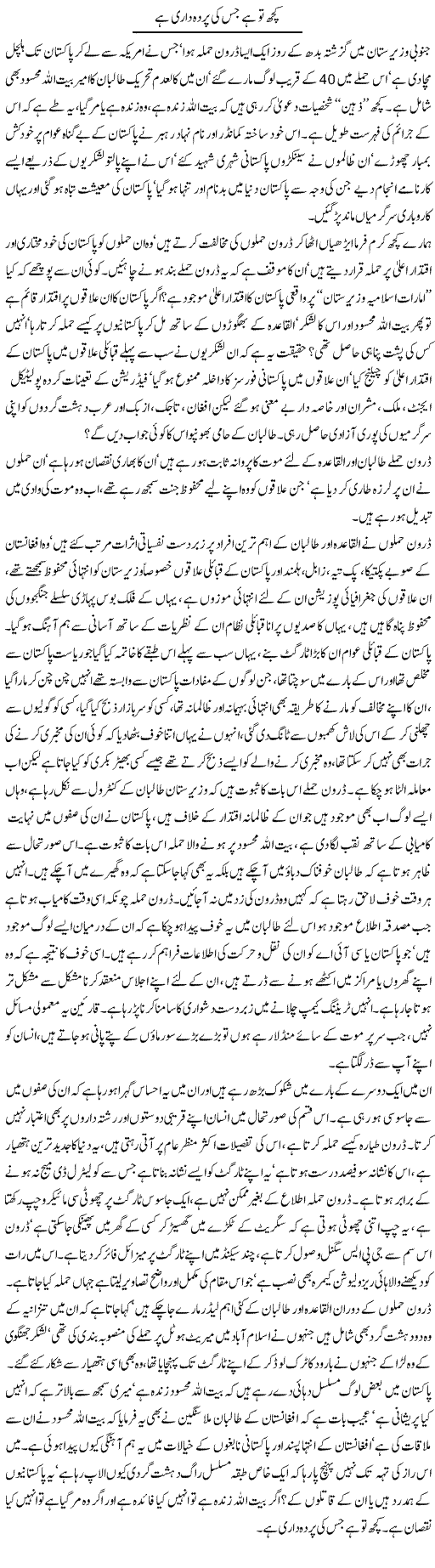
Two opposite perspectives on drone attacks and Baitullah Mehsud


Irfan Siddiqui (a pro-Taliban journalist) and Latif Chaudhry (a pro-democracy journalist) offer two opposite perspecitves on the US drone attacks on the Taliban/Al Qaeda hideouts in Pakistan.


(Irfan Siddiqui, Daily Jang, 12 August 2009)


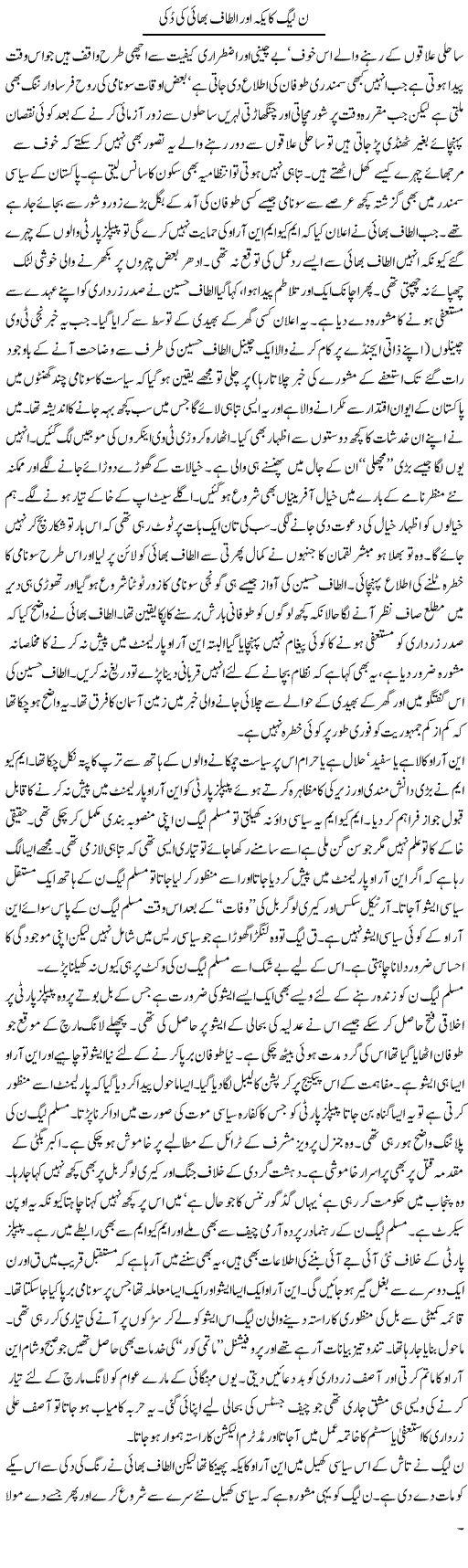
(Latif Chaudhry, Daily Express, 12 August 2009)

Finall, why do journalist such as Irfan Siddiqui, Ansar Abbasi, Shahid Masood and Hamid Mir, and politicians such as Nawaz Sharif, Hamid Gul, Aslam Beg, Imran Khan, Qazi Hussain Ahmed have dual standards, Saleem Safi offers a critical analysis:


Read more...

Wednesday, 15 April 2009

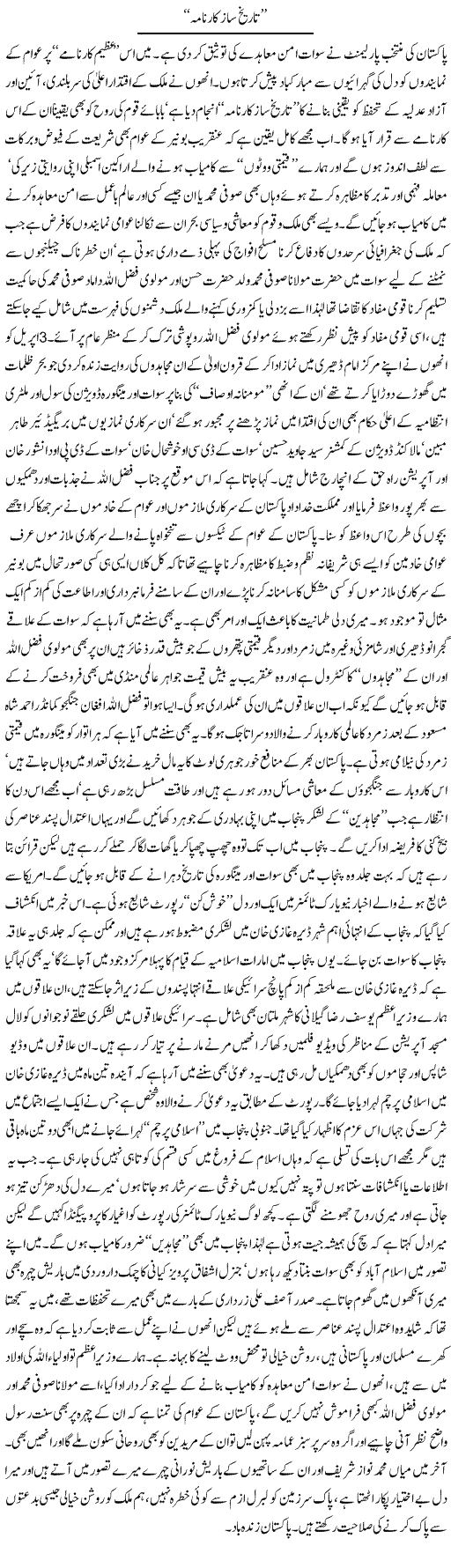
A Critique of Nizam-i-Adl Regulation (formal surrender of Swat to Taliban) by Latif Chaudhry


Daily Express --- 15th April, 09

Read more...

Wednesday, 8 April 2009

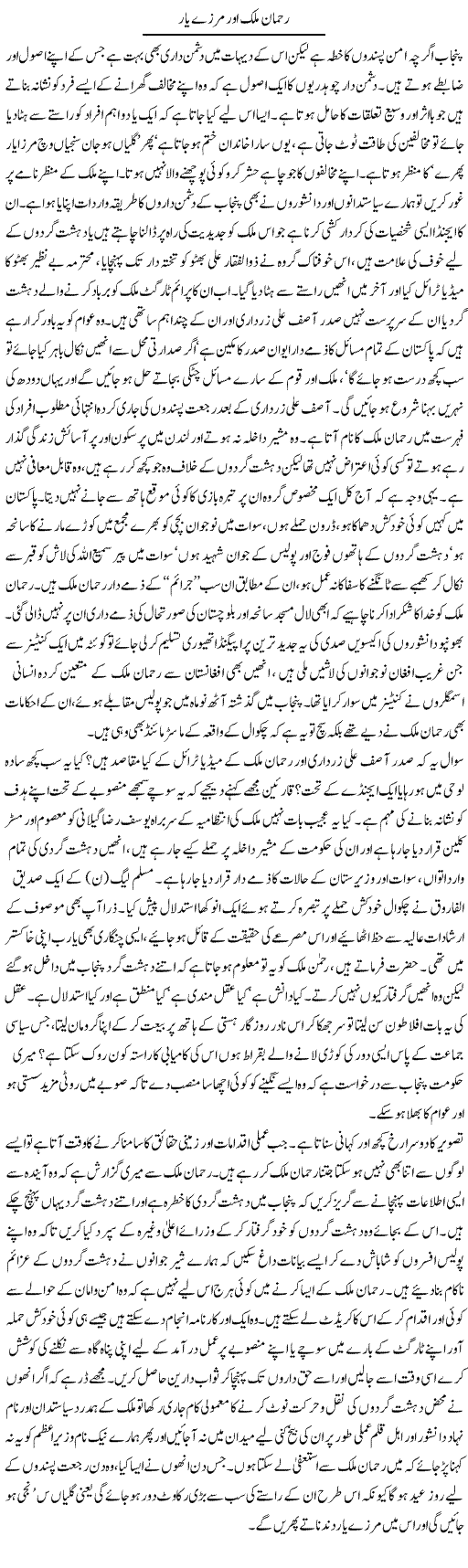
Should we hold Rehman Malik responsible for all suicide and other terrorists' attacks ?


By Latif Chaudhry
Daily Express --- 8th April, 09
Read more...