Editor's Choice

--------------------------------------------------------------------------------------------------------------------------
Featured Post
--------------------------------------------------------------------------------------------------------------------------

"Let us build Pakistan" has moved.
30 November 2009

All archives and posts have been transferred to the new location, which is: http://criticalppp.com

We encourage you to visit our new site. Please don't leave your comments here because this site is obsolete. You may also like to update your RSS feeds or Google Friend Connect (Follow the Blog) to the new location. Thank you.


--------------------------------------------------------------------------------------------------------------------------
Showing posts with label Hasan Nisar. Show all posts

Wednesday, 18 November 2009

Pakistan after President Zardari

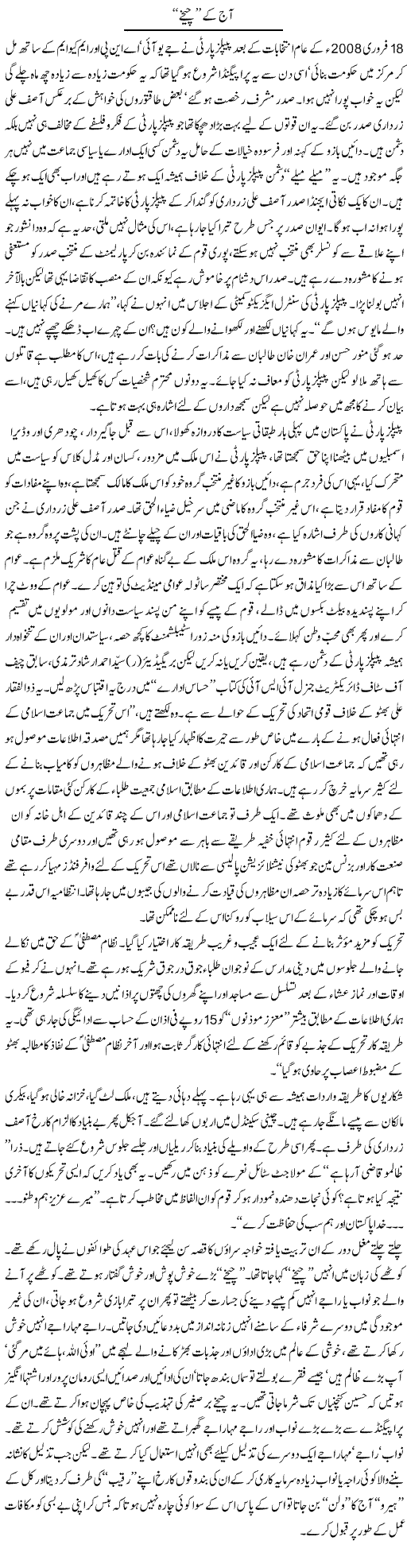
Hasan Nisar presents a realistic picture of a scenario even if the minus-one (minus-Zardari) formula of the pro-Taliban and anti-democracy establishment is implemented in Pakistan. Next is a column by Latif Chaudhry in which he compares certain senior members of the Mullah Media Alliance (Pakistani Taliban Union of Journalists) with the eunuchs (cheekhay) of the Mughal era. Only if wishes were horses...


Read more...

Thursday, 12 November 2009

The Plus All Formula: Let us build Pakistan

Hasan Nisar rejects the minus-one (i.e. minus President Zardari) formula, and instead suggests that all patriotic Pakistanis should support the democratic government in order to build their beautiful country.

Read more...

Tuesday, 3 November 2009

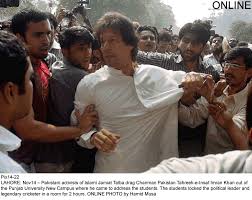
Imran Khan and ‘mass movement’ - Let us pray for Imran Khan's swift recovery


First a new announcement by Imran Khan, which is followed by analyses by Hasan Nisar and Nazir Naji.

Imran announces campaign against NRO
Sunday, 1 Nov, 2009 11:12 pm
http://www.aaj.tv/news/National/151104_detail.html

LAHORE : Pakistan Tehreek-e-Insaaf has announced to launch a campaign against National Reconciliation Ordinance (NRO) here on Sunday, Aaj News reported.

Addressing a press conference PTI Chief Imran Khan said that a protest demonstration would be staged next Friday in Islamabad while in Lahore protest demonstration would be held on Saturday.

He said NRO is continuity of the policies of former President Pervez Musharraf, adding South Waziristan operation is also part of those policies.

He added that after the passing of NRO from the assembly it would clear that who wanted a society based on justice and who wanted loot and plundering.

Imran appealed all the political parties to oppose this ordinance.

He said Kerry-Lugar Bill is the bill of American interest and Pakistani people will not accept this aid at any cost.

....
Editorial
Leader of Pakistan Tehreek-e-Insaf (PTI) Mr Imran Khan has decided to hold mass movement rallies in Islamabad and Lahore to mobilise the people for a mid-term general election and against the National Reconciliation Ordinance (NRO) as it passes through the process of legislation in the two houses of parliament.

It is difficult to imagine how Mr Khan will manage to whip up any national passions for a mid-term election when people don’t even come out to the marketplace; and Mr Nawaz Sharif, the most popular man in the country and the one most likely to become the next prime minister, vows that he has no plan to go for a mid-term change. Nor will the people feel moved greatly by the NRO to mob the streets and deliver on the plans set on foot by PTI.

There is a separate politics of mass mobilisation in the country and the last time it was done, not by the political parties exclusively but by the lawyers agitating for an independent judiciary, its denouement was prevented by a phone-call from the army chief. Is that a part of Mr Khan’s strategy? We have seen many small parties trying to get people to come out on the streets for their causes without great success. People seem to have switched off from the politicians. Jamaat-e-Islami is still at it — it has even held a national referendum on the Kerry-Lugar Act — without much effect.

Mr Khan is a big leader of a small party and has a growing political profile, but he may be jumping too far ahead by calling for a mass movement. He runs the risk of becoming the head of a fringe party forever by running after objectives that may be before their time. The Jamaat has actually reduced itself much by moving in radical directions under its former chief, Qazi Hussain Ahmad. It continues to do so under its new chief. The JUI under Maulana Fazlur Rehman has been more pragmatic. The PTI is still cutting its teeth; it must be more supple in its selection of goals. * (Daily Times)

....


(Hasan Nisar)


Let us pray for Imran Khan's swift recovery

(Nazir Naji)


Read more...

Saturday, 31 October 2009

Hillary Clinton's meeting with the 'ghairatmand' journalists: A summary

The secretary of state didn't shy away from sharp questions in bid to alter public opinion.

By NEWS SERVICES
Last update: October 30, 2009

ISLAMABAD, PAKISTAN - U.S. Secretary of State Hillary Rodham Clinton, who has had her ups and downs in the news media, faced sharp rebukes in Pakistan on Friday, including one woman who accused the United States of conducting "executions without trial" in aerial drone strikes.

Slapping back, Clinton questioned Pakistan's commitment to fighting terrorists. "Somebody, somewhere in Pakistan must know where these people are," she said in an exchange almost as blunt as her exasperated comments a day earlier that Pakistani officials lacked the will to target Al-Qaida.

Clinton rolled with the punches this week in a media-saturated tour of Pakistan. She submitted to four roundtable interviews over three days in which Pakistan's leading journalists took their best shots at her, when they were not busy whacking one another.

By the time she left Islamabad on Friday, she appeared to have fought Pakistan's fourth estate to a draw.

Najam Sethi, editor in chief of the Daily Times, another English-language daily, said Clinton "did well to interact. She may not have made many new friends, but she certainly didn't make new enemies."

Engaging Pakistan's unruly media was perhaps Clinton's most important job on this visit. Newspapers and television drive public opinion more here than in many countries, and the coverage is sharply critical of the United States, partly because it sells papers and lifts ratings.

That poses a problem for the Obama administration, which needs Pakistan to join its campaign to fight extremists and stabilize Afghanistan. The recent spike in anti-American sentiment here was driven by media reports that a new aid bill would infringe on Pakistan's sovereignty.

"I will admit that clearly there is a lot of misperception, and perception is reality, so therefore it is up to us to try to set it straight," Clinton said in an interview with seven leading TV personalities.

http://www.startribune.com/world/67830192.html?elr=KArksLckD8EQDUoaEyqyP4O:DW3ckUiD3aPc:_Yyc:aUUsZ

Clinton's call
Saturday, October 31, 2009
Hillary Clinton's three-day visit to Pakistan, her first as US secretary of state, marks a fairly distinct break with the past. Unlike her tough-talking and deliberately abrasive predecessor, Condoleezza Rice, Ms Clinton went out of her way to be charming, open and to talk to a wide range of people. Her experiences in the US Senate also meant she brought in a mature handling of queries and a better understanding of how complex the regional situation is. The interaction with students at the Government College University in Lahore should have been especially instructive for the person who will be playing a key role in devising foreign policy in Washington. The students who lined up to question her were not hostile. But they made it clear they shared with the majority of citizens a lack of trust for the US and scepticism about intentions. To her credit Ms Clinton accepted there were good grounds for this lack of faith. Her assurance that the Obama administration represented real change is one that will need though to be proven through deeds and not just words. The sometimes startled response from the secretary of state to the far tougher questions thrown at her by a TV panel made up of top anchor people suggests the government functionaries she met in Islamabad may have offered up a typically sanitized picture of prevailing sentiments. It is, therefore, encouraging that despite the immense security concerns Hillary Clinton made it a point to see the 'real' Pakistan, also holding a meeting with Mian Nawaz Sharif in his home city.

But for all her pleasant smiles, Ms Clinton did not shy away from making some things quite clear. She stated that she believed the Al Qaeda leadership was indeed in Pakistan, she stressed an all-out effort on every front was needed against terrorism and she focused on how much Pakistan had to gain, especially in economic terms, by normalizing ties with India. If we are honest, we cannot deny that much of what she said was true. For reasons buried in ideology, many of us, whether we draw influence from the right or the left of the political spectrum, have difficulty in suggesting that an alliance with the US could benefit Pakistan. It would also be naïve to assume that Washington wishes to 'help' Pakistan as an ally. International relations are after all geared around self-interest and self-preservation. There is nothing noble about Washington's focus on Islamabad. But it is possible that at this particular moment in history the interests of both nations coincide. This is something we should use to our advantage.

Overcoming the militant threat and entering in to a less acrimonious relationship with India would benefit most citizens. There are segments that would stand to lose, but ways must be found to prevent them from subverting the interests of the majority. They have done so repeatedly through the decades since 1947. The current US setup seems to have recognized some of this. Ms Clinton also emphasized in this respect a dramatic change in policy from those of the George W Bush-led team. The Bush administration's virtually blind backing for former president Musharraf created a number of the problems we face today. Our political leaders must assess the way we can most effectively counter these. In realistic terms, going beyond rhetoric or wishful thinking, it is inevitable that we will need to work with the US at least for some years to come. We cannot on our own hope to conquer that monster of terrorism that Washington's policies helped create. Nor do we have the economic or moral wherewithal to do this. Hillary Clinton has demonstrated a willingness to better understand concerns in Pakistan and to open wider the doors of communication. There are still plenty of reasons to be wary of US intentions. But for now, the opportunities for a more open relation laid out by the secretary of state need to be seized and utilized to pull our country out of the pit into which it has stumbled as a result of errors made in the past. (The News)

(Asadullah Ghalib)

(Nazir Naji)
(Hasan Nisar)

Some comments: (Source: pkpolitics)

hasankhan said:

these anchors (who met Hillary Clinton) are liars,biased,maniplators,twisters of events,supporters of taliban.on the other hand pakistani people are innocent and simple they follow anchors blindly.there should be strict rules to control these destructive anchors.government should not leave the innocent people of pakistan on the mercy of these anchors.

Nonaligned said:

News media and electronic media never stop scolding Musharaf for the restriction he applied on media (if any). I think our news media has short memories, reporters were tortured, jailed and some even got killed when Zia-ul-Haq was the president, Almost same happened to reporters when Nawaz Sharif and Benazir were the Prime Ministers. I think our news-media has enjoyed complete freedom since last ten years but now the future does not look so rosy, let us wait and see, they may miss Musharaf era soon..

Kashif said:

@hasankhan

You are spot on. These anchors can only be checked by GHQ. They sided with GHQ on KLB for 1.5b $$ civilian aid. On 1.5 B $$ military aid that Pentagon just appropriated no one say anything. Why Dr. Moeed, Talat Hussein, Hamid Mir, SM and all these GHQ puppits criticise that. Why don’t they say refuse aid for bombs and guns …. This is not free media …. Why video of Army Jawans interogating Swati Talibans was not relayed by channels. Hamid Mir admitted in London … they are not as free as people think, they were not allowed by GHQ to broadcast that tape.

They ‘d blame Zardari, Rehman Malik, Nawaz Sharif for drones but won’t say a word about Gen Kiyani and Gen . Pasha …. Nusrat Javed and Najam Sethi are among very few exceptions … rest of the lot in urdu media is there to discredit Politicans on GHQ’s guidelines…..

Also read:

Clinton’s encounter with media and Talat Hussain's $640 million mistake


Read more...

Monday, 5 October 2009

"Islam khatray main hay" Islam is in danger.


A critical column by Hasan Nisar

Read more...

Wednesday, 30 September 2009

Kerry-Lugar Bill - Is it good or bad for Pakistan?


We may be entering a ‘new phase’ in relations between the US and Pakistan with the passage of the bill, but the paeans to ‘fundamental change’ don’t jibe with reality. –Photo by AP
Kerry-Lugar Bill: the fruition of 62 years
Wednesday, September 30, 2009
Mosharraf Zaidi

$1.5 billion a year does not measure up well against the per capita assistance that Uncle Sam has provided for countries like Jordan, Georgia, Egypt and Israel. Nevertheless, America's friendship with Pakistan is entering a new and exciting phase. The Kerry-Lugar Bill signals a dramatic shift in how American power seeks to engage with Pakistanis. While even moderate Democrats in Washington DC are alarmed by how many Cold War bunnies President Obama has in his diplomatic arsenal, it is also true that the Obama people have a fundamentally different worldview than the one that motivated the actions of the Cheney-Rumsfeld cabal of the Christian Taliban. Rest assured, the era in which that gang of neocon torturers and war-profiteers was allowed to sleep serenely in beds that Gen Musharraf and his enablers made for them is over.

Reading the Kerry-Lugar Bill exposes several pleasant realities. Its analysis of Pakistan's development challenges is succinct, to the point and reasonably comprehensive. The depth of analysis in the bill indicates genuine American interest in serious Pakistani issues. Moreover, given the lamentable efforts of Pakistani governments to document its own development priorities (who can forget the PRSP fiascos?), the bill represents a very good summary of the country's development challenges. Finally, to the abiding credit of American democratic institutions, the Kerry-Lugar Bill is a well-crafted document that makes no secrets of its motivations.

Section 3 of the bill is titled Findings, and is a list of the issues that motivate the bill. There are a total of 12 findings. Findings 1 and 2 are platitudinous expressions of the US-Pakistan friendship, and the $15 billion that the US government invested in the Gen Musharraf regime. Finding 3 recognises the importance of the February 18, 2008, election. Findings 4 through 9 focus on Al Qaeda, the Taliban and FATA. Findings 10 and 11 contain statistics about poverty and the economy in Pakistan. Finally, Finding 12 recognises the IDPs crisis caused by the May 8 Swat offensive. Nine of the twelve findings specifically refer to the Taliban, Al Qaeda, security, terrorism and/or FATA. Only one finding mentions the word poverty. This is not an accident. The Kerry-Lugar Bill is an American legislative measure designed to pursue American interests.

The bill's three main sections further clarify the purpose and method that will define the engagement of American power with Pakistan. The first is focused on Pakistan's traditional development challenges, titled, "Democratic, Economic and Development Assistance for Pakistan" and has up to $1.5 billion associated with it. The second is titled "Security Assistance for Pakistan" and does not specify how much money is available, but does define a new era in US-Pakistan military relations. Most importantly this section delinks American support for Pakistani national security from the military, and places the control of any support provided with democratically elected civilian governments. This is a marked departure from the laissez faire rental agreements made by American governments and the Pakistani military under Musharraf with the Bushies, and under Zia, with the Bushies' ancestors in the Reagan White House.

The final section, and the one of most interest from a purely development perspective, is titled "Strategy, Accountability, Monitoring and Other Provisions". This section details a complex set of planning, reporting, auditing and accounting documents that are designed to ensure that Pakistan uses the money it is given in accordance with the wishes of the US Congress -- a fine and noble cause given that it is their money. The Kerry-Lugar Bill's rather detailed set of accountability instruments will, however, if American bureaucrats are not careful, paralyse the mobility of almost all of the $1.5 billion a year.

The Kerry-Lugar Bill calls for the production of at least three major, macro-level strategic documents that will double as budgeted work-plans, to be presented to relevant committees of the US parliament. The secretary of state must produce a Pakistan Assistance Strategy Report within 45 days of the bill's passage, and a Security-Related Assistance Plan Report within 180 days of the bill's passage. The US president must produce a Comprehensive Regional Strategy Report for submission to the relevant committees within 180 days of the passage of the bill. This last document, the regional strategy, seems to have been inspired by the president's book titled "The Audacity of Hope", seeking as it does, ways by which not only Pakistan, but Afghanistan and India too can be made more secure, through the Kerry-Lugar Bill assistance money.

Six months after the secretary of state's Pakistan Assistance Strategy, Madam Secretary, or her predecessor, in concert with the secretary of defence, will be required to submit the first Semi-Annual Monitoring Report. Every six months thereafter, they will be required to produce one of these reports. If they ever make it to the public domain, these will be chart toppers at Amazon and on the New York Times' best sellers' lists.

The semi-annual reports will not only detail expenditure and achievements, but will also include an evaluation of efforts by the government of Pakistan to "disrupt, dismantle, and defeat Al Qaeda, the Taliban", "eliminate safe havens", close "Lashkar-e-Taiba and Jaish-e-Mohammed terrorist camps", "cease all support for terrorist groups", "prevent attacks into neighbouring countries", and "close madressahs linked to the Taliban".

It gets better. In addition to evaluating Pakistan's performance along these lines, the report will also describe Pakistan's anti-proliferation efforts, assess whether US assistance is enabling Pakistan to spend more on nukes, and finally, assess the extent of civilian government control over the military, including "oversight and approval of military budgets, the chain of command, the process of promotion for senior military leaders".

It may be an understatement to suggest that these requisite documents will exact a heavy toll on an already-stretched US bureaucracy in Pakistan. What is more worrying is that each new diplomat will require several individuals to help protect his or her life. Those 'protectors' will not be from among the Islamabad Traffic Police. They will be drawn from a pool of private contractors, hired through the State Department's Worldwide Personal Protective Services (WPPS) contracting vehicle.

The WPPS, as anyone who has read Jeremy Scahill's exceptional book about Blackwater will know, is a bit of a problem. The hullabaloo over Blackwater's presence in Pakistan is not a conspiracy theory. It is a very legitimate concern about the use of mercenaries that are immune from the law. Blackwater may or may not be present in Pakistan -- but its ilk, most definitely are. Among these, DynCorp's presence here has already been verified, thanks to the now infamous Pakistani sub-contractor named Inter-Risk.

Other mercenary companies, such as Triple Canopy, Xe, and Richard Armitage's CACI will eventually be deployed in Pakistan because protecting an army of bureaucrats will require several armies of mercenaries.

Of course, a lot of this is a reflection of the Pakistani state's failure to protect guests when they visit this country. Over the last eight years American diplomats have been bombed (Karachi and Islamabad), ambassadors have been killed (Czech Republic at the Marriott), and journalists and engineers beheaded on camera (Danny Pearl and Piotr Stanczak).

The Kerry-Lugar Bill is a bitter pill that Pakistan's strong and resilient people must swallow because they have repeatedly been failed by both their military dictators and their civilian megalomaniacs. True proof of the very different planet that the Pakistani elite inhabit drips from Farahnaz Ispahani's pen in a lionisation of her government published in the Huffington Post on Saturday, and this paper, just yesterday. Says Ms Ispahani, "Pakistan stands perhaps in the strongest diplomatic position in its sixty-two year history". How's that for a punch-line?


The writer advises governments, donors and NGOs on public policy. He can be reached through his website www.mosharrafzaidi.com (The News)

Deciphering the US aid bill
By Cyril Almeida
Friday, 02 Oct, 2009

Never let the facts get in the way of a good debate. That pretty much sums up the approach to the Kerry-Lugar/Berman bill, officially, the Enhanced Partnership with Pakistan Act of 2009, now approved by Congress.

How angry are some of the critics? Very angry; frothing-at-the-mouth angry. A PPP government has once again sold the country, its sovereignty, its very soul to the Yanks. And going by some of the wildest claims, there doesn’t seem to be a shortage of patriots lining up to water the tree of liberty here with their blood. Pakistan will be saved. The conspiracy to destroy us will be defeated.

Right. About the facts. What appears to have sent the bill’s Pakistani opponents into convulsions is this: Sec 203: limitations on certain assistance. Specifically, paragraph (c) of sec 203, entitled ‘certification,’ which lists three subjects the secretary of state has to certify to Congress that Pakistan is cooperating on, committed to and eschewing from.

I’ll get to those conditions in a bit, but first the pesky fact that the ‘nattering nabobs of negativism’ here have missed. (Tip of the hat to William Safire, The New York Times man who passed away this week and who probably had little clue that his brilliance was being lapped up in faraway Pakistan.)

The certification limitation applies to two things: security-related assistance and major defence transfers, both defined in sec 2, ‘definitions,’ if anyone is interested. The certification does not apply to the democratic, economic and development assistance.

So Pakistanis are supposed to be angry that the Americans have put conditions on selling guns to Pakistan, but not on democratic, economic and development assistance? Of course not. Which is why the chest-thumping uber-nationalists here have ignored the point and pretended that the conditions are applicable to the full amount of the aid. Remember, never let the facts get in the way of a good debate.

Now, to the other side, Pakistani and American officials, also prone to exaggerating the effect of the bill. We may be entering a ‘new phase’ in relations between the US and Pakistan with the passage of the bill, but the paeans to ‘fundamental change’ sung particularly by Pakistani officials don’t jibe with reality.

Pakistan is a tactical ally of the US, not a strategic partner; that has been the reality since 9/11 and that continues to be the reality even after the passage of the Enhanced Partnership Act.

The language of the bill tells its own story. From sec 3: findings: ‘(1) The people of the Islamic Republic of Pakistan and the United States share a long history of friendship and comity, and the interests of both nations are well-served by strengthening and deepening this friendship’ (emphasis added). And from the same section: ‘(4) Pakistan is a major non-Nato ally of the United States and has been a valuable partner in the battle against al Qaeda and the Taliban, but much more remains to be accomplished by both nations’ (emphasis added). Hardly stirring stuff.

Next, the limitations on security-related assistance and arms transfers. First, the secretary of state must certify that ‘the Government of Pakistan is continuing to cooperate with the United States in efforts to dismantle supplier networks relating to the acquisition of nuclear weapons-related materials, such as providing relevant information from or direct access to Pakistani nationals associated with such networks.’

Yes, the earlier direct reference to A.Q. Khan has been deleted and semantically it could be argued that he is any case no longer ‘associated’ with nuclear proliferation networks. But that isn’t the point. The point is that the language reveals once again the true nature of Pak-US relations: we are a tactical ally, not a strategic partner.

To get an idea of the language Congress uses for strategic partners, consider the certification requirement in the United States-India Nuclear Cooperation Approval and Nonproliferation Enhancement Act passed by the previous Congress: ‘the President shall certify to Congress that entry into force and implementation of the Agreement … (does not in any way) assist, encourage, or induce India to manufacture or otherwise acquire nuclear weapons or other nuclear explosive devices.’

Yes, the bill stipulates that legal requirements of the Henry J. Hyde Act of 2006 and Atomic Energy Act of 1954 are not overridden and the Hyde Act places additional requirements on India that the US president must certify, but those do not imply that India is involved in nuclear weapons proliferation, which the Kerry-Lugar/Berman bill does. The difference isn’t something to be sneezed at. We are and are set to remain a tactical ally, not a strategic partner, of the US.

The second condition applies to Pakistan’s ‘sustained commitment to … and significant efforts towards combating terrorist groups.’ Again, in broad strokes the condition is not very controversial because it is in line with Pakistan’s publicly declared policy against militancy.

But here’s the rub: the details contain implicit references to India. After specifically requiring that Pakistan move towards ceasing support for any groups that launch attacks against US or coalition forces inside Afghanistan, the condition also mentions ‘the territory or people of neighbouring countries.’ Then it goes on to refer to the Lashkar-i-Taiba, its headquarters in Muridke and the Jaish-i-Mohammad. Connecting the dots isn’t very difficult.

Frankly, the conditions themselves are arguably what the state should be doing in any case; we need to be rid of the curse of militancy and we need to do it for our own good. But in the present context, it matters who is asking us to do it and why.
From a hard-nosed, realpolitik perspective — and you cannot ignore that in statecraft — the references amount to Indian security concerns inserting themselves into an American bill meant to provide democratic, economic and development assistance to Pakistan.

So even if you ignore, and you should, the most outrageous bile of the bill’s critics, the more subtle point is reinforced: we remain a tactical ally of the US, not a strategic partner.

Going forward, what that really calls for is a serious, measured, thoughtful debate about our approach to the US specifically and our grand, national security and national military strategies generally. But don’t bet on that happening. Remember, we don’t let the facts get in the way of a good debate.

cyril.a@gmail.com (Dawn)


Making use of aid
Dissenting note

Friday, October 02, 2009
Dr Masooda Bano

The US House of Representatives has reached a consensus to continue to direct US aid flows to Pakistan by approving a five-year support package of 1.5 million per annum going to 2014. The good news is that this money is meant to be primarily used for education and infrastructure. Any external support aimed at improving Pakistan's education sector is, of course, always welcome. The issue, however, is to ensure that the aid is actually spent on the selected sector. The aid utilisation trends in Pakistan have historically been far from impressive.

Outright corruption and mismanagement have often resulted in development aid being largely misspent. Since the Sept 11 attacks, the problem has grown: since the donors are now channelling aid to Pakistan in a bid to curtail militancy they have started to use aid as a leverage to make the government agree to counter-militancy measures rather than ensuring that it is actually spent on the relevant sector. If these new approved funds from the US are to make any contribution to the Pakistan's education sector, this trend for sure has to be checked.

Aid in general is a controversial subject in development literature. While there are clearly arguments for the developed world enjoying the comforts of a good life to try to contribute towards improving living conditions for millions in the poor countries, the practice is not that easy. Aid is hardly ever given for purely altruistic reasons. Political and strategic interests of the donors always play a critical role in the amount of aid that they channel to any country. These political and strategic interests also determine which actors they fund within the chosen countries. Of course, there are differences among donors where some bilateral donors are known to be less political than others but the US is not one of them.

In any case, the increased security concerns in Pakistan has meant that more western donors have felt their security interests links to Pakistan, and as a result have been increasing their aid portfolios for Pakistan. The education sector has also greatly benefited in paper from these increased aid flows. However, in practice it is very difficult to see how this aid has made any difference to the Pakistani state education system. There is clearly something amiss with the way aid is being utilised in Pakistan, especially in the education sector.

The answer to this is not difficult either. The problem is because donors have increased their aid flows to Pakistan due to concerns about militancy, they become less concerned about ensuring that the government actually spends the money on the education sector. Rather, they prefer to use this aid money to negotiate other anti-militancy measures with the government. Thus, as long as the Pakistani government agrees to carrying out the next round of military operations or any such counter-militancy measures, the donors feel less pressured to actually ensure that the aid money meant for education or other sectors is actually being used for that purpose. The primary concern of the donors remains to keep the Pakistani government involved because the donors are desperate to stay engaged with Pakistan for the counter-militancy programmes. They therefore don't want to pressure the government to deliver on the social-sector front too much as they might end up offending certain parties and then being told to withdraw their portfolios.

Seen from the Pakistani perspective this is a very advantageous position. The fact that the donor is keen to stay engaged with a country is a good thing as it gives Pakistani government a lot of negotiating power. However, this could only be a strength provided the government at the Pakistani end was sincere in utilising the aid money for the right purposes. Pakistan's tragedy is that even the present government is no different than the Musharraf government when it comes to ensuring efficient utilisation of aid funds. There are no signs that the corruption under this government is checked or that the government has special commitment to reforming education sector. In such circumstances additional aid to education sector in Pakistan will only help make the people at the top comfortable rather than actually improving the conditions of the Pakistani schools. However, what is important to remember is that these choices are in Pakistan's own hands. If only the leadership of the time was to think of the long-term individual and collective interest rather than pursuing short-sighted gains, increased aid flows to Pakistan could become a blessing.


The writer is a research fellow at the Oxford University. Email: mb294@hotmail.com (The News)


Read more...

Monday, 28 September 2009

The last Ottoman's death: A slap on the face of the pro-Khilafat Mafia


The Khilafat Mafia in Pakistan (e.g. Dr Israr Ahmed) and abroad (e.g. Dr Zakir Naik) and Hizb ut-Tahrir keep trumpeting about the imaginary benefits of an imaginary khilafat of all Muslims. Here is a slap on their face:

"Osman, dubbed the "last Ottoman" by the Turkish media, died in the hospital of kidney failure on Wednesday at the age of 97. Osman, the most senior member of the Ottoman royal family, was exiled by the newly established Turkish Republic in the early 1920s with his family. He was not yet 10 when he left his homeland.

He spent much of his life in New York and came to Turkey in 1992 after he was granted “amnesty.” The advent of the Justice and Development Party (AK Party) to power in 2003 changed the mainstream ideology of Turkish governments with respect to the Ottoman dynasty. In 2004, the Turkish government granted Turkish citizenship to Ertuğrul Osman." Source


Analysis by Hasan Nisar:


Ertugrul Osman

Ertugrul Osman, who has died aged 97, should, technically speaking, have been addressed as His Imperial Highness Prince Ertugrul Osman Efendi.

Daily Telegraph, Published: 27 Sep 2009

Had events been otherwise his title would have been grander still: His Imperial Majesty Grand Sultan Osman V, Emperor of the Ottomans, Caliph of Islam. As it was, the man who would have been the 45th head of the continent-spanning Ottoman dynasty, founded by Osman I in 1299, lived on the third floor of a rent-controlled flat in New York and was content to be known as plain old Osman.

As a descendant of Abdul Hamid II (who reigned between 1876 and 1909) he was the last-surviving grandson of any serving Ottoman Emperor, and the only remaining scion of the dynasty to have been born in the imperial homeland.

His death marks the end of a story that reached its zenith at the gates of Vienna in 1683. Shortly after that failed siege, Ottoman power began to decline, culminating in its collapse and the establishment of the Turkish Republic under Kemal Ataturk in 1923. The royal family was subsequently expelled, and Osman, who was abroad at the time, did not return to Turkey until 1992.

During the intervening time he refused to take up a Turkish passport, claiming instead to be a citizen of the Ottoman Empire. With the help of a document drawn up by his lawyer he somehow managed to have this official limbo accepted by passport authorities until September 11 2001, when more stringent regulations came into force.

None the less, he was by no means a firebrand exile, never calling for the return of the Sultanate or the overthrow of the democratically elected government in Turkey. On the contrary, he seemed studiously determined to be as uncontroversial as possible, always replying to the question of whether he was in favour of a future Restoration with the simple answer "No".
Ertugrul Osman was born in Istanbul on August 18 1912, the youngest son of Prince Mehmed Burhaneddin and his first wife Aliye Melek Nazliar Hanim, and spent his toddler years roaming the mahogany parquet corridors of the 285-room Dolmabahce Palace, which clings to the banks of the European side of the Bosporus.

Aged 10 he was sent to Vienna to study, and it was there that he heard, in March 1924, of the abolition of the caliphate, which gave the Sultan authority over the world's Sunni Muslims and was the last significant imperial role to be scrapped by Ataturk. The Sultan and his family were sent into exile. "The men had one day to leave," Osman recalled in a recent interview. "The women were given a week."

Osman stayed in Vienna until the outbreak of war in 1939 and then moved to New York. By war's end he was ensconced in a "walk-up" apartment above a restaurant on Lexington Avenue in Manhattan, the only residence in what was otherwise a commercial block.

He lived there with his first wife, Gulda Twerskoy, whom he married in 1947. It was, he admitted, a far cry from the opulent imperial residences in which he had grown up. But instead of growing embittered by his dramatic reversal of fortune, those who met him said Osman assessed his unique situation in understated, often comic tones.

He made his career in the mining business, with the company Wells Overseas, for whom he did indeed frequently travel abroad, particularly to South America. He was on a business trip there in 1974 when the imperial family's exile was repealed and he was told he could apply for Turkish citizenship. "I was in Venezuela when we were granted amnesty," he said later. "We had a mine there. A Turkish ambassador sent me the news: 'Apply to us if you want to be a citizen. We can give you a passport or visa if you want.'"

Osman said he refused the offer, replying: "We do not need amnesty since we have not done anything wrong."

In retirement Osman, who first wife had died in 1985, met Zeynep Tarzi Hanim, an Afghan princess almost three decades younger than he. She too had led the life of a royal exile, after her uncle King Amanullah was toppled in 1929. She had moved with her family to Istanbul before heading to New York in 1971, where she carved out a niche in the fashion world by selling Turkish designs.

Though Osman was worried about the age gap between himself and Zeynep Tarzi, she did not see it as a problem and concentrated his mind by issuing an ultimatum: "Eventually I told him, 'If you won't marry me, I'll marry someone else.' It was an empty threat, but it worked." They married in 1991.

A year later he returned to the land of his birth for this first time in more than half a century. He had been extended an official invitation by the Turkish government and made headline news as he touched down.

Although he granted interviews, he preferred to keep a low profile as he toured the landmarks from which his grandfather had ruled a century earlier. During his trip to the Dolmabahce Palace, for example, he refused a private visit in favour of a public tour group: "I didn't want a fuss," he said. "I'm not that kind of person."

In 1994, with the death of Mehmed Orhan, son of Prince Mehmed Abdul Kadir, Osman became the eldest surviving member of the Ottoman dynasty, and heir – in theory at least – to the title of Pretender to the Sultanate. In fact, he was quite happy to admit that "democracy works well in Turkey".

Things were working less well at home in New York, where the fabric of his modest flat was wearing thin. Four years ago his wife narrowly avoided being struck by falling plaster and they began a dispute with the landlord, to whom – having occupied the flat for so long – they had to pay only $350 in rent each month.

In his final years, Osman finally accepted a Turkish passport, using it to return on several occasions to Istanbul. "I do not have much time left. I want to be in Istanbul all the time," he said.

It was there last year that his wife gave him a surprise birthday party in the garden of a villa on the Bosporus owned by her brother, Mahmut Tarzi.

It was also in Istanbul that Osman was placed in intensive care a week ago, and died on September 23.

According to Turkish reports he will be buried near the tombs of Sultans Mahmut II and Abdulhamit II in the Cemberlitas district of the city.

He is survived by his wife.

Read more...

Sunday, 30 August 2009

The ISI-Nawaz Sharif alliance: Too old to remember?


Reinventing history —Dr Hasan-Askari Rizvi

The current debate in the electronic and print media on the 1992 security operation, first in rural Sindh and the then in Karachi, is not a non-partisan, fact-based study. The debate is highly polemical and divisive, which could undermine interactions among the political parties

Political developments in Pakistan over the last couple of weeks show that there is a deliberate attempt to reinvent history regarding the 1992 security operation in Karachi, ISI funding to anti-PPP political leaders in 1990, and Pervez Musharraf’s trial for high treason. This is being done against the backdrop of the “minus one, two or all” formulas and the stories about dubious American presence in and around Islamabad.

The key issue is why these stories are being re-told. Is the aim to search for the truth or are these narratives meant to demonstrate how the army/intelligence agencies can manipulate and buy off politicians?

Perhaps some retired officers want their role as history-makers acknowledged, as none of them seems to regret the fact that they helped undermine democracy and caused distortions in politics and society. These stories may also aim to divide political leaders and parties by reminding them of their ‘free-for-all’ struggle for power during the 1990s civilian interlude between the Zia and Musharraf military governments.

The past is relevant to the present and the future if history is examined in a dispassionate, comprehensive and non-partisan manner to understand historical processes in their proper contexts.

Many political groups adopt the ‘pick and chose’ approach towards history to justify the on-going political expediency. Those wanting to dominate the present and the future often want to control the past in order to justify their current agendas.

The current debate in the electronic and print media on the 1992 security operation, first in rural Sindh and the then in Karachi, is not a non-partisan, fact-based study. The debate is highly polemical and divisive, which could undermine interactions among the political parties whose role is crucial to the smooth functioning of the on-going political order.

There is nothing new in the information on the ISI funding some anti-PPP political leaders prior to the 1990 general elections. Its details are on record at least since June 1996, when the then Director General ISI submitted an affidavit to the Supreme Court. This issue is being revived thirteen years later ostensibly to add to the current political controversies. Most political leaders denied accepting any money from the ISI when their names became public in 1996. They are not expected to change their position now. However, the revival of the issue engages the attention of political leaders of all kinds.

The third issue dominating the current political discourse is the prosecution of General Pervez Musharraf for high treason under Article 6 of the constitution in light of the Supreme Court judgement of July 31, 2009. The PMLN is spearheading the campaign for the trial of Musharraf, although it is clear to its leadership that they are not going to succeed. The Jama’at-e Islami is also championing this cause. The Jamiat-e Ahle-e Hadees (another Islamic party) and Imran Khan’s Pakistan Tehrik-e Insaf are also supporting a trial of Musharraf.

This issue has polarised the political forces. The PMLN and the JI are using this issue to build pressure on the PPP-led government at the federal level. The PMLN and the MQM are engaging in polemical exchanges on the issue as well, because the MQM is opposed to the PMLN proposal for the trial of Musharraf.

The ‘minus one, two or all’ formulas for removal of top people in the government have evoked interest in political quarters. Some would like to see Asif Ali Zardari removed from power, while others would prefer the entire PPP government to be removed. This is being coupled with a propaganda campaign about increased corruption in various government agencies; and some are going to the extent of accusing people in and around the presidency of involvement in shady financial deals.

It would be interesting to track the source of these ‘minus’ proposals. If they were floated by some political circles opposed to President Zardari, there is not much to worry about; they can be described as part of the polemical debate between the government and some elements in the opposition. However, it becomes a serious matter if some elements in the ISI or the MI have directly floated the proposal or encouraged some political elements to do so. That could have serious implications for the future of the political system.

On top of all this is the issue of expansion of the American embassy in Islamabad, including the presence of some American troops. A section of the media, along with Islamic political parties and circles, has described this as the setting up of an American military outpost that would be a challenge to Pakistan’s sovereignty. This debate, based less on facts and more on emotions, deflects attention away from Pakistan’s current acute problems and increases political pressure on the government.

The simultaneous surfacing of these five issues does not appear to be accidental. It is a planned effort to divide and fragment political forces. The underlying idea is to divide them so sharply that they are no longer in a position to work together.

The major political parties have shown much restraint in their interactions after the February 2008 elections. Despite their differences and complaints against each other, they have not resorted to free-for-all war against each other because they now recognise that unrestrained competition would uproot the democratic experiment, and all of them would lose to religious extremists and the military-bureaucratic elite.

If the dynamics of the current effort to reinvent the conflicts of the 1990s is not fully appreciated by the political forces, they will fall into the trap of those who have no stake in the present system or want to weaken it to wrest the political initiative. It is interesting that the 1990 ISI funding and the 1992 episode are being reinvented though retired army/intelligence officers who could hardly be sympathetic to the present-day political leadership.

The experience of the 1990s suggests that all minus-prime minister formulas were implemented with the blessings of the army chief, and prior to the removal, stories of corruption and mismanagement appeared in the press.

If the minus one or all formula does not have the blessing of the army/intelligence agencies, there is nothing to worry about, because such formulas cannot be implemented without their support. If the formulas have the blessings of some elements in the army and its intelligence agencies, this reflects a shift in the orientation of the top brass from professionalism to cautious dabbling in politics. It would be unfortunate if some elements have started toying with such an idea because, under the present circumstances, the military will be confronted with a more complex situation, compromising its capacity to counter terrorism.

Dr Hasan-Askari Rizvi is a political and defence analyst


Read more...

Wednesday, 18 March 2009

Hasan Nisar: Justice, Chief Justice and Illusion


This site has moved to http://criticalppp.com, click this link if you are not redirected
Read more...

Monday, 2 March 2009

Hasan Nisar: Punjab and People's Party


Editorial: Give Punjab back?

Amid scuffling MNAs, Prime Minister Yousaf Raza Gilani announced Saturday on the floor of the National Assembly that the PPP would sit on the opposition benches in the Punjab Assembly if it failed to form a majority government in the province. He must have been a bit self-conscious when he added, “There is no need for horse-trading...we will sit on the opposition benches if we fail to form a majority government”.

The prime minister also talked of reconciliation as the touchstone of the PPP’s politics as asserted by the late Chairperson Ms Benazir Bhutto. He asserted that he had not known about the Supreme Court verdict on the electoral eligibility of the Sharifs and apparently expressed the wish to smoke the peace pipe with the PMLN. That, of course, would mean giving Punjab back to the Sharifs under a new PMLN chief minister. But is that on the cards?

The change in Punjab has not gone down very well in the country. It has not only further polarised national politics; it has displeased the people watching it. Even the coalition partners have chosen to go to the media condemning it and offering to mediate between the two traditionally brawling parties. The umbrage is specifically taken, not on the Supreme Court verdict, but the imposition of Governor’s Rule. The PMLN has charged that President Zardari had manipulated the “fake” judiciary but most of the “impartial” criticism has focused on the emergency that preceded the imposition of Governor’s Rule and, more intensely, the Governor’s Rule.

Governor’s Rule is not popular because it conceals behind its legality the business of buying and selling votes in the Punjab Assembly. It becomes more ominous when you consider that the PMLN has a majority that might increase rather than decrease if it is a better horse trader than the PPP. But then one has to keep in mind the reflexes of our politicians. They keep looking for the main chance and jump ship if the jumping is lucrative and promises more years in power and the spoils that power brings. Already the gossips are talking of crores of rupees being held up as the price for a single Punjab vote.

But two months are a long time to test the probity of the Punjabi politician. Prime Minister Gilani has hinted at the irreducibility of these two months. The two months are clearly meant for something else. You don’t have to cudgel your brains to arrive at the conclusion that the PPP aims to ward off the danger of the Long March on March 12 and the more dangerous “dharna” on March 16 in Islamabad.

Punjab is pivotal to the success or failure of the Long March. Whoever controls Punjab controls the fortunes of the Long March. And it goes without saying that it will have to be controlled not inside Islamabad but before it reaches Islamabad. It is the gathering of its force in the approaching districts including Rawalpindi which is the main threat and which has to be countered. The PMLN and its supporters will have to be endowed with colossal will power to scale the impediments that the new Punjab administration will place in their path. Once the Long March threat subsides, it will be time to think of the numbers in the Punjab Assembly.

If the Long March is not successful — that is, if the “indefinite dharna” doesn’t lead to the restoration of Justice Iftikhar Muhammad Chaudhry or the unseating of the PPP government — there will be a month and a half in which to persuade the “forward bloc” MPAs to change their sentiments. As we know, loyalties have a peculiar way of undergoing change after an unsuccessful undertaking. The general atmosphere of deflation will no doubt set the stage for the PPP’s victory. But, before that, there is a more sensible and wise course open, that of compromise and reconciliation. And the time for it has not passed. (Daily Times)
Read more...

Wednesday, 21 January 2009

Romance, USe and Absue: The Relationship between PPP and PML-N

Hasan Nisar: Donon sachay hain (Jang)


Read more...

Saturday, 13 September 2008

Zulfiqar Ali Bhutto slaps General Zia and Ziaists from his grave - Hasan Nisar; Also Tariq Ali's interview on Zia and Bhutto

Hasan Nisar:


....

Tariq Ali on Zia and Bhutto (BBC Urdu)

Part 1:


Part 2:


Source: http://fanonite.org/2007/12/29/tariq-ali-on-zia-and-bhutto-bbc-urdu/

Tariq Ali is speaking about his play, The Leopard and the Fox commissioned initially by the BBC. The play dealt with the relationship between Pakistan’s former dictator, General Zia-ul-Haq, and former Prime Minister (and Benazir’s father) Zulfikar Ali Bhutto. In the play, Tariq wrote about the direct US involvement in ZAB’s execution who had earlier been warned by Henry Kissinger that he will be made an example of unless he ceased his provocations of the US. Zia was seen by Bhutto as a meek and obsequious figure, and hence the latter promoted him over many others to become the chief-of-staff. In the end, Bhutto, who despite his failures remained an immensely popular figure, was hanged by Zia. The courageous Leopard (Bhutto) was outsmarted by the wily Fox (Zia). Benazir essentially inherited the father’s legacy.

BBC, back then, got cold feet at the mention of US complicity, and asked Tariq to drop any mention of it. Tariq refused, and hence the play was scrapped. Channel 4 showed interest, but they did not have the resources. This year, the book was finally republished in India.


Some Comments

1. LeaNder Says:
December 29, 2007 at 4:25 pm

I read your comments over at Phil’s. It is a pity really the BBC interview of Tariq Ali is in Urdu only.

How about giving us central points?


2. Crimson East Says:
December 30, 2007 at 12:15 am

First off, m.idrees, thanks for posting this. I found this interview very interesting.

LeaNder,

I can try to give the central points.

Apparently, the BBC editor-in-chief asked Tariq Ali for the scripts, which Tariq provided. But then he got no response from the BBC for a long time. It turns out that the British Foreign Office told the BBC to be careful when broadcasting such material, as it might affect their cozy relationship with Zia-ul-Haq’s military regime in Pakistan.

The BBC suggested that Tariq Ali truncate those parts of the play which referred to US complicity in Zulfiqar Ali Bhutto’s hanging. Tariq Ali refused to go along with this censorship.

Tariq Ali then describes how the Indian publisher visited his home recently, saw the script for the play, and agreed to publish it. This publisher will also attach to the book the text of correspondence between Tariq Ali and the lawyers of the BBC, on the pros and cons of broadcasting the play back in the 80s.

The host then asks Tariq Ali why the issue of Zia’s regime hanging Bhutto is so important/relevant in Pakistan.
Tariq explains that post-1971, ZAB held immense power in the country, with the working masses firlmy lined up behind him. With this power, ZAB could have achieved much social progress in Pakistan, even bring about revolutionary changes.

ZAB didn’t achieve all these desired changes, but he still won the confidence of Pakistan’s working-masses. They knew that with him in power, they could not be exploited as brutally as before.

For his popularity as well as his mistakes, ZAB holds immense importance in Pakistani political history.

According to Tariq Ali, one of ZAB’s mistakes was to appoint Zia-ul-Haq as the Chief of Army Staff, over and above more senior generals. ZAB wrongly assumed that Zia was a quite and un-ambitious general

But actually, Zia had been trained at Fort Bragg in the United States.
When he had been posted in Jordan, he gained notoriety for his vicious military effort against the Palestinian resistance guerrillas during the brutal crackdown in Black September.

So basically, Tariq Ali is pointing out that Zia had a background of being a reactionary, pro-imperialist swine. :P

The host then asks Tariq Ali why the Pakistani working masses didn’t rise up against Zia’s regime when it tried to hang ZAB. After all, wasn’t he so popular among them?

Tariq responds by citing two possible reasons. First, the extremely repressive nature of Zia’s regime…hangings, torture, public hangings, etc. These effectively crushed resistance.

And furthermore, Tariq points out the fact that ZAB did not (or could not) carry out the policies which initially won him so much popularity with the masses. So perhaps they didn’t feel that they had enough to lose, and hence they didn’t feel the need to risk their necks for him.

Tariq also says that some generals in Zia’s military regime offered Bhutto a chance to leave the country safely, instead of being tried in a rigged court and hanged.

According to Tariq, ZAB refused this offer and insisted that his place was in his country, with his people, to the very end.

And so, ZAB (the leopard) proved brave, but Zia (the fox) proved more cunning and deceitful…


3. rumple stiltskin Says:
January 24, 2008 at 1:21 pm

I think it is also worth pointing out that due to the Feudal nature of Power in Pakistan ( brilliantly explained by Dalrymple), of which despite some populist reforms Bhutto was very much a central peg, have disempowered the local Populace to a fait accompli degree.

As of this moment Flour and Sugar , as well as electricity are in such short reply that the lot of the common man is to get up in the morning; get through the day and try repeat the process the next day requires all the capacity that one has.

The other factor is that there is no Middle Class as such , there is either the super rich or the poor ( and very poor).

Challenges to the elite are usually from the Middle Class asserting its rights to extract more gains from the elite ( from Revolutionary France ( which was actually a dispute between the new estate and the old royal order )to Todays South Korea ( where every right they enjoy today has had to be earned by rioting in the streets).

Though a great Man , i think to Lionise Bhutto the elder is to fall into the trap that Galloway has gotten into of making a secular super-hero out of a feudal landlord.Tariq Ali should be a little more careful than Galloway , as he knows the History better than outsiders , but i rather think that Tariq is tripping over his own ideology.
Read more...

Monday, 23 June 2008

My choice today: Monday 23 June 2008

The Pakistani nation needs a visionary leader; a statesman. By Khurshid Nadeem


Nizam ki tabdeeli? Rhetoric or reality? Hasan Nisar

The pathway to the future of Pakistan – Khurshid Nadeem

Remembering Benazir Bhutto – Ajmal Niazi

Death sentence abolished in Pakistan – Abbas Athar

Myth of minorities’ protection

The ANP government is challenged by the outlaw militants of the Tribal Areas and their followers in Peshawar and has vowed to fight back to protect the city. But while the resolve is still in the process of being strengthened, a gang of “bearded youth with long hair” has kidnapped around 20 Christians of Banaras Town and savagely beaten up the rest. The Christians were gathered at a charity dinner and had no idea that they would be accused of “bad behaviour”. The Taliban left a message behind: “Christian population should mend its ways”. This is a fresh reminder for Pakistanis that Pakistan’s dirt-poor Christians have been killed in the past to avenge the killings of Muslims at the hands of American “Christians” elsewhere in the world.

Banaras Town or Banarasabad has 350 Christian families that go back in history. Peshawar itself is a kind of melting pot of nationalities and Muslim sects. The act of attacking the poorest section of the citizens of Pakistan was dastardly in the extreme. The terrorists, arriving in half a dozen brand new SUVs and as many pick-ups, failed to see the moral contrast of what they were doing. A fully armed gang had attacked the most disadvantaged section of the city. It would be a cruel joke if the 20 abductees are kept as hostages to the demand that the Americans should leave Afghanistan. Peshawar city has seen maltreatment of its non-Muslims at the hands of its “pious” extremists in the past, but this is the most shameful example of how the city has lost control over itself and finds itself in a state of siege even as it parleys with the Taliban for a “peace” deal.

But why should we single out the NWFP? Punjab has had the dubious distinction of staging the most gruesome attacks on the life and property of the country’s constitutionally protected citizens. Under the jurisdiction of the last government, Sangla Hill saw the wholesale destruction of the places of worship of the local Christians after one Christian was accused — you have guessed it — of “desecrating the Quran and insulting the Holy Prophet PBUH”. As the government — which boasted a mismatch of ideology with its patron President Pervez Musharraf — acted against the vandals with painful unwillingness, fire-breathing clerics from Lahore swooped down on Sangla Hill and saved the culprits from punishment under law.

Faisalabad has the distinction of being the scene of the self-immolation of Bishop John Jacob after the conviction for blasphemy of an innocent Christian. It outdid itself again when on June 5, 2008, the principal of Punjab Medical College, one Mr Randhava, rusticated 23 Ahmedi boy and girl students from college and ordered them out of the college hostel “with immediate effect”. His decision was triggered by the campaign of some one thousand students of the college demanding their expulsion. The zealots encircled the principal’s office and he, instead of calling in the administration, got rid of the minority students just because they were accused, falsely, of trying to proselytise on the college premises. The agitation came from students belonging to organisations like Muslim Students Federation (MSF), Islami Jamiat-e Tulaba (IJT) and Anjuman Tulaba-e Islam (ATI). Some politically “non-aligned” students joined the siege for the sake of their own safety and also for the “empowerment” which the weak enjoy by joining the strong offenders these days. The rustication order read: “Due to the religious dispute, hate material distribution and on recommendation of the college disciplinary committee, the following students are rusticated from the college as well as hostel roll under Rule III clause-V of the college prospectus with immediate effect to maintain the law and order situation in the college and hostel premises”.

The students clashed on the basis of religion. The Ahmedi students tore down the Sunni poster against their faith and were threatened. The police arrived. Governor Punjab activated the administration. A committee has been formed of three teachers of the College to find out what really happened. But everyone in the College says it would be impossible to reinstate the expelled Ahmedi students. According to a student, as quoted in a newspaper report: “The College has a very rich history (sic!) of curbing this fitna (evil). In the 1974 movement against the Ahmedis, the College played a very important role. Some of our teachers, who were then students of the College, took an active part in that movement. We are once again ready to lead such a movement if the Ahmedi students are allowed to come back to the College”.

Up in Peshawar, the state has lost most of its writ; down in Faisalabad, the dominant sect wants to finish off an apostatised minority. There are very few who would like to prevent Pakistan from violating its own Constitution that gives equal rights to its minority communities. (Daily Times).

Islamabad Knowledge City

THE development of our country’s intellectual capital is crucial because this is an important source of competitive advantage in the new economy. So is the development of academic-industry linkages. An ambitious knowledge-development project focusing on nurturing local if not regional talent is being planned for the federal capital. Known as Islamabad Knowledge City, an initiative of the federal ministry of education, the project will be executed by a nine-member task force comprising leading officials from relevant ministries and the Islamabad Chamber of Commerce and Industry. The term ‘knowledge city’ refers to an urban centre that places knowledge at the centre of city planning and economic development, enabling knowledge flows, research, technology, brainpower and innovation to provide a sustainable environment for high value-added products and services. In other words, knowledge cities are those in which both the private and public sectors value knowledge, nurture it and spend money on its dissemination and discovery to create products and services that add value and create wealth. Currently there are over

65 urban development programmes worldwide formally designated as knowledge cities. Islamabad Knowledge City could feature on the list if the project is soundly planned and effectively implemented.

What is required is not only political will and commitment to see the project through but effective coordination between relevant government agencies and industrial and commercial sectors, both private and public. Islamabad already possesses the basic educational infrastructure for such a knowledge hub. Building on the special sector which the civic authorities recently designated as an education city, Islamabad Knowledge City can leverage all other knowledge resources in the capital including schools, higher education institutions, technology parks and other public and private academic and training institutes, particularly those in the portion of the city reserved for educational and institutional development. It is also expected to house branch campuses of leading foreign universities. Supported by adequate residential and recreational facilities, Islamabad Knowledge City could help establish the federal capital as a model in innovative education and research in this region, as well as lead the people of Pakistan in meeting the challenges of an ever-changing world. (Dawn).

Lessons of the long march
By Mohammad Waseem

THE great show of solidarity with the judiciary from June 10 to 15 ended not with a bang but with a whimper. Nothing can be more offensive to the leaders and organisers of the long march than being blamed for turning back from their commitment to lay siege to the corridors of power till they achieve their objectives. They never promised that.

But, scepticism about the efficacy of the whole strategy of the long march has crept into the minds of at least some of the leaders at the top of the movement itself, apart from others from the media, the political class and civil society.

The march was a genuine outburst of anger against a series of illegal actions taken by President Musharraf from March 9 till Nov 3, 2007. It was a tribute to the intellectual, organisational and financial commitment of the lawyers’ community to the noble cause of the restoration of the judiciary. The march exhibited a superb sense of collective leadership, and a sense of shared responsibility on the part of the leaders and their followers. The picture fitted the frame.

But the question is, to what end? This has been answered in multiple ways by people from within and outside the march. The leadership replied on a positive note; it believes that the objective of building pressure on the powers that be on the judges issue has been achieved. But, some lawyers, many journalists and a large number of participants from the civil society interpret it as a lost opportunity. In hindsight, one finds two things missing in the whole spectacle: firstly, there was no strategy to achieve the goal of putting the judges back in the courts in the form of either a sit-in or a blockade, or lobbying as a pressure group or conducting negotiations. Second, there was no policy on the target of the long march, whether it was the President House or Parliament House or Army House.

In terms of strategy, the black coats’ movement failed to devise a plan beyond a show of street power. No sit-in was on the agenda, possibly because it would have been difficult to sustain it after a while in terms of numbers, momentum and newsworthiness. To lay siege needed a commitment of a much-higher order, such as in the case of Shia activism in 1980.

In the weeks and months before the march, the leaders of the movement had consistently lobbied but failed to elicit a favourable response from the government. Similarly, no elaborate preparations were made to enter serious negotiations with the PPP leadership. In the absence of a strategy, it boiled down to a shot in the dark with a hope that sheer numbers on the street would deliver.

In the light of a long delay in the restoration of judges, protagonists of the cause wanted to put their entire weight behind the long march to achieve their objective. Others, especially from the media and political parties, cautioned the lawyers against measures that could weaken parliament and harm democracy. The leadership seemed to take two steps forward and one step back.

Who was the target of the long march? President Musharraf did it all. But, he was already relegated to a secondary role in the power structure. He could not bring the judges back to their positions even if, in theory, he wanted to do so. Why was parliament projected to be the target? Was a new law to be passed or a new amendment sought? It was amazingly naïve to target the parliament. In the end, even the parliament was not really targeted, unless gathering in the parade ground can be construed to mean that.

Prime Minister Gilani was conspicuous by his absence from the political scene altogether. It was a tacit recognition of the fact that the chief executive did not carry authority of his office with him. He was neither a part of the controversy nor the target of public anger. The lawyers’ leadership comprehensively missed out on delineating the target of their great show of discipline, commitment and solidarity.

In the first phase, the movement upheld what was essentially a legal cause. The case in the Supreme Judicial Council, later Supreme Court, against rendering the chief justice non-functional remained a constant point of reference in the movement. Lawyers were able to make a common cause with the civil society, the media and to some extent the political community.

In the second phase after the emergency, when sixty judges were sent home in an overtly extra-constitutional measure, the movement widened its scope to join the political parties in protest. The third phase after the formation of governments in the centre and provinces from April onwards obfuscated the whole situation. Partners of yesterday stood opposite each other. Partners within the coalition spoke with two faces.

What will happen now? Will the bar associations be able to mobilise lawyers and the public at large within a few weeks or months? Loss of momentum on June 15 is critical in this respect. People saw no tangible gain after their huge mental and physical input. PPP lawyers are caught between two loyalties. Meanwhile, other issues such as inflation and shortage of food items and electricity are potential competitors when it comes to attracting people’s attention and energies.

All this poses a great challenge to the leadership of the legal fraternity in terms of its credibility; and the judges’ issue is staring it in the face. Will it or will it not deliver on this count? Will it reconcile with half-way measures such as the provision for 29 judges of the Supreme Court and other ‘soft’ provisions in the envisioned constitutional package? Will the movement be overtaken by events? Alternatively, do lawyers have other strategies up their sleeve to restore the judges to their rightful positions, and the country to a respectable position in the comity of nations? (Dawn).
Read more...
