Editor's Choice

--------------------------------------------------------------------------------------------------------------------------
Featured Post
--------------------------------------------------------------------------------------------------------------------------

"Let us build Pakistan" has moved.
30 November 2009

All archives and posts have been transferred to the new location, which is: http://criticalppp.com

We encourage you to visit our new site. Please don't leave your comments here because this site is obsolete. You may also like to update your RSS feeds or Google Friend Connect (Follow the Blog) to the new location. Thank you.


--------------------------------------------------------------------------------------------------------------------------
Showing posts with label Zardari phobia. Show all posts

Tuesday, 24 November 2009

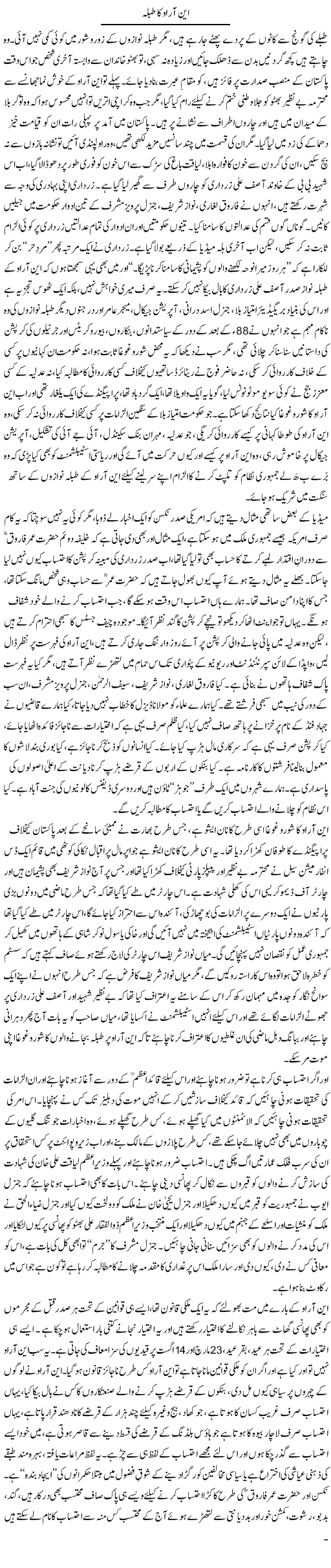
Accountability of Zardari and beyond

A critical analysis by Asadullah Ghalib on the NRO Tabla and the anti-Zardari campaign
.
.
.

Read more...

Monday, 23 November 2009

Shaheen Sehbai attempts (wishes) to convert Gilani into Leghari

By Abdul Nishapuri

They (agents of the anti-democratic establishment in Pakistan) have tried everything to derail democracy. So far, the PPP and its coalition partners have successfully foiled such plans with a smile and a firm commitment to the democratic system.

They tried to create an artificial anti-Kerry Lugar Bill hype, anti-Musharraf, anti-USA, anti-Swat operation, anti-Waziristan operation hype in Pakistan. Their main aim was to derail the democratic set up. But nothing has worked so far.

In their frustration, they also suggested the final resting place (grave) for Zardari. They offered a choice between Medina and Garhi Khuda Bakhsh. The suggestion created a few laughters, and no more.

Now the most dangerous tool of the anti-democracy establishment, namely Shaheen Sehbai, who is notorious for previously writing a series of anti-Pakistan and anti-Pakistan army columns in foreign newspapers, is trying to create a rift between Prime Minister Gilani and President Zardari. Once again, he is no friend or well-wisher of Gilani. He is a well-wisher of the establishment only.

Shame on you, Shaheen Sehbai. Scums of earth, such as yourself, will be remembered in history as Mir Jafars and Mir Sadiqs of Pakistani journalism. You along with Shahid Masood seem to be suffering from Zardari phobia. "Flies" like you are a pioneer of the Mullah Media Alliance in Pakistan.

People of Pakistan are indeed aware of your evil designs. We will soon drag you in a court of law for violating the Article 6 of Pakistan's constitution. You cannot escape the long arm of the law; the gallows await you, along with your other anti-democracy and/or pro-Taliban cronies.

Here is an op-ed written by Shaheen Sehbai which truly reveals his frustrated mindset.

How to clean up the bloody mess-2

Monday, November 23, 2009
News analysis

By Shaheen Sehbai

KARACHI: Prime Minister Yousuf Raza Gilani and the Asif Zardari-led PPP set-up have reached a dead end on their political highway to nowhere. After the official release of the NRO list, it has become impossible for Gilani to sleep in the same bed with boggy and smutty crocodiles and cockroaches when he was about to quit his lucrative job if just a speck of the NRO dirt had hit his real life partner.

This is how outsiders see it. But those sitting inside the secure PM House have no different view and it is now widely known that the Syed from Multan is no longer prepared to take public or private snubs and insults anymore.

His many travels outside Islamabad have often left his hosts in a daze. Recently in Sindh, he was almost in tears recalling to some dear friends what huge burden he was facing on his conscience and how humiliatingly he was being treated by the party high command. In the recent CEC meeting, there was repeated mention of rebirth of Farooq Legharis within the PPP, arrows thrown at the PM by Zardari loyalists meaning that he was a traitor.

It was in this desperate state of mind that Gilani took his revenge and forced his law minister to go out and announce to the world the notorious list of thieves and crooks who had first robbed the country dry and then had taken refuge behind a disgraceful deal with a dictator. He was paying back his critics, in kind.

Once PM Gilani crossed that red line and made the shame and ignominy of even his top leaders officially public, he has left no room for a retreat. It would be the world’s most exciting conversation when President Asif Zardari and PM Gilani sit down again in the Presidency for another of their frequent one-on-one talks. There is no one present when they talk, but there are walls and there are flies on these walls, if not of the biological kind, of the electronic species. Of course, it is generally known that whatever is said within the four-walls of our big secure houses is not only heard by our own spooks and spies but sometimes by even listeners with headphones sitting thousands of miles away. Interestingly, when President Zardari meets anyone, a huge grandfather clock between him and his guest is always ticking. Electronic bugs could always sneak into that clock.

According to one such fly, a recent tense talk between the big two of the country was in such a bad taste and in such foul language that the Syed from Multan may have resigned and left for his hometown directly from the House on the Hill, if anyone else had been present to watch his humiliation. That he did not do so was because he did not want to surrender without his revenge. That was before the NRO sh— had hit the roof.

The situation as it stands today reminds me of a news analysis that I had written under the same headline as this piece, almost 15 months ago. It was on Sept 2, 2008, before Asif Zardari had become the president that I had said: “The sudden prospect of Asif Ali Zardari sitting on the most powerful and sensitive political hot seat in the country has shaken everybody. There is a greater sense of uncertainty in the political class as well as the civil and military establishment, although the presidential election should have removed the clouds of doubt hanging over the political scene.”

Another para had stated: “In short, the leaders and parties are not prepared, or capable, of handling this mess. It would, in fact, be unfair and totally unjustified to expect them to clear the nine-year-old backlog, in less than nine months. Basically, though, the responsibility of correcting the situation is on the elected representatives who should chalk out a plan, call an all-party conference, invite the Army leadership to reach a consensus or whatever, but they seem either not interested or not too involved in petty politicking.”

It was in this piece that I had politely asked the Pakistan Army to play its role, from behind the scenes, to clean up the mess which General Musharraf had left at the doorstep of unprepared politicians. There was a massive uproar in the country over my article and I had counted 29 columns and numerous TV talk shows attacking me for “inviting the Army to take over”. It was a preposterous charge. But look at what happened in the last 15 months.

I had suggested that General Kayani should use his influence to restore the judges to the Nov 2 position. The politicians made him do that on Mar 15. I had proposed that he should get the NRO repealed so that its beneficiaries should be made to face normal process of law and clear themselves. Again the failure of parliament has led to this now being done whether Asif Ali Zardari likes it or not. I had suggested that Kayani should cancel all the secret deals that Musharraf had made with politicians or foreign powers as these deals were not binding. The Kerry-Lugar fiasco and the GHQ reaction hinted at this approach.

It was also said that a National Accountability Commission, with men of undisputed credibility, strength of character and certified competence be set up so that all the corruption cases, past, present and future, are sent to it and anyone cleared by it is genuinely considered an honest and clean person. This is the next likely step to happen.

It was argued that Gen Musharraf must also be brought before it and made to face the charges, instead of providing him a blanket amnesty. Things are moving in that direction without any visible resistance from the Army.

Instead of stabilising the political system, giving a clean and effective government and supporting the Army and security forces to fight the menace of terrorism with full political backing and support, the arrogant and lop-sided governance style of President Zardari has messed up everything. Within a year he has reached the point where everyone is asking and discussing “what after him”. Musharraf took nine years to reach that stage when the Americans dumped him. Zardari was fast. He has now dug into his bunker and is ready to fight. But fight for what? Fight with his own self against his own failures?

Today’s mess is not for the Pakistan Army to clean, as it was 15 months ago. The Army has already played its behind-the-scene role to keep the system going. Today the failure is of the politicians and they should not blame anyone else, as is now becoming a habit in pro-Zardari circles. No one wants to destabilise the system. But the blunders and egocentricities of the PPP leadership is going to do that.

A very mischievous impression is being given that criticism of Zardari, and sidelining him, would mean another attack on Sindhi rights. He should be sidelined because he has failed as a politician and not as a Sindhi. He should pay for his acts of omission and commission, the rampant corruption unleashed all around and the failed policies that he has forced on everybody. All this has nothing to do with Sindh or the Sindhi card.

In fact, all reports from Sindh say people in Larkana and Nawabshah would be more than happy if the tyranny of these newly unleashed feudals is ended. The decades old servants and workers of Mr Bhutto’s ancestral homes would like to come back to their jobs and not live in wilderness any more.

The heavy onus of correcting the situation thus lies on the prime minister and the PPP, or whatever part of the organisation which can come out of the scare spell of the presidency. Gilani is considering many options, including his own resignation if he does not get his way. But right now the centre of power has shifted to his office and the presidency is in a lame-duck mode.

As a starter Gilani can slash his cabinet and remove all the tainted NRO hit ministers, advisers and ambassadors. In one go, he will boost his image and credibility and deliver a fatal blow to the one-man style of governance that has led the PPP into a corner in just two years.

The PM should then move with super speed to get the 17th Amendment repealed, get the competent and popular PPP leaders back into the party fold, take Mian Nawaz Sharif and others on board, even in his cabinet, as in the early days of the coalition. Get a political consensus on major issues, start a dialogue with moderates in the ranks of militants and then lead the country with a focus on ending the miseries of the poor harassed masses and crushing the militancy.

He should keep the president informed and on board if he wants to play along. But it should be clear that the buck would stop at the PM House. If this does not happen and Mr Zardari creates hurdles, plays his dirty tricks, unleashes his ‘Ghairat’ or ‘Izzat’ brigades against the PM, the media, the security establishment or all of them, he would be the one responsible for demolishing the system. No one else should then be blamed. (Source)

Also read: Trying to Knock out Zardari and Army Simultaneously?

Read more...
Saturday, 21 November 2009

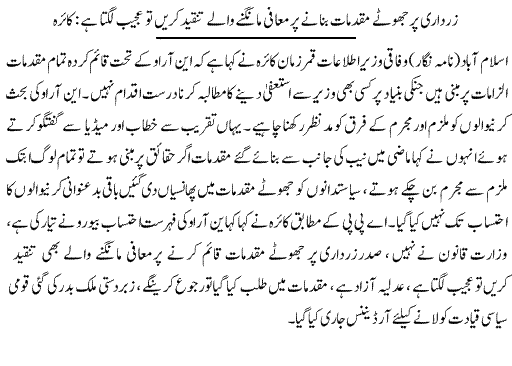
Charge sheet against Zardari

Enemies of democracy and supporters of Taliban taunt President Zardari for what they term as his cowardice to refrain from exposing himself in public meetings. The main aim of the Mullah Media Alliance here is to help their foot-soldiers by "facilitating" Zardari's death in a suicide attack. Asadullah Ghalib offers his analysis on this topic in the following op-ed.


...
Here is yet another great columns on this topic, by Munno Bhai

Read more...

Wednesday, 18 November 2009

Pakistan after President Zardari

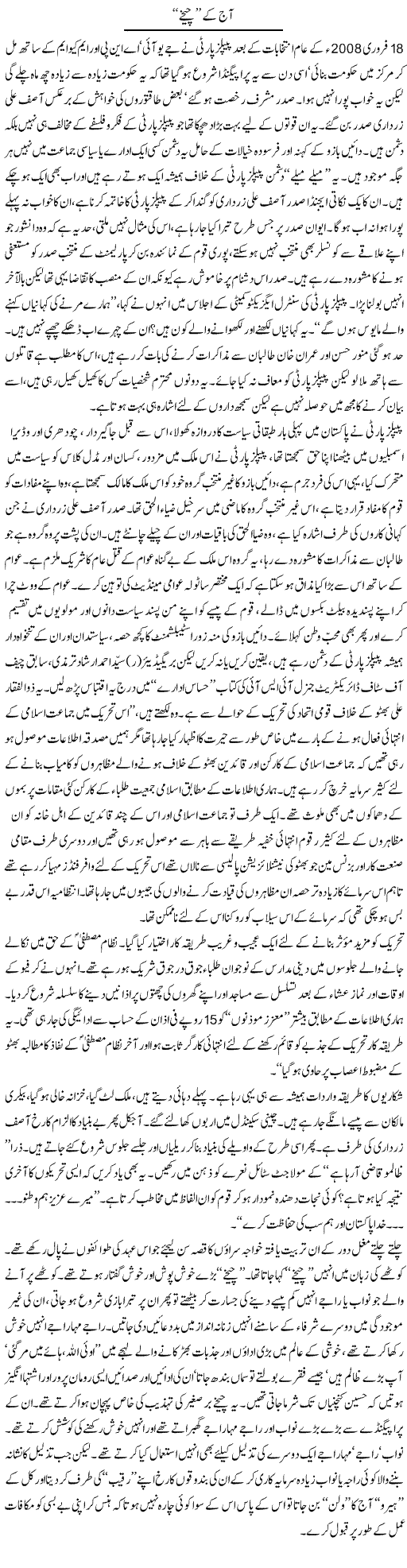
Hasan Nisar presents a realistic picture of a scenario even if the minus-one (minus-Zardari) formula of the pro-Taliban and anti-democracy establishment is implemented in Pakistan. Next is a column by Latif Chaudhry in which he compares certain senior members of the Mullah Media Alliance (Pakistani Taliban Union of Journalists) with the eunuchs (cheekhay) of the Mughal era. Only if wishes were horses...


Read more...

Tuesday, 17 November 2009

General Musharraf: Proclaimed liar


Proclaimed liar

Mir Jamilur Rahman

Mr Pervez Musharraf, in a recent outburst, called President Zardari "a criminal, a fraud and a third-rater". Short of calling Zardari a bloody civilian, Musharraf called a number of colourful names that he thought best describe our president. By calling Mr Zardari names, Musharraf has tarnished the uniform he wore for 44 years and degraded himself.

President Zardari is heavily criticised every day, which he takes in his stride without getting upset. Musharraf sits in his London home and pontificates that Zardari is not patriotic. He does not attack Zardari's policies but uses filthy language against him. He has used the word 'third-rater' for Zardari, but Musharraf's foul tongue has made him a 'tenth-rater'. He has held the two most important offices in Pakistan, the Chief of Army Staff (COAS) and president. Nawaz Sharif is responsible for creating the mother of all follies by appointing him as the COAS. The presidency he grabbed with the help of junior army officers.

Musharraf has been the absolute ruler of Pakistan for nine years but has contributed zero to the well-being of the people. The energy, atta and sugar crises are his legacies. He is now making vain attempts to convey to the people that he is still an important actor in Pakistani politics. He backs up this false assertion by claiming that he and General Kayani are still in contact. One wonders what he talks about with General Kayani. There is nothing common between the two. One is a fighter engaged in cleansing Pakistan of militants and the other is the defeated Kargil general. One respects the democratic authority and the other loathes it. One speaks the truth and the other is a proclaimed liar.

It is very risky for a newspaper to call somebody a liar for fear of legal battle. But the Washington Post did it four years ago. In its editorial titled 'Gen Musharraf lies', the paper called Musharraf a bare-faced liar. It was a serious allegation and had it not been proven, it would have brought millions of dollars to Musharraf in libel damages.

An American journalist describes the episode in the following words: our commando-in-chief can only grit his teeth in the face of damning proof of his mendacity. After making his infamous comment during a Washington Post interview in 2005, insinuating that Pakistani women seek to get raped to make money and obtain foreign visas, he was daft enough to subsequently deny it. The commando-in-chief actually went on record to say: "Let me say with total sincerity that I never said that and it has been misquoted. These are not my words, and I would go to the extent of saying I am not so silly and stupid to make comments of this sort."

He was lying to acquit himself from an awful remark against Pakistani women, but was damned by his own words. The Post not only stood by its interview but also put voice clip of the ex-army chief on its website. Since then, Musharraf promised many things including taking off his uniform, thus earning the title of 'proclaimed liar'.

The women of Pakistan were outraged at Musharraf's rape comments: "you must understand the environment in Pakistan. This (rape) has become a 'money-making concern' and many argued it was a way to get money and a visa to emigrate. A lot of people say if you want to go abroad, get a visa for Canada or citizenship and be a millionaire, get yourself raped."

Musharraf could have saved face by apologising to the Pakistani women. However, he lacked the courage to admit his imprudence, just the way he lacked courage to admit his Kargil blunder.

The writer is a freelance columnist. Email: mirjrahman@hotmail.com
(The News, 17 Nov 2009)

Read more...

Monday, 16 November 2009

Zardari at a crossroads - An analysis by Mahmood Sham

Perhaps, the members of the central executive committee of the Pakistan People's Party (PPP) do not realise that this meeting is taking place at an extremely decisive juncture of the Zardari era. The apolitical forces have made up their mind to oust a political president.

So much moral pressure has been exerted on the presidency of Zardari through the media, judiciary and the coalition partners of the PPP that these forces believe there would no serious reaction in a few circles in Sindh in case he is removed from the office and there would be calm after a few days.

These forces claim US Secretary of State Hillary Clinton, after reviewing the situation herself, has signalled from Washington that they would issue statement saying that it is internal matter of Pakistan. These quarters do not think that Zardari has some trump card to stop any such development.

It is to be seen as to which way out is suggested by the PPP central executive committee to its leadership of this situation and as to what steps President Zardari can take, after taking the party into confidence, to save the democratic system. There is a chance that any respectable personality is made a powerless president in consultation with all political parties and all powers are vested in the prime minister. Permission may be sought from the judiciary for appointment of a cabinet comprising technocrats so that the objectives of good governance and economic stability could be achieved. On the other hand, the military can focus all its attention on elimination of terrorism. The provincial governments may not be touched in the first phase. President Asif Zardari wants to improve the situation by announcing in the first week of December the abolition of the 17th constitutional amendment.

It is being stated that Eid of many may be spoiled as the month of sacrifice demands sacrifices. Who comes up to the standard of sacrifices and besides the individual sacrifice, arrangements are also being made for collective sacrifices. In a democratic system, voters and then parliament has the authority to take decisions but the schedule is being finalised somewhere else. Nobody is suggesting a formula to make the parliament powerful and supreme. The fate of 75 million people, who have to make their destiny, is being decided in Washington, GHQ, Aiwan-e-Sadr and Raiwind. Much is being heard about the impending change and only procedure is being settled.

Before addressing the readers, I first went to the power corridors in Lahore and Karachi to have firsthand knowledge about the facts and then went to Islamabad to observe the situation. According to one scenario, it is being thought that everything should go ahead in accordance with the constitution and it does not happen. But there is no harm in assuming that the government of the majority party elected in the February 18, 2008 elections should complete its term, the prime minister should hold his office till March 24, 2013 and President Asif Zardari should stay in the presidency till September 8, 2013 after announcing fresh elections in February 2013 before completion of the term of the National Assembly. Moreover, Chief Justice Iftikhar Muhammad Chaudhry should hold his office till 2013. Chief of Army Staff General Ashfaq Parvez Kayani should retire on completion of his three-year term on November 29, 2010 and his successor should be appointed. This scenario is of the civilised and democratic societies where the government, judiciary and military do their respective jobs.

Most of the rumours circulating in the country are about President Zardari and it seems that a politician became the president against the will of many. It has been experienced several times that a prime minister commanding majority in the parliament is removed from the office but the action against a president elected by majority in the parliament will be the first of its kind.

One of the efforts to flood the national and international media with so much old scandals to increase moral and political pressure on the president to such an extent that he himself is compelled to find solace in stepping down. This advice is also being conveyed directly through friends and close circles and this impression has been deepened that the military is uneasy with his status of the supreme commander. Therefore, the comments and intentions of President Zardari and Pakistan Ambassador to the US Hussain Haqqani regarding the military in direct and telephonic conversations with the US administration are being made the major justification. The gulf between the military and the president widened after unveiling of the details of the Kerry-Lugar Bill. The military circles expressed their disliking for the bill covertly as well as overtly and it seems there is no chance of backtracking.

Some circles within the PPP are of the view that the electoral victory of the PPP and election of Asif Zardari as the president were not wholeheartedly accepted in the very beginning but the gulf started widening when President Zardari offered India to sign an accord for not using nuclear weapons in South Asia. They claim that the step was taken after taking the concerned military quarters into confidence. They said that the efforts regarding the trade across the Line of Control were also disliked and then the Mumbai terrorist attack created a lot of misunderstandings between the military and political leadership. The issue of the identification of Ajmal Kasab added fuel to the fire while objections have also been raised about the close ties with and repeated visits to China saying that the military leadership is not taken into confidence. The efforts to address the problem of political unrest and sense of deprivation in Balochistan and stance of a standing committee about non-construction of cantonments are also a source of conflict whereas the military circles describe the notification to give the control of the ISI under the Ministry of Interior as the beginning of the differences. Asif Zardari was not president at that time though he has been held responsible for that. The notification was issued when the prime minister embarking upon his maiden trip to the US, and we too were accompanying him, directed for issuing an explanation in this regard. But when a condition was attached with the Kerry-Lugar Bill to vest the power of appointments and promotions in the military in the civil administration, it was linked to the notification of July 2008. Some ministers talked about the military irresponsibly. The prominence of the pictures of Zulfikar Ali Bhutto and Mohtarma Benazir Bhutto as compared to that of Quaid-i-Azam in the Aiwan-e-Sadr has also been described as tantamount to tainting the image of this purely apolitical office. Holding of the party leadership and the party meetings in the presidency has also been disliked by the establishment. It is ironic that the president, who is head of the establishment, and establishment are pitched against each other, and at a time when the armed forces are fighting the militants in various parts of the country, this might be extremely harmful for the country.

The November 28 will be made doomsday with regard to the NRO and those who benefited from the ordinance will have to seek bails but the courts where their cases were being heard will be unable to grant them bail and high courts are being described as eligible to do so. There is an impression that the chief justice was not restored by President Asif Zardari on his own but did so under the pressure of the long march, the US and army. Some circles are describing the executive order to restore the chief justice as unconstitutional. This order could have been passed earlier and that would have benefited the president. Instead of a good opinion, the attitude of the senior judiciary is rather adverse. Therefore, it is being expected that the judiciary and legal pendulum will swing in disfavour of the PPP. The closest aides of the president including Rehman Malik and Salman Farooqi seem to be caught in the NRO snare and PPP Secretary General Jahangir Badr will also fall prey to the NRO while no action can be initiated against the president because of the constitutional protection. However, an affidavit submitted by him in a British court about his mental health has been found and a senior lawyer is drafting an application on the basis of that document. Some legal circles are highly confident that the chief justice would immediately rule him ineligible for the office of the president. The PPP circles are not giving it importance more than a joke but the ruling given by the chief justice would be accepted because he is currently stand high moral ground.

Stories about the relationship between Prime Minister Yusuf Raza Gilani and President Asif Zardari have also been making rounds and several quarters tell the prime minister that he is the chief executive so he should assert himself. It is said he is close to Mian Nawaz Sharif and in case of a no-confidence motion, the PML-N will vote for him. One impression is that the military finds itself closer to the prime minister. There is no immediate chance but if the PPP decides to elect a new prime minister, a crisis might erupt because the PML-N and media will make hue and cry.

But the issue of coalition partners, ANP, JUI and MQM directly pertains to President Zardari. He has been meeting commitments made with them and fulfilling their conditions. It will be seen as to whether or not the army will intervene in such a scenario to create internal strife in the PPP.

The US might want political crisis in Pakistan in view of the deteriorating political situation in Afghanistan but no alternative to Gilani is been searched for the time being. However, the president will emerge victorious if such an attempt is made.

The way the Pakistan Muslim League-Nawaz is opposing President Zardari on the Kerry-Lugar Bill, NRO and submarines deal, it might turn PPP's coalition in the Punjab as an unnatural alliance. Leaders and workers and even ministers of the PPP in Punjab are themselves not satisfied with the present dispensation. Besides political opposition, they say that police and government servants are not being given their due respect. Mian Sahib is often repeating that Musharraf's era is continuing.

When the PML-N is not ready to join the government at the Centre, why in the Punjab power is being shared with those dubbed as corrupt, ultra-constitutional, and bargaining their respect for American slavery? Loyalties of the bureaucracy have been divided.

Mian Shahbaz Sharif despite all his abilities and enthusiasm has not been able to show the mettle of the past chief minister and this in turn is taking its toll on the Punjab. Here any change in the government from any side before budget could be both historical and logical. How long the president and the prime minister would tolerate it? Both the army and the judiciary could play a key role in averting this crisis.

There is also a possibility of operation against the terrorists in south Punjab. Logic of the same is being found in reports from the US and contents of the Kerry-Lugar bill. The Punjab Government is not showing any seriousness in ending extremism here. Therefore if any plan to destabilise the Punjab Government is made, the operation will be its focal point.

It is being painfully thought that nothing should be said to the provincial governments and a cabinet of technocrats be set up at the Centre under the prime minister. It is also being called as 'Bangladesh formula', where the chief justice is leading the cabinet. This way an independent and courageous chief justice could be jacked up from here and brought at the top before 2013. However, technocrats have to be taken from the political parties so that political forces do not make a hue and cry against such a dispensation.

The objective is to create political and economic stability in the country. Except the PPP, others have already given the names of such persons. All these formulas are making rounds but what will be the course? Will it be ultra-constitutional or will be a legal framework order? What homework would have been done for making such a system acceptable both morally and politically? Can't the PPP stop all these scenarios through its political sagacity? The success of PPP in Gilgit-Baltistan is though a harbinger of victory for the PPP but, by making tall claims of rigging, the rival political parties want to turn it a part of the charge-sheet against the party. We wanted to know as to what damage control steps the high echelons of the PPP in the Presidency and Prime Minister House are taking in Islamabad.

Both the president and the prime minister are openly expressing their concern over spreading of these landmines. It is being heard that the president while sensing the dangers is ready to confront them and not leave the ground open under pressure. He does not believe that the army or the judiciary have decided to send the democratic system packing. We restored the chief justice and he is now deciding the fate of judges without any interference from our side. Every PPP government has always given strong institutions to the country. It established the National Finance Commission, set up the Council of Common Interests, formed the Friends of Pakistan at international level which will help Pakistan during the PPP rule but also in future. Long-term projects are being planned as a result of frequent tours to China. In the past the formula of Maxi Pak seed was obtained from the US and now the experience of China is being exploited which will provide seeds that give good yield even in little irrigated lands. He believes that in India too the small political alliances tease both the Congress and the BJP but this does not result in ending the democratic dispensation adding why then such fears persist here.

The PPP is striving to forestall events like political parties summersaults on the NRO in future. Negotiations have been taking place and some parties have been making demands that would have been difficult for any one to pay.

In so far as good governance is concerned, the first two years were consumed in clearing the dirt of the past. Loadshedding, water, dams and such other issues are being dealt with on permanent basis. The party high command believes that if it goes by the advice being given that some ministers and corrupt colleagues be removed to restore the party's image, it will lead to a division within the party. It instead wants to adopt a legal course in this regard but will not leave colleagues in the lurch during difficult times. They still believe their policy of reconciliation to be in the interest of the country. We want to come so closer that there is no foe in future and the PPP, ANP and MQM join hands as political partners. It will stabilise democracy. High echelon of the party and the government do not believe at any stage that those elected on the party ticket will change loyalty. NRO could have been got through the parliament but when it was felt that it was not in the interest of the country it was not made a matter of ego and thus not taken up in the parliament.

Counselling is being offered for using presidential pardon for corrupt elements but these pieces of advice are not being accepted. Circles believe that steps taken in urgency in face of the media campaigns and some irresponsible statements from individuals within the government have morally dented the government image to a certain extent but why then all the blame is put on the president? After all the prime minister is the head of government. It is a sort of one-sided campaign where the wrongs committed by the opposition and the prime minister are also being ignored. The president alone is being made a scapegoat. But, if the president shows steadfastness and keeps close contact with party colleagues and other institutions of the state, an atmosphere of tolerance among them will develop.

In past, collective sacrifice had inflicted damage on the country, which could also happen now. Some circles have advised that the whole mess was created by media, TV channels and ban should be imposed on them. But, the president and prime minister have categorically decided that no action would be taken against media despite the propaganda against them.

Co-Chairman of the PPP and President Asif Ali Zardari has been facing internal and external challenges which were never faced by any Pakistani leader in the history of Pakistan. Could he and his team overcome them? Have they such an ability and capability. Sympathetic circles say that if it is not evident then they should be helped, as no leader of any other party could face these threats so easily.

The concerns of the establishment are right, but its solution lies in collective leadership and mutual consultation. Packing the whole democratic set-up would not serve the purpose. The country has been weakening. Still there is need for the reconciliation ideology of Benazir Bhutto, which President Zardari had made base for democracy.

On the other hand if the non-political forces expect better results from technocrats, then why a road map for this democratic set-up could not be made by technocrats that should be implemented through Parliament, through which the ministers and parliamentarians could get training.

The US has been facing difficult situation in Afghanistan and its worst effects could engulf Pakistan. In such a situation any crisis in Pakistan would not only be dangerous for itself, but also for the whole region.

NWFP is fighting against terrorists, Balochistan has been suffering from sense of deprivation and if Sindh was inflicted with political setback, then such chaotic and violent social set-up whether political, non-political or technocrat would not bear the internal and external challenges. Those who are crossing the limits should be pressed to conduct meaningful debate in the Parliament. At last a strong Parliament could create a society of rule of law and democracy in Pakistan, like the US, Europe and India.


Monday, November 16, 2009 (The News)
....

PPP CEC meeting
Dawn Editorial
Monday, 16 Nov, 2009

THE meeting of the Central Executive Committee of the PPP in Islamabad is a chance for the party to hit the reset button and steady the ship of governance that has been rocked by political crises in recent times. As the largest party in the coalition at the centre and a member of three of the four provincial governments, the PPP is clearly the most politically powerful party in the country. However, as the recent NRO debacle vividly demonstrated, the PPP’s parliamentary advantage is not large enough for it to go it alone and therefore does not automatically translate into legislative and policy successes. Politically, therefore, the PPP remains vulnerable and under pressure and the party must use today’s meeting to chart a new course for itself. There are some obvious things the party can do to reduce the prevailing political uncertainty: speed up the passage of the 18th Amendment bill, strip away the anti-parliamentary powers of the president, lift the bar on a third-term prime minister, etc. Such measures would be proof that the party leadership can be statesmanlike and rise above the poisonous environment of cut-throat, mutually destructive politics.

But the weaknesses of the PPP-led coalition are not purely political. There is a palpable sense of drift in Islamabad in governance matters. Does anyone know if the PPP has a legislative agenda, and if so, what that agenda is? There are scores of ministries and ministers and ministers of state, but what have been the policy initiatives of the vast majority of them? The PPP has fully backed the fight against militancy and its economic team has helped at least stave off economic disaster — for which the party does deserve the appropriate credit — but the problem is that on the achievement front there is little else of any significance. With nearly a third of this parliament’s full term having already gone by, it is unfortunate that politics, and not policies, continues to occupy centre stage.

Away from the national, inter-political stage, intra-party politics may also need to be addressed by the CEC. One of the persistent uncertainties is the relationship between the president and the prime minister. As co-chairman of the PPP, President Zardari would still technically be the boss of Prime Minister Gilani in party affairs even if the powers arrogated to the presidency by Gen Musharraf (retd) were to be given up by Mr Zardari. As such, any tension or difference in opinion between the two men could impact national political stability. Messrs Zardari and Gilani, therefore, need to demonstrate that they are in fact on the same page. (Dawn)

Read more...

Friday, 13 November 2009

The Triple S Brigade's ill-wish and Zardari's grave

"The Triple S Brigade" (i.e. Shaheen Sehbai, Shahid Masood, Shireen Mazari) are persistent in their anti-democracy and pro-Taliban agenda.

Lady Taliban, Dr Shireen Mazari, the Resident Editor of The Nation, has released the following report on President Zardari, through her reporter Maqbool Malik (a close associate of Ansar Abbasi), about the possible location of Zardari's grave.

The triple S brigade, and other Friends of Taliban in Pakistan, it would appear, are now resorting to ill-wishes in order to get rid of the democratic government. Here is the news item which appeared in The Nation on 11 November 2009, which is followed by a satirical analysis by Nazir Naji:

Zardari chooses Ghari Khudabakhsh as last abode
By: Maqbool Malik | Published in The Nation: November 11, 2009

ISLAMABAD – Struggling head-on to surmount a plethora of challenges, President Asif Ali Zardari has been contemplating about his future to the extent of even choosing his last abode, The Nation has reliably learnt on Tuesday.

According to sources close to the President, Asif Zardari has been brainstorming for some time whether it should be Ghari Khudabakhsh or Madina (Saudi Arabia) for his last resting place.

The sources were of the view that President Zardari has actually chosen Ghari Khudabakhsh as his last abode, which he reportedly believed, had more to do with the cause of democracy in the country.

“President Zardari is prepared to die for the cause of democracy rather than succumbing to any pressure to compromise”, the sources said.

According to the sources, the President has been making up his mind about his personal decisions for quite some time now. They also denounced the impression that he made up his mind after surviving three attempts aiming at unseating him from the power corridors. Rather, the sources added, the President was determined to do or die for his ambition of changing status quo with a governance system based on democracy and accountability.

Another source well acquainted with President Zardari shared with the TheNation the secret of Zardari’s self-assured grin saying, “It was always to give out a contrary impression.”

“Trust deficit has been haunting the President ever since he stepped into his political career”, the sources informed.

Ghari Khudabukhsh is the ancestral graveyard of President Zardari’s in-laws where apart from his assassinated wife and two times Prime Minister late Benazir Bhutto, his father in law late Z.A. Bhutto and brothers-in-law are buried.


Read more...

Wednesday, 11 November 2009

In the name of God, go. Let our next military saviour step in.

By Abdul Nishapuri


Friends of Taliban in Pakistani media are continuously and shamelessly suggesting that politicians are corrupt, and that democracy has failed to deliver good governance in Pakistan.

Here are two different perspectives on this topic: The first perspective is offered by Ansar Abbasi and Roedad Khan who suggest that in the interests of the country, President Asif Zardari must quit his position sooner than later.

The second perspective is offered by Nazir Naji who deconstructs the myth that politicians are corrupt whereas military dictators are the saviours of Pakistan.

....

In the name of God, go

Wednesday, November 11, 2009
Roedad Khan (The writer has been a key supporter of the military dictatorships of Generals Ayub, Yahya and Zia-ul-Haq.)

Some leaders sail with the wind until the decisive moment when their conscience and events propel them into the centre of the storm. Altaf Hussain's fateful decision not to support Zardari on the infamous NRO issue was a masterly stroke in the game of politics. Otto von Bismarck famously said that political genius entailed hearing the hoofbeat of history and then rising to catch the galloping horseman by the coattails. This is what Altaf Bhai has done, to the surprise of friends and foes alike.

Altaf Bhai's friendly advice to President Asif Zardari to sacrifice his exalted office for the sake of the country and democracy reminds me of the fateful "Norway Debate” in the House of Commons in May 1940. Britain was at war, facing the full might of Nazi Germany. In the backdrop of the dismal picture of failure and retreat which confronted the nation, L S Amery, MP, delivered the historic speech which led to the resignation of Prime Minister Chamberlain and elevation of Churchill as prime minister. "I cast prudence to the winds," Amery wrote in his diary, "and ended full-out with my Cromwellian injunction to the government… 'You have sat too long here for any good you have been doing. Depart, I say, and let us have done with you. In the name of God, go.' "

"I say solemnly," Lloyd George who followed Amery, declared, "that the prime minister should give an example of sacrifice because there is nothing which can contribute more to victory in this war than that he should sacrifice his Seals of Office." President Lyndon Johnson had won an enormous election victory and proposed civil rights legislations and Great Society. Less than three years later, broken by the Vietnam War, realising the nation no longer trusted him, and unable to appear in public, he announced he would not seek re-election. What is President Zardari going to do?

All presidents fall from their honeymoon highs, but no elected president in history has fallen this low this fast. All presidents are opposed, of course, and many are disliked; but few suffer widespread attacks on their personal integrity or veracity. President Zardari is one of those few. Zardari knows well the man responsible for the trouble he is in. He looks at him everyday while shaving.

Talking about despotic rulers, like himself, Mussolini said just before he faced the firing squad: "Have you ever seen a prudent, calculating dictator, they all become mad, they lose their equilibrium in the clouds, quivering ambitions and obsessions – and it is actually that mad passion which brought them to where they are." Absolute power, unrestrained by law, must make people mad. Power is heady substance. How else can one explain Zardari's erratic behaviour and his massive blunders?

Sometimes, once in a long while, you get a chance to serve your country. Today President Zardari is the Atlas on whose shoulders the state of Pakistan rests! Few people had been offered the opportunity that lay open to Mr Zardari. He blew it. No wonder, the country is gripped by fear and uncertainty. If Zardari remains in command of the ship of state, we will all go down like the Titanic.

At a time when the country is at war, Mr Zardari, the Supreme Commander, spends almost his entire existence in the confines of a bunker – which he seldom leaves these days. Mortally afraid of his own people and the sword of the NRO hanging over his head, he is more concerned about protecting himself and his power rather than protecting the country or the people of Pakistan.

Mr Zardari is so swathed in his inner circle that he has completely lost touch with the people and reality. He wanders around among small knots of persons who agree with him. His blunders are too obvious, his behaviour too erratic, his vision too blurred. He has painted himself into a corner.

A year after he captured the presidency, Zardari seems to have lost his "mandate of heaven." At a time when leadership is desperately needed to cope with matters of vital importance to the very survival of the country, Pakistan is led by a president who lacks both credibility and integrity. What is worse, he seems oblivious to the realities of his awesome responsibilities and is only interested in perpetuating himself.

What is it that people really expected from their president in a national crisis? It is something that the national psyche needs. The people, especially those in the war zone, expect the occupant of the Presidency to share their suffering, to assure those trapped in the crossfire that they will survive; that they will get through it. He has to be a Chief Executive who is in command, who reacts promptly, who alleviates human suffering. Above all, he must inspire confidence and hope. And so, he has to be that larger-than-life figure, which Zardari is not. No president and no prime minister can govern from a bunker.

These are critical days in Pakistan. Isn't it a great tragedy that at a time like this there is a loveless relationship between the rulers and the ruled? There is no steady hand on the tiller of government. The survival of the country, its sovereignty, its stunted democracy, its hard-won independent judiciary, all are on the line. Tragically, in our political life, we prefer to wait until things reach the emergency room. Each man feels what is wrong, and knows what is required to be done, but none has the will or the courage or the energy needed to speak up and say enough is enough. All have lofty ideals, hopes, aspirations, desires, which produce no visible or durable results, like old men's passions ending in impotence.

"Fortune is a fickle courtesan," Napoleon said on the eve of the battle of Borodino. "I have always said so and now I am beginning to experience it." When I watched Zardari a few days ago on TV, he was visibly undergoing a similar experience and looked like the captain of a sinking ship, the wind of defeat in his hair. How fortunes fluctuate! The calendar says Zardari will be around for another four years, but the writing on the wall shows the party is almost over.

For Mr Zardari, the accidental president of Pakistan, the moment of truth has arrived. His presidency is collapsing all around us; the wolf is at the door.

The presidency is more than an honour, it is more than an office. It is a charge to keep. Asif Zardari's sudden ascension to presidency caused panic among the people. Thrown there by accident, he is grotesquely unsuited for his position. Henry Adams once wrote that the essence of leadership in the presidency is "a helm to grasp, a course to steer, a port to seek." President Zardari grasped the helm more then a year ago but the country still doesn't know whether he has an inner compass, or a course to steer or a port to seek. It is now abundantly clear that he is not worthy of the trust placed in him by his people. He carries a serious baggage, dogged for years by charges of corruption until they were abruptly dropped under the NRO, which he tried to get validated through the Parliament but failed. No democrat should come to power through such an array of backroom machinations, deals with Generals or foreign powers. No wonder, too many people reject Zardari's political legitimacy.

The Zardari aura is crumbling. His star is already burning out, but he will stop at nothing to keep his lock on power.

The writer is a former federal secretary. Email: roedad@comsats.net.pk, www.roedadkhan.com (The News)

....

Ansar Abbasi:

...
Nazir Naji

Read more...

Zardari Unpopular Even Amongst PPP Voters?

According to the agents of pro-Taliban and anti-democracy forces, President Asif Ali Zardari is unpopular even amongst PPP supporters. Some elements have suggested that if Zardari is removed (?) from power, no more than a handful of Pakistani citizens will feel sorrow for him or for PPP. Here is an analysis by Abbas Ather.


Read more...

Tuesday, 10 November 2009

We won't let you bury NRO; you can bury democracy instead.

Here is a selection of three op-eds on this topic:

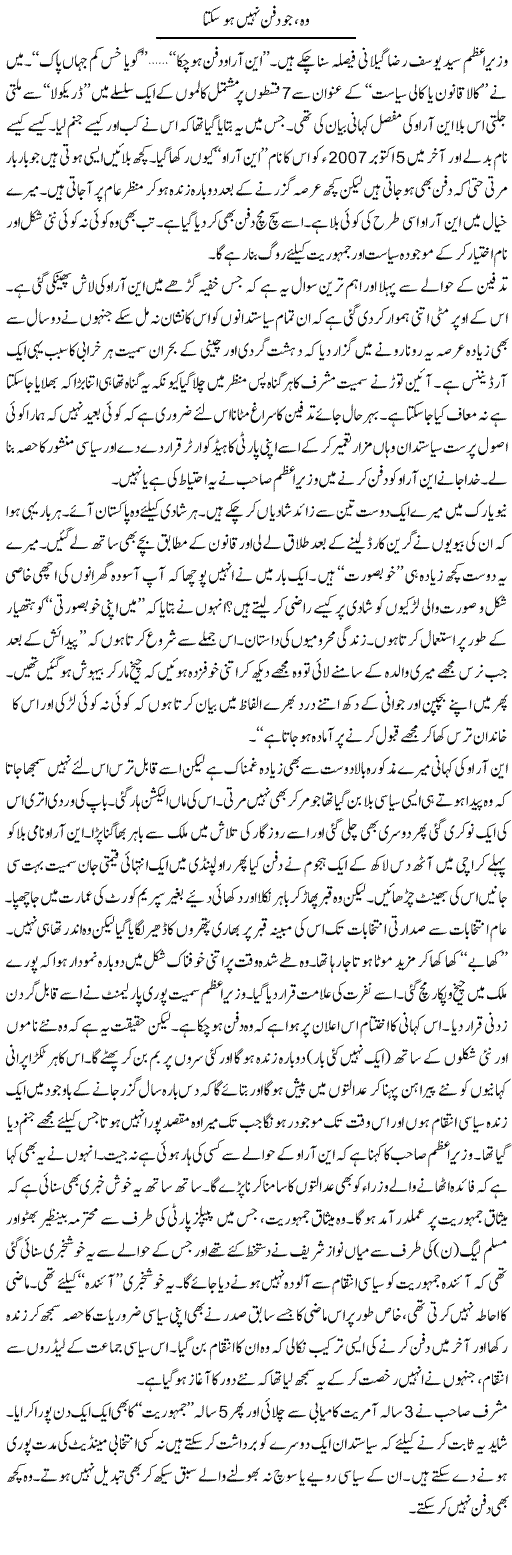
Abbas Ather notes that the right-wing (pro-Taliban) anchors and propagandists don't want to bury NRO; instead they wan't to bury democracy in Pakistan.

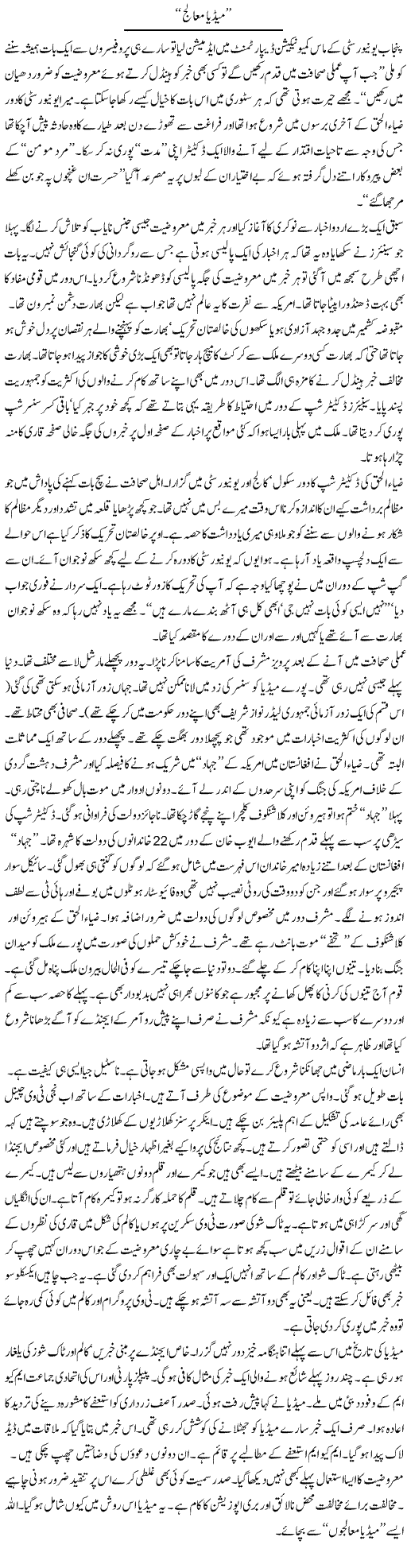
Munno Bhai wonders if the abusers of the freedom of media in Pakistan might need a "Saif-ur-Rehman" in the future?

Ayaz Khan advises anchors and journalists with a particular (pro-Taliban, anti-Zardari or anti-democracy) agenda to have a bit of objectivity in their reporting and analysis.

(Abbas Ather)

(Munno Bhai)

(Ayaz Khan)

Read more...