Editor's Choice

--------------------------------------------------------------------------------------------------------------------------
Featured Post
--------------------------------------------------------------------------------------------------------------------------

"Let us build Pakistan" has moved.
30 November 2009

All archives and posts have been transferred to the new location, which is: http://criticalppp.com

We encourage you to visit our new site. Please don't leave your comments here because this site is obsolete. You may also like to update your RSS feeds or Google Friend Connect (Follow the Blog) to the new location. Thank you.


--------------------------------------------------------------------------------------------------------------------------
Showing posts with label Abbas Ather. Show all posts

Sunday, 22 November 2009

Establishment's temporary NRO for Yusuf Raza Gilani

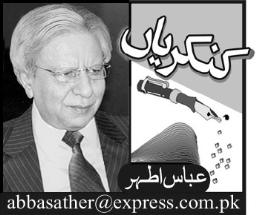
It seems that the all powerful establishment in Pakistan and their agents in Pakistani media have decided to, at least temporarily, ignore the cases of alleged corruption against Prime Minister Yusuf Raza Gilani (and other politicians). They have offered this temporary NRO to Gilani because their first target is to hit and malign President Zardari. Gilani and other politicians will be dealt with in the next round. Here is what was reported in Dawn today, which is followed by an analysis by Abbas Ather:

PM’s wife paid Rs45.5m against Rs570m liabilities
By Syed Irfan Raza
Sunday, 22 Nov, 2009

ISLAMABAD: Although the wife of Prime Minister Yousuf Raza Gilani had settled her default case with the National Accountability Bureau (NAB), she had been given ‘undue favour’ and asked to pay only Rs45.5 million against total liabilities of Rs570 million, sources in the NAB alleged on Saturday in an interview with Dawn.

A scrutiny of Fauzia Gilani’s case revealed that she had obtained two loans totalling Rs200 million from Zarai Taraqiati Bank Limited (ZTBL), but she settled the case after committing ‘wilful default that prevailed over a decade’.

According to documents, the sources said, the principal of Rs200 million had swelled to Rs570 million as non-payment of instalments spanned a decade. However, she managed to settle the case by paying back Rs45.521 million.

The sources said she had obtained a loan of Rs120 million for Multan Edible Oil Extraction and another loan Rs77 million for Pak Green Fertilisers.

According to the NAB press release, the cases were settled by the ZTBL in pursuance of the Sindh High Court’s order of Oct 2, 2006, and March 17 of last year and a circular of the State Bank.

In consequence, ZTBL forwarded a request to NAB for withdrawal of the cases.

‘After having received clearance of liability certificate from ZTBL regarding full payment of the settlement amount of Rs45.521 million, NAB withdrew references against the companies.’

The source said Mrs Gilani had gone through the prescribed procedure of settlement of ‘wilful default cases’. They interpreted the move as a ‘confessed wilful default’.

The NAB Ordinance defines wilful default as: ‘Wilful default under this ordinance if he does not pay, or continues not to pay, or return or repay the amount due from him to any bank, financial institution, cooperative society, Prime Minister Gilani faced two other cases in NAB—illegal appointments in National Assembly when he was National Assembly speaker and purchase of vehicles. Both cases were settled in the Islamabad High Court.

A case of the prime minister’s personal secretary, Tariq Khakwani, in which he was accused of obtaining a plot in Sector I-8, Islamabad, under the prime minister’s quota in 1988-89 is still alive in Lahore High Court.

The NAB had filed an appeal against its own reference and had requested an accountability court to dispose of the case.

However, the court turned down the request and the NAB moved LHC against the accountability court’s decision.

The LHC upheld the verdict of the accountability court and the case is still pending. Source..

Abbas Ather
.

Read more...

Friday, 20 November 2009

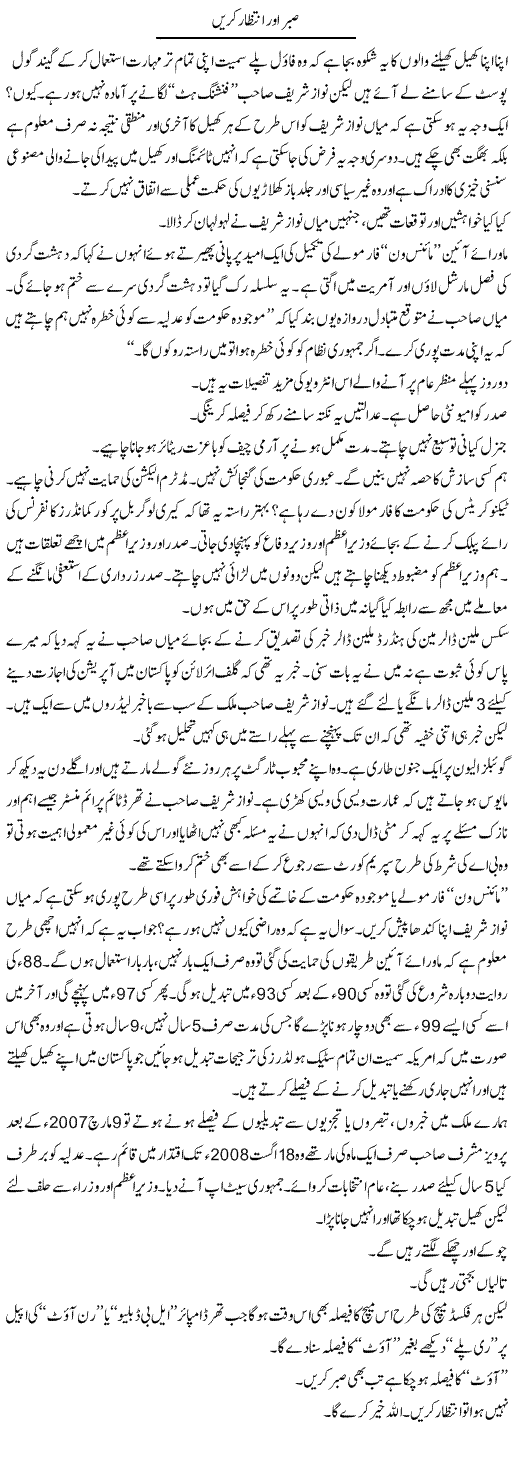
"Goebbels Eleven", minus-one brigade and Nawaz Sharif


Here are three columns on this topic: The first one is by Ayaz Amir (a PML-N MNA) who terms the minus-one brigade (Shahid Masood, Ansar Abbasi, Shaheen Sehabi etc) as media galdiators. The second column is by Asadullah Ghalib in defence of democracy (President Asif Zardari and Opposition Leader Nawaz Sharif), and in defiance of the anti-democracy and pro-Taliban agenda of the Mullah Media Alliance also known as Pakistani Taliban Union of Journalists. Finally, the third column is by Abbas Ather who highlights the frustration of Goebbels Eleven because of Nawaz Sharif's refusal to be a part of the Establishment's game against democracy.

...

The charge of the minus-one brigade

Friday, November 20, 2009
Ayaz Amir

A week is indeed a long time in politics. Just last week the get-Zardari campaign was in full swing. Media gladiators — now very much the media’s vanguard — and assorted weather prophets were convinced (they had certainly convinced themselves) that he had to go. Indeed, that his departure was inevitable. They only differed about the timing.

Their first self-imposed deadline was September. When that passed — President Zardari, spending most of that month on a never-ending series of foreign visits — the deadline shifted to October. Then it was November, then December, some optimists being so specific as to propose Dec 7 as D-Day. But just in a few days all this feverish speculation, some of it accompanied by near-foaming at the mouth, has suddenly died down, all because of two developments:

(1) The note of defiance struck by Zardari at a meeting of the PPP Central Executive at which he declared that no matter what his enemies said, the PPP would not succumb to pressure and would continue its “forward march”; and

(2) Nawaz Sharif’s clear affirmation, leaving nothing to doubt, that if there were any threats to the democratic system he would stand in the way.

Nothing has fundamentally changed. We could do with a more effective government at the centre, and it would be in everyone’s interests if fewer skeletons rattled in Mr Zardari’s many cupboards. But the dark clouds massed on the horizon have receded, revealing an open sky.

And media gladiators have gone silent. Which doesn’t mean their gloomy prognostications will cease: that’s hoping for too much. But having received a rude shock in the form of the two aforementioned developments, it will be some time before they can work up vitriolic anger to the levels we saw in recent days.

True, they can no more abide Zardari now than they did before. But their hopes have been dashed and before the outline of things becomes clearer, perforce they have to rein in their enthusiasm.

The PPP’s defiance has played its part in this process. But the man of the hour is Nawaz Sharif, whose clear stance against any extra-constitutional move has been the decisive factor in halting the headlong charge of the minus-one brigade.

Once upon a time his detractors — of whom there was never a shortage — dubbed him as the quintessential man of confrontation. And to think that now he is the principal bulwark of the present democratic order. Which I suppose only goes to show the extent to which his political outlook has matured.

Zardari alone would be vulnerable — was vulnerable — to the array of forces ranged against him. Much as he and his camp may hate the thought, it is Nawaz Sharif who is holding him up — not, it goes without saying, for Zardari’s person but for democracy’s sake. Having gone through the mill and learning from bitter experience, Nawaz Sharif, more than most politicians, is not only aware but feels it in his bones that once extra-constitutional moves are afoot there is no knowing how and where they will end.

Minus-one, then, remains confined to not one number but acquires wider and wider dimensions. So it has been always in our history, not once but four times, each successive intervention leaving behind a richer crop of disaster than the one before. Why should it be any different this time?

But we remain slow learners. Even though the memory of Musharraf remains alive and fresh, here we were seeing a fresh army of enthusiasts hoping for some kind of miracle that, in their eyes, would cleanse the presidential stables. How precisely this was to be achieved they weren’t quite sure, but they were convinced that it would somehow happen.

Would Triple One Brigade move? No, no, that wasn’t an option. So what, then? Oh, bereft of all support, Zardari just couldn’t go on. His position was untenable. It was in his best interest if he stepped down himself; otherwise, he would be made to quit. But how? Oh, it would happen. This was mumbo-jumbo, more an articulation of belief and faith than any attempt at political analysis.

But it had Islamabad in its grip even if there was something completely surrealistic about these angry mutterings. The party was solidly behind Zardari, all too aware that even if his name was mired in controversy, as the keeper of the Bhutto flame he was the unlikely cement holding the party together. It was all calm and peaceful in the National Assembly, with not the slightest hint of discord. So, coming down to the technicalities of it, how would the get-Zardari operation proceed?

One expected scenario, of course, was that the NRO would be the bomb to explode in Zardari’s face. But sensing the mood in the National Assembly — which would have erupted in revolt if there had been an attempt to force the law down its throat — the Presidency, for once, acted sensibly, choosing discretion over valour and withdrawing the bill. This had a double effect. It rescued Zardari from the pit into which he was walking and it seriously confounded his enemies, who were hoping he would hang himself with this rope.

In a sense, therefore, if the tabling of the NRO in the National Assembly was the high watermark of Zardari’s troubles, the decision to withdraw it — under pressure, let us not forget — may be the starting point from where the pressure on him begins to ease. We shouldn’t find this mystifying. Zardari’s fortunes had hit rock bottom. From there the only way forward was up.

I think the political class as a whole and the media need to go through a refresher course in politics after the debacle of the minus-one brigade. Do we believe in democracy or not? If we do, we must abide by democracy’s rules. Zardari is elected president of the Republic and if his transgressions are so great that they are considered a threat to the country, there is a procedure under the Constitution for presidential impeachment.

That is the only choice anyone has, and if there are objections to it, then the only alternatives are: (1) the Iskander Mirza formula, whereby a group of generals, pistols in holsters, tramp up to the Presidency and demand and obtain Zardari’s resignation; or (2) the march of the Triple One Brigade. In either event we will end up with another general on horseback riding the nation’s back. Haven’t we had enough of such experiments? Have we forgotten Musharraf so soon and the disasters he brought in his train?

The Republicans hated Clinton and tried to impeach him. When the numbers in Congress did not support them they had no choice but to put aside their hatchets. If Zardari is impeachable — meaning that Parliament turns against him — that’s another matter. Barring that, time and history should take their course.

But the nation won’t survive Zardari, anguished voices proclaim. Please, let us have done with this self-serving argument used time and again to justify coups and adventurism.

When Bhutto was in power, the rightwing parties up in arms against him said the same thing. Bhutto for them was evil personified and his elimination — not just political but physical — they considered more pressing than the survival of democracy. The same argument was deployed by Ghulam Ishaq Khan, first against Benazir Bhutto in 1990, then Nawaz Sharif in 1993. Farooq Leghari invoked it against Benazir Bhutto in 1996, Musharraf against Nawaz Sharif in 1999. High time we overcame this passion for listening to the same old broken records.

Which doesn’t mean things shouldn’t change. Zardari would be doing everyone a favour — it would also be in his enlightened self-interest — if he learnt to check his horses and exercise some control over his itching fingers. If the nation is to regard him with patience — and this will test all the nation’s fortitude — he should also learn to show some consideration to the nation’s feelings.

There are enough skeletons in his cupboard. Having risen to the Presidency — a dizzying ascent not even Macbeth’s witches could have foretold — there’s no need why he should be adding to this collection.

Email: winlust@yahoo.com (The News)

Read more...

Wednesday, 18 November 2009

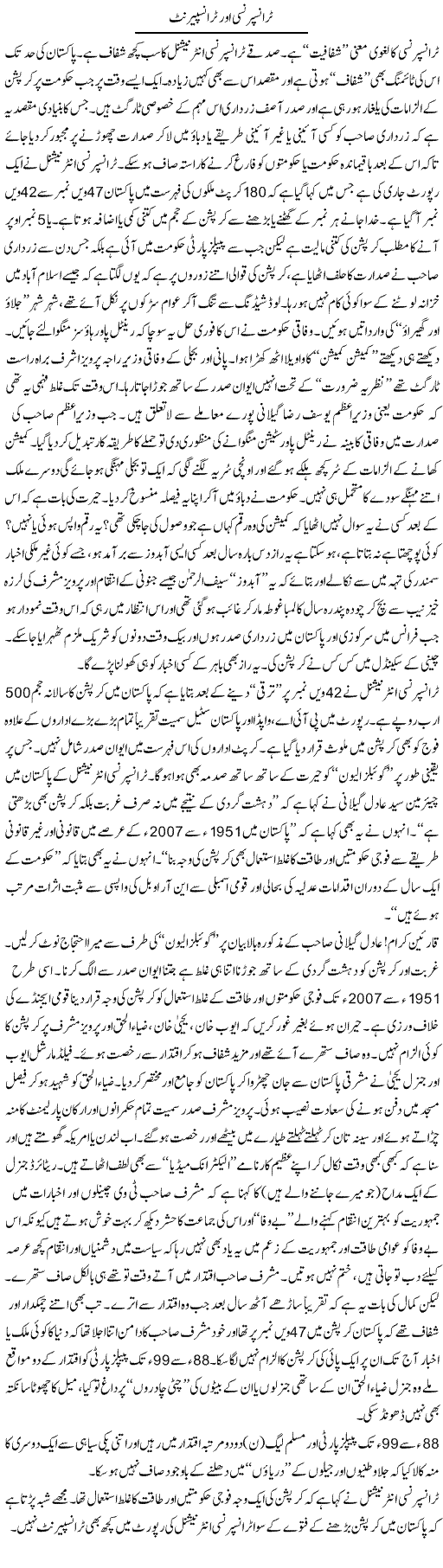
Transparency International 2009 Report on Pakistan: An Analysis


In its annual Corruption Perceptions Index, the TI said Pakistan’s 2009 Corruption Perceptions Index Score is 2.4, and of the 180 countries and in its ranking as the most corrupt country it has slipped five ranks, from 47 in 2008 to the 42nd most corrupt country in 2009. (In Nawaz Sharif's government in 1999, Pakistan was 13th most corrupt country in the world.)

TI Pakistan Chairman Syed Adil Gilani said TI Pakistan was of the view that terrorism was the direct result of poverty, which had resulted due to corruption, especially the illegal direct, or indirect, rule of armed forces in Pakistan since 1951 to 2007. The endorsements provided to military regimes by a corrupt judiciary were also to be blamed.

Adil said positive impact of the few good governance steps taken by the government would be visible by the next year.

He mentioned the reinstatement of sacked judges by the Prime Minister through an executive order on March 16, declaration by the Supreme Court chief justice of zero tolerance for corruption and the withdrawal of the National Reconciliation Ordinance from the National Assembly as positive steps.

He said TI Pakistan also congratulated the Pakistan Army, which had proved to the world that Pakistan’s military were among the best in the world.

“The elimination of terrorists in Swat in two months is what the US and NATO forces have failed to achieve in 8 years in Iraq and Afghanistan, which has made Pakistan a proud nation,” TI Pakistan said. (Daily Times, 17 Nov 09)

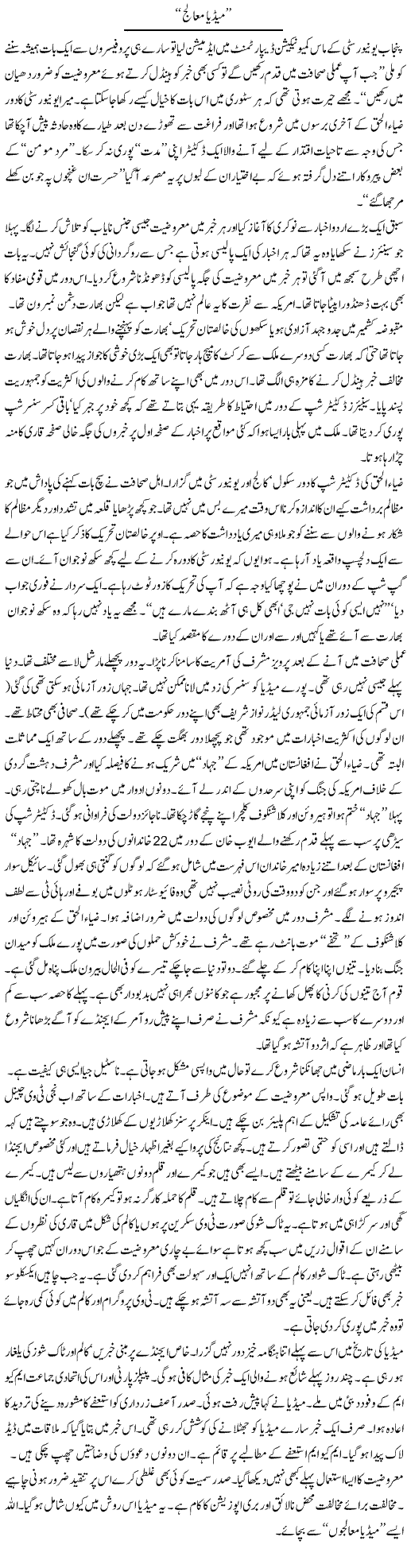
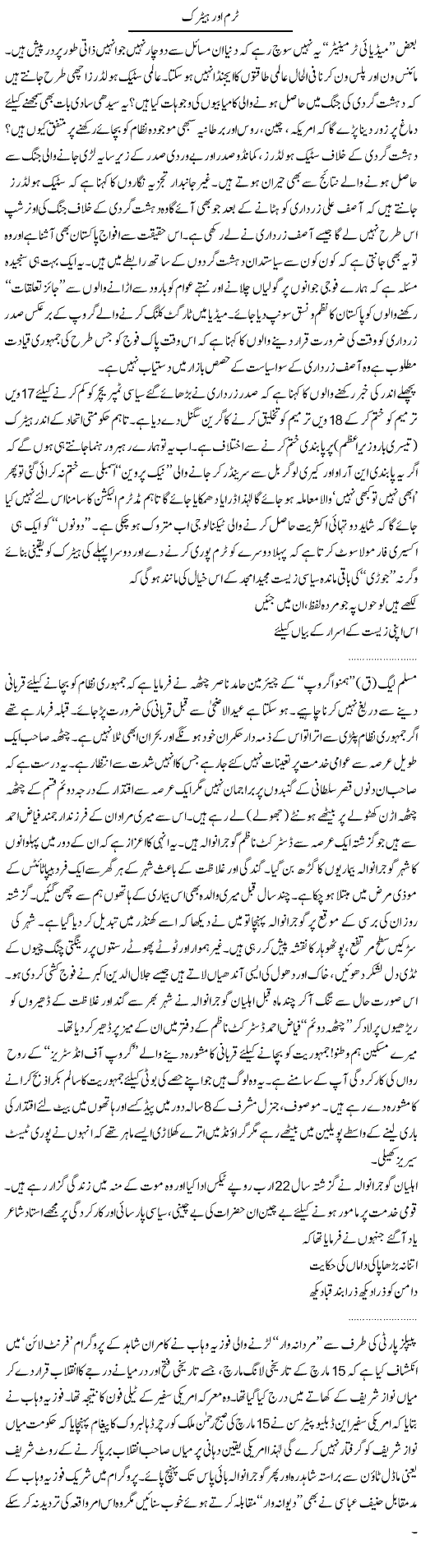
Here is a critical and realistic analysis by Abbas Ather:
Here is another critical analysis by Rauf Klasra in which he compares politicians' corruption with the military rule's corruption in Pakistan:

Read more...

Wednesday, 11 November 2009

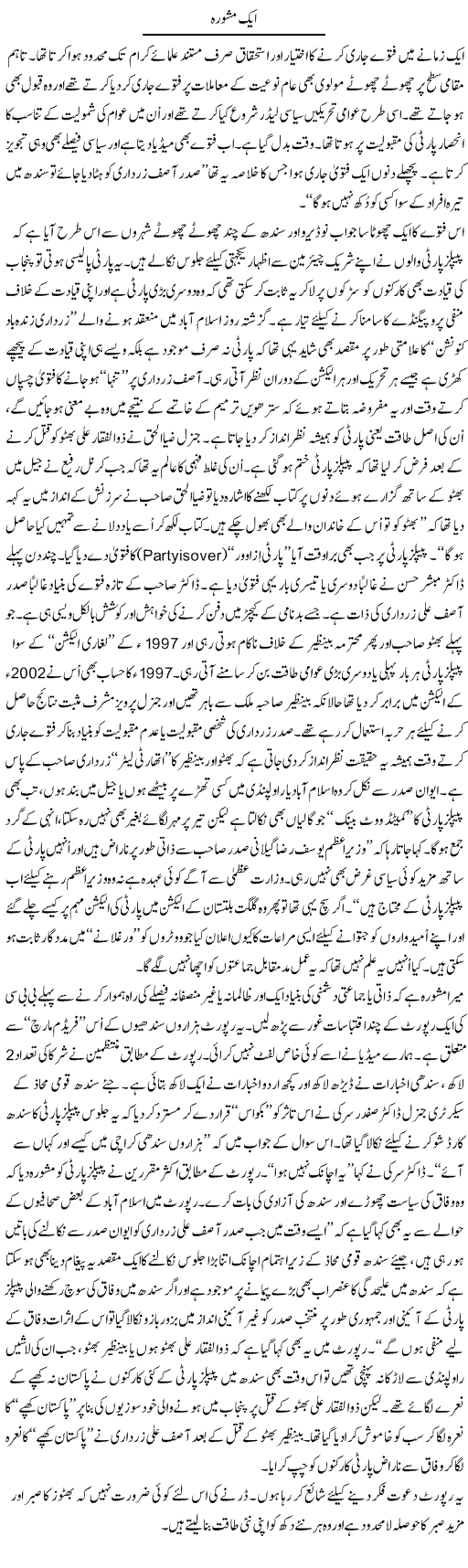
Zardari Unpopular Even Amongst PPP Voters?

According to the agents of pro-Taliban and anti-democracy forces, President Asif Ali Zardari is unpopular even amongst PPP supporters. Some elements have suggested that if Zardari is removed (?) from power, no more than a handful of Pakistani citizens will feel sorrow for him or for PPP. Here is an analysis by Abbas Ather.


Read more...
Tuesday, 10 November 2009

We won't let you bury NRO; you can bury democracy instead.

Here is a selection of three op-eds on this topic:

Abbas Ather notes that the right-wing (pro-Taliban) anchors and propagandists don't want to bury NRO; instead they wan't to bury democracy in Pakistan.

Munno Bhai wonders if the abusers of the freedom of media in Pakistan might need a "Saif-ur-Rehman" in the future?

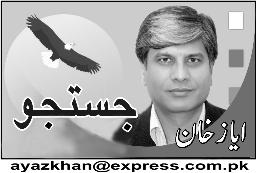
Ayaz Khan advises anchors and journalists with a particular (pro-Taliban, anti-Zardari or anti-democracy) agenda to have a bit of objectivity in their reporting and analysis.

(Abbas Ather)

(Munno Bhai)

(Ayaz Khan)

Read more...

Sunday, 8 November 2009

Zardari phobia and hostile col-anchors

= See full size image


For years at least some of our anchors have claimed that the Mehsud militants are backed by foreign enemies of Pakistan. But neither the war in Waziristan nor the terrorist attacks in Rawalpindi have received the kind of attention that befits them. For the overzealous TV anchors, the real issue is how to embarrass President Zardari. Some of them claim they have the establishments backing in doing so. (Source)

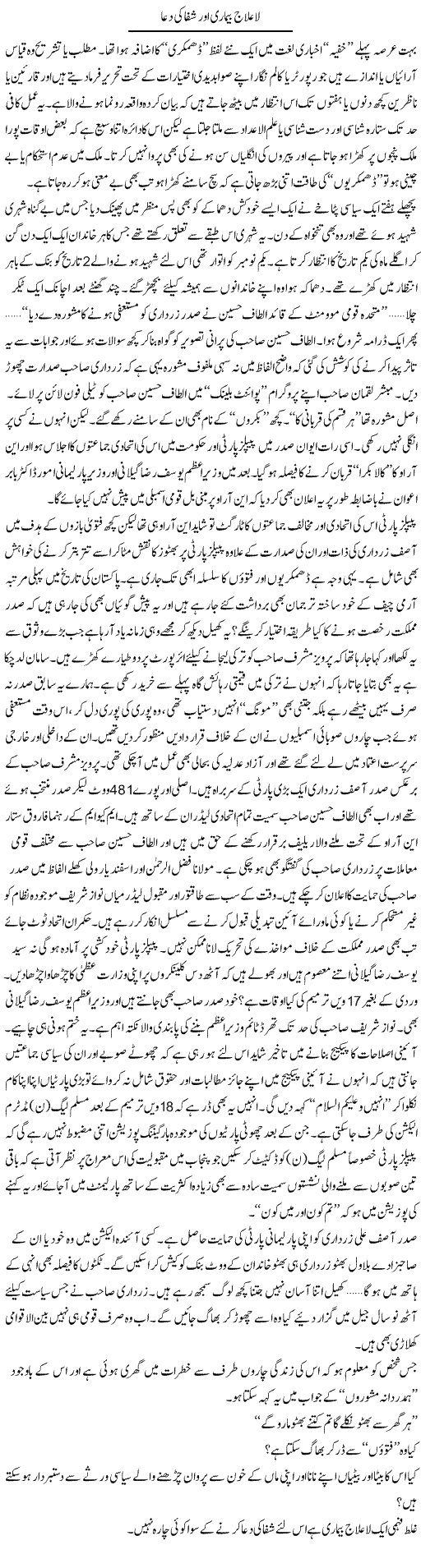
Abbas Athar requests everyone to pray for the swift recovery of those col-anchors (pro-Taliban or pro-establishment) who are currently suffering from Zardari phobia.


In the words of Sadiq Saleem:
Those striving for a Constitutional knockout of President Zardari need to reconsider whether they will accomplish anything even if they succeed. The first consequence of such a knockout would be to give the PPP and the Bhutto-Zardari family the mantle of victimhood once again. After the initial grumbling is over, the People’s Party will most likely rally round the family that has given the greatest sacrifices for it. Even if Prime Minister Yousuf Raza Gilani becomes part of the knockout plan, which is highly unlikely, he would be reduced to the same position as Farooq Leghari was within months of his action against Benazir Bhutto in 1996.

If the fingerprints of the establishment are found in President Zardari’s decapitation, as the anti-Zardari anchors and columnists claim, it would revive in all likelihood the anti-establishment polarization that the military sought to end by withdrawing from politics after the eclipse of General Pervez Musharraf. In any case, why should the establishment become part of an anti-Zardari game plan if all it would do is bring Mr Nawaz Sharif to power?

The issue of civil-military relations will certainly not be resolved to the establishments satisfaction because if Mr. Nawaz Sharif rises to power with the weakening of a Zardari-led PPP then he is unlikely to be more deferential to GHQ.

Since the unfortunate era of General Ziaul Haq the Pakistani establishment has had a pro-Jihad faction that operates politically through the media and various political actors. These people did not respect General Asif Nawaz, General Abdul Waheed, or General Jehangir Karamat. General Pervez Musharraf pleased them by championing adventurism in Kargil but lost their backing in the post-9/11 context. Now, too, it is not General Ashfaq Kayani who wants an army (or establishment) role in politics. It is the beneficiaries of Jihad Inc., including the many media figures beholden to the Jihadis, who want to shoot at a liberal government using the establishments shoulder.

If Pakistan will gain nothing from upsetting the applecart, why are some people so insistent on continuing to distract the nation from fighting terrorism and from sympathizing with terrorist victims? Why not allow the Parliament to decide matters even if it is with a single vote? Why don’t the TV anchors ask Imran Khan how he can judge the government’s actions and claim to speak for the people without being elected? Why is every initiative of PML-N a media initiative and never brought to the elected chambers? Is it not the purpose of democracy to find a way to get past issues instead of getting bogged down by them?

The media, especially its electronic manifestation, seems like a bunch of quacks (fake doctors) that keep generating campaign after campaign against someone they dislike (President Zardari). It is time the people fight back and say let there be some sanity in the country. Let priorities be priorities.

"Media Terminators" in Pakistan
By Tahir Sarwar Mir


Col-anchors will never raise the following issues (courtesy "revolution"):

Where are CJ Iftikhar Chauhary's famous suo moto actions?
Why is Amina Masood Janjua still standing outside Supreme Court Building?
Why no one got punished for November 3 and May 12 actions?
Why No suo moto against foreign interventions in Islamabad streets?


Read more...

Thursday, 5 November 2009

Ansar Abbasi, Zardari's corruption and the Media Taliban

(Abbas Ather)

(Asadullah Ghalib)

Why are the media Taliban (Ansar Abbasi, Shahid Masood, Shaheen Sehbai, Hamid Mir) angry with Asif Zardari. Here is the answer:

EDITORIAL: Ignored victory in South Waziristan

On Tuesday the Pakistan army took control of Sararogha in South Waziristan, the nerve-centre of the operations launched by Tehreek-e-Taliban Pakistan (TTP) into the populated heart of the country. As the troops entered Sararogha and were carrying out search and clearance operations the rest of the country was busy witnessing the falling apart of the political order brought about by the 2008 general elections. But the success achieved by the Pakistan army is extremely significant in the context of what is expected to transpire in Pakistan in the coming days.

Sararogha was where the TTP Shura met and decided the targets the Taliban suicide bombers were going to hit. This is where the various branchline warlords streamlined their plans and the spokesmen of the TTP made important announcements about the crimes the TTP had committed in the name of their dubious sharia. The taking of Sararogha was important after the capture of the symbolic Kotkai, the home of the current leader of the TTP, Hakimullah. It is too soon to say if this latest victory is going to lead to the disintegration of the Taliban, but it will definitely relieve some pressure on such important cities as Bannu, which lie right next to Sararogha.

The final success of the operation will depend on the ability of the Pakistan army to prevent the expanding of the war front. The Taliban must be engaged within the territory controlled by Pakistan and the enemy must not be allowed to flee to areas where Pakistan army cannot pursue them. If the enemy were able to flee across the Durand Line and regroup on Afghan territory, the effectiveness of the operation would be halved, putting pressure on the paramilitary forces that the army will leave behind after ‘pacifying’ South Waziristan.

It is for this reason that Pakistan was upset earlier on when it saw that the US-NATO forces were seen to remove their border posts, which later was said by the Americans to be mere “readjustment”. Already a large part of Afghanistan is said to be the target of Taliban forays because the US-NATO forces do not control it or control it only temporarily. The Taliban strike not only in the heart of Kabul city but anywhere in the country at will, and even more freely in southeast Afghanistan, which is predominantly Pashtun territory. It is more or less known now that the Taliban on both sides of the border are acting under one shared command. Hence, the success of the Pakistani operation in South Waziristan will depend on how well the US-NATO forces are going to coordinate with the Pakistan army.

There is hardly any doubt about the importance of the South Waziristan operation in the eyes of the US and its allies. The view on the other side of the border is that men coming across from Pakistan carry out most acts of terrorism committed by the Taliban in Afghanistan. For instance, the attack on the UN guesthouse was blamed on suicide-bombers that had come from Pakistan. Pakistan is often subliminally blamed for not guarding the border well enough, but the same charge could be made about the allied forces guarding the border on the other side.

President Barack Obama faces his own dilemmas on the subject of Afghan policy. Should he go for reconstruction or counter-terrorism? Since reconstruction is impossible without control, he has to beef up the ability of the allied troops in Afghanistan to handle the Taliban aggression. The US army chief in Afghanistan, General McChrystal says 40,000 more American troops are needed, but that balks the Pakistan army on other counts. The last time the Taliban came under pressure from the American troops they made a beeline for Pakistan. When the additional troops put pressure on the Taliban they will retreat into Pakistani territory for regrouping and in the process negate the success achieved in the Tribal Areas by the Pakistan army. Clearly, both sides are pointing to the same weaknesses that they actually share. The only way is to coordinate and tackle the menace jointly. (Daily Times)


Read more...
Sunday, 25 October 2009

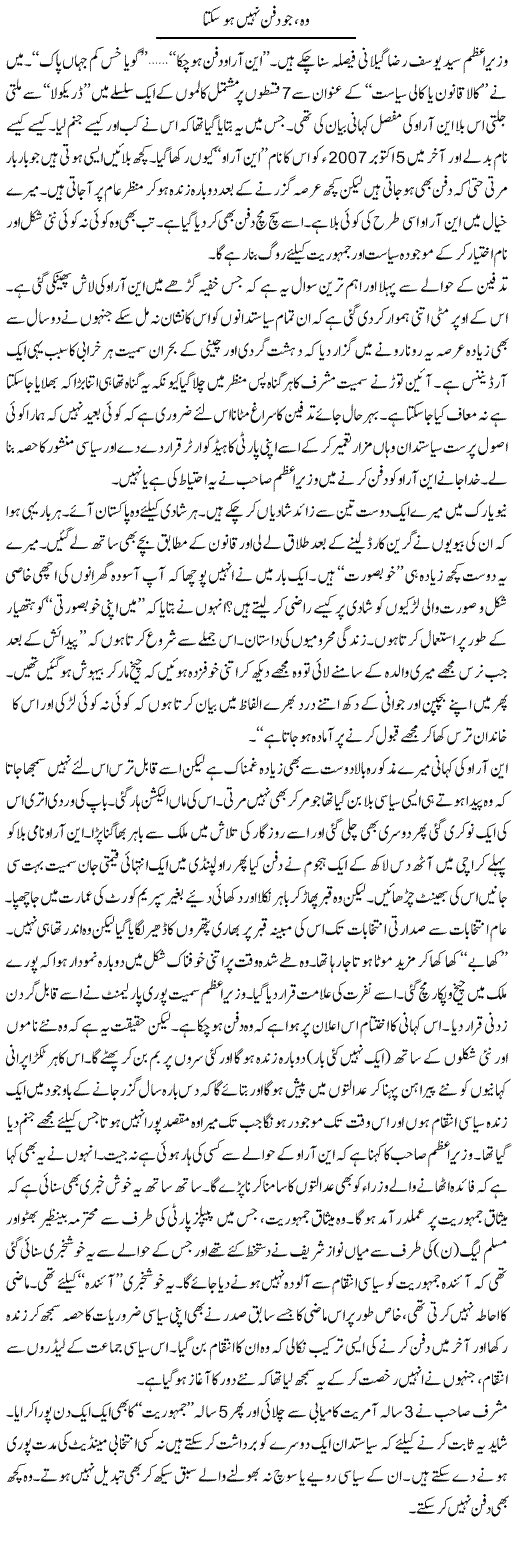
The real story of NRO - an extensive analysis by Abbas Ather

First an editorial of Daily Times and a news item, which are followed by extensive seven-episode columns on NRO and Pakistani politics by Abbas Ather. A must read.

NRO comes centre-stage

As the National Reconciliation Ordinance (NRO) makes its progress at the committee level before coming before parliament, the country’s polarised politics is boiling over. Walking out of the committee preparing the NRO bill, the PML-N has declared war on it. Laying out the party position, Punjab Chief Minister Shahbaz Sharif said Saturday that the passing of the NRO in parliament would be a defeat of the country.

If you want to read the political map of Pakistan, just read what the political parties are saying about the NRO. First, there is the extra-parliamentary opposition, which did not take part in the 2008 elections because the polls were rendered invalid by Musharraf’s act of dismissing the Supreme Court in November 2007. The issuance of the NRO the previous month formed a part of the delegitimisation of the elections.

The PML-N went to the court against the NRO but took part in the 2008 elections, thus partially legitimising it. Then it showed respect for the ‘spirit’ of the NRO by briefly joining the PPP-led government. (A bunch of PPP MPAs are still hanging on to the Punjab government as remnants of that phase.) After that, political recidivism set in. The PML-N thought it would become more popular by being in the opposition. This has been proved right and the NRO is now anathema to most people in Pakistan.

The PML-Q, which midwifed Musharraf’s NRO, is now a purist on it. It is accusing the PML-N of secretly supporting the NRO, which is patently false if you look at the public posturing of our politicians. The lawyers, divided like everyone else, fight over whether an act passed by parliament can be struck down by the Supreme Court. The PPP will have a tough time mustering the required numbers, but from the way the opposition is fussed over the matter, it seems the act will be passed, and the Court will have to pull yet another undesirable political chestnut out of the fire. (Daily Times, Editorial, 1 Nov 2009)

All political forces supported NRO, says Musharraf

LAHORE: Former president Pervez Musharraf on Saturday said all political forces of the country had been taken on board before the promulgation of the National Reconciliation Ordinance (NRO). Talking to a private TV channel, the former president said he did not want to indulge in the discussion on the NRO, however, he considered the ordinance’s basic purpose had been to eliminate cases against politicians. Separately, speaking with the channel, Pakistan Muslim League-Quaid President Chaudhry Shujaat Hussain said approving the NRO had been a mistake and he apologised to the nation. Shujaat said the ordinance was promulgated to create an environment of reconciliation in the country, adding he did not have the right to forgive the people who had embezzled money from the national exchequer. daily times monitor


Read more...