Editor's Choice

--------------------------------------------------------------------------------------------------------------------------
Featured Post
--------------------------------------------------------------------------------------------------------------------------

"Let us build Pakistan" has moved.
30 November 2009

All archives and posts have been transferred to the new location, which is: http://criticalppp.com

We encourage you to visit our new site. Please don't leave your comments here because this site is obsolete. You may also like to update your RSS feeds or Google Friend Connect (Follow the Blog) to the new location. Thank you.


--------------------------------------------------------------------------------------------------------------------------
Showing posts with label Yusuf Raza Gilani. Show all posts

Tuesday, 24 November 2009

President felicitates the nation on Balochistan empowerment package


This picture was taken during BB's last visit to Quetta , 15th Dec, 2007

Late Benazir Bhutto on her last visit to Baluchistan sought a public apology from Baluch Brothers and sister. She promised to give them their due rights. And today federal government has announced to pay all the arrears of Gas Development surcharge from 1954-1991 amounting to Rs.120 billion to the Province in a period of 12 years. This single step would address a long standing economic demand of the Province along with other major announcements including the appointment of Chief Minister Baluchistan as the Chairman of Gawadar Development Authority.


Islamabad November 24, 2009: President Asif Ali Zardari has felicitated the government, the political parties and the people over the announcement today of Agaz-e-Haqooq-e Balochistan to make the province an equal partner in the Federation.

Spokesperson to the President former Senator Farhatullah Babar said that the President described the announcement of the empowerment package today as “a giant leap forward” towards addressing the issues of the people of the Province and empowering them in accordance with their aspirations..

The President recalled that Shaheed Mohtarma Benazir Bhutto during her visit to Balochistan a fortnight before her assassination in December 2007 had promised the people of the Province that the PPP after coming into power would earnestly address their grievances. Thereafter the PPP, even before coming into power publicly and formally apologized to the people of Balochistan for the wrong and injustice done to them in the past by successive governments. It was followed by the setting up of a Shaheed Mohtarama Benazir Bhutto Committee on Balochistan to formulate proposals for addressing the grievances of the people in consultation with all stake holders. Finally a Parliamentary Committee was set up by the government which drew up the Empowerment Package in consultation with all political parties.

President Asif Ali Zardari said that the provision of release of all political workers, return of the exiles, the initiation of political dialogue across the political spectrum in the province and the setting up of a Commission in respect of the missing persons were measures of far reaching significance which will have a salutary impact on the people of Balochistan.

The President said that the decision to pay the arrears of Gas Development surcharge from 1954-1991 amounting to Rs.120 billion to the Province in a period of 12 years would address a long standing economic demand of the Province.

The President said that all those who worked tirelessly in preparing the package and all the political parties and stake holders that participated in the process and lent their support to it deserved the gratitude of the people of Balochistan, indeed of the whole country. He said it was a thanks giving day as a pledge made to the people had been redeemed.

President Asif Ali Zardari also advised the government that an effective monitoring mechanism should be put in place to oversee the implementation of the proposals announced today. The President said that he will closely watch the implementation of these proposals.

Dinner- Meeting of PPP and allies at the Presidency‏:
Islamabad; November 24, 2009: President Asif Ali Zardari has said that a resolution on the Balochistan Empowerment Package was not the end but the beginning of the resolutions by the Parliament to the problems of other provinces as well.

He said that the Pakistan Peoples Party as the largest political force in the country had the will and the capacity to lead and it also knew the way. This he said while addressing the members of the Parliament in the Presidency Tuesday night, who were invited for a dinner gathering after the presentation of the Balochistan Empowerment Package in the joint sitting of the Parliament today.

The dinner meeting was also attended by the Prime Minister Syed Yusaf Raza Gilani, Federal ministers and members of the allied parties.

The President congratulated the Prime minister, Parliamentary committee on Balochistan and all the political parties. He said this was an occasion not only to celebrate but also to make a commitment to implement the package in letter and spirit.

The President said that through the Empowerment Package the government and the allied parties had created an atmosphere to make a new beginning. He said that it was a very satisfying moment for all of us, when we recall that Shaheed Mohtrama Benazir Bhutto had promised the people of Balochistan in Quetta on December 15, 2007 that the PPP will empower them and redress their grievances.

Read more...

The Aghaz-e-Haqooq-e-Balochistan Package: A new dawn for Balochistan


Thank you, People's government, for addressing genuine issues and grievance of the people of Balochistan, through a comprehensive "Aghaz-e-Haqooq-e-Balochistan Package" which was tabled in the Parliament today as advised by the President of Pakistan Asif Ali Zardari.

Prime Minister Syed Yousuf Raza Gilani formally announced the promised package on Balochistan in parliament on Tuesday, saying that “dreams of Baloch people have come true,” report said. “The Aghaz-e-Haqooq-e-Balochistan Package is being announced today. Dreams of people of Balochistan will come true through this package,” said the Premier. He said the package contains a series of constitutional reforms, economic measures and administrative steps to assuage the hurt feelings of the people of Balochistan. Gilani also said: ‘We apologise for neglecting Balochistan in the past’

The Head of package-preparing Committee Mian Raza Rabbani announced the package in the joint session of the Parliament. He said the package comprises four parts, i.e. constitutional, political, administrative and economic recommendations.

However, he said the package is not a substitute for provincial autonomy, adding the national history in connection with provincial autonomy is rather bitter and those who raised their voice in past demanding their rights were termed as defectors.

Mian Raza said the dialogue process would be initiated with all political forces in the province and the exiled people would be offered passage for homecoming.

Also, it has been recommended to present to the fore the list of missing people and they would be brought to the courts, adding the package recommends that those missing people would be set free who have no cases against them.

The joint session of the Parliament was held here today at 3.00 p.m. for approval of Balochistan package.

President Asif Ali Zardari under the article 54(1) of the Constitution summoned the joint session of the Parliament to discuss the package for the uplift of Balochistan.

Editorial: Balochistan package

The government on Tuesday presented the much-awaited Balochistan package to parliament. The package comprises constitutional, political, administrative and economic recommendations. It states that the government is “conscious that the provinces have a sense of deprivation in the political and economic structures of the federation” and that the provisions of the 1973 Constitution related to federation-province relations were circumvented in the past. The package talks about giving provincial autonomy to Balochistan and abolishing the concurrent list. It also recommends that the under-construction cantonments at Sui and Kohlu in the Bugti and Marri areas respectively be halted for the present, and the military be withdrawn, to be replaced by the FC. The package also deals with the issue of missing people. It says that the list of missing persons would be investigated and if they are found in custody, would be released. The government has also assured that there would be no political victimisation. Among other things, there would be an inquiry by the superior judiciary into the murders of Nawab Akbar Bugti, Baloch political workers, and target killing in the province.

It is indeed a welcome move that for the first time any government has realised that in order to safeguard the federation, it has to seriously address the Balochistan issue. For the first time, a government has recognised the internally displaced persons (IDPs) in Balochistan and promised to rehabilitate them. Balochistan has been gravely neglected in the past and victimised. With the insurgency in Balochistan registering its presence time and again, the issue of provincial autonomy has finally assumed critical importance. Bringing normalcy to Balochistan may not be as easy a task as may appear because the people of Balochistan carry a history of neglect, exploitation and repression. The Baloch people have been fighting for their rights through political and constitutional means for nearly three decades after the military action of the 1970s and only frustration with that fruitless process persuaded a new generation to take up arms again. The Centre has finally been forced to consider the question of provincial autonomy and equitable distribution of resources. Despite being the richest province in terms of natural resources, including gas and minerals, successive governments have been denying the benefits of these riches to the local population of Balochistan. The government has now promised to settle the arrears of gas royalty owed to the province. It has also promised that all new mega projects would be initiated with the consent and approval of the provincial government. Balochistan’s share in the projects’ profits/benefits has also been assured. This is indeed a welcome move because in the past, the federal government did not involve the local people in any project, two prominent examples being Gwadar Port and the Saindak project.

With this government’s conciliatory and mature approach towards the issues facing the country, it is hoped that Balochistan’s grievances will finally be addressed. However, some of the provisions of the package may work against its thrust of reconciliation. For example, the leaders in exile are welcome to come home without fear of prosecution, except those who have serious charges against them. Similarly, political prisoners are to be released except those with serious charges against them. That leaves out all the prominent leaders in exile and most of the political workers in custody, whether acknowledged or ‘missing’. This will hardly work to bring a healing touch to the troubled province. The government must talk to the actual protagonists to bring about real change in the province.

That said, the government must be appreciated for bringing forth a package that addresses the most important issues related to a province that has been neglected and hard done by for the last six decades. The Baloch people deserve relief after successive military operations and exploitation at the hands of the Centre.

http://dailytimes.com.pk/default.asp?page=2009\11\25\story_25-11-2009_pg3_1


Read more...

Sunday, 22 November 2009

Establishment's temporary NRO for Yusuf Raza Gilani

It seems that the all powerful establishment in Pakistan and their agents in Pakistani media have decided to, at least temporarily, ignore the cases of alleged corruption against Prime Minister Yusuf Raza Gilani (and other politicians). They have offered this temporary NRO to Gilani because their first target is to hit and malign President Zardari. Gilani and other politicians will be dealt with in the next round. Here is what was reported in Dawn today, which is followed by an analysis by Abbas Ather:

PM’s wife paid Rs45.5m against Rs570m liabilities
By Syed Irfan Raza
Sunday, 22 Nov, 2009

ISLAMABAD: Although the wife of Prime Minister Yousuf Raza Gilani had settled her default case with the National Accountability Bureau (NAB), she had been given ‘undue favour’ and asked to pay only Rs45.5 million against total liabilities of Rs570 million, sources in the NAB alleged on Saturday in an interview with Dawn.

A scrutiny of Fauzia Gilani’s case revealed that she had obtained two loans totalling Rs200 million from Zarai Taraqiati Bank Limited (ZTBL), but she settled the case after committing ‘wilful default that prevailed over a decade’.

According to documents, the sources said, the principal of Rs200 million had swelled to Rs570 million as non-payment of instalments spanned a decade. However, she managed to settle the case by paying back Rs45.521 million.

The sources said she had obtained a loan of Rs120 million for Multan Edible Oil Extraction and another loan Rs77 million for Pak Green Fertilisers.

According to the NAB press release, the cases were settled by the ZTBL in pursuance of the Sindh High Court’s order of Oct 2, 2006, and March 17 of last year and a circular of the State Bank.

In consequence, ZTBL forwarded a request to NAB for withdrawal of the cases.

‘After having received clearance of liability certificate from ZTBL regarding full payment of the settlement amount of Rs45.521 million, NAB withdrew references against the companies.’

The source said Mrs Gilani had gone through the prescribed procedure of settlement of ‘wilful default cases’. They interpreted the move as a ‘confessed wilful default’.

The NAB Ordinance defines wilful default as: ‘Wilful default under this ordinance if he does not pay, or continues not to pay, or return or repay the amount due from him to any bank, financial institution, cooperative society, Prime Minister Gilani faced two other cases in NAB—illegal appointments in National Assembly when he was National Assembly speaker and purchase of vehicles. Both cases were settled in the Islamabad High Court.

A case of the prime minister’s personal secretary, Tariq Khakwani, in which he was accused of obtaining a plot in Sector I-8, Islamabad, under the prime minister’s quota in 1988-89 is still alive in Lahore High Court.

The NAB had filed an appeal against its own reference and had requested an accountability court to dispose of the case.

However, the court turned down the request and the NAB moved LHC against the accountability court’s decision.

The LHC upheld the verdict of the accountability court and the case is still pending. Source..

Abbas Ather
.

Read more...

Saturday, 7 November 2009

Nawaz Sharif's (temporary) NRO for the wife of Yusuf Raza Gilani

After the "minus one" campaign, do you know who will be the next in line? Yes, it will be our very dear, (apparently) acceptable to Nawaz Sharif and ISI, Prime Minister Yusuf Raza Gilani.

It was thus observed in an editorial of The News (8 Nov 09): "As speculation about the imminent downfall of the president grows in volume and pitch, with more and more people convinced that Mr Asif Ali Zardari is headed out of the towering gates of the presidential palace he moved into just over a year ago, it seems to have suddenly dawned on the prime minster that he must do all he can to save himself. While Mr Yusuf Raza Gilani has been quite willing, for some months, to play along with those who would like to see the back of Mr Zardari, he now seems conscious of the fact that the same elements may see no need to allow him to retain his post either. The 'minus-one' formula we have heard so much about since the middle of the year may not turn into the 'minus-342' move the Punjab governor has spoken of. But its impact could expand beyond the presidency and draw into the churning whirlpool the prime minster and his government. While Mr Zardari has been drawing much of the flak for the paralysis we see in government, and indeed he has been partially responsible for this by intervening in decision-making at every level, the cabinet must accept a significant chunk of responsibility for failing to get things moving in any meaningful direction."

Here is a glimpse of the ammunition that will be used against the Gilani sahib of Multan Sharif.

According to recent media reports, the NAB withdrew two cases against Fauzia Gilani and others who received Rs71.480 million from the Agricultural Development Bank of Pakistan in 1987. Two years later, the same tola milked the same bank for another Rs100.200 million. After grabbing Rs171.680 million in a span of 24 months, Mrs Gilani (actually, could it be Mr Gilani?) and her five business partners scooted--I mean, defaulted. The timing for defaulting was ideal – it was the reign of Benazir Bhutto and Gilani was in her cabinet.

Today, fate again favours Gilani making him our prime minister and the NAB favours him by forgiving his wife the default.


'Out, damned spot'!

Saturday, November 07, 2009 (The News)
Anjum Niaz

"All the perfumes of Arabia will not sweeten this little hand," cried Lady Macbeth after killing Duncan, king of Scotland, in Shakespeare's Macbeth. Fast-forward four centuries. We know that all the laws in the world, not even the NRO, can wash clean the corruption of our leaders, both in the government and the opposition. The media, like Macbeth's three witches, brews up toxicants while dancing around a cauldron boiling over with 100 corruption cases of the president and his cronies. Chanting "Fair is foul and foul is fair," the witches (read: the media) are foreshadowing events to come, predicting the evil that will cloud the president's judgment in pursuing the passing of the NRO by Parliament.

The president blocked the restoration of Chief Justice Iftikhar Chaudhry till the end. He feared the chief justice would never give him and his friends a free pass for their alleged corruption. Today, a nation of 180 million is crying out for justice. Our only hope is the Supreme Court. My Lords, dispense swift justice in dispatching the NRO and make sure the beneficiaries receive exemplary punishment.

The pots meanwhile have started calling the kettles black. "All parties benefited from the National Reconciliation Ordinance; it also helped people (the Sharif brothers) who had been exiled for 10 years to return to Pakistan under a deal," Sindh chief minister Qaim Ali Shah is reported as saying. "These NRO beneficiaries are now playing politics," Shah said, referring to Nawaz Sharif's rejection of the NRO.

If the system has to be cleaned, let there be accountability across the board. It's not only the PPP godfathers who stole from a beaten nation, but leaders of all political parties, civil and military scofflaws. Go get them all.

Among those whose past must be made transparent is the prime minister's wife, our First Lady. The media is airbrushing Gilani as the next in succession to Zardari. But there are skeletons rattling in his cupboard. One of them is the stuffing of undeserving people in the National Assembly Secretariat. An NAB official dealing with the case gave me glaring examples of how Yusuf Raza Gilani had "reprehensibly" misused his position as Speaker. The official has all the records, but they are worthless because his bosses at the grandly called National Accountability Bureau have unashamedly caved in to the prime minister and withdrawn two bank-default cases against Mrs Fauzia Gilani and five others. They settled "out of court," we're told.

According to recent media reports, the NAB withdrew two cases against Fauzia Gilani and others who received Rs71.480 million from the Agricultural Development Bank of Pakistan in 1987. Two years later, the same tola milked the same bank for another Rs100.200 million. After grabbing Rs171.680 million in a span of 24 months, Mrs Gilani (actually, could it be Mr Gilani?) and her five business partners scooted--I mean, defaulted. The timing for defaulting was ideal – it was the reign of Benazir Bhutto and Gilani was in her cabinet.

Today, fate again favours Gilani making him our prime minister and the NAB favours him by forgiving his wife the default.

"Surely these loans, including the principal amount as well as the accumulated mark-up for the past many years, must have been repaid," writes Brig (retd) Farooq Hameed Khan, a former NAB consultant in Lahore. "If this has really happened, it is unbelievable in a country like Pakistan where the rich and powerful do not normally return bank loans. This 'mother of all settlements' should be made public for all others to follow this historic and rare gesture by the country's top elite," he says.

We have a right to ask about the reported "out-of-court settlement" between the First Lady and the NAB.


The writer is a freelance journalist with over twenty years of experience in national and international reporting. Email: aniaz@fas.harvard.edu ; www.anjumniaz.com

Read more...

Thursday, 17 September 2009

Is Nawaz Sharif willing to apply Article 6 to General Kayani and also some of his cronies within PML-N?


Article 6 can’t just apply to one man: Gilani

* PM says those who supported Musharraf are in cabinet and some of them have also joined PML-N
* Musharraf not given indemnity, convicted or pardoned, no question of deal

By Zulfiqar Ghuman


ISLAMABAD: Prime Minister Yousuf Raza Gilani said on Wednesday that Article 6 could not be applied to only one person, as there were several politicians in parliament who also supported former president Pervez Musharraf by voting for the 17th Amendment.

“I have no love lost for Musharraf ... if parliament decides to try him, I will be with parliament. Article 6 cannot be applied to one individual ... those who supported him are today in my cabinet and some of them have also joined the PML-N ... the MMA, the MQM and the PML-Q supported him ... this is why I have said that it is not doable,” said the prime minister while informally talking to editors and also replying to questions by journalists at an Iftar-dinner he had hosted for them.

On President Asif Zardari’s disclosure about a “negotiated settlement”, he said, “Parliament has so far not given indemnity to Musharraf, nor has he been convicted or pardoned, so there is no question of any deal.”

About the balance of power between the offices of president and prime minister, Gilani said, “If you refer to Article 58(2b), let me tell you that this article has become redundant ... a parliamentary committee is working on the constitutional package.” (Daily Times)

Nazir Naji's Analysis:

Abbas Ather's Analysis:

Defence, not deterrence
By Cyril Almeida
Friday, 18 Sep, 2009
Dictators have arrived on the scene when the politicians have discredited themselves and the people left searching for saviours. —File Photo

HAS the PML-N jumped the shark in its purported quest to have Musharraf tried for treason? The plot has definitely taken a turn towards the ridiculous this week.

We, the people, are expected to believe that the PML-N is shocked, shocked that a ‘deal’ was struck with outside powers to guarantee Musharraf a safe exit. Snow White, aka the PML-N, can’t imagine a deal could be struck to, say, bail a prime minister out of jail, fly him across to luxurious exile in Saudi Arabia and then engineer his return to our ‘sovereign’ nation. Oh wait, isn’t that what happened to Nawaz Sharif, leader of Snow White?

Right, that was different. Different why, you ask? Because, y’know, that was Nawaz Sharif, leader of the people, a democratic would-be amirul momineen, heir to the throne of the Mughal emperors of yore, the greatest ruler since sliced bread, and did I mention, leader of the people? So it’s OK, gosh darn necessary even, for outside powers to ride to the rescue of Sharif because he’s different.

The only thing that is different though are the circumstances. The hunted has become the hunter and in the jungle of Pakistani politics he thinks he can smell blood. But in the smoke-and-mirrors game that is our politics, don’t be so sure that the victim is who you think it is. For some, the PML-N’s ‘try Musharraf’ cry sounds awfully like ‘get Zardari’.

With astonishing speed, Zardari’s indiscretion has ricocheted and become about him. Nothing less than the ‘independence and sovereignty’ of parliament has been undermined by Zardari, according to the PML-N. But don’t expect the PML-N to fire off angry missives about the ‘violation’ to the other parties involved. Perhaps to the Americans and the British, but definitely not the Saudis. Sharif knows what’s good for him, and invoking the ire of the Saudi king definitely isn’t.

Keeping Zardari under pressure though is good for Sharif, hence the PML-N’s alacrity in tabling a motion against him in the National Assembly. For those keeping track of the tit-for-tat game, we’re now in round three. Round one was the minus-one formula that rattled Zardari, round two was the raking up of Sharif’s past and now round three is about doing the dirty on Zardari and embarrassing him.

That doesn’t mean Sharif wouldn’t like to see Musharraf hanged, drawn and quartered. The bitterness is palpable despite Sharif’s denials; he isn’t one to forgive or forget the humiliation of being handcuffed and thrown into a dingy cell. But that is neither remarkable nor unprecedented.

Legend has it that Zia and his generals decided to hang ZAB because that proud, disdainful prime minister had made it clear he would hang them if he ever got the chance. And the bitterness between Leghari and the PPP lives on to this day, 13 years since BB’s man in the presidency dismissed her government. That’s just how politics is and we can’t do anything about personal enmities.

But what the rest of us on the outside and at the mercy of the politicians and their vendettas can do is at least understand when acting on those enmities is a good idea from a systemic perspective and when it isn’t.

If trying Musharraf and throwing him in jail – I personally am squeamish about the death penalty – can yield some good that outstrips the risk of damage to the democratic project, I’m all for it.

I never was a fan of Musharraf because a dictatorship isn’t the answer to the problems of our polity. Well-intentioned or ill-intentioned is beside the point for me. The fact is, our polity is diverse and fractious and for historical, social and political reasons a one-man show is bound to exacerbate the tensions in the federation. Ergo, a dictator is a bad idea in the long term.

(Arguably, in the short term, a dictatorship may help reset the balance to keep the country in a low-level equilibrium rather than keel over from the depredations of the civilian political class, but that is a separate issue and, in any case, should the point not be to break out of a low-level political, economic and social equilibrium?)

But I just can’t see how prosecuting Musharraf will set a good precedent and buttress the democratic project in its present phase. Judging Musharraf guilty of treason in a court of law would be a precedent, absolutely, but what exactly would it achieve?

Deter the next dictator? Dictators have arrived on the scene when the politicians have discredited themselves and the people left searching for saviours. Ayub, Zia, Musharraf, each arrived when cynicism was at a peak.

It can be debated whether the public truly wanted a dictator at those points in time or whether the army had a hand in creating the political trouble in the first place, but the point is that deterrence – in the sense of threatening unacceptable costs to a would-be dictator – is not what is needed; a stronger defence is.

The deterrence, defence dichotomy is not mere word play, it is at the root of our present misguided national debate. There simply is no nuclear option to deter would-be dictators. Threaten to hang him and his cohorts? Right. The next adventurist general may just decide to hang all the politicians first and drag the country into a dark place we don’t even want to think about. Zia is the worst of the dictators we have had, but he isn’t the worst of all dictators we could have had.

A better bet, then, is to shore up the civilian political defences against a dictator. Build on the present transition to democracy. Incrementally push the army out of the governance and policy space. If there are 10 things a democratic government must have to be truly in charge and the army only allows it, say, two or three issues (education, health, the economy, whatever), then do those two or three things right and use the leverage to prise away more subjects from the army’s control.

And if the politicians must fight, fine. But do it within bounds. Zardari’s bid for power in Punjab was bad because of the way he attempted it by pouncing on Shahbaz Sharif’s disqualification and imposing governor’s rule. He could have tried to win a straight vote in the Punjab Assembly instead. And if Sharif wants to push for mid-term elections or defang Zardari, fine. But don’t do it in a roundabout way and flirt with invoking the army’s wrath at this delicate juncture in the transition to democracy.

A post-politics phase in which politicians on both sides of the aisle agree on everything and hug and kiss and hold each other’s hands is neither desirable nor beneficial to the democratic project.

What is needed though to build a solid defence against adventurist generals is selective cooperation. Zoom out and in the bigger picture politicians need to cooperate to defend the system against threats from rival institutions. Zoom in and they need to present alternatives on policies and different approaches to governance.

It’s not rocket science. But neither is it schoolboy stuff. And at the moment all we seem to have is a PML-N bent on throwing tantrums and chucking toys out of its pram and a PPP led by rank amateurs.

cyril.a@gmail.com (Dawn)


Read more...

Tuesday, 1 September 2009

PML(N)'s balloon punctured by Brigadier Imtiaz?


Asadullah Ghliab's analysis: PML(N)'s baloon punctured?


Ayaz Khan: Nawaz Sharif under pressure?

PML(N) issues 24 hour deadline
LAHORE: PML-N Information Secretary Ahsan Iqbal initially announced a 24-hour deadline for the PPP to stop its “propaganda campaign” before extending it to 48 hours, a private TV channel has reported. He told journalists the party would respond in kind if the campaign were not stopped, it added. daily times monitor

Go ahead! We don’t care: PPP

* Babar says issuing ultimatums against spirit of reconciliation, mutual accommodation
* Presidency has no role in allegations of slush fund distribution among politicians

Staff Report


ISLAMABAD: In a tit-for-tat reply to Pakistan Muslim League-Nawaz (PML-N) Information Secretary Ahsan Iqbal’s warning that his party would respond against the Pakistan People’s Party’s (PPP) leadership if it did not mend its ways within 48 hours, PPP leaders said they were not afraid of any ultimatum.

The president’s spokesman Farhatullah Babar rejected and condemned the attempts to accuse the Presidency of being involved in what has been described as “character assassination” of some political leaders. “There is no question of the Presidency being behind the resurrection of old accusations against some political leaders,” he said.

He said the accusation relating to the distribution of slush funds among politicians some two decades ago were not new and kept popping up every now and then. He said that it was strange that the Presidency was being accused for the first time of a role in the said accusations.

Not good: Babar described the present “hurling” of ultimatums at the president and the Presidency as most unfortunate, uncalled for and against the spirit of reconciliation and mutual accommodation.

The president’s spokesman said the PML-N should provide evidence to back up its claims.

He said the PML-N should not retaliate because of old accusation being brought up by a few disgruntled indivisuals.

Babar said those making the accusations were perhaps hoping to exert pressure on the Presidency to reject any previous record against the said people and in effect giving them future immunity. “This, however, is not the responsibility of the Presidency’s media outfit,” he said.

Babar recalled that when the same person had levelled the accusations against former prime minister Benazir Bhutto and the PPP leadership, the party and its leadership had directly confronted and squashed the false claims.

Pending: He said the case of alleged distribution of slush funds among politicians was not only almost two decades old but also pending in the Supreme Court. “As such the PPP cannot formally comment upon it let alone endorse the guilt or innocence of anyone allegedly involved,” he said.


PML (N) knew about Karachi operation: General Safdar Ali Khan

Updated at: 1830 PST, Monday, August 31, 2009

LAHORE: Ex Director General Rangers Major General (retired) Safdar Ali Khan said the maps of Jinnahpur were recovered in a raid, however the news was later repudiated under political pressure.

Talking to media in Lahore, he said, “Karachi operation was not against any particular party or community, but it was carried out to purge the city from weapons and criminal elements. Whereas Jinnahpur maps were found in a search operation, which were later dined under political pressure.

“The then president Ghulam Ishaq Khan did not want that Muttahida Qaumi Movement (MQM) be crippled against Pakistan Peoples’ Party (PPP), Jamaat e Islami (JI) and Jamiat Ulema-e-Pakistan (JUP), and it was the main reason to end the Karachi operation.”

He said, “Pakistan Muslim League (N) cannot shake off the responsibility by claiming that it did was not informed about the operation, since such operations are not carried out without apprising the government.”

Not only the torture cells were found at Jamshoro University, but anthem and slogans for Sindhu Desh were also witnessed written on the walls, he continued.

He said, “When I was GOC Hyderabad in 1987, Altaf Hussain held a rally along with Jeay Sindh, where he torched the National Flag saying it was a great blunder to acknowledge Pakistan.”

Major General (retired) Safdar Ali Khan said he ordered the than Commissioner Ali Mohammad Sheikh to arrest Altaf Hussain, but the Commissioner replied (the than) president Zia-ul-Haq had directed him not to take any action against the MQM Chief.

General Beg’s mess

Ex-army chief General Aslam Beg (Retd) gets bogged down in damning facts whenever he tries to fend off criticism of his past misdeeds. In the latest attack launched by an ex-ISI officer Brigadier Imtiaz Ahmad Billa (Retd), his tenure as the army chief is again highlighted. The charge — as framed by those who are taking note of Brig Ahmad’s campaign — is that the PPP was victimised by Gen Beg and President Ghulam Ishaq Khan and that Ms Benazir Bhutto was dubbed a “security risk” in order to get rid of her.

In answer to Brig Ahmad’s accusation that operation “Midnight Jackals” against the government of Ms Bhutto was at the behest of General Beg and the then ISI chief General Hamid Gul, Gen Beg has now asserted that “Benazir Bhutto was no threat to national security”. To prove that she was “loyal” rather than a “risk”, he cites an incredible but typical secret agency report in 1990 that “the US, the Israelis and Indians were planning to attack Pakistan’s nuclear facilities”. According to him, her response was that “the Pakistan Air Force should be ready to attack India’s nuclear facilities in case Pakistan was attacked”. But if one reads the memoirs of Ms Bhutto, she doesn’t return the compliment. In fact her version is that General Beg didn’t trust she would be sensitive to the security of the country and was warned off certain areas of policy that the army had monopolised and was not willing to change despite a string of failures. She was asked to stay sway from the Afghan policy, Kashmir policy and the nuclear programme, among other issues.

Gen Beg is also keen to divert attention away from his Mehrangate scandal and focus instead on — in his thinking — a less culpable source of the money that was distributed among the politicians to defeat the PPP at the coming polls. He says, “The Saudis had given bags full of money to Mahmood Haroon to woo politicians to join the Islami Jamhoori Ittehad (IJI), which was constituted to ensure that Benazir did not return to power”. To make it more realistic he has added the detail: “Haroon had claimed that the ‘money-bags’ were so heavy that his shoulders hurt for days”. But evidence shows that it was not Mr Mahmood Haroon’s shoulders that hurt but the hearts of the account-holders in the Mehran Bank that bled when details of how the bank had disbursed big amounts of money to Gen Beg came out. However, Gen Asad Durrani, the then ISI chief, has stated that he had distributed the IJI funds on orders from the army chief. If Mr Beg knew that the money was going to unfairly tilt the elections against the PPP, why did he allow the ISI to distribute it? Especially as he thought Ms Bhutto was no security risk.

Gen Beg is apparently running out of his stock of red herrings. Instead of explaining his own problems with Prime Minister Nawaz Sharif, he has chosen to explain how Mr Sharif fell foul of the then army chief General Asif Nawaz. He should have explained his insubordination when he went and discussed the nuclear programme with Iran without consulting the prime minister. Mr Sharif is on record as having complained that Gen Beg was running his own nuclear policy in violation of his oath as the chief of Pakistan Army.

Gen Beg is in the habit of floating impossible theories as “breaking news” simply because there are people in the national media willing to listen to his anti-American rhetoric. Whenever there is a need for this kind of catharsis, he contributes fantasies that he has named “strategic defiance”. His latest pronouncement is that the people (read the US) who killed General Zia in 1988 also killed Benazir in 2007. He has blithely disregarded the fact that in any investigation of General Zia’s death his name has cropped up again and again.

Not surprisingly, this has compelled General Zia’s son, Mr Ijazul Haq, to say: “Mirza Aslam Beg should participate in the criminal investigation into the deaths of General Ziaul Haq and Benazir Bhutto if he has information about the killers”. Mr Haq is also on record as saying that he had read the “secret” Justice Shafiur Rehman (Retd) Commission report on the death of General Zia and that it had contained information about how the army had obstructed the commission’s inquiry. (Daily Times)


Read more...

Saturday, 29 August 2009

Province-like admin structure approved for NAs. Thank you, PPP.


Long live democracy, long live PPP. Historical reforms for the Northern Areas of Pakistan approved by the PPP Government.

Province-like admin structure approved for NAs

ISLAMABAD: The province-like administration structure has been approved in federal cabinet with Prime Minister Syed Yousuf Raza Gilani in chair, Geo News reported Saturday.
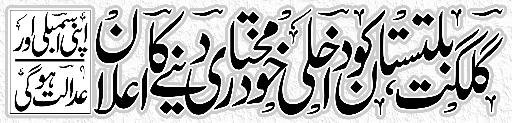
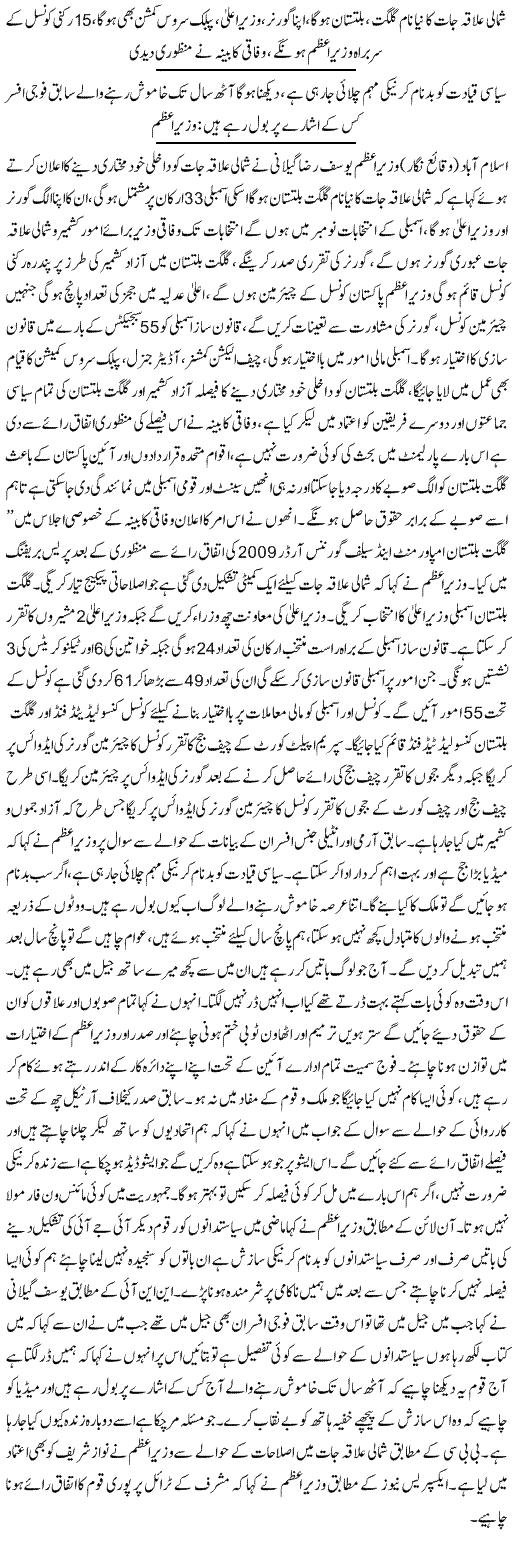
Addressing a press conference flanked by Federal Information Minister Qamaruz Zaman Kaira, he said 15-member administrative council will see about the matters of Northern Areas; the council will choose the chief minister.

The PM said a committee has been constituted for the Northern Areas, adding all the stakeholders have been taken in confidence on Gilgit-Baltistan Empowerment Act.

Previously, it was Pakistan People’s Party (PPP) that worked for Northern Areas, the PM said.

The Northern Areas, renamed in cabinet meeting as Gilgit-Baltistan will have a Chief Minister and six ministers along with three technocrat seats and two women seats, he informed.

The cabinet of Gilgit-Baltistan will approve their budget; however, the federation will appoint the governor.

He said Auditor General and election Commissioner would be appointed in Gilgit-Baltistan.

Commenting on secrets unfolded by former military officers, he said these statements should lead us to question why these today’s speakers kept silent for that long period, adding, ‘We want to abolish 17th amendment and 58-2B.’

‘We want harmony in powers of President and Prime Minister..and all the national institutions including military are working in their deputed jurisdiction,’ he added.

Cabinet approves self-rule for NAs

* Northern Areas to be named Gilgit-Baltistan
* Governor to be appointed by president, CM to be elected by legislative assembly
* Kaira to act as governor until elections in region

By Irfan Ghauri


ISLAMABAD: In its special meeting on Saturday, the federal cabinet approved the Gilgit-Baltistan Empowerment and Self-Governance Order 2009, which would be implemented through a presidential ordinance to be promulgated shortly.

Prime Minister Yousuf Raza Gilani, who chaired the meeting, later told reporters that replacing the Northern Areas Governance Order 1994, Gilgit-Baltistan had been proposed as the new official name of the Northern Areas where a governor would be appointed by the president to represent the federation.

Kaira: Until elections for the legislative assembly take place, Federal Minister for Kashmir and Northern Areas Qamar Zaman Kaira would act as governor.

The new order also proposed that the Gilgit-Baltistan Legislative Assembly – whose elections are likely to be held by the end of the year – should elect a chief minister.

The legislative assembly would consist of 30 members, 24 to be elected directly and six on reserved seats for women and technocrats. The chief minister would be assisted by six ministers and would be authorised to appoint two additional advisers. The Gilgit-Baltistan Assembly would have powers to make laws on 61 subjects while the council would deal with 55 subjects.

To empower the council and the assembly on financial matters, there would be a council-consolidated fund under Article 54, and the Gilgit-Baltistan Consolidated Fund under Article 55 of the 2009 law. The annual budget would be presented before the Gilgit-Baltistan Assembly as is the practice in the provinces.

The chief judge of the Supreme Appellate Court would be appointed by the chairman of the council on the advice of the governor. The number of judges would be increased from three to five and the tenure of the present judges of the superior judiciary would be protected under the new order. (Daily Times).


Rescuing the Northern Areas

Some people think that the self-governance reforms package for the Northern Areas announced on Saturday is already too little too late. But given how many things are nowhere near solution in the country, the PPP government has taken the right step. The Northern Areas will be Gilgit-Baltistan from now on, with its own elected Assembly, albeit in parallel to an independent Council working under a centre-appointed governor.

The PMLN could have opposed it simply because the change will favour the PPP, but it hasn’t, which is a sign of maturity. In its earlier tenure in power, the PPP had allowed party politics in the region, which had immediately led to the dominance of the party there. But in democracy, some things done for short term political gain finally turn out to be good for everyone in the long run. The important thing for this increasingly disturbed border region is that it has got self-rule.

The PMLN has welcomed the big change of status. It is quite clear why it has done so. During its rule it had discovered that the Northern Areas were ruled entirely from the point of view of “national security” and there was little that the central government could do — despite the political parties’ activities there — because the locus of power in Gilgit was firmly in the hands of the army.

The Northern Areas’ nationalism has developed in opposition to the constitutional limbo in the region. It was accepted by the state as a part of Kashmir in international treaties. Azad Kashmir claimed it for that reason and challenged an early law of 1949 that had separated it “administratively”. The people of Gilgit-Baltistan claim they had liberated themselves from Kashmir at Partition and want the status of a separate province. Like Balochistan and the NWFP, this nationalism too is focusing on the possession of natural resources and water and energy assets. Because they were representationally suppressed, a fringe began to call for “Free Balawaristan”.

Representation and freedom of party politics will undo some more serious damage done by two military rulers. General Zia-ul Haq, fighting a relocated Iran-Saudi sectarian war, allowed Sunni lashkars into the region in 1988 to cut the Shia majority down to size. This was a useless bloodletting in an area where the people were generally peace-loving. The Ismaili ethos of tolerance and tranquility represented by Hunza prevailed even among the Twelver Shia.

The tragedy of Gilgit-Baltistan sprang from its designation as an area of “strategic importance”. It faces Ladakh across the border in Indian-administered Kashmir. For countless years, the Pakistan Army eyed Ladakh for a set-piece battle with India, and each army chief was presented with a scenario of victory. Then General Musharraf came along and thought he could pull it off. In the process, the people of Gilgit-Baltistan went into another phase of sectarian massacres.

General Musharraf did not care that some of the “non-state actors” he was using at Kargil were savagely anti-Shia. After the fiasco of Kargil, sectarianism has never stopped raising its ugly head in the region and will take the salve of democracy now to heal. Religious leaders were killed under General Musharraf. Textbooks prescribed by bureaucrats were rejected. People arose against choices made in Islamabad of fundamentalist commissioners at Gilgit. And the local military commanders applied the iron fist indiscriminately.

If there is extremism in Gilgit-Baltistan today it should not surprise us. But the process of election, good governance and sense of participation will gradually lead to acceptance. The Karakoram Highway has opened up the region economically; the construction of Basha Dam will bring wealth and prosperity. Above all, the opening up of this heretofore “strategic” area to the media will tell the people of Pakistan for the first time what has been going on there and what should be done to bind the old wounds.

The Jammu and Kashmir Liberation Front (JKLF) has opposed the self-governance package because it hopes to liberate Jammu & Kashmir from both India and Pakistan and give it the status of a sovereign state. But anyone who has taken a close look at the people of Gilgit-Baltistan knows that their demand has been for a separate province within Pakistan, based on their belief that they are not Kashmiris. The JKLF can fight the next Gilgit-Baltistan election and see where it stands with the people. That is its right. (Daily Times)


A step in the right direction —Rasul Bakhsh Rais

Since Gilgit-Baltistan was part of the Jammu and Kashmir state, its fate became linked to which way the disputed state would go. This was implicitly the reason for the six-decades-long delay in restructuring the governance of the region

Granting a sort of autonomy, or self-rule, to the Gilgit-Baltistan region is the first critical step in the right direction. This is something that the people of the region have been demanding for a very long time.

But is the proposed structure of self-governance that is going to be implemented through a presidential ordinance enough, or do we need more in terms of autonomy from the outset of reforms than wait for further political demands? Have we, in this sense, neglected Gilgit-Baltistan?

The people of this rugged and difficult region have their own individuality and a sense of ethnic identity that has been shaped by history and geography over a long period of time. There is no doubt that this sparsely populated, vast region has diverse communities within it, but at the same time there are overlapping bonds of religion, language and social networks.

Parallel to unifying themes, there are also distinctive feelings among communities at the local level, a pattern similar to the social patchwork that we see in mountain communities.

Unlike tribal communities, the social networks that we have observed in Gilgit-Baltistan are essentially non-feudal, less hierarchical and more open to social change and development than even mainstream areas in the rest of Pakistan. One is greatly impressed by how local communities have embraced the idea of education, community organisation and development, often in competition to outdo others in achieving social and developmental objectives.

The people of Gilgit-Baltistan rightly take pride in liberating themselves from the Raja of Kashmir in 1947 and unconditionally acceding to Pakistan. This region like many others in the subcontinent had changed hands among local and foreign rulers before the Raja of Jammu and Kashmir annexed it in his ambitious quest of empire building.

Since Gilgit-Baltistan was part of the Jammu and Kashmir state, its final fate became linked to which way the disputed state would go. This was implicitly the reason for the six-decades-long delay in restructuring the governance of the region. In fact, equally crucial was the act in 1948 to separate Gilgit-Baltistan from what became known as Azad Kashmir or the Pakistani part of the disputed Jammu and Kashmir state.

It is interesting that Kashmiri nationalists on both sides of the Line of Control claim Gilgit-Baltistan as an inherent part of the Jammu and Kashmir state. The Indian government also took a similar position when it raised questions about Pakistan’s border demarcation agreement with China in 1963. In fact, Pakistan and China while signing the border agreement added a proviso that it was subject to the final settlement of the Kashmir dispute.

In the coming weeks and months, we will see a storm of protest from Kashmiri nationalists and even mainstream Kashmiri leaders over granting self-rule to Gilgit-Baltistan. One of the fundamental reasons Gilgit-Baltistan couldn’t get the status of a province was our interest in placating Kashmiris’ feelings.

There are two important issues that we need to discuss in this regard. First, who should really determine who the people of Gilgit-Baltistan are? No external power and group can fix the identity of any community. What is important in this case and universally acknowledged is how the people define themselves and the identity they give to themselves.

In our part, there are two sides to such identities, territorial and linguist-ethnic. The latter is much fuzzier because the territorial units we have evolved over centuries are not ethnically exclusive but contain other ethnic and linguistic groups. Gilgit-Baltistan has a territorial identity and a deep sense of historicity. But its linguistic particularities that are natural features of mountain communities living in isolated valleys are not too sharp to divide them into smaller identities.

How do the people of Gilgit-Baltistan define themselves? They may have petty regional differences, and sub-regional identities like Hunza and Nagar, but they don’t refer to themselves as Kashmiris. The only thing apparently common with the state of Jammu and Kashmir is their being subject to foreign rule against their will, and against which they rebelled and secured their freedom. But their freedom from the ruler of Jammu and Kashmir was unfortunately followed by direct federal rule from Islamabad in an independent Pakistan. But then the complex triangle of Kashmir, India and Pakistan and the sensitivities of the Kashmiri leaders that we have supported unconditionally at a great cost and may continue to do so were resistant in recognising the historic name and character of Gilgit-Baltistan.

The name sounds so natural and comes so easy on tongue than the bureaucratic characterisation of this historic people as the “Northern Areas of Pakistan”. The title Islamabad gave to this region and its people was devoid of human touch, as if territory mattered more than the people who have lived there for thousands of years.

The people in fact matter when they are granted the identity they wish to adopt, freedoms, and autonomy within a national framework of the state. There is no conflict and cannot be conflict between a national government and a region and province when powers are adequately devolved to the units to their satisfaction. This kind of federalism is a necessity in ethnically diverse countries like Pakistan.

Recognising self-rule for Gilgit-Baltistan should be considered a first instalment of governance reform with the objective of giving it the full status of province. The region has all the essential features, strengths, resources and more importantly political aspirations to become a province. The size of population should never matter in recognising such an historical realities; just cast a look at the variations in the sizes of American states: what matters is history for Rhode Island, Delaware and New Hampshire and not their demographic strength compared to California and New York.

The decision that the PPP and its coalition partners have taken in recognising rights of the people of Gilgit-Baltistan is courageous and politically mature. More than that it will pull the people of this region out of administrative mumbo-jumbo and set them on a clear path of political evolution to a province. It would be better and more far reaching if provincial status for Gilgit-Baltistan is settled in the constitutional reform package now, than to leave it for future political dispensations.

Finally, Kashmiri nationalists lack sound reasons for tagging Gilgit-Baltistan to Jammu and Kashmir. In their own struggle, what matters is their sense of identity, constitutive elements of community and historical facts that they believe separate them from the rest. Why then do they deny the same right to the people of Gilgit-Baltistan to define who they are and what type of political arrangements they want for themselves?


Dr Rasul Bakhsh Rais is author of Recovering the Frontier State: War, Ethnicity and State in Afghanistan (Oxford University Press, 2008) and a professor of Political Science at the Lahore University of Management Sciences. He can be reached at rasul@lums.edu.pk (Daily Times)

گلگت بلتستان: اصلاحات پر تحفظات

بلستان، فائل فوٹو

ہنزہ کو ایک سے زائد نشستیں دینے کے مطالبے کے لیے تمام جماعتوں نے بدھ کو ہنزہ میں ہڑتال اور احتجاجی جلسہ بھی کیا: مقامی صحافی

چھ اضلاع پر مشتمل پاکستان کے شمالی علاقہ جات کو’گلگت بلتستان‘ کے نام سے نئی انتظامی حیثیت دینے کے بارے میں جاری کردہ صدارتی آرڈیننس پر متعلقہ علاقوں کے زیادہ تر لوگ تو خوش ہیں لیکن اب بھی کچھ معاملات کے بارے میں جہاں گلگت اور بلتستان کے لوگوں کو تحفظات ہیں وہاں بیشتر کشمیری رہنماؤں کو بھی سخت اعتراضات ہیں۔

بیس لاکھ سے زیادہ آبادی اور اور تقریباً تہتر ہزار مربع کلومیٹر کے رقبے پر پھیلے’گلگت بلتستان‘ کے بعض فریقین کا مطالبہ ہے کہ سابق فوجی حکمران پرویز مشرف کے دور میں ہنزہ اور نگر کو ملا کر ’ہنزہ نگر‘ کے نام سے جو ساتواں ضلع بنانے کا وعدہ کیا گیا تھا وہ صدر آصف علی زرداری کی جاری کردہ اصلاحات کا حصہ نہیں ہے۔

بعض مقامی صحافیوں کا کہنا ہے کہ سب سے زیادہ اعتراض ہنزہ کو قانون ساز اسمبلی میں صرف ایک سیٹ دینے پر ہے۔ ان کا کہنا ہے کہ حکمران پیپلز پارٹی سے لے کر مذہبی جماعتوں تک سب اس بارے میں متفق ہیں کہ ہنزہ کی ایک سیٹ بڑھائی جائے کیونکہ ہنزہ کی آبادی اب سوا لاکھ سے بھی زیادہ ہے اور محض ایک سیٹ کافی نہیں۔

ان کا یہ بھی کہنا ہے کہ جب ہنزہ سے ملحقہ علاقے نگر کو قانون ساز اسمبلی میں دو نشستیں ہیں تو ہنزہ کی کیوں نہیں؟۔ تمام جماعتوں نے اپنا مطالبہ منوانے کے لیے بدھ کو ہنزہ میں ہڑتال اور احتجاجی جلسہ بھی کیا۔ لیکن تاحال پاکستان کی حکومت نے اس بارے میں کوئی ردِ عمل ظاہر نہیں کیا۔

’گلگت بلتستان‘ کے نام سے صوبے نما انتظامی حیثیت سے نئی بننے والی اس اِکائی کے متعلق کشمیر کی بیشتر سیاسی جماعتوں کے اعتراضات متعلقہ علاقے کے لوگوں سے یکسر مختلف ہیں۔ علیحدگی پسند کشمیری رہنما امان اللہ خان سے لے کر جماعت اسلامی کے عبدالرشید ترابی سمیت اکثر کو اعتراض گلگت اور بلتستان کو پاکستان کے زیر انتظام کشمیر سے جدا کر کے علیحدہ انتظامی حیثیت دینے پر ہے۔

’گلگت بلتستان‘ کے نام سے صوبہ نما انتظامی حیثیت سے نئی بننے والی اس اِکائی کے متعلق کشمیر کی بیشتر سیاسی جماعتوں کے اعتراضات متعلقہ علاقے کے لوگوں سے یکسر مختلف ہیں۔ علیحدگی پسند کشمیری رہنما امان اللہ خان سے لے کر جماعت اسلامی کے عبدالرشید ترابی سمیت اکثر کو اعتراض گلگت اور بلتستان کو پاکستان کے زیر انتظام کشمیر سے جدا کر کے علیحدہ انتظامی حیثیت دینے پر ہے۔

یہ اعتراض کرنے والے کشمیری رہنماؤں نے خدشہ ظاہر کیا ہے کہ اصل میں بیرونی دباؤ کی وجہ سے پاکستان کی حکومت نے یہ فیصلہ کیا ہے۔ ان کے مطابق اس سے ایک تو کشمیر کی تقسیم کی راہ ہموار ہوجائے گی اور بھارت کو موقع مل جائے گا کہ وہ کنٹرول لائن کو عالمی سرحد تسلیم کرانے کے لیے پاکستان پر دباؤ بڑھا سکے۔

جبکہ حکومت ان کے خدشات کو مسترد کرتے ہوئے کہتی ہے کہ پیپلز پارٹی نے شمالی علاقہ جات کے عوام کو سیاسی، انتظامی، مالی اور عدالتی طور پر خودمختار کرنے کا وعدہ پورا کیا ہے۔ صدر کے ترجمان فرحت اللہ بابر کے مطابق گلگت اور بلتستان کے متعلق پہلی بار ذوالفقار علی بھٹو نے انیس سو پچہتر میں اصلاحات کیں، بعد میں انیس سو چورانوے میں بینظیر بھٹو نے اور اب صدر آصف علی زرداری نے خودمختاری دی ہے۔

حکومتی اصلاحات کے مطابق ’گلگت بلتستان‘ کے لیے بالغ رائے دہی کی بنا پر چوبیس اراکین پر مشتمل قانون ساز اسمبلی ہوگی، ان کا اپنا وزیراعلٰی اور گورنر ہوگا۔ نئی انتظامی اِکائی کی اپنی سپریم کورٹ، الیکشن کمیشن، آڈیٹر جنرل اور دیگر اعلیٰ انتظامی افسران ہوں گے۔ اسمبلی کو اکسٹھ معاملات کے بارے میں قانون سازی کا اختیار ہوگا، وغیرہ وغیرہ۔

’گلگت بلتستان‘ کو آزاد حیثیت دینے کا حکومتی دعوٰی اپنی جگہ لیکن بعض ماہرین کا کہنا ہے کہ ان کی تمام تر آزادیاں اب بھی اسلام آباد کے ایک حکم کی غلام رہیں گی۔ لیکن اس میں کوئی شبہہ نہیں کہ اس طرح کی ملنے والی خودمختاری پر بھی بیشتر مقامی لوگ خوش ہیں اور مقامی صحافیوں کے مطابق ہزاروں شہریوں نے سڑکوں پر نکل اپنی خوشی کا اظہار بھی کیا۔

اگر تاریخی حقائق کو دیکھا جائے تو گلگت اور بلتستان کے لوگوں کی اس خوشی کے پیچھے ان کی ایک صدی سے بھی زیادہ عرصہ کی وہ محرومیاں ہیں جو ان کی کئی نسلیں بھگتتی رہی ہیں۔ سولہ مارچ اٹھارہ سو چھیالیس کو جب سکھوں کو شکست دے کر انگریزوں نے امرتسر میں گلاب سنگھ سے ایک معاہدے کے تحت کشمیر کی حکمرانی پچہتر لاکھ روپوں کے عوض گلاب سنگھ کے حوالے کی تو اس وقت گلگت اور بلتستان کشمیر کا حصہ نہیں تھا۔

ہنزہ، فائل فوٹو

پاکستان نے کشمیر کو جب ’آزاد درجہ‘ دیا تو کئی دہائیوں تک کشمیر کا دم چھلا بنے ہوئے شمالی علاقہ جات کو ’آزاد کشمیر‘ میں بھی کوئی مقام نہیں ملا

ڈوگرہ راج دریائے سندھ تک تو تھا لیکن بعد میں جب گلاب رائے کے صاحبزادے رنبیر سنگھ بادشاہ بنے تو ان کی افواج نے گلگت اور بلتستان کو فتح کرکے کشمیر کا حصہ بنا لیا۔ لیکن بعد میں ان کی گرفت کمزور پڑی اور حالات بدلتے رہے لیکن انیس سو سینتالیس کو جب پاکستان بنا تو سنہ اڑتالیس کی پہلی پاک، بھارت جنگ کی اقوام متحدہ نے فائر بندی کروائی اور کنٹرول لائن پر دونوں ممالک میں اتفاق ہوا تو پاکستان کے زیر انتظام آنے والے کشمیر کے ساتھ گلگت اور بلتستان کو بھی شامل رکھا گیا۔

جس کی بڑی وجہ بھارت اور پاکستان کے درمیان منقسم کشمیر کے متلعق اقوام متحدہ کی اکیس اپریل انیس سو اڑتالیس کو منظور کردہ وہ قرارداد تھی جس میں کہا گیا تھا کہ منقسم کشمیر کا حتمی فیصلہ حقِ رائے دہی کی بنا پر کیا جائے گا۔

پاکستان نے اپنے زیر انتظام کشمیر کو جب ’آزاد درجہ‘ دیا تو کئی دہائیوں تک شمالی علاقہ جات کو ’آزاد کشمیر‘ میں بھی کوئی مقام نہیں ملا۔ اس پورے عرصہ میں شمالی علاقہ جات حقِ رائے دہی کے چکر میں برائے نام تو کشمیر کا حصہ رہا لیکن وہاں کے شہریوں کو بہت سے معاملات میں پاکستانی شہریوں جیسے حقوق یا درجہ بھی نہیں دیا گیا۔ لیکن اس کے باوجود بھی اس علاقے کے لوگوں نے کارگل کی جنگ میں پاکستان کی لاج رکھی اور لالک نامی سپاہی نے پاکستان کا سب سے بڑا فوجی اعزاز نشانِ حیدر حاصل کیا۔

انیس سو تریسٹھ میں جب اس وقت کے وزیر خارجہ ذوالفقار علی بھٹو نے اپنے چینی ہم منصب کے ساتھ سرحدوں کے متعلق ایک معاہدے پر دستخط کیے توگلگت اور بلتستان سے متصل پانچ ہزار ایک سو اسی مربع کلومیٹر کا علاقہ چین کے حوالے کیا گیا۔ اس معاہدے کے مطابق چین اور پاکستان نے طے کیا کہ جب مسئلہ کشمیر کا معاملات حل ہوجائے گا تو دونوں ممالک اس علاقے اور سرحدی حد بندیوں کے بارے میں دوبارہ مزاکرات سے معاملات طے کریں گے۔

انیس سو تریسٹھ میں جب اس وقت کے وزیر خارجہ ذوالفقار علی بھٹو نے اپنے چینی ہم منصب کے ساتھ سرحدوں کے متعلق ایک معاہدے پر دستخط کیے توگلگت اور بلتستان سے متصل پانچ ہزار ایک سو اسی مربع کلومیٹر کا علاقہ چین کے حوالے کیا گیا۔ اس معاہدے کے مطابق چین اور پاکستان نے طے کیا کہ جب مسئلہ کشمیر کا معاملہ حل ہوجائے گا تو دونوں ممالک اس علاقے اور سرحدی حد بندیوں کے بارے میں دوبارہ مذاکرات سے معاملات طے کریں گے۔

چار صفحات اور سات شقوں پر مشتل انیس سو تریسٹھ کے پاک، چین معاہدے میں یہ کہیں نہیں لکھا کہ چین کو دیے گیے علاقے میں آباد لوگ بھی کشمیر کی رائے دہی میں حصہ لیں گے۔ لیکن پاکستان کے زیر انتظام کشمیر کے ایک سیاسی رہنما سردار خالد ابراہیم کا دعویٰ ہے کہ اس معاہدے کی رو سے چین کے حوالے کردہ علاقے کے لوگ بھی حق رائے دہی میں حصہ لینے کے حقدار ہیں


Read more...

Sunday, 23 August 2009

Musharraf's trial and Gilani's first "khoba": A critical analysis


Musharraf on trial
By Anwar Syed
Sunday, 23 Aug, 2009 (Dawn)

STRIDENT calls for Gen Pervez Musharraf’s trial under Article 6 of the constitution have of late been coming from various individuals and groups. But he is not without supporters.

The more prominent among them is PML-Q. Chaudhry Shujaat Hussain, its head, has recently declared that his party will oppose moves against him. The MQM has adopted a similar stance. The general has supporters even beyond these two parties.

Some other observers maintain that putting the general on trial would be a waste of time and effort, that it would be best to leave the past alone and attend to the tasks that must be done today. Still others ask why, if the past must be raked up, begin and end with Musharraf?

While this debate goes on in Pakistan, the general lives in London and goes out to various places to deliver lectures charging an enormous fee. He told a television interviewer that he intended to return to Pakistan after his speaking commitments and that he will face any trial that may be held against him. However, his future course of action is problematic at best.Prime Minister Yousuf Raza Gilani says his government will institute a case against the former president if parliament unanimously passes a resolution requiring such a move. This is his way of saying that he will not proceed against Musharraf: he knows fully well that no such resolution will be forthcoming since certain groups in parliament have already declared their opposition to the proposed trial.

Mr Nawaz Sharif, who is the most vociferous in demanding Musharraf’s trial, indicated his party would introduce the relevant resolution in parliament if the government doesn’t. Actually, as some observers have pointed out, no parliamentary resolution is necessary. The executive can proceed against Musharraf on its own authority. But, as noted above, the PPP government does not intend to make any such move.

Let us now see what Article 6 of the constitution is all about. It says anyone who abrogates or subverts the constitution is guilty of high treason. He who conspires with another to abrogate or subvert it or aids this other person’s act of abrogating or subverting it is likewise guilty of high treason.

Gen Musharraf set aside and then subverted the constitution on Oct 12, 1999 and Nov 3, 2007. On the first of these occasions he overthrew Nawaz Sharif’s government, alleging that the prime minister had attempted to hijack the aircraft that was bringing him back from Sri Lanka. The Supreme Court recently rejected this allegation, which is an indication that the general had already made plans to seize the government. This implies that in planning and executing this coup he had the concurrence of his corps commanders who could thus be looked upon as co-conspirators.

The Supreme Court validated his coup and later the National Assembly. All of them and hundreds of civil servants aided the implementation of his decisions and directives. Thus, all of them — generals, civil servants and legislators — invite the charge of high treason as prescribed in Article 6.

The security services chiefs were present in Gen Musharraf’s camp office when Justice Iftikhar Mohammad Chaudhry went to see him on March 9, 2007 when he was made non-functional. Perhaps they too could be seen as co-conspirators.

It may be assumed that Musharraf imposed a state of emergency on Nov 3, 2007 with the concurrence of other services’ personnel. This time again he subverted the constitution. So, in terms of Article 6, those who aided him too could be charged with high treason.

I do not remember demands for the trial of any of Gen Musharraf’s predecessors who abrogated, amended and subverted the constitution. Ziaul Haq died while he was still in office. There was some talk of trying Yahya Khan for his role in the dismemberment of Pakistan but not for his abrogation or subversion of the constitution. Ayub Khan resigned his office and went to live in his palatial home. Iskander Mirza was sent to London where he lived for the rest of his days, albeit in reduced circumstances. Ghulam Mohammad retired to his daughter’s home in Karachi. He had to go because he had become too sick to work.

One may say that if the right thing was not done in the past, that nonfeasance is not a good reason for neglecting it now. It should be noted, however, that in any society there are hundreds of right things that could possibly be done. They need not be done all at one time. They have to be prioritised on the basis of a cost-benefit analysis. Those found to be the most urgent might be undertaken here and now, while others wait.

It cannot be argued that Musharraf’s trial is one of the most urgent needs of Pakistan. Actually, it is dysfunctional. For if he is to be tried for abrogating and subverting the constitution, then his co-conspirators and collaborators must also be tried. That would be an extremely messy and destabilising exercise.

The advice of those who want to bury the past and mind the present merits serious consideration. Putting the former president of Pakistan on trial would be like opening a huge can of worms, which would spread and crawl all over the place, causing panic, confusion and chaos. Those who argue that Musharraf’s chastisement is necessary to deter other generals from overthrowing civilian governments are mistaken. Politically ambitious generals will move in to fill a vacuum of power if one has been created by the civilian regime’s infirmity, internal incoherence and inability to function effectively.

The writer is professor emeritus at the University of Massachusetts.

anwarsyed@cox.net


(Tahir Sarwar Mir, Express)

....

Irfan Siddiqi's frustration: (This man is the unofficial spokesperson of PML-N; an ex-personal servant of Rafiq Tarar):


....

Finally, Abbas Ather hits the nail at the head by exposing the intricacies of Musharraf's trial:


Tailpiece:
PML-N disowns Zafar’s plea for Musharraf trial

* PML-N information secretary says party to take issue to court after exhausting all political options

ISLAMABAD: Senior PML-N leader Syed Zafar Ali Shah on Saturday moved the Supreme Court seeking directions to the government to try former president Pervez Musharraf under Article 6, but the party itself disowned the plea.

PML-N Information Secretary Ahsan Iqbal said Senator Zafar had filed the petition in his own capacity.

Talking to a private TV channel, Ahsan said Musharraf’s trial was a political issue and the PML-N was trying to build a consensus on the matter, adding that the government did not require a parliamentary resolution for trying Musharraf.

Exercise: Ahsan said it was only a matter of time before his party went to court to take up the issue, but it would explore all political options first.

Earlier, Shah filed the constitutional petition in the SC under Article 184 (3), naming the federation and the former president as respondents.

He submitted that a 14-member bench of the SC, headed by Chief Justice Iftikhar Muhammad Chaudhry, had declared the imposition of emergency on November 3, 2007 by Musharraf “illegal and unconstitutional”.

Therefore, he requested the court direct the federation to act in accordance with the provisions of Article 6 of the constitution to initiate criminal proceedings against Musharraf under the High Treason Act, 1973.

Shah told Daily Times that he had filed a petition on the basis of the SC’s July 31 decision.

He said the 14-member bench had held that Musharraf, in the garb of emergency and Provisional Constitutional Order (PCO), had made amendments in the constitution by self-acquired powers which had all been unconstitutional, unauthorised, without legal basis and without any legal consequences.

Shah said the former president had overturned the entire political and democratic system by abrogating the constitution and was liable to be punished under Article 6.

He said he had requested the apex court to direct the federal government to initiate legal proceedings against the former military dictator in line with the SC decision.

Earlier on Wednesday, the PML-N decided not to move a parliamentary resolution seeking Musharraf’s trial under Article 6.

Prime Minister Yousuf Raza Gilani had informed the National Assembly that his government would try Musharraf for high treason only if the parliament adopted a unanimous resolution. staff report/daily times monitor


Read more...

Thursday, 20 August 2009

Don't be fooled by the ISI-sponsored journalists, Prime Minister Gilani!


Reacting to charges of corruption

Prime Minister Yousaf Raza Gilani has dismissed the chairman of the Pakistan Steel Mills Corporation and asked the interior ministry to probe the charges of corruption made against him in the media. Since the “scandals” aired on the media related also to the PIA and the Pakistan Trading Corporation, he has asked the Auditor General to start investigating his government’s years in power and set aside the investigations focusing on the misdeeds of 15 years ago.

The Steel Mill has been making losses after the tapering off of the international boom triggered by high growth rates in China and India. The Supreme Court quashed its privatisation but the period of boom soon came to an end and the demand for steel went down.

Now the Mill is making losses of approximately two billion rupees a month. No one can honestly say that there is no corruption in a state-owned corporation. But no one can also claim that after sacking its chairman, the steel mill will take off once again. In fact, it is a universal fact that corporations run by the state and prevented from being privatised by courts will go bankrupt sooner or later.
If the interior ministry in fact unearths hanky-panky in the Steel Mill, then the PPP will have to take the rap. It is in this light that the step taken by Mr Gilani should be welcomed. He has set on foot a process that will either doom his government as one that runs on favouritism or will encourage the media that is gunning for his government.

There is no dearth of incompetence, however. The sugar crisis in the country has been mishandled. The bureaucrats reacted stupidly to TV reports and advised raids on the sugar mills. The sector was described as the monopoly of the powerful politicians. After the raids, the government was forced to retreat and say the sugar mills were not to blame. The media had misled the government. And the sugar crisis continues. Let’s hope the Steel Mill probe doesn’t end the same way. (Daily Times)

Read more...