Editor's Choice

--------------------------------------------------------------------------------------------------------------------------
Featured Post
--------------------------------------------------------------------------------------------------------------------------

"Let us build Pakistan" has moved.
30 November 2009

All archives and posts have been transferred to the new location, which is: http://criticalppp.com

We encourage you to visit our new site. Please don't leave your comments here because this site is obsolete. You may also like to update your RSS feeds or Google Friend Connect (Follow the Blog) to the new location. Thank you.


--------------------------------------------------------------------------------------------------------------------------
Showing posts with label IJI. Show all posts

Wednesday, 4 November 2009

How did MQM foil PML-N's anti-democratic plans on NRO - An analysis

MQM denies ever pressing for Zardari’s resignation


November 3rd, 2009 - 2:30 pm ICT by ANI
Islamabad, Nov.3 (ANI): The Muttahida Quami Movement (MQM) has denied issuing any statement which asked for President Asif Ali Zardari’s resignation.

According to reports, a delegation of MQM leaders led by the leader of the party in parliament Dr. Farooq Sattar met Prime Minister Yousuf Raza Gilani to clarify its stance over the issue.

The delegation, which included Parliamentary Affairs Minister Dr Babar Awan, Petroleum Minister Syed Naveed Qamar and other senior party leaders, rejected media reports that the MQM president Altaf Hussain has asked Zardari to step down, The Nation reports. Earlier, it was reported that Hussain while asking his party leaders to oppose the National Reconciliation Ordinance (NRO) in parliament had advised Zardari to tender his resignation. Hussain, during an interview with a private television channel, said that he has directed his party members to oppose the NRO in parliament, and that he had also told the President that the ordinance was a ‘black law’.

Hussain said the government should not table the ordinance in the House as the people of the country have already rejected it. He, however, later clarified that he never asked for Zardari’s resignation. “I did not talk about Zardari’s resignation in the entire interview. We are not against the Pakistan People’s Party or Zardari. The MQM is not responsible if our advice is misunderstood. Neither can the MQM become a party to legalising corruption through the assembly,” Hussain said. (ANI)

....


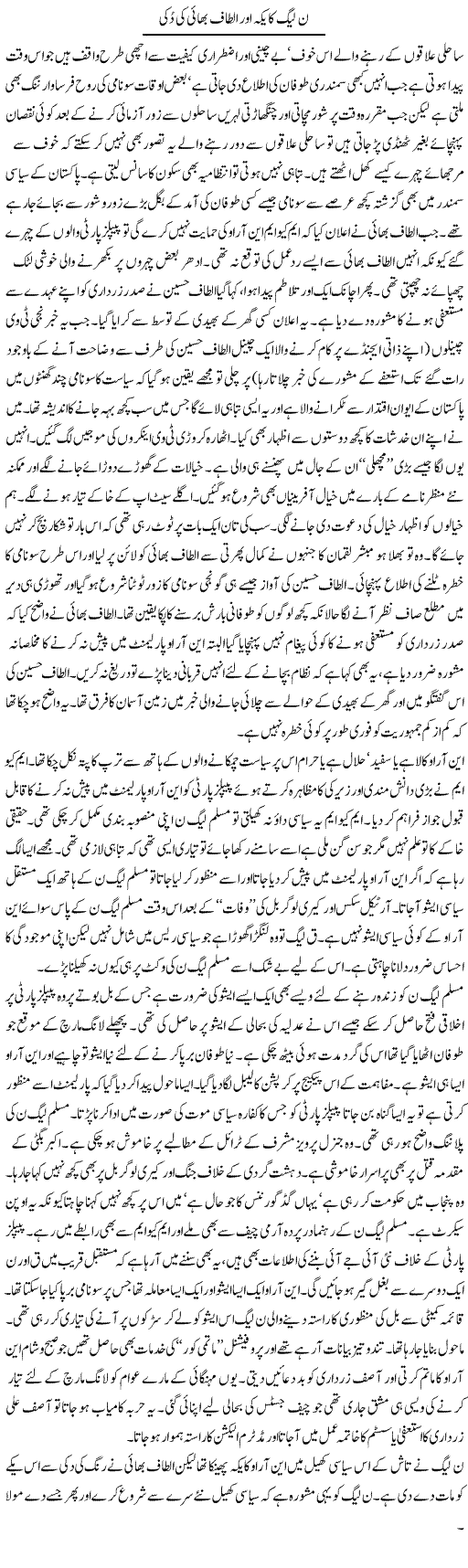
By Latif Chaudhry


A day of reconciliation in NA
Wednesday, November 04, 2009
By By our correspondent

ISLAMABAD: It was a day of reconciliation in the National assembly after the government’s decision not to present the controversial National Reconciliation Ordinance (NRO) in parliament and the treasury benches received accolades from the opposition for bowing to the parliament’s demand.

Tuesday’s proceedings coincided with the second anniversary of the emergency and the PCO imposed by Musharraf and the House echoed with demand of his trial under the Article 6 of the Constitution. Interestingly, the PML-Q members, who were part of Musharraf’s dispensation, were also critical of the Nov 3 acts, but some of them, including Marvi Memon and Akram Gill, had a word of praise for him.

Kicking off the debate on a point of order, Leader of the Opposition Chaudhry Nisar Ali lauded the government for its decision not to table the NRO in the National Assembly. He asked the government to try Musharraf under the Article 6. “It is time to take concrete measures to make parliament a truly sovereign institution and the centre of power,” he added.

He announced that the PML-N would hold a rally outside the Parliament House today to condemn the November 3 action and to express solidarity with the judiciary. He appealed to all the political forces to join them.

Ahsan Iqbal said that after the Supreme Court’s verdict, the government was bound to proceed against Musharraf. Interior Minister Rehman Malik described the decision of not tabling the NRO in the House as ‘political wisdom’. Responding to a point of order, he agreed to give an in-camera briefing to parliamentarians about national security issues. Responding to Ahsan’s comment that US Secretary of State Hillary Clinton had said Pakistan provided no evidence on Indian interference in the country, Malik said foreign dignitaries gave such statements and “we are not supposed to respond.” Meanwhile, Speaker National Assembly Dr Fehmida Mirza clarified that neither she nor her husband ever took benefit under the NRO. (The News)

Also read: The Project IJI - Second Edition

Read more...

The Project IJI - Second Edition

Compiled by: Abdul Nishapuri
Title:
The Project IJI (Islami Jamhoori Ittehad - Second Edition)
Alias: Mullah Military Alliance
Aim: To destabilize the democratic government of Pakistan
Key sponsor: ISI, GHQ
Key constituent parties: PML(N), PML(Q), Jamaat-e-Islami, MQM, Farooq Leghari, Mumtaz Bhutto
Key media agents of the ISI: Ansar Abbasi, Shahid Masood, Shaheen Sehbai, Hamid Mir, Javed Chaudhry, Haroon-ur-Rashid, Talat Hussain, Irfan Siddiqi
The hidden agenda: All of the above (except MQM and Haroon-ur-Rashid) are staunch supporters of Taliban. MQM has been blackmailed into this alliance because they have been offered an "NRO" by Nawaz Sharif and Imran Khan on the 12 May 2007 massacre in Karachi. Haroon-ur-Rashid is known for his qasida khwani (praise) of General Zia-ul-Haq, General Hameed Gul, Major Amir, and other criminals of the ISI (mullah-military alliance). He has also written an 'official history' book titled Fateh in appreciation of the criminal General Akhtar Abdur-Rehman.
....

PPP MPs annoyed with NRO spat

ISLAMABAD: Some Pakistan People’s Party (PPP) MNAs on Tuesday severely criticised opposition parties for blocking the NRO in parliament and the role played by a section of the media in the affair. While the government decided to withdraw the ordinance, the controversial document appears to continue to haunt those in power. National Assembly Speaker Dr Fehmida Mirza clarified a news item, saying her husband and she never benefited from the NRO, while the PPP’s Nawab Yousaf Talpur also had to give a similar clarification. PPP member Akunzada Chattan said the move to block the NRO in parliament was worse than former president Pervez Musharraf’s imposition of emergency rule, as “political forces, the civil society and a section of the media acted against the PPP at the behest of the GHQ”. The PPP’s Chaudhry Nadeem Afzal Chan said politicians were being defamed under a conspiracy. He also criticised some private TV anchorpersons and journalists who had become “propaganda tools”. irfan ghauri (Daily Times)

....

Kerry-Lugar law critics are Taliban backers: Holbrooke

Daily Times Monitor

LAHORE: US special envoy Richard Holbrooke has said those criticising the Kerry-Lugar law are either opposed to the current Pakistani government or are supporting the Taliban, reported a private TV channel on Tuesday.

Holbrooke told the channel that Pakistan’s current political situation would not become similar to the crisis on March 16 – when top US officials had to make phone calls to the Pakistani leadership to sort out issues related to the restoration of the judiciary. He said the US only supported the leadership of constitutionally elected governments. Holbrooke said although the NRO did not come under much discussion during Hillary Clinton’s recent visit to Pakistan, US officials were fully aware of the situation.

About Pakistan’s claim that India is supporting militancy in the Tribal Areas and an insurgency in Balochistan, the envoy said the US fully understood these concerns.

....

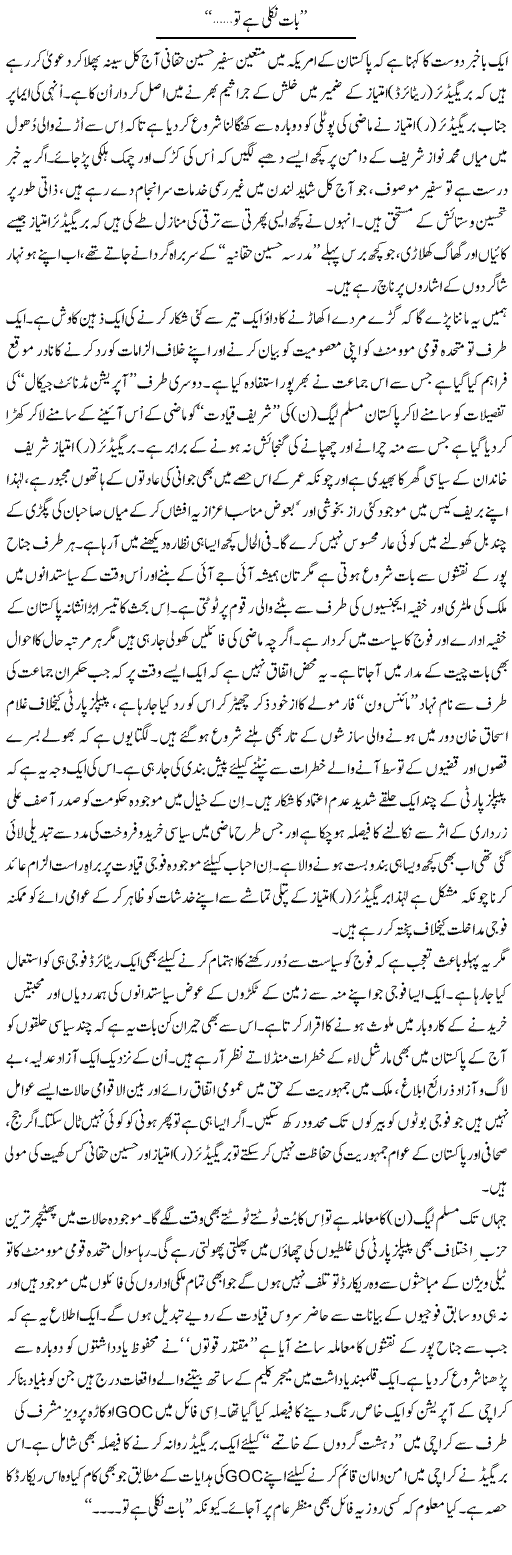
(Nazir Naji)

....

EDITORIAL: Retreat over NRO

After a high level meeting of the ruling alliance at the Presidency on Monday, the PPP government has decided not to bring the controversial National Reconciliation Ordinance (NRO) to parliament for a vote. This is clearly a reversal but one which could have been avoided had the ruling party consulted its allies beforehand. It is quite apparent that the NRO as a bill was brought to the relevant committee of the National Assembly without making sure that all the numbers needed were in hand.

The withdrawal will not put an end to the “dangers” that the NRO represented to the map of power brought about by the 2008 general elections. After the debacle caused by an aggressive withdrawal of the MQM from the pro-NRO consensus, the next crisis in the offing is the march of the opposition to a no-confidence vote. The PML-N, whose chief is determined to start a Long March on the ordinance, is no longer averse to the thought of a mid-term change, whether through a new general election or through the ‘minus-one’ formula under a ‘national government’, possibly with Prime Minister Yousaf Raza Gilani in the driving seat.

Monday night, the MQM seemed overly righteous about the NRO, which betrayed some other long-brewing disagreement between the PPP and Mr Altaf Hussain. The disagreement was definitely not on the NRO. Had that been the case, the MQM would have taken a position on it long ago. It says the MQM members supposed to be let off the hook by the NRO were never really affected by it. It insists that all the cases were criminal and were reviewed by the courts and struck from the record. Mr Altaf Hussain, who spoke in some detail to the TV channels, kept emphasising that his party was not targeted for corruption, hinting that the PPP government was in the dock for corruption, not only under the NRO, but also because of its current performance.

The depth of the MQM alienation from the PPP could be grasped from the way the MQM chief kept using the “sacrifice” innuendo for President Asif Zardari, which the media took to mean that he was actually asking the PPP chief to resign as president. This can only mean that the two allied parties had engaged in some kind of polemic over the sharing of power — most probably in Sindh — and had failed to resolve it despite the several meetings the MQM top leaders had with President Zardari over matters in Karachi. Mr Hussain was angry but was at pains to hide his anger behind the justifications he offered for not supporting the government on the NRO.

Had someone in the PPP looked deeper into the NRO imbroglio he would have examined the options of a power-denied MQM. It was a question of whether the PPP should give the MQM what it wants in Karachi or face the NRO alone. It is obvious that the PPP took it for granted that the MQM will not be able to go against the NRO because of the extent to which it had benefited from it. It forgot that the MQM was disciplined enough to take the fallout from going against the NRO to pressure the government in Islamabad. It is because of the cadre discipline of the MQM that it has been able to take the bitter pill of opposing the NRO in order to challenge the PPP’s decisions in regard to the governance of Karachi. The intensity of the PPP-MQM clash is reflected in the latter’s decision to vote against the passage of the NRO.

Pakistan will be further destabilised from now on. The PML-N will muster the forces intent on overthrowing the government and will move to ask the government to take a confidence vote. Its pious assertions to the contrary, it will push the country towards another general election while the Taliban have passed to the phase of targeting innocent citizens wherever they find them in large gatherings. Taking the PPP government as ‘pro-America’, they will most likely spare the Long March agitation of the grand opposition, if it comes. Faced with this, the remaining allies will rethink their political strategy and make the paucity of numbers in parliament more glaring for the PPP. Meanwhile there is always the “peaceful” alternative of going to the Supreme Court, which is likely to strike the NRO down as being violative of the spirit of the constitution. * (Daily Times)
(Muhammad Amir Khakwani)
...

(Tahir Sarwar Mir)

Also read:

Read more...

Thursday, 17 September 2009

March of the skeletons


By Mahir Ali
Wednesday, 16 Sep, 2009 (Dawn)

The plethora of talking heads on private television channels has yielded a few intriguing insights. —File Photo

GOING by the rate at which former operatives from a plethora of military and other agencies have been emerging from the woodwork and spilling the beans, it almost seems as if someone went around spiking their preferred beverages with truth serum in the run-up to the month of fasting.

If only it were that simple. Were there is some sort of guarantee that their outpourings consisted of nothing but the truth, it would be possible to applaud the skeletons that have steadily been striding out of all manner of cupboards in recent weeks.

Back in the dying years of the Soviet Union, Mikhail Gorbachev laid considerable store by his policy of glasnost, which was an attempt to fill in the blank pages of his nation’s history. Much of the material that saw the light in those heady days was, of course, already common knowledge outside the USSR.

There can be little doubt that there are many blank pages in Pakistan’s history, but the present process of filling them cannot reasonably be compared with glasnost. A crucial reason for this is that invariably the source of the so-called revelations and the motivation behind them is more relevant than the content. The ‘why’ has more value than the ‘what’, not least because the latter often involves a regurgitation of established facts.

For instance, did anyone seriously doubt that the Islami Jamhoori Ittihad (IJI) was cobbled together by the Inter-Services Intelligence (ISI) 21 years ago in an attempt to thwart the electoral appeal of the PPP? Surely, the abortive attempt to keep the PPP out of power following the 1988 elections could not have eluded even a casual observer of those shenanigans. And it was followed by efforts to destabilise and, ultimately, abolish the PPP-led government.

Is there any element of surprise, then, in the nugget that the ISI distributed largesse among the PPP’s political opponents in the run-up to the next election, or that it was involved in buying loyalties during the effort to push through a motion of no-confidence against the government of Benazir Bhutto?

It has also long been rumoured that Osama bin Laden was generous to Benazir’s opponents, and the allegation that he met Nawaz Sharif five times a dozen or so years before 9/11 is of passing interest in the wider context of the Saudi role in Pakistani politics.

Intriguingly, the claim comes from former ISI official Khalid Khawaja, who reportedly heads an NGO called Defence of Human Rights, an organisation that focuses exclusively on those whose rights may have been violated by the US and its allies but can evidently summo n up no sympathy for the victims of terrorism.

Khawaja was arrested a couple of years ago for distributing ‘hate material’ outside Islamabad’s Lal Masjid, and one thing he decidedly shares in common with the other bean-spillers – not least the retired brigadier Imtiaz Ahmed, formerly of the Intelligence Bureau (IB) and ISI – is that they personally have a great deal to answer for.

However, what seems crucial at the moment is the question of who or what has instigated them to start talking openly about misdeeds in which they were intimately involved.

Was it an attempt to distract attention from the moderately mysterious minus-one formula that dominated media attention for a while (the one in question being President Asif Ali Zardari)? Or was it primarily intended to bury the demand for former military dictator Pervez Musharraf’s trial? Or were there multiple motivating factors, including an attempt to rehabilitate the reputation of the neo-fascist Muttahida Qaumi Mahaz (MQM) – whose leader, settled in London for 17 years, has established a new paradigm in political cowardice?

Musharraf, like Altaf Hussain, is domiciled in the British capital, albeit rather more tentatively. The argument that placing him alone in the dock would be a travesty, given that there is a long list of people whose constitutional transgressions and related offences qualify them for prosecution, is certainly not without merit.

Tragically, it is more convincing than the idealistic hope that an ex-dictator’s trial and punishment would deter future military takeovers. In fact, it is quite conceivable that the army would feel obliged to flex its muscles in the event of its former chief being made to answer for his crimes. And that may not be a risk worth taking.

It is harder to agree with those who see little point in revisiting the recent past, fearing that history’s ghosts could block the road to reconciliation – but perhaps forgetting that no meaningful reconciliation can occur without an explicit recognition of what has gone before.

This is not to suggest that the current cacophony of probable falsehoods and motivated semi-truths qualifies as an adequate – or even desirable – reckoning. At the same time, the plethora of talking heads on private television channels has yielded a few intriguing insights. It was extremely interesting, for instance, to encounter former army chief Mirza Aslam Beg’s ingratiatingly reverent references to the Bhuttos, père et fille, and even an expression of sympathy for al-Zulfikar.

It is well worth remembering, among other things, that while Z.A. Bhutto’s prime ministerial tenure had its redeeming features, it was also the period during which Saudi and ISI interference in Pakistani politics was initiated. It didn’t pay off for the PPP. Unlike their recent gesture towards Musharraf, the Saudis made no effort to save Bhutto’s life.

The extent to which they are willing to coddle Nawaz Sharif remains to be seen, but there can be little question that recent indications that the latter would be a considerably more popular choice as helmsman than the incumbent are based on selective amnesia.

Meanwhile, as Zardari hits the handout trail yet again, bringing his personal philosophy – that money is the solution to every problem – to bear on affairs of state, it’s worth noting that Pakistan’s poverty reflects not so much the absence (or, rather, incredible disparities) of wealth as the preponderance of stealth and, above all, heavily depleted stores of honesty.

mahir.dawn@gmail.com


Read more...

Sunday, 13 September 2009

Nawaz Sharif met Osama five times: Ex-ISI official


The unholy alliance of Nawaz, Osama, Gul and Khawaja

Daily Times Monitor

LAHORE: After claims of close ties between Osama bin Laden and PML-N leader Nawaz Sharif by the British author and journalist Simon Reeves, a former Inter Services Intelligence (ISI) officer named Khalid Khawaja has revealed similar facts during his interview to different media outlets including a Pakistani TV channel.

According to the information given by Simon Reeves in his book “The New Jackals: Ramzi Yousaf, Osama bin Laden and the future of terrorism”, backed by that of Khalid Khawaja, Bin Laden not only sponsored the election campaign of former prime minister and PML-N leader Nawaz Sharif in 1988 but paid him large sums of money to ensure protection of Al Qaeda operatives in Pakistan and to “Islamise” the state and society.

Khawaja, who also runs a non-government organisation with the name of Defence for Human Rights, has claimed in an interview to a local TV channel that Bin Laden had held five meetings with PML-N chief Nawaz Sharif.

He further stated that he had arranged these meetings between the Al Qaeda leader and Nawaz on the former prime minister’s request. He also said that he could produce evidence of these meetings to counter the denial by PML-N spokesman Siddique ul Farooq who said that no such meetings ever took place.

However, Khawaja denied that he ever stated that Osama gave more than Rs 500 million to Nawaz Sharif. He said hopefully Nawaz Sharif would not “tell a lie” in this regard, and added that the statement of PML-N spokesman Siddique ul Farooq was untrue that no such meetings had taken place.

Khawaja said that he used to be a close associate of Bin Laden in the past and might have met him more than a hundred times but he never met him after the 9/11 terror attacks.

A blogger at ABCNews.com had previously quoted the former ISI official as stating that Nawaz took a million dollar payoff from Bin Laden for turning a blind eye to Al Qaeda operatives in Pakistan.

ABC News also confirmed the same incident of payoff by quoting former FBI agent Jack Cloonan who used to interrogate one of the key Al Qaeda operatives in US custody, Ali Muhammad.

Cloonan, who is currently working as an ABC News consultant, claimed that Ali had once told him that Bin Laden paid Nawaz’s representatives $1 million for not cracking down on the militants in the Northwest Frontier Province.

Simon Reeves states in his book that after re-establishing Al Qaeda, one of Bin Laden’s first actions was to try and guarantee the security of his men living in Pakistani refugee camps by throwing money at the election campaign of Nawaz Sharif, “an energetic Pakistani politician” standing for the election of Prime Minister.

He also states in his book that Nawaz had received the money from Bin Laden with a promise to convert Pakistan into a strict Islamic state.

An American website named History Commons Website has not only confirmed Cloonan’s claim but has also mentioned another book by Scott-Clark and Levy, claiming that General Hameed Gul had contacted Osama Bin Laden who was then known to provide financial support to the Afghan mujahideen, to pay for a coup and assassination of the late Prime Minister Benazir Bhutto.

Source

Nawaz Sharif met Osama five times: Ex-ISI official


ISLAMABAD: Former Pakistan prime minister Nawaz Sharif has met al-Qaida chief Osama bin Laden five times, says a former official of Pakistan's ISI, a claim hotly denied by Sharif's Pakistan Muslim League-Nawaz (PML-N).


Speaking in ARY news programme "Eleventh Hour", the former ISI official and now chairman Defence of Human Rights organisation Khalid Khwaja claimed he had arranged meetings between bin Laden and Nawaz Sharif on bin Laden's request and the Pakistan Muslim League-Nawaz (PML-N) chief had held five meetings with the al-Qaida chief so far.

"I challenge the deniers of such meetings and can present solid evidences in this respect," Khwaja was quoted as saying by ARY News on Wednesday.

He said hopefully Nawaz Sharif would not "tell a lie" in this regard.

He said he had met the al-Qaida chief more than a hundred times "but not after the 9/11 incident".

However, Pakistan Muslim League-Nawaz has termed the claims of the head of Defence of Human Rights organisation as baseless.

The claims by Khalid Khwaja regarding the meetings between Nawaz Sharif and Osama bin Laden were "meaningless", the party's information secretary Ahsan Iqbal told ARY news.

Source

Osama introduced Nawaz Sharif to Saudi royals: ex-ISI officer

LAHORE: Osama bin Laden introduced Nawaz Sharif to the Saudi royal family in the late 1980s and during a meeting the former Premier had asked the Al Qaida Chief to provide employment to Pakistanis in Saudi Arabia, former ISI officer Khalid Khwaja claimed on Sunday.


Khwaja, who was close to Sharif in the late 1980s and early1990s, made the claim in an interview.

"During his first visit to Saudi Arabia as Chief Minister of Punjab in the late 1980s, no one from the royal family had given Sharif importance," he said.

"Thereafter, on Sharif's request, Osama bin Laden introduced him to the royal family and that helped him in getting closer to the Saudis," said Khwaja, who was a squadron leader in the Pakistan Air Force before joining the ISI in 1985.

"A close aide of Sharif family and I arranged at least five meetings between Sharif and bin Laden in Saudi Arabia.

"During a meeting with bin Laden as Prime Minister in the 1990s Sharif asked him to provide employment to Pakistanis in Saudi Arabia and undertake development projects in Pakistan," said Khwaja, who was dismissed from service by late military ruler Gen Zia-ul-Haq in 1988 for reportedly writing a letter in which he disagreed with Zia on certain policies.

Khwaja's disclosure came in the wake of a series of revelations by former ISI and Intelligence Bureau officials about payoffs to politicians by intelligence agencies and the role of the ISI in making or breaking governments.

"Nawaz Sharif had always despised and discarded his well-wishers and bin Laden, (former ISI chief) Hamid Gul and I are included in that long list," Khwaja said.

Khwaja said Sharif got annoyed with him when he asked him not to toe the US line while serving as premier. "Leave America and join hand with Islamic forces, I argued. Sharif said no, I cannot," he said.

Source


Read more...

General Aslam Beg is the real bitch!


Read more...

Saturday, 5 September 2009

General Aslam Beg's Message to Supreme Court


In his letter to Nazir Njai, General Beg admits his implict threat in his message to the Supreme Court of Pakistan.

MQM was established to counter Sindhi nationalists: Beg

Daily Times Monitor

LAHORE: Former army chief Mirza Aslam Beg said on Friday the Muttahida Qaumi Movement (MQM) was established as a political measure to counter the Sindhi nationalist movement following the hanging of PPP founder Zulfikar Ali Bhutto.

Talking to a private TV channel, Beg said the MQM did not exist before 1978 and was established on the directions of General Ziaul Haq, then military ruler, only to counter Sindhi nationalists who had lost Bhutto after Zia’s military coup.

He said the caretaker government under Ghulam Ishaq Khan had decided to support the Islami Jamhoori Ittehad (IJI) to counter the PPP in order to balance the political atmosphere. “I think the formation of the IJI was a right decision at the time,” he said.

Beg said the IJI were the only means that could create a strong opposition at the time.

He said former president Pervez Musharraf had created and supported the Muttahida Majlis-e-Amal (MMA) and the PML-Q to prolong his term in office, but no one had pointed that out.

Beg said he believed the Bahawalpur plane crash that killed Gen Ziaul Haq was “sabotage”.

‘Breaking’ news —Shaukat Qadir

We have been sliding downhill for too long, the slide must stop somewhere. Now is as good a time as any, and better than most, given a COAS who is bending over backwards to establish the principle of civilian supremacy

When I first read in the papers that the intelligence ‘Wonder Boy’ Brigadier Imtiaz Ahmed (retd) alias ‘Billa’ had decided to open his mouth and that he had been running from pillar to post asking people to interview him, I decided he was best ignored. However, I did wonder what treatment succeeded in ridding him of the constipation of years and why. That the disease (or should it be treatment?) was bound to be contagious was a foregone conclusion; and even when asked, I refrained from comment except to ask, “what was unknown that he has now disclosed?”

I have been prompted to write on the subject by PMLN leader Ahsan Iqbal’s ultimatum to the President and the response it has evoked.

What is there about our history that is unknown? Did we not know that the erstwhile IJI was a creation of the Zia-ul-Haq era, to counterbalance the PPP? Did we not know that a number of politicians were bribed to turn-coat and join the IJI? Lt Gen Asad Durrani submitted his affidavit to the Supreme Court naming individuals and sums disbursed by him while he was DG ISI, on the instructions of General Mirza Aslam Beg, then COAS, many years ago. The judgement is still withheld. That one of them has publicly acknowledged it redounds to her credit, but this is not the first time our politicians have been bought or sold, nor is it likely to be the last.

As the DG ISI, Lt Gen Hameed Gul in his first briefing to Benazir Bhutto as prime minister, acknowledged that he and the ISI played a role in creating the IJI.


We all know how the PMLQ took birth with Pervez Musharraf as midwife. We have witnessed the party deserting him and the formation of a ‘Forward Bloc’. We are all aware of how the religious political parties were nurtured by Zia and later by Musharraf. We have witnessed them being bought and sold so many times that it is not possible to predict who they will support tomorrow.

Did we not know that the MQM was another creation of Zia to counterbalance the PPP in the major urban centres of Sindh, Karachi and Hyderabad? Did we not know that when Zia lost control of the MQM and this organisation began to terrorise the two urban centres under its total control, Zia tried to counter it by creating the MQM (Haqiqi)? Did we not know about the MQM’s methods; were we unaware of the Musharraf-MQM nexus? Any doubts as to the latter were put to rest in May 2007.


Did we not know about an announced intention to create a homeland for the ‘mohajirs’? What is the fresh disclosure in the ‘maps of Jinnahpur’? Whether there were any or not, the intent was known publicly.

Who was unaware that Gen Beg made every effort to subvert Benazir Bhutto’s first tenure as PM? Or that he was suitably rewarded by Nawaz Sharif, when he retired, by providing him the funds to set up the organisation called FRIENDS? Who was unaware that, at a time when Benazir Bhutto was seeking reconciliation with India and had ordered the army not to interfere in Indian-held Kashmir, Gen Beg was fighting his private war there, funnelling millions to support it?

However, there is an upside to this public washing of our dirty linen. Whoever had any illusions left about our politicians’ or our military leadership’s role in playing havoc with the country at every given opportunity in our history is likely to lose them. What is more, it throws into stark contrast our current apolitical army leadership.

Other retired friends tell me they feel bad about the damage all this is doing to the army’s reputation. In my view, that is the best part of it all. No institution should be considered to be, or be, above the law. It is time, and more, that senior military officers again become accountable to the people and to the representatives of the people — however contemptible or reprehensible the elected representatives might be. It is also high time that the people begin to hold their representatives accountable.

We have been sliding downhill for too long, the slide must stop somewhere. Now is as good a time as any, and better than most, given a COAS who is bending over backwards to establish the principle of civilian supremacy. I am sure he will pass this test with flying colours, as he has done every one in the past. (Daily Times)

.....

Democracy deficit? —Abbas Rashid

Meanwhile, a former spook with the most unsavoury of reputations has been a feature on the airwaves, making revelations that are clearly politically motivated. What Brigadier Imtiaz Ahmad (retd) has to say about the 1992 operation against the MQM and the absence of any Jinnahpur maps as well as other matters is largely geared to embarrass Nawaz Sharif. The Nawaz camp thinks this is a manoeuvre by the PPP to get them to back off on the issue of the NRO or the minus-one option (PPP minus Zardari). Hopefully, they are wrong.

Again on the issue of General Musharraf’s trial, the PPP regards this primarily as a move to put them in a difficult spot by pitting them against the army. So, there is a pragmatic consideration here on the part of the PPP not going forward on this. At the same time, while Musharraf may have illusions of leading at least a faction of the PML back in Pakistan, it is more likely that given the serious charges against him, he will come to prefer exile to his day in court.

There are also calls to proceed with another case that impinges crucially on the area of civil-military relations, and has been before the Supreme Court for around thirteen years, since 1997. The petitioner, a well-respected former military officer, Air Marshal Asghar Khan (retd) had brought the case against former Army Chief General Aslam Beg (retd), ex-ISI chief Lt Gen Asad Durrani (retd) and ex-chief of Mehran Bank Younis Habib. Essentially, Beg is accused of instructing Durrani to disburse money provided by Habib to the newly formed IJI by way of ‘logistic’ support.

The interesting thing about this case is that in an affidavit before the court, Durrani has admitted to disbursing the money and named the politicians as well as the sums handed over. And, as Justice Saeeduzzaman Siddiqui reminded us in a recent appearance on TV, none among the recipients had denied getting the money. More recently, though, some have.

Regardless, it is Durrani’s claim that he was only obeying a superior officer’s orders and Beg would have us believe that the orders had actually come from the chief executive at the time, President Ghulam Ishaq Khan. And was anyone trying to determine the legality or otherwise of such orders, before carrying them out? How disposed the Supreme Court is to take up this case again remains to be seen.


PM doesn’t mind!

Prime Minister Yousaf Raza Gilani has taken the tension out of the political atmosphere in the country by telling journalists in Karachi on Thursday that he took opposition criticism in his stride. His view was that governments did not fall by “disclosures” of the sort being made on TV channels these days.

Mr Gilani said something more meaningful after coming out of a meeting of the Sindh cabinet. When his attention was drawn to remarks made by PMLN leader Mr Nawaz Sharif that “failure of the PPP-led coalition was becoming failure of democracy”, he said: “I don’t mind what Nawaz Sharif Sahib says”.

He was right in conceding that the party in power has to be long in patience and that the opposition is always more strident in its criticism. Also he can ignore a lot of the criticism being bandied about these days about his government being “inactive”. Being rash in action simply to satisfy a few politicians and some partisan TV anchors might land him in trouble.

Most of the problems facing him are issues of either long gestation or of slow resolution. That the economy is in trouble and terrorism forces the state to lean on international support is also not his fault. There are signs of slow improvement in the economy; and the military operations against the terrorists are not going badly at all. As for Mr Sharif, he is a “friend in opposition” as he himself likes to admit.

The Raza Rabbani committee in parliament is shortly going to present the constitutional amendment that will get us rid of the universally abominated 17th Amendment. After that, the only issue left would be the trial of General (Retd) Musharraf. We hope that the PMLN will not insist upon it to the exclusion of everything else in the longer term interest of political stability in the country, as Saudi King Abdullah is wisely advising. (Daily Times)


Read more...

Tuesday, 1 September 2009

Are you sleeping Chief Justice Chaudhry? Why is Air Marshal Asghar Khan’s case pending before the SC since 1996?


Govt not to ask SC to take up Asghar’s case: AG

Tuesday, September 01, 2009

By Sohail Khan

ISLAMABAD: Attorney-General Sardar Latif Khosa on Monday said the government would not file an application in the Supreme Court, praying for an early hearing of Air Marshal (retd) Asghar Khan’s case pending before the SC regarding formation of the Islami Jamhoori Ittehad (IJI).

The Pakistan People’s Party (PPP) would not ask the apex court for the early hearing of the case filed in 1997 by Asghar Khan against the formation of the IJI by an intelligence agency against the PPP, Latif Khosa told newsmen at the Supreme Court.

He said the case was pending in the court and it was up to the court to decide its time of hearing. The attorney-general said the Pakistan People’s Party believed in democracy and would not derail the democratic process in the country. He said a particular group was intentionally trying to raise this old issue, but it would be of no use to reopen it.

Air Marshal (retd) Asghar Khan had filed a petition in the Supreme Court in 1997 regarding the formation of the IJI, making Gen (retd) Mirza Aslam Beg, the then chief of the Army staff (COAS), Lt-Gen (retd) Asad Durrani, former ISI director general and others as respondents. The petition is still pending before the apex court.

Earlier on June 16, 1996, Air Marshal (retd) Asghar Khan had requested Justice (retd) Sajjad Ali Shah, the then-chief justice of Pakistan, to initiate legal proceedings against Mirza Aslam Beg and Lt-Gen (retd) Asad Durrani for bringing a bad repute to armed forces and had been guilty of undermining the discipline of the armed forces.

Asghar Khan had drawn attention of the then-chief justice of Pakistan, Justice Sajjad Ali Shah, to the disclosure by the interior minister in the National Assembly on June 11, 1996, that Gen (retd) Mirza Aslam Beg had drawn Rs 150 million from the Mehran Bank and had distributed the amount to various people prior to the 1990 elections. He disclosed that this had been done through Lt-Gen (retd) Asad Durrani, the director general of the Inter-Services Intelligence Directorate at that time.

Asghar Khan had submitted before the then chief justice of Pakistan that the action of Mirza Aslam Beg and Asad Durrani was tantamount to gross misconduct and requested for initiating legal proceedings against both the persons.

Only 'Billa' can tell why
By Zaffar Abbas
Tuesday, 01 Sep, 2009
Brigadier (retd) Imtiaz Ahmed.

ISLAMABAD: Brigadier (retd) Imtiaz Ahmed, or others like him who served in the security services over the past three decades, may alone know the real reason for re-igniting the controversies regarding their role in the making and breaking of political parties, alliances and governments, and of institutionalising corruption in the country’s politics.

It is unclear whether this was his intention but the retired brigadier, known as Imtiaz ‘Billa (the cat)’ in the army circles of yesteryear, has done one great service to this nation.

Through his confessions, which he proudly describes as ‘revelations’, he has revived memories of some of the worst transgressions of the law and violations of norms of decent conduct and human rights by the intelligence agencies. Particularly during the dreaded rule of the dictator Gen Ziaul Haq during the late ’70s and early ’80s.

As these revelations jog one’s memory, one is propelled back in time to the period when Imtiaz Billa’s name had become synonymous with dirty, horrible, tactics in dealing with Zia’s political opponents. During this period, arrests, torture and even death in custody of political opponents dubbed Indian or Soviet agents, had become the order of the day.

As the re-emergence of the debate takes some of us down the memory lane, an unforgettable reference comes to mind when ‘Imtiaz Billa’ came to be known among the communist and other left-wing activists as ‘butcher’.

Tasked by Gen Zia to eliminate anyone or everyone who had even tenuous links with the otherwise tiny communist movement, Billa and his men took upon themselves the task of hunting down those associated with groups viewed as pro-Soviet.

Basking in the glory of having earned the support of the United States because of the Soviet presence in Afghanistan, Gen Zia wanted to pursue his own agenda of Islamisation by neutralising all who may have represented socialist or secular ideals.

Noted journalist Sohail Sangi, one such victim of the security services, recalls that in those days Imtiaz Billa was either posted in Karachi or, as an ISI colonel, was supervising the anti-communist operation in Karachi and elsewhere in Sindh province.

It was during these days in August 1980 that a group of left-wing activists approached a few journalists at the press club in Karachi to seek their help in highlighting the news of death in custody of communist student leader Nazir Abbasi.

Abbasi had died during torture as attempts were made to extract information from eight prominent members of the defunct Communist Party of Pakistan (CPP). The news had come out once his body was handed over to his relatives for burial, but the newspapers were unable to publish the reason for his death because of strict censorship.

As Professor Jamal Naqvi, one of the arrested communist leaders, later mentioned in his testimony during the famous ‘Jam Saqi trial’, it was Nazir Abbasi’s death that saved the rest of the detainees from further torture, as they were soon shifted from a military interrogation cell to a Karachi prison.

Even during the military trial the actual case that the intelligence agency had framed against Jam Saqi and his comrades was not about their involvement in promoting Soviet communism in the country but of working for the Indian intelligence to topple Gen Zia’s military regime.

Prof Naqvi, Jam Saqi and also others like Sohail Sangi, Jabbar Khattak, Kamal Warsi and Shabbir Sher are around to testify to the horrors of that dark period.

Then there were many other cases against nationalist leaders like Rasul Bux Palijo or communist activists like lmdad Chandio and scores of others that were all fabricated so that those charged could be kept away from mainstream politics.

Hijacking case

The ISI’s political cell under Gen Zia had acquired a much bigger role with the hijacking of a PIA plane by the so-called Al Zulfiqar in 1981. This incident gave a new lease of life to Gen Zia, as he used it to his advantage to allow the intelligence to round up thousands of political activists in the country – perhaps the biggest crackdown since the mass arrest of political activists to coincide with Mr Bhutto’s hanging. Also, Brig Imtiaz Billa is once again trying to make a big thing of the so-called conspiracy hatched by Ghulam Mustafa Khar to topple Gen Zia’s regime. At one point, noted lawyer and activist Raza Kazim was also implicated in the case, and so were a number of junior officers.

In this case too they were accused of having links with RAW. None of them ever denied having worked to remove Gen Zia, but for ‘Billa’ and others the easiest thing was to link them to India to justify their military trial.

‘American agent’

Perhaps the most bizarre of such incidents was the arrest of a trade union leader in Karachi, Rafiq Safi Munshi on the charge of being an American agent. A few months ago Imtiaz Billa ‘disclosed’ in a newspaper interview how he trapped an ‘American agent’ who was passing on nuclear secrets in Karachi to his ‘handlers’ at the US consulate.

Many may differ with the Rafiq Safi’s style of politics, but the fact is that he was associated with the PPP, and was a prominent leader of the Karachi Electric Supply Corporation’s (KESC) trade Union, and was not working at Karachi Nuclear Power Plant (Kannup) as the retired brigadier had portrayed. Even otherwise, what has Kannup plant got to do with Pakistan’s nuclear weapons programme?

But in the martial law period the arrest of any opponent of the military junta was justified, and branding them as Indian or Soviet, or in one case, even American, agent kosher.

Special courts

What helped the junta more was a blanket news censorship and holding of trial in summary and special military courts, whose verdicts were often written before the start of the case proceedings.

It will be quite interesting to find out that in many cases the only crime of such left-wing activists, including many professors of Quaid-i-Azam University, was secretly publishing anti-Zia literature.

The role of the military intelligence services in former East Pakistan is often described as the worst as in those days hundreds disappeared and popular opinion was suppressed by arresting and trying Awami League leaders as foreign agents.

But a close study of Gen Zia’s days, and the powers that were given to people like ‘Billa’, or the entire ISI under first Generals Ghulam Jilani and then Akhtar Abdur Rehman and finally Lt-Gen Hameed Gul, may show how blatantly they violated the law and human rights.

Probe commission

Now that Brig (retd) Imtiaz has himself decided to spill the beans, perhaps, as many believe, to defame a few more politicians, there are some quarters who argue that democracy will be served better if the politicians collectively demand a high-powered commission to probe into the role of the intelligence services in the country’s politics, particularly during the days of Gen Ziaul Haq and beyond.

Politicians may or may not have taken money from the ISI or Intelligence Bureau. But if a former ISI chief, Lt-Gen (retd) Asad Durrani, accepts he distributed money among a large number of politicians, and if Lt-Gen (retd) Hamid Gul boasts of forming an anti-Benazir Bhutto opposition alliance, or if Brig (retd) Imtiaz goes on television to accuse Ghulam Mustafa Khar of taking Rs5 million for his election campaign, then there are enough grounds to initiate proceedings against them and others for subverting the democratic process in the country.

Perhaps, the best person to head the commission would be Air Marshal (retd) Asghar Khan, as he is the one who had approached the Supreme Court to expose the role of the ISI in the country’s politics. And if the present Army Chief General Ashfaq Kayani is to be believed about having disbanded ISI’s political wing, it will be fair to assume he will have no objection in a public discussion about the intelligence agencies’ dubious political role in the past. At a time when the military is battling forces of religious extremism and militancy, the irony won’t be lost on the leadership that under a different regime it was their own colleagues who tried to crush those representing more tolerant political thought. (Dawn)

Military reviewing ‘revealing’ statements by former officials

* Officials determining if recent statements, interviews violate Official Secrets Act, 1923
* Lawyers say proceedings must be launched against those guilty

By Sajjad Malik


ISLAMABAD: The military top brass is reviewing a string of statements and interviews by former defence officials to determine whether they are guilty of breaching the Official Secrets Act of 1923, official sources told Daily Times on Wednesday.

“The matter is being considered and reviewed at the appropriate level,” said the defence officials when asked if General Headquarters was considering action against retired defence officials for disclosing information on actions carried out in official capacity.

The sources said all former defence officials were bound to maintain the secrecy of sensitive matters related to the time they held any office. They said any violation could lead to prosecution under the Official Secrets Act.

“They are bound to keep secrets as secrets, and they are not allowed to go around revealing things done while in active service,” said the sources.

Replying to a question, they said only the “organisation” could determine if an official had disclosed any secret information during interviews, writings or announcements.

They said the law applied not only to defence officials, but also to civilian officials. He said all officials were strictly required to maintain the secrecy of whatever they had done in official capacity in the best interest of the state.

Proceedings: Senior lawyer SM Zafar said all such former officials were liable under the Official Secrets Act of 1923. “All of them are liable, but the nature of their crime is like sedition or treason... only the government can proceed against them and prosecute them in a court of law,” he said.

Another senior lawyer, Abid Hassan Manto, said it was not clear if recent statements by former army officers fell in the category of official secrets. “But once it is established that they have violated the law, they all can be punished,” he said.

Fakharuddin G Ibrahim said he was not sure if the recent interviews and pronouncements were a violation of the Official Secrets Act, but what they had said was “self-incriminatory”.

“In my opinion the very fact they have accepted the wrongdoing is self-incriminatory and enough to take them to a court of law,” he said, adding that the army should proceed against them if they had violated any law of the defence forces. (Daily Times)


Read more...

Monday, 31 August 2009

Brigadier Imtiaz ‘Billa’ causes predictable dissension


War of words and lack of action
In the national interest

Monday, August 31, 2009
Kamal Siddiqi

The writer is editor reporting, The News

This week was dedicated to political statements and the fact that nothing ever gets done if you leave it to our present band of leaders. When her government was attacked for not being able to ensure the supply of wheat at the price it had announced only the previous day, Sindh information minister Shazia Marri retorted that the cheap wheat was not for the middle class – “only for the poor.”

But it is another set of statements that keeps us amused. This is the proxy war of our politicians being fought through the media. On one side is Mian Nawaz Sharif and on the other are the president and the MQM and other coalition partners. In the middle stands the ex-president, retired general Perwez Musharraf. In all this, Prime Minister Gilani stands nowhere.

The week started with Brig (retired) Imtiaz “Billah” (does he have a surname?) informing us that the map of Jinnahpur was a “drama” and its publication was meant to malign a democratic party. This disclosure took place in a TV programme, and it came out of the blue. Not so say some who saw it on TV screens installed conveniently in the streets of Azizabad.

Gen Naseer Akhtar, who was corps commander at the time of the operation, also candidly admitted in the same TV programme that he had no knowledge of the Jinnahpur map, and that is why it was withdrawn by the ISPR two days after its release. This is possibly the first time such an admission has been made.

The Jinnahpur map and the “revelations” around it led to the bloody operation in Karachi, which was inherited by then-general Naseerullah Babar. Hundreds of people died in it on both sides. The MQM was declared anti-Pakistan and this was enough to justify the strong-arm tactics that were used against the party and its supporters.

But what about those soldiers and officers who did all this in the genuine belief that they were saving Pakistan from disintegration? In the words of Brig Imtiaz, “people are used on and off – and they don’t even know when and why.”

The same scene is now being played out in Balochistan. Various Baloch outfits are being declared anti-Pakistan and the whole Baloch anger against the Centre is seen in this context. There is no talk of addressing the issues of the Baloch people. Only that such moves need to be put down with a strong hand. Possibly it is this strong hand that weakens Pakistan the most.

But why has Brig Imtiaz suddenly woken up? It would be interesting to find out why Brig Imtiaz and Gen Akhtar came on TV and made this statement and who asked them to. And why should we believe them?

As if on cue, the PML-N’s information secretary, Ahsan Iqbal (once known as Mister 2010), stated that the military had initiated the operation in 1992 without taking the government of the time into confidence. The plot thickens. If such an operation could have been started without the knowledge of the prime minister of the country, something must definitely be wrong somewhere.

Former prime minister Nawaz Sharif claims to this day that he was not aware of the details of the army’s Kargil operation in 1999 in Kargil, and that Gen Musharraf did not fully brief him on its extent.

In response to this media offensive, Mian Nawaz Sharif opened up the gates on Balochistan. The troubles in the province are seen as a result of misrule by Gen Musharraf, and the lowest point was the death of Nawab Akbar Bugti. Bugti has become a hero for the Baloch people and his death anniversary this week led to renewed calls for the trial of Gen Musharraf for his murder.

In this, Mian Nawaz Sharif invited Bugti’s grandson, Shazain Bugti, to Lahore where he was given an unusually warm reception. In a telling speech, Mian Nawaz Sharif said that Bugti’s death was one of the most brutal acts of the dictatorship, and that exemplary punishment should be given to those responsible for his murder. In other words: get Musharraf.

However, before this could sink in, another salvo was fired — this time by retired Justice Saeeduz Zaman Siddiqui. He said in a TV programme that money was given to persuade politicians to join the Islami Jamhoori Ittehad (IJI), including Mian Nawaz Sharif. The allegations by the former chief justice were substantiated by retired ISI chief Asad Durrani, who confirmed that the payments had been made. Syeda Abida Hussain, who was then a member of the PML-N, publicly acknowleged that she had received the political bribe. Now Ms Abida Hussain is with the PPP.

To be fair, this is not new information. The Mehran-gate scam, as it was known then, has been in the news in the past and all that Justice Siddiqui said was public knowledge. Again, the choice of messenger and the timing of the story was telling.

Gen Aslam Beg, the former COAS, told GEO TV that all the details of the case were public knowledge and candidly commented that the statement had been made to embarrass Mian Nawaz Sharif. It may be recalled that Justice Siddiqui played an important role in the judicial crisis that eventually led to the ouster of Justice Sajjad Ali Shah. Without going into the details of his role, as told by Justice Shah in his book Law Courts in a Glass House, we can safely assume that Justice Siddiqui is no supporter of the PPP. So why make a statement at this time?

While this test of wills and war of words continue, President Zardari trots around the globe with some of his closest advisers while Prime Minister Gilani spends time in Multan. The Zardari-Altaf Hussain meeting in London may lead to delay in the sacking of the local bodies. But it is a tough decision to take – since, besides the MQM, the other beneficiary of this move would be the PML-Q. Both PPP and PML-N members want the local bodies system to be done away with for the time being.

Amidst all this, there are also rumours that President Zardari may be meeting his predecessor as well in his tour abroad. This meeting comes at a time when the heat is being turned to bring him to book. Gen Musharraf also has some powerful allies and well wishers within and outside Pakistan. They have advised that it is not conducive for him to return to Pakistan. So far, Gen Musharraf has listened, but he is also convinced that nothing would happen to him if he were to return. However, his return would put the government in a fix.

With donors unhappy with the pace of government reforms and our prime minister insisting that the government will do its own accountability, we are unsure how we are to move ahead. Prime Minister Gilani promises that his government will set the example for good governance. What we see instead is exactly the opposite.

Why do we all talk so much – that too at the same time? On-ground realities do not seem to be on the radar of our politicians. We are more interested in showing the other person down than to work towards the uplift of Pakistan and its people. We will spend hours on TV to talk about issues that are done with and settled. But won’t have time to actually make a difference in the everyday lives of people? Will this ever change?

Email: kamal.siddiqi@thenews.com.pk (The News)

....

‘Billa’ causes predictable dissension

The PMLN Information Secretary, Ahsan Iqbal, has swallowed the bait and interpreted the “multi-directional” attacks made by ex-ISI and ex-IB officer Brigadier (Retd) Imtiaz Ahmad alias Billa and accused President Asif Ali Zardari of running a Dirty Tricks Special Cell in the Presidency to slander Nawaz Sharif and other PMLN leaders. But all is not what it seems to the PMLN.

What is the objective of this “slander unit”? To cut down Nawaz Sharif’s massive popularity, says Mr Iqbal. He added to the conspiracy one more unnamed element scared of “the impending two-thirds majority that the PMLN chief would get in the next parliamentary polls”. Other gains from this evil machination are: “distraction of public attention from the huge corruption in the rental power projects and demands for Musharraf’s trial on high treason charges and undoing of the 17th Amendment”. For good measure he has added to the uncanny Army-Zardari combine inside the Presidency a third party of conspirators: the PMLQ as the front for General Musharraf who wants to avoid being punished and may want to stage a comeback by maligning the PMLN. Mr Iqbal has also claimed that his party had “hundred times more” scandals of the PPP up its sleeve, “but it followed principled politics”.

But the fact is that Brigadier Billa has squirted his allegations around indiscriminately and his victims are an all-parties affair. The PMLN should have kept quiet as it did when Rehmat Shah Afridi was allowed his moment in the sun. The TV channels are trotting Billa around to sell their time, but the man will get nowhere in the end. Mr Iqbal should have listened to Prime Minister Gilani when he said Billa was out to discredit all politicians.

The unwitting distraction offered by Billa is from the “national consensus” on hanging Musharraf. But hanging Musharraf may not be the top priority all over the world. For instance, the Friends of Democratic Pakistan, who keep us economically alive, think that the demand to “hang Musharraf” is a distraction from the more urgent task of fighting terrorism. (Daily Times)

Read more...

Sunday, 30 August 2009

The ISI-Nawaz Sharif alliance: Too old to remember?


Reinventing history —Dr Hasan-Askari Rizvi

The current debate in the electronic and print media on the 1992 security operation, first in rural Sindh and the then in Karachi, is not a non-partisan, fact-based study. The debate is highly polemical and divisive, which could undermine interactions among the political parties

Political developments in Pakistan over the last couple of weeks show that there is a deliberate attempt to reinvent history regarding the 1992 security operation in Karachi, ISI funding to anti-PPP political leaders in 1990, and Pervez Musharraf’s trial for high treason. This is being done against the backdrop of the “minus one, two or all” formulas and the stories about dubious American presence in and around Islamabad.

The key issue is why these stories are being re-told. Is the aim to search for the truth or are these narratives meant to demonstrate how the army/intelligence agencies can manipulate and buy off politicians?

Perhaps some retired officers want their role as history-makers acknowledged, as none of them seems to regret the fact that they helped undermine democracy and caused distortions in politics and society. These stories may also aim to divide political leaders and parties by reminding them of their ‘free-for-all’ struggle for power during the 1990s civilian interlude between the Zia and Musharraf military governments.

The past is relevant to the present and the future if history is examined in a dispassionate, comprehensive and non-partisan manner to understand historical processes in their proper contexts.

Many political groups adopt the ‘pick and chose’ approach towards history to justify the on-going political expediency. Those wanting to dominate the present and the future often want to control the past in order to justify their current agendas.

The current debate in the electronic and print media on the 1992 security operation, first in rural Sindh and the then in Karachi, is not a non-partisan, fact-based study. The debate is highly polemical and divisive, which could undermine interactions among the political parties whose role is crucial to the smooth functioning of the on-going political order.

There is nothing new in the information on the ISI funding some anti-PPP political leaders prior to the 1990 general elections. Its details are on record at least since June 1996, when the then Director General ISI submitted an affidavit to the Supreme Court. This issue is being revived thirteen years later ostensibly to add to the current political controversies. Most political leaders denied accepting any money from the ISI when their names became public in 1996. They are not expected to change their position now. However, the revival of the issue engages the attention of political leaders of all kinds.

The third issue dominating the current political discourse is the prosecution of General Pervez Musharraf for high treason under Article 6 of the constitution in light of the Supreme Court judgement of July 31, 2009. The PMLN is spearheading the campaign for the trial of Musharraf, although it is clear to its leadership that they are not going to succeed. The Jama’at-e Islami is also championing this cause. The Jamiat-e Ahle-e Hadees (another Islamic party) and Imran Khan’s Pakistan Tehrik-e Insaf are also supporting a trial of Musharraf.

This issue has polarised the political forces. The PMLN and the JI are using this issue to build pressure on the PPP-led government at the federal level. The PMLN and the MQM are engaging in polemical exchanges on the issue as well, because the MQM is opposed to the PMLN proposal for the trial of Musharraf.

The ‘minus one, two or all’ formulas for removal of top people in the government have evoked interest in political quarters. Some would like to see Asif Ali Zardari removed from power, while others would prefer the entire PPP government to be removed. This is being coupled with a propaganda campaign about increased corruption in various government agencies; and some are going to the extent of accusing people in and around the presidency of involvement in shady financial deals.

It would be interesting to track the source of these ‘minus’ proposals. If they were floated by some political circles opposed to President Zardari, there is not much to worry about; they can be described as part of the polemical debate between the government and some elements in the opposition. However, it becomes a serious matter if some elements in the ISI or the MI have directly floated the proposal or encouraged some political elements to do so. That could have serious implications for the future of the political system.

On top of all this is the issue of expansion of the American embassy in Islamabad, including the presence of some American troops. A section of the media, along with Islamic political parties and circles, has described this as the setting up of an American military outpost that would be a challenge to Pakistan’s sovereignty. This debate, based less on facts and more on emotions, deflects attention away from Pakistan’s current acute problems and increases political pressure on the government.

The simultaneous surfacing of these five issues does not appear to be accidental. It is a planned effort to divide and fragment political forces. The underlying idea is to divide them so sharply that they are no longer in a position to work together.

The major political parties have shown much restraint in their interactions after the February 2008 elections. Despite their differences and complaints against each other, they have not resorted to free-for-all war against each other because they now recognise that unrestrained competition would uproot the democratic experiment, and all of them would lose to religious extremists and the military-bureaucratic elite.

If the dynamics of the current effort to reinvent the conflicts of the 1990s is not fully appreciated by the political forces, they will fall into the trap of those who have no stake in the present system or want to weaken it to wrest the political initiative. It is interesting that the 1990 ISI funding and the 1992 episode are being reinvented though retired army/intelligence officers who could hardly be sympathetic to the present-day political leadership.

The experience of the 1990s suggests that all minus-prime minister formulas were implemented with the blessings of the army chief, and prior to the removal, stories of corruption and mismanagement appeared in the press.

If the minus one or all formula does not have the blessing of the army/intelligence agencies, there is nothing to worry about, because such formulas cannot be implemented without their support. If the formulas have the blessings of some elements in the army and its intelligence agencies, this reflects a shift in the orientation of the top brass from professionalism to cautious dabbling in politics. It would be unfortunate if some elements have started toying with such an idea because, under the present circumstances, the military will be confronted with a more complex situation, compromising its capacity to counter terrorism.

Dr Hasan-Askari Rizvi is a political and defence analyst


Read more...

Saturday, 29 August 2009

A comprehensive review of the ISI money, Nawaz Sharif, IJI and MQM Pandora Box

PML-N’s losing grace

Behaviour of the party's gung-ho may tarnish PML-N image as moderate. — File Photo

ISI money case to reopen old wounds, hurt many
Situationer

Saturday, August 29, 2009
By Amir Mir

LAHORE: Former chief justice of Pakistan Saeeduzzaman Siddiqui’s statement that the Inter Services Intelligence dished out millions of rupees to different politicians during President Ghulam Ishaq Khan’s regime to manipulate the 1990 elections, followed by Asghar Khan’s demand that the present chief justice should re-open the said case which he had filed in 1996 to take it to its logical end, has dusted off an old controversy, which is set to blemish the democratic credentials of many leading politicians of the country.

Chief justice (retd) Siddiqui told a private TV channel that the ISI was an intelligence agency and it should not interfere in national politics, or be used against politicians. Seasoned politician Air Marshal (retd) Asghar Khan had gone one step ahead in asking Chief Justice Iftikhar Chaudhry to reopen the case he had filed with the apex court almost 13 years ago with a view to take the culprits to task. His case is pending with the Supreme Court of Pakistan following the November 1997 unceremonious exit of former chief justice Sajjad Ali Shah from his office at the hands of the then prime minister Nawaz Sharif. The case had originated on June 16, 1996 from a letter by Asghar Khan to the then chief justice Sajjad Ali Shah, asking him to take appropriate action on then interior minister Naseerullah Babar’s statement in the National Assembly. Babar had stated on the floor of the house: “The ISI collected some Rs 140 million from the Habib Bank Ltd and distributed among a number of politicians prior to the 1990 elections with a view to manipulate the results in favour of the Islami Jamhoori Ittehad.” Asghar Khan’s letter was subsequently converted into a constitutional petition (19 of 1996) by the chief justice under Article 184(3), envisaging the human rights jurisdiction of the apex court. According to the petitioner, Asghar Khan, he had sent the first letter with the sole purpose of exposing the role of the ISI in manoeuvring the election results and supporting its favourite politicians to fulfil political ends of the establishment. “You never know how many elections have been rigged and manoeuvred by the ISI in the past,” Asghar had stated in his letter to the CJ, adding the ISI moves since 1988 were actually aimed at defeating the PPP and, therefore, the matter be adjudged and action be taken against those found guilty.

The respondents in the said case were former Army chief Mirza Aslam Beg, Lt-Gen (retd) Asad Durrani, ex-director-general of the ISI Directorate, and Younis Habib, ex-chief of ex-Mehran Bank Ltd, then confined to Central Jail, Karachi. However, the case could not be decided because of the premature dismissal of chief justice Sajjad Ali Shah. He was followed by CJPs Ajmal Mian, Saeeduzzaman Siddiqui, Irshad Hasan Khan, Bashir Jehangiri, Shaikh Riaz Ahmed, Nazim Hussain Siddiqui and now Justice Iftikhar Mohammad Chaudhry. Yet, even after a lapse of 13 years, the Human Rights Petition No 19/96 remains shelved as none of the chief justices after Sajjad Shah had dared to invite the wrath of the mighty military and intelligence establishment by reopening the controversial case. In his written reply to the apex court and subsequently reported by the media, Aslam Beg had stated: “More serious damage has been caused to the reputation and the goodwill of the armed forces by Air Marshal (retd) Asghar Khan in bringing the petition before this Honourable Court and raising an issue before the apex court which of course would receive great publicity and would cause greater damage by scandalisation in the media... That dragging the ex-service chief to the courts on a letter may be detrimental to the prestige, honour and dignity of the institution he has once represented. That Asghar Khan has approached this august court with ulterior motives and his representation is based on mala fides.”

Beg had stated in his written reply to the apex court: “That in early September [1990], Mr Younis Habib, then serving in the Habib Bank Ltd as Zonal Chief, had called on the answering respondent [Beg] and informed him that he was under instructions from the President’s [Ghulam Ishaq] Election Cell to make available a sum of Rs 140 million for supporting the elections of 1990.

“That in 1990 the National Assembly of Pakistan was dissolved and the government of Ms Benazir Bhutto was dismissed. A caretaker government was formed to hold elections within 90 days. The then president, Ghulam Ishaq Khan, had formed an Election Cell directly under him managed by Roedad Khan/Ijlal Haider Zaidi. That later on, the answering respondent was informed by Director-General, ISI, that various accounts were opened and the amount of Rs 140 million was deposited in those accounts directly by Younis Habib. Director-General, Inter Services Intelligence, made arrangements to distribute these amounts amongst the politicians belonging to various political parties and persons as instructed by the Election Cell.”

The petition further stated: “That in 1975, Zulfikar Ali Bhutto, the then prime minister, had created a Political Cell within the ISI organisation. As a result, the ISI was made responsible to the chief executive, i.e. the prime minister/president for all matters of national and political intelligence. The receipt of this amount by ISI from Younis Habib in 1990 was also under the directions of the Chief Executive. DG ISI also informed the answering respondent that funds so received were properly handled and the accounts were maintained and that Ghulam Ishaq was briefed by him on this matter.

“That during this period, in his meeting with President Ghulam Ishaq Khan, the answering respondent had informed him about the donations made by Younis Habib and its utilisation by DG ISI under the instructions of the Presidentís Political Cell. That the petitioner has made the following allegations : (a) actions of Gen Mirza Aslam Beg and Lt-Gen Asad Durrani amounted to gross misconduct; (b) both have brought the armed forces of Pakistan into disrepute; (c) both have been guilty of undermining the discipline of the armed forces. That these allegations are false, based on mala fide, and unfounded. That DG had ISI acted within the limits of the ‘lawful command’ received from the President’s Election Cell. Definition of lawful command as interpreted by Pakistan Army Act Section 33 Note b(3) is: ‘A superior can give a command for the purpose of maintaining good order or suppressing a disturbance or for the execution of a military duty or regulation’, and Pakistan Army Act Section 33 Note b(11): ‘A civilian cannot give a ‘lawful command’ under this sub-section to a soldier employed under him; but it may well be the soldier’s duty as such to do the act indicated. That the actions of the respondent and Lt-Gen Asad Durrani did not amount to gross misconduct and the orders were carried out under a lawful command.”

Afterwards, a former ISI DG, Lt Gen (retd) Asad Durrani, had conceded in an affidavit submitted to the FIA that his political cell received Rs 140m from Younis Habib for distribution among the anti-PPP politicians at the behest of Aslam Beg. (The News)

PML-N warns of long march if Musharraf ‘not fixed’

Saturday, August 29, 2009
Says ISI money matters can’t undermine Nawaz’s popularity; threatens protest if vilification against its leader doesn’t stop
ISLAMABAD: The Pakistan Muslim League-Nawaz said on Friday it could go for a Long March to ensure former president Pervez Musharraf was punished.

Addressing a news conference, PML-N Secretary Information Ahsan Iqbal on Friday said that character assassination of the party chief Nawaz Sharif could in no way deter the PML-N’s struggle for the supremacy of the Constitution, parliament and Musharraf’s trial under Article 6.

He said: “We succeeded to get the deposed judges reinstated despite the fact that democracy had not yet strengthened its root in the country at that time. This time too, we would make firm efforts to get our constitutional demands fulfilled,” said the information secretary.

He said the issue of Karachi operation was being trumpeted by those who afraid of Nawaz’s increasing popularity, adding that if such malicious campaign was not stopped, the N-League reserved the right to protest in as well as outside the Parliament.

The party leader said the November 3, 2007 steps were not protected under the Constitution, so it was essential that the person who took such steps must be tried. Ahsan Iqbal said the matter of giving money to political leaders by the secret agency could not undermine Nawaz’s popularity and people elected him despite such maligning drive. He told the media that the military operation in Swat got appraisal from all circles and if this operation had been carried out by dictator, it could have never won such praise. (The News)


In the ring
Thursday, August 27, 2009
The hand of the so-called 'establishment', that shadowy entity comprising the army, the bureaucracy and the agencies among other forces, has long been a part of politics in Pakistan. The coming and going of governments, the downfall of individuals and all kinds of other events are attributed to it. But today, we apparently find this powerful entity locked in what appears to be an internal dilemma. According to a report in this newspaper and rumours that drift across Islamabad's leafy avenues, elements within the establishment are engaged in an all-out effort to discredit Nawaz Sharif, a man whose political career is said to have begun with the support of the same lobby. The purpose appears to be to save former president Musharraf from trial – and possibly by exposing or threatening to expose misdeeds from the past – pressurising Sharif to abandon the strident position he has taken on the issue. It has been alleged that key figures have attempted to use the media to advance their stance and that a Karachi-based political party is also being used for the same purpose.

The tussle is a fascinating one in many ways. The PML-N, which insists it will not back down, has for the first time come up directly against those with whom it is said, in the past, to have worked with hand in glove. The accounts also suggest that as many suspect, the army is indeed keen to save a former chief and by doing so keep intact the notion that the men who wear khaki cannot be touched and ride above the law of the land. There have been some suggestions that Nawaz Sharif may still have supporters in powerful places who are willing to back him against Musharraf – thus opening up a distinct divide.

As has happened before, such events also act to throw light on some of the more murky deeds in our history. Sadly these are many. The continued lack of access to information means that truths about corruption rackets or other equally dark deeds rarely surface unless somebody wants to throw back the dust covers and expose such goings-on, to serve their own purposes. As such, there is a possibility, as the power struggle hinged around Musharraf continues, that more facts may emerge from the past. These could help satisfy curiosity and give the public more information about leaders. The risk though of course is that accuracy will be lost amidst the effort to score points. It is impossible for the present to predict who the winner will be in the ongoing tussle. But what it does underscore is the powerful role the establishment still plays in our set-up and how difficult it indeed is to distance the military from events in the political sphere. (The News)

60 MQM men buried in Margalla hills in 1997: Shujaat

Thursday, August 27, 2009
ISLAMABAD: PML-Q chief Chaudhry Shujaat Husain has disclosed that at least 60 activists of the MQM were buried in the Margalla Hills of the Federal Capital in 1997.

Talking to a TV channel on Wednesday, he said the said activists, apprehended from Karachi, were shifted to Islamabad, where they were tortured to death and later buried in the Margalla Hills. No investigations of any sort were held regarding the killing of the detainees.”

Chaudhry Shujaat further disclosed: “I was Federal Interior Minister at that time, but Chairman Accountability Bureau Saif-ur-Rahman was more influential than me. The map, which the law-enforcement agencies exposed, has no reality.

Responding to a query, he elucidated that trial for the former dictator Pervez Musharraf would not be held. Shujaat said he was personally not in favour of presenting the resolution in the House. The incumbents, as at this juncture of time, should focus their attention to relieve the masses from prevailing energy and commodity crisis, instead of indulging in dead issues.

The PML chief said the political leadership of the country was taken into confidence in connection with the 1992 military operation in Karachi. The federal cabinet was also not briefed before the military operation in Karachi, he said.

The PML-Q leader expressed his anger that the issues of 1992 military operation and ‘Jinnahpur’ were being aired at this particular time to divert the attention of the masses from prevailing crisis.

Meanwhile, the spokesman for the PML-N, Siddiq-ul-Farooq, while refuting the allegations levelled by Chaudhry Shujaat, emphasised that the PML-N chief had nothing to do with any sort of genocide during his both the tenures.

Farooq said Chaudhry Shujaat Husain was federal interior minister in 1997 and should have resigned from his office, if he had any moral courage, over the ëkilling of 60 activists of the MQM in the Federal Capital. (The News)

Chief politicians embezzle donation money in Ishaq era


KARACHI: According to the sworn undertaking of ISI’s former chief Lieutenant General (rtd) Asad Durrani, which he took before Supreme Court (SC) on July 24, 1994, that he was instructed in September 1990 by the then Chief of Army Staff (COAS), the former General Mirza Aslam Baig for provision of Logistic Support to embezzle money donated for election preparations from some Karachi traders and use the same donation money for Islami Jamhuri Ittehad (IJI) party.

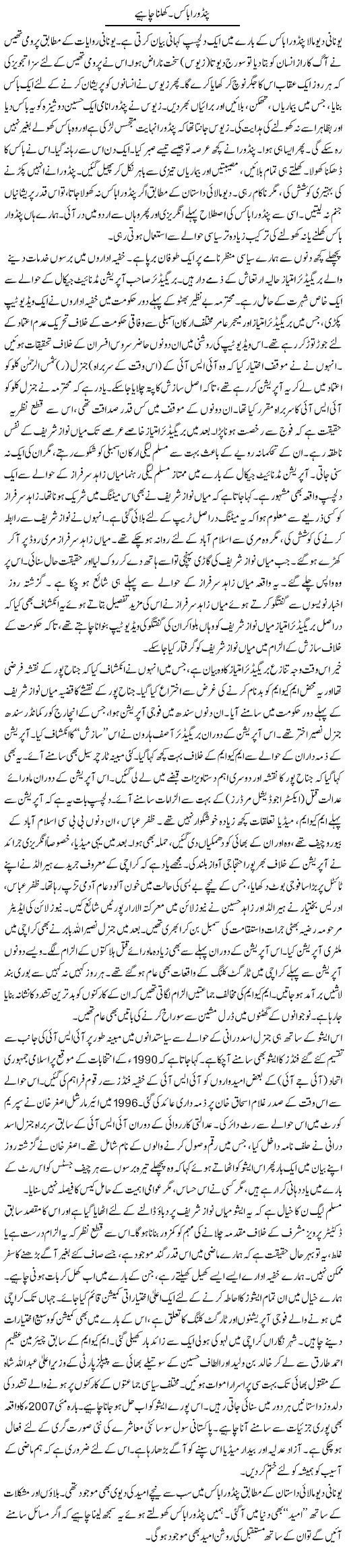
Asad Durrani was told that the instructions to misappropriate donation money were backed by the then government of Pakistan, according to his affidavit statement before SC.

Subsequently, in pursuit of the instructions he received, he was forced to open some fake bank accounts in Karachi, Quetta and Rawalpindi while one donator from Karachi, by the name Younis Habib, deposited as much as 140 million rupees and the money from all accounts were transferred to other places according to the need for extension of logistic support to IJI party while the remaining money was transferred to a special fund, his sworn statement added.

His statement further added, Rs10 million were given to Mir Afzal in NWFP province, Rs3.5 million to Mian Muhammad Nawaz Sharif in Punjab, Rs5.6 million to Lieutenant General (rtd) Rafaqat for advertisement on media, Rs5 million to Jamat-e-Islami, Rs1 million to Begum Abida Hussain, Rs0.5 million to Altaf Hussain Qureshi and Mustafa Sadiq, Rs3.3 million to small groups, Rs5 million to Ghulam Mustafa Jatoi in Sindh, Rs5 million to Jam Sadiq, Rs2.5 million to Muhammad Khan Junejo, Rs2 million to Pir Pagara, Rs0.3 million to Molana Salahuddin, Rs5.4 million to small parties, Rs1.5 million to Humayun Muree, the son-in-law of Bugti, Rs4 million to Jamali, Rs1 million to Kakar, Rs0.7 million to Jam Yousuf, Rs0.5 million Bazinjo and Rs1 million were given to Nadir Mengal. (The News)

It is pertinent to mention that the value in rupees of 12 grams of gold was Rs33 at the time when money was misappropriated while it stands at Rs29,000 today. (The News)


Nawaz Kush Campaign and Fauji Chooran - By Rashid Murad:


Some relevant comments:
Source: pkpolitics

runaway said:

Now NS claiming that 92 operation was done without his permission. What the hell? He was the Prime Minister of PAKISTAN not PUNJAB.

Kargil done without his knowledege..92 operation done without his permission.
Was Qarz Utaro Mulk Sanwar and Dollar Freeze also done without his knowledge…bhola !!

Gul said:

I totally disagree the ‘quaidabad’ issue is of headline importance. This was clarified way back in 92 soon after the accusation was made.

Brig. Imtiaz’s bringing it up yet again, at this time, is nothing but a typical red herring to distract from the genuine issue of MQM’s terrorism, and the inquiries it now faces. It is also being used to somehow weaken Nawaz Sharif, who appears unstoppable in gaining popularity. It suits, and has always suited, the establishment not let any one political party or leader become very strong. Keep them all weak, thereby keeping own hold on country.

There can be NO other purpose in bringing up such a non issue at this time, and sending all the talking heads spinning into this rat hole.

Amir Hameed said:

@Gul,
Re: your post above, I tend to disagree with you. We need to highlight the role of intelligence agencies in weakening the political structure of this country. Hamid Gul has also issued a statement recently where he has indicated how the agencies were involved in forming IJI. The bottom line is that agencies need to stay out of the political structure, period.

Gul said:

@Amir Hameed

I agree with you a 100% on the need to struggle against agencies’ role in preventing Pakistan from ever acquiring a strong democratic dispensation.

Where I don’t agree is that this dead issue, a red herring, will do that. As I said, the fact that there never was such a map was very much contradicted and clarified very shortly after the claim was made. Beating this idiotic and long failed, long disproven claim, NOW, is meant to serve purposes entirely different form highlighting agencies’ role in the past or the present.

Amir Hameed said:

@sacheebat,
…unless politicians or parties are involved in anti-Pakistan or other illegal activities…

That is fine but it is related to treason and not the political structure. Agencies’ role should be to protect the country, both from inside and outside threats, BUT not to interject their influence in the political structure.

@Gul,
Re: this being a dead issue; Altaf Hussain’s speech in India should also be a dead issue because we all know that it DID happen but we beat this dead horse every single chance we get. In the context of Jinahpur, I do not see any reason why we should not discus a) who orchestrated it, meaning where did the orders come from? b) why was it done? c) What was the role of the-then government?

These are all legitimate questions and should not be put under the cover. People have the right to ask and to know the truth.


Read more...