Editor's Choice

--------------------------------------------------------------------------------------------------------------------------
Featured Post
--------------------------------------------------------------------------------------------------------------------------

"Let us build Pakistan" has moved.
30 November 2009

All archives and posts have been transferred to the new location, which is: http://criticalppp.com

We encourage you to visit our new site. Please don't leave your comments here because this site is obsolete. You may also like to update your RSS feeds or Google Friend Connect (Follow the Blog) to the new location. Thank you.


--------------------------------------------------------------------------------------------------------------------------
Showing posts with label Drone Attack. Show all posts

Saturday, 3 October 2009

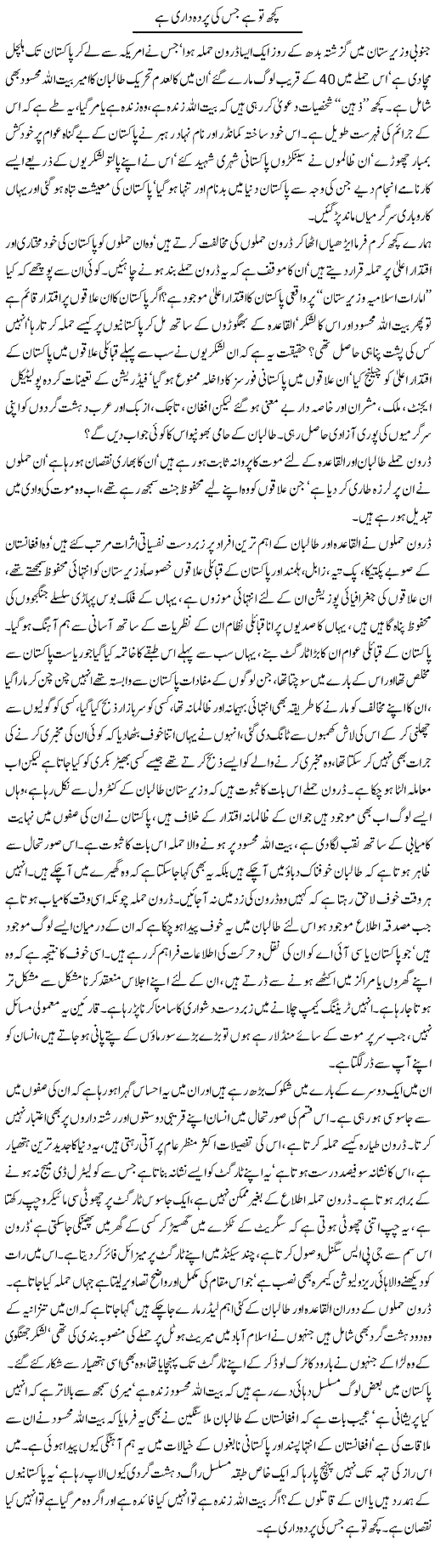
Tahir Yuldashev: end of a regional terrorist


Yuldashev: end of a regional terrorist

The death in South Waziristan of Qari Tahir Yuldashev by an American drone closes the career of a remarkable man who challenged Uzbekistan, Tajikistan, Pakistan, China and the United States in the name of his radical Islam. He and his nearly 5,000 Uzbek fighters — estimates have varied over time — have been a part of the Afghan Taliban and the Tehreek-e-Taliban Pakistan (TTP) under the tutelage of Mullah Umar and Al Qaeda. Indeed, he was present as a witness to the 2006 peace agreement between the Pakistan Army and the Taliban in South Waziristan.

Tahir Yuldashev founded the Islamic Movement of Uzbekistan together with the senior leader Juma Namangani in 1998 but had to flee the oppressive regime of Uzbekistan to Afghanistan in 2000, where in 2001 Juma Namangani was killed during fighting. The heat on the IMU came after it abducted a group of Japanese tourists from Kyrgyzstan that year. Yuldashev wanted to establish an Islamic state in the Central Asian region inhabited by Turkic peoples, and thus challenged also China in its Xinjiang province where the local Muslim population is also Turkic.

In the period immediately before 9/11, Al Qaeda had a free run of Pakistan with its key second-rung leaders embedded comfortably in Karachi. The 9/11 attacks were planned in Karachi and the money for the 19 suicide attackers was also sent from Pakistan. Juma Namangani, who was leading the terrorists in Tajikistan from his stronghold in Tavildara, was in fact in Karachi for a time. He returned to Tajikistan by taking a chartered flight from Karachi to Bishkek in Kyrgyzstan, disguised and without a beard. The Tajikistan government was greatly alarmed and accused Pakistan of interference and of posting ISI officers as ambassadors to Central Asia, including Tajikistan.

Pakistan’s relations with Uzbekistan were affected by the IMU’s repeated attempts on the life of the Uzbek president, which led to the return of Russia to the region as a “protector” and to the setting up of the Shanghai Cooperation Organisation (SCO) comprising “frontline” Central Asian states, Russia and China, “advancing mutual economic interests, fostering military trust among its members and combating Islamist radicalism”. In many senses, Pakistan could be seen as an early target of this anti-Islamist radicalism objective.

Tahir Yuldashev became greatly involved inside Pakistan because of the tutelage of the Al Qaeda leader Ayman Al Zawahiri. As more and more Uzbeks fled the Ferghana Valley in Central Asia and joined him in South Waziristan, the IMU turned away from their homeland and began focusing its attention jointly with the TTP inside Pakistan. It sent its warriors to Swat too when Fazlullah began his activities there after making contacts with Baitullah Mehsud in South Waziristan. His importance was highlighted when an ANP leader who had named him publicly was nearly killed in Peshawar through an explosive device.

The IMU also caused the “Chinese factor” to become prominent in the tribal areas. After the Chechens from Russia, the Uighur-Muslim rebels from Xinjiang too began to congregate in South Waziristan. China handled the emerging situation tactfully but became more vocal in its complaints after the Uighur rebels began to attack Xinjiang after taking guerrilla training in South Waziristan. China also acted in concert with the members of the SCO to consolidate the road and bridge networks in Central Asia to organise a defence system against Tahir Yuldashev and his IMU.

The death of Tahir Yuldashev at the hands of the Americans has, as in the case of Baitullah Mehsud, provided relief to Pakistan and lent strength to its resolve to finally grasp the nettle of South Waziristan. But this time, it has benefited also China and the Central Asian states, and Russia who is the regional “security-umbrella” provider. After President Obama’s new “friendly” policy towards Moscow, an understanding on the Taliban-Al Qaeda threat from Pakistan will also be easily reached with China.

The year 2009 was the biggest year so far for drone strikes inside Pakistan. The people killed reached the record number of 404, out of which civilians accounted for only 43. But these attacks have killed some of the most important leaders belonging to the TTP-Al Qaeda network. Tahir Yuldashev was clearly an important target of the drone attacks; as far as Pakistan’s neighbours are concerned, perhaps more important than Baitullah Mehsud. The IMU will be hard put to find another leader like him and may therefore suffer a period of weakness. (Daily Times)


Read more...

Tuesday, 25 August 2009

Pakistani Taliban admit Mehsud killed in US strike. Thank, you President Obama!


The USA Drone attacks against the Al Qaeda / Taliban / Sipah-e-Sahab hideouts in Pakistan are proving effective. Thanks, President Obama, for continuing the proactive elimination of terrorists in Pakistan's tribal area. The next target in line is Hakimullah Mehsud, Mullah Fazlullah and the Haqqani network.

Also, there is a need to bring to justice the supporters, funders and trainers of the Taliban, such as General Hamid Gul, Mullah Munawar Hasan, clean-shaven Mullah Imran Khan, Mullah Abdul Aziz, and Hafiz Saeed. These Taliban lovers are the traitors to Pakistan and Islam.


Pakistani Taliban admit Mehsud killed in US strike

© 2009 The Associated Press

Aug. 25, 2009


DERA ISMAIL KHAN, Pakistan — Two commanders of the Pakistani Taliban say the militants' top leader, Baitullah Mehsud, is dead. They say he died from wounds from a U.S. missile strike.

The statements by two of Mehsud's top deputies are the first time the militants have acknowledged his death, first reported shortly after the Aug. 5 missile strike near the Afghan border.

Hakimullah Mehsud and Waliur Rehman called The Associated Press on Tuesday evening to make the announcement. They said Baitullah Mehsud was wounded in the missile attack but only died Sunday.


بیت اللہ محسود کی ہلاکت کی تصدیق

کالعدم تحریک طالبان پاکستان نے تنظیم کے سربراہ بیت اللہ محسود کے جو ایک ڈرون حملے میں شدید زخمی ہو گئے تھے ہلاک ہونے کی تصدیق کر دی ہے۔

کالعدم تحریک طالبان کے نئے امیر حکیم اللہ محسود نے کسی نامعلوم مقام سے بی بی سی سے فون پر بات کرتے ہوئے بیت اللہ محسود کی ہلاکت کی تصدیق کرتے ہوئے کہا کہ ان کی موت دو دن پہلے ہی واقع ہوئی ہے۔

حکیم اللہ محسود نے کہا کہ بیت اللہ محسود ڈرون حملے میں شدید زخمی ہو گئے تھے اور مسلسل بے ہوشی کی حالت میں تھے تاہم دو دن قبل وہ بے ہوشی کی حالت ہی میں چل بسے۔

حکیم اللہ محسود کے علاوہ طالبان کمانڈر ولی الرحمان نے بھی بی بی سی سے فون پر بات کی اور طالبان کے درمیان اختلافات کی خبروں کی تردید کی۔ انہوں نے کہا کہ ان کے درمیان کسی قسم کے اختلافات موجود نہیں ہیں۔

ولی الرحمان کو وزیرستان کے محسود علاقے میں طالبان کا کمانڈر مقرر کر دیا گیا


Read more...

Wednesday, 12 August 2009

Two opposite perspectives on drone attacks and Baitullah Mehsud


Irfan Siddiqui (a pro-Taliban journalist) and Latif Chaudhry (a pro-democracy journalist) offer two opposite perspecitves on the US drone attacks on the Taliban/Al Qaeda hideouts in Pakistan.


(Irfan Siddiqui, Daily Jang, 12 August 2009)


(Latif Chaudhry, Daily Express, 12 August 2009)

Finall, why do journalist such as Irfan Siddiqui, Ansar Abbasi, Shahid Masood and Hamid Mir, and politicians such as Nawaz Sharif, Hamid Gul, Aslam Beg, Imran Khan, Qazi Hussain Ahmed have dual standards, Saleem Safi offers a critical analysis:


Read more...

Friday, 10 April 2009

Does Pakistani State Really Control FATA, which is under CIA's drones' attack ?


According to Wikipedia -----"Sovereignty is the right to exercise, within a territory, the functions of a state, exclusive of any other state, and subject to no other authority."
http://en.wikipedia.org/wiki/Sovereignty
Keeping aforementioned definition in mind, are we really justified to term drones' attacks on terrorists' targets in FATA as a violation of Pakisan's sovereignty ??
Every sane citizen of Pakistan knows very well that writ of Pakistani state has completely been eroded by Taliban and Al-Qaeda Terrorists in FATA, its adjoining areas and in Swat.
So, in my humble opinion Pakistani nation must come out of state of denial and should recognise the mortal threat posed by growing Talibanisation, which is now creeping in settled areas of NWFP, South Punjab, Pushtoon Belt of Baluchistan, and even in cities of interior Sindh !

Analysing drone attacks —Najmuddin A Shaikh


Increasing discontent in Pakistan over the purport of President Obama’s AfPak policy has many elements.


Let’s begin with the reiteration of an old Obama position: “And we will insist that action be taken — one way or another — when we have intelligence about high-level terrorist targets”.


This has been correctly interpreted as meaning that drone attacks in the tribal areas would continue despite Islamabad’s position that they violate Pakistani sovereignty and are counter-productive. Pakistan has consistently argued that the collateral damage makes this war an even harder sell for any government in Pakistan, causes further alienation and increases support for the common enemies of Pakistan and the United States.


Foreign Minister Shah Mahmood Qureshi’s statement at the joint press conference with Richard Holbrooke and Admiral Mike Mullen that Pakistan would neither accept nor offer blank cheques has been widely welcomed as is his assertion that there is a gap between the Pakistani and American positions on the drone attacks and that Pakistan would continue to get the Americans to see the light. Pakistan, it is being said, is now behaving like a self-respecting nation that would not yield to the bullying of a superpower.


And yet, what is the truth about the drone attacks? That such attacks violate Pakistan’s sovereignty is unquestionable. No nation has the right to enter our territory or air space, let alone carry out aerial operations without our permission. But do we control this territory? Do we really know how much collateral damage is caused and how counter-productive it is?


For many months I have read carefully every account that has appeared about the drone attacks in our newspapers. Invariably we are told that the “local Taliban” surround the area of the incident, remove the bodies for burial and take the injured to hospitals of their choice and then let the press know what the collateral damage has been.


Independent corroboration, clearly, is not possible since there is no local authority present, no reporter has access to the area and the local populace is too cowed to offer an account of the incident that differs from what the Taliban have said. We have to fall back on damage assessments offered by the Americans.


We claim that for every innocent civilian killed in these attacks ten new Taliban recruits are created and our effort at dialogue is frustrated. And yet have we asked ourselves the question why among these very people ten new anti-Taliban fighters have not emerged for each of the hundreds perhaps thousands of tribal Maliks and elders that the Taliban and their foreign cohorts have slaughtered even more mercilessly than the drones.


The truth is that the government and our security forces have not been able to reassure the people of the region that they would protect them against the Taliban if they stood up to offer resistance and the local populations, like the people of Swat after an initial period of resistance, have decided that they do not have the means to prevent the small but well-armed Taliban and Al Qaeda groups from exercising control and imposing their reign of terror in the region.


Where army operations have been successful, and Bajaur is a prime example, the collateral damage in terms of displacement of the population has been terribly high. More than half a million people from Bajaur have left their homes and have received little assistance in the settled districts to which they have fled. The army has reached a truce with the Taliban in the area on terms that seem to suggest a Taliban acceptance of the State’s right to impose its writ. But even this has not been enough to convince the Bajaur people to return to their homes; nor, as far as one can tell, has this led to the return of the local administrators and the commencement of development work.


Why did the Bajaur displacement occur?


I think it would be fair to say that the area had to be softened up by ground artillery and aerial bombardment before troops could move in. The collateral damage was high because Pakistan has precious little by way of precision guided munitions in its arsenal and ordinary bombs and shells kill many more than the people they are aimed at. Perhaps as we acquire more sophisticated equipment and training we will be better able to avoid such collateral damage in our bid to reassert the government’s writ.


But how do you, in the meanwhile, avoid a Bajaur situation and still disrupt Taliban and Al Qaeda dominance of the area.
Let us think at least that the drones may be one way of doing so and rather than the current emphasis on protecting Pakistan’s sovereignty the government should be explaining that this is what the drones are seeking to achieve and that we are trying to acquire the know-how and equipment to do this ourselves.


This is what our conversations with the Americans on this subject should also focus on. Better intelligence sharing, better equipment for and training of our forces and such better coordination as would put us in the driver’s seat with regard to choice of targets and drone targeting. By this I mean that we should be able to target those who are specifically carrying out operations against Pakistani security forces as also those who are attacking NATO forces in Afghanistan.


There has been a great deal of talk about the expanding drone attacks to Balochistan where the Americans believe the leadership of the Afghan Taliban have found safe haven and from where they are said to plan operations in Afghanistan. Balochistan is not the badlands of the Tribal areas and the highly urbanised areas there cannot be treated as such.


I think this is a redline that the Pakistan government has drawn and which the Americans will not cross. I believe that all this talk has been generated to suggest that the Pakistan authorities need to be more aware of American and Afghan concerns on this account and to use their own means to tackle this problem.


While advising the government one would also like to suggest that its spokespersons must also lead the way in convincing the people that Baitullah Mehsud’s claims notwithstanding his suicide bomber attacks in Pakistan are not just retaliation for drone attacks but part of a wider plan to create the sort of instability which allows obscurantist forces to make a bid for power or cause Pakistan to fall apart. One hopes that that in doing so the government will take account of what has been happening under its nose.


There are disquieting reports about the growing influence of extremist forces in parts of the country that should theoretically have the greatest revulsion towards extremism. In Sindh, where the Sufi interpretation of Islam — love and tolerance — has been dominant there has been graffiti according to press reports in which satellite dishes, cable TV and VCRs are described as “three signs of the approaching doomsday”.


A TV channel was forced to cancel a musical show in Nawabshah after the local court issued a restraining order at the behest of a religious party. More recently, with the approval of the local police, a musical dance event was cancelled in Shahdadkot district again at the instance of a religious party. The PPP, a strongly secular party is in power in Sindh; its ally the MQM is even more determinedly secular and yet this happens.


Why is the police acting in this fashion and why is the government not defending freedom of expression in the courts?Up North it is now almost commonplace to see reports such as the one from Mansehra two days ago about the killing of three female workers of the National Rural Support Programme presumably by militants and presumably because they were like other NGO representatives spreading vulgarity by having males and females working together. No reports have yet surfaced about any arrest in connection with the killing of three people last year when militants stormed the office of an NGO in that area. Is this what we will see coming to the rest of the country?


Our free media makes these facts public and, in the absence of a clearly enunciated and forcefully implemented policy of nipping such ominous trends in the bud, civil society remains largely quiescent. What then should the rest of the world think about the direction in which events are moving in Pakistan and what then is likely to happen? Food for thought!


The writer is a former foreign secretary.


SOURCE: DAILY TIMES, 10th April, 09


Read more...

Saturday, 4 April 2009

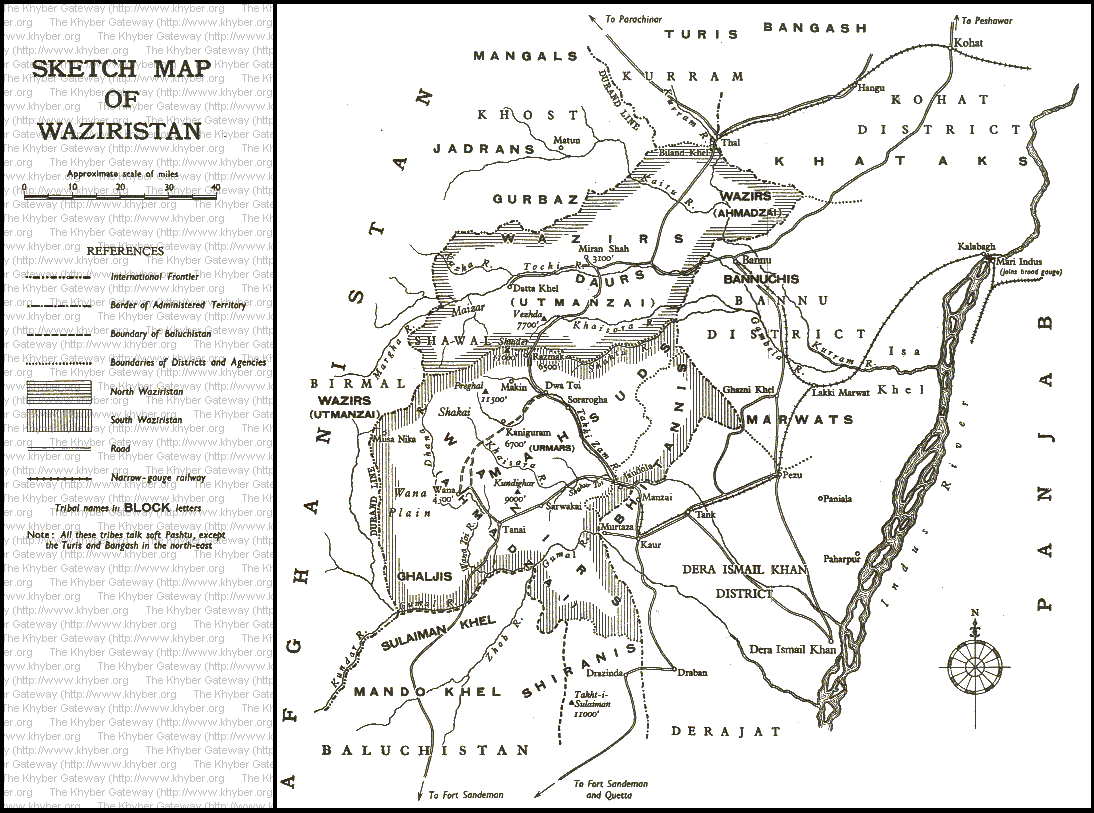
Farhat Taj: Target: terror secretariat in Miranshah

http://www.longwarjournal.org/maps/Pakistan-waziristan-sketch-map.gif


The Taliban are a diverse mix of different groups, each led by its own leader, which support each other in militancy. Still, it is not uncommon to see two Taliban groups at cross-purposes with each other, and fighting. At that point, something happens and the groups give up hostilities and once again become "brothers in faith and comrades. Most certainly, somewhere there is an infrastructure in place that makes this happen, such as a particular terror "secretariat" in Waziristan.

Some people in FATA who have had the opportunity to see the terror secretariat from inside shared with me what they observed. According to them,

The secretariat consists of three complexes owned by Jalaluddin Haqqani and run by his son Sirajuddin Haqqani. The first complex is located right in front of the Frontier Constabulary, FC Fort in main Miranshah bazaar in North Waziristan. Apparently there is a computer institute in this complex but the complex also contains compounds which are well-guarded and no-go area. The second complex is located in Sirai Darpakhel just behind Miranshah Bazaar. This complex consists of seven compounds and is believed to be the headquarters of the Taliban, who move back and forth between Pakistan and Afghanistan. The complex is believed to be commanded by diehard Taliban Bakhta Jan Afghani. The third complex, at a distance of not more than a kilometre from the Pakistan army camp in North Waziristan, is situated in Dandi Darpakhel on the road to Afghanistan.

The secretariat is a huge and spacious structure spread over an area of a 100 kanals. There is a madressah in the complex in Sirai Darpakhel. All the three complexes have large open grounds, big guest houses and no-go areas. Taliban and Al-Qaida terrorists active in various parts of Pakistan and Afghanistan are believed to stay in the guesthouses. The no-go areas are believed to contain a large quantity of weapons and ammunition. Also, the large grounds are quite possibly used for training terrorists. Jalaluddin Haqqani's extended family resides in the Dandi Darpakhel complex.

The people who went to the compound said that they talked to many students and teachers at the madrasa and observed them. It may well be that the teachers were teaching more than basic education to the students and that they were being trained to become suicide bombers. Qari Hussain, who is believed universally to be a master trainer of suicide bombers, is also resident in the area. There were many Pakhtuns, especially Mehsud and Wazir, as well as Punjabis, Arabs and Tajiks, Uzbeks, Afghans and Africans.

Jalaluddin Haqqani, an Afghan, is a former Mujaheedin leader. Due to his old age he has left the management of the complex to his son Sirajuddin. The senior Haqqani is widely respected among the Taliban and he uses his position to make peace among warring Taliban groups. When two Taliban groups anywhere in Pakistan or Afghanistan get at each other's throats and kill each other, Jalaluddin asks his son to invite the two to one of his guest houses in the terror secretariat. He ultimately convinces them to stop fighting each other, by giving money to some and weapons to others. Jalaluddin is also a key link between the Taliban of Swat and Baitullah Mehsud. Some time back he managed to make peace between Maulvi Nazir, who leads a strong group of Taliban in North Waziristan, and Baituallah Mehsud. The dispute was over the presence of Uzbeks in the area. Maullvi Nazir wanted them kicked out of Waziristan because they were not interested in fighting in Afghanistan.

In case of any action against the complex, the government will have to consider its close proximity to the FC fort in the area. It is quite possible that in case of an attack on the terror secretariat, the terrorists would try and take control of the fort and kidnap the FC soldiers deployed there. Also, the complex is not far from the main Miranshah bazaar, so any error in the operation may bring about significant collateral damage. The terrorists use women and children as human shields.

An attack on these terrorists needs to be considered, because of the major impact it could have on the coordination and networking of Taliban groups in FATA. (The News, 4 April 2009)


The writer is a research fellow at the Centre for Interdisciplinary Gender Research, University of Oslo, and a member of Aryana Institute for Regional Research and Advocacy. Email: bergen34@yahoo.com
Read more...

Friday, 3 April 2009

There is nothing wrong with the drone attacks on an area where there is Taliban's (instead of Pakistan's) writ.

https://blogger.googleusercontent.com/img/b/R29vZ2xl/AVvXsEi4tJeM_03B-ypqgEIOwLrIyzXVhjxz03b-fnniEnZV37g1qP4DktJtvC7klGPambgJ5tmH95PukSnC2KUV_J9PpTOWNVrKbdp_dp4IFRY5QM2CYO8feVH0b8e0kNehWr4Kb6f4_lrJjz2S/s320/drone_attack_Obama_090123_mn.jpg

Logic of drone attacks

A US drone attack in Orakzai agency has killed 12 recruits of the Tehreek-e Taliban Pakistan (TTP) of Baitullah Mehsud, including one local leader. An Arab too has been killed while the family of the man providing them haven, Maulana Gul Nazir, was the only “collateral damage”. The press links the US attack to Baitullah Mehsud’s challenge that he was going to attack Washington again. The drone’s target was Hakimullah Mehsud, Baitullah’s close contact and local commander of the TTP training centre.

Since the media in Pakistan is formally against the drone attacks, efforts were made on several TV channels on Wednesday night to get the anti-drone stance of the public confirmed. But all Pashtun reporters covering Orakzai refused to give the drones a blanket stamp of disapproval. Asked why Orakzai was attacked if it was not geographically linked to Afghanistan, the answer was: it was attacked because it had become a stronghold of the TTP and foreign terrorists since the last one year and was clearly seen as a threat by the Americans as a training resource for those who attacked across the Durand Line.

This meant that since one year Orakzai has been open as a possible stronghold of the terrorists while the media has been concentrating on Swat, Bajaur and Mohmand as the region of TTP challenge where the Pakistan army is supposed to be taking action. It was discovered that the local Orakzai population had given in after the slaughter of their anti-TTP “jirga” last year did not evoke much response from the army or the state of Pakistan. Added to the TTP dominance of Kurram Agency, a whole swath of territory in the tribal areas was now ruled by Baitullah Mehsud. Orakzai, where the terrorists plied special vehicles stolen from NATO supply caravans in Khyber, was the base from where TTP commanded the NWFP city of Hangu where the Shia are made to live like a hunted minority.

When asked if the drone attack in Orakzai will provoke the local population into becoming anti-American, the Pashtun reporters told the TV channels that unless collateral damage became widespread enough to include the local population, there was no chance of an anti-American feeling. They said that the population was completely under the despotic rule of the TTP and would actually want the drone attacks to continue to lessen the severity of TTP control on them. Had Pakistan any sovereignty left to counteract the TTP, the local population would have fought against the terrorists.

This evidence weakens the argument we have heard advanced against the American drone attacks. A Peshawar-based NGO has come under pressure from the authorities and the media for discovering exactly what was revealed by the TV reporters on Wednesday night. The Aryana Institute for Regional Research and Advocacy (AIRRA) published an article recently (The News, March 5, 2009) which stated that its teams visited Wana (South Waziristan), Ladda (South Waziristan), Miranshah (North Waziristan), Razmak (North Waziristan) and Parachinar (Kurram Agency) and found that the victim population was not opposed to drone attacks.

The AIRRA teams handed out 650 structured questionnaires to people in the above areas. The 550 respondents — 100 declined to answer — were from professions related to business, education, health and transport. The following were some of questions and responses of the people of FATA. 1) Do you see drone attacks bringing about fear and terror in the common people? (Yes 45%, No 55%). 2) Do you think the drones are accurate in their strikes? (Yes 52%, No 48%). 3) Do you think anti-American feelings in the area increased due to drone attacks recently? (Yes 42%, No 58%). 4) Should the Pakistani military carry out targeted strikes at the militant organisations? (Yes 70%, No 30%). 5) Do the militant organisations get damaged due to drone attacks? (Yes 60%, No 40%).

One thing is certain: the local population is against the TTP and doesn’t mind too much if the Americans take it out in the absence of an adequate Pakistani response. The Pakistani stance that its sovereignty is being violated by the drones is weakened by the day by the very clear loss of Pakistan’s sovereign territory to the TTP and the inability of the state of Pakistan to either recapture it or come to the rescue of the local population. The “external” argument that this lost territory brings the world under real threat of terrorist attacks through the local and foreign terrorists also gains strength as Baitullah Mehsud extends his violence-based emirate to Punjab and Sindh in the coming days. (Daily Times)
Read more...

Thursday, 26 March 2009

US offers $5m reward for Baitullah Mehsud

WASHINGTON: The United States on Wednesday offered up to $11 million in rewards to find and capture three Al Qaeda terrorists, including Tehreek-e-Taliban Pakistan chief Baitullah Mehsud. The US announced a $5 million bounty for the location or arrest of Mehsud. The other two terrorists named in the list were Sirajuddin Haqqani and Abu Yahya Al-Libi. Washington is offering $5 million for Haqqani, a suspected leader of the Haqqani terror network founded by his father, and $1 million are being offered for Al Qaeda member Al-Libi. afp (Daily Times, March 26, 2009).

بیت اللہ پر پچاس لاکھ ڈالر کا انعام

بیت اللہ محسود

بیت اللہ محسود تحریِک طالبان پاکستان کے سربراہ ہیں

امریکہ نے بیت اللہ محسود سمیت تین طالبان اور القاعدہ رہنماؤں کی گرفتاری میں مدد پرگیارہ ملین ڈالر انعام کا اعلان کیا ہے۔

امریکی سٹیٹ ڈپارٹمنٹ کی ویب سائٹ پر موجود ایک بیان کے مطابق بیت اللہ محسود اور سراج الدین حقانی کی گرفتاری میں مدد دینے یا ان کے ٹھکانے کی نشاندہی پر پچاس پچاس لاکھ ڈالر جبکہ ابو یحیٰی اللبی کی گرفتاری میں مدد پر دس لاکھ ڈالر انعام مقرر کیا ہے۔

سٹیٹ ڈپارٹمنٹ کے مطابق ’ بیت اللہ محسود پاکستان میں سرگرم طالبان کی تنظیم تحریکِ طالبان کا کرتا دھرتا اور پاکستان کے قبائلی علاقے جنوبی وزیرستان میں القاعدہ کا مرکزی مددگار ہے‘۔

بیت اللہ محسود کا نام پاکستان کی سابق وزیراعظم بینظیر بھٹو کے قتل کے سلسلے میں بھی لیا جاتا رہا ہے اور پاکستان میں اس قتل کے الزام میں ان کے وارنٹ گرفتاری بھی جاری کیے جا چکے ہیں۔ خیال رہے کہ پاکستان کے قبائلی علاقے جنوبی وزیرستان میں بیت اللہ کا مضبوط گڑھ سمجھا جانے والے علاقے مکین میں بدھ کو ہی ایک مبینہ امریکی جاسوس طیارے کے حملے میں سات عرب باشندے ہلاک ہوئے ہیں۔

سٹیٹ ڈپارٹمنٹ نے افغان مجاہد رہنما جلال الدین حقانی کے بیٹے سراج الدین حقانی کی گرفتاری میں مدد دینے یا ان کے ٹھکانے کا پتہ فراہم کرنے پر بھی پچاس لاکھ ڈالر کا انعام رکھا ہے۔ پاکستان کے قبائلی علاقے میں واقع مولانا جلال الدین حقانی کے مدرسے اور گھر کو گزشتہ برس میزائل حملوں کا نشانہ بنایا گیا تھا جس میں متعدد افراد ہلاک ہوئے تھے۔ جلال الدین حقانی اور سراج حقانی کو کابل میں بھارتی سفارتخانے پر ہونے والے خودکش حملے کا ذمہ دار بھی قرار دیا جاتا رہا ہے۔

http://www.bbc.co.uk/urdu/pakistan/2009/03/090325_baitullah_headmoney_zs.shtml

...

US airstrike kills 8 in Baitullah Mehsud's hometown

US Predators killed eight terrorists, including "foreigners," in an attack on a Taliban convoy in South Waziristan.

The attack took place in Makeen, the hometown of Baitullah Mehsud, the leader of the Tehrik-i-Taliban Pakistan, or the Movement of the Taliban in Pakistan.

"Two missiles struck two vehicles carrying militants and from information we have received, some guests were among the dead," a Pakistani intelligence official told Reuters, who did not specify the identity or the nationality of those killed. Geo News reported eight were killed, including "foreigners," a term commonly used to describe al Qaeda operatives.

Baitullah sheltered in a safe house in Makeen run by Anwar Shah at the end of December 2008 after claiming credit for former Prime Minister Benazir Bhutto's assassination.

Today's strike is the sixth recorded attack against camps and compounds in Baitullah's tribal areas. The last attack in Baitullah's territory took place on March 1. Eight terrorists, including Arabs and Uzbeks, were reported killed in the March 1 attack.

Although The New York Times reported that a Predator strike on Feb. 14 was the first such attack against Baitullah Mehsud and signaled an expansion of the air war, the report is incorrect. There were three US strikes in Baitullah's tribal areas between July 2008 and January 2009.

In mid-June 2008, a strike hit a Taliban safe house in Baitullah's hometown of Makeen. In mid-October 2008 , a Predator strike took place in the village of Saam in the Ladha region. And on Jan. 2, 2009, another strike took place in Madin, also in the Ladha region.

Today's strike is the tenth inside Pakistan this year and the first since March 15, when US Predators conducted an attack in Bannu, a frontier region outside of Pakistan's tribal areas. Bannu borders the Taliban-controlled North and South Waziristan tribal areas to the east.

Source: http://www.longwarjournal.org/archives/2009/03/us_airstike_kills_8.php

....

Head-hunting
Friday, March 27, 2009
Hiding in plain view is something that occurs in nature all the time – creatures camouflage themselves either for protection from a predator – no pun intended – or as predators in hiding and waiting for prey. We have a fine example of the technique here amongst us, a certain Mr Baitullah Mehsud, who is visible to millions via the medium of television, but apparently invisible to those agencies searching so diligently for him. So visible is he that he recently gave a press conference that was attended by numerous print and electronic media journalists who had presumably arrived at his location by conventional means; and were not tele-ported in as we see travellers move around space and time in science-fiction films. All these media persons were presumably in possession of that essential adjunct to modern life – a mobile phone. Mobile phones emit tracking signals, signals which are regularly followed by intelligence-gathering agencies when they are hunting for the bad guys. Journalists are chatterboxes by nature – surely one of them must have made a call either from Mehsud's location or en-route to it? No? It stretches our credulity far beyond snapping point that no agency with an interest in the whereabouts of Mr Mehsud was apparently aware of this tête-à-tête. Had it simply escaped their notice, busy as they are with so many other things? Or did it just happen that they were distracted momentarily and looked in another direction?

The mystery of the invisible Mehsud is all the more perplexing when viewed in the light of the generous bounty recently offered by the American government for his capture. The United States has offered $5 million for information leading to the capture or death of Baitullah Mehsud. The US has offered large cash rewards for terrorism suspects in the past, but until recently they regarded Mehsud mainly as a threat to Pakistan and unworthy of their attention. Previous US drone attacks had avoided targeting Mehsud's hideouts but this changed earlier this month when US drones also began to target Mehsud and his men. The US State Department has identified Mehsud as a key leader of the Pakistani Taliban and an Al Qaeda 'facilitator' in South Waziristan. He is also fingered as a suspect in the killing of Benazir Bhutto and the Marriott bombing, plus he has made no bones about his intention of attacking the US if he can – and he probably can. All of this should qualify him for an early visit by Mr Predator and Mrs Hellfire -- if only he can be found, that is. It should not be difficult to find Baitullah Mehsud, any number of media persons knows where he is and so do others. Five million dollars is a lot of money and head-hunting via a bounty has loosened tongues in the past, so the technique is proven and the five million is peanuts as far as the US is concerned. It remains to be seen just how long hiding in plain view is an option for the elusive Mr Mehsud. (The News, 27 March 2009)

Read more...

Sunday, 22 March 2009

US drone strikes hurt Al-Qaeda in Pakistan

Sunday, 22 Mar, 2009 (Dawn)

A six-month campaign of Predator strikes in Pakistan has seriously damaged the Al-Qaeda structure. — Reuters

LOS ANGELES: A six-month campaign of Predator strikes in Pakistan has seriously damaged the Al-Qaeda structure there, forcing militants to turn on one another as they search for culprits, The Los Angeles Times reported Saturday.

Citing unnamed US intelligence and counter-terrorism officials, the newspaper said on its website that the pace of the attacks has increased dramatically after the administration of former president George W. Bush made last August a previously undisclosed decision to abandon the practice of obtaining permission from the Pakistani government before launching strikes from the unmanned aircraft.

Since the end of August, the CIA has carried out at least 38 Predator strikes in northwest Pakistan, compared to 10 reported attacks in 2006 and 2007 combined, the report said. And the Obama administration is set to continue the strikes.

‘This last year has been a very hard year for them,’ the paper quotes a senior US counter-terrorism official as saying of Al-Qaeda militants. ‘They’re losing a bunch of their better leaders. But more importantly, at this point they’re wondering who’s next.’ The official also said that Al-Qaeda leaders in Pakistan ‘have started hunting down people who they think are responsible’ for security breaches.
‘People are showing up dead or disappearing,’ the official added.

According to The Times, the stepped-up Predator campaign has killed at least nine senior Al-Qaeda leaders and dozens of lower-ranking operatives.

Among those killed since August are Rashid Rauf, the suspected mastermind of an alleged 2006 transatlantic airliner plot; Abu Khabab Masri, who was described as the leader of Al-Qaeda's chemical and biological weapons efforts; Khalid Habib, an operations chief allegedly involved in plots against the West; and Usama al-Kini, who allegedly helped orchestrate the September bombing of the Marriott Hotel in the Pakistani capital, Islamabad, the paper said.

Many of the dead are longtime Osama bin Laden loyalists who had worked with him since the 2001 US-led invasion of Afghanistan, the report said.They are being replaced by less experienced recruits, according to The Times.


Read more...

Thursday, 5 March 2009

Farhat Taj: A survey of Drone Attacks in Pakistan. What do the people of FATA think?


This site has moved to http://criticalppp.com/archives/26239, click this link if you are not redirected
Read more...

Monday, 16 February 2009

Drone attack on a terrorist camp in Kurram agency kills at least 30


Why do not our own intelligence agencies / ISI / Army/ Air Force / Police route out such terrorist / jihadi/ sectarian camps?

Thank you Obama for cleaning the dirt of the ISI/Taliban duo in Pakistan.


FATA MAP

'US missile strike' kills 30

Three missiles thought to have been fired from a US unmanned aircraft destroyed a house used by a local Taliban commander in the Kurram tribal region of Pakistan, killing at least 30 people, witnesses said.

The US has launched a barrage of similar attacks against suspected militants in the border region by unmanned aircraft since August last year, killing top militants but angering Pakistani leaders, who say they undercut their fight against terror.

Rehman Ullah, a resident of the targeted village of Baggan, said drones were seen in the sky before the attack.

He said bodies had been dug up from the wreckage. Pakistani officials were not available or declined comment.

Meanwhile, Pakistani militants said the government had agreed to impose Islamic law as part of a proposed peace deal in a one-time tourist destination in the north-west where Taliban extremists increasingly hold sway.

The agreement would cover the Swat valley and surrounding regions.

Islamist militants there have been brutally enforcing a hardline version of Islamic law since the middle of last year when an earlier deal broke down, burning girls schools and attacking government targets and security forces

Several past deals with militants in north-west Pakistan have failed and been criticised by the US as giving insurgents time to regroup, but the country's civilian government says force alone cannot defeat the extremists wreaking havoc there and attacking US troops in neighbouring Afghanistan.

The drone fired two missiles at the hideout, where a meeting of the banned Tehrik-e-Taliban Pakistan was being held, TV channels reported.

There was no official word on the incident. Though US drones target Taliban and al-Qaeda bases in Waziristan region, this was the first such attack in Kurram Agency.

Minutes after the strike, Taliban militants surrounded the area and were not allowing locals to approach the scene of attacks.

The missile strike came two days after another US drone attack in South Waziristan tribal region killed 32 people, most of them Uzbek supporters of al-Qaeda.

Kurram Agency has also been a scene of widespread sectarian violence between Shia and Sunni [Deobandi/Wahhabi] tribesmen since last year. Hundreds of people have been killed in clashes between rival tribesmen. The situation in Kurrum Agency took a turn for the worse after Taliban fighters infiltrated the area and began backing the Deobandis/Wahhabis.

Read more...

Saturday, 14 February 2009

South Waziristan: US drones kill 26; most of them Uzbek Taliban / Al-Qaeda operatives..


S Waziristan: US drones attack toll reaches to 16

Updated at: 1140 PST, Saturday, February 14, 2009 WANA: The death toll of US missile attack in Ladha area of South Waizirstan has reached to 16.

According to sources, US drone planes fired two rockets at a house in Malik Khel in Ladha killing 16 and injured many people.

Six bodies have been recovered from the rubbles of the house whereas several bodies still trapped under the rubbles.

The eight injured have been shifted to local hospital. A British news agency reported that missiles attack targeted the house of Taliban commander in Zangari area that kills 25 people.

The missile strike was the third such attack since U.S.President Barack Obama took office last month.

....

BBC Urdu dot com report:

http://www.bbc.co.uk/urdu/pakistan/story/2009/02/090214_missile_attack_waizr_zs.shtml

Read more...

Sunday, 8 February 2009

Reviewing Pakistan- Afghanistan policy

Sunday, February 08, 2009

Lt-Gen (r) Talat Masood

The US being a super power enjoys a unique status around the world and cannot be treated as any other country. For Pakistan US means even more, as no other country exercises as much influence, for good or for bad, over Pakistan's foreign and domestic policy as US does. Ever since Pakistan's inception it has been closely aligned with United States. First, during the Cold War as an ally in SEATO and CENTO, then during Soviet occupation as front line state in support of Afghan Jihad and since 2001 in the war on terror. The relationship has had its troughs and peaks and expectations run high but have suffered many disappointments. Pakistan presents a paradox as well for it is among the top countries where anti- Americanism is at its peak. It is also true that Pakistan is heavily dependent on the US for economic assistance, military hardware and as a countervailing power against India, notwithstanding Washington's close and expanding ties with New Delhi.

With the change in US administration the Afghan and Pakistan policy is under major review. Obama's administration and Pentagon realize that Afghanistan and Pakistan are closely interlinked and Afghanistan's stability is vital otherwise it would continue to have a destabilizing influence on its nuclear neighbor. President Obama in his recent interview with NBC News stated that Afghanistan has to be stabilized for ensuring the stability of Pakistan. This thinking indicates that Washington is fully conscious of the ramifications of a weak Pakistan. Moreover, it also confirms Pakistan's viewpoint that the primary source of the problem rests in Afghanistan and unless conditions improve there it may not be possible to stabilize the tribal belt and Pakistan itself. In a way the new administration is taking a broader and a longer view in which the solutions are to be found in a regional context. This aspect was reflected when President Obama referred to the need for the resolution of the Kashmir problem. India should have taken these remarks positively instead its nervous reaction to the proposal made US realize that best way of going about it would be quiet diplomacy and that too after the Indian national elections. The seasoned US diplomat Mr Richard Holbrooke who has been appointed as special envoy for Afghanistan and Pakistan was initially tasked to address the Kashmir issue also but had to be taken off in deference to Indian sensitivities.

Washington has come to the conclusion that extensive reliance on military force will not resolve Afghanistan's complex problems and political solution though not easy will have to be found. Washington is also lowering its sights in Afghanistan and the report prepared by Joint Chiefs of Staff recommends de-emphasizing longer term goals of promoting democracy. Forthcoming presidential elections in Afghanistan will be a major event and it is not clear if Karzai would win, or even enjoy American support. In the event that another candidate emerges than what will be the prospects of his turning Afghanistan around.

United States' plan about Pakistan seems to be work in progress. Mr. Richard Holbrooke is expected to come out with a plan for Pakistan in the regional context. On the military side, General Petraus will be finalizing his strategic direction and the two plans will have to weld together.

The relationship between the US and Pakistan military high commands is now relatively well defined and mutual confidence is gradually growing. Relations of US administration with the civilian government too are good. But long term relations will depend on how the government internally consolidates its position and manages issues of governance, economy and militancy.

Obama's administration is looking for political investment in Pakistan so that there is greater space for politics to function. Washington has been fully supportive of the PPP led government and especially of President Zardari. In assisting Pakistan build its institutions it is aiming at a long term relationship. United States has a serious interest in Pakistan's security. The proposed assistance package which is likely to be revived as Kerry- Lugar bill aims at providing Pakistan 15 billion dollar assistance spread over 10 years to build and strengthen its civilian institutions. There appears to be bi-partisan support for it in Congress. But the success of the program will depend on how the program is implemented.

In the immediate term the security of supply lines to US and NATO forces, management of the border and securing it so that Taliban and Al-Qaeda do not kill or harm US forces would remain the main focus.


President Zardari had remarked that with the change in US administration in January 2009 the missile strikes by un-manned drone aircraft in Pakistan's tribal belt will come to an end. Was it mere wishful thinking or based on some assurance given to him by members of the new power structure is a matter of conjecture. That aside, it has revived a raging controversy within Pakistan and aggravated anti-American sentiment and placed the civilian government in an embarrassing situation. It is diverting attention from the war on terror and is an impediment in mobilizing public support for counterinsurgency. Missile strikes in FATA demonstrate lack of trust between US and Pakistan as CIA is not prepared to share either the intelligence or sophisticated equipment of drones with Pakistan military. There is another major implication of US strikes. Other countries using this as a precedent can also strike at Pakistan as was being threatened by India after the Mumbai attack.

From the US perspective, the missile strikes are an extension of the Bush doctrine of preemption, enunciated in 2002, according to which US can take unilateral action if its security is threatened. CIA operatives are of the view that top leadership of Al-Qaeda is hiding in sanctuaries created in the tribal belt and pose a great threat to US and NATO forces. They also claim that several high value targets have been hit and Al- Qaeda is on the defensive. In any case from America's perspective Pakistan has lost control over its territory in FATA and by implication its sovereignty over the area and is incapable of coping with the problem. Loss of internal sovereignty has given rise to loss of external sovereignty. Perhaps, Mr. Holbrooke in his current mandate could also find ways of reconciling these diverging perceptions.
(The News)


The writer is a retired lieutenant general. Email: talat@comsats.net.pk
Read more...

Wednesday, 4 February 2009

Drone attacks on Pakistan - an analysis by Khurshid Nadeem


[col8.gif]

[col8a.gif]

Read more...

Saturday, 31 January 2009

Rahimullah Yusufzai: And the drone policy continues…

And the drone policy continues…
Saturday, January 31, 2009
Rahimullah Yusufzai


Pakistan abdicated its right to be taken seriously long ago when it first agreed to assist the US in fighting the Soviet occupying forces in Afghanistan, hosting, training and arming the Afghan mujahideen, and then did an about-turn in the wake of the 9/11 attacks to enable America to occupy the same country. Both decisions were made primarily at the behest of the US to advance the American agenda without calculating the consequences that such a policy would have for Pakistan. Pakistani society was radicalised due to the fallout of this policy and the consequences are now in evidence all over the country.

It is meaningless to indulge in a debate on whether the US is simply informing Pakistan, as Mr Gates disclosed about its drone attacks, and that too after the strikes have been made, or there is some kind of understanding between the two countries on the issue. In either scenario, the US doesn't want a negative answer. Conveying the information about the missile strikes to Pakistan is considered good enough and apparently non-negotiable. If the US hasn't already secured an understanding from the Pakistani government about the necessity of carrying out the drone attacks to target Al Qaeda figures, it could possibly do so by offering some carrots or by wielding the stick. Having given itself the right to launch pre-emptive attacks anywhere in the world to prevent harm to the US, superpower America is confident that it cannot be made accountable for its actions in our lopsided world where might is always right. Using this right, the US has attacked and occupied countries and bombed faraway places. it has gone too far in its revenge after 9/11 and created for itself a lot more enemies than it previously had.

In terms of airstrikes, Pakistan has suffered more US attacks than Syria, Yemen and Somalia for the simple reason that its tribal areas have been marked as a safe haven for Al Qaeda militants. All these countries are Islamic, just like Iraq and Afghanistan that are under US occupation, and this is a major reason for Muslims to complain that they are the real target of the US-led Western war against terror. It is true that some Al Qaeda operatives have been killed in the drone attacks and others are still hiding in the tribal areas or elsewhere in Pakistan, but the civilian casualties far outnumber of Al Qaeda militants eliminated and the outcome has been a further increase in anti-US sentiment. Still, the US is convinced that its policy is working as the drone strikes are considered an effective tool to hit Al Qaeda-linked militants and deny them safe havens in the tribal borderland. There is no realisation that this policy is destabilising Pakistan and making it increasingly difficult for its weak and directionless PPP-led coalition government to continue cooperating with the US.

Also, the missile strikes in Pakistani territory don't seem to have lessened the resolve of the Afghan Taliban or weakened their resistance against the US-led NATO forces in Afghanistan. Instead, the resurgent Taliban have forced the US to send another 30,000 troops over and above the 75,000 foreign forces already in Afghanistan by opening new frontlines and spreading their presence to 72 percent of the Afghan territory as a recent report by a European think-tank observed. If the US and its allies with all their might and technology cannot defeat the largely resourceless and outnumbered Taliban in Afghanistan, where questions of sovereignty have long been put to rest, how is it possible for America to destroy Al Qaeda and its allied Taliban and jihadi groups through occasional drone attacks in Pakistan's tribal areas? Killing a few Al Qaeda operatives or Pakistani and Afghan militants once in a while may provide a sense of achievement to the US military but it cannot be part of a successful long-term policy to combat militancy and extremism. Militant groups such as Al Qaeda and Taliban have a remarkable capacity to replace fallen comrades and attract new recruits, more so since the cause has a religious dimension. The motivation is to liberate your homeland from foreigners and the enemy is America. (The News)


The writer is resident editor of The News in Peshawar. Email: rahimyusufzai@yahoo.com Ghost Of TK Says:
January 31st, 2009 at 3:42 pm


Why is it that the “Violation of Pakistan’s sovereignty by American Drones” is WORSE than the “Violation of Pakistan’s Sovereignty by Taliban Drones”

Why do those who bemoan the US drone attacks overlook the breaches of Pakistani State’s sovereignty by Talib Faggots?

P.S. US Drone violations can be technically fixed by two things:

1. Acquisition of said drones by Pakistan clandestine services.
2. Sharing of intelligence.

But, How shall we stop the Talib Faggots from trampling all over Pakistan’s sovereignty?

Are the Talibs and the US Drone Masters NOT morally equivalent? or shall we say equally morally depraved?

Muhammad Usman Says:
January 31st, 2009

Crush talibans with full force, zero tolerance.
This menace has to go.

Some A hOLES WERE praising changez khan when he entered baghdad, he slaughtered them first.

Why dont these taliban sympathizer understand , ther throats will cut first, if god forbid, these evil people advance.


gditpp Says:
January 31st, 2009

@GoTK

P.S. US Drone violations can be technically fixed by two things:

1. Acquisition of said drones by Pakistan clandestine services.
2. Sharing of intelligence.
—————

Good suggestion.

But Who TF in the first place trusts Pak Army and its secret services. Wernt they hunting with the hound and running with hare all through the Mush era. Drones attacks started when the US finally got the wind of our double faced strategy of trying to appear controlling the fire while actually fanning it clandetinely. Simulateous and mutually oppossing actions of ISI’s overt and covert wings with the knowledge of GHQ have led us to the compromisg position that we find ourselves in today.

Here Dr Manzur Ejaz explains our dilemma:

When it comes to dealing with the Taliban and the US, the people of Pakistan seem to have a schizophrenic mindset. The average Pakistani rejects the Taliban’s interpretation of Islam but does not approve of the US strikes on them. He dislikes US influence but praises the rulers who can get more economic aid from Washington. He knows that Pakistan’s security forces have not succeeded in halting the Taliban advance so that in many areas the state has no writ; and yet he does not want the US to violate the country’s ‘sovereignty’.

Unfortunately, such self-contradiction is not limited to lay masses. The most powerful institutions of the state are either afflicted with the same malaise or have chosen to encourage a mindset prone to it.

http://www.dailytimes.com.pk/default.asp?page=20091\28\story_28-1-2009_pg3_3

Muhammad Usman Says:
January 31st, 2009

how ,when and who will be able to have dialogue with Taliban and have peace in return?

ANP has done peace deals with these and in result asfand was attacked.

Yo did that in waziristan and you got more violence
Read more...

Friday, 23 January 2009

President Obama 'orders Pakistan drone attacks'; also, why are drone attacks important?

US Air Force unmanned predator aerial vehicle with a hellfire missile attached

(US Air Force/EPA) A Predator drone


Missiles fired from suspected US drones killed at least 15 people inside Pakistan today, the first such strikes since Barack Obama became president and a clear sign that the controversial military policy begun by George W Bush has not changed.

Security officials said the strikes, which saw up to five missiles slam into houses in separate villages, killed seven "foreigners" - a term that usually means al-Qaeda - but locals also said that three children lost their lives.

Dozens of similar strikes since August on northwest Pakistan, a hotbed of Taleban and al-Qaeda militancy, have sparked angry government criticism of the US, which is targeting the area with missiles launched from unmanned CIA aircraft controlled from operation rooms inside the US.

The operations were stepped up last year after frustration inside the Bush administration over a perceived failure by Islamabad to stem the flow of Taleban and al-Qaeda fighters from the tribal regions into Afghanistan. Mr Obama has made Afghanistan his top foreign policy priority and said during his presidential campaign that he would consider military action inside Pakistan if the government there was unable or unwilling to take on the militants.

The strikes come just a day after Mr Obama appointed Richard Holbrooke, a former UN ambassador, as a special envoy for the region.

Eight people died when missiles hit a compound near Mir Ali, an al-Qaeda hub in Pakistan's North Waziristan region. Seven more died when hours later two missiles hit a house in Wana, in South Waziristan. Local officials said the target in Wana was a guest house owned by a pro-Taleban tribesman. One said that as well as three children, the tribesman's relatives were killed in the blast.

Pakistan has objected to such attacks, saying they are a violation of its territory that undermines its efforts to tackle militants. Since September, the US is estimated to have carried out about 30 such attacks, killing more than 220 people.

.....

Read report on BBC Urdu dot com

The report confirms that at least four killed are of Arab origin, most probably operatives of Al Qaeda and the Takfiri/Salfai branch of Islam (extremists).

http://www.bbc.co.uk/urdu/pakistan/story/2009/01/090123_waziristan_missile_attack.shtml

....

A must read...

An analysis of drone / missile attacks on Al-Qaeda and Taliban hideouts in Pakistan's tribal areas. March-Nov 2008... Dawn, BBC, Daily Times Reports


Read more...

Thursday, 22 January 2009

Pakistan's sovereignty, America and the Taliban...

American drones and Taliban terrorism

An important visit by the chief of US Central Command (CENTCOM), General David Petraeus, on Tuesday ended on a note of disagreement in Islamabad. President Asif Ali Zardari “expressed concern” over the US drone attacks on Al Qaeda and Taliban targets in Pakistan’s Tribal Areas in his meeting with him. But to no avail apparently. While General Petraeus tried to sound upbeat about Pakistan’s efforts to fight terrorism by calling them “sacrifices”, Pakistan’s Joint Chiefs of Staff Committee Chairman General Tariq Majid called on “outside powers” to stop demanding Pakistan do more: “Repetitive rhetoric by some of the external players asking Pakistan to do more and prove sincerity... Such unhelpful statements must stop”.

One Pakistani “sacrifice” that the US has decided to do without exclusively is the supply route of the NATO-ISAF forces going through Pakistan. General Petraeus said in Islamabad that he had visited Kazakhstan, Turkmenistan, Tajikistan and Kyrgyzstan and reached agreements with them about an alternative route, and that this includes the support of Russia. The decision to find an alternative route was taken after a series of attacks near Peshawar destroyed convoys of large carrier trucks, resulting in theft of equipment by the Taliban. Some thought that the attacks were a reaction to America’s refusal to accede to Pakistan’s request to stop drone attacks inside the Pakistani territory. But this doesn’t stand to reason because the theft of equipment has led directly to the beefing up of the Taliban resistance to the Pakistan’s military efforts to regain lost territory in the Tribal Areas.

The Americans have taken the trouble to go back to some of the Central Asian states they had offended not long ago for the route concession. This tells us how important they think the drone attacks are for them. In particular, the approach made to Russia in the wake of President Bush’s anti-Russia line on the question of the Russian invasion of Georgia and the inclusion of Georgia and Ukraine in NATO signals a new direction of policy under President Obama. Washington is apparently satisfied by the terrorist-casualties the drone attacks have claimed. A number of important Al Qaeda leaders have been killed. This gibes with the common US-European understanding that these attacks have pressured Al Qaeda into looking to its own security and not plan more attacks in the West.

The opinion at the popular level in Pakistan is intensely opposed to the drone attacks and, derived from there, to the policy of allowing a transit route for supplies meant for NATO forces in Afghanistan. The media interprets drone attacks as an American violation of Pakistan’s sovereignty and territorial integrity. The PPP government in Islamabad is therefore opposed to the attacks. Equally, the army, once tacitly accepting under General Pervez Musharraf, now seemingly rejects them. To the outside world, however, this protest looks ironical because Pakistan’s sovereignty is more completely destroyed by the Taliban and Al Qaeda than America. Recent news that Osama bin Laden’s son has moved from Iran to Pakistan because of the “improvement” of his security situation in Pakistan’s lost territories must have aroused the world’s impatience with Pakistan’s stance.

In the coming days, President Obama’s policy of beefing up forces in Afghanistan and offering Pakistan an aid package it cannot resist will cause a lot of internal strife in Pakistan. The government will find the “package” irresistible, but the army may pay less attention to questions related to the survival of the national economy. Since the media and the public opinion in Pakistan are greatly incensed at drone attacks, the government may find the job of caring for the economy more difficult. How unfortunate. (Daily Times)
Read more...

Friday, 9 January 2009

Two Qaeda Leaders including the mastermind of the Marriott Hotel Bombing Killed in U.S. Strike in Pakistan

By ERIC SCHMITT
January 8, 2009

WASHINGTON — An American missile strike on Jan. 1 in Pakistan’s tribal areas killed two senior leaders of Al Qaeda, including one militant suspected of overseeing last September’s deadly suicide bombing at a Marriott Hotel in Pakistan’s capital, an American counterterrorism official said Thursday.

In the past week, American officials have concluded that Hellfire missiles fired from a remotely piloted Predator aircraft operated by the C.I.A. killed a Kenyan citizen who used the name Usama al-Kini and who was described as Al Qaeda’s chief of operations in Pakistan, as well as his Kenyan lieutenant, identified as Sheik Ahmed Salim Swedan, the official said.

Both militants have been linked to suicide attacks in Pakistan in recent months, and were also on the F.B.I.’s most-wanted list for ties to the 1998 bombings of the United States Embassies in Kenya and Tanzania.

Mr. Kini, whose death was first reported on The Washington Post’s Web site on Thursday, was at least the eighth senior Qaeda leader killed in an increasingly aggressive C.I.A. air campaign to attack top militants who have carved out a sanctuary in Pakistan’s tribal areas along the Afghanistan border.

The C.I.A. declined to comment on the reported deaths of the top Qaeda operatives, reflecting the secrecy surrounding the Predator strikes along the border that have stirred anger among Pakistan’s political and military leaders, and the residents of the mountainous region.

But an American counterterrorism official confirmed that the airstrikes in South Waziristan on Jan. 1 were successful. “There is every reason to believe that these two individuals have met their end,” said the official, who was not authorized to speak publicly about the missile strikes.

“Al-Kini was a rising and lethal operations figure within Al Qaeda,” the official added. “The demise of a succession of senior Al Qaeda figures is certain to have at least a near-term debilitating effect on the group.”

As part of the intensified attacks in recent months, the C.I.A. has expanded its list of targets in Pakistan and has received approval from the government there to bolster eavesdropping operations in the border region, according to American officials.

Once largely reserved for missions to kill senior Arab Qaeda operatives, the Predator has since last summer been increasingly used to strike Pakistani militants and even trucks carrying rockets to resupply fighters in Afghanistan. Many of the Predator strikes are taking place as deep as 25 miles into Pakistani territory, not just along the border.

Mr. Kini, whose given name was Fahid Mohammed Ally Msalam and who was believed to be 32 years old, was active in training terrorists in Africa in the 1990s, the American official said. He was indicted by a federal grand jury for his role as a central planner in the attacks on the embassies in Kenya and Tanzania in 1998.

After the Sept. 11 attacks, Mr. Kini became head of Al Qaeda’s operations in Zabul Province in Afghanistan. At the same time, he oversaw operations to recruit and train operatives and raise money in the Horn of Africa, the American official said.

By 2007, Mr. Kini had been tapped as Al Qaeda’s chief of operations in Pakistan, and was a mastermind of a string of suicide attacks against the Pakistani police, military personnel and political figures, the American official said. He was behind the failed attempt to assassinate Benazir Bhutto, a former Pakistani prime minister, in Karachi in October of that year, as well the truck bombing of the Marriott Hotel in Islamabad last September that killed more than 50 people. Ms. Bhutto was assassinated in December 2007.


Senior military and counterterrorism officials say the increased Predator strikes have disrupted planning, pushed some insurgents deeper into Pakistan, prompted some militant commanders to post additional sentries and forced the militants to use their cellphones and satellite phones, which American eavesdropping operations can monitor.

But American officials also acknowledge that Al Qaeda has shown surprising resilience and a knack for regrouping quickly under new operational commanders.

The New York Times
http://www.nytimes.com/2009/01/09/world/asia/09pstan.html?_r=1&hp

...

Read report on BBC Urdu

http://www.bbc.co.uk/urdu/pakistan/story/2009/01/090109_alqaeda_killed.shtml

Read more...

Wednesday, 26 November 2008

A confusing policy on drone attacks - by Nasim Zehra

Wednesday, November 26, 2008 (The News)

The gap is too obvious between what Pakistani government representatives state and what appears to be the reality. For example, the recent statements by the president and prime minister hoping that the Obama administration will end drone attacks on Pakistan's territory are in direct contrast with reliable reports that come in from Washington. According to a report the Wall Street Journal on Nov 18, "the US Army is preparing to deploy a network of drones and other surveillance aircraft to Afghanistan in an expanding effort to defeat the resurgent Taliban and reverse a downward spiral in the country."

The report (titled "US to expand drone use, other surveillance in Afghanistan"), further states that "the effort, known as Task Force ODIN-A, is set to begin early next year and will coincide with the planned deployments of thousands of American troop reinforcements to Afghanistan."

Quoting "senior US military officials" and "official sources," the report elaborates that drones and manned surveillance aircraft "will be deployed to identify insurgent targets inside Afghanistan, including on the Afghan side of the border with Pakistan. The military will use the information to launch airstrikes and ground attacks on militants." Hence, drone attacks, for now according to US plans, are here to stay.

Similarly, on the one hand the president and prime minister both complain that drone attacks are responsible for the deteriorating security situation within Pakistan and yet there are no signs of any strain in Pakistan-US relations on any front. The official press note stated after a recent meeting the president and the prime minister that the two men agreed that the US drone attacks have been undermining Pakistan's efforts to fight terrorism within Pakistan and have also increased the number of suicide bombings within Pakistan. But US and NATO commanders claim that their relations with their Pakistani counterparts have never been better.

Clearly, all is not known to the people of Pakistan on the understanding that exists between the US administration and the Pakistani government on the drone attacks. Based on reliable information available in the public sphere, Pakistani officials issue anti-drone statements but such statements often lack any substantive and sober reference to Washington's violation of international law and Pakistan's sovereignty in these attacks. These weak statements are also never backed by either the threat of action or in fact the taking of any real action to deter Washington from launching further drone attacks.

The civilian government has raised its mildly stated objection to the drone attacks. In his pre-Sharm el Shiekh meeting with the US president the Pakistani prime minister has flagged the issue of drone attacks with the US ambassador in Pakistan. Ambassador Anne Patterson was as candid about the US policy of pursuing militants inside Pakistan as was General Mullen during his September visit to Pakistan. Both US officials were unable to guarantee that there would be no repeats of either the drone attacks or, even worse, the first-ever ground attack on Pakistani territory on Sept from Pakistan's western borders by a foreign force.

The public statements following meetings between the US president and the Pakistani president and prime minister have never once included a clear-cut articulation by Pakistani officials that US drone attacks are unacceptable because they undermine Pakistan's sovereignty.

This is anything but plausible deniability. This flimsy policy, where words and actions do not match, has created endless public cynicism vis-a-vis the government. There are few Pakistanis who believe that the government is serious about wanting the US to stop the drone attacks. Some believe the understanding of the Musharraf days, where the US would inform the Pakistanis just minutes before launching drone attacks, was a slippery slope policy. In fact while Gen Musharraf was still in power, the US conducted two attacks without pre-warning and seeking permission from the Pakistani government.

With the civilian government in power, the US has continued on the same track. Some in Pakistan believe that the civilian government, with the army's support, has given US the clearance to carry out these attacks. Others believe the army is not pleased with this policy of the US conducting drone attacks without Pakistan's permission. The divide in public opinion perhaps is based on logical inferences, conjecture and people's own political preferences. It cannot be different. Pakistan's position on the drone factor is a flimsy and confused position drained of credibility.

Military cooperation between Pakistan and the US seems to be at an all-time high. This, too, at an operational level covering Afghanistan and Pakistan's own tribal areas. The institutional cooperation on multiple fronts also continues. So, what is the cost to the US of violating the sovereignty of Pakistan and of killing its innocent citizens, even if as "collateral damage?" None at all.

It does not earn the government plausible deniability, nor does it earn people's confidence, nor even US trust. The loss of innocent Pakistani lives is a major issue for which the government of Pakistan seems unable to take an action, other than calling in the US ambassador to complain occasionally or to issue rhetorical statements. The respect and protection of the life and dignity is a primary constitutional responsibility of the state and the government.

Instead, on the drone issue the government seems to be a loser on many fronts. The government of Pakistan appears to hunt with the hound and run with the hare. It doesn't walk the talk. It protests so loudly and acts so meekly. Is it because there is a plan whereby Pakistan believes that the drone attacks are helping Pakistan to get Al Qaeda "high value" targets who are also harming Pakistan? This too is unclear. One, because the claim of the eight high-value targets from the Al Qaeda leaders having been killed is still doubtful. Secondly, because the killing of innocent Pakistanis by US drone attacks is adding to radicalism in Pakistan.

The government of Pakistan, as well as the army leadership, has to be clear on what is at stake. This incoherent and questionable policy on the drone attacks is also putting Pakistan's future security at stake. If the US has arrogated to itself the right to hit at Pakistan's territory based on its own intelligence and without any UN mandate, which other country would follow suit tomorrow?

Pakistan needs a coherent policy on the drones. But that must include the US as partners. Such a possibility will come only when the US recognises that without the trust factor between Pakistan and the US no counter-insurgency efforts is likely to succeed. For Pakistan a made-in-Pakistan policy factoring in external concerns is crucial. But the onus of that is on Pakistan, not the US. (The News)

The writer is an Islamabad-based security analyst. Email: nasimzehra@hotmail.com
Read more...

Tuesday, 25 November 2008

Aligning regional security policies - By Khalid Aziz

Tuesday, November 25, 2008
Khalid Aziz

What was projected to occur within the next few weeks in my last article has come to pass already; the drones for the first time attacked a target inside the district of Bannu and there are reports of more flights now over Kohat. Soon Robocop (as I call the drones) will be seen over Jamrud in Khyber Agency and Peshawar. The war is entering the Pakistani mainland with bewildering speed. The Pakistani leadership has been so deluged with constant bad news that it has become somnolent, instead of dealing with the situation with alertness.

Both Ahmed Rashid and Barnett R Rubin think that the US is trying to pressure Pakistan to change its policies. Is the new pattern of drone attacks yet another move to shift Pakistan's policy into some other direction? Secondly, experts on counter-insurgency claim that without legitimacy the war against the militancy cannot be won. In this context the drone attacks by the US challenge Pakistan's authority to deal with its own people and thus damages its image. Thirdly, and more seriously, the drone attacks shift the tactical centre of gravity of security operations into the districts. Once this happens it will attract the insurgents into the districts and open new fronts; the military will have to be pulled back from FATA to deal with the problem. In a very Dr Strangelove sense it will lead to the withdrawal of troops from the tribal areas, confirming the statement by Ahmed Rashid and Rubin that "Many in Pakistan believe that (Washington) has deceived (Islamabad) into conniving with it to bring about (Pakistan's) own destruction…" However, to my mind this is not the case; there is a simpler explanation.

The Bush administration has never reviewed its goals in Pakistan and Afghanistan since the November 2001 operations in Afghanistan. Thus, it has been following separate policies in Afghanistan and Pakistan, and there is a lack of policy convergence. Furthermore, I think that the US policy as seen in Pakistan shows that it is based more on anti-terrorism than a counter-insurgency approach. Anti-terrorism places reliance upon military action and depends on force, while counter-insurgency provides a larger framework and is aimed at winning the population though different means. The drones are the foremost weapon in the arsenal of anti-terrorism and thus cannot help win an insurgency war.

However, as pointed out earlier, the US wants a shift in Pakistan's policy which is to stop it from helping the Taliban in Balochistan, an accusation which appears with frequent regularity in the literature printed by US think tanks. This is a difficult shift and one which is linked to finding a regional solution for addressing Pakistan's security concerns with India. As long as Pakistan continues to fear an Indian encirclement through Afghanistan, it will continue to maintain some form of links to the Taliban. In a manner, Pakistan is buying insurance. Thus, it will not be possible to achieve peace and stabilisation in Afghanistan unless the Pakistan-India dispute on Kashmir is out of the way. Furthermore, the growing friendship between the US and India creates further suspicion against the real US design in Pakistan.

Every four years the Asia Foundation, an independent international think tank, publishes a set of recommendations for the incoming US administration. In its 2008 publication regarding "America's Role in Asia," it has offered some thoughtful recommendations, many of which deserve consideration by policymakers in the US, Afghanistan and Pakistan. I discuss here one of these.

According to it, if the US wishes to solve the problems facing it, it must engage the Pushtun people who number about 42 million. There are about 27 million living in Pakistan and about 15 million in Afghanistan. Without cooperation of the Pushtun tribes, it concludes, the US will not have peace. Secondly, most US anti-terrorism operations in Afghanistan and Pakistan are in Pushtun areas. The drone attacks create more Pushtun enemies because of the collateral deaths. Unless the US wins the friendship of these people there will never be complete peace. Furthermore, the Pushtuns have integrated into the trans-national Al Qaeda network and have thus become a formidable mass of warriors who follow a religious flag of convenience.

Many Pushtun intellectuals believe, wrongly, I think, that the Pushtun has been a peaceful rustic who has been transformed into a fighting machine by the Afghan jihad. They fail to understand the basic cultural and religious drivers within Pushtun society. The US has no problems with the Tajik or Uzbek or other ethnic groups inside Afghanistan. However, with the Pushtuns the US faces a unique cultural difficulty. The problem is that the Pushtun is prone to religious extremism and readily accepts membership into millenarian movements to resist reform of a centralising state which externalises Pushtun governance and politics; he cannot live with the transfer of his management to a larger entity like a modernising state. This is because he fears that his social conduct, "Pushtunwali," will be endangered and he will lose his identity. For a Pushtun, whether he is supporting Mulla Umar in Afghanistan, Fazalullah in Swat, Maulvi Faqir in Bajaur or Baithullah in Waziristan – he is fighting a war to preserve his identity.

On the other hand, the US believes deeply in civic values of freedom and democracy almost like religion; to the US, Pushtun resistance doesn't make sense! However, this Gordian knot of social misunderstanding between America and the Pushtun cannot be cut by drone attacks or "kinetic operations" alone. A fundamental shift of approach is needed which is based on befriending the Pushtun. The killing of Pashtuns must stop. If one examines history there have been many Pushtun revolts in the past and they have arisen when the Pushtun felt that his identity was under attack – and whenever that happened he has looked for a religious leader to lead him because his own social setup is so affected by jealousies that he would not follow a secular leader who might rule him tomorrow.

Therefore, the US must forge a policy which focuses on strengthening the Pushtun social structure. However, while doing so the US must realise how deeply the Pushtun issue divides both Afghanistan and Pakistan. In an effort to prevent Pushtun ethnic nationalism from undermining the Pakistani state, US leaders have promoted religious radicalism in the tribal areas. On the other hand, US interest lies in reducing the support of the Pushtuns for religious extremism reflected in the presence of Al Qaeda safe havens in FATA. It is thus clear that the interests of the US and Pakistan will not converge without a solution of the Durand Line issue with Afghanistan.

Three recommendations arise out of this discussion. Firstly, the US must adopt a counter-insurgency approach based on winning the friendship of the Pushtuns. Secondly, it must assist in the solution of the Kashmir dispute between India and Pakistan and, thirdly, it should help in resolving the Durand Line dispute between Pakistan and Afghanistan.

The writer is a former chief secretary of NWFP and heads the Regional Institute of Policy Research. Email: azizkhalid@gmail.com (The News)
Read more...