Editor's Choice

--------------------------------------------------------------------------------------------------------------------------
Featured Post
--------------------------------------------------------------------------------------------------------------------------

"Let us build Pakistan" has moved.
30 November 2009

All archives and posts have been transferred to the new location, which is: http://criticalppp.com

We encourage you to visit our new site. Please don't leave your comments here because this site is obsolete. You may also like to update your RSS feeds or Google Friend Connect (Follow the Blog) to the new location. Thank you.


--------------------------------------------------------------------------------------------------------------------------
Showing posts with label Survey. Show all posts

Monday, 5 October 2009

President Zardari's popularity ascends: Survey


Zardari emerges as the most popular personality: Survey
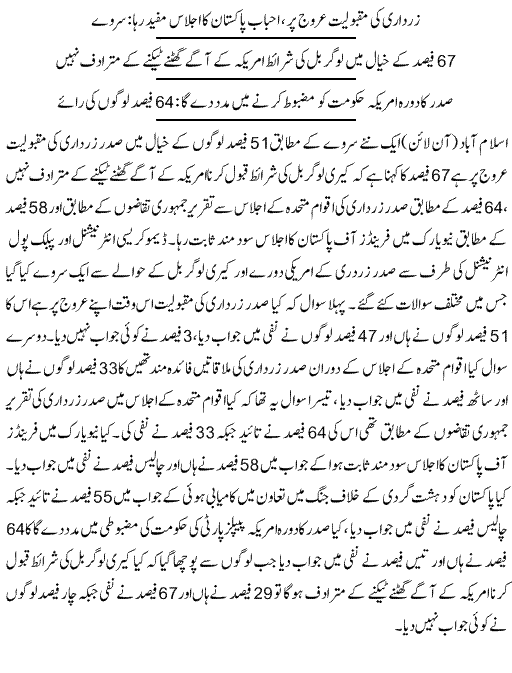
ISLAMABAD: President Asif Ali Zardari has emerged as the most popular personality on the Pakistani political landscape as 51 percent of the people terming President Asif Ali Zardari as the most popular personality. While 67 percent people said that to accept the conditions on Kerry-LugarBill is not to surrender to the policies of the US, 64 percent people termed President Asif Ali Zardari’s address in the United Nation in accordance with Democratic Norms, while 58 percent said that the Friends of Democratic Meeting in New York remained fruitful. Democracy International and Public Poll International have conducted a survey to gauge public opinion about President Asif Ali Zardari to US and Kerry-LugarBill. The first question was about the popularity of President Asif Ali Zardari. The findings revealed that 51 percent of the respondents’ favoured President Asif Ali Zardari, 47 opposes it while 3 percent showed no response. The second question was about the President Asif Ali Zardari visit to USA and his meetings with US officials. The results showed that 33 percent favoured it while 60 percent go against his visit. The third question about the President Asif Ali Zardari address in UN. The findings showed that 64 percent favoured it while 33 go against his address. The fourth question was about the Friends of Democratic Pakistan. The findings revealed that 58 percent answered “Yes, it was fruitful” while 40 percent answered in the negative.—Agencies

http://www.regionaltimes.com/05oct2009/frontpagenews/zardari.htm


http://express.com.pk/epaper/PoPupwindow.aspx?newsID=1100729549&Issue=NP_LHE&Date=20091005

Read more...

Saturday, 3 October 2009

The reality of IRI and other opinion surveys


Zardari popularity ascends after July: US survey
Updated at: 0238 PST, Friday, October 02, 2009
Zardari popularity ascends after July: US survey WASHINGTON: According to a survey carried out by a US based independent company, the popularity graph of the leader of Pakistan Muslim League Nawaz (PML-N) Mian Muhammad Nawaz Sharif has considerably declined while the President Asif Ali Zardari’s gained momentum after July this year, but yet another time, Nawaz Sharif has got upper hand over Zaradri in this race, Geo news reported on Thursday.

Total 25 per cent Pakistanis consider President Zardari rendering his services vigilantly as the same natured survey conducted in March this year placed President Zardari 6 percent less than September survey, the survey said.

The N-League leader Nawaz Sharif was liked by 67 percent people 7 percent less than survey conducted in March, it added. (Geo News)

An analysis by Ataul Haq Qasmi

Another analysis by Munno Bhai:


Read more...

Thursday, 17 September 2009

Most Pakistanis want democracy


By Amin Ahmed
Thursday, 17 Sep, 2009

About 62 per cent of Pakistanis feel it’s ‘very important’ to live in a democratic country.—Photo by AP

RAWALPINDI: After decades of dictatorial rule in the country since independence, a majority of Pakistanis now feels that it’s important to live in a democratically ruled country.

According to a study entitled ‘World Public Opinion on Political Tolerance’, about 62 per cent of Pakistanis feel it’s ‘very important’ to live in a democratic country.

Some 26 per cent say it’s ‘somewhat important’ while seven per cent feel this is ‘not very important’. Two per cent remain rather indifferent.

Sponsored by the Inter-Parliamentary Union, the study was released on Tuesday to mark the International Democracy Day.

The ‘WorldPublicOpinion.Org’ conducted the poll in 24 countries that account for 64 per cent of the world’s population.

The countries are China, India, the United States, Indonesia, Nigeria, Pakistan, Russia, South Africa, Argentina, Chile, Mexico, Germany, Great Britain, France, Israel, Poland, Azerbaijan, Ukraine, Kenya, Egypt, Turkey, Iraq, Korea and the Palestinian territories (Palestine).

The surveys were conducted between April 4 and June 30. The poll reveals a widespread perception of a serious lack of political tolerance.

Large majorities perceive that people in their nations are not completely free to express unpopular views, that opposition parties do not get a fair chance to express their views and try to influence government decision, and that legislators have limited freedom to express views that differ from their political party.

The poll found strong support for democracy in general. Asked ‘how important is it for you to live in a country that is governed democratically?’, majorities in all 24 nations said it was very or somewhat important. In no country did those calling it unimportant exceeded about one in four.

On average across all nations polled, 90 per cent said it was important to live in a democratically governed country and 67 per cent said it was very important.


In Pakistan, about 56 per cent said ‘very important’ when asked how important did they think it was for people to be free to express unpopular political views, without fear of being harassed or punished.

Thirty-five per cent considered unpopular political views as ‘somewhat important’.

As far as the status of free expression was concerned, 33 per cent of Pakistanis gave their opinion that there was an opportunity of free expression while 35 per cent spoke of ‘somewhat free’.

Asked how often did opposition parties get a fair chance to express their views and try to influence government policies, approximately 50 per cent said: ‘Most of the time.’

Thirty-three per cent said ‘only some times’ while 39 per cent stated that most of the time members of the legislative body felt free to express views that differ from official views of their own political party.

More than 80 per cent of the people polled said women were fairly represented in the legislative body. (Dawn)


Read more...

Thursday, 26 March 2009

Mapping the Madrasa Mindset: Political Attitudes of Pakistani Seminaries

http://www.hindu.com/fline/fl2216/images/20050812001704801.jpg

Muhammad Amir Rana
24-3-2009

Pakistani madaris are perceived as a catalyst factor promoting orthodox views. Many analysts
view that their role in shaping the views of the masses and their students is a serious concern for
many. Their affiliation with political, sectarian and militant organizations is also a major cause of
concern.

Madrasa teachers are a major determinant in shaping views of the students. This study is based
on interviewers of and a survey administered to madrasa teachers. Main purpose of the survey was to determine the political attitudes of the clergy that controls madaris. Their replies vary from sect to sect, area to area and with respect to their political affiliations. Within the sects, variations are very narrow, underlining a near unanimity of responses.

Contrary to the common perception, the survey finds out that 172 out of 251 (62%) madaris
have political affiliations out of which 59 percent are affiliated with religio-political parties and 3
percent with other mainstream parties. At the same time, 18 percent are affiliated with sectarian or jihadi parties. The majority’s political affiliation indicates that madaris are eager to play a prominent political role in the country.

The survey showed that Deobandi and JI madaris are more inclined towards politics as 82% of
Deobandi and 100% of JI madaris have political affiliations. It is understandable about JI madaris that they are under the patronage of a political party but for the deobandi madaris it can be a matter of their tradition. The Barelvies do not focus much on their political tradition. The survey finds out that only 27 percent of the Barelvi madaris have political affiliations including mainstream political parties. Seventy percent of Ahle Hadith and 48 percent of Shia madaris have political affiliations but mostly to safeguard the interests of their schools of thought. Only 20 percent said that it is a religious obligation.

Field researchers found that madaris administration was reluctant to disclose their sectarian
and militant affiliations. Only 18% owned up their affiliation with sectarian outfits. As a matter of
principle, most of the responding madrasas condemned terrorism as an evil. Fifty-seven percent of the madaris, view the war on terrorism as directed exclusively against Islam and Muslims.
One hundred and three out of the 115 madaris oppose the military operation in tribal region.
Thirteen percent of the respondents agreed that Pakistan should be a part of international campaign against terrorism while 77% disagreed. At the same time, 70 percent of Shia madaris consider that Pakistan should not be a part of global campaign against terrorism. Almost half of the 69 Barelvi madaris believe that what is called terrorism is a product of America’s Cold War policies against the Soviet Union. Eleven of the fourteen JI madaris think that War on Terror is designed to target Islam and Muslims. All of the JI favor that Pakistan should not be a part of global campaign against terrorism and oppose the military operations in tribal areas against Taliban. Similar views were found among Ahle-Hadith madaris with a minor difference. Most of the Deobandi madaris suggest that Pakistan should deal with the issue on its own without taking ‘dictation’ from the West. More than 90 per cent of the respondents were clear in their opinion against the suicide attacks inside Pakistan.

The survey shows that 57% of the madaris believe that the presence of foreign troops in
Afghanistan is a main reason behind the suicide attacks in Pakistan and 22% think it is because of Pakistan’s partnership in the war against terrorism.

The survey findings show two facets of the madrasa mind. One, they consider themselves and
their profession as superior to worldly pursuits and, two, they suffer from a siege mentality and think of themselves as targets of a conspiracy by the West and its allies in Pakistan. Majority of the madaris favors democratic process in the country as 73% agreed that democracy is the solution to many issues in the country. Around 90% were in favor of a peaceful solution of the Kashmir problem. Only 9% believe that jihad is a solution to the dispute. Similarly, on Afghanistan issue, only 6% supported the solution through jihad but a majority (82%) linked it with the exclusion of foreign forces from Afghanistan.

(The complete paper is included in PIPS research journal Conflict and Peace Studies, Volume 2,Number-1 Jan-Mar 2009.)

http://san-pips.com/

...

Jaish madrassa operates in Bahawalpur despite ban

* Former Jaish member says would-be jihadis practice martial arts, archery and horse-riding skills
* Police officer says hard-line madrassas in Bahawalpur recruit teens and young men for jihad in FATA or in Afghanistan


BAHAWALPUR: The compound bore no sign. Residents referred to it simply as the school for "jihadis," speaking in awe of the expensive horses stabled within its high walls - and the extremists who rode them bareback in the dusty fields around it.

In classrooms nearby, teachers drilled boys as young as eight in an uncompromising brand of Islam that called for holy war against enemies of the faith. Sitting cross-legged on the floor of the Darul Uloom Madina school, they recited verses from the holy Quran.

Both facilities are run by an Al Qaeda-linked terror network, Jaish-e-Muhammed, in the heart of Punjab. Their existence raises questions about the government's pledge to crack down on terror groups’ accused of high-profile attacks in Pakistan and India.

Jihadis: There, would-be jihadis practice martial arts, archery and horse-riding skills and get religious instruction, according to a former member of Jaish-e-Muhammed, who spoke on condition of anonymity.

"You can say Jaish is running its business as usual," said Amir Rana, from Pakistan's Institute for Peace Studies, which tracks militant groups. "The military wants to keep alive its strategic options in Kashmir. The trouble is you cannot restrict the militants to one area. You cannot keep control of them."

Recruit: A top police officer said the madrassas in the area were used to recruit teens and young men for jihad in the NWFP or in Afghanistan. He spoke on condition of anonymity because of the sensitivity of the issue.

A guard wielding an automatic weapon stood at the gate of the Usman-o-Ali school and turned a visiting journalist team away. But the head teacher at nearby Darul uloom Madina allowed the group a tour and an interview.

Attaur Rehman said none of the students were allowed to be recruited for jihad while studying there, but added that he could not stop them joining up after they graduated.

"Pakistani citizens, and especially Punjabis, are the Taliban trainers in the area for bomb-making," said Asadullah Sherzad, police chief in Afghanistan's insurgency-wracked Helmand province, adding there are around 100 Punjabis at any one time in that area of Afghanistan.

A police officer in Bahawalpur said Jaish members were not believed to be training with weapons in the town's schools and other facilities, adding that law enforcement agencies had infiltrated the group. He spoke on condition of anonymity because sections of the government and security agencies disagreed on the need to crack down on the group.

Jaish is believed to have been formed in 2000 by hard-line cleric Masood Azhar after he was freed from an Indian prison in exchange for passengers on a hijacked Indian Airlines flight that landed in southern Afghanistan the same year.

Azhar was born in Bahawalpur, though the government says his current whereabouts are not known. A small stall outside the Usman-o-Ali school sells his speeches and writings. ap (Daily Times, 25 March 2009)

....

مدارس کی نئی سوچ

مدرسہ(فائل فوٹو)

نو فیصد اساتذہ کا خیال ہے کہ مسئلہ کشمیر جہاد کے بغیر حل نہیں ہو سکتا

پاکستان میں تہتر فیصد مذہبی مدراس کے اساتذہ جمہوریت کے حق میں ہیں اور ان کا خیال ہے کہ جمہوریت کئی قومی مسائل کا حل ہے۔

اسلام آباد کے ایک سرکردہ تحقیقی ادارے پاکستان انسٹی ٹیوٹ فار پیس سٹڈیز ( پائپس) نے ملک کے مختلف علاقوں میں مختلف مکاتبِ فکر کے دو سو اکیاون مدارس کے اساتذہ کی آراء پر مبنی سروے سے یہ نتیجہ اخذ کیا ہے کہ باسٹھ فیصد مدارس کسی نہ کسی مذہبی و سیاسی تنظیم یا گروہ سے وابستہ ہیں جبکہ اٹھارہ فیصد مدارس کا جھکاؤ کسی نہ کسی فرقہ وارانہ یا جہادی تنظیم کی طرف ہے۔

سروے کے مطابق جماعتِ اسلامی کے سو فیصد ، دیوبندی مکتبِ فکر کے بیاسی فیصد ، اہلِ حدیث کے ستر فیصد، اہلِ تشیع کے اڑتالیس فیصد اور بریلوی مکتبِ فکر کے ستائیس فیصد مدارس کا جھکاؤ کسی نہ کسی مذہبی و سیاسی جماعت یا تنظیم کی طرف ہے۔

سروے کے مطابق زیادہ تر مدارس اصولی طور پر دہشت گردی کے رجحانات کی مذمت کرتے ہیں تاہم ستاون فیصد مدارس کے اساتذہ کے خیال میں دہشت گردی کے خلاف جنگ کا نشانہ اسلام اور مسلمان ہیں۔ تقریباً اسی فیصد مدارس قبائلی علاقوں میں فوجی آپریشن کے خلاف ہیں جبکہ ستتر فیصد مدارس کے خیال میں پاکستان کو دہشت گردی کے خلاف عالمی مہم کا حصہ نہیں بننا چاہیے۔ ان میں شیعہ مدارس کا تناسب ستر فیصد ہے۔

ستاون فیصد مدارس کے خیال میں پاکستان میں خودکش حملوں کا بنیادی سبب افغانستان میں امریکہ سمیت غیرممالک کی فوجی موجودگی ہے جبکہ بائیس فیصد مدارس کے خیال میں خودکش حملوں میں اضافے کا بنیادی سبب دہشت گردی کے خلاف جنگ میں پاکستان کا کردار ہے۔

تیرہ فیصد مدارس کے خیال میں پاکستان کا عالمی مہم میں شریک ہونا درست ہے۔ پچاس فیصد بریلوی مدارس کے اساتذہ کا خیال ہے کہ دہشت گردی کی موجودہ لہر کے ڈانڈے امریکہ اور سابق سوویت یونین کی سرد جنگ کے زمانے سے ملتے ہیں۔ جماعتِ اسلامی، اہلِ حدیث اور دیوبندی مکتبِ فکر کے مدارس کی بہت بڑی اکثریت کا خیال ہے کہ پاکستان کو دہشت گردی سے نمٹنے کے لیے مغربی دنیا سے ڈکٹیشن لینے کی بجائے اپنی پالیسی آزادانہ طور پر وضع کرنی چاہییے۔

جہاں تک خودکش حملوں کے بڑھتے ہوئے رجحان کا معاملہ ہے تو ستاون فیصد مدارس کے خیال میں پاکستان میں خودکش حملوں کا بنیادی سبب افغانستان میں امریکہ سمیت غیرممالک کی فوجی موجودگی ہے جبکہ بائیس فیصد مدارس کے خیال میں خودکش حملوں میں اضافے کا بنیادی سبب دہشت گردی کے خلاف جنگ میں پاکستان کا کردار ہے۔

نوے فیصد مدارس مسئلہ کشمیر کا پرامن حل چاہتے ہیں جبکہ نو فیصد مدارس کے اساتذہ کا خیال ہے کہ مسئلہ کشمیر جہاد کے بغیر حل نہیں ہوسکتا۔ بیاسی فیصد مدارس کا خیال ہے کہ اگر غیرملکی فوج افغانستان چھوڑ دے تو مسئلہ کا پرامن حل ممکن ہے۔جبکہ چھ فیصد مدارس کے خیال میں افغان مسئلے کا علاج مسلح جہاد ہے۔

http://www.bbc.co.uk/urdu/pakistan/2009/03/090324_madarsa_wusat_zs.shtml


Read more...

Thursday, 5 March 2009

Farhat Taj: A survey of Drone Attacks in Pakistan. What do the people of FATA think?


This site has moved to http://criticalppp.com/archives/26239, click this link if you are not redirected
Read more...

Wednesday, 7 January 2009

IRI award for Sherry Rehman

ISLAMABAD: International Republican Institute (IRI), renowned for conducting various political surveys in Pakistan, has awarded Federal Minister for Information Sherry Rehman the title of ‘democracy’s hero’ for her struggle for democracy in the country.

According to IRI, Sherry worked diligently to initiate democratic reforms and was the architect of several bills in support of press freedom and women’s empowerment.

She worked closely with former prime minister Benazir Bhutto to campaign for the restoration of democracy in Pakistan, and braved tear-gassing and confinement by security agencies on several occasions. app (Daily Times)
Read more...

Tuesday, 23 December 2008

Foreign Polls and Surveys: Reality, Deception and Hidden Agenda

By: Afreen Baig

Recently, it had become sort of a fashion, to give reference to Foreign Polls and Surveys while speculating on the future of Pakistan and the popularity levels of our leaders. Later it was Pakistan’s election process and its consequences. The Media religiously quote these Polls & Surveys to pursue their specific agenda and give credibility to their rumoring views and specious news. The faith is so great that the credulous Pubic doesn’t even bother to check on the reliability, funding and intentions of the lobbies behind these Polls & Surveys.


[A survey released by the U.S based International Republican Institute was released recently with all sorts of negative indicators shown associated with the elected government of the PPP and its coalition partners.]

The credibility of these organizations leaves a huge question mark, when they fail to come clean and clear about their affiliations and their loyalty to their financers. Who funds them and for what purpose?

Founded in 1983, the International Republican Institute (IRI) is an organization, funded by United States government. The IRI operates as a political organization abroad, providing training and assistance to political parties. One could question the interest of the IRI in elections of other countries and the kind of assistance or leverage it provides to their political parties? Why would Pakistan’s political parties require assistance from abroad, specifically the IRI?

As a 501(c) (3) tax-exempt organization, IRI plays no part in domestic U.S. politics. It further raises suspicions, as to why a US organization is not allowed to publish polls and surveys about their own elections, while meddling in Pakistan?

The majority of its board, staff and consultants are drawn from the Republican Party. Most of its staff and board have links to right-wing think tanks, foundations, and policy institutes, while many also represent major financial, oil, and defense corporations. Oil and Defense corporations - the root cause of all recent evil wars!

IRI Board of Directors includes the current aspiring US Presidential candidate Senator Mc Cain. No wonder the Republican Party was eager to group with late Benazir Bhutto and wanted to see the moderate forces together. The IRI was projecting fraudulently the future allies of the Republicans i.e. the PPP in the upcoming Pakistani elections.

The IRI is also accused of training some of the leaders of the 2004 coup d’etat in Haiti, as well as funding opposition groups in the country in a destabilization campaign in the months leading up the removal of democratically-elected President Jean-Bertrand Aristide by a coalition of Canada, USA and France.

......

Abbas Ather's column:
A new survey: A new conspiracy?
[1100543191-2.gif]
(Express, 23 Dec 2008)

[1100544330-2.gif]
(Express, 25 Dec 2008)
Read more...

Monday, 29 September 2008

19% of Pakistanis have a positive view of Al-Qaeda: BBC Poll

(In our view, most of these terrorist supporters or sympathizers are likely to be voters of right wing (mostly Deobandi) parties in Pakistan, including Jamaat-i-Islami, (defunct) Sipah Sahaba, Pakistan Muslim League (Nawaz), Imran Khan, and JUI.)

Al-Qaeda not weakening - BBC poll

http://www.bbc.co.uk/urdu/regional/story/2008/09/080928_bbc_survey_rza.shtml


US-led efforts to tackle the al-Qaeda group are not regarded as successful, an opinion poll carried out for the BBC World Service suggests.

Some 29% of people said the "war on terror" launched by President George W Bush in 2001 had had no effect on the Islamist militant network.

According to 30% of those surveyed, US policies have strengthened al-Qaeda.

The most commonly held view of al-Qaeda in the 23 nations polled was a negative one - except in Egypt and Pakistan.

Terror stalemate

Asked who is winning "the conflict between al-Qaeda and the US", 49% said neither side while 22% believed the US had gained the upper hand. Just 10% said al-Qaeda was winning.

US soldier in Afghanistan, file image
The US made al-Qaeda a prime target in its "war on terror"

BBC defence analyst Rob Watson said the overall verdict across the world appeared to be that the war on terror had produced something of a stalemate.

The next question the pollsters asked was: "Do you think what US leaders refer to as the 'war on terror' has made al-Qaeda stronger, weaker or has had no effect either way?"

Just 22% said US action had made the organisation weaker - that figure rising to 34% in the US itself.

Losing hearts and minds?

Our correspondent says there is plenty in this survey to worry the governments of Egypt and Pakistan.

When asked "overall would you say your feelings about al-Qaeda are positive, negative or mixed", some 60% of Egyptians said they had either a positive or mixed view.

Analysts say the group continues to have many Egyptians among its leaders.

Meanwhile in Pakistan, where much of the battle against al-Qaeda is being fought, just 19% said they had a negative view of Osama Bin Laden's organisation.

Doug Miller, from polling agency Globescan, said the findings from Egypt and Pakistan were "yet another indicator that the US 'war on terror' is not winning hearts and minds".

Some 24,000 adults across 23 countries were polled for the BBC World Service between 8 July and 12 September.
Read more...