Editor's Choice

--------------------------------------------------------------------------------------------------------------------------
Featured Post
--------------------------------------------------------------------------------------------------------------------------

"Let us build Pakistan" has moved.
30 November 2009

All archives and posts have been transferred to the new location, which is: http://criticalppp.com

We encourage you to visit our new site. Please don't leave your comments here because this site is obsolete. You may also like to update your RSS feeds or Google Friend Connect (Follow the Blog) to the new location. Thank you.


--------------------------------------------------------------------------------------------------------------------------
Showing posts with label Urdu. Show all posts

Thursday, 19 November 2009

Kidhray naan paindiyan dassaan: In memory of Faiz Ahmed Faiz

vs

Faiz Ahmed Faiz (February 13, 1911-November 20, 1984)

Faiz Ahmed Faiz and Zulfiqar Ali Bhutto

The poem Meray dil meray musafir ("My heart, my traveller") was written in 1977 when Faiz left Pakistan after the overthrow of Bhutto. He was to stay in exile for many years. The poem Kya Karain ("What should we do") was written when Faiz was in Beirut, where he missed his friends and family terribly. He was in distress about the repressive rule of Zia-ul-Haq. This poem, which I have in Faiz's hand, was written at the end of a letter he sent me from Beirut to Vienna: Meri teri nigha mein/jo laakh intizar hain ("Countless yearnings/ Petrified/In your eyes and mine"). Faiz was still in exile when Bhutto was executed, plunging him in grief. Faiz was a man of few words but when he was mourning, he would become very, very quiet, something I witnessed myself when I told him in London that his beloved teacher and friend Sufi Ghulam Mustafa Tabussum had died in Lahore.

The ghazal he wrote over Bhutto's death contains the verse: Aabad kar kai sheher-e-khamoshaan hur aik soo; Kis khoj mein hai tegh-e-sitmgar laggi hui ("In every direction, there now lies the city of silence/So who does the sword of the oppressor seek now?"). Another of Faiz's celebrated couplets was written during Zia's dark rule: Challo aao tum ko dikhayain hum jo bachha hai maqtil-e-sheher mein/Ye mazar ahl-e-safa kai hain ye hain ahl-e-sidq ki turbatain ("Let me show you what has survived in the murder yard of the city/Here lie those who were pure of heart and there are the graves of the truthful ones").

But I would like to end this with one of the most beautiful love poems that can be said to exist in any language. Agha Nasir, quoting the late Dr Aftab Ahmed Khan, a close Faiz friend, also lifts the veil on the one who inspired the poem. It was a woman Faiz was smitten with in his youth and years later, when she was married and living in Karachi, Faiz went to see her. This poem immortalises that meeting with all its longing and sadness. It begins " Gulshan-e-yaad mein gar aaj dum-e-baad-e-saba. " This is how I translated it: "If the breeze wants to blow today in the garden of memories/If it wants the flowers to bloom again, let it do so/The pain that lies in a forgotten corner of days past/If it wants to rise again, let it do so."

We who have lived in the times of Faiz should forever be grateful for that privilege.
(Khalid Hasan, Friday Times, 12 Sep 2008)

Faiz is and remains the most outstanding Urdu poet of the second half of the last century. During the last few years of his life, however, he wrote some Punjabi poetry as well which can be found in his last two books namely Shaam-e-Shehryaraan and Mairay Dil Mairay Musaafir. The following is one of his most famous Punjabi poems, which is the lamentation of a beloved for her lover who had become a prisoner of war in India:

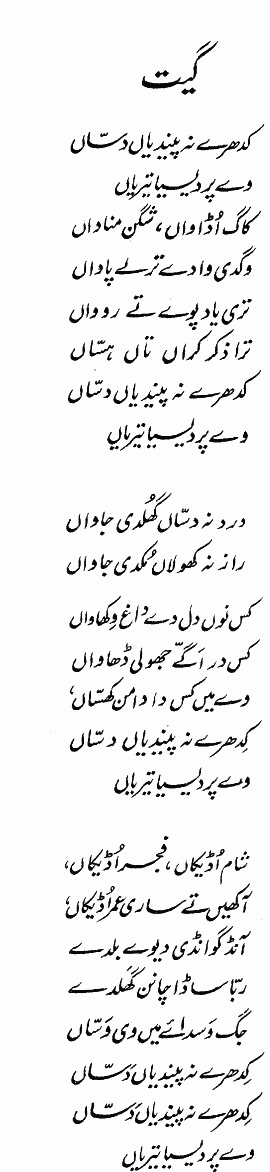
Kidhray naan paindiyan dassaan
Pardesia vay tairian

(I don't hear anything about you
My lover, living far away)

These very simple lines reflect the agony and suffering of the Punjabi woman in the most effective words possible.

Shaam udikaan, fajarudikaan
Aakhain tay sari umar udikaan
Ahand gawandi deevay balday
Rabba sada chanan ghalday
Jug vasda ay main vi vassaan

(I am waiting in the evenings and mornings
If you so desire I can wait the whole of my life
There are lights everywhere in the neighborhood
O God, Send my light also
The whole world is living and I might also live)
(Source)


Read more...

Sunday, 8 November 2009

Allama Iqbal in the eys of Jon Elia

جون نے اقبال کی شاعرانہ عظمت کے مداح شمس الرحمان فاروقی سے کہا وہ شاعر عظیم کیسے ہوسکتا ہے جس نے متضاد کرداروں کی مدح سرائی کی ہو۔

جیسے ؟؟ شمس الرحمان فاروقی نے استفسار کیا۔

جون نے اپنے بالوں کی لٹ پیچھے کرتے ہوئے کہا مثلاً ڈاکٹر اقبال کا ہیرو بیک وقت اورنگ زیب بھی ہے اور سرمد بھی۔ ایک ہی شاعر بیک وقت قاتل اور مقتول دونوں کو بلند کردار کہہ رہا ہے۔۔ مسولینی میں عظیم انسان کی کون سی خوبیاں تھیں؟ وہ ڈاکٹر اقبال کا ہیرو کیسے ہوگیا ؟ برٹش امپائر کے شہنشاہ کے سامنے اقبال نے سرِ تسلیم کیسے خم کردیا؟ کیا عظیم شاعر کا یہی کردار ہوتا ہے کہ وہ ہر طبقے کے لوگوں کو خوش کرنے کی کوشش کرے؟ اور شاہین ایک ایسا خونخوار طائر ہے جس میں رحم کا جذبہ ہرگز نہیں ہوتا۔ کیا اقبال نے شاہین کو علامت بنا کر انسان کو خونخوار بننے کی تعلیم نہیں دی ؟؟

اس گرما گرمی کے سبب محفل پر کچھ دیر کے لیے خاموشی طاری ہوگئی اور پھر ہربندر سنگھ وقت نے ماحول کو ہلکا کرنے کے لیے گفتگو فراق گور کھپوری کی شاعرانہ عظمت کی طرف موڑ دی۔

Here is the link to the complete article on BBC Urdu dot com

Read more...

Saturday, 19 September 2009

Jinnah's Choice of National Anthem for Pakistan


اے سرزمینِ پاك
ذرّے ترے ہیں آج ستاروں سے تابناك
روشن ہے كہكشاں سے كہیں آج تیری خاك
اے سرزمینِ پاك

Another time, another anthem
By Beena Sarwar
Saturday, 19 Sep, 2009
Jinnah wanted the national anthem to be written by a Hindu ‘to sow the seeds of secularism’ in Pakistan. — File photo

Most people are unaware that prior to Hafeez Jullundhri’s Persianised lyrics being adopted as the national anthem in the 1950s, Pakistan had a national anthem — commissioned and approved by no less a person than Mohammad Ali Jinnah.

The lyricist was the Isa Khel (Mianwali)-born Jagannath Azad, son of the renowned poet Tilok Chand Mahroom (who won accolades for his rendering of naat at mushairas). A few bloggers have made mention of this in the past but I learnt of it recently through an unexpected source — an article on the history of Pakistan’s flag and national anthem in PIA’s monthly Hamsafar magazine (‘Pride of Pakistan’, by Khushboo Aziz, August issue).

‘Quaid-i-Azam, being the visionary that he was, knew an anthem would also be needed, not only to be used in official capacity but [to] inspire patriotism in the nation. Since he was secular-minded, enlightened, and although very patriotic but not in the least petty, Jinnah commissioned a Hindu, Lahore-based writer Jagannath Azad three days before independence to write a national anthem for Pakistan. Jagannath submitted these lyrics:

Ae sarzameene paak

Zarray teray haen aaj sitaaron se taabnaak

Roshan hai kehkashaan se kaheen aaj teri khaak

Ae sarzameene paak’

(‘Oh land of Pakistan, the stars themselves illuminate each particle of yours/rainbows brighten your very dust.’)

As Jaswant Singh’s recent book on Mr Jinnah created ripples in mid-August, The Kashmir Times, Jammu, published a short piece, ‘A Hindu wrote Pakistan’s first national anthem — How Jinnah got Urdu-knowing Jagannath Azad to write the song’ (Aug 21, 2009). The reproduction of a front-page report by Luv Puri in The Hindu (Jun 19, 2005), it drew on Puri’s interview of Azad in Jammu city days before his death, published in Milli Gazette, New Delhi (Aug 16-31, 2004).

Azad told Puri that he was working at a literary newspaper in Lahore ‘when mayhem had struck…. All my relatives had left for India and for me to think of leaving Lahore was painful.... My Muslim friends requested me to stay on and took responsibility [for] my safety.’ On the morning of Aug 9, 1947, he received a message from Pakistan’s first governor-general, Mohammad Ali Jinnah, through a friend working in Radio Lahore ‘who called me to his office. He told me ‘Quaid-i-Azam wants you to write a national anthem for Pakistan’.’

Azad felt it would be difficult to do in five days, but agreed upon his friend’s insistence as the request had come from the Quaid.

Why him? Azad thought the answer lay in Jinnah’s speech of Aug 11, 1947, stating that if everyone saw themselves ‘first, second and last a citizen of this state with equal rights, privileges, and obligations … in the course of time, Hindus will cease to be Hindus and Muslims will cease to be Muslims, not in the religious sense because that is the personal faith of each individual, but in the political sense as citizens of the state’.

‘Even I was surprised when my colleagues in Radio Pakistan, Lahore approached me,’ recalled Azad. ‘… They confided in me that ‘Quaid-i-Azam wanted the anthem to be written by an Urdu-knowing Hindu’. Through this, I believe Jinnah Sahib wanted to sow the roots of secularism in a Pakistan where intolerance had no place.’

Mr Jinnah approved Azad’s lyrics within hours, and the anthem was broadcast on Radio Pakistan, Karachi.

Increasing insecurity forced Azad to migrate to Delhi in mid-September 1947. He returned to Lahore in October, says his son Chander K. Azad in an email to this writer. ‘However, his friends advised him against staying as they found it difficult to keep him safe.... He returned to Delhi with a refugee party.’

Azad had a distinguished career in India — eminent Urdu poet, journalist and editor, authority on Allama Iqbal, author of over 70 books, government servant (retired in 1997), and recipient of numerous awards and honours. His last wish, he told Puri, would be to write a song of peace for both India and Pakistan.

His lyrics survived in Pakistan barely six months beyond Mr Jinnah’s death in September 1948. ‘The people and the constitutional bodies of the country wanted to have a more patriotic and more passionate national anthem that depicted their values and identity to the world,’ explains Hamsafar.

The National Anthem Committee (NAC), formed in December 1948, took two years to finalise a new anthem, finally choosing NAC member Hafeez Jullundhri’s poem from among 723 submissions.

The anthem commissioned by Mr Jinnah was just one of his legacies that his successors rejected, along with the principles he stressed in his address to the Constituent Assembly on Aug 11, 1947 — his political will and testament according to his official biographer Hector Bolitho.

Pakistan’s inherited problems that Mr Jinnah outlined in that speech included the maintenance of law and order (the state must protect ‘the life, property and religious beliefs of its subjects’), the ‘curse’ of bribery and corruption, the ‘monster’ of black-marketing, and the ‘great evil’ of nepotism.

This speech, literally censored by ‘hidden hands’ as Zamir Niazi documents in Press in Chains (1986), also contains the famous ‘fundamental principle that we are all citizens and equal citizens of one state’, where religious identity becomes secondary and where religion, caste or creed ‘has nothing to do with the business of the state....’

In March 1949, the Objectives Resolution laid the basis for recognising Pakistan as a state based on an ideology.

In all these deviations from Mr Jinnah’s vision, perhaps discarding Azad’s poem appears minuscule. But it is important for its symbolism. It must be restored and given a place of honour, at least as a national song our children can learn. After all, Indian children learn Iqbal’s Saarey jahan se accha. Such symbolism is necessary if we are to resurrect Mr Jinnah’s vision of a nation where religion, caste or creed ‘has nothing to do with the business of the state’.

The writer is a freelance journalist and documentary film-maker.


Also see Zaheer A. Kidvai's article on this topic: 'A Tale of Two Anthems'
- http://www.kidvai.com/windmills/2009/05/tale-of-two-anthems.html -Thanks Zak.

and `Censoring the Quaid' by Dr M. Sarwar, Aug 7, 1991 The Frontier Post)
at www.drsarwar.wordpress.com ('Writings' section,
http://drsarwar.wordpress.com/dr-sarwar-writings/#censorQuaid

and a word about Azad:

http://www.dawn.com/2004/06/27/fea.htm#4

A speech by Dr Jagan Nath Azad on Pakistan-India relations

and his ghazal, Hum khaak ko zar se kabhi kamtar nahiN kehte.


Read more...

Wednesday, 25 March 2009

Shafeeq-ur-Rahman: the inimitable humorist

By Rauf Parekh
Tuesday, 24 Mar, 2009 (Dawn)

Despite having not written for such a long time, Shafeeq-ur-Rahman did not fade out and new editions of his books were published every few years. –File Photo

Mushtaq Ahmed Yousufi, one of the most celebrated humorists of the Urdu language, said in an interview early in his literary career that he had decided to quit writing humour. Reason? He thought it was useless to write humour if one could not write it the way Shafeeq-ur-Rahman did. (Though, luckily enough, Yousufi Sahib later decided that he could write humour the way he himself did.)

Such was the influence of Shafeeq-ur-Rahman, a humorist who ruled the world of Urdu humour for about 60 years, and is still doing so.

Shafeeq-ur-Rahman began writing and established himself in the pre-independence era like his contemporaries, such as Ibrahim Jalees, K.L. Kapoor, Krishan Chandr, Shaukat Thanvi and Rasheed Ahmed Siddiqi.

His first book ‘Kirnen’ (1942) was a collection of quasi-romantic and quasi-humorous short stories. His early stories did not show any signs of a great humorist. But in his second book, ‘Shagoofe’ (1943), romanticism gave way to humour and it was his later books, ‘Lehren’ (1944) and ‘Parwaz’ (1945), which established him as a pure humorist. ‘Himaqaten’ (1947) and ‘Mazeed Himaqaten’ (1948) earned him more accolades but the flow of his books shrank to a trickle of articles and then for almost 25 years he wrote nothing.

Zameer Jafri, in one of his columns titled ‘Kuchh na likhne ki silver jubilee’, ‘commemorated’ in his peculiar style Shafeeq’s literary hibernation.

Some believe that for writers it is a must to keep on writing or run the risk of being forgotten and that the adage ‘publish or perish’ is not true of publishers alone, but of writers as well. (In my personal opinion, most of the writers of our times ‘publish and perish’.)

Strangely enough, despite having not written for such a long time, Shafeeq-ur-Rahman did not fade out and new editions of his books were published every few years. The copies of his books that I preserve like a treasure were published mostly in the early 1970s.

So, what are the factors that have kept him very much ‘in’ for such a long time? First, his humour has such a vigour and freshness that it has not wilted even today. Some of his essays in his early books are timeless. His wit and repartee put him way ahead of some of his contemporaries who, for example Shaukat Thanvi, depended more on playfulness or situational comedy.

Azeem Baig Chughtai (though hardly his contemporary, as he died in 1941), like Shaukat Thanvi, relished pranks and his humour consists largely of cheery boisterousness.

Though Shafeeq Sahib’s humour is not shy of practical jokes, he uses it sparingly and his playfulness stops just in time to save the humour from becoming tragedy, which sometimes is the case with Chughtai.Secondly, Shafeeq is the master of parody.

Hardly any humorist in Urdu can match his satire and bubbling wit when it comes to parodies. His five parodies — ‘Qissa-i-chahaar dervesh’, ‘Qissa-i-Hatim Tai bai tasweer’, ‘Qissa Professor Ali Baba ka’, ‘Tuzk-i-Nadri urf Siyahat nama-i-Hind’ and ‘Safar nama Jahazbad Sindhi ka’ — are fine satires on our history and culture.

For instance, in his ‘Tuzk-i-Nadri’, probably the most successful of all parodies in Urdu, he not only mocks the kings and their ‘tuzks’ (memoirs), but our political system is also his target when he writes (in the words of Nadir Shah) that: ‘In those days Delhi was in the grip of election fever. Ulloo Shanaas submitted that I had become so popular in Delhi that I could win election from any constituency, no matter on whose ticket I contest it…Out of my seven opponents, two withdrew when they were presented with large amounts of cash, the third was coerced into withdrawal, the fourth had to be made an ambassador to a country, two turned out to be a bit too obstinate and one of them had to be beaten black and blue and the other died in mysterious circumstances. When polling began, the entire population of the city was invited for a feast and presented with money and valuables. And if there happened to be any impudent voter who did not admit to my popularity, he was made to accept it with the help of a stick.’ (Mazeed himaqaten, p37).

Another factor that contributed a lot to Shafeeq Sahib’s public acclaim was his popularity among the adolescent. The main character in most of his humorous short stories is a young and witty college boy who is fond of cricket and movies.

Also, Shafeeq often portrays infatuations. This gives the youth a vicarious feeling. And his characters appear kind of flirtatious, too. His most famous character, Rufi alias Shaitaan, once quips: ‘Sonny! Don’t be sulky if you miss a bus or a girl, another one will be just round the corner.’ (Himaqaten, p121).

Then he often philosophises about joys and sorrows, sweeping the young readers with the bouts of optimism and pessimism, giving semi-philosophical, semi-romantic explanations to the queries that haunt the youth.

In addition, his many essays are nothing but a collection of jokes and the essay itself is only the thread that binds them together. His characters, novel and funny, such as Rufi or Shaitaan, Maqsood Ghora, Hukoomat Aapa and Buddy, make reading joyful.

All this put together is enough to hook young readers. I don’t know exactly which way the wind is blowing these days, but in my late teens and early twenties, I had read each and every book by Shafeeq-ur-Rahman many times over.
Shafeeq-ur-Rahman was born on Nov 9, 1920, in a small town near Rohtak. He was educated at Bahawalpur, as described by Muhammad Khalid Akhter, Shafeeq’s classmate at Sadiq Dean High School and a humorist in his own right.

Shafeeq-ur-Rahman did his MBBS in 1942 from Lahore’s King Edward Medical College. Having joined the Indian Medical Service as a lieutenant, Shafeeq-ur-Rahman was posted, according to Khalid Akhter, at different war fronts during the Second World War.

He then joined Edinburgh University and London University to further his education. It certainly broadened his perspective. But both Shafeeq-ur-Rahman and Khalid Akhter were already immersed in English literature and it had definitely influenced their writings.

On Shafeeq’s style one can trace the influence of western humorists such as Stephen Leacock and Mark Twain, but he is among those writers of Urdu who are well-grounded in their own literature and culture and have a peculiar style of their own.

After independence, Shafeeq-ur-Rahman held high positions in the Pakistan Army and Navy and in December 1980 was made chairman of the Pakistan Academy of Letters, a post he held till December 1986. His other books include ‘Madd-o-jazar’ (1946), ‘Pachhtawe’ (1948), ‘Dajla’ (1980) and ‘Dareeche’ (1989).

The irreplaceable and inimitable Shafeeq-ur-Rahman died in Rawalpindi on March 19, 2000.

drraufparekh@yahoo.com

.....

The Legend That Was Shafiq-ur-Rehman

By Dr. Zeba Hasan Hafeez

Dr Shafiq-ur-Rehman was one of our most illustrious writers of extraordinary humor. Like P.G. Woodhouse he has given enduring pleasure to his readers. The similarity between him and Mushtaq Ahmed Yusufi, is also striking. Both did justice to their careers, the former serving in the armed forces and the latter in the banking sector, and also reached the heights of literary excellence.

Early in his career as a writer, Shafiq-ur-Rehman became a household name. I recall the words of Akhtar Mahmud Faruqui, a former assistant editor of Dawn: “My dear father had wanted me to become an engineer but I used to spend most of my time reading Shafiq-ur-Rehman and learning his afsanas by heart. That was also true of my cousins and college friends. Even ahmaq in Maddojazar fascinated us and we readily identified ourselves with the character. I was entranced by his writings when I was 15. I found his afsanas equally absorbing forty years later. Perhaps more. Pachtawaey sounded so familiar. So did Himaqataen. ‘Shaffoo bhai’ (Kirnaey or Shagoofae?) was, of course, my ideal, my hero.”

Dr Shafiq-ur-Rehman began writing humorous stories during his school days. His stories were published in a literary monthly magazine called Khayyam. Kirneyn was completed before he joined the medical college and was published in 1938 while he was still a medical student. It was followed by Shagoofay , Lehrain, Maddojazar, Parvaaz, Himaqatain, Mazeed Himaqatain, Dajla (a travalogue), Insaani Tamasha (a translation of “a human comedy”) and lastly Dareechay. His unforgettable characters include Razia, Shaitaan, Hukoomat Aapa, Maqsood Ghora, Buddy, Nannha and others. His work added a new dimension to humor in Urdu literature. He created a world for us that was very real with all its joys, pains and anguish. It was an affirmation of life and of human values: empathy, compassion and respect. Even the seemingly frivolous and trivial situations had hidden meanings that probed deep into the human psyche. His language was simple, spontaneous and expressive.

After passing his MBBS in 1942, Dr Shafiq-ur-Rehman joined the Indian Army Medical Corps. He completed his post-graduation in tropical medicine and public health from Edinburgh, in 1952.

As his niece, I had the rare pleasure and privilege of being close to him. He was always my hero. I found everything about him extraordinary: his literary genius, his conversation, his stature, his handsomeness, his handwriting… I don’t think, I have seen anyone more becoming in an army or naval uniform. We all called him uncle. There was an ancient timepiece on the sideboard in the dining room which he only was able to adjust. When I met my aunt recently, she sadly said that no one manipulated it now. They had many common interests and a great companionship. Dr Shafiq-ur-Rehman was a friend of her brother, Shaukat Hasan. They were classmates at King Edward Medical College, which was the beginning of a life-long friendship. In Barsaati, the “friend” accompanying the author in Spain, is him. Lieutenant General Shaukat Hasan has served as consultant surgeon to the Pakistan armed forces for about twenty years.

Dr Shafiq-ur-Rehman had many nieces and nephews. He had committed to memory some act or conversation of each child in the family. Whenever he met me after an interval, he would say that years ago, I had asked him to wear a suit for an occasion and he had found my suggestion so appropriate that he had quickly gone in and changed. I always felt important when he mentioned this incident. Our families had the opportunity to spend a lot of quality time together in Karachi, from 1972 to 1975 when he was posted as Director Medical Services, Navy with the rank of commodore and later as rear admiral. When he reverted to the army, he became Major General. My aunt took a long leave from her post as professor of English at the Government College, Rawalpindi to join him. He adored his sons and spent a great deal of time with them, playing cricket, swimming and engaging in other activities. Dr Shafiq-ur-Rehman was very much of an outdoor person. He was tall, athletic and slim; strenuous exercise being a daily ritual for him. Every Sunday, he would wear his hat and go for a long walk to the bazaar of used books. He returned with an interesting assortment and gave each one of us a book to read .

Whenever we went to Dr Shafiq-ur-Rehman’s house, we knew that depending upon the time, he would either be at work, outdoors for his daily exercise or in his study. If it was one of the meal times, we would have the memorable opportunity of being in his company. I always felt honored to sit at the dining table with him. He spoke most of the time and we listened, mesmerized. He had an amazing memory and his conversation would mostly be about books, poetry and jokes. His jokes were endless and he never repeated a single one. He had a special way of telling a joke which threw us all into fits of laughter while he sat with a straight face. Later, I found out that most people who had met him shared this impression. It was an unwritten law in their house that meal times were a reunion of the family and that anything unpleasant, including illness, was not to be discussed.

Every time I visited the family in Rawalpindi, my aunt and I took turns in reading out passages from his books. She told me the background of many situations too. I always made it a point to go through all their old picture albums. Dr Shafiq-ur-Rehman was very fond of photography. Each photograph seemed to have a historical perspective to it. My aunt had a story to tell about each one. They seemed to open a gateway to a dreamland of romanticism, youth; a glimpse into life, as he had lived it and as it had inspired him. His room was quite bare. He was an extraordinarily simple and private person. I sometimes caught a glimpse of him while he worked. There was a newspaper stand in his room where he stood for hours, barefoot, reading. He even wrote while standing. His library comprised thousands of books. These were all stacked neatly in steel trunks which were kept locked. He seemed to have a working catalogue in his mind and knew where each book was placed, even the pile and row down to the last detail.

Dr Shafiq-ur-Rehman had given me an autographed set of his books. Somehow Mazeed Himaqatain was missing from this collection. When I went to Rawalpindi after his passing away, I requested my aunt to autograph it for me. She wrote,

Barey shauq saye suun raha tha zamana

Hameey soo gayae dastaan sunaatey sunaatey.

I have tried to translate a few lines from Barsaati that have always moved me. “Alhamra seems like the home of fairies. Every pillar, arch, wall and their beautiful engravings, every inch seems magical. In this solitude, the only sign of life seems to emerge from the sound of these fountains. These springs have never been silent. They have been flowing since the era of the Arabs. The limitedness of human life, the vicissitudes of time, philosophy, creation and destruction; all seem to have become absorbed into the sound of these fountains.”

After retiring from the army, General Shafiq-ur-Rehman, served as Chairman of the Academy of Letters from 1980 to 1985. During his tenure, the Academy of Letters acquired a new dimension as a prominent literary institution of Pakistan. He continued to write till his end in March 2000. He was the only Major General to be awarded the Hilal e Imtiaz for his military and civilian services. He was bestowed the latter honor after his death and his son, Atiq-ur-Rehman, received it on his behalf on 23 March, 2001.
Dr Shafiq-ur-Rehamn is a legend in Urdu literature and lives on in our hearts. His books have been appreciated and read so widely that had he belonged to any other country, he would have been a millionaire. However, he never asked for any royalties and never made any kind of monetary agreement with his publishers. His lifestyle was always simple. On an occasion, a thief tried to break into their house and in the process damaged a door whose repair caused the family considerable inconvenience. I recall uncle saying that a sign should be posted outside for thieves, “The door is open, you don’t have to break it.”

http://www.pakistanlink.com/letters/2002/Dec/06/04.html

....

An excerpt from Shafiq-ur-Rehman’s ‘lehreN’
Owais Mughal

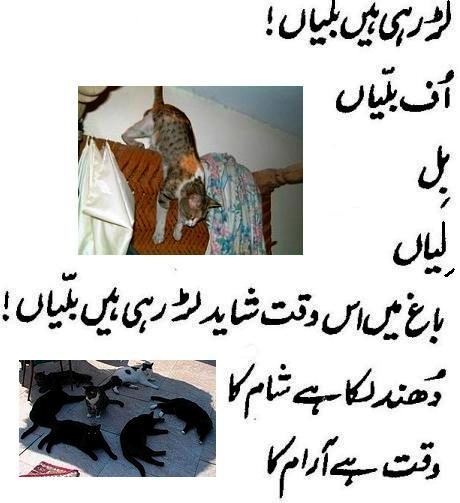
Following ‘azad’ poem is by one of my favourite writers, Shafiq-ur-Rehman and it comes from his book ‘lehreN’. The poem is actually a satire on modern day poets who write ‘azad’ Urdu poem by using all the ‘azadi’ they can get. The poem describes a situation of fighting cats in a garden. I hope it brings a smile to you just like it has been bringing smiles to me for the past 20 years.
Here is my attempt at an approximate translation for our English readers:

Cats are fighting
Oh Cats
Caaaa…
…tsss
May be cats are fighting in garden now
There is the haze of dusk
It is time to rest
to work
to
get rewarded
And cats are fighting
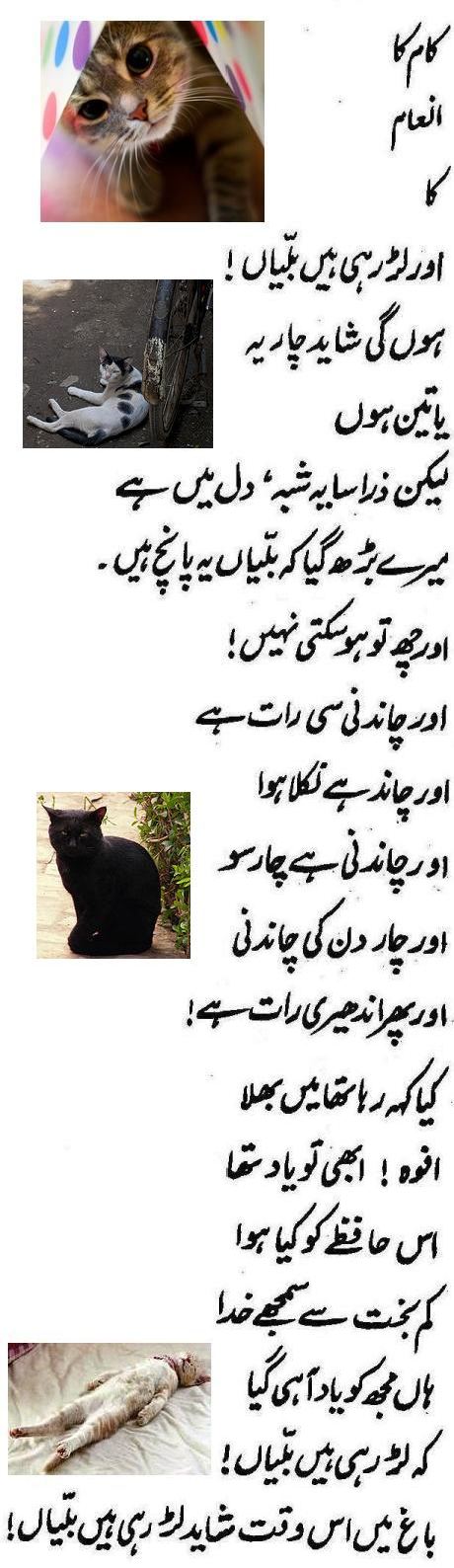
May be they are 4 in number
or may be 3
But this little doubt has made house in my heart
that the cats are 5 in number
and definitely they cannot be 6
and the night is glowing in moonlight
and the moon is shining bright
and the moonlight is ubiquitous
and this moonlight will only last for a little while
and then there is a pitch dark night ahead
What was i saying?
Aah, it just slipped out of my mind
What happened to my memory?
Only God can fix it
Oh Yes, I just remembered!
the cats are fighting
Cats are probably finghting in the garden now!

Photo Credits: Flickr.com

Source: http://pakistaniat.com/2008/02/09/billi-cat-pakistan/

List of his books

  • Kirnein (Rays of Light)
  • Shagoofey
  • Lehrein (Waves)
  • Maddojazar (Ebb and Flow)
  • Parvaaz (Flight)
  • Himaqatain
  • Mazeed Himaqatain
  • Dajla (a travalogue)
  • Insaani Tamasha (a translation of “a human comedy”)
  • Dareechay
  • Pachtaway (Regrets)

Read more...

Saturday, 7 March 2009

Zikr-e-Shahab: Remembering Qudrat Ullah Shahab


This site has moved to http://criticalppp.com/archives/26595, click this link if you are not redirected
Read more...

Tuesday, 24 February 2009

Remembering Wasif Ali Wasif


This site has moved to http://criticalppp.com, click this link if you are not redirected
Read more...

Wednesday, 21 January 2009

Kalam-e-Iqbal: Tu abhi rehGuzar main hai

Kalam-e-Iqbal

Tu abhi rehGuzar main hai


Poetry: Allma Muhammad Iqbal

Singer: Jawad Ahmed

One of the best things I heard for ages...


Read more...

Tuesday, 23 December 2008

Urdu ka janazah hay zara dhoom se nikle... By Mosharraf Zaidi

Urdu kay aakhree lamhay
Tuesday, December 23, 2008
Mosharraf Zaidi

The glorious tales of wit, spirituality and love from Urdu's golden age are sometimes so heavily infused with South Asian Latin (better known as Persian) that my generation of English-as-a-first-language Pakistanis are completely out of our depth when Grandpa or old-school uncles are in their element. Urdu has been sliding out of the national consciousness for so long now, that attempts to resuscitate it are perhaps too little, too late. After all, if this is what we wanted to do with Urdu, why did we treat the brothers from the Bay of Bengal with such unadulterated wrath when they asked the simple question, "Can we please conduct business in a language we are comfortable with?"

Back in the day, everyone from the Quaid to the UP and Punjab nawaabs were deeply committed to ensuring national unity, even if it meant pursuing a linguistic apartheid. This passion for Urdu, more than anything else, ended any chance of a successful union of the two grand wings of South Asian Islam's political mainstreams. Stanley Wolpert quotes the Great Leader as having once said something to the effect that Urdu is Pakistan's national language, and anyone who felt or thought otherwise was an enemy of the state.

So that was that for East Pakistan, the intellectual jewel of the South Asian Muslim experience. The residual post-1971 Pakistan not only lost that jewel, it clearly also lost its lust for Urdu. It is nearly 40 years since the legitimate aspirations of Bangla-speaking Pakistanis were achieved through the independence of Bangladesh. It made sense to assume that the birth of Bangladesh should have been the beginning of the golden age of Urdu. What has happened to Urdu instead is a gut wrenchingly tragic story that will end in the ultimate death of the language.

Three symptoms are particularly worrying for Urdu. The first has to do with the increasing invisibility of Urdu in symbols and instruments of the state. The second is the emergence of Roman Urdu. The third is the absence of a standardized and widely adhered to natural Urdu script.

Starting with the formulation of laws in the country, to the oath taken by the president of the country, to the rather disturbing unconfirmed rumour about a judge insisting that all citizens appearing in his courtroom need to speak English--Urdu is increasingly invisible in matters of the state. The range of its invisibility is both at times gravely depressing and at times, just downright hilarious.

When Islamabad's Capital Development Authority (CDA), the bureaucratic dictatorship that runs the capital, installed shiny new bus shelters all across the city this summer, it did so in some cases at locations where a bus or van has never been, and will never be. The real rub however was the signs on the blank advertisement spaces on the bus shelters. The exact words were, "Use this Bus Shelter. PLEASE DON'T ABUSE IT!"

It does not take the intelligence of Dr Abdus Salam to unscientifically conclude that an overwhelming majority of Islamabad's patrons of public transport may not be able to digest the catchy and sophisticated English-language message.

The absence of Urdu is not always funny however. When President Asif Ali Zardari took his oath of office with President Hamid Karzai in attendance, the contrast between a nation with a coherent identity and one without it could not have been clearer. The president of a country of 172 million took his oath in English, a language that (conservatively) more than 100 million of his citizens can neither speak, nor read, nor understand. Afghanistan has many, many problems--but one problem it does not have is linguistic confusion. Afghans speak Dari and Pashto without shame, and for the most part with much pride.

We can tell that the slide of Urdu has reached epic proportions when the distribution of state patronage through politicians and their families begins to be disbursed in standardized templates that are in English. The recent cyber-hullabaloo about a letter from the prime minister's sister asking government officials to treat people's request favourably is an overblown reaction to one of the building blocks of "real" Pakistan--patronage, or "sifarish". There is nothing scandalous about this.

The scandal is that the infamous letter of "sifarish" letter is in English, and in utterly poor English at that. The irony could not be deeper. Here is a letter bearer (spelt "barer" in the actual template) who clearly does not know the English language. The letter he "bares" has been typed by a person who is clearly not comfortable typing the English language. The letter has been endorsed by someone to whom English is not natural or native. Most importantly, the letter is addressed to an employee of the Islamic Republic of Pakistan (the same republic that was torn asunder to retain the supreme status of Urdu as the national language). And of course, the person it is addressed to is most likely also less than comfortable with the English language.

If this letter of "sifarish" had instead been delivered through a phone call, the conversation would most certainly have been in Urdu. Yet it is clear why the letter was in English--a langree, loolee English, at that. For a high-ranking public official to send someone a letter in Urdu would have made the "barer", the sender, and the recipient all feel like they were part of something way below the level of a Prime Minister.

This brings us to the second major sign of Urdu's imminent death, the emergence of Roman Urdu. From the perspective of the English-as-a-first-language crowd, this has been a brilliant way to conceal the inadequacy of our Persian-script writing abilities. Most importantly, the takeover of Pakistan's multinationals by the yuppie, English-as-a-first-language types allowed this slender minority to infuse the popular culture with a virtually new language where it could plug the gap between its own incompetence in the Urdu language, and the majority of Pakistanis who are equally incompetent in the English language. The imprint of this strange nexus between the burger minority and the bun kabab and daal roti majority is most visible in the fake American accents splattered all over the electronic media. The most painful element of Roman Urdu is how Roman Urdu is spoken. Its pronunciation is a tragicomedy: perfectly local boys and girls raised by hard working, decent Pakistani parents have decided all of a sudden to forget to roll their R's, and inexplicably elongate their vowels.

Since it is the 21st century, it is only appropriate that underpinning the cultural avalanche that is killing the Urdu language, is the third major symptom of Urdu's imminent death: technology. Despite valiant individual efforts from stalwarts like Dr Sarmad Hussain of the Centre for Research in Urdu Language Processing, and Dr Attash Durrani, of the Centre for Excellence for Urdu Informatics, there is no single agreed-on standard for the use of a natural Urdu script in information and communication technologies. Several agreements have taken place in meetings since 2000--when this problem emerged as a major challenge. But such meetings and agreements have never resulted in a widely used or standardized script. The greatest proof is always in the pudding. The Jang and Nawai Waqt websites both use image files, rather than normal script to post their Urdu content on the Web. Websites that use Urdu script, such as the BBC Urdu site (itself a reality that is dripping with irony), and others like Google's Urdu page, and the Iqbal Academy's website use an unnatural script that looks more like Arabic. The natural Urdu script (that Jang uses for example) is called Nastaliq--and in 2008, there is still no standardized and widely used Nastaliq script.

Urdu is not important because it is a unifier. History has taught us that in fact Urdu may not be much of a unifier at all, but it is a functional least common denominator. In a country of 172 million that desperately needs common denomination (and functionality), that's important. There are less women, minorities, children or the disabled in Pakistan than there are citizens who cannot read, write or speak English. The tangible truth is that language is the greatest instrument of social exclusion in Pakistan. There can be no democracy in Pakistan without the rescue of the Urdu language, beginning with its patronization by symbols and instruments of the state. (The News)


The writer enjoys the resplendence of irony entailed in a call to save Urdu, in English. He can be reached through his website at www.mosharrafzaidi.com

Read more...

Tuesday, 28 October 2008

Iftikhar Arif - By Ataul Haq Qasimi

[col3.gif]
Read more...