All archives and posts have been transferred to the new location, which is: http://criticalppp.com
We encourage you to visit our new site. Please don't leave your comments here because this site is obsolete. You may also like to update your RSS feeds or Google Friend Connect (Follow the Blog) to the new location. Thank you.
Frequently in their TV appearances (on Geo TV) and newspaper columns (in Jang and The News), agents of anti-democracy establishment, e.g. Shaheen Sehbai, Dr Shahid Masood, Ansar Abbasi and their cronies, have openly or implicitly invited General Kayani to intervene into political affairs of the country in an ultra-constitutional manner.
In the following op-ed, Talat Hussain condemns all such elements who are trying to derail democracy in Pakistan by encouraging or supporting military intervention into political affairs of the country. Talat Hussain requests General Kayani to pay no heed to such illegitimate voices.
We at Let us build Pakistan agree with Talat Hussain's analysis, and request Chief Justice Iftikhar Chaudhry to direct police to arrest all such so-called journalists (black sheep in the journalist community) and also their ruthless owners, and award maximum exemplary punishment to them under the Article 6 of Pakistan's constitution. ..
Sunday, November 15, 2009 (The News) Dr Farrukh Saleem
President Z is entangled in a non-cooperative game with a whole host of other players whereby each player's "success in making choices depends on the choices of other players." That in essence is "Game Theory"--an attempt to mathematically capture the behaviour of "intelligent individuals interacting with one another in an effort to achieve their own goals."
Pakistan's heptagonal (a polygon with seven sides) game matrix has President Z, the Pakistan Army, the PPP, the PML-N, America, the media and the judiciary as major players. Game theory assumes that each of the seven players shall always act to maximise their individual gains by trying to anticipate the response to their own actions by one or other players in the game.
Game theory also assumes that President Z is a rational player, and that means he is in the game in order to seize--and sustain--as much power as possible. Being rational also means that President Z undertakes a conscious cost-benefit analysis for every power he has seized or thinks of abdicating. And, that means President Z will not voluntarily give away any of his powers, including the 17th Amendment, unless the cost of retaining that power exceeds its benefits.
Game theory assumes that the Pakistan Army, that continues to be the dominant player, is in the game to preserve its political as well as economic domination. Being dominant also means that the Pak Army can influence the moves of other major or minor players (the media and the MQM, for instance) to achieve their own goals.
Then there's America, whose foreign policy is firmly rooted in realism, devoid of both ethics and morals. Within America, the two major players looking at Pakistan are the White House and the Pentagon. The Pentagon is convinced that the Pak Army is in control of the game in Pakistan; the White House not so clear. Clinton, it appears, was here to find out for herself as to who is in charge--President Z or the army. Moves made by the MQM subsequent to Clinton's visit provide circumstantial evidence that the White House now concurs with the Pentagon's stance.
America's readily identifiable interests for remaining in Pakistan's heptagonal hypercube are two fold-the "war on terror" and nuclear proliferation. Ironically, both the "war on terror" and the nuclear dimension are driven by the Pak Army. Consequently, America and the Pak Army share the same bedroom within the hypercube.
Nawaz Sharif seems to be basing his game plans on the "median voter theorem" ("if a politician wants to maximise his votes then he should commit to the policy position preferred by the median voter"). Such game plans have pitched Nawaz Sharif against the other major players, both the Pak Army and America.
Let the games begin. Clearly, game players right now are busy increasing the costs for President Z to continue holding on to the 17th Amendment. Yes, "No criminal proceedings whatsoever shall be instituted or continued against the President… (Article 248)." Yes, an impeachment resolution has to be passed at a joint sitting "by the votes of not less than two-thirds of the total membership (Article 47)." But, come Nov 28, all the king's knights and all the king's pawns may be forced back into the box, leaving no cloths for the king to wear.
Then there's the "imperfect information paradigm." I submit that President Z is playing the game based on imperfect information and that President Z's imperfect information database is rooted in the PPP's pool of un-elected decision-makers. Then there are games within games and a fool only wins the first game. And, that ushers in either Fazal Illahi or Sonia Gandhi while the average Pakistani survives by the skin of his teeth.
The writer is the executive director of the Centre for Research and Security Studies (CRSS). Email: farrukh15@hotmail.com Read more...
Our Rommels and Guderians are not about to alight from their top of the line BMWs and Mercedes and climb into Suzuki Mehrans. –File Photo
I have read the complete text of the Kerry-Lugar Bill four times. I find nothing in it that impinges on Pakistan’s sovereignty, which went out the window with the Pakistan Army’s first steps towards forming a symbiotic, but completely inferior, relationship with the United States military.
I give below verbatim (parenthesis mine) an exact copy, but slightly abbreviated, of a Top Secret but now declassified (vide NND 959417 14/1/93) letter written by Gen Mohammad Ayub Khan, C-in-C of the Pakistan Army, to Admiral Arthur Radford, Chairman Joint Chiefs of Staff, Pentagon [sic], Washington D.C. (Please read athttp://www.icdc.com/~paulwolf/pakistan/ayubkhan27sept1955.htm)
My dear Admiral Radford, Considering that you have been such a good friend, I thought you would be interested to know how the affairs of military aid stand looked at from our angle … which to say the least is gloomy.
2. In early 1954, we were informed that Meyer’s Mission was coming out to Pakistan to negotiate details of military aid with us. In order to prepare our appreciation and plan for presentation to this Mission, we made several approaches to Pentagon [sic] to give us an indication of the scope of the aid. On failing to get any reply we prepared our case on the following basis. In the event of major aggression against Pakistan, determine the forces required to:- (a) Defend it. (b) Launch a counter-offensive from it. The result of appreciation on the above basis gave us an estimate of the additional effort to be put in by USA. [sic] after deducting our maximum effort on one or both scores, depending on how far America was prepared to go. It was not till the end of our briefing we were told [sic] that … the Mission had come out to find out our deficiencies in nuts and bolts and no more.
3. Then came our meeting in Washington in October ‘54. On it [sic] we were told that America would be prepared to complete one ½ Division of our Armour and four Divisions of Infantry, and as we were spending the maximum we could on Armed Forces, apart from weapons etc required our additional internal expense [salaries, staff cars?] would also be covered for these Formations. The programme was to take three years to complete. Thereafter our dealings began with the USMAAG.
4 .Now that the target was set, I thought the things will move smoothly so long as a sound working arrangement was evolved between the American Staff and our Staff. So, I issued a directive to my staff that they will work in close collaboration with the Americans, who were also asked to work more or less on a joint staff basis with our fellows. Unfortunately I failed to obtain American cooperation on this with the result that when our staff presented our requirements list it was objected to on the ground that our Divisional strength was in excess of theirs, which could not be supported. In any case no more than 40,000 additional men could be catered for. Our figure was 56,000 men. When asked for the working of the figure of 40,000 men, no satisfactory answer could be given.
5. Thereupon the whole thing was put in the melting pot and our staff went to work again. We reduced our establishments to remain within 40,000 men additional permissible limit with the following effect:- (a) Reducing of officer strength by 20per cent. (b) Reduction of JCO and OR strength by 10per cent. (c) Conversion of A/Tk units to Fd Arty Units. (d) Conversion of two 5.5’ gun units to 155 mm How units. (e) Non-activation of certain units. (f) Deletion of expansion in Schools & Centers [sic].
6. Our requirements based on above [sic] were then worked out and submitted to USMAAG and presumably accepted by the Department of the Army, who allotted certain amount of funds for internal use for the fiscal year 1954-55. Incidentally the allotment for a certain set of accommodation [!] estimated to cost 16.64 crores [sic] rupees was 7.40 crores and so on. Meanwhile, the whole of Pakistan Army [sic] in general and especially the five ½ Divisions earmarked for completion are being churned up and re-organised to conform as far as practicable to American establishments.
7. Then came the bomb-shell in the form of the message from the Head of the USMAAG … shorn of its verbiage it reads that as far as the Army is concerned the ceiling of military aid is 75.5 million dollars and that all talk of balancing five ½ Division [sic] is revoked.
8. Forgive me for being frank, but I would be failing in my duty if I did not tell you that our people are completely frustrated. They think they have been given an enormous amount of work unnecessarily and that they have been let down. They are in a mood not to accept an American word however solemnly given. This is sad in that it does not augur well for our future good relationship which was one of the things I had been hoping to develop.
9. What the political repercussions be [sic] when this news gets known, and after all you cannot conceal facts indefinitely in a Democracy [this is really rich coming from the grand-daddy of coups d’état in the Land of the Pure!], I do not know. But one thing I do know that [sic] this government will come under tremendous pressure and fire from within and without. Hope you are in very good health. With best wishes, Yours sincerely, M.A. Khan’
So, gentlemen, why the discourteous, nay rebellious reaction to the Kerry-Lugar bill? Bullying the ‘bloody civilians,’ eh? After all your great forebear even gave out the TO&E (table of organisation and equipment) of the Pakistan Army in such detail? Surely the bit about the secretary of state certifying ever so often that the bloody civilians in Pakistan ‘exercise effective control of the military…’!?
I can only appeal to President Obama not to change a single word in the bill except ‘or the reallocation of Pakistan’s financial resources that would otherwise be spent for programmes and activities unrelated to its nuclear weapons programme.’
For that is our money. Otherwise tell ‘em to take it or leave it. Our Rommels and Guderians are not about to alight from their top of the line BMWs and Mercedes and climb into Suzuki Mehrans.
Amazingly, the people of Pakistan are being convinced to reject a US financial assistance bill which, for the first time in our history intends to help the people and bar the government from diverting these funds to the military, which many view as being the main hindrance to democracy in the country.
Why do we call it dictation when the bill bars the government from diverting these funds to the military? Isn't it a fact that so far whatever foreign aid has been given to Pakistan, most of it has been consumed by the military establishment? Is it not a fact that the sons of all the previous dictators, who all belonged to the middle or lower middle classes of our society, are today some of the richest in this country? I think we have "eaten enough grass" and the time has come to inject some nutrients in to the drained veins of the hapless masses.
Why is it being portrayed as meddling in our internal affairs when the bill, under the heading, purpose of assistance, says, "to help strengthen the institutions of democratic governance and promote control of military institutions by a democratically elected civilian government"? Or when it states, under limitations on certain assistance, "the security forces of Pakistan are not materially and substantially subverting the political or judicial processes in Pakistan"? Is it not what our Constitution says? Or are we forgetting Chaudhry Shujaat's famous utterances that it takes only one jeep and a truck to bring about regime change in this country?
Why are we raising a ruckus over the Americans asking us not to get involved in nuclear proliferation or to stop supporting networks involved in proliferation activities given that it has been proven that certain Pakistani individuals were indeed involved in such activities? Also, what is so wrong with the certification requirement in the bill that the government of Pakistan prevent Al Qaeda, the Taliban and associated terrorist groups, such as the Lashkar-e-Taiba and Jaish-e-Mohammad, from operating within the territory of Pakistan? That this also include the prevention of cross-border attacks in to neighbouring countries, the closure of terrorist training camps in FATA, and the dismantling of terrorism infrastructure in other parts of the country? If we oppose the bill what signal are sending to the rest of the world? That we are involved in nuclear proliferation and are abetting terrorism overseas?
In fact it would be fair to say that most of the anti-KL bill critics are advocating the adoption of a position that runs counter to our national interest. Also, it would be equally fair to assume that most of the critics will not have read the bill in its entirety and are also unaware of the fact that the certification clauses included in it are usual for most aid bills that the US legislature passes.
Since we say that we are responsible nation and not involved in proliferation activities or that we provide help to terrorist groups operating from our soil to carry out attacks in other countries, there should be little reason for us to oppose Kerry-Lugar. Besides, let us not forget that during the Afghan war, in return for US funding, we were supposed to cap our nuclear programme and that the US president then too was required to certify every year that this was being done. And despite that we managed to develop our nuclear deterrence.
We are projecting ourselves as a nation whose policies, instead of interests, are governed by emotions. Also, in this emotional frenzy, we fail to see that for a change – and this is perhaps a first – the aid that we receive will not go towards purchasing tanks or warplanes but towards addressing poverty, towards building schools, hospitals, improving access to clean drinking water, and on socio-economic development in general.
It is good to see parliament and the civil society debate and discuss our relationship with the US vis-à-vis the conditions attached to Kerry-Lugar. Having said that, it needs to be pointed out that the majority of criticism of the bill is coming from quarters who are known to be supporters, beneficiaries and perpetuators of the rule of the men in khaki. Since the birth of our country, our sovereignty has been time and again breached from within and not outside. I wish the Americans had translated the bill into Urdu and other regional languages so that the people could read it for themselves and see that for a change we are getting foreign aid with strings whose objective seems to be to foster socio-economic development.
The writer is a development consultant based in Peshawar. Email: fayyazalikhan@ yahoo.com (The News)
For one, the use of tribal elders and jirgas as mediators is not necessarily viable any more. AP/ –File photo
A report in this newspaper yesterday has suggested that the state has intensified ‘back-channel efforts’ to win the support of militants in North Waziristan against the Baitullah Mehsud network, now led by Hakeemullah Mehsud, in South Waziristan. The report is in keeping with the three-pronged strategy of the state in South Waziristan, i.e. the use of blockades and aerial and artillery firepower against the Mehsud strongholds, encouraging rival factions within the Mehsud tribe to take up arms against the Baitullah Mehsud network, and attempting to win over powerful warlords such as Hafiz Gul Bahadur and Maulvi Nazir (South Waziristan).
Thus far the state has had moderate success with its strategy. But a word of caution: particularly with commanders like Gul Bahadur and Nazir, ensuring consistent cooperation with the state has been an elusive goal. Gul Bahadur and Nazir, who formed the United Mujahideen Council with Baitullah Mehsud earlier this year, are unpredictable characters who have periodically attacked the security forces. Their ultimate objective appears to be to secure their quasi-kingdoms and rule with little or no ‘interference’ from the state. So the idea that Gul Bahadur, for example, is a ‘good’ Taliban does not really stand up to scrutiny. In early June, the kidnapping of students from the Razmak Cadet College in North Waziristan was apparently facilitated by Gul Bahadur.
Nevertheless, in an area as fraught with danger as the Waziristan agencies the state will on occasion have to hold its nose and strike ‘deals’ with at least some local elements. However, here too problems are apparent. For one, the use of tribal elders and jirgas as mediators is not necessarily viable any more. With the decapitation of the traditional tribal leadership, the maliks, in many parts of Fata, especially the Waziristan agencies, the influence of the institution has waned and there is a big question mark over its ability to hold the militants to their side of any bargain. Second, militant leaders such as Gul Bahadur are believed to be involved in and supporting the insurgency in Afghanistan and linked to Al Qaeda and the Afghan Taliban. Anything done by the state here that further entrenches Gul Bahadur in North Waziristan is sure to unsettle the US and Afghan governments and may worsen the already tense relationship between the three countries.
Third, the state must be careful and ensure that it is not effectively replacing one menace with another — just like Baitullah Mehsud arose to torment the state after a rival Mehsud group fell out of favour, so may other groups create more problems for Pakistan in the not-too-distant future.
Tehrik-i-Taliban claims responsibility for GHQ attack Monday, 12 Oct, 2009
Taliban spokesman Azam Tariq called The Associated Press on Monday and said the attack that killed 20 people was only the first in a planned series of strikes intended to avenge the killing of their leader Baitullah Mehsud in a CIA drone attack in August.
He said the raid on army headquarters was carried out by a Punjabi faction of the militant group and it had given orders to other militant branches across the country to launch similar operations.
He also warned the army that if it launched a planned offensive into Waziristan it would be its undoing.(Dawn)
GHQ attack planned in SWA: Military spokesman Updated at: 1810 PST, Monday, October 12, 2009
RAWALPINDI: Director General (DG) ISPR Maj. Gen. Athar Abbas the plot of attacking GHQ was chalked out in South Waziristan while five of the terrorists belonged to the area of Baitullah Mehsud.Giving briefing to the media here on Monday, DG ISPR said the objective of the militant’s action was to hold senior military officials hostage and get their demands fulfilled. “They gave a list of 100 people, which included names some very dangerous terrorists, and demanded their release,” he said. Maj. Gen. Athar Abbas said the apprehended terrorist Aqeel alias Dr. Usman is not in a condition of giving statement.He said 10 terrorists, clad in military uniform and riding a white car, attacked GHQ on October 10 at 11:30 AM.Six army personnel were martyred in the incident. The security personnel immediately surrounded the GHQ building where 42 people were taken hostage.DG ISPR said rescue operation ‘Janbaz’ was launched and 30 hostages were rescued in the first phase. But three of them were martyred, he added.In the second phase Aqeel alias Dr. Usman was apprehended while 9 terrorists were killed in the action.Those supplying food to the hostages played role of spies, he said. The terrorists were wearing suicide jackets and had explosives on them, but they could not detonate them as the commando action was underway at that time, DG ISPR said.He said the terrorists were well-trained and if the army had not taken a timely action, enormous damage could have been caused. They were in contact with media and South Waziristan.He said the Army Chief remained constantly updated on the latest situation. DG ISPR said a combined investigation of the incident will be undertaken. He said there is information about presence of terrorists, linked with banned Jaish-e-Muhammad and Lashkar-e-Jhangvi, in Waziristan. There is similar information of a small group of militants present in Southern Punjab, he added.“The situation is being analyzed and any decision taken will be in the interest of the country and nation,” Maj. Gen. Athar Abbas said.He said Amjad Farooqui group has claimed responsibility of GHQ attack. (The News)
PESHAWAR: A suicide bomber flung himself at a military convoy passing through a busy market in northwest Pakistan on Monday, killing 41 people, the military said.
The bomber targeted a paramilitary convoy as it passed through a security check post in a bazaar in Alpuri town in Shangla, a district neighbouring Swat valley and the target of a recent anti-Taliban military offensive.
Pakistan's army claims to have cleared Swat and nearby districts of the Taliban threat in an offensive launched in April, and are now poised to start a similar ground and air assault in the nearby northwest tribal belt.
‘Forty-one people were killed and 45 were injured in the suicide blast,’ said Iftikhar Hussain, the information minister for the North West Frontier Province.
‘Twelve of the injured are in serious condition.’
Major Mushtaq Khan, a spokesman at the military-run Swat Media Centre, said that six of the dead were soldiers, while the rest were civilians.
‘The attacker was wearing a suicide vest packed with high-quality explosive material,’ he told AFP.
‘Our assessment is that the bomber was on foot. When he blew himself up, some of the trucks carrying ammunition were also hit and the ammunition exploded, causes more human losses.’
Khan said that 12 shops and seven vehicles were destroyed in the blast, while some buses packed with civilians were also caught in the explosions.
‘The target was a security convoy near an army check post. This is a crowded bazaar and a lot of people were present at that time,’ Shangla Member of Parliament Fazlullah Khan said on a local television station.
Swat valley was the target of the punishing military offensive launched in April this year after Taliban militants advanced towards Islamabad.
Fighting also spilled into Shangla, where Taliban militants had infiltrated in a bid to impose a harsh brand of Islamic law across the northwest.
Alpuri was known to be a stronghold of fugitive Swat Taliban commander Mullah Fazlullah, who remains at large, raising concerns that the Swat Taliban are regrouping in the northwest Pakistan's rugged mountains.
There was no immediate claim of responsibility for the blast, but the Pakistani Taliban have vowed to avenge both the Swat military offensive and the death of their leader Baitullah Mehsud in a US missile strike in August.
Pakistan has been hit by a wave of attacks blamed on religious extremists in the past week, with at least 52 civilians killed on Friday when a suicide bomber rammed his car into a market in the northwest capital Peshawar.
Then on Saturday, suspected Taliban-linked gunmen staged an audacious day-time raid on the army headquarters near Islamabad, shooting their way into a building and barricading themselves inside with 42 hostages.
In total, eight militants, 11 soldiers and three hostages were killed in the crisis that unfolded at the heart of the military establishment in the garrison city of Rawalpindi, which ended with a commando raid Sunday.
The military are now readying for a full-on ground assault into the Taliban strongholds in the northwest tribal belt neighbouring Afghanistan. (Dawn)
Read more...
ISLAMABAD: The “constitutional chain of command” comprising the president, the prime minister and the defence minister was not taken into confidence by either of the participants of a recent secret meeting of the COAS General Ashfaq Parvez Kayani with Punjab Chief Minister Shahbaz Sharif and the Opposition Leader in the National Assembly Ch Nisar Ali Khan.
Sources told The News that President Asif Ali Zardari, Prime Minister Yousuf Raza Gilani and even Defence Minister Ahmed Mukhtar were caught off guard when the media reported the details of the secret meeting between the top leaders of PML-N with General Kayani. The sources even claimed that these frequent secret meetings between the top leaders of PML-N and the Chief of Army Staff as confirmed by Ch Nisar Ali Khan in his speech in the lower house the other day, might well have given the required confidence to the top guns of the GHQ to send the tersely worded press note to the media after the corps commanders meeting.
The sources said that the departure of the Army chief from his earlier tall claims of not getting himself involved in the political matters of the country after he took oath in 2007 had greatly shaken the confidence of this chain of command in the promises of top military brass, which had doled out commitments to the nation and the media of staying away from the politics.
The sources claimed that even the PML-N, which had been championing the cause of democracy from exile, had conveniently violated the CoD by secretly holding a meeting with the COAS.
DG ISPR Major General Athar Abbas, when asked to comment if the president, prime minister or defence minister were informed about the secret meeting with Shahbaz Sharif and Ch Nisar Ali Khan, was unresponsive.
Ch Nisar Ali Khan justified the meeting by saying that it was held in the national and security interests. But, the sources said, this plausible justification was not enough to convince those people who heard the PML-N making tall claims in the past—not to meet the Army generals what come may. These meetings with the army chief further led to speculations in the Islamabad circles that perhaps the history of 90s was being repeated when the military establishment used the opposition leaders to topple the sitting governments.
The immediate result of this secret meeting with General Kayani was that the very next day, to the much surprise of the PPP rulers at Islamabad, Shahbaz Sharif launched lethal attack against the Kerry-Lugar Bill.
The sources said the PML-N leaders were now fast getting frustrated with the policies of President Zardari who was not showing required interested in bringing about changes in the 17th Amendment. The sources said, by holding such secret meetings, PML-N leaders were trying to improve their bargaining position visa-a-vis 17th Amendment. On the other hand, the army establishment was happy to meet them secretly to also make the PPP rulers fall in line.
* PM regrets people making comments about bill without even reading it
* PPP meeting agrees to build consensus on bill
MUZAFFARABAD: A meeting of the country’s top leadership is being convened soon to discuss the Kerry-Lugar bill and its implications, Prime Minister Yousuf Raza Gilani said on Friday.
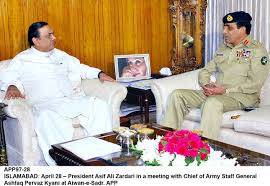
“President Asif Ali Zardari, myself, Chief of Army Staff Ashfaq Kayani and Foreign Minister Shah Mehmood Qureshi will hold a meeting immediately,” the prime minister said.
Gilani said the foreign minister had been asked to return from the US to respond to the queries being raised in the National Assembly.
To questions about various controversial clauses in the bill, he said parliament was the right forum to discuss important national issues.
Gilani however regretted that people were commenting on the bill without even having read it.
Meanwhile, President Zardari chaired a meeting of senior leaders of the Pakistan People’s Party (PPP) to discuss the political situation following the differences over the Kerry-Lugar bill.
Sources said the party leaders rallied behind the president to support the bill.
Federal ministers Qureshi, Qamar Zaman Kaira, Nazar Muhammad Gondal, Babar Awan, Naveed Qamar, Minister of State for Parliamentary Affairs Mehreen Anwar Raja, President’s spokesman Farhatullah Babar and parliamentarian Rukhshana Bangash were also present.
The foreign minister briefed the participants on the bill, which for the first time has de-linked the civilian assistance to Pakistan from the security aid.
He also briefed the meeting about his meetings with US leaders and exchange of views on issues related to Pakistan’s security.
Consensus: The sources said the meeting also decided to address the concerns of the security establishment and said the government would create consensus on the issue as the country could not afford internal dissension. They also said Zardari was eager to end the controversy on the bill as soon as possible, as any delay would tarnish the image of the government. They said the president had put off all other engagements to focus on the issue. app/sajjad malik
Troika meets today to resolve all issues
Saturday, October 10, 2009
Parliament likely to reject Kerry-Lugar Bill
By Hamid Mir
ISLAMABAD: President Asif Ali Zardari has agreed to relent on his hitherto uncompromising stance on the Kerry-Lugar Bill in its existing shape. The president and the prime minister have decided to defuse the current crises by both assuring Army chief General Ashfaq Parvez Kayani on Saturday that all the controversial clauses of the Kerry-Lugar Bill will be debated in both houses of parliament and subsequently these clauses could be rejected by parliament.
The president and the prime minister will meet jointly with the army chief today (Saturday) in a bid to address all concerns of the Army high command regarding the Kerry-Lugar Bill. Both the prime minister and the president discussed the current political crises in different meetings on Friday. A group of federal ministers first met the prime minister in the morning in his parliament chambers and then the president in the late afternoon. This group of ministers was on a crisis-defusing mission. They included Foreign Minister Shah Mehmood Qureshi, Information Minister Qamar Zaman Kaira, Petroleum Minister Naveed Qamar, Parliamentary Affairs Minister Dr Babar Awan and Labour Minister Khurshid Shah. Presidential spokesman Farhatullah Babar was also part of the meeting in the late afternoon.
A recent statement of Farhatullah Babar also came under discussion in which he reportedly said that opponents of the Kerry-Lugar Bill were opponents of President Zardari. Farhatullah Babar claimed that his statement was distorted. It was decided that in future he will speak only after first consulting with Information Minister Qamar Zaman Kaira.
Interior Minister Rehman Malik was not invited to this meeting but he too remained active till late last night. He contacted top army brass Thursday and assured that the president had no plans to remove General Ashfaq Parvez Kayani from the command of Pakistan Army.
He categorically told one general that; “Neither I nor the president is hatching any conspiracy against General Kayani and if someone can prove anything against me I will resign.” According to reliable sources, the president himself will assure General Kayani today that nobody is going to remove him from his current job.
It is also learnt that at least two federal ministers recommended to President Zardari that he must identify and fire all those who are responsible for creating misunderstanding between the Army high command and the civilian leadership. Some action on their recommendations is expected soon.
Everybody present in the meeting agreed that the country cannot afford confrontation between different institutions and there is an urgent need to defuse the crises so that no internal or external enemy could take advantage of this situation. The president said that the country needed unity against extremist forces and any political crises will only help all those who have become a threat for the state in the tribal areas. It was also decided that the prime minister will talk to the heads of all major political parties for making a joint strategy on Kerry-Lugar Bill.
One minister informed the prime minister in the morning meeting that Kerry-Lugar Bill is not the only source of irritation between the army high command and the government. The president was also informed about the activities of some US citizens in Islamabad and Peshawar that created a lot of concern in army circles.
Reliable sources claimed that rejection of the controversial clauses of Kerry-Lugar Bill by the parliament will not be enough. The army high command and a large number of federal ministers want a check on the mysterious activities of some US nationals in Pakistan. The Interior Ministry had recently informed prime minister that there were 411 US nationals present in Pakistan these days out of which 286 enjoyed the status of diplomats.
US embassy in Islamabad has hired about 307 houses in the capital. Security agencies have completed a survey of these houses and informed the government in clear words that most of these houses will not be used just for residences but also for spying activities. The president and the prime minister will discuss all these issues with COAS today and will try to form a joint strategy to secure and stabilise the country.
WASHINGTON (SANA): The US’ House Foreign Affairs Committee Chairman Howard Berman said thatPak Army had complete details of Kerry-Lugar Bill and top military leadership remained in contact with US officials till approval of the bill.
Talking to media in Washington, Howard Berman said that he held talks many times with General Ashfaq Pervaiz Kayani and other top level officials in this regard.
He said that President Asif Ali Zardari and military leadership were agreed to jointly take action against the militant groups to get rid of this menace. He said that those people are opposing the Kerry-Lugar Bill who did not read it or want to mislead the countrymen deliberately.
The US congressman said that purpose of these people seems to destabilize the country and provoke the Pak Army.
Those making uproar about the bill greet the drone attacks in our tribal belt with deafening silence. There cannot be a more explicit and glaring breach of our sovereignty than the drone strikes, but my memory fails to recall any recent ISPR statements condemning those strikes. The sudden uproar of national sovereignty is quite confounding. In my view, it has nothing to do with national security. It boils down to one ultimate theme in our politics, that our establishment cannot contemplate playing second fiddle to a civilian, elected government and any attempts to tame our establishment by any civilian leader, be it Nawaz Sharif, Asif Ali Zardari will be blocked – by any means possible.
But notwithstanding the problems with the bill or the PPP's imprudent attitude, why are our khakis arrogating to themselves the ultimate right to define and defend Pakistan's national security interests? There is so much wrong with the press release issued by the ISPR wagging a finger at the civilian government over the Kerry-Lugar Bill that one doesn't know where to begin. Do we even know the terms on which drone attacks were allowed, airfields leased and citizens handed over to the US during eight years of military rule under Musharraf?
Where do our khaki saviours derive the moral authority to lecture anyone over a cheap deal with the Americans when they themselves surrendered the entire house for free over a midnight phone call? Whence do corps commanders assume the legal authority to reprimand a civilian government over its conduct of foreign or economic policy? Is the concept of civilian control of the military not mandated under our Constitution? Do we not continue to criticize US administrations for lionizing successive military dictators at the expense of our democracy? Is it then not welcome that for the first time in history the US legislature is legally binding its executive branch to deal directly with the lawful civilian government of Pakistan? General Kayani and his fellow officers have a right to disagree with the choices being made by the PPP government. But they can either counsel the government in private, or exercise their rights in public as ordinary citizens once they retire or resign. The civil society, the media and the people of Pakistan are capable of holding their representatives accountable. We are done with self-proclaimed saviours.
Memo to the Pakistan Army: don’t wait for the revolution in military affairs to get a high-speed Internet connection. Actually, the army could have spared the country a fresh political crisis with even a dial-up connection.
Here’s what it had to do to give the government its ‘formal input’ — the ISPR’s terminology — on the Kerry-Lugar bill: run a search online, download the various iterations of the Biden-Lugar bill, study them and then forward its ‘formal input’ to the government.
If that sounds elementary and facetious, it is. Step back from the howling pack of critics for a minute and ask yourself, is it possible that the Pakistan Army was unaware of the broad contours, if not the specifics, of the Kerry-Lugar bill for all the months it wended its way through Congress?
To believe the army did not, or could not, know is to accuse the army of a staggering level of incompetence. Wednesday’s prickly ISPR statement also has this gem: ‘COAS reiterated that Pakistan is a sovereign state and has all the rights to analyse and respond to the threat in accordance with her own national interests.’ Given that the Kerry-Lugar bill has already been passed by Congress, the army’s interpretation of our ‘rights to analyse and respond’ would appear to be less a diagnosis and more a post-mortem.
Logic, then, suggests that the army was at least aware of what was unfolding in the US Congress. Which leads to the obvious question: what was the signal the army was sending on Wednesday and to whom?
Was it sending a signal to Zardari that it was putting him on notice, that he better shape up and pay obeisance to the army’s pre-eminence or else would be shipped out soon? By now, it’s clear the army doesn’t like Zardari’s way of doing business.
It quickly reversed his bid to put the ISI under civilian control, it slapped down his suggestion of a no-first-strike nuclear posture, it forced him to back off from precipitating a possibly bloody clash during the long march to restore the deposed judges in March — and now it has publicly contradicted the government and suggested the Kerry-Lugar bill impinges on national security. That’s already a long, ignominious list of reversals for a president who has been in office only 13 months. And those are only the differences that we know about publicly.
But like him or not, four factors limit the army’s ability to precipitate change in the civilian set-up headed by Zardari. One, the disastrous end to the Musharraf era has meant that the army’s political credentials are yet to recover. Two, the army has to stay focused on fighting the counter-insurgency. Three, there may be a pro-Gilani/anti-Zardari camp within the PPP, but historically the party has resisted following the dictates of the army. Four, the only other viable political alternative is Nawaz Sharif, but the army continues to eye him with mistrust.
So expect the status quo to hold for now. Indeed, Wednesday’s ISPR statement hints at this: ‘However, in the considered view of the forum, it is the parliament, that represents the will of the people of Pakistan, which would deliberate on the issue, enabling the government to develop a national response.’ Translation: we aren’t happy, but we’re not going to wind up the democratic project — for now. The emphasis still is on ‘shape up’ rather than ‘ship out.’
But the danger hasn’t passed yet. If there’s one thing that is clear from the country’s tattered, tawdry political history, it is that public jousting leaves fatal scars on the psyche of the players involved. A wounded ego can cause all sorts of rash decisions, and both Zardari and the army may yet try and slip a knife in the other’s back.
Other than Zardari, the army is also likely to have been sending a signal to the Americans. Roughly translated, it would read something like this: we’ve got business to do together, but don’t push us; we’re going to get it done as partners, not as clients.
Quetta, Muridke, the nuclear programme, civilian control over the army — there are enough red rags to the army in the Kerry-Lugar bill to make it very angry. But there are bigger issues at stake than just the bill in relations between the US and Pakistan at the moment, and the army’s response has to be seen in that context.
In all the debate and controversy surrounding the Obama administration’s re-evaluation of its own strategy on Afghanistan announced in March, little attention has been paid to the signals that the Pakistan Army has been quietly sending.
While opposing an American troop build-up in Afghanistan, the army is also not calling for a troop withdrawal. In fact, it has been pushing the ‘stability’ line with the Americans: shore up the Afghan government; give more space to our favourites, the Pakhtuns; negotiate with the amenable among the Afghan Taliban; neutralise, or reduce, the interests of players like India; and start thinking about an exit time frame.
In addition to this, it is quite clear that at the operational level, intelligence cooperation to capture or eliminate the Al Qaeda types as well as the Pakistani militants attacking the state from their bases in Fata is continuing.
So the army clearly realises the importance of working with the Americans to secure the state’s interests. But it also knows that there is a limited convergence of interests. From the Pakistani perspective, the Americans suffer from two chronic problems: one, they are clumsy and often create a bigger mess; and two, some of their interests in the region are at cross-purposes with Pakistan’s.
Enter the Kerry-Lugar bill into that wary, mutually suspicious relationship. On the one side, you have American officials like Vice President Joseph Biden, partner in the creation of the Kerry-Lugar bill, with his ‘Pakistan first’ theory that essentially portrays the country as a danger to the world and itself.
On the other side, you have the Pakistan Army, which realises the need to work with the Americans on certain issues but also suspects them of trying to undermine Pakistan’s genuine interests and pooh-poohing its security threat perceptions.
The likely result: those here in Pakistan demanding that we slam the door on the Americans after kicking them out will be disappointed; however, we will continue to carp and complain publicly while privately continuing a tightly calibrated, limited security-based alliance.
A method in the madness, then? Perhaps. But the army’s signalling won’t seem so clever if the brinkmanship on the domestic front ends in the collapse of the transition to democracy.
Without discipline the Army would just be a bunch of guys wearing the same- color clothing. -- Frank Burns
In recent days, one cannot help but notice some extremely disturbing and perturbing indicators in the political arena of the country. At the onset of this democratic era, many of us who had fought alongside the lawyers and the politicians hoped that our efforts would result in the army renouncing all participation in politics. And that, if nothing else, the politicians would not give them the excuse to dabble in political matters in the future. Although I am delighted at the lawyers and civil society achieving their goal of securing a determined judiciary trying to correct its previous follies, I unfortunately am not as glad as to the army's current role in our political system.
Ever since the democratic government came to power, there has seemed to be a power struggle of sorts going on between the GHQ and the PPP-led government. Unfortunately, at all crucial points, the army has shown its reluctance at the thought of being subservient to Parliament and the democratically elected government. This can be fathomed from various incidents which have taken place over this short democratic period.
The first indicator was when the government sent out a notification bringing the intelligence authorities within the control of the ministry of interior, which the army clearly found totally unpalatable. Although a silly idea to begin with, the reasons for its revocation rather than the revocation itself are a cause of concern. The fact that the notification was taken back within hours rather than days indicates the influence the army held within the political circles, and the degree to which the political government was able to control the army. The rumoured intervention of the army chief in the reinstatement of the chief justice of Pakistan, via the much trumpeted "Kayani formula," is also an indicator of the army's continued involvement in politics even at this stage.
Other than that, the fact that important foreign dignitaries or officials who grace Pakistan with their presence meet the army chief and discuss "various matters" in addition to talking to his political counterparts indicates the larger global role that the army has undertaken and retained despite the return of democracy. Much more recently, and extremely disturbing, is the meetings that the COAS has allegedly had with certain political leaders of the ruling and opposition parties, with the exclusion of the persons who make up the present government. And om addition to this, the press statement released by the ISPR which commented on the Kerry-Lugar Bill, despite its being a matter solely within the domain of the political arena, also has resulted in some eyebrows being raised.
Now let's be clear. Clearly, in addition to the army's role in politics, there are certain persons in the media and political circles who, intentionally or inadvertently, bolster the image of the armed forces at the expense of the political leadership. The army should be praised where it has done something commendable, but in an appropriate manner, and not at the expense of any other institution or pillar of the state. For example, certain people tend to claim that the army is solely to praise for the success of the Swat offensive, despite the fact that similar operations that took place under the leadership of Musharraf resulted in utter failure. The one difference between those previous operations and the present one was the political shrewdness of the ANP and other political parties which enabled the army to arise victorious by successfully cutting off all local support to the Taliban via the Nizam-e-Adl Regulation episode. But this element of the debate is usually overlooked.
All this does not bode well for this nascent democracy which has barely completed a year! The political government, despite its immense shortcomings and incompetent handling of administrative matters, must be given a fair chance. After all, if we can give dictators years on end, why can't we allow the democratic dispensation to complete its term? The people elected them for five years, and that is the time that it should be given. Perhaps people will then realise the true worth of their votes, and will cast them with a bit less reckless abandon, and much more caution.
Side Note: On a related matter, I find it astonishing how the ISPR so brazenly commented on the Kerry-Lugar Bill and its contents before the Parliament even had a chance to go over it! Clearly, this bill comes within the purview of the political leadership, which must conduct foreign affairs, among other things. An argument is made that the document deals with "national security" and hence can be analysed by the army but, then again, one wonders where was this argument when Musharraf was selling Pakistani citizens to America for some "well deserved" bounty, or when the first drone attacks took place in FATA, or when Musharraf started a full-fledged operation in Balochistan bringing the federation to its knees.
The writer is a graduate of Columbia University who is currently working as a lawyer in Karachi. Email: basil.nabi@ gmail.com
Army stance puts govt on the back foot
By Iftikhar A. Khan and Syed Irfan Raza Friday, 09 Oct, 2009
ISLAMABAD, Oct 8: The fissures created by the top army command’s objections over some of the conditionalities attached to the Kerry-Lugar aid package continued to have a direct impact on the functioning of the government, with ripples created during the day as sources said that the Prime Minister’s Secretariat had received the detailed version of the objections raised by General Ashfaq Pervez Kiyani and his fellow commanders a day earlier.
There was a near paralysis in government circles as most ministers, parliamentarians and officials remained locked in debates at various forums on the consequences of the army’s objections, and the manner in which public mood was being influenced by some opposition leaders and a section of the media.
A few were furious over what was described as army’s over-intrusive action, but were not prepared to go on record.
Sources in the government said the communication by the army chief sent directly to Prime Minister Yousaf Raza Gilani was based on army’s interpretation of various clauses or conditions attached to the American legislation, which the military commanders believe are highly intrusive in nature and will have serious implications on national security.
There was no immediate comment either by the army spokesman or government’s media managers on the detailed report sent by the army to the prime minister. However, official sources said brainstorming sessions were held at Aiwan-e-Sadr and Prime Minister’s House during the day where ways of dealing with the situation were discussed.
Though Prime Minister Gilani had said in his National Assembly speech on Wednesday that the concerns of the army over the bill would be addressed, official sources said the word from President Asif Zardari was that the government and party would defend what they believe was a ‘pro-democracy legislation’.
The presidential camp was further encouraged in the evening when US Ambassador to Pakistan Anne W. Patterson met Mr Zardari, mainly to discuss the fallout of the Kerry-Lugar bill controversy.
Presidential Spokesman Farhatullah Babar confirmed the meeting, but did not provide its details. According to him, “it was just a routine meeting”.
However, a private TV channel which interviewed Ms Patterson quoted her as saying that there were a few drafting errors in the legislation, and that the US embassy would convey to Washington the views and objections being raised by concerned quarters in Pakistan. She was also quoted as saying that the Pakistani military would also be consulted on the matter. Another TV channel had earlier quoted her as saying that the legislation was supportive of the people of Pakistan.
Even otherwise, during the day the presidency remained over-active in finding ways of encouraging PPP politicians and government allies to take on the critics of the aid package.
But despite a clear message from Mr. Zardari to adopt a pro-active approach, most ministers and senior party leaders during the day avoided taking up the issue, either in the parliament or on the electronic media. A senior PPP politician told Dawn that most of them were not willing to stick their neck out at a time when uncertainty prevailed after the army’s strong reaction against the US legislation.
Even most of the media managers were reluctant to go on record, and instead were busy distributing prepared material among journalists and analysts in support of the legislation, but desiring to remain anonymous.
In the end it was once again the selfless Farhatullah Babar who decided to spearhead the president’s team with a forceful defence of the government’s position on the US bill.
“There is not a single thing in the bill that is against the interest of the people of Pakistan”, he said during a debate on Dawn News TV.
Mr. Babar appeared with a host of documents in support of his argument, including copies of the aid deals the former military ruler President Pervez Musharraf had struck with the US government, and in which conditions mentioned were as ‘strict’ or ‘controversial’ as they were in the Kerry-Lugar bill. The main thrust of his argument was that it was a bill approved by the Congress with the conditions addressed to the US State Department, and neither the agreement was with Pakistan, nor the Pakistani president or prime minister were its signatory.
The argument was presented as former ministers Faisal Saleh Hayat and Aftab Sherpao, who were once strong defenders of Gen Musharraf and his actions spoke in the National Assembly, criticising the conditions attached to the aid package, calling it an insult to the honour of Pakistani people.
Some of the more sober elements in the main opposition party like writer-politician Ayaz Amir were seriously concerned about the language used in the bill, and thought it was too humiliating for the people to accept it. He, however, declared in a televised debate that the parliament through a democratic process would be able to find an honourable solution to the crisis.
Although the criticism of the Kerry-Lugar bill has been going on in the media for a few weeks, it acquired an entirely new dimension when the army command, instead of communicating its reservations to the government through a formal channel like the Defence Committee of the Cabinet decided to go public. However, the formal communication sent to the prime minister on Thursday was not made public.
However, sources in the government said the main areas where army had expressed its reservations to the prime minister on the inclusion of a clause under which an assessment was required on whether assistance provided to Pakistan was going directly or indirectly to aid the expansion of its nuclear weapons’ programme. The army in its communication has said that the language used in the bill would amount to the capping of the nuclear programme.
Concern has also been expressed over the requirement of certification that Pakistan has made progress in preventing cross-border attacks and whether it has dismantled the alleged terrorist basses in Quetta and Muridke. And another serious reservation was on the clause related to civilian control of the military’s promotions and other related matters that were totally unacceptable to the military commanders.As the belated debate continues over the finer points of Kerry-Lugar, the prophets of doom who have never been in short supply in Islamabad, have already started predicting that unless the government succumbs to the army’s pressure, its days will be numbered. And the presidential camp believes that the real objective is to isolate President Zardari, and hopes that it will once again be thwarted with the active support of the prime minister. (Dawn)
Deep breath, count to ten, exhale
Friday, October 09, 2009 Chris Cork
It is difficult to determine just how much 'outrage' the Kerry-Lugar Bill is generating outside the media, blathering politicians, the armed forces and the chattering classes generally. A canter through the TV channels would suggest that we teeter on the verge of revolution, such is the public dismay at the contents of a bill that is American in origin, has not yet been signed into law by the US President, and whose contents remain a mystery to the majority of the population who are illiterate anyway. How many of us have read the Kerry-Lugar Bill in its entirety? (I have; worthy but dull like most legislation.) And why have we got ourselves in such a lather about it anyway…is our sovereignty – and anybody care to give me a definition of 'sovereignty' – so compromised by it, are Blackwater (…or Xe or Xi or Pi) poised to take over the country, why does the President smile so much and is there anywhere that I can buy sugar for Rs40 a kilo?
To the ordinary mortal such as myself the principal problem with the Kerry-Lugar Bill seems to be that it puts in writing what had previously been a tacit understanding, and that the nod-wink-handshake way of doing business with Pakistan is now a thing of the past. It also seems to signal a sea-change in the way that America does business with us in a far wider sense. It is still a transactional document and there is very much the sense that we are having a finger wagged at us, but there are some subtle shifts. The American financial relationship with us hitherto has largely been focused on the military at the expense of development and infrastructure. The US has supported assorted unsavoury military dictatorships around the world – including ours – over the last 50 years in support of its own global hegemony, but the world is changing and America has to change with it. The priorities and preoccupations of the Bush years are not all the same as those of Obama.
After 9/11, the American foreign policy, not only in Pakistan but in many other countries as well, has become hugely unpopular. The Obama presidency is seeking to change the course of the American ship of state -- change course, not turn around, please note. America needs to re-brand itself, restore some of the confidence and popularity it once enjoyed, create 'signature' projects that polish its image and mollify its critics. In the case of the Kerry-Lugar Bill that means a marked shift in priorities, towards civilian projects and with an emphasis on bolstering governance and the democratic institutions.
Understandably, the military are less than delighted with this turn of events. They have enjoyed a pre-eminence for the entire life of the nation, have directly governed it for more than half that life and indirectly governed it for the rest. There is no sense that the military is or ever has been accountable to civilian bodies as it is in other democratic states, the military budgets are never published and are minimally discussed in the legislature. The Defence Ministry is little more than a front-of-house billboard and the armed forces conduct their business out of sight of civilian bureaucrats. All of the avenues of accountability have been closed off. Once again this is a state of affairs arrived at by the consistent failure of civilian governments and the civil service to deliver the goods to the population – the most recent evidence for this being the yet-unresolved 'sugar crisis' that was the product of a cabal of mill-owners who were also politicians fixing the markets to their own advantage – hardly the stuff of emerging democracy and unlikely to impress the military establishment as an example of what the civilians can do if left to their own devices.
The military has, over the years, colonised parts of civil space – banking and housing to name but two – and has a very different relationship with the nation than does the military elsewhere. It is because of the weakness of civilian governance that it has been able to do this; and if America now seeks to back a civilian dispensation against the long-established trend of backing the military then tension is inevitable at every point of contact between the two – a tension now exploited to the full by the polarised political parties who themselves are now busy with backchannel negotiations to ensure their own place at the front of the queue if the military decide to move the pieces around on the board again.
What the Kerry-Lugar Bill begins to do is redefine and reshape the relationship between the military and civil institutions, and military and civil-political reaction to it has generated more heat than it has light. It is not difficult to see such a move as a direct challenge to our sovereignty, a Trojan horse within which is hidden the seeds and agents of yet more micro-management of Pakistan by an external player. It is not difficult to interpret the wording of the bill in such a way as to see that there is a desire to influence, however indirectly, the internal dynamics of our governance and the civil/military relationship; and the bill will have been drafted in a detailed knowledge built up over many years of the personalities and institutions on which it will impact. It presents difficulties to the 'establishment' and the military like in that it may be a challenge to the status quo that has prevailed whatever the government in power – khaki or feudal.
At the end of the day as a past senior law officer said on a private TV channel on Wednesday night that "beggars can't be choosers". If we go cap-in-hand anywhere in the world seeking money with a track-record for corruption and lack of transparency such as ours then there are going to be conditionalities. We are always going to have that kind of transactional relationship with any donor no matter how 'friendly' – and a past ambassador to both London and Washington Maleeha Lodhi has said several times that there are no permanent friends in international political relationships. We are not friends with America, nor they with us. We are not friends with any of the countries making up the Friends of Democratic Pakistan group. We have a relationship with them that is determined by mutual interest, not by whether we like one-another or not. The Americans may dislike and despise us as we dislike and despise them, but being true friends is not the way to do diplomatic business. America has an interest in sustaining us not because it wants to see happy smiling Pakistani faces painted with American flags across CNN and Fox News, but because it suits their wider geopolitical agenda and regional interests. $1.7 billion a year for the next few years is, frankly, peanuts. Loose change. We may not like picking it up but we don't have much choice in the matter – short of walking away from it completely. The Kerry-Lugar Bill is not yet signed, and we need to take a deep breath, count to ten and gently exhale before we paint ourselves into a corner. Again.
The writer is a British social worker settled in Pakistan. Email: manticore73@ gmail.com (The News)
Abbas Athar ki tobah:
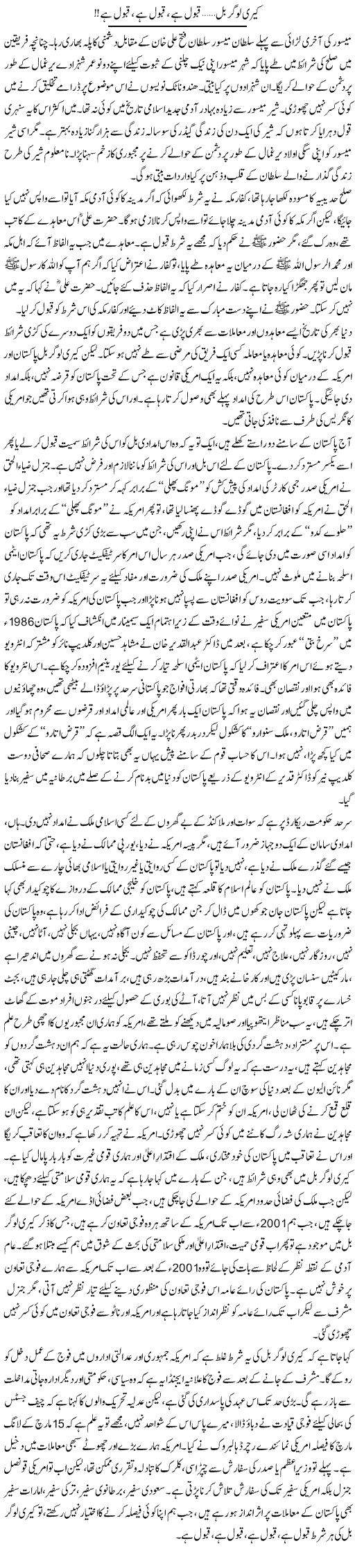
Asadullah Ghalib analyses the Kerry-Lugar bill in a historical context:
Some relevant comments:
Source: pkpolitics. pak defence forum
Sarah said:
President of Pakistan is the commander-in-chief of Pakistan Army. By making public their concerns, instead of using appropriate forums such as through Secretary of Defence, General Kayani and his corps commanders have breached the discipline. All of them must be court-martialled.
hasankhan said:
army should stay under the limmit.president of pakistan should chair the meetings of core commanders.enough is enough,it should be decided who will rule pakistan, army or the politicians.
Kashif said: (Off the Record, 8 Oct 09)
Hats off to Asma Jhangir. This is first time some one showed Hamid Gul mirror.
“Hum ne foj ke kartoot dekh leye they ‘71 mein”
“Foj ko kiss ne ejazut de ke beach mein phuduk ke aa jai”
Shame on all those who prefer GHQ over parliment. Zardari is very unpopular and I don’t give a damn about him. He is the most possible corrupt person who can possibly lead Pakistan. I don’t mind if he is kicked out. He doesn’t have any roots in public anyway.
If Zardari is replaced by Nawaz Sharif or IK or Qazi …. we will have same power struggle between Rawalpindi and Islamabad. Why Musharaaf and GHQ kicked NS out. He was fairly popular and had 2/3 rd majority. Shame on PMLN for getting everything and getting in bed with GHQ again in sheer violation of CoD.
Last but not the least I back every word that Kashif Abbasi read from Hussain Hiqani’s book. US (mostly republicans) have strengthend Army over civlian institutions. They should reverse the course. They should use their influence (aid $$$) to bring GHQ under civilian regime. Hussain Hiqani is my hero. I do not endorse everything that he did to date but these days he is serving Pakistan tremendously. He is the best possible spokesman Pakistan can have at this time. I salute him.
@kashif, You are right. I think Corps commander’s conference declaration, Mian sb. meeting with Kiyani , and of course the KL perceived impact on the army needs to be discussed. It seems to me that the battle between establishment (read army) and democratic forces is now again in the open. I would have thought that AZ could immediately dismissed Kiyani , he may do so even now? However I may be wishful. Though unlike you I still believe that AZ and NS are together in this battle , the meeting between NS and Kiyani may have been on the request of Kiyani , who might have feared his dismissal. I am sure NS would not have offered him anything except a cunning smile and kind hearing. I am still hopeful that Kiyani (and perhaps couple of his associate corps commanders) should be immediately dismissed by AZ, it could happen after Parliament passes resolution in KL bill and pass comments against the corps commanders uncalled for comments.
A tribute to Pakistani soliders fighting the terrorists of Taliban, Al-Qaeda and Sipah-e-Sahaba
Shaheed Mohtarma Benazir Bhutto 1953-2007
Ghalib
The rose, with its redolent petals The water lily, with its robe of virgin white These have surely come to us in transmigration Of but a few of those Endowed with sublime beauty and grace. Some embrace death to sprout again But most, forever, in dust remain.
Links to Free Talkshows / Videos on Pakistan Politics
(Only) When love teaches the etiquette of self-knowledge, Are the Imperial Mysteries revealed to the slaves! Whether it be Attar or Rumi, Razi or Ghazali, Nothing comes to hand without supplication in the early dawn Do not lose hope in them, 0' wise guide! Even though the wayfarers are slow-moving, They are not without zeal (to reach the goal)! (Iqbal)