
Editor's Choice

--------------------------------------------------------------------------------------------------------------------------
Featured Post
--------------------------------------------------------------------------------------------------------------------------

"Let us build Pakistan" has moved.
30 November 2009

All archives and posts have been transferred to the new location, which is: http://criticalppp.com

We encourage you to visit our new site. Please don't leave your comments here because this site is obsolete. You may also like to update your RSS feeds or Google Friend Connect (Follow the Blog) to the new location. Thank you.


--------------------------------------------------------------------------------------------------------------------------
Showing posts with label Dr. Farrukh Saleem. Show all posts

Sunday, 15 November 2009

Game Theory, President Zardari and Pakistani Politics


President and game theory

Sunday, November 15, 2009 (The News)
Dr Farrukh Saleem

President Z is entangled in a non-cooperative game with a whole host of other players whereby each player's "success in making choices depends on the choices of other players." That in essence is "Game Theory"--an attempt to mathematically capture the behaviour of "intelligent individuals interacting with one another in an effort to achieve their own goals."

Pakistan's heptagonal (a polygon with seven sides) game matrix has President Z, the Pakistan Army, the PPP, the PML-N, America, the media and the judiciary as major players. Game theory assumes that each of the seven players shall always act to maximise their individual gains by trying to anticipate the response to their own actions by one or other players in the game.

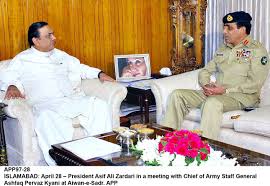
Game theory also assumes that President Z is a rational player, and that means he is in the game in order to seize--and sustain--as much power as possible. Being rational also means that President Z undertakes a conscious cost-benefit analysis for every power he has seized or thinks of abdicating. And, that means President Z will not voluntarily give away any of his powers, including the 17th Amendment, unless the cost of retaining that power exceeds its benefits.

Game theory assumes that the Pakistan Army, that continues to be the dominant player, is in the game to preserve its political as well as economic domination. Being dominant also means that the Pak Army can influence the moves of other major or minor players (the media and the MQM, for instance) to achieve their own goals.

Then there's America, whose foreign policy is firmly rooted in realism, devoid of both ethics and morals. Within America, the two major players looking at Pakistan are the White House and the Pentagon. The Pentagon is convinced that the Pak Army is in control of the game in Pakistan; the White House not so clear. Clinton, it appears, was here to find out for herself as to who is in charge--President Z or the army. Moves made by the MQM subsequent to Clinton's visit provide circumstantial evidence that the White House now concurs with the Pentagon's stance.

America's readily identifiable interests for remaining in Pakistan's heptagonal hypercube are two fold-the "war on terror" and nuclear proliferation. Ironically, both the "war on terror" and the nuclear dimension are driven by the Pak Army. Consequently, America and the Pak Army share the same bedroom within the hypercube.

Nawaz Sharif seems to be basing his game plans on the "median voter theorem" ("if a politician wants to maximise his votes then he should commit to the policy position preferred by the median voter"). Such game plans have pitched Nawaz Sharif against the other major players, both the Pak Army and America.


Let the games begin. Clearly, game players right now are busy increasing the costs for President Z to continue holding on to the 17th Amendment. Yes, "No criminal proceedings whatsoever shall be instituted or continued against the President… (Article 248)." Yes, an impeachment resolution has to be passed at a joint sitting "by the votes of not less than two-thirds of the total membership (Article 47)." But, come Nov 28, all the king's knights and all the king's pawns may be forced back into the box, leaving no cloths for the king to wear.

Then there's the "imperfect information paradigm." I submit that President Z is playing the game based on imperfect information and that President Z's imperfect information database is rooted in the PPP's pool of un-elected decision-makers. Then there are games within games and a fool only wins the first game. And, that ushers in either Fazal Illahi or Sonia Gandhi while the average Pakistani survives by the skin of his teeth.

The writer is the executive director of the Centre for Research and Security Studies (CRSS). Email: farrukh15@hotmail.com

Read more...

Sunday, 25 October 2009

Taliban's psywar in Pakistan

Capital suggestion
The psywar


Sunday, October 25, 2009
Dr Farrukh Saleem

On Oct 23, a suicide bomber attacked the aeronautical complex in Kamra. On Oct 22, gunmen shot-dead an army brigadier. On Oct 20, two suicide attackers bombed the International Islamic University, Islamabad. On Oct 16, a suicide bomber rocked the offices of the Special Investigation Unit (SIU) in Peshawar Cantonment. On Oct 15, a multi-man assault team attacked the Federal Investigation Agency (FIA) building, the Manawan Police Training School and the Elite Police Academy, all in Lahore.

On Oct 5, a suicide bomber dressed in military fatigue blew himself inside the United Nations World Food Programme in Islamabad. On Oct 9, a suicide bomber attacked Khyber Bazaar in Peshawar. On Oct 10, at least nine militants in army uniforms stormed the nerve-centre of Pakistan's robust military machine, GHQ. On Oct 12, a suicide bomber attacked a military convoy in Shangla.

Kamran Bokhari, my friend and colleague, and Regional Director, Middle East & South Asia for Stratfor, a Texas-based private intelligence outfit, asserts that this is classic 'psychological warfare' or psywar. According to Kamran, "The militants lack the capacity to take on the military might of the Pakistan army and so they resort to psywar."

Over the past two weeks there have been a dozen major incidents of terrorism-related violence. To be certain, militants are no match for the 7th Infantry Division, Golden Arrow, Pakistan army's "oldest and most battle-hardened division", marching southwards from Razmak. Militants cannot take on the 9th Infantry Division -- closing in on Makeen -- in a conventional face-off.

From a purely strategic standpoint, all of these incidents put together mean next to nothing to the Pakistan army as none of this has been able to damage the core physical fighting capacity of the military. To be certain, these are all militant-designed tactical manoeuvres in a long drawn-out clash of nerves.

What message do the militants want to convey? One, that they are alive and kicking. Two, that South Waziristan is not the only troubled spot in Pakistan; Islamabad, Peshawar, Rawalpindi and Lahore are not beyond their reach either. Three, that Pakistan is in a state of civil war. Four, that the whole of Pakistan is unsafe to live. Five, they want Pakistan isolated from the rest of the world.

What do the militants really want? A Pakistan that lacks 'order and predictability'. They want an absolute "absence of government -- a state of lawlessness". The militants want to create an environment where normal state of governance cannot continue. Kamran is convinced that there is a "method to their madness" and that the militants want to "overwhelm the state of Pakistan" and bring her down to her knees through psychological warfare -- economically, socially and politically.

Psychological terrorist warfare can be defined as the "planned use of violence having the primary purpose of influencing the opinions, emotions, attitudes and behaviour" in order to mould the state from taking action against terrorists. What that means is that terrorists cannot face the state of Pakistan in a symmetrical conflict and thus the use of terrorist violence to "influence the opinions, emotions, attitudes and behaviour" of Pakistanis in order to establish terrorist diktat over the state and society of Pakistan; a 'harsh, unilaterally imposed' diktat over the whole of Pakistan.

To be sure, the militants are serious. Between 2003 and 2009, fatalities in terrorist violence stand at 22,110 of which 7,004 were civilians, 2,637 were security force personnel. What should the state and society do? Society should not fall into the terrorist trap and the state must beef up its intelligence. Remember, it's not symmetric, it's war of intelligence. Society should not let incidents of terrorist violence influence its opinions, emotions, attitudes and behaviour in favour of the terrorists.

The writer is the executive director of the Centre for Research and Security Studies (CRSS). Email: farrukh15@hotmail.com (The News)
...

Defending Taliban: EDITORIAL: South Punjab and Taliban

In a TV discussion, ex-Jama’at-e Islami chief Qazi Hussain Ahmad asserted that the terrorists who were killing innocent Pakistanis were not only not Muslims but that the killing was being done by three enemy states: the United States, India and Israel. In another TV discussion, Punjab Law Minister Rana Sanaullah made the case that South Punjab was not the home of terrorism and that the territory of South Punjab was being exaggeratedly expanded by critics to include cities like Jhang.

Qazi Hussain Ahmad rounded off his scenario of a three-state attack on Pakistan by saying that the US wanted to destroy Pakistan’s nuclear programme because it did not want an Islamic state to possess the atom bomb and join the club of nuclear powers. The discussion did not pinpoint the identity of those who killed innocent Pakistanis, so we will not know what he thought of the Tehreek-e-Taliban Pakistan (TTP), especially when it routinely announces ownership of the lethal suicide attacks being carried out in the country.

The JI line on the TTP is that they are own people determined to fight the Americans and that the government should talk to them instead of despatching troops into their territory. One can say that it has tactfully placed itself at the head of all the elements in Pakistan who embrace anti-Americanism and reject “conditional” American aid to Pakistan in these days of economic crisis, manifested each day by protesting state employees who have not received their salaries for months.

But one must note the reluctance on the part of JI leaders like Qazi Hussain Ahmad to define the Taliban as terrorists after alleging that those who kill are not Pakistanis but those paid to do the dirty work by the US-Indian-Israel combine. But in Indian-administered Kashmir, the Jama’at chief Mr Ali Gilani is prepared to concede that “the Taliban are defaming Islam by killing innocent people and destabilising Pakistan”.

His repartee to TTP chief Hakimullah’s claim that he was committed to spreading Islam was: “The Taliban are portraying Islam in a poor light and are defaming it. I advise them to give up violence and bring Islamic revolution in the country by adopting peaceful means”. The opinion in Pakistan too has swung around after the TTP’s misdeeds in the Malakand-Swat region. The Pakistan Army has undertaken its operations against the terrorists only after gauging the mood of the people. There was simply no other alternative.

The ANP government in the NWFP, which replaced the MMA government of which the JI was a part, thinks differently. It sees the survival of the country only in confronting and defeating the terrorists. Despite its anti-American credentials, it doesn’t think that those killing the innocent citizens are agents of the US-India-Israel combine. Additionally, it wants the Punjab government to assist in lessening the intensity of TTP violence by reining in its own Punjabi Taliban.

The Punjab government is however not convinced that the Punjabi Taliban are embedded in South Punjab alone: according to Rana Sanaullah, they are no more, no less than such elements found in all the regions of the country. It develops that the “official” delineation of what is South Punjab is different from the experts who write on terrorism in the province. Administratively, for instance, Jhang doesn’t fall in South Punjab, but culturally and linguistically it does.

If you count Jhang in South Punjab then terrorism actually owes its birth there, with time spawning breakaway outfits that spread from South Punjab in all directions. Scholars who study the phenomenon include the following cities in the 13 districts of South Punjab: Bahawalnagar, Bahawalpur, Bhakker, Dera Ghazi Khan, Jhang, Khanewal, Layyah, Lodhran, Multan, Muzaffargarh, Rahimyar Khan, Rajanpur, and Vehari. The Seraiki Movement in South Punjab actually includes many additional districts of Upper Punjab too.

It is also denied that DG Khan has an abnormal concentration of militant madrassas. Editor of The Nation, Ms Shireen Mazari, who hails from DG Khan wrote recently: “In DG Khan, taking both its tehsils, there are 185 registered madrassas, of which 90 are Deobandi (with a total of 324 teachers), 84 are Barelvi (with a total of 212 teachers), six are Ahl-e-Hadith (107 teachers) and five are Fiqh-e-Jafaria (10 teachers)”. The unregistered madrassas are not in the count.

Punjab has done well to upgrade its police department. South Punjab is a challenge that it must tackle with a first-rate police cadre and a highly developed intelligence network. Let us not force the army to tackle what the province can take care of within its own jurisdiction. On the other hand, the JI must clear its mind about terrorism and not obfuscate the issue through populist politics. (Daily Times)


Read more...

Saturday, 10 October 2009

An objective analysis of the Kerry-Lugar Bill --- by Dr Farrukh Saleem


Read more...

Sunday, 4 October 2009

Why are Muslims so disempowered?

An analysis by Dr Farrukh Saleem:

Education is the key.

Read more...

Tuesday, 29 September 2009

The US Embassy expansion in Pakistan: Fact and Fiction

An analysis by Dr Farrukh Saleem

Read more...

Sunday, 19 July 2009

India-Pakistan rivalry


Sunday, July 19, 2009
Dr Farrukh Saleem

India and Pakistan are in a state of active hostility — if not war or at least two proxy wars. At least six of the Pakistan army’s nine corps are on the border with India. Of the six, I Corps and II Corps are heavy armour strike corps. At least seven of the Indian army’s 13 corps are on the border with Pakistan. Of the seven, X Corps and II Corps are powerful strike corps (strike corps is an offensive formation). Additionally, all of India’s holding crops that are directly facing Pakistan also have significant offensive capabilities. In effect, 66 per cent of the Pakistan army’s holding and strike formations are directly facing India. In effect, more than 53 per cent of the Indian army’s holding and strike formations are directly facing Pakistan.

Pakistan maintains — and sustains — critical assets in the northeast that have managed to pin down India’s XV Corps, IX Corps, XVI Corps, XIV Corps, XI Corps, X Corps and II Corps. India’s 4 Armoured Brigade, 340 Mechanised Brigade, 11 and 12 Infantry Divisions, Jaisalmer Air Force Base, Utarlai Air Force Base and Bhuj Air Force Base maintain a threatening-offensive posture. India is actively supporting anti-Pakistan Baloch elements as well as anti-Pakistan Taliban factions. India is bent upon projecting power into Afghanistan thus encircling Pakistan. And, India – post-Operation Parakram — has been investing into a "Cold Start War Doctrine" involving joint operations by the Indian army, air force and navy; eight integrated battle groups with armour, artillery, infantry and combat air support.

For FY 2009, India’s defence spending will rise by close to 50 per cent to a colossal $32.7 billion (according to Jane’s Information Group). India is planning its biggest-ever arms purchases; $11 billion fighter jets, T-90S tanks, Scorpion submarines, Phalcon airborne warning and control system, multi-barrel rocket-launchers and an aircraft carrier. At $32.7 billion India’s defence spending translates into 2.7 per cent of GDP.

For FY 2009, Pakistan’s official defence spending is set at $4.3 billion while unofficial estimates go as high as $7.8 billion. If Pakistan were to match India’s rise we would have to spend more than five per cent of our GDP on defence. For the record, Iraq, Somalia and Sudan spend an overwhelmingly large percentage of their GDP on defence. Iraq, Somalia and Sudan are all — or have been — in a state of civil war. For the record, the Soviet Union and Czechoslovakia use to spend an overwhelmingly large percentage of their GDP on defence. Soviet Union is no more. Czechoslovakia is no more.

The US and the Soviet Union fought a 50-year Cold War during which the Soviet Union stockpiled some 13,000 active nuclear warheads. In 1991, the US won without even firing a shot. The Soviet Union raced a race that it couldn’t win. The Soviet Union split into 15.

Over the past century, economic development has been all about intense trading. Pakistan has two population centres; central Punjab and Karachi. Central Punjab is a thousand kilometres from the nearest port. Between Karachi and central Punjab is a desert in the east and on west is an area that does not — and cannot — support population concentrations. To develop economically, we must trade. Trade we must. And, the only population concentration to trade with is on our east.

Time — and money — is on India’s side. Composite dialogue among civilians means little — if anything at all. What is needed is a strategic dialogue. How can India be persuaded to pull back its offensive formations? In return for what? How can we use our America leverage in our longer-term interest? We cannot win an arms’ race with India. We ought to race a race that we can win. We can continue to race a race that we are bound to lose. Or, begin a new race that we may be able to win — or at least not lose. (The News)


The writer is the executive director of the Centre for Research and Security Studies (CRSS). Email: farrukh15@hotmail.com
Read more...

Wednesday, 29 April 2009

At least 11 per cent of Pakistan's landmass has been ceded to the Taliban. Where is the Pakistan army? Questions Dr. Farrukh Saleem


Where is the Pakistan army?

By Dr. Farrukh Saleem

Five thousand square kilometres of Swat are now under Taliban control -- de jure. Chitral (14,850 sq km), Dir (5,280 sq km), Shangla (1,586 sq km), Hangu (1,097 sq km), Lakki Marwat (3,164 sq km), Bannu (1,227 sq km), Tank (1,679 sq km), Khyber, Kurram, Bajaur, Mohmand, Orkzai, North Waziristan and South Waziristan are all under Taliban control -- de facto.

That's a total of 56,103 square kilometres of Pakistan under Taliban control -- de facto.Six thousand square kilometres of Dera Ismail Khan are being contested. Also under 'contested control' are Karak (3,372 sq km), Kohat (2,545 sq km), Peshawar (2,257 sq km), Charsada (996 sq km) and Mardan (1,632 sq km). That's a total of 16,802 square kilometres of Pakistan under 'contested control' -- de facto. Seven thousand five hundred square kilometres of Kohistan are under 'Taliban influence'. Additionally, Mansehra (4,579 sq km), Battagram (1,301 sq km), Swabi (1,543 sq km) and Nowshera (1,748 sq km) are all under 'Taliban influence'. That's a total of 16,663 square kilometres of Pakistan under 'Taliban influence' -- de facto. All put together, 89,568 square kilometres of Pakistani territory is either under complete 'Taliban control', 'contested control' or 'Taliban influenced'; that's 11 per cent of Pakistan's landmass.

Where is Pakistan army? To be fair, under our constitution law enforcement -- and establishing the writ of the state -- is the responsibility of our civil administration. Yes, under Article 245, the federal government can call in the army "in aid of civil power" but the overall strategy has to be devised by our politicians. Counter-terrorism and counter-insurgency are very specialised operations. Textbook counter-insurgency has three elements: Clear-Hold-Build (C-H-B). The army may be required to 'clear' insurgents from a particular area but every army operation creates a vacuum that has to be filled by a civil-political administration. After the 'clearing' of insurgents it has to be the politicians to 'hold' that area and then fulfil the social contract -- dispensation of justice, municipal services etc -- between the ruled and the rulers (classic counter-insurgency is DDD, disrupt, dismantle and defeat).

At least 11 per cent of Pakistan's landmass has been ceded to the Taliban. Where is the Pakistan army? I Corps is in Mangla, II Corps is in Multan, IV Corps in Lahore, V Corps in Karachi, X Corps in Rawalpindi, XI Corps in Peshawar, XII Corps in Quetta, XXX Corps in Gujranwala and XXXI is in Bahawalpur, In effect, some 80 to 90 per cent of our military assets are deployed to counter the threat from India. The Pakistan army looks at the Indian army and sees its inventory of 6,384 tanks as a threat. The Pakistan army looks at the Indian air force and sees its inventory of 672 combat aircraft as a threat. The Pakistan army looks at the Indian army and notices that six out of 13 Indian corps are strike corps. The Pakistan army looks at the Indian army and finds that 15, 9, 16, 14, 11, 10 and 2 Corps are all pointing their guns at Pakistan. The Pakistan army looks at the Indian army and discovers that the 3rd Armoured Division, 4 RAPID Division and 2nd Armoured Brigade have been deployed to cut Pakistan into two halves. The Pakistan army looks at the Taliban and sees no Arjun Main Battle Tanks (MBT), no armoured fighting vehicles, no 155 mm Bofors howitzers, no Akash surface-to-air missiles, no BrahMos land attack cruise missiles, no Agni Intermediate Range Ballistic Missiles, no Sukhoi Su-30 MKI air superiority strike fighters, no Jaguar attack aircraft, no MiG-27 ground-attack aircraft, no Shakti thermonuclear devices, no Shakti-II 12 kiloton fission devices and no heavy artillery.

Pakistan is on fire and our fire-fighters are on the Pakistan-India border. To be certain, none of those Indian tanks can cross the Himalayas into China so Arjun MBTs must all be for Pakistan. Thus, the Pakistan-India border has to be defended. Then, what about this hyperactive insurgency that is snatching away Pakistani physical terrain -- bit by bit? There certainly is no easy way out. America wants the Pakistan army to neutralise threats to the mainland US. The Pakistan army, on the other hand, has to defend the Pakistan-India border. The need of the hour, therefore, is for all organs of the Pakistani state -- the executive, the legislature, the judiciary and the military -- to put their heads together and devise a National Counter-Insurgency Policy.

Source: The News International


Source: Daily Express


Read more...

Sunday, 22 February 2009

Troop surge in Afghanistan and the Great Game.

Capital suggestion
2009

Sunday, February 22, 2009
by Dr Farrukh Saleem

2009 is going to be about four things: the Af-Pak War Theater, Global Financial Crisis, a resurging Russian Bear coming out of its 20-year hibernation and NATO Supply Routes. The Obama Administration, having brewed up Af-Pak or Afghanistan-Pakistan as the single theatre of war, is no longer using the 'war on terror' cliché. Af-Pak is now about a troop surge, a bloody spring offensive, an attempt to split Al Qaeda from the Taliban followed up by a negotiated--negotiated from a position of strength--exit strategy.

Some 30,000 American soldiers are already in Afghanistan, 3,000 soldiers of 10th Mountain Division arrived just last month (and have already gone into combat) while an additional 17,000 are expected in the immediate future. To be certain, Americans are here not to win a war in this 'graveyard of empires' but to neutralize Al Qaeda as a threat to the American mainland. Al Qaeda has extra-territorial ambitions, the Taliban do not. Al Qaeda is a threat to mainland America, the Taliban are not.


The Great Game has completely enveloped Obama; Russia, China, Pakistan, Iran, India and Saudi Arabia are all players. The US, Russia, China and Iran do not want Kabul Talibanized. Saudi Arabia and Pakistan have other plans. Biden, Petraeus, Mullen and Holbrooke have all become the most frequent of visitors to both Kabul and Afghanistan.

Petraeus has stuck deals with Kazakhstan for oil and with Latvia for 100 military containers a day (on February 19, a train loaded with supply for the US military left Riga for Afghanistan). On February 3, Kyrgyzstan, in exchange for $2 billion from Russia, put the US on notice to vacate Manas Air Base. On February 17, Petraeus was in Uzbekistan for talks on new supply routes (on 29 July 2005, Uzbekistan had told the US to vacate Karshi-Khanabad Air Base within 6 months).

Obama has now brought back Henry Kissinger, the 85-year old Cold War warrior, to try and put a lid on Russian ambitions. The US-Russian dialogue revolves around 4 issues: NATO expansion, Strategic Arms Reduction Treaty (START), Ballistic Missile Defense (BMD) and, of course, Afghanistan. America wants to suck Ukraine and Georgia into NATO. Russia, on the other hand, wants America to recognize the independence of South Ossetia and Abkhazia. Next, START-I is scheduled to expire on 5 December 2009. Russia doesn't have the resources to get into an arms race with America and thus wants a renewal while America wants to use the renewal issue as a bargaining chip. Next, America wants to up a radar station in the Czech Republic and at least 10 anti-missile missiles in Poland (as part of America's Ballistic Missile Defense shield). The 'big, brutal and clumsy' Bear wants none of that. Looks like a compromise--in which America will not deploy BMDs (in Poland and Czech) and Russia will provide a supply route--is in the making.

The Af-Pak War theatre means Petraeus' combat brigade teams pushing battalions and battalions of war-hardened Taliban into Pakistan while Pakistan is already on fire. Adding fuel to fire means a firestorm, an uncontrolled conflagration that threatens Pakistan and every form of life within Pakistan. The firestorm would then attain a life of its own; heated air rising in the centre inducing strong inward winds that supply further oxygen to the fire and the firestorm creates and sustains its own combustion.


Afghanistan will never be stable. No one really wants Afghanistan to stabilize. To be sure, this 'graveyard of empires' won't let America win. But, remember, America isn't here to declare victory; it's here to bury Al Qaeda.


Pakistan has always been the next door neighbour to the 'graveyard of empires'. In 2009, would we be able to keep it that way? (The News)


The writer is the executive director of the Centre for Research and Security Studies (CRSS). Email:farrukh15@hotmail.com

.....

In the new game, Baitullah Mehsud group is now a target for the CIA drones:

Mehsud now a target for US drones

LAHORE: The US government has finally expanded its covert war in Pakistan to include Baitullah Mehsud’s Tehreek-e-Taliban Pakistan among its targets, The New York Times claimed on Friday.

The paper said two missile strikes on training camps run by Mehsud represented a broadening of the US campaign. Under President George W Bush, the United States frequently attacked militants from Al Qaeda and the Taliban involved in cross-border attacks into Afghanistan but stopped short of raids aimed at Mehsud and his followers, who have played less of a direct role in attacks on US troops.

But last year Mehsud was identified by the US as well as Pakistani officials as the man who had orchestrated the assassination of former prime minister Benazir Bhutto. Bush then included Mehsud’s name in a classified list of Taliban leaders the CIA and US commandos were authorised to capture or kill.

The paper said Pakistani military and intelligence officials have complained “for months” about the US refusal to strike at Mehsud. According to a senior Pakistani official, Pakistan’s intelligence services twice in recent months gave the United States detailed intelligence about Mehsud’s location, but, he said, the United States did not act on the information. Bush administration officials had said it was the Pakistanis who were reluctant to take on Mehsud and his network. Special US envoy to Pakistan and Afghanistan Richard Holbrooke and the White House declined comment on Mehsud or the new strikes. daily times monitor (22 Feb 2009)


....

This explains why there is an emerging alliance (forged by the ISI) of Taliban in Waziristan:

The ISI forges the Taliban alliance in Waziristan against the war on terror...


Read more...

Sunday, 8 February 2009

The Iran-USA relations: Chabahar port can play a key role in rebuilding Afghanistan...

Shaytan-e-Bozorg
Sunday, February 08, 2009

Dr Farrukh Saleem

Grand Ayatollah Sayyid Ruhollah Musavi Khomeini, the 1st Supreme Leader of Iran, in a speech on 5 November 1979, labelled the United States "Shaytan-e-Bozorg" or the 'Great Satan'. That was more than 29 years ago.

On 7 October 2001, when the Americans launched 'Operation Enduring Freedom', Grand Ayatollah Sayyid Ali Hoseyni Khamene'i, the 2nd Supreme Leader of Iran, collaborated with the US military in bringing down the Taliban regime (India and Russia also provided intelligence along with logistical support while Tajikistan and Uzbekistan both provided military bases). Exactly four months after a joint Bush- Khamene'i operation brought down the Taliban, George Walker Bush, the 43rd President of the Untied States, in his State of the Union Address, placed Iran into his 'Axis of evil'.

Is there an Iran-US patch-up in the making? All eyes are on the 45th Munich Conference on Security Policy (Münchner Konferenz für Sicherheitspolitik), the annual event, that began February 6 at the Hotel Bayerischer Hof in Munich, Germany.

Joseph Biden, America's 47th Vice President, will be at the Hotel Bayerischer Hof (Biden is also scheduled to address the Conference). Others from America (who are scheduled to attend) include General David Petraeus, the Commander of US Central Command, James Jones, Obama's National Security Advisor, and Richard Holbrooke, Obama's Special Representative for Pakistan and Afghanistan.

Grand Ayatollah Sayyid Ali Hoseyni Khamene'i has sent Manouchehr Mottaki, Iran's 8th Minister of Foreign Affairs and Ali Ardashir Larijani, the current speaker of the Majilis, a one-time representative of the Supreme Leader Khamene'i at the Supreme National Council and also the top negotiator on Iran's nuclear program.

There's talk that Iran and America will come face to face at the Hotel Bayerischer Hof. As a matter of record, Iran and the US have been moving closer ever since direct talks between Ryan Crocker, the US Ambassador to Iraq, and Hassan Kazemi Qomi, Iran's Ambassador in Baghdad, were held on 27 May 2007. The Crocker-Qomi talks were the first official and direct talks in the past 27 years. On 17 July 2008, The Guardian reported, "The US plans to establish a diplomatic presence in Tehran for the first time in 30 years…" adding that "a US interests section--a halfway house to setting up a full embassy. The move will see US diplomats stationed in the country."

On 14 November 2008, a panel of 20 American experts, that included James Dobbins, former US special envoy to Afghanistan and Thomas Pickering, former US ambassador to the United Nations, called for "unconditional negotiations" with Iran asserting that "it was the only option to break a cycle of threats and defiance."

On 9 January 2009, General Petraeus, while addressing the US Institute of Peace, said that the United States and Iran have "common objectives" in Afghanistan (Petraeus must also be looking at the Port of Chabhar as an alternative supply-route to NATO troops in Afghanistan).

On January 11, the New York Times disclosed that "President Bush rejected several Israeli requests last year for weapons and permission for a potential air strike insider Iran."

On February 2, Mottaki told Tehran Times, "Resumption of relations with the US under the new circumstances is of prime importance and we are now studying the change of attitude and US policies….." The same evening, General Craddock, NATO's senior military commander, said, "NATO would not oppose individual member nations reaching bilateral deals with Iran for the transit of supplies to Afghanistan."

On February 4, the United States Department of Treasury added the Party for a Free Life in Kurdistan (PJAK) to its list of terrorist organizations (PJAK has been active in trying to overthrow the ruling Iranian clergy).

The United States of America once again needs Jomhuri-ye Eslami-ye Iran. And, Jomhuri-ye Eslami-ye Iran needs the United States of America. America needs Iran to fight the Taliban-Al Qaeda combo in Afghanistan and America needs Iran to supply rations to NATO troops in Afghanistan. Iran needs America to break Iran's isolation and Iran needs America so that Iran can once again attract global capital in the face of $100-a-barrel drop in the price of crude.

Iran has Chabahar, the port with direct access to the ocean, a road link to Zaranj in south-western Afghanistan and then on to the Kandhar and Bagram Air Bases. America needs Chabahar. America can open up doors for Iran to attract capital. Iran needs money--and lots of it--to finance its growing deficits.

Shaytan-e-Bozorg or a marriage made in heaven? (The News)

The writer is the executive director of the Centre for Research and Security Studies (CRSS). Email: farrukh15@hotmail.com
Read more...

Sunday, 18 January 2009

Score 2008: Taliban killed 6715 Pakistanis, Israel killed 1200 Palestinians....

This is General Zia-ul-Haq's legacy in Pakistan

Many bomb blasts, many dead
Sunday, January 18, 2009

Dr Farrukh Saleem

Muslims are killing Muslims in the name of Islam.

In 2008, there were 599 bomb blasts and 6,715 Pakistanis lost their lives to terrorism.

In 2007, there were 462 bomb blasts and 3,599 Pakistanis had lost their lives to terrorism.

Clearly, 2008 was worse than 2007.

In 2003, there were only 2 suicide attacks; 56 suicide attacks in 2007 and 61 suicide attacks in 2008.

It's surely getting worse. Look at the figures of annual fatalities resulting from terrorist violence: In 2003, total annual fatalities from terrorist violence stood at 189. In 2004, a total of 863 Pakistanis died, 648 died in 2005, 1,471 in 2006, 3,599 in 2007 and 6,715 died in 2008. Over the 2003-2008 period, 13,793 precious Pakistani lives have been consumed by terrorist violence.

In 2008, Swat burned like no other district did. According to a report posted by Ashrafuddin Pirzada, Swat "topped the list of districts where 11 suicide bombers hit targets, killing 101 people and injuring 294 others. Four suicide bombers struck in Peshawar in 2008, killing 99 and wounding 226 others. Punjab witnessed 10 suicide blasts with five in Lahore alone. Three suicide bombers hit their targets in the federal capital during the year. One of these attackers targeted the Danish embassy." In 2008, around 75 percent of all suicide attacks took place in NWFP or the Federally Administrated Tribal Areas (FATA).

Muslims are killing Muslims in the name of Islam. To be sure, terrorist violence in Pakistan predates the arrival of NATO forces in Afghanistan. In the first 9 months of 2001, even before September 11, Pakistan went through 45 bomb blasts including 12 in Quetta, 10 in Karachi, 3 in Rawalpindi and 2 each in Lahore and Peshawar (there were bomb blasts in Okara, Gujranwalla, Sialkot and Gujrat). To be certain, attacks on cable television operators, beauty parlors and on women who either refuse to wear a veil or wear western attire had become common in settled Pakistani areas several years prior to September 11. At least 2 years prior to September 11, the state of Pakistan had lost its writ over some 10,000 square kilometers of physical terrain between Tochi and Gomal rivers (all figures are based on data bases maintained by the Center for Research and Security Studies (CRSS), the Institute of Conflict Management and news reports).

In effect, Muslims who reject the current world order want to impose their own world view on the rest of Pakistan--and that too through violence. In essence, it is a struggle for political power, a struggle between two world views. The struggle is for the soul of Pakistan and the origin of this struggle is older than September 11.

Pakistan now has more casualties from terrorist violence than does Iraq or Afghanistan. In NWFP, the entire political leadership is on the run and extremists are winning. In Punjab, there is no political consensus on fighting terrorism. Nawaz Sharif, the leader of the largest political party in Punjab, does not even view the current terrorist threat as a clash between two world views. Shahbaz Sharif says, "The government should shun someone else's war." Nawaz Sharif says, "There's no reason not to engage in a dialogue with those involved in terrorist activities."

The fact of the matter is that the threat to Pakistan is no longer terrorism; it's from a hyper-active insurgency (terrorism refers to 'acts which are intended to create fear' while an insurgency is a rebellion where rebels actually hold physical terrain).

Of the 778,720 square km land area we call Pakistan there's some 20,000 square km in FATA that is beyond Islamabad's writ, around 25,000 square km of NWFP is barely under the writ of the state and some 300,000 square km of Balochistan has long been in a state of turmoil, agitation and severe distress.

Our nightmare: Politicians divided and Pak Army up against a dozen fronts; a frustrated India and a dozen insurgencies at home. Divided we all fall; unity is our only route to survival.

The writer is an Islamabad-based freelance columnist. Email: farrukh15@hotmail.com
Read more...

Sunday, 7 December 2008

Did you know that over the past 14 years 54,969 Indians have been killed by Indian militants? Incredibe India - by Dr Farrukh Saleem

Capital suggestion
Incredible India

Sunday, December 07, 2008 (The News)
by Dr Farrukh Saleem

Did you know that over the past 14 years 54,969 Indians have been killed by Indian militants? Incredible. That translates into roughly 4,000 Indians getting killed per year by India's own militant entities. Did you know that of the 608 districts in India at least 231 districts are "currently afflicted, at differing intensities, by various insurgent and terrorist movements?" Incredible. And, that translates into roughly 40 per cent of the entire country being afflicted with some kind of militancy.

Did you know that RDX that killed 68 Samjhauta Express passengers was stolen from the Indian army by Indian army's Lt-Col Shrikant Purohit (RDX is explosive nitroamine used by militaries around the world)? Incredible. In 1985, National Security Guards or 'Black Cats' was formed to respond to terrorist activities. Do you know where the 'Black Cats' were on the night of November 26? Well, Black Cats were on VIP security duties. Sounds just like Pakistan, doesn't it? Guess who was arrested by India's Anti-Terror Squad (ATS) after a series of bomb blasts that killed 37 people in Malegaon (290 kilometres from Mumbai). It was Indian army's Lt Col Purohit. Do you know that the Students Islamic Movement of India (SIMI) had accepted responsibility for the 2008 Ahmedabad bombing, the 2008 Japipur bombing and the 2008 Delhi bombing?

Clearly, the incidence of corruption within the Indian army is high. Clearly, the Intelligence Bureau (IB) is in a coma, RAW was caught snoring, the Joint Intelligence Committee has been caught sleeping and the Joint Cipher Bureau was nabbed napping.

Did you know that India suffers a $100 billion trade deficit? Did you know that this year the Bombay Stock Exchange has come down from 21,000 points to around 8,000; a loss of 60 per cent? Did you know that India is heavily dependent on foreign direct investment (FDI) to fill its external deficit?

These are all facts. Three more facts: one, the Indian State of Mizoram goes to polls on December 2. Two, the Indian State of Rajasthan goes to polls on December 4. Three, India must call general elections by April 2009. Now let us move to perceptions. The overwhelming perception, not just in India but around the world, is that there was some Pakistani connection to the Mumbai tragedy. The Indian National Congress (INC) has a serious political need to retaliate. And, India's national security apparatus would want to make sure that the Mumbai mishap is not repeated. At the same time, it is not in the interest of America's 'war on terror' that Pakistan's attention is diverted from FATA to the eastern border.

Intelligence Bureau (IB), India's internal intelligence agency, has already identified 270 home-grown militant entities operating within India. India's militants are out of control. So are Pakistan's.

The Indian army has absolutely no surgical strike capability and a very limited inventory of infrared-guided or laser-guided 'smart bombs' or precision guided munitions. Introducing combat projectiles (BM-30 Smerchs with a firing range of 90km, for instance), heavy munitions, BrahMos cruise missiles (from Brahmaputra of India and Moskva river of Russia) or Indian Air Force's (IAF) Jaguar IS, MiG-27s or Sukhoi Su-30s, ground attack aircraft, would achieve no national security objective -- and may in effect prove counterproductive. The INC is therefore using the US to pressurise Pakistan into producing substance that is politically sellable to voters in Delhi. The Pakistan army is already heavily burdened by battles in Bajaur, Swat, FATA and frequent drone attacks. Can it realistically afford to open up additional fronts?

Why is there a global perception that there was some Pakistani connection to the Mumbai tragedy? We must indeed be doing something wrong. Ronald Reagan used jihadis to defeat Russia. George Bush used the Northern Alliance to bring down the Taliban. India uses the Balochistan Liberation Army and the Baloch Students Organisation. In realpolitik, countries use non-state actors to bolster their foreign policy aims. So does Pakistan. But, our ex-proxies are going out and undertaking operations that are not in our strategic interest -- and those operations are giving us a bad name the world over.

Perceptions can be more powerful than facts. Pakistan must therefore redress global perceptions -- and crackdown on all sources of such perceptions. "Will Pakistan succumb to Washington's pressure to meaningfully clamp down….." wrote Syed Saleem Shahzad, the best strategic analyst around in these most difficult of days. That in fact amounts to tightrope walking -- domestic turmoil or an international crisis. Which one would it be?


The writer is an Islamabad-based freelance columnist. Email: farrukh15@hotmail.com
Read more...

Sunday, 23 November 2008

International conspiracies against Pakistan - an eye opener for conspiracy theorists

Capital suggestion
Conspiracies against us


Sunday, November 23, 2008
by Dr Farrukh Saleem

It's a Jewish conspiracy. Medinat Yisra'el or the State of Israel has appointed Yuli Tamir, a PhD from the Oxford University, as their minister of education. Just look at the fact: this has happened when Pakistan didn't even have a minister of education (and then the Islamic Republic appointed Mir Hazar Khan Bijarani). Consider this: Zubaida Jalal Khan, our one-time minister of education, is being investigated by a Senate committee for her role in the Rs3.6 billion Tawana Pakistan Project scam. Just look at this other fact: exactly when Zubaida Jalal was running Tawana Pakistan, Yuli Tamir was a research fellow first at Princeton and then at Harvard. How cunning indeed, the ministry of education in Israel gets to spend $1,500 every year on each Israeli citizen while the ministry of education in Pakistan has a mere $20 per year for every Pakistani man, woman and child.

Imagine; Israel produces more scientific papers per capita than any other country on the face of the planet -- 109 per 10,000 people. Pakistan produces one per cent of Israel's productivity. Israel spends $110 on scientific research per year per person; Pakistan spends $2.

This one must be an American conspiracy. The Yanks have somehow duped us into buying $35 billion worth of mobile phones, luxury limousines, wheat, tea, raw cotton, plastic materials, petroleum products and edible oil when the Yanks know full well that 170 million Pakistanis cannot export goods worth more than $20 billion. It has to be the Yanks causing this depletion of our hard-earned foreign exchange reserves. It has to be the Yanks forcing us to fall for the IMF bait. It has to be our bomb that they hate.

Finally, the Indian conspiracy against us. Now, even Prime Minister Singh is going to help Pakistan get into the IMF trap. Then there are a billion penny-pinchers, a mere 177 miles east of Islamabad, using Aishwarya Rai to hypnotise each and every one of our 55 federal ministers into spending a colossal Rs600 billion per year more than the entire government of Pakistan earns every year. How wicked, insidious and vicious are the Indians; opting for the moon for their own country and wanting to make an international beggar out of us.

What's wrong with Saudi Arabia? They make $700 million per day by selling oil at $70 a barrel. Do they also have a hidden agenda against us? Why can't King Abdullah bin Abdul Aziz al Saud, the Custodian of the Two Holy Mosques, throw our way a few billions? What's wrong with China; our friendship higher than the Himalayas and deeper than the Indian Ocean? After all, Hu Jintao is sitting on $1.9 trillion dollars worth of foreign exchange reserves. Why can't he throw a few billions our way? Is China also conspiring to bring us down to our knees?

Look at Lockheed, the world's largest defence contractor, conspiring to deplete our foreign exchange reserves. The fact is that no one is buying F-16s anymore and the Forth Worth aircraft assembly plant is laying off workers. Why is Lockheed then shoving down at least 18 F-16 C/D Block 50/52, worth a colossal $1.43 billion, down our poor, hungry throats? Lockheed knows full well that three out of four Pakistanis make less than $2 a day. Raytheon, the world's largest producer of guided missiles, has now forced us to buy 500 of its advanced medium-range air-to-air missiles in return for our hard-earned $629 million.

When the whole wide world is conspiring against us the IMF must have been feeling lonely. The fact is that the IMF had been left clientless. Out of the blues, the IMF allured us into fabricating this massive balance of payment crisis so that the IMF could stroll right into Pakistan, lend us billions and in return ruin us and destroy us (if we are destroyed who would pay back the IMF its billions?). In short, our current fiscal and monetary emergency is not our own creation. Only if the three -- Israel, India and the US -- were to be swallowed up by the devil himself we could make a heaven out of the 778,720 sq km of land area we call Jamhuryat Islami Pakistan.

The writer is an Islamabad-based freelance columnist. Email: farrukh15@hotmail.com (The News)

Also read:

Munir Attaullah: Conspiracy. Will anyone tell me who these terrorists are?

"RAW Totay": The conspiracy theory parrots. The supporters of Sipah-e-Sahaba and Taliban remember Lal Masjid and shed crocodile tears....

Asinine and anodyne in '09?: The industry of conspiracy theory in Pakistan

Everyone at fault, except us. Why is it that everything that goes against us becomes a conspiracy?


Read more...