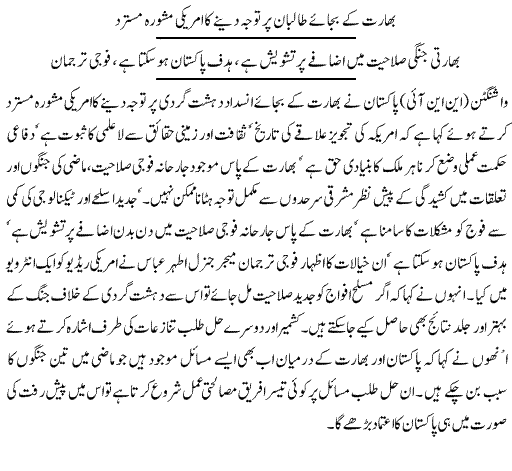
| The News predicted attack |
 |
|
|
Sunday, October 11, 2009 Punjab CID’s warning ignored  By Tariq Butt ISLAMABAD: Could this attack have been thwarted or handled in a better manner is the question that warrants a response because the attack on the Army’s General Headquarters (GHQ) had been specifically predicted by an intelligence agency, which had reported to every authority concerned that the GHQ would face an assault in precisely the same fashion, as it happened on Saturday. The News had broken this story in its October 5 issue. A Punjab home department letter had quoted intelligence gathered by it had revealed that terrorists belonging to the Tehrik-e-Taliban Pakistan (TTP), in collaboration with the Lashkar-e-Jhangvi (LJ) and the Jaish-e-Mohammad (JM), were planning to attack the General Headquarters (GHQ), Rawalpindi. It had warned that the terrorists were planning to make their way into the GHQ clad in military uniforms and riding a military vehicle. “Alternately, they may use a vehicle, which would be driven to the boundary wall of the GHQ where one of its portions is reportedly broken and they would jump into the compound by scaling/using a ladder. They may then move to the central building of the GHQ and resort to indiscriminate firing, which may result in bloodshed,” the intelligence report, which was published by The News, had warned. The attack has been claimed by the Amjad Farooqi (Sipah-e-Sahaba) group of Taliban. So far unknown Amjad Farooqi Group is thought to be part of the banned Lashkar-e-Jhangvi group as Amjad Farooqi, a former member of banned Lashkar-e-Jhangvi, is believed to be the mastermind of two attacks in Rawalpindi on December 14 and December 25 2003, on the life of former President Pervez Musharraf. Amjad Farooqi, alias Amjad Hussain, was also accused for killing American journalist Deniel Pearl. Farooqi was killed in a gun-battle with security forces in a house in southern Sindh on September 26, 2004. The group is reported to have set up dumping stations in Southern Punjab and one of which exploded in Mian Channu in which many innocent people lost their lives. Thirty-nine rescued as GHQ siege comes to end  ‘The security forces are inside the building, and they are going around searching and mopping up,’ said Major Gen Athar Abbas. - APP photo RAWALPINDI: Troops stormed Pakistan's army headquarters Sunday to end a day-long hostage drama, freeing 39 people held by militants who brazenly struck at the heart of the military establishment. Three hostages, two soldiers and four suspected Taliban militants were killed in a rescue operation hailed by the military as 'highly successful', despite a total of 19 dead since the rebels launched their assault. Six soldiers and four other militants had already been killed in the 24-hour siege, which began Saturday in the garrison city of Rawalpindi and was the third dramatic militant strike in the nuclear-armed nation in a week. The audacious attack exposed Pakistan's vulnerability in the face of a Taliban militia who have regrouped after the death of their leader and are determined to thwart an army assault on their tribal hideouts, analysts said. Military spokesman Major General Athar Abbas said troops went in at about 6:00 am (0000 GMT) and met with resistance from five militants armed with suicide vests and barricaded in the building with captive security personnel. 'Thirty-nine hostages were rescued and three were killed,' Abbas told AFP, adding that the captives were shot dead by the militants. 'The militants had suicide jackets, improvised explosive devices, grenades... they wanted to blow up all the hostages and cause maximum damage.' He said that two soldiers and four of the insurgents were killed in the hours-long rescue operation. One rebel escaped and detonated a number of explosives, before being injured and arrested. 'The operation is over. It was highly successful,' Abbas added. The drama unfolded just before midday on Saturday, when nine Taliban gunmen in military uniform and armed with automatic weapons and grenades drove up to the compound and shot their way through one checkpost. Four militants and six soldiers were killed near a second post but the rest of the rebels fled during the firefight, taking military employees hostage in a building near the army HQ in the city adjoining the capital Islamabad. The military released photographs of the four militants killed Saturday, all young men with shreds of olive-green army uniforms visible on the corpses, while a brigadier and a lieutenant-colonel were among the army dead. In London, visiting US Secretary of State Hillary Clinton said the attack underlined the extremist threat in Pakistan - on the frontlines of the US war on Al-Qaeda - and officials here immediately blamed the Taliban. 'They are the enemies of Islam and Pakistan. All their actions are against the sovereignty of Pakistan,' Interior Minister Rehman Malik said on a local television station. Political and defence analyst Hasan Askari said the militant strikes showed the army had not broken the back of the Taliban, as they claim. 'This shows weaknesses in the security arrangements of the state agencies and the determination and commitment of the extremist Taliban,' he told AFP. |

It was the third major attack in Pakistan this week, adding fresh urgency to the Pakistan Army's plans to mount a much-anticipated ground offensive in the Taliban's mountainous base in South Waziristan, along the Afghan border. Earlier this week, the Pakistani Taliban claimed responsibility for the bombing of the World Food Program's office in Islamabad, killing five people. The militant group is also believed to be behind a devastating suicide bombing in a Peshawar marketplace on Friday that killed 49 people. With Saturday's attack, the government has been left with "no other option" but to hit back, Interior Minister Rehman Malik told a local news channel. "We will have to proceed. All roads are leading to South Waziristan."
As in the attack on the WFP office, the attackers managed to confuse guards by disguising themselves as soldiers. Arriving in a small, white van, they drove up to the first checkpoint, opening fire and killing at least one guard and others present. They then spread themselves around the compound, hurling grenades and exchanging fire with military guards. They proceeded to a second checkpoint, where a fierce firefight broke out for an estimated 45 minutes, military officials said. Four of the attackers were killed, but not before they had killed an army brigadier and lieutenant colonel.
This "fedayeen" tactic — killing until killed — was also deployed with chilling effect on March 30, when Taliban attackers wearing police uniforms stormed a police academy just outside the eastern city of Lahore, leading to an eight-hour firefight before paramilitary troops and police commandos eventually overwhelmed the attackers. That attack came just weeks after gunmen attacked the visiting Sri Lankan cricket team in the heart of Lahore. In both instances, while the operation was surely orchestrated from South Waziristan, the attackers were traced to southern Punjab, where the presence of Taliban-linked militants is burgeoning.
So far, the government has showed no signs that it is willing to take action against the militants in southern Punjab. Access to ready and heavily indoctrinated recruits from that part of the country is crucial to the militant's demonstrated ability to continue to strike in Pakistan's heartlands, despite losing their much-feared leader Baitullah Mehsud to a US airstrike on Aug. 5. Last week, his successor, Hakimullah Mehsud, reemerged after weeks of silence to vow a series of revenge attacks. Hakimullah Mehsud is considered a much weaker leader, and the already fractious alliance of militant groups under the Pakistani Taliban umbrella is expected to fracture further under his inexperienced command.
Still, the Mehsud network and its deadly allies remain a major threat to Pakistan's stability. In perhaps its toughest challenge yet, the Pakistan Army is gearing up, after much reluctance, for a ground offensive in South Waziristan to target what remains of Baitullah Mehsud's group, over five thousand well-armed central Asian fighters known for their brutality, and Arab fighters belonging to al-Qaeda. From their eastern patch of South Waziristan, the militants have authored close to 250 suicide attacks across Pakistan in the last two and a half years, and trained other militants who have spread the Pakistani Taliban's brutality across the northwest.
Pakistanis will have to be braced for the fallout. At the moment, after a largely successful sweep of the Taliban who dominated the Swat Valley in the northwest, army morale is cresting. Revulsion against the militants' brutality has also sent anti-militant sentiment to an all-time high. But it remains to be seen whether that resolve will hold up in the face of expected troop losses and further bombing attacks across the northwest and in major cities; security is now being beefed up outside government buildings, western targets, and civilian areas. There is also the fear that by moving against the militants in one area, they may simply relocate to others. Nor does the army have the luxury of fighting on a single front: battles continue in pockets in Swat and across the tribal areas.http://www.time.com/time/world/article/0,8599,1929592,00.html
High-ups decide to lunch operation in South Waziristan

ISLAMABAD (SANA): The top civil and military leadership, in a meeting at the Presidency, finally decidedto carry out military operation in restive South Waziristan tribal areas here Saturday.
The meeting chaired by President Asif Ali Zardari was attended by Prime Minister Syed Yousuf Raza Gilani, Chief of Army Staff General Ashfaq Parvez Kayani, Foreign Minister Makhdoom Shah Mehmood Qureshi and DG ISI Lt. Gen. Ahmed Shuja Pasha.
The meeting finalized the strategy for South Waziristan operation. It also decided to convey Pakistan’s reservations over Kerry-Lugar bill, besides fine-tuning government’s plan to tackle the inner crisis over the aid bill.
Sources said the President and PM have decided to hold talks with the US administration over the disputed points of the bill.
The meeting discussed the prevailing security situation, with a particular reference to the attack on the GHQ and the recent attacks at Peshawar and Islamabad.
Earlier, Prime Minister Syed Yousuf Raza Gilani separately called on the President and discussed current political situation with the President.
http://www.sananews.com.pk/english/2009/10/11/high-ups-decide-to-lunch-operation-in-s-waziristan/
Terrorists hold 10-15 people hostage in GHQ's security officeISLAMABAD: About 4 to 5 terrorists are holding 10-15 people, including security and civil personnel, hostage in a security office of GHQ, DG ISPR Maj. General Athar Abbas said on Saturday.
Security personnel have surrounded the office, he added.
Earlier, six terrorists attempted to launch an attack on GHQ which was foiled by the security personnel. Four terrorists were killed while two escaped from the scene. Six security men including Brigadier Anwar and Lt. Col. Wasim were also martyred in the incident.
Six terrorists in army uniform attempted to get entry into GHQ at 11:30 am on Saturday from gate no 1. When stopped by security officials, they reached at check post no 1 and opened fire on security men after taking positions after leaving the car. Four terrorists were killed and two fled during trade of fire between security officials and terrorists. Army gunship helicopters started hovering over the area for vigilance. The commandos seized the bodies of terrorists and shifted them.
The DG ISPR confirmed killing of four terrorists whereas six security personnel including Brigadier Anwar and Lt. Col. Wasim were also martyred in the operation. Two terrorists managed to flee.
The security men later found that the escaped terrorists took shelter in a nearby security office which is now surrounded by security forces.
The ISPR said that more than two terrorists are in the security office where several security personnel are held hostage.

Read more...