Editor's Choice

--------------------------------------------------------------------------------------------------------------------------
Featured Post
--------------------------------------------------------------------------------------------------------------------------

"Let us build Pakistan" has moved.
30 November 2009

All archives and posts have been transferred to the new location, which is: http://criticalppp.com

We encourage you to visit our new site. Please don't leave your comments here because this site is obsolete. You may also like to update your RSS feeds or Google Friend Connect (Follow the Blog) to the new location. Thank you.


--------------------------------------------------------------------------------------------------------------------------
Showing posts with label Zahida Hina. Show all posts

Wednesday, 14 October 2009

Bullying ‘bloody civilians’ over the Kerry-Lugar Bill


Bullying ‘bloody civilians’
By Kamran Shafi
Tuesday, 13 Oct, 2009 (Dawn)
Our Rommels and Guderians are not about to alight from their top of the line BMWs and Mercedes and climb into Suzuki Mehrans. –File Photo
I have read the complete text of the Kerry-Lugar Bill four times. I find nothing in it that impinges on Pakistan’s sovereignty, which went out the window with the Pakistan Army’s first steps towards forming a symbiotic, but completely inferior, relationship with the United States military.

I give below verbatim (parenthesis mine) an exact copy, but slightly abbreviated, of a Top Secret but now declassified (vide NND 959417 14/1/93) letter written by Gen Mohammad Ayub Khan, C-in-C of the Pakistan Army, to Admiral Arthur Radford, Chairman Joint Chiefs of Staff, Pentagon [sic], Washington D.C. (Please read athttp://www.icdc.com/~paulwolf/pakistan/ayubkhan27sept1955.htm)

‘General Headquarters
Rawalpindi
[Pakistan]
27th Sep ‘55.
D.O. No. 7/36/C-in-C.

My dear Admiral Radford,
Considering that you have been such a good friend, I thought you would be interested to know how the affairs of military aid stand looked at from our angle … which to say the least is gloomy.

2. In early 1954, we were informed that Meyer’s Mission was coming out to Pakistan to negotiate details of military aid with us. In order to prepare our appreciation and plan for presentation to this Mission, we made several approaches to Pentagon [sic] to give us an indication of the scope of the aid. On failing to get any reply we prepared our case on the following basis.
In the event of major aggression against Pakistan, determine the forces required to:-
(a) Defend it.
(b) Launch a counter-offensive from it.
The result of appreciation on the above basis gave us an estimate of the additional effort to be put in by USA. [sic] after deducting our maximum effort on one or both scores, depending on how far America was prepared to go. It was not till the end of our briefing we were told [sic] that … the Mission had come out to find out our deficiencies in nuts and bolts and no more.

3. Then came our meeting in Washington in October ‘54. On it [sic] we were told
that America would be prepared to complete one ½ Division of our Armour and four Divisions of Infantry, and as we were spending the maximum we could on Armed Forces, apart from weapons etc required our additional
internal expense [salaries, staff cars?] would also be covered for these Formations. The programme was to take three years to complete. Thereafter our dealings began with the USMAAG.

4 .Now that the target was set, I thought the things will move smoothly so long as a sound working arrangement was evolved between the American Staff and our Staff. So, I issued a directive to my staff that they will work in close collaboration with the Americans, who were also asked to work more or less on a joint staff basis with our fellows. Unfortunately I failed to obtain American cooperation on this with the result that when our staff presented our requirements list it was objected to on the ground that our Divisional strength was in excess of theirs, which could not be supported. In any case no more than 40,000 additional men could be catered for. Our figure was 56,000 men. When asked for the working of the figure of 40,000 men, no satisfactory answer could be given.

5. Thereupon the whole thing was put in the melting pot and our staff went to work again. We reduced our establishments to remain within 40,000 men additional permissible limit with the following effect:-
(a) Reducing of officer strength by 20per cent.
(b) Reduction of JCO and OR strength by 10per cent.
(c) Conversion of A/Tk units to Fd Arty Units.
(d) Conversion of two 5.5’ gun units to 155 mm How units.
(e) Non-activation of certain units.
(f) Deletion of expansion in Schools & Centers [sic].

6. Our requirements based on above [sic] were then worked out and submitted to USMAAG and presumably accepted by the Department of the Army, who allotted certain amount of funds for internal use for the fiscal year 1954-55. Incidentally the allotment for a certain set of accommodation [!] estimated to cost 16.64 crores [sic] rupees was 7.40 crores and so on. Meanwhile, the whole of Pakistan Army [sic] in general and especially the five ½ Divisions earmarked for completion are being churned up and re-organised to conform as far as practicable to American establishments.

7. Then came the bomb-shell in the form of the message from the Head of the USMAAG … shorn of its verbiage it reads that as far as the Army is concerned the ceiling of military aid is 75.5 million dollars and that all talk of balancing five ½ Division [sic] is revoked.

8. Forgive me for being frank, but I would be failing in my duty if I did not tell you that our people are completely frustrated. They think they have been given an enormous amount of work unnecessarily and that they have been let down. They are in a mood not to accept an American word however solemnly given. This is sad in that it does not augur well for our future good relationship which was one of the things I had been hoping to develop.

9. What the political repercussions be [sic] when this news gets known, and after all you cannot conceal facts indefinitely in a Democracy [this is really rich coming from the grand-daddy of coups d’état in the Land of the Pure!], I do not know. But one thing I do know that [sic] this government will come under tremendous pressure and fire from within and without.
Hope you are in very good health.
With best wishes,
Yours sincerely,
M.A. Khan’

So, gentlemen, why the discourteous, nay rebellious reaction to the Kerry-Lugar bill? Bullying the ‘bloody civilians,’ eh? After all your great forebear even gave out the TO&E (table of organisation and equipment) of the Pakistan Army in such detail? Surely the bit about the secretary of state certifying ever so often that the bloody civilians in Pakistan ‘exercise effective control of the military…’!?

I can only appeal to President Obama not to change a single word in the bill except ‘or the reallocation of Pakistan’s financial resources that would otherwise be spent for programmes and activities unrelated to its nuclear weapons programme.’

For that is our money. Otherwise tell ‘em to take it or leave it. Our Rommels and Guderians are not about to alight from their top of the line BMWs and Mercedes and climb into Suzuki Mehrans.
kshafi1@yahoo.co.uk

....
Sovereignty or
self-perpetuation?

Thursday, October 15, 2009
Fayyaz Ali Khan

Amazingly, the people of Pakistan are being convinced to reject a US financial assistance bill which, for the first time in our history intends to help the people and bar the government from diverting these funds to the military, which many view as being the main hindrance to democracy in the country.

Why do we call it dictation when the bill bars the government from diverting these funds to the military? Isn't it a fact that so far whatever foreign aid has been given to Pakistan, most of it has been consumed by the military establishment? Is it not a fact that the sons of all the previous dictators, who all belonged to the middle or lower middle classes of our society, are today some of the richest in this country? I think we have "eaten enough grass" and the time has come to inject some nutrients in to the drained veins of the hapless masses.

Why is it being portrayed as meddling in our internal affairs when the bill, under the heading, purpose of assistance, says, "to help strengthen the institutions of democratic governance and promote control of military institutions by a democratically elected civilian government"? Or when it states, under limitations on certain assistance, "the security forces of Pakistan are not materially and substantially subverting the political or judicial processes in Pakistan"? Is it not what our Constitution says? Or are we forgetting Chaudhry Shujaat's famous utterances that it takes only one jeep and a truck to bring about regime change in this country?

Why are we raising a ruckus over the Americans asking us not to get involved in nuclear proliferation or to stop supporting networks involved in proliferation activities given that it has been proven that certain Pakistani individuals were indeed involved in such activities? Also, what is so wrong with the certification requirement in the bill that the government of Pakistan prevent Al Qaeda, the Taliban and associated terrorist groups, such as the Lashkar-e-Taiba and Jaish-e-Mohammad, from operating within the territory of Pakistan? That this also include the prevention of cross-border attacks in to neighbouring countries, the closure of terrorist training camps in FATA, and the dismantling of terrorism infrastructure in other parts of the country? If we oppose the bill what signal are sending to the rest of the world? That we are involved in nuclear proliferation and are abetting terrorism overseas?

In fact it would be fair to say that most of the anti-KL bill critics are advocating the adoption of a position that runs counter to our national interest. Also, it would be equally fair to assume that most of the critics will not have read the bill in its entirety and are also unaware of the fact that the certification clauses included in it are usual for most aid bills that the US legislature passes.

Since we say that we are responsible nation and not involved in proliferation activities or that we provide help to terrorist groups operating from our soil to carry out attacks in other countries, there should be little reason for us to oppose Kerry-Lugar. Besides, let us not forget that during the Afghan war, in return for US funding, we were supposed to cap our nuclear programme and that the US president then too was required to certify every year that this was being done. And despite that we managed to develop our nuclear deterrence.

We are projecting ourselves as a nation whose policies, instead of interests, are governed by emotions. Also, in this emotional frenzy, we fail to see that for a change – and this is perhaps a first – the aid that we receive will not go towards purchasing tanks or warplanes but towards addressing poverty, towards building schools, hospitals, improving access to clean drinking water, and on socio-economic development in general.

It is good to see parliament and the civil society debate and discuss our relationship with the US vis-à-vis the conditions attached to Kerry-Lugar. Having said that, it needs to be pointed out that the majority of criticism of the bill is coming from quarters who are known to be supporters, beneficiaries and perpetuators of the rule of the men in khaki. Since the birth of our country, our sovereignty has been time and again breached from within and not outside. I wish the Americans had translated the bill into Urdu and other regional languages so that the people could read it for themselves and see that for a change we are getting foreign aid with strings whose objective seems to be to foster socio-economic development.


The writer is a development consultant based in Peshawar. Email: fayyazalikhan@ yahoo.com (The News)

Read more...

Wednesday, 5 August 2009

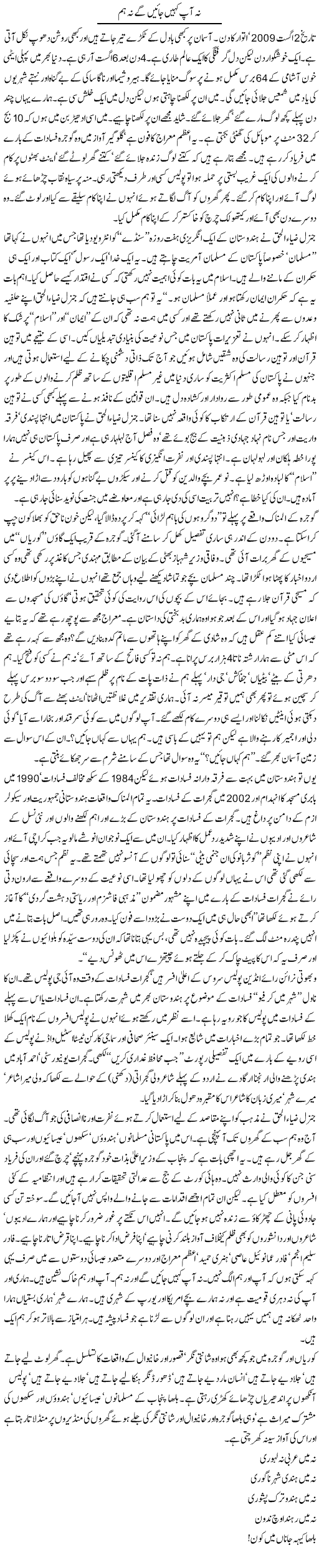
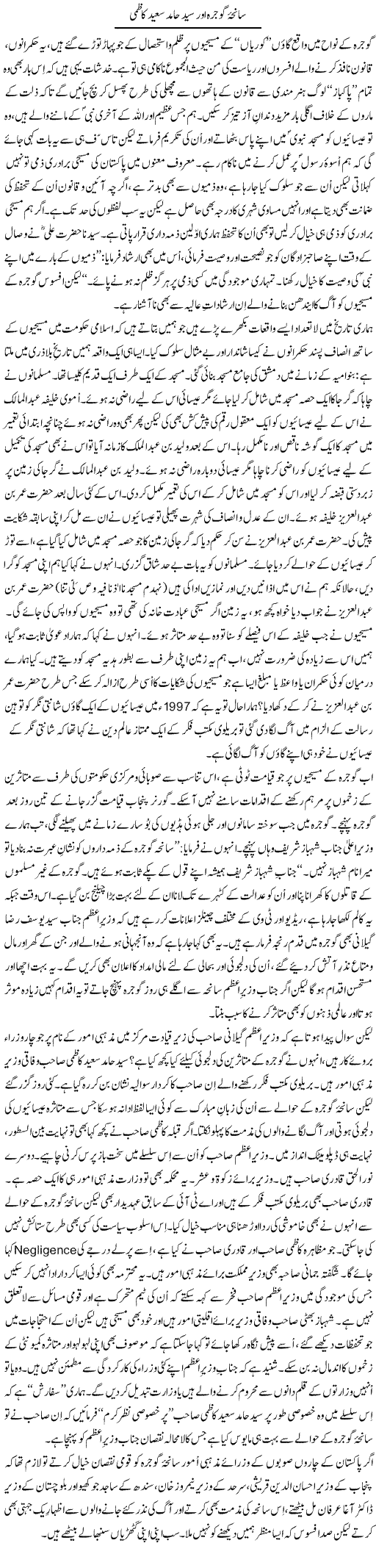
The Gojra tragedy, religious extremism, and General Zial-ul-Haq's legacy in Pakistan

گوجرہ

Zahida Hina writes on the Gojra tragey in Pakistan, in which 8 Christians were burnt alive by the pro-Taliban Deobandi-Wahhabi alliance, namely Sipah-e-Sahaba and Lashkar-e-Jhangavi. She also discusses the role of General Zia-ul-Haq in sowing the seeds of hatred in the Pakistani society.

Sipah-e-Sahaba Pakistan (SSP), an outlawed pro-Taliban Sunni Muslim sectarian group, and its al Qaeda-linked offshoot, Lashkar-e-Jhangvi (LeJ), were suspected of orchestrating the attack in Gojra town, according to Rana Sanaullah, Punjab's law minister.

Incensed by unsubstantiated allegations that the Koran had been desecrated by a Christian, an angry mob torched dozens of houses in the town Saturday, killing eight people, including four women and a child.

"Absolutely, these banned groups are involved in the rioting," Sanaullah, who is also responsible for the security matters of the province, told Reuters by telephone from Gojra.

Sanaullah said "masked men" had come from the nearby district of Jhang, birthplace of both SSP and LeJ, to incite the anti-Christian rioting in Gojra.

Around 150 people were detained for questioning.

The government received an intelligence report two months ago suggesting that militants were switching from suicide bombings to inciting sectarian strife in the country," Sanaullah said.

Minorities Minister Shahbaz Bhatti held the same fears following the attack in Gojra.

"We suspect and we are getting evidence that members of banned organizations were involved in it," he told Reuters.

SSP was founded in the 1980s and is primarily connected to sectarian violence against minority Shi'ite Muslims. It was officially banned in January 2002.

LeJ, a splinter group of SSP, has forged ties with al Qaeda.

http://www.boston.com/news/world/asia/articles/2009/08/04/pakistan_suspects_al_qaeda_allies_killed_christians/

While the Deobandi-Wahhabi alliance is responsible for executing the Gojra massacre, Barelvis must also think about their criminal negligence on this tragdey, writes Tanvir Qaiser Shahid:

.....

PMLN President Qadeer Awan involved in the Gojra massacre. Shame on you Nawaz Sharif and Shahbaz Sharif:

Sectarian violence hits Pakistani town

By Aleem Maqbool
BBC News, Gojra, Pakistan


On a street in the small Punjabi town of Gojra, house after house stands gutted and looted.

One home in particular is the focus of attention. The windows and doors are gone, what is left of the furniture lies gnarled inside, and some of the ceilings have collapsed. People are peering into a small bedroom at the back of the building.

It is from here that the charred bodies of six members of the Hameed family, from Pakistan’s minority Christian community, were recovered. The youngest of the dead was four-year-old Mousa.

We found his father, Almass Hameed, 49, in a crowded hospital ward nearby.

‘Shocked and crying’

“He was such a bright boy. His teachers complained that he was cheeky at times, but nobody could doubt how clever he was. But now he’s gone,” Mr Hameed said, breaking down.

“ It was like the most horrific movie. They destroyed our lives ”
Almass Hameed
He described how an angry Muslim mob came through the area, known here as the Christian Colony.

“I think there were thousands,” he said. “My elderly father went out to see what was happening and they shot and killed him. We were all shocked and crying. Before we knew it, they were breaking into the house.”

Mr Hameed explained how he and nine other members of the family hid in the bedroom as the house was over-run.

“We could hear them smashing everything and dividing our belongings amongst themselves,” he said. “Then they started beating on the door saying they would teach us a lesson and burn us alive.”

Soon after, a fire was raging through his house.

“We just couldn’t breathe,” he said. “I grabbed my eldest son and managed to get out of the room through the flames, my brother came out with one of my daughters, but the rest were stuck and we had no way of rescuing them.”

As well as his father and Mousa, Mr Hameed lost his 11 year-old daughter, his wife, a brother, a sister-in-law and her mother.

“It was like the most horrific movie. They destroyed our lives.”

‘Fired shots’

Tensions had risen after allegations that Christians in the nearby village of Korrian had torn up and burnt pages of the Koran at a wedding a few days earlier.

“They started it,” 19-year-old Omar Ali Raza said in Gojra’s marketplace.

“We Muslims are the victims. We gathered to protest about what they did to the Koran in Korrian and just wanted to walk through their area, but they threw stones at us and fired shots.”

“Of course it is bad that Christians died,” he added. “But they provoked the Muslims here. I don’t understand why everyone is on their side.”

But an elderly Muslim man passing by interrupts. “The responsibility is with the one who actually burns the Koran, not all Christians,” he said. “Here, we live together, and there were no problems before this.”

As it happens, a local police chief, Ahmed Javaid, said he believed the claim that Christians desecrated the Koran was not true in the first place.

“Yes, pieces of paper had been cut up to look like money at a Christian wedding, but they were not pages of the Koran,” he said.

“However, the rumour spread and the issue became politicised.”

Very soon after the allegations from Korrian surfaced, politicians from several parties held large rallies denouncing Christians in the area, calling for action. These were not just politicians from expressly right-wing Islamist parties.

PML-N leaders have visited Gojra in recent days, expressing solidarity with minority communities. But Christians here say they are sceptical.

They accuse the party and others of having previously taken advantage of anti-Christian feelings rather than helping to calm things down.

‘Rare’ violence

Senator Pervaiz Rashid, at the headquarters of the Nawaz party, told me it was very serious in its commitment to minority rights.

“We acknowledge there were problems in Gojra, and it is an embarrassment,” he said. “However, it was an isolated incident and the local president, Qadeer Awan, has now had his party membership suspended.”

“I do not believe that there are any other local politicians in our party involved in such activities.”

Violence of this scale against Pakistan’s estimated three million strong Christian community may be rare (this is the worst such incident in seven years), but complaints of discrimination are certainly commonplace.

The government says it has opened an inquiry into what happened in Gojra, but Asma Jahangir, the chairperson of the Human Rights Commission, is not expecting the type of change she thinks is needed.

“For too long the Pakistani state has protected people with extremist views,” she said.

“It is not just political parties. There are radicalised individuals, and supporters of militant groups within the judiciary, the education system, the bureaucracy and police as well.”

This was not the vision of Pakistan held by its founder, Muhammad Ali Jinnah.

“Minorities, to whichever community they may belong, will be safeguarded. Their religion or faith or beliefs will be secure,” he said just weeks before Pakistan’s creation in 1947.

“They will be, in all respects, the citizens of Pakistan without any distinction of caste or creed.”

But as Pakistan prepares to mark its independence day, many of its citizens do not see any cause for celebration.

Source: http://news.bbc.co.uk/go/pr/fr/-/2/hi/south_asia/8196013.stm


Read more...

Monday, 6 October 2008

The genius of Jhang: Dr Abdus Salam

[1100527052-2.gif]
(Zahida Hina, 23 Nov 2008, Express)


.......

The genius of Jhang: Dr Abdus Salam

By Ahmad Faruqui (Daily Dawn)

EVERY October, the Nobel Academy announces the names of individuals whose genius has earned them its coveted prize.

The winners are awarded the prize by the King of Sweden in a formal ceremony. The prize in physics garners much attention, focusing as it does on the fundamental forces of nature.

So it was with great wonderment on Dec 10, 1979 that those who were gathered to witness the physics award saw a tall, bearded figure walk towards the stage. The very antithesis of western formalism, the man was draped in a long fully buttoned black suit with a closed upright collar, white baggy pants and white turban. Decorative shoes that could have come out of the Arabian nights completed the profile.

The man was Prof Abdus Salam. He had the honour of being the first scientist from the Muslim world to get the Nobel. His presence was a visible reminder of how far the young boy from the obscure town of Jhang on the banks of the Chenab had come.

Abdus Salam had shown evidence of brilliance at a young age by scoring the highest marks ever in a matriculation examination in Punjab. After studying at Government College, he went to Cambridge University (St John’s College), where he scored a double first in mathematics and physics and later obtained a doctorate. He would later teach at Government College, Imperial College (London) and the International Centre for Advanced Physics (Trieste, Italy).

Even though he had started out as an experimental physicist, he quickly turned into a theoretician, citing his lack of patience for accumulating data and working with “recalcitrant equipment”. His focus was on subatomic particles and the forces of attraction and repulsions that existed between them.

A century earlier, British scientist James Clerk Maxwell had shown that electricity and magnetism were two manifestations of a common electromagnetic force. Others had shown in the early part of the 20th century that a ‘weak’ nuclear force existed between subatomic particles and was responsible for phenomena such as beta-radioactive decay. This happens when a neutron in the nucleus spontaneously shoots off an electron as it turns itself into a proton, hence transmuting the element. However, the best available theory of weak force reactions by Enrico Fermi was known to be only valid at low energy levels.

In the 1960s, Abdus Salam, along with two Americans, put together a theory that described the weak force and electromagnetism as low-energy manifestations of a single ‘electroweak’ force. This theory agreed with all the observed data and behaved nicely at higher energy levels, unlike Fermi’s.

But there was a catch. It relied on the existence of several new particles that had never been seen in any prior experiment. One of these implied a set of ‘weak neutral current’ reactions, a brand new concept.

The Nobel was awarded to Abdus Salam and his co-researchers once the existence of the particles implied by their theory was confirmed by experimental scientists at CERN, the European test facility in Geneva. Prof Salam’s Nobel lecture, ‘Gauge unification of fundamental forces’ was a model of scientific eloquence (http://nobelprize.org/nobel_prizes/physics/laureates/1979/salam-lecture.html).

Almost three decades later, his electroweak theory still stands, despite an extraordinary amount of testing. It has led to the development of the Standard Model in particle physics (quantum chromo-dynamics), which combines the electroweak theory with the ‘strong force’ theory.

However, from the days of Einstein onwards, no one has been able to integrate gravitation with the other three forces. Grand unification of the four fundamental forces remains an aspiration for future physicists. In science, theories are only interesting if they can be rejected. In his Nobel lecture, Prof Salam quoted from Einstein to affirm his belief in empirical testing: “Pure logical thinking cannot yield us any knowledge of the empirical world; all knowledge of reality starts from experience and ends in it.”

One of the loose ends in the Standard Model is the existence of the Higgs boson, which is still to be observed. Physicists around the world are anticipating that once the multi-billion-dollar Large Hadron Collider at CERN that runs under the Franco-Swiss border is operational again, it will be able to test for the existence of the Higgs boson.

It is fitting that the life and work of Prof Salam have been celebrated in a new biography by Gordon Fraser, Cosmic Anger (Oxford, 2008). In the book, Abdus Salam emerges not just as a world-renowned scientist but as a humanist committed to the advancement of the developing world and as a humble man with a tremendous sense of humour.

During the Ayub era, he served as chief scientific adviser to the president and was a member of the Atomic Energy Commission. In those days he inspired countless students in Pakistan to pursue the physical sciences.

Unfortunately, serious policy differences between him and the country’s top leadership surfaced when Zulfikar Ali Bhutto ascended to power. Bhutto was committed to bringing a nuclear weapons capability to Pakistan even if that meant, as he famously put it, that Pakistanis would have to eat grass for a thousand years. Prof Salam disagreed with Bhutto’s idea and felt it was ill-suited to a country as poor as Pakistan. Further difficulties arose with the passage of a law that excommunicated people of his faith from Islam.

A deeply religious man, Prof Salam was heartbroken. That year, with much anguish, he left the country for good.

He came back only once, at the behest of President Zia who wanted to recognise his achievements to the cause of science in Pakistan. He continued his work in the years that followed and travelled widely to compare notes with scientists around the world.

In 1996, at the age of 70, Prof Salam passed away in Oxford after a prolonged illness. But his legacy lives on. Many centres and professorships are named after him across the globe. His work continues to inspire new generations of graduate students to seek out the mysteries of particle physics.

But one would be hard pressed to find much evidence of his legacy in the land of his birth. That is a genuine tragedy since Pakistani science attained a high-water mark during his tenure that has yet to be surpassed.

The writer is the author of Musharraf’s Pakistan, Bush’s America and the Middle East.

faruqui@pacbell.net
Read more...