Editor's Choice

--------------------------------------------------------------------------------------------------------------------------
Featured Post
--------------------------------------------------------------------------------------------------------------------------

"Let us build Pakistan" has moved.
30 November 2009

All archives and posts have been transferred to the new location, which is: http://criticalppp.com

We encourage you to visit our new site. Please don't leave your comments here because this site is obsolete. You may also like to update your RSS feeds or Google Friend Connect (Follow the Blog) to the new location. Thank you.


--------------------------------------------------------------------------------------------------------------------------
Showing posts with label Abdul Qadir Hassan. Show all posts

Sunday, 1 November 2009

Zardari's corruption and our saviours in Pakistan Army


PAC wants culprits behind NLC losses identified

By Irfan Bukhari

ISLAMABAD: The Public Accounts Committee on Thursday directed the Planning and Development Division to identify those responsible for losses of Rs 1.7 billion to the National Logistics Cell (NLC).

Considering the audit para pertaining to losses suffered by NLC from investment in the stock exchange between 2004 and 2008, the PAC directed the secretary to submit names of the officials responsible within 15 days.

The Planning and Development Division secretary informed the committee that NLC had invested Rs 4.8 billion in the stock exchange between 2004 and 2008 and had suffered losses of Rs 1.7 billion.

Briefing the committee about the findings of an inquiry report, the secretary said NLC officials had purchased shares of various companies in violation of company policy and against the decision of the board of directors.

He said Lt General (r) Khalid Munir Khan, Lt General (r) Afzal Muzaffar, Major General (r) Khalid Zaheer Akhtar, Najeeb Ullah Khan and Saeedur Rehman were heading the NLC at the time.

He said the Planning and Development Division held these men responsible for the losses, but Auditor General Tanvir Ali Agha said responsibility could not be fixed without a proper trial.

PAC member Hamid Yar Hiraj endorsed Agha’s remarks and PAC acting chairperson Yasmeen Rehman directed the Planning and Development secretary to fix the responsibility through proper procedure, so that money could be recovered from them.

http://www.dailytimes.com.pk/default.asp?page=2009\10\30\story_30-10-2009_pg7_23


Three generals cause multi-billion loss to NLC

Friday, October 30, 2009

By Rauf Klasra

ISLAMABAD: Two former lieutenant generals and one major general of the Pakistan Army calling shots at the National Logistic Cell for five years, stood exposed before the Public Accounts Committee (PAC) on Thursday, when an inquiry report revealed that after defying the orders of the then prime minister Shaukat Aziz, these generals had quietly borrowed Rs2billion from four banks on commercial rates to make investments in the volatile stock markets and in the process lost Rs1.8billion in the stocks.

A total of Rs4billion of the NLC including the pension fund of its employees, were invested in the stock markets, out of which, according to the report, Rs1.8billion were already lost during this adventure.

The PAC was informed through its inquiry report that OIC/NLC Lt General Azfal Muzaffar evn continued to make investments in the stock market till the last day of his retirement in 2008 even though the rest of the government departments and organizations had stopped this exercise in 2006.

The PAC was informed that after causing a loss of Rs1.8billion in cash to the NLC which would continue to pay the loan installments of the banks in the years to come, these three army generals were never questioned about their acts of omission and commission which had caused a loss of billions to the organisation.

The PAC members suspecting some foul play in the multi billion investment spree sought the names of the brokers and directors of those firms through whom these billions were invested despite the orders of PM Aziz in 2003 to stop investing in stocks.

The interesting part of this scam is that this was Shaukat Aziz who as a finance minister had devised a policy to make the public sector departments, organizations, corporation etc to invest their pension funds into stock markets to show fake recovery and financial health of the country.

Earlier, the secretary planning division Ashraf Hayat placed the names of five top guns of NLC who according to inquiry repot were responsible for this massive financial loss. Secretary said he did not have any doubt in his mind that following five were responsible—-Lt General Khalid Munir Khan who served in OIC NLC during 15.1.2004 to 14.6.2005, Lt General Afzal Muzaffar ( 15.6.2005 to 17.10.2008), DG NLC Major General Khalid Zahir Akhar ( 25.7.2002 to 27.2.2008), DFA Najeebullah Khan ( 25.10.2002 to 10.4.2007) and Chief Finance Officer ( 20.6.2004 to 22.10.2008).

These top guns were holding the positions of OIC DG AND DFA/CFO when these amounts were borrowed from the four commercial banks and invested in the markets.

According to official inquiry report placed before the PAC, a total loan of Rs2billion was borrowed— Bank Al Falah (Rs650million), National Bank of Pakistan(Rs90million), UBL (Rs800m) and ABL (Rs500m) and out of this loan, Rs 1.8billion has already been lost in the stock markets because of the decision of these three top army generals who had contracted with some brokers to make these heavy investments in stock markets.

The shocked PAC members however stopped short of ordering the recovery of these huge financial losses from these top military generals even after it was established that not only these generals had defied the orders of the then prime minister Shaukat Aziz not to make investment in the markets, but Staff Retirement Benefit Fund of employees was also thrown and lost in the stock markets. The PAC decided to wait for two more weeks to get another review of the inquiry report before ordering the recovery of these losses from those top military men who made such silly investments in the stocks.

Earlier, the PAC met here with Yasmeen Rehman in the chair. Sardar Bhadur Khan Sihar, Riyaz Fatinya, Hamid Hiraj, Sardar Ayaz Sadiq, Nadeem Afzal Chann and others.

The secretary Planning Ashraf Hayat laid the inquiry report before the PAC and he did not have any doubt in his mind that these three generals were responsible for this huge financial losses to the NLC by making faulty decision of investing in the volatile markets of the country. Despite the repeated questions of the PAC members the secretary did not budge from his stance that three generals were responsible for this loss. MNA Riyaz Fatina was wondering that why PAC was ordering the fixing of responsibility when it was clear from documents that these generals had defied the orders of the PM Aziz and this single violation was enough to establish a case against them.

The PAC was informed that three generals even devised a new strategy to make the money invested when after consuming the pension funds NLC employees, they even decided to borrow from four commercial banks and then threw it in the stocks. The PAC was informed that the sorry part of this sordid affair was that even the pension fund of the employees of the NLC was not spared in the heat of investment with the help of some powerful brokers.

According to the inquiry report, as a part of its official policy, NLC should invest 20 percent of the total fund under the management in non government securities/TFCs and shares. The report said in its 37th meeting of NBL held on September 8, 2003 the chairman NLB approved the investment policy of NLC advising not to invest in the stocks and carry over transactions. In its next Board meeting held on Jan 7, 2005, while viewing the status and results of NLC investments, the prime minister/chairman of NLB pointed out that public sector companies should not trade in stocks. The DG NLC clarified that investment policy was made as per the guidelines by the ministry of finance. The PM Aziz asked the secretary finance for an approval and issuance of fresh guidelines, he further directed that a strategy should be worked out by NLC in consultation with secretary finance to disinvest from the stock market. The DG NLC reiterated that irrespective of the policy, PM Directive to withhold trading in stock till fresh guidelines from the finance division will be followed.

The inquiry report said it analysed the investment record and reached the conclusion that massive financial irregularities were detected. The report said, “ besides noticing the acts of blatant violations of instructions, procedures and other guidelines”. The PAC would now decided whether to summon these generals in meeting and put recovery on them in its next meeting after receiving another report within two weeks.
http://www.thenews.com.pk/top_story_detail.asp?Id=25281


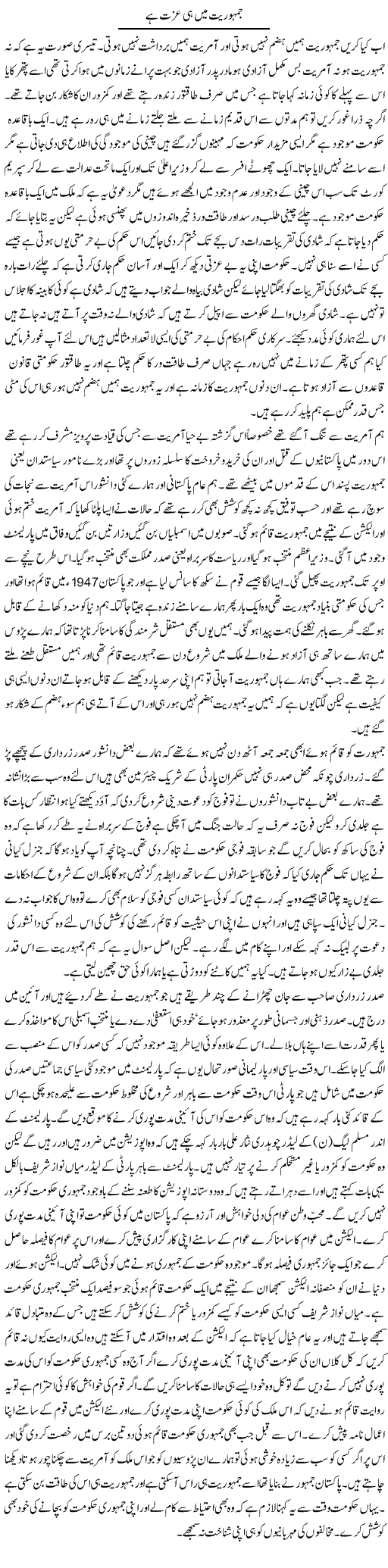
http://www.jang.com.pk/jang/nov2009-daily/01-11-2009/col10.htm

(Abdul Qadir Hassan)


Read more...

Friday, 16 October 2009

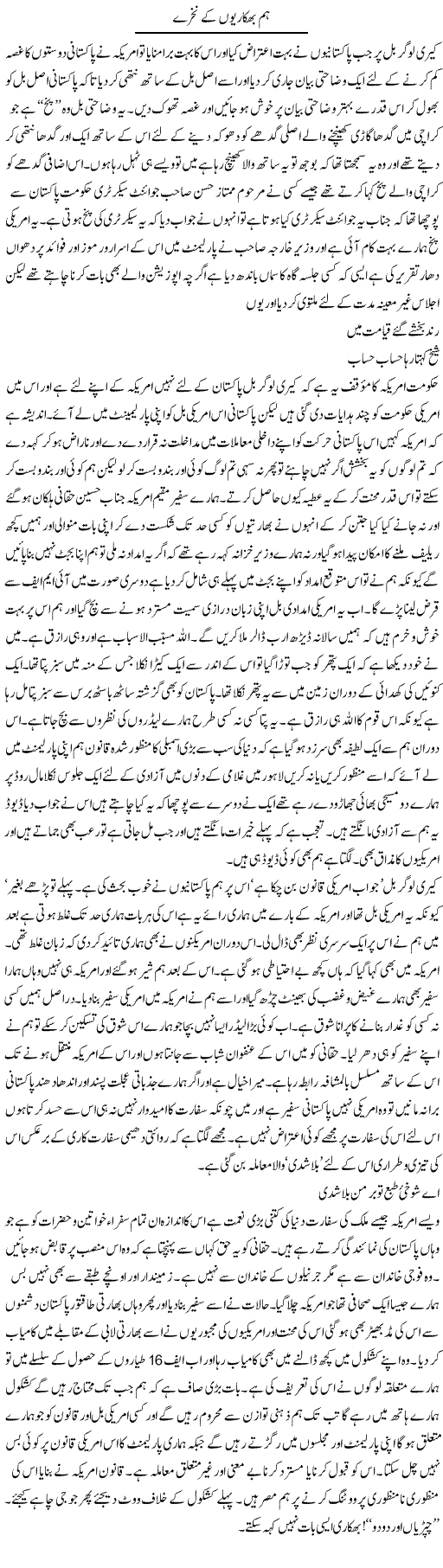
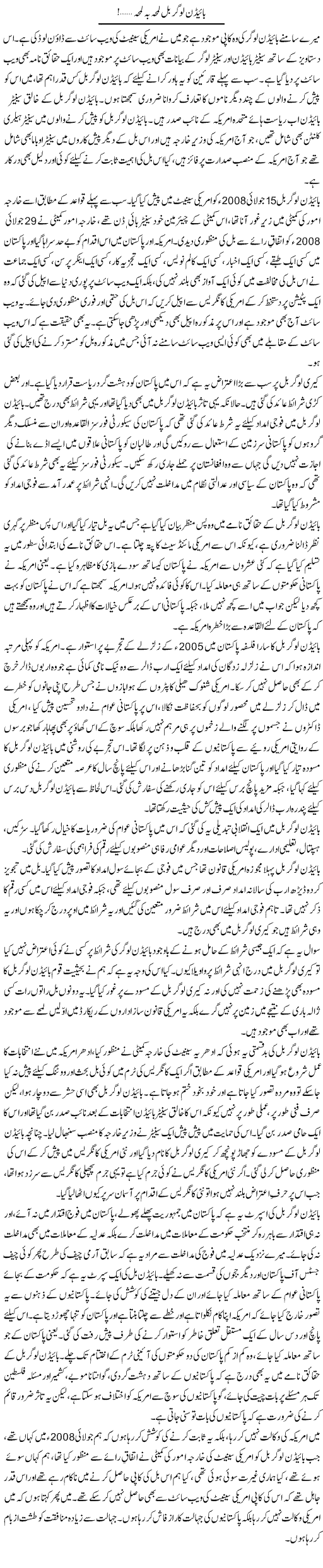
Kerry-Lugar Bill and our "Ghairat"

Abdul Qadir Hassan: A column against Hussain Haqqani


Nazir Naji
Kerry-Lugar and our response
Dissenting Note

Friday, October 16, 2009
Dr Masooda Bano

AThe stiff response of the Pakistani military leadership to the Kerry Lugar Bill has led to the Pakistani government and its US counterparts agreeing to mellow down some of the clauses. The joint explanatory statement issued by the US Congress shows a softening of the clause that stirred the heaviest resistance from the Pakistani military: i.e., asking for greater civilian control over the promotion of military officials and strategic planning within the military. This softening of the position can hardly be argued to be a means of establishing Pakistan's sovereignty. The fact of life is that the US has been playing a highly interventionist role in Pakistan especially since the Sept 11 attacks and will continue to do so. Ironically, when there is resistance to the US, it is not to protect the interests of the ordinary Pakistanis but of the Pakistani military. It shows the military is in no mood to become more accountable to civilian authorities.

Aimed to strengthen Pakistan's capability to resist militancy, the Bill, unlike in the case of the last eight years of US engagement with Pakistan, prioritises investment in long-term development of Pakistan. Rather than channelling aid towards the Pakistani military to meet immediate security targets, which are related to US interests, the Bill in principle priorities investment in socio-economic development of Pakistan to ensure long-term development. It argues for supporting the economic activity, and investment in education. It also emphasises reaching out and adequately compensating the people who have been displaced due to the military operations conducted by the Pakistani army to check the militants. It asks for closer scrutiny of the utilisation of the aid money. And since the Bill also states strengthening of democracy as an important objective of this new aid package, among other things it puts some requirements for better accountability of the military to the civilian leadership.

Coming from a country whose leadership has since 2001 only been concerned with using Pakistan to flight its war against the Al-Qaeda, the clauses in the Bill were actually a positive shift. It is easy for people to start talking about sovereignty of Pakistan but why does the sovereignty only matter when the external party is arguing for the military to be made more accountable to civilian-- i.e., elected leadership of the country? As the Bill also notes in the background section, Pakistan has since 2001 received two times more military aid than civilian aid. Out of $15,000,000,000 US assistance to Pakistan since 2001, more than $10,000,000,000 has been paid as security-related assistance and direct payments.

This huge flow of security related assistance has primarily been channelled through the military. The Pakistani public has no means to make either the US or the Pakistani military accountable for how that money was used. Gen Musharraf himself acknowledged in his controversial autobiography that the Pakistani military and the related agencies have been handsomely rewarded by the US government for handing over Pakistani suspects to the US. The military-led government of Gen Musharraf was actually receiving US dollars for handing over Pakistanis without giving them a trial in country. The scale of such cases was large enough to result in the missing people's campaign by the families of the victims. Yet, the Pakistani military top command did not seem to face any moral dilemma about the sovereignty of the country being affected by receipt of huge flow of unchecked military aid.

The question is that what is more objectionable: a foreign state directly channelling huge amount of funds to Pakistani military without involving civilian leadership or the foreign state trying to ensure that the Pakistani military actually becomes more responsive to the civilian command structure. The US engagement with Pakistan under the Bush administration has been led by the former approach. This was also the easiest route for the US: keep giving aid to Pakistani military to carry out the counter-militancy operations don't be that concerned about the long term development of the country.

The Kerry Lugar Bill on the other hand makes a conscious shift towards engaging with the civilian command structure and more importantly investing in the long-term development of Pakistan. True, Pakistan would be better off with less of US intervention. However, when the intervention has to be there, it is better that it is designed to help civilian rule rather than supporting military intervention in state governance. Kerry Lugar Bill tried to shift the balance but it is clear that the Pakistani military is not ready to adjust the power balance against the civilian leadership.


The writer is a research fellow at the Oxford University. Email: mb294@hotmail .com (The News)

....

Asadullah Ghalib


Capital suggestion
Aid from America

Sunday, October 18, 2009
Dr Farrukh Saleem

The official title of the Kerry-Lugar Bill is the Enhanced Partnership with Pakistan Act of 2009 and has 8,151 words and 53,562 characters. Terror-related terms appear 38 times, 'nuclear' five times, Quetta and Muridke each appear twice and India appears only once. The primary focus of the entire act is non-military aid amounting to $1.5 billion per year for the following five years (while all the debate within Pakistan relates to military aid). However, non-military aid is unconditional.

Section 203 -- titled 'limitations on certain assistance' -- of the act applies only to security assistance for Pakistan. Under Section 302, the secretary of state, in consultation with the secretary of defence, has to submit a monitoring report evaluating the Government of Pakistan's efforts to "disrupt, dismantle and defeat… extremists and terrorist groups", which has been the officially stated policy of the government long before this act was passed. The monitoring report must "evaluate" the government's efforts towards shutting down Lashkar-e-Taiba and Jaish-e-Mohammed – both these religious outfits were banned by the Pakistani government back in 2002.

The report must also evaluate government's efforts towards preventing attacks in the neighbouring countries -- the officially stated policy is to prevent the use of Pakistani soil for attacks into neighbouring countries. In this regard, the Charter of Democracy, signed by Nawaz Sharif and Benazir Bhutto, states that "terrorism and militancy are by-products of military dictatorship, negation of democracy, are strongly condemned, and will be vigorously confronted."

Furthermore, the monitoring report must also evaluate "Pakistan's efforts to prevent proliferation of nuclear-related material" but the officially stated policy of the government is to prevent proliferation of nuclear-related material as well. It must include an "assessment of the extent to which the Government of Pakistan exercises effective civilian control of the military, including a description of the extent to which civilian executive leaders and parliament exercise oversight and approval of military budgets, the chain of command, the process of promotion for senior military leaders, civilian involvement in strategic guidance and planning, and military involvement in civil administration."

Under Article 243 of the Constitution of Pakistan, "the federal government shall have control and command of the armed forces." In this regard, the Charter of Democracy, signed by Nawaz Sharif and Benazir Bhutto, states that "the ISI, MI and other security agencies shall be accountable to the elected government through Prime Minister Secretariat, Ministry of Defence and Cabinet Division respectively. Their budgets will be approved by DCC after recommendations are prepared by the respective ministry. The political wings of all intelligence agencies will be disbanded. A committee will be formed to cut waste and bloat in the armed forces and security agencies in the interest of the defense and security of the country. All senior postings in these agencies shall be made with the approval of the government through respective ministry (clause 32)." This is an aid package and not a bilateral agreement. The Government of Pakistan is under no obligation whatsoever -- the only entity empowered to make laws for Pakistan is our National Assembly.


The writer is the executive director of the Centre for Research and Security Studies (CRSS). Email: farrukh15@hotmail.com (The News)

Kerry-Lugar is good for Pakistan
Sunday, October 18, 2009
Aakar Patel

Popular opinion is not, and shouldn't be, the place where foreign policy is decided.

It isn't usually, because most people don't care what their nation's relationship is with another nation. This has exceptions. We are interested in the way our nation behaves with a neighbour we have gone to war with, or a country that we have deep economic ties with. But we are unconcerned about what treaties our government signs with Congo or Vietnam or Austria.

And popular opinion shouldn't be where foreign policy is decided, because weighing in on foreign policy needs more information and background – what is called domain expertise -- than is available to most of us. If it is available, most of us find it uninteresting.

It is for the same reason that budget deficits are not decided directly by popular opinion, but indirectly through elected leaders.

We could decide to influence our policy with a nation through popular opinion, but then a significant majority of us must know the history of the two nations' relationship. They must understand the text of current documents, and the consequences of action.

This is difficult, though there are times when all of it is swept aside because it becomes irrelevant, for instance if that nation declares war on us.

Another reason for foreign policy being best kept out of popular opinion is that we are emotional when thinking of ourselves as a nation.

We might think of our collective behaviour as honourable or shameful, but our nation does not feel our emotion, even though we cast it in a human light as motherland or fatherland.

In our temporary emotion, we might push the government into taking a position that is actually harmful to the nation in concrete economic terms, though it might make us feel better emotionally.

In most democracies, foreign policy is not in the domain of popular opinion for the first reason: people do not care. Americans didn't care about their country's policies regarding Afghanistan, till the September 11 attacks brought Afghanistan, and the emotion of vengeance, into the domain of popular opinion and Bush declared war.

America's relationship with Iraq also came into public opinion, and it inverted what had been a popular presidency. Foreign policy cost the Republican Party their legislative majority because the public quickly corrected their mistake, which had been made in a fit of anti-Arab emotion.

India fought China in 1962 and lost. The Chinese withdrew from most of the captured Indian territory in Arunachal Pradesh voluntarily, but Indians still fear China.

Partly this has to do with that nation's size and power. But it also has to do with the fact that we cannot understand the Chinese, and they are alien to us.

Indians cannot think about China unemotionally or rationally and so that creates a problem for the government.

For a few weeks, stories on China have been prominent in India. The one that caused most anxiety was the report that Chinese soldiers were trespassing on the Indian side of the border.

Had there been a skirmish? No. Had any Chinese been seen? No.

What the report was based on was some rocks that had been found which had Chinese writing on them.

Much coverage was given to this, and the Chinese know that Indians respond to the slightest shift and so they keep us unbalanced.

The media in democracies understands public opinion quite well, especially television, which is quite alert to what sort of story works because it gets feedback through ratings.

In successive weeks we had stories of the Chinese stamping visas for Jammu and Kashmir residents on loose leaves instead of their passport; Chinese objections to Manmohan Singh's visit to Arunachal Pradesh (based on an internet poll); and then a story about a dam being raised over the Brahmaputra, which originates in China and then flows into India. This last story was probably the one that should have worried us most, but that got mention only in one newspaper because it doesn't concern national honour.

Left to itself, this government will probably sort out matters with China easily, because India in 2009 is not the India of 50 years ago. But being pushed forward by the fearful and enraged public behind it makes its job tougher.

It is an example of an issue that has become complicated by being in the public realm.

Something similar is happening in Pakistan, where some are opposed to the Kerry-Lugar bill which President Zardari's government thinks will be good for Pakistan.

The US government will give Pakistan $7.5 billion through 2014. It is very unlikely the majority of Pakistanis know what $ 7.5 billion means; certainly most Indians would not know. This is because we do not use million and billion, but lakh and crore.

What the US is giving is Rs622.5 billion in exchange for fighting extremism in the Frontier. This is Rs3,660 for every Pakistani.

America wants to make this money conditional, which is its right as a donor. As a recipient of aid, Pakistan is entitled to reject conditions and go its own way.

But it is already fighting a war against extremism. And it is doing this with an effectiveness that can be seen in the desperation of last week's attacks.

Pakistan is fighting this war because Zardari's government believes it's the right thing for Pakistan. Some of those urging Pakistan to reject this money have been wrong before. Some of them said earlier that the Taliban should not be fought, that they were a threat only because of America's war. But that line of argument ended after the Pakistan army's stunning success in Swat.

The people who are disturbed by America's possible infringing on the sovereignty of the Pakistan government could also respond to the real infringement of sovereignty that happened when the army expressed its concern on the Kerry-Lugar bill. The Pakistan army is a servant of the government and has as much of a right to express its concern publicly as any other government department.

One of the conditions of the bill is that Pakistan's army remain out of politics. This is good news for all Pakistanis who like democracy because it supports their cause, but it might have upset GHQ. The army should have raised his irritation or concern in private with the government, to whom he reports, rather than send a public memo through the media. In India if an armed forces chief were to do that, he would be fired from his job – and that is what sovereignty is really about.

To outsiders it is difficult to understand what the fear of Pakistanis over Kerry-Lugar is; or why Pakistan's honour has been stained by accepting these conditions.

America will withhold money if Pakistan does not act to prevent a repeat of the proliferation which happened under A Q Khan. But surely that is something that the Pakistani government and army must also be concerned about.

The US says that groups like Lashkar-e-Taiba and Jaish-e-Mohammad must be acted against, but that is something that is already happening.

It's quite silly to say that we will do something that benefits us, but only if America doesn't say we have to do it.

Pakistan is served by some very competent ministers, like Shah Mehmood Qureshi, who's really world-class, and there should not be an irrational fear that they are acting against Pakistani interest. They should be allowed to do their job without the press of public opinion that is based on emotion more than it is on rational thoughts about where the benefit to Pakistan really lies.

Pakistan's brave soldiers are shedding blood on behalf of the international community in the war against extremism. Pakistan must be compensated for that, and that is what the Kerry-Lugar bill is actually about.


The writer is director with Hill Road Media in Bombay. Email: aakar@ hillroadmedia.com (The News)


Read more...

Saturday, 26 September 2009

"The Friends of Democratic Pakistan" disappoint "the democracy haters in Pakistan"

‘Stable Pakistan’ and the world

Co-chairing, with the US President Barack Obama, the Friends of Democratic Pakistan (FoDP) meeting on Thursday, President Asif Ali Zardari stated that “a stable and prosperous Pakistan is the world’s greatest hope against the spread of extremism and terrorism”. The basis for his claim on the attention of the “friends” was Pakistan army’s success in its war against the Taliban terrorists in the Malakand Division in the NWFP and the promising nature of the ongoing military action in other parts of the Federally Administered Tribal Areas (FATA).

President Zardari deployed effective rhetoric by claiming that Pakistan was fighting for the entire civilised world. The truth is that the entire civilised world wants Pakistan to save itself from the scourge of the Taliban and, at least in theory, is ready to compensate it in return. Because terrorism around the world spreads from the epicentre of violent creeds in this region, the world agrees that if Pakistan fights it, it would save its own soul and also help the world fight in Afghanistan. This cooperative fight, the world thinks, would be tantamount to defending the entire civilisation as it exists today. The FoDP is supposed to translate the world’s gratitude towards Pakistan into monetary assistance. And a bit of that happened on Thursday.

The US Senate passed the Kerry-Lugar Bill which will give Pakistan USD1.5 billion annually towards a total payment to Pakistan of USD10 billion in five years. Already the FoDP have made it possible for Pakistan to receive USD13 billion as assistance to its foreign reserves, leading immediately to an improved credit rating, following by a boom at the Karachi stock exchange. The IMF had virtually no funds and had loaned only USD1 billion in 2007 and was nearing closure; today, thanks to the global recession and the efforts by the world to get out of the slump it finds itself in because of free market excesses, the IMF has USD750 billion and has already loaned USD160 billion to troubled economies all over the world.

The fight against terrorism is a complex issue. While it is important for Pakistan to remain on the sympathetic radar of everyone and walk in lockstep with the community of nations worried about terrorism in this region, there is much that the US-led allies need to do in Afghanistan to make Pakistan’s work easy. That has not happened so far, as should be clear from General McChrystal’s initial assessment report that has been leaked to the media a couple of days ago. That report also mentions the role of India as a destabilising factor which must be addressed in order for Pakistan to begin to take care of groups that might be attacking the NATO-ISAF interests in Afghanistan. But more than that there is reason for one to be concerned about the failure so far of the US, NATO and ISAF troops to bring that country under effective control.

Meanwhile, if the FoDP meeting seems to praise President Zardari for his “achievements” after one year in office, the media in Pakistan is in the process of presenting him as a villain. The US, which spearheads the international movement supporting Pakistan, is being described as an enemy country which, together with India, is trying to enslave it and snatch its nuclear assets. The US, according to the TV channels, has landed its mercenary Blackwater soldiers in Islamabad and is buying up land to set up a military base in Islamabad.

The general opinion takes a very depressive view of the PPP government. All the economic indicators that compel the world to look at Pakistan with hope are ignored and in fact seen as doomsday signs. The sugar crisis, in great measure caused by a “targeted subsidy” gone wrong, has taken over the national mind to the exclusion of all objective indicators.

Pakistan has stabilised considerably. Suicide-bombings are at an end; people uprooted by war are settling down with prospects of international humanitarian aid. But the Pakistani opinion, haunted by dangerously brawling politicians and hostile media, continues to destabilise it. It paints the present as “extension of what went before”, if not “worse than ever before”, and sees no hope in the future. This trend must change and it can change if the politicians and the media become more objective. (Daily Times)

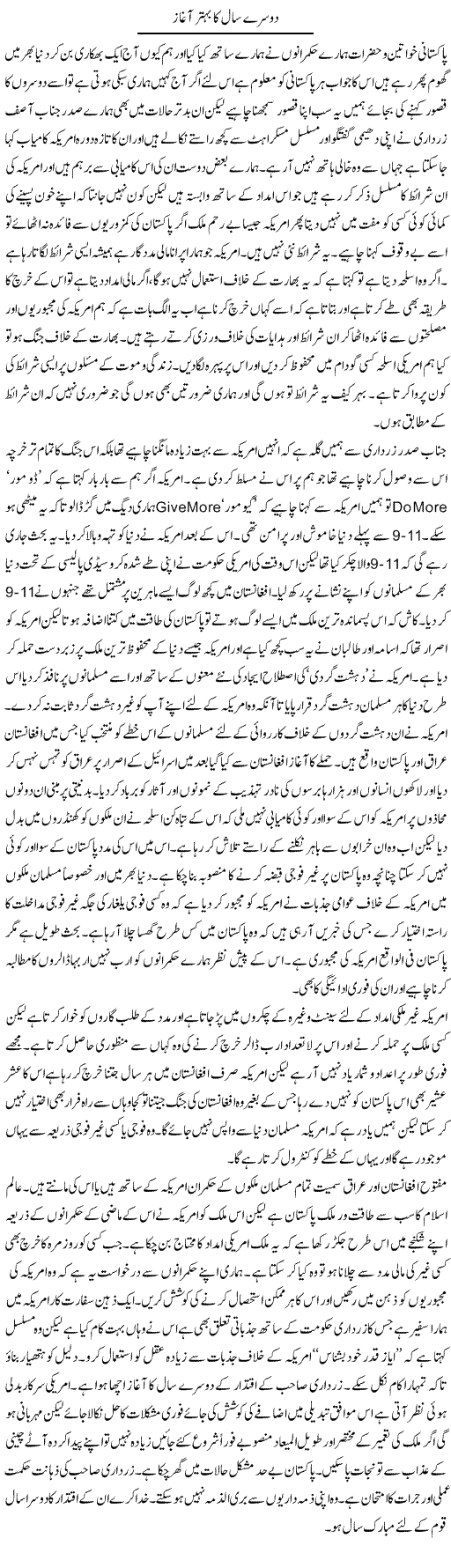
comment: Begging with dignity —Rafia Zakaria

In our sixty-second year, perhaps it’s time we came to terms with the reality that we are and have always been a nation of beggars. Ironically, it is only in embracing this grim reality that we can find the opportunity to change our future


If the recent summit in New York is a reliable gauge, then Pakistan, or rather “democratic” Pakistan is doing pretty well in the popularity contest otherwise known as the General Session of the United Nations General Assembly.

On Thursday, the “Friends of Democratic Pakistan” met to discuss the promotion of stable governance and economic development in Pakistan. The group includes Australia, Britain, Canada, China, France, Germany, Italy, Japan, Saudi Arabia, Turkey, the United Arab Emirates, the United States, the United Nations and European Union. President Obama, who co-chaired the meeting, announced the passage of the Kerry-Lugar Bill, which will provide Pakistan with $1.5 billion every year for the next five years.

The meeting and accompanying announcement of aid disbursement have provided much fodder for discussion in both the United States and Pakistan. The United States has expectedly tried to announce passage of the Kerry-Lugar Bill as well as the meeting itself as a major commitment that substantiates its long-term interest in Pakistan. Coming as it does, in the footsteps of an expected change in US policy toward the region, the announcements provide the Obama administration a means to deflect attention from its woes in Afghanistan by pointing to the potential of success in Pakistan.

For the Pakistani government, led by President Zardari, the task in New York is markedly more difficult. It must tread the delicate balance of being both gracious for the assistance while at the same time drawing attention to the holes in the Obama administration’s beneficence. One attempt to do just this was President Zardari’s demand, made a day before the meeting, that the United States reimburse the $1.6 million that Pakistan has spent fighting the War on Terror in the tribal belt. The demand was programmed ostensibly to emphasise the fact that aid disbursements to Pakistan are in exchange for services rendered in the US-led war against Al Qaeda rather than an act of magnanimity by the United States. In other words, the Pakistani delegation tried to paint as “payment” what the Americans would present simply as an act of generosity.

This delicate dance between grantors and receivers of aid is not in itself new. In the last few decades, as globalisation has become an economic and security challenge rather than an abstract theory, this dynamic has become a repeated accompaniment to most global summits. The rich nations controlling large chunks of the world economy have packaged their security interests as moralistic efforts to assist the poor without any strings attached. At the same time, poorer nations have sought to expose the security interests and consequent challenges to sovereignty that lie beneath the Global North’s commitments to economic and social development in the Global South.

The duelling narratives that emerge from the above dynamic mean that rich nations always have the task of presenting their aid as magnanimous while poorer ones always have an interest in presenting the aid amounts as emerging out of rich countries’ self-serving security interests.

In the current case, the challenge for the Pakistani government becomes more complex in light of ideological currents at home that present this dynamic as an inherent attack on the country’s sovereignty. Conservative commentators, especially those belonging to Islamist parties, present the need for aid as a failure by the current administration to safeguard the sovereignty of the nation. In doing so they disregard both the facts of Pakistan’s precarious economic existence in a world beset by financial crises but also the fact that whether we like it or not, the world market is controlled by countries like the United States.
In fomenting this attitude towards aid in general, these critics present the acceptance of aid as a choice rather than the necessity it has been for many governments past and present. Gullible Pakistanis are thus fed the myth that it is a particular government’s greed rather than the nation’s need that makes aid a requirement, and that the only thing keeping Pakistan from true self-sufficiency is the corruption of one or another administration.

The fact is that the acceptance or rejection of aid by Pakistan is not a facet peculiar to the Zardari administration. Governments past, present and future have been and are likely to remain tied to the disbursement of foreign assistance for many decades in the future. The scale of current security challenges and the inability of our weak state to respond to a growing insurgency necessitates that we accept any help that we get. The particular ravages of the global financial crisis on our economy and the mounting costs of a civil war that has led us to become a world leader in suicide bombings are recent precipitators of our hapless condition.

Idealistic notions of self-sufficiency that suggest that we deny how integral foreign assistance has been to our precarious existence these past sixty odd years indicate a blindness to both our local challenges and the place we hold in the international sphere. Pakistan is not and has never been a superpower, militarily, morally or economically. We do not have the infrastructure to create self-sufficiency in either our agricultural, industrial or manufacturing sectors. We do not have the natural resources to provide for all our energy needs or the capabilities to sell what we do have on the global market. Yet, instead of accepting these challenges and their consequent impact on our place in the world, we live imbued in nationalist myths and pretend that our current reliance on aid is solely a product of temporary mistakes or greedy politicians.

A novel argument for us as we poke fun at the unfortunate officials charged with the task of begging for this aid in New York would be to consider not the hokey notions of becoming the next global powerhouse fuelled by our un-availed (and largely imaginary) natural resources but rather a realistic assessment of what our capabilities and challenges really are. Not once in our sixty-two year existence have we survived without the assistance of foreign governments.

In our sixty-second year, perhaps it’s time we came to terms with the reality that we are and have always been a nation of beggars. Ironically, it is only in embracing this grim reality that we can find the opportunity to change our future.

Rafia Zakaria is an attorney living in the United States where she teaches courses on Constitutional Law and Political Philosophy. She can be contacted at rafia.zakaria@gmail.com (Daily Times)


Nazir Naji's analysis:

پاکستان کی ’عیدی‘

فرینڈز آف پاکستان‘ ہے کیا؟ اگرچہ کہا جاتا ہے کہ ’فرینڈز آف پاکستان‘ صدر آصف علی زرداری کی اپنی تخلیق ہے جو انہوں نے گذشتہ سال دو ہزار آٹھ میں پاکستان کا عہدہ صدارت سنبھالنے کے بعد پہلی بار جنرل اسمبلی کے اجلاس میں شرکت کے موقع پر ایک عرب دوست ملک (غالباً متحدہ عرب امارات) کی مدد سے قائم کیا تھا اور جس کا مقصد پاکستان کیلیے دوست ممالک کی طرف سے اقتصادی امداد اور سیاسی حمایت حاصل کرنا تھا۔

لیکن اصل میں ’فرینڈز آف پاکستان‘ دو ہزار آٹھ میں اس وقت معرض وجود میں آیا جب پاکستان میں سخت افراط زر آیا ہوا تھا اور پاکستان کے چین اور سعودی عرب جیسے دیرینہ دوستوں نے بھی ، ترتیب وار، کیش اور تیل دینے سے معذرت کر لی تھی۔ تو ایسے کڑکے میں صدر زرداری ’نگری نگری پھرا مسافر‘ کی مصداق ملکوں ملک دورے کرتے رہے لیکن کوئی بھی ملک پیسہ دینے کیلیے تیار نہ تھا جبکہ اوپر سے آئی ایم ایف کے قرضوں کے تقاضے بڑھتے جاتے تھے۔ چار بلین ڈالر کے پہلے ہی مقروض اور چھ بلین ڈالر کا قرضہ آئي ایم ایف اپنی شرطوں پر دینا چاہتا تھا۔ تو ایسے حالات میں پاکستان کے دوست چاہے ڈونر ممالک نے پاکستان کیلیے ایک ’بیل آؤٹ' پروگرام‘ فرینڈز آف پاکستان کے نام پر قائم کیا جس کا مقصد پاکستان کو براہِ راست امداد نہیں پر ان ملکوں سے منصوبوں کے ذریعے دینا تھی۔

نیویارک میں منعقدہ اجلاس پلیجنگ اجلاس نہیں بلکہ زرداری حکومت کی سیاسی حمایت کے لیے تھا۔ مائنس ون فارمولے جیسی باتوں کے بیچ موجودہ حکومت کو یقیناً ’لیز آف لائف‘ مل گئي ہے لیکن پیسے نہیں ملے۔

لیکن پاکستانی حکومت اور ڈونر یا ’فرینڈز آف پاکستان‘ کو اصل مسئلہ ’ کریڈیبلٹی‘ کا ہے۔ یہ ایک ایسی صورتحال ہے جب مصیبت میں گھرے ہوئے مار کھاتے ہوئے شخص کی چیخ و پکار سن کر ’ آیا بھائي آيا‘ تو سب دوست کہتے ہیں لیکن حقیت میں مدد کو نہیں آتے۔

فرینڈز آف پاکستان کے نیویارک سے لے کر ابوظہبی، ترکی اور جاپان میں ہونیوالے اجلاسوں میں وعدے وعید تو پانچ بلین ڈالر تک کےہوئے لیکن اب تک ایک ڈالر بھی نہیں مل سکا۔ دوست ممالک اور عالمی برادری کی مشکل یہ ہے کہ انہیں زرداری حکومت کی کریڈبلٹی پر شک ہے جبکہ زرداری حکومت کا مسئلہ پاکستان کی مشکلات سے زیادہ ان کی حکومت کی مضبوطی یا معیاد حکومت کی گارنٹیز کی ضرورت ہے۔

اگر یہ امداد پاکستانی حکومت کی خواہشوں کے برعکس غیر سرکاری سیکٹر کے ذریعے دی بھی جائے بھی تو مسئلہ یہ ہے کہ ڈونر ایجنسیوں کو شاید یہ پتہ ہو کہ سرکاری شعبے کی طرح اب نوالہء تر غیر سرکاری سیکٹر بھی بنتا جا رہا ہے۔ اچھی بات ہے کہ پاکستان میں تعلیم یافتہ نوجوان جو اس سے پہلے سرکاری سروسز کے سیکٹر میں جاتے تھے اب پاکستان میں یو ایس ایڈ جیسے اداروں میں نوکریوں اور گرانٹوں کی دراخواستیں دے رکھی ہیں۔

اگر یہ امداد پاکستانی حکومت کی خواہشوں کے برعکس غیر سرکاری سیکٹر کے ذریعے دی بھی جائے بھی تو مسئلہ یہ ہے کہ ڈونر ایجنسیوں کو شاید یہ پتہ ہو کہ سرکاری شعبے کی طرح اب نوالہء تر غیر سرکاری سیکٹر بھی بنتا جا رہا ہے۔

اسی لیے تو کچھ دن پہلے واشنگٹن میں کیری لوگر بل پر کچھ ڈیموکریٹک چاہے ر پبلکلن پارٹی کے سینیٹرز نے دو طرفہ اعتراضات یہ کیے تھے کہ اس کی کیا گارنٹی ہے کہ امریکی ٹیکس دہندگان کے پیسے پاکستان میں ایسی قیادت کے ہاتھوں میں جائیں گے جن پر مسٹر دس فیصد ہونے کا الزام ہے اور اس کی کیا گارنٹی ہے کہ پیسے سوئس بنکوں میں ذاتی اکاؤنٹس میں نہیں جگہ پائیں گے۔ یہ ایسی باتیں ہیں جو امریکہ سمیت عالمی برداری کو امداد دینے سے پہلے دو دفعہ سوچنے پر مجبور کریں گی۔

فرینڈز آف پاکستان کے نیویارک اجلاس میں برطانیہ کے وزیراعظم گورڈن براؤن کی تجویز پر ’ملٹی نینشنز ٹرسٹ فنڈ‘ قائم کیا گيا ہے جو ایشیائی ترقیاتی بنک کے ذریعے فاٹا اور ديگر قبائلی علاقوں میں ترقی کے منصوبوں کی صورت میں جاری کیا جائے گا۔ برطانیہ نے اسی فنڈ کے لیے پچاس ملین اسٹرلنگ پونڈ کی رقم دینے کا وعدہ کیا ہے۔ روبن رافیل جیسی بیوروکریٹ کو اس فنڈ کا ’ کو آر ڈینیٹر‘ مقرر کیا گیا ہے۔ ایک سینئر تجزیہ نگار کے مطابق’اوورسیئر‘ کا مہذبانہ نام ’کوآرڈینیٹر‘ رکھا گیا ہے۔ یعنی کہ پیسے بہت کم جائیں گے لیکن پروجیکٹس کی صورت میں۔

’فرینڈز آف پاکستان‘ سے ’فرینڈز آف ڈیموکریٹک پاکستان‘ میں بدلنے کی ضرورت اس فورم کو موجودہ پی پی پی حکومت کی سیاسی حمایت حاصل کرنے کے لیے کیا گيا وگرنہ چین سعودی عرب اور متحدہ عرب امارات کا ’ڈیموکریسی‘ سے کیا لینا دینا۔ نیویارک میں منعقدہ اجلاس پلیجنگ اجلاس نہیں بلکہ زرداری حکومت کی سیاسی حمایت کے لیے تھا۔ مائنس ون فارمولے جیسی باتوں کے بیچ موجودہ حکومت کو یقیناً ’لیز آف لائف‘ مل گئي ہے لیکن پیسے نہیں ملے

...
Abdul Qadir Hassan's Analysis:

Munno Bhai's Analysis:


Read more...

Saturday, 24 January 2009

‘Zardari paid Umra cost himself’ - Rauf Klasra and Abdul Qadir Hassan


‘Zardari paid Umra cost himself’
Friday, January 23, 2009 (The News)

By Rauf Klasra

ISLAMABAD: President Asif Ali Zardari became the first head of the state who paid Rs 24.9 million from his own pocket to the government last year when he went to perform Umra along with an entourage of 188 people, including federal ministers, politicians, bureaucrats, their wives, friends and media persons.

The details of these payments were laid down before the National Assembly on Thursday by Foreign Minister Shah Mahmood Qureshi. A quick look at the papers submitted in the House revealed that unlike former prime ministers, particularly Ch Shujaat Hussain and Shaukat Aziz, who made false claims of paying the cost of Umra from their own pockets, at least President Zardari has kept his promise of paying the full Umra cost of the members of his entourage.

Earlier, the information about the payment of the Umra cost by the president was placed before the National Assembly on Thursday when MNA Faiz Muhammad Khan sought the details of the total number of entourage of President Zardari along with the expenditures incurred and the source. It was also asked that the province-wise names and addresses of the members of the entourage should be submitted. The Foreign Office submitted the details of those expenditures, which disclosed that all the expenditures of the PIA chartered flight, accommodation and transport were paid by the president from his own pocket.

The PIA chartered flight cost a sum of Rs 19.8 million, accommodation Rs 2.9 million, transport Rs 1.7 million and miscellaneous charges, including the payment of porters, purchases of Ahrams and belts, etc, cost Rs 0.486 million.

In the past, Ch Shujaat Hussain had also taken an entourage of his friends, along with the members of his family, to perform Umra when he became the caretaker prime minister for hardly 30 days. However, when the official record was placed before the NA, seeking details of the expenditures of his entourage, it was revealed that Ch Shujaat made a false claim before the nation as millions of rupees were spent from the taxpayers’ account for this purpose.

Likewise, Shukat Aziz also announced to pay the bill of his entourage when he assumed the office of prime minister in 2005. He beat his drums the world over that he was the first prime minister, who had paid the bill of Umra instead of putting a burden on the taxpayers, like his predecessor Ch Shujaat Hussain.
Read more...

Friday, 21 November 2008

PPP's counter allegations against PML-N, Rana Sanaullah, Nawaz Sharif and Shahbaz Sharif, Tahira Syed and Honey Bridge revisited....columns & comments


This site has moved to http://criticalppp.com/archives/474, click this link if you are not redirected
Read more...

Tuesday, 18 November 2008

Major relief to people in the shape of reduction in oil prices and also in load-shedding....

While we are keen to criticize Zardari and PPP on what we consider their failings, we must also appreciate any positive steps taken by the government.


POL prices substantially reduced in Pakistan.


Sunday, November 16, 2008 (The News)
Petrol price cut by Rs10, diesel by Rs 7; kerosene to cost Rs 5 less

By Khalid Mustafa

ISLAMABAD: In a major relief to the people, the government on Saturday reduced petrol price by Rs10 per litre, light diesel oil (LDO) by Rs7 and kerosene oil by Rs5 per litre with immediate effect for the next fortnight.

The regime also decreased the price of High Octane Blending Component (HOBC) by Rs15 per litre.

This is the second relief provided to the people in a row as earlier the government had reduced the POL prices on November 1, 2008.

Under the new POL prices build up, petrol (motor spirit) would be valued at Rs66.66 per litre which was earlier reduced to Rs76.66. Similarly, prices of high speed diesel would stand at Rs56.87 and kerosene oil at Rs53 per litre.

The new price of HOBC would stand at Rs81.08 and LDO at Rs53 per litre.

The government on November 1, reduced the petrol price by Rs5 per litre and LDO by Rs4 per litre.

The reduction in POL prices will help reduce inflation in the country for which the Sate Bank of Pakistan has also increased the discount rate to 15 per cent.

Inflation which is hovering around 25 per cent will tumble in the days to come with sizeable reduction in POL prices, particularly decrease in LDO by Rs7 per litre and Rs10 per litre in petrol price in two fortnights in a row.

The reduction in LDO price would give comfort to the masses and it would now lead to big relief in kitchen items and food prices as transportation costs would come down.

The price of kerosene oil will provide relief in real terms to those poor people who live in remote areas of the country where natural gas and LPG facilities are not available.

The fast dwindling of prices of POL and food commodities in the international market will not only help massively reduce inflation in the country, but also give oxygen to the ailing economy of Pakistan.

However, according to economic experts, inflation would be negative in most of the world except Pakistan in the new scenario.

In the case of Pakistan, inflation would reduce substantially due to the decrease in oil and food prices in world markets but would not go negative because of the massive increase in procurement prices of wheat by the government as wheat has a substantial share in the CPI (consumer price index) basket.

......

Load shedding ends in cities

* Ashraf says improved water level in rivers has increased power generation
* PEPCO DG says shortage down to 1,000MW electricity

ISLAMABAD: Load shedding across the country has been ended from November 1, Minister for Water and Power Raja Pervez Ashraf Saturday said on Saturday.

Talking to the Pakistan Television (PTV), he said, “Water level has improved in the country’s rivers and presently there is no load shedding across the country.”

He said the government was trying to maintain the present situation, adding that the ministry was also monitoring the uninterrupted power supply across the country.

Ashraf said, “I am also monitoring the supply of power on (an) hourly basis,” adding that from December 20 to January 20 every year, there would be a canal closure for desilting, which would disrupt the regular hydropower production. However, he said, during this period the government will focus on thermal generation to meet the power shortage.

Power shortage: However, Pakistan Electric Power Company (PEPCO) Director General Tahir Basharat Cheema told a private TV channel that there was still a shortage of 1,000 megawatts (MW) of electricity in the country, which would be handled by the load management programme.

Earlier, there was shortage of about 5,000MW of electricity. To address the issue, Ashraf had constituted a Power System Operation Committee.

Now, with sufficient gas supply to power generating units, increased level of water in reservoirs and re-functioning of the units closed for annual maintenance work have enabled PEPCO to end load shedding from the city areas, he added.

Earlier, the federal minister for water and power had said that 1,500 MW additional power had been added to the national grid and due to this load shedding in the industrial and agricultural sectors had been ended.

Ashraf said that the government was fully determined to eliminate the menace of load shedding by December 2009 by adopting rational policies and setting up new power plants to minimise the miseries of the people. He said infrastructure was being developed for importing the 1,000MW from Iran.

The minister said that the government stressed the need for investment to meet the growing demand of the economy, and urged the private sector to come forward to support the government by investing in the sector. app (Daily Times, 2 Nov 2008)

.........


[1100522899-2+aqh.gif]

(By Abdul Qadir Hassan)


[1100523636-2.gif]
(By Asadullah Ghalib)

Also, read the following columns:

"Khopay" by Babar Awan

http://letusbuildpakistan.blogspot.com/2008/09/ansar-abbasi-irfan-siddiqi-other-ppp.html

and

"Disinformation Cell Part 2" by Asadullah Ghalib

http://letusbuildpakistan.blogspot.com/2008/09/disinformation-cell-part-2.html
Read more...

Saturday, 1 November 2008

Do Qazi Hussain Ahmed and Imran Khan respect judiciary (Supreme Court of Pakistan including Iftikhar Chaudhry)? Some pages from history....


This site has moved to http://criticalppp.com, click this link if you are not redirected
Read more...

Tuesday, 7 October 2008

The Bacha Khan family of Pakistan - by Abdul Qadir Hasan

[bacha.gif]
Read more...

Monday, 16 June 2008

My choice today: Monday 16 June 2008

Long March – an analysis (1) – Abbas Athar

[1100426425-2+long+march+1.gif]

Let us mourn the Long March – Abdul Qadir Hasan

[1100426676-2+qadir.gif]

Nawaz Sharif's speech at the Long March –Aftab Iqbal

Dharna dharay ka dhara reh gaya – Ajmal Niazi

Long March, Civil Society and Politicians – Khurshid Nadeem

[col6+khur.gif]

[col6a.gif]

Stealing a march —Ejaz Haider

The restoration of the judges per se cannot lead to constitutionalism which requires the fulfilment of conditions that cannot be had in this polity in full at this stage for a number of reasons How does one analyse the Long March that culminated before the parliament building and reverse-marched after speeches by the leaders. It depends on where one stands.For the Pakistan People’s Party-led government (read: Asif Ali Zardari), the March and how it ended should be a matter of great satisfaction. The strategy Mr Zardari has adopted is increasing his choices and reducing those of his rival players. That is the basic benchmark of whether one is playing the game better than the rival players.Mr Zardari’s strategy is two-pronged: keep voicing support for strengthening the institution of judiciary while also, in principle, agreeing with the issue of restoration of the judges; and, two, resisting the demand that the judges be restored upfront while tiring out the lawyers’ movement. The latter is important because the demand, as formulated, conflicts with the pact the PPP has with General (retd) Pervez Musharraf and by extension with the army and the United States.The terms of that pact, essentially the place and position within it of Mr Musharraf, can only undergo a change if the army or the US or both review their support to Mr Musharraf. Until that happens, Mr Musharraf is secure, even if carrying the stigma of being a discredited and unacceptable president.But Mr Musharraf’s continuation in office also means the PPP cannot succumb to the demand by the lawyers to restore the judges upfront and face the possibility of another round of crippling executive-judiciary standoff. Such eventuality not only has the potential to create another crisis involving the Supreme Court and the Presidency but will also end up cutting the ground from under the government’s feet.The going is good for Mr Zardari because the lawyers’ movement has lost steam and, as was visible from the Long March, is now dependent largely for mobilised protestations on the political actors. While the APDM (All Pakistan Democratic Movement) parties, especially Jama’at-e Islami, are not much to write home about in the absence of any parliamentary presence, the big political player lending support to the movement is the Pakistan Muslim League-Nawaz.That is also what makes Mr Zardari breathe easy.Being in power in the Punjab in coalition with the PPP and being a junior coalition partner at the Centre, the PMLN can afford to bark but not bite. Mian Nawaz Sharif has been holding aloft the judges’ cause and it makes eminent political sense for him to continue with that without really rocking the boat for a government of which he is an essential part.His brother, Mian Shahbaz Sharif, has won uncontested and taken oath as chief minister of Punjab. He is settling in and has big plans for the province. That again is understandable because Punjab is the PMLN’s bastion and the younger Mr Sharif has the desire and the capacity to do much good.But doing much good also presupposes stability and good working relations with the Centre. So even as the elder Mr Sharif continues to thunder, the younger needs to get down to doing practical work to improve governance in the province and consequently further strengthen the party’s political position.The strategy is compatible. The younger Sharif has to start governing; the elder Sharif needs to make noises because he has gained space and acceptability with the lawyers and civil society members. Plus, he needs to keep the pressure on the PPP even as he enters into an understanding with the PPP away from the glare of the “median voter”. But, and this is crucial to understanding the game, the elder Mr Sharif cannot afford to lose Punjab.The lawyers marched to or on Islamabad, depending on how one looks at it; the democratically elected PPP government let them be, as Mr Zardari had promised and which fits in neatly with his strategy; the democratically elected party, the PMLN, lent the lawyers support and made the right noises which underscores its strategy. Some lawyers, the radical and the younger ones, wanted to take the March to a more vociferous end but they can be excused for thinking that they were participating in this country’s Boston Tea Party.By now Barrister Ahsan knows the limits and limitations of the movement he has spearheaded. He should, having co-authored a book on civil-military relations. He was thus a stabilising influence on the lawyers and announced that the March had achieved its aims. For good measure he also announced a “train march”, which, except for the problem of semantics — trains can’t march — should be okay with Messrs Zardari and Sharif.For his part, the elder Mr Sharif has also gained politically by making Barrister Ahsan accept that in the future all decisions about what the lawyers might do should be made in consultation with him. Barrister Ahsan’s acceptance indicates that he is aware of what can and cannot be done.This also means that the lawyers’ movement will now be effectively controlled by the PMLN which, being a political party, will foist its own agenda and colours on it. To that extent, the movement, in its original incarnation, is dead. Mr Zardari, I have a feeling, is smiling.In a nutshell, the Long March should satisfy all those players that are playing the game within the given structural constraints. It should be a huge disappointment for those who thought — and still think — that the March could and did herald a transformation towards constitutionalism.As I have mentioned earlier in this space, the restoration of the judges per se cannot lead to constitutionalism which requires the fulfilment of conditions that cannot be had in this polity in full at this stage for a number of reasons. (That’s a topic to which we shall return shortly.) The best one can hope for is some political stability so the current gains can be solidified before elbowing on to make more political space.


Ejaz Haider is Consulting Editor of The Friday Times and Op-Ed Editor of Daily Times


Read more...