
Aitzaz Ahsan explains his decisions in his email to Samad Khurram: Association with the PPP; the pace of the Lawyers' Movement; The Long March Dharna, and the war in FATA...
Dated: September 18th 2008.
To: Samad Khurram, Harvard.
My dear Samad,
I opened your mail yesterday and was deeply pained by it and by its tenor.
Of late there is a veritable campaign being fostered on the net and many mails are targeting the leadership of the Lawyers Movement. There is no doubt that most of the criticism is pointed at me but the beauty of the Movement has been that we have seldom taken any decision except through consensus though I admit to have been, in many ways, the prime mobiliser. As a result the criticism, to the delight of those who oppose the Movement, is of the entire leadership.
There are several issues being raised on blogs and through emails. I will address each briefly in this message because I greatly value your emotion and passion for an independent judiciary in Pakistan. But first the matter that has disturbed you as per your latest mail.
1. My association with the PPP: This is one issue, however, that is personal to me yet it is one that I have shared with my colleagues. There are two aspects of it: the persona of Mr. Zardari and the PPP as a party.
1. You accuse me of having accepted Zardari as the constitutional president of Pakistan. Whether one likes it or not Zardari has been elected through a democratic process in accordance with the letter of the Constitution. That is undeniable. An even more significant aspect is that within that process the representatives of three smaller provinces have voted for him almost unanimously. Thus there are both the issues of democracy and the federation.
2. In our quest for an independent judiciary we cannot become oblivious to the primacy of the democratic will and the federal compact. In this quest we cannot befuddle either. Pakistan can only be sustained as a democracy and as a federation. Punjabi politicians must accept the democratic choice of the smaller provinces.
3. This is not merely an issue of likes or dislikes. Equally it is not merely about the independence of the judiciaryor the legitimacy of the Chief Justice. We do not recognize Dogar as the legitimate CJP. But we cannot ignore the democratic verdict, particularly the resounding ‘voice’ of the three smaller federating units. Hence in my statement I said precisely that: ‘Although Zardari is the constitutionally elected President of Pakistan, there is a defect in the oath that he took. However, it would be unfair not to recognize him as the President after he has obtained the overwhelming majority of the votes of the electoral college expressly provided in the Constitution whose supremacy we seek’.
4. Also when we speak of intra party democracy remember how Hilary Clinton, after having pounded Obama for a year, accepted him as the Party’s candidate when he got the Democratic nomination. She now campaigns for him. We call that democracy. So why when Aitzaz, having raised the issue (of the presidential nomination) in the Party (and outside it) goes with the overwhelming Party majority, is it a betrayal? And note, too, that no one complains that neither PML-N (Justice Siddiqui) nor PML-Q (Mushahid) raised any objection to his candidature when they had the opportunity during formal proceedings before the Election Commission.
5. The judicial issue remains paramount with me. Even within the PPP I am the loudest voice of dissent on this issue and keep it alive in the Party. Is it not essential that some voices of dissent remain in this Party, which does, after all, enjoy the support of a very large section of Pakistanis at home and abroad? Why must we abdicate and leave the field open for those opposed to CJP Iftikhar? I can assure you that he does not want me to leave the PPP. On the contrary, (and believe me, or check with others close to him) he wants me to remain in the Party as do I. And yet I openly join issue with the Party on the judges’ matter. I contest the position and logic of its leaders openly and without mincing any words.
6. The apparent slow-down in the movement is attributed to my connection with the PPP. Thrice I have volunteered to place the leadership of the Movement in other hands while continuing to work for it as an ordinary comrade. On each occasion (July 19 in the All Pakistan Representative Lawyers Conference in Lahore, August 23 in the meeting of the National Co-ordination Council in Islamabad, and September 4 in the meeting of the Steering Committee of the NCC in Lahore), all 300 representatives of all the Bars by a resounding and unanimous acclaim reposed confidence in my leadership.
7. I have led the lawyers from the front. You have found me in the thick of the lathi charge, being hit by stones hurled by police, being arrested and jailed, writing poetry from prison cells, rousing bazaars during the Black Flag Week, clambering upon the Edhi ambulance to save the Movement as well as Sher Afgan from sure fire lynching, leading the Long March in the scorching summer heat, touring the country, driving the Chief Justice, pleading his case before the Supreme Court, and engaging media persons as well as opponents in the debate and argument. Highlighting the fact that the martyred leader of the party Mohtrama Benazir Bhutto declared Chief Justice Chaudhry as the Chief Justice of Pakistan and its Co-Chairperson thrice signed agreements to restore him as such, a promise that must be kept it is my effort, I seek from within the Party, that it honours these solemn declarations. And when I have been imprisoned my wife had taken up the banner and led rallies and protests. All this while I have obtained no office from the PPP (twice even declining to become its MNA in solidarity with the Movement).
8. None who chooses to throw stones at me, and there are a vast number, stops to reflect upon the fact that all the decisions he/she chooses to nail me for were made after deliberation and by consensus. If I was indeed motivated by my association with the PPP in not going for a dharna after the Long March (on which more later), what persuaded men of such integrity as Muneer Malik, Ali Kurd, Tariq Mahmood, and all the four provincial Presidents: Anvar Kamal, Latif Afridi, Rashid Rizvi and Baz Kakar (all strongly or mildly anti-PPP) to expressly state in their own speeches at that rally that there would be no dharna that night? Certainly not my association with the PPP.
9. In fact I personally had concluded my speech (you will recall) by saying that all those who wanted to do a dharna were free to do so if they wished! Why did then only a dozen or so volunteer?
10. I have no doubt been prohibiting some slogans being raised against the PPP leadership. It is the slogan I consistently prohibited against Musharraf also, being of the variety liking him to a particular animal or questioning his parentage. Yes I have pleaded with lawyers to remain dignified and ‘shaista lab’. I believe that emotions do not have to be expressed in expletives to be effective. The contrary has more effect.
11. The PPP is a major element in the politics of Pakistan. You may or may not agree, it commands the support and loyalty of millions of Pakistanis most of whom are perfectly likeable, family-oriented, peaceable and honest people committed to the political process. It is also a mainstream party with effective and country-wide cadres and organization. Many PPP lawyers continue to vigorously support the Movement. The Islamabad Bar President belongs to the Party as does the Secretary of the Rawalpindi Bar. These two Bars have been the front edge of the Movement being proximate to Parliament and the Supreme Court. Most district and taluqa Presidents of Bars in Sindh belong to the PPP and were in the forefront of the nation-wide dharnas. The shaheed Imdad Awan was a PPP stalwart, a PPP Senator, who died in harness. He used to be deeply disturbed when his Party was condemned by protesters. Must we lose all of them, and even when they support us on this one vital issue?
12. The Lawyers’ Movement is a plural movement comprising of a rich diversity of opinions and persuasions. It is not easy to lead such a collective, and to do so for 18 months, keeping them all together. It is even more difficult to keep within the movement cadres and members of a Party whose leadership turns away from it. Yes, there are some who want to take advantage of this turning away for their own political benefit. But it would splinter the Movement as many of its opponents want. This has been, and remains a delicate task not to be addressed by emotion alone. The collective wisdom of the leadership of the Movement is a better guide to follow than the emotion of some of the more passionate ones who may be reckless about the split in the ranks of the movement (not just in the leadership).
13. As to myself, I have a long association with the PPP and its supporters, cadres and office-bearers. I have been with them in street demonstrations over the past four decades, been beaten by the police and been in jails and lock-ups with them. There is a bonding of a nature so pure and I have no intention of giving up that association.
14. This should suffice to address your current disappointment with me, but I take this opportunity of posting you with some other issues as you are a well keyed-in young man with many a critic and supporter within the reach of your net.
2. The pace of the Movement:
1. You must understand the nature of political and social movements. They cannot be sustained at the same high pace all the time. They cannot be run in top gear all through. Nor can they continue the same activity at varying speeds all the time.
2. If the only measure of success is the actual physical reinstatement of Chief Justice Chaudhry, then we have failed, at least to this point in time. But consider some of the successes of the Movement:
* The July 20, 2007 unanimous verdict of the Supreme Court.
* The return of the exiled leaders on the 18th October and 25th November.
* The 27th November shedding of the uniform.
* The 18th February resounding defeat of the dictator at the polls.
* Payment of all back dues to deposed judges immediately after the Long March.
* Even more significantly, there were three outright victories, and (prima facie) final and successful conclusions of the struggle. From any perspective whatsoever these should have been a triumphant completion, thrice over, of the last lap. This is the number of times the Movement impelled the leaders of the ruling coalition to actually and publicly sign formal documents and to make public declarations of their solemn commitments to restore all judges in accordance with the Murree Declaration. Would you not categorise that as a triumph each time? Should more have been required of the Lawyers?
3. We cannot, after all, carry the Chief Justice and judges on our shoulders, smash plate glass and padlocked doors, and break into court-rooms and seat the judges in the chairs they ought to be occupying. Telecast live by the channels across the globe, such mayhem will be the end of the Movement as well the judges. There is a dignity in the Lawyers’ Movement which is all about avoiding scenes like the Sher Afgan incident in Lahore on April 8. That dignity has won us global respect and acclaim. We have to remain within the bounds of what is non-violently possible and doable though some will shout: we need to give up non-violence! Fair enough: come out yourself and take it up as a course of action. The present leadership and vast body of lawyers will not resort to such actions howsoever much we may be chided with pusillanimity in this behalf.
4. Note also that regardless of whomsoever has reaped its benefit, the Lawyers Movement remains the only sustained movement in this country that has not had the support (in fact, it has been actively opposed) by the Army, the Intelligence Agencies and the United States. That is a feather in its cap.
5. When, to every one’s surprise, the signed declarations were not acted upon last month I immediately called a nation-wide two-hour dharna on the 28th of August. That strategy was a resounding success. Though the time of dharna was limited, the spread and span was wide, thus jamming at once all the traffic in the entire country. What more can a mere 80,000 lawyers (of which at least half have always been non-practising or indifferent) and brave activists of civil society do given their small numbers? So I gave a call for what we could do with small numbers peppered across the land.
6. But, yes, I confess the Chief Justice has not been reinstated despite the signatures, the public promises, the Long March and dharnas. Meantime many of his colleagues broke ranks and took fresh oath. What do you do when people who, undoubtedly have been under pressure, decide to break rank? Hum nay tou in ko dhoop bhi nahin lagnay di. We braved the sun, the baton, the gas, the bullet and the prison cells. But they gave up. It affects the morale of the rank and file. I hope they will remain conscious of the cross on their shoulders and be good judges in the days ahead.
7. The Movement has also slowed down on account of Ramzan. That is why we did the nation-wide dharnas before its advent. Immediately after it we will be pre-occupied with Kurd’s election to my post. With a political government in place, it will not be a walk-over and the campaign will demand all our energies and time.
8. But the lawyers and civil society must not only be remembered for heating up the streets. Let us be realistic. We need at least one of the big parties with us. But both are now engaged in power-politics and consolidation of their governments in the Centre and the Punjab.
9. However, to keep the spotlight on the issue I have plans for the CJP’s visit to Europe and North America. For that we need the support of the community abroad. From November 4 to 14 he will travel through Belgium, Holland, Germany, France and the UK. November 15 he travels to NY to receive the NY Bar’s Honorary Life Membership. On November 19 he receives the Harvard Law School’s Medal of Freedom previously awarded only to Thurogood Marshall and Nelsen Mandela. (You are aware how Ali, my son, has co-coordinated the grant of both honours). These events will spotlight the underlying issue of the independent judges. What a shame it will appear when the US Bars and academia honour a Chief Justice we have ousted? We need you and your friends to mobilize people to accompany the CJP in long processions of cars in his travels around the US as other destinations will also be indicated soon.
10. I would also like him to attend the Lawasia Conference in Malaysia end October. He should be seen striding across the world with confidence and the gait of the constitutional Chief Justice of Pakistan. That will be another phase of the Movement, albeit with fewer participating lawyers from Pakistan.
11. So the Lawyers’ Movement is not all about the street alone. It is about an issue that has been agitated vigorously on the street and will be done again when the moment is ripe. To ripen it we may have to broaden our platform to link the issues of popular weal such as inflation, crime, discrimination, with that of the restoration of the Chief Justice. People miss his suo moto energies. But we are neither a political party now, nor can we aspire to become one in the future (there is such a rich diversity of views and persuasions amongst the community of lawyers). That can be stated to be our weakness. But it is real.
3. The controversy about the Long March dharna.
1. In my estimation the Long March (LM) was a huge success. It spanned the country. It woke up the people. It demonstrated that the people of every nook and corner, or every hamlet, village and town of Pakistan urgently wanted the reinstatement of the CJP and judges. It mobilized an entire nation. Every habitat that the ‘Marchers’ drove through was thronged with the locals showering rose petals, offering water bottles and food items. There were men, women and children of all ages, regions, ethnicities, linguistic groups and religious persuasions. Students, labour unions, lumpen labour, farmers, white collar professionals, even senior executives joined the milling crowds with pride and enthusiasm. The nation was energized.
2. Though the proposal for the Long March was mine, the decision was collectively taken by the All Pakistan Representative Lawyers’ Conference in Lahore on May 17. More than 300 Bar Presidents and office bearers from all over the country attended. There was indeed some talk at the Conference of the LM culminating in a dharna, but the Conference did not adopt the proposal. The decision was the LM would disperse after the concluding speech.
3. There were the hard-liners. They were not in a majority, but they were certainly more vociferous. I tried to plead with them at all stages to remain within the ambit of the decision. So we had to put our heads together again during the LM. Muneer, Kurd, Afridi, Tariq, Anvar Kamal, Baz Kakar, Rashid Rizvi, and I were all one that the dharna was impossible given the weather. It was June 14. You should remember the next day’s blazing sun. Incidentally when we rose from the two-hour dharna in the sun on August 28, countless lawyers thanked me for saving them a 14 hour sun blazer on the bare and boundless asphalt of the Islamabad Parade Ground at a much hotter time of the year, mid-June! Hamid suggested a 24 hour dharna but there was no point. The full day’s heat the next day was before us. And getting up after 24 hours we would have still been pestered by the media: have the judges been restored that you are leaving the venue? And there was no way that we were going to storm any building. I have already described to you what might have happened in such an eventuality.
4. We had not gone there to invite another military intervention. Certainly not. We had not gone there for a blood bath. Let that be clear. If the dharna had not petered out in the blazing sun, an assault would have resulted in discredit and, perhaps, a blood bath. What we wanted to do, to start with, in the LM we achieved. We wanted to force the world to notice the agitation within the nation as a whole on the judges’ issue. We were consciously following the precedent of Martin Luther King, not of any militant insurgency.
5. True there were shouts for a dharna in the front end of the crowd and just beneath the stage. These started after the speech of Mian Nawaz Sharif (who had himself contributed much of the crowd) that there be no dharna. Earlier both Qazi Hussain Ahmed and Mr Imran Khan in their speeches had exhorted the crowd to stage a dharna and left. Now when MNS suggested the contrary, these front benchers became anxious and began to shout “abhi nahin toa kabhi nahin”. They even aimed plastic water bottles full of water at us on the stage. Some tried to storm Parliament behind the stage. These activities were covered by the media.
6. But should we have been cowed down by this emotion? Jalib said: Hajoom dekh kay rasta nahin badaltay hum….
7. That is what leadership means. The leaders have often to take seemingly unpopular decisions. So we had to be firm in our resolve. I had invited families, women and children to the final rally. I had promised that it would be peaceful and would end in peace. Men on motorbikes had brought wives, mothers and children with them. It was a large and festive crowd. They had come to make a point and they knew they were making it. More was not required of them or any one else.
8. The decision not to go for a dharna was a collective decision. Is one allowed to wonder why I am, alone, being targeted by those (most of whom were not even there), who think that the dharna would have made the government capitulate. I nevertheless have shoulders broad enough to take the criticism on myself alone because I think what we did was right.
9. I think those, like you, who were themselves there and prepared for the dharna, have a right to be critical. You wrote me a very strongly worded mail. You were disappointed even then, though I think I was able to convince you of the merits of the conclusion of the LM. Those, however, who never came there are aiming the most vicious stones. And there are far more of the latter category than of the first pelting projectiles of hate and venom. That remains their privilege.
4. The war in FATA:
1. I promised you a word about my own view on this war. Any support to the Government in its actions in this military campaign should again not be taken as capitulation on national interest or on the judges’ issue. To my mind:
* We must not condone US intrusions into our airspace. That is unacceptable.
* The Americans have messed up this region of ours with our rulers blindly complying with all US requirements.
* Innocent Pakistanis are dying in these cross-border incidents and this is called ‘colateral damage’.
* We cannot also, and at the same time, support elements that slit peoples’ throats, program kids to become human bombs, stone men and women, lob bombs upon schools forcibly preventing the female education, or deny polio drops to infants.
* We believe that the most effective weapon in a war has nothing to do with post-modern technology. It is a friendly local population that has enforceable rights.
* Rights cannot be enforced without an independent judiciary.
* The Militants blow up hospitals, schools and roads but promise only some rough and ready justice. That is all. That is what draws some people to them.
* So we have to ensure that our people do not lose hope of justice within the system.
* Hence we come back to the point of the independent judiciary and independent judges.
* But we are in veritable pincer and must not, in emotion, lose sight of the demerits of either side.
2. We must nevertheless recognize that this war is against a mindset that threatens our Pakistani way of life, the culture of the Indus Muslims: a tolerant, liberal, democratic, plural Islam. The average Pakistani is anything but an extremist. So in this fight we may again be supporting Zardari and the Army without prejudice to our position on the Chief Justice and the Judges.
5. Finally, the Lawyers’ Movement has not been easy to lead. Unity has had to constantly be created, and recreated, out of a natural and wide diversity, often antagonism, of views and backgrounds. Different party policies and affiliations have always had to be balanced. Individual sensitivities predilections have had to be accommodated even when others have been hostile to these. But we have marched forth. We will continue to do so though the shape and manner of the forward progress may vary.
This, however, is a crucial time. It is time to stand together and to be patient with mistakes, past or future. Kurd’s election bid calls for a closing of the ranks. Much of the viscious criticism is grist for the mills of the opposition. We have to slow down the pace to strive for a broader, winning consensus amongst the limited electorate comprising of senior lawyers registered with the Supreme Court. While the support of the younger advocates is unreserved, the SCBA members who mainly comprise the more senior lawyers, are less strident and adventurous. But they are the electorate. Their support is crucial to the Movement, and their pace slower. We may, of necessity, have to lower the decibel level. And now with a political government opposed to us the election will be a challenge. But we must face it with solidarity.
With fond regards,
Aitzaz.
Source: http://www.teeth.com.pk/blog/2008/09/19/aitzaz-explains-decisions
COMMENTS:
paindoo says:
carr on AA, you are the true hero of all centre-left and left oriented activists in Pakistan.
makhalil says:
I would like to mention please tell me
1-who made first ever highway in Pakistan connection Peshawer to karachi {called indus highway}
2-who brought Internet to Pakistan first time ever.
3-who brought mobiles phones to Pakistan first time ever.
4-who brought first ever semi private TV channel in Pakistan called STN/NTM at time when india didnt has any
5-who started Ghazi Brotha and Neelam Jhelum projects (1 thousand Mega Watts)
6-who started Chashma power plant 1
7-who distributed 35000 acres of land among the landless peasants.
8-who gave Agosta submarines for the Pakistan Navy
9-who started the missile technology.
10-who allowed in pakistan first time to have a satellite dish and FM radio.
11-who gave 30,000 Jobs [to women first time in the history of subcontinent that specific jobs for women on this scale as Lady Health visitors
12-who gave the people of Northern Areas the right to vote.
13-who appointed first time in the history of pakistan women in superior courts as Judges.
14-who made gawader airport, Sehwan sharif airport,katty bader port, akra dam to provide safe drinking water to Makran coastal line.
15-who held first and last SAF games in Pakistan.
list goes on and on
all above has been done by PPP
these are what i can remember on top of my head.
and it doesn’t include anything from ZA Bhuttos government.
Its PPP governments first term for 19-20months, second term 36 months.
in total less a full term of 5 years.
Read more...
Showing posts with label SCBA. Show all posts
Showing posts with label SCBA. Show all posts
Friday, 14 November 2008
Aitzaz Ahsan explains his decisions: Association with the PPP; the pace of the Lawyers' Movement; the Long March Dharna, and the war in FATA...


Thursday, 6 November 2008
Terrorism by rogue lawyers in Lahore: Thousands of innocent citizens suffer
![[1100515103-2+court+lock.gif]](https://blogger.googleusercontent.com/img/b/R29vZ2xl/AVvXsEjeGh3DPAsbYF2J8o8b3baSC0TTf5fog0MzGDBc0BBOh25LgcL85CpZICzj1mZO6yf5GS0ciQRB0nU7qK3m_NOHD2wcsCHJeVciA7pAg5XR9K1F5TFkrSFyHVhWWHWwtM9zsZYu1XhbYVc/s1600-h/1100515103-2+court+lock.gif)
LBA: be kind to citizens
The Lahore Bar Association (LBA) on Tuesday locked down the entire lower courts in Lahore, causing a lot of harassment to the litigant citizens. This was following the Black Day on Monday when the entire legal system of the country was more or less shut down. On Thursday (today), the weekly protest by the lawyers is expected to cause more disruption.
Efforts to shut down the High Court have not borne fruit, which may unfortunately fire the powerful lawyers to use more coercion. But our appeal to the powerful lawyers is to take pity on the citizens who actually support them. The provincial government is on their side, which should persuade them to behave with grace and mercy. By any yardstick of justice, punishment cannot be “indirect”, that is, the government in Islamabad cannot be chastised through the pain suffered by innocent citizens of Punjab. The lawyers’ movement can ill afford an erosion of popular support at this stage. (Daily Times)
Read more...
Tuesday, 4 November 2008
In defense of Aitzaz Ahsan: What do ordinary Pakistanis think?
gditpp Says:
November 3rd, 2008
The depth of hatred of right wing urban central punjab against BB is amazing. Of 30 years of her political life she was in power for only five years. Compare it with 15 years of Sharifs in power and 20 years of military raj.
Why Atezaz still remains in PPP:
1. Atezaz is a democrat, PPP is the largest democratic political party
2. Atezaz’s sees Pakistan as a federation, PPP is tha biggest federal party
3. Atezaz’s belongs to left centre of political landscape, PPP is the leading party on the left centre
4. Atezaz is ideologically liberal progressive, anti mullah, anti establishment, so in his view PPP is still the ace political force in this regard
5. Atezaz shares the idea of geographic nationalism with PPP in contrast to religion based pan nationalism of the right wingers.
Hence he remains in PPP. His only irreconcilable difference with the party is teh restoration of 2 nov judiciary in toto.
pejamistri:
November 3rd, 2008
Interestingly Aitzaz Ahsan is the leader of the lawyers struggle and he will remain the leader and more interestingly CJ is also making sure that he does not fall into hands of the agencies , I was amused and could guess frustration of some people when CJ talked about “Shaheed Benazir Bhutto” and also about the current assemblies being elected constitutionally and giving assurance to the elected government that “Free Judiciary” is not a threat to democratic setup.
dara:
November 3rd, 2008
...Imran Khan has no plan no manifesto , no party, no courage and above all has no relation to poor masses. Imran is just playing cheap politics on judiciary issue. Suppose if there was no judiciary issue? suppose BB was alive and restored Iftikhar then what?
After Nov 03 2007 when most of the lawyer leaders were jailed including Aitizaz what Imran did?
and finally when sent to jail why he beg and went on hunger strike for his own release?
pejamistri:
November 3rd, 2008
This is perhaps the most frustrating period for the ISI and its cronies as the government sitting in Islamabad is led by no other than Asif Zardari , opposition is led by no other than Nawaz Sharif , and struggle for the independent judiciary is led by no other than Aitzaz Ahsan and the hero of the people is no other than CJ Iftikhar Chaudary.
There is a difference between talking the talk and walking the talk. Aitzaz has proved himself to be leader perhaps one of the best leaders. As I said this is perhaps the best era in our socio-political history where we have the government led by AZ , opposition led by NS, movement led by AA and hero Iftikhar Chaudary…
I am amused and glad.
You know what people like yourselves will be just as disappointed by Ali Ahmed Kurd as you are disappointed by Aitzaz Ahsan , just here the Kurd’s speech today and read his history. Kurd has always been left wing comrade , he has spent years in jail along with comrades of Aitzaz , he has braved many dictators just like Aitzaz.
dara:
November 4th, 2008
Atizaz Ahsan is not an ordinary leadership. I don’t want to go in politics right now. Suppose Aitizaz had not been a politician, Suppose he was not even a great lawyer even then his book “Indus Saga” is a great favor to our nation. We are nation who doesn’t know its history or origin.
He has represented in a very unique way our identity as Pakistani, as we were sons of Indus that was unique and different from Ganga Jamna civilizations.
But who cares?
Read more...
November 3rd, 2008
The depth of hatred of right wing urban central punjab against BB is amazing. Of 30 years of her political life she was in power for only five years. Compare it with 15 years of Sharifs in power and 20 years of military raj.
Why Atezaz still remains in PPP:
1. Atezaz is a democrat, PPP is the largest democratic political party
2. Atezaz’s sees Pakistan as a federation, PPP is tha biggest federal party
3. Atezaz’s belongs to left centre of political landscape, PPP is the leading party on the left centre
4. Atezaz is ideologically liberal progressive, anti mullah, anti establishment, so in his view PPP is still the ace political force in this regard
5. Atezaz shares the idea of geographic nationalism with PPP in contrast to religion based pan nationalism of the right wingers.
Hence he remains in PPP. His only irreconcilable difference with the party is teh restoration of 2 nov judiciary in toto.
pejamistri:
November 3rd, 2008
Interestingly Aitzaz Ahsan is the leader of the lawyers struggle and he will remain the leader and more interestingly CJ is also making sure that he does not fall into hands of the agencies , I was amused and could guess frustration of some people when CJ talked about “Shaheed Benazir Bhutto” and also about the current assemblies being elected constitutionally and giving assurance to the elected government that “Free Judiciary” is not a threat to democratic setup.
dara:
November 3rd, 2008
...Imran Khan has no plan no manifesto , no party, no courage and above all has no relation to poor masses. Imran is just playing cheap politics on judiciary issue. Suppose if there was no judiciary issue? suppose BB was alive and restored Iftikhar then what?
After Nov 03 2007 when most of the lawyer leaders were jailed including Aitizaz what Imran did?
and finally when sent to jail why he beg and went on hunger strike for his own release?
pejamistri:
November 3rd, 2008
This is perhaps the most frustrating period for the ISI and its cronies as the government sitting in Islamabad is led by no other than Asif Zardari , opposition is led by no other than Nawaz Sharif , and struggle for the independent judiciary is led by no other than Aitzaz Ahsan and the hero of the people is no other than CJ Iftikhar Chaudary.
There is a difference between talking the talk and walking the talk. Aitzaz has proved himself to be leader perhaps one of the best leaders. As I said this is perhaps the best era in our socio-political history where we have the government led by AZ , opposition led by NS, movement led by AA and hero Iftikhar Chaudary…
I am amused and glad.
You know what people like yourselves will be just as disappointed by Ali Ahmed Kurd as you are disappointed by Aitzaz Ahsan , just here the Kurd’s speech today and read his history. Kurd has always been left wing comrade , he has spent years in jail along with comrades of Aitzaz , he has braved many dictators just like Aitzaz.
dara:
November 4th, 2008
Atizaz Ahsan is not an ordinary leadership. I don’t want to go in politics right now. Suppose Aitizaz had not been a politician, Suppose he was not even a great lawyer even then his book “Indus Saga” is a great favor to our nation. We are nation who doesn’t know its history or origin.
He has represented in a very unique way our identity as Pakistani, as we were sons of Indus that was unique and different from Ganga Jamna civilizations.
But who cares?
Read more...
Saturday, 1 November 2008
Do Qazi Hussain Ahmed and Imran Khan respect judiciary (Supreme Court of Pakistan including Iftikhar Chaudhry)? Some pages from history....
This site has moved to http://criticalppp.com, click this link if you are not redirected
Read more...
Why is there no chance of Iftikhar Chaudhry's restoration. Abbas Ather
A tragic truth: Qazi Hussain Ahmed, Imran Khan etc have politicized the Chief Justice issues. No chance of Iftikhar's Chaudhry's restoration. By Abbas Ather
![[1100511825-2.gif]](https://blogger.googleusercontent.com/img/b/R29vZ2xl/AVvXsEhU1mZSYFycrpEvnakL7r_8qau9vFdmyj7Ae4bGn0QxU1_kYkqcoqy1L8s4XpxDUZdm3ecMqNCiJrUM9pn_AmKjC0oN61bZcUQ8rwpa-HJngF4s7-zn0oRz0cJwokfAXJGKR9lPojnVHrk/s1600/1100511825-2.gif)
Read more...
![[1100511825-2.gif]](https://blogger.googleusercontent.com/img/b/R29vZ2xl/AVvXsEhU1mZSYFycrpEvnakL7r_8qau9vFdmyj7Ae4bGn0QxU1_kYkqcoqy1L8s4XpxDUZdm3ecMqNCiJrUM9pn_AmKjC0oN61bZcUQ8rwpa-HJngF4s7-zn0oRz0cJwokfAXJGKR9lPojnVHrk/s1600-h/1100511825-2.gif)
Read more...
A tumultuous year - by Aitzaz Ahsan
Saturday, November 01, 2008
I waited for the results of the Kurd election with some trepidation. The government and the judges had put in their most fervent efforts against him. And it would not only be a mandate for him. It would also be a judgement on me. I too was under scrutiny. Thus when charged lawyers raised me on their shoulders as the landslide results poured in I felt a weight lift off mine.
I had had no intention of contesting for the office of president Supreme Court Bar Association (SCBA). Remaining in the national arena I had never participated in bar politics. Yet I had spent an intense few months literally at the wheel of the Lawyers' Movement driving the Chief Justice through sunsets and sunrises and arguing his critical petition before the Supreme Court. I was tired. It was no doubt Punjab's turn but Hamid Khan had already nominated Kazim Khan (now an opponent of the CJP) as a pro-Movement candidate. Yet Munir Malik, Iqbal Haider, Tariq Mahmood and Asma Jahangir had virtually roped me in to contest.
"It is your victory more than mine," a gracious Kurd said as the two of us were precariously lofted on jostling shoulders. "You raised the profile of the SCBA on the national horizon." He was obviously overly generous though mine had indeed been a turbulent tenure. But I had been in the eye of the storm long before my term had begun.
Months before it, CJP Iftikhar Mohammad Chaudhry had been ousted by Pakistan's military dictator General Musharraf. He had then been reinstated by a unanimous judgement of thirteen judges of the Supreme Court. Lawyers raised the banner of revolt when there was no challenge within the country to the dictator. Crippled, he prostrated at the feet of the exiled leaders within days of the July 20 verdict.
Later when Musharraf stood for re-election to the office of president a perfectly legitimate constitutional challenge was mounted before an 11-member bench of senior judges. As it seemingly neared a decision against Musharraf he, on November 3, arrested the CJP (who was not even on the bench), most of the judges comprising the bench and several other judges of the high courts including the chief justices of Sindh and Peshawar. I was one of several thousand lawyers across Pakistan arrested in a massive swoop. Pakistan was placed under martial law (deceptively called emergency). Judges were required to take an oath contrary to the one they had previously taken under the Constitution.
Despite arrests and strong-arm tactics the movement continued. Weakened severely by it Musharraf was compelled to shed his uniform, allow the exiled leadership to return and to hold elections on February 18, 2008. In a letter of December 5, 2007 from detention, I proposed participation in the elections. The letter was widely reported and commented upon but the proposal was not accepted by the Pakistan Bar Council. To keep the movement in tact I withdrew my nomination papers from my Lahore constituency. The result of the elections was a resounding set back to Musharraf. Lacking representation in parliament we continued our struggle.
Our position was clear. No one man had the right to suspend the constitution or fire and detain any judge as per the November 3 actions. No judge could be removed in this manner. The CJP and judges continued as judges and no fresh oath was required.
Since we now perceived a certain lack of will on the part of parliament we pressed on. By March 2008 Munir Malik, Tariq Mahmood, Ali Ahmed Kurd and I had been freed. Each had been through a really harrowing time with Munir almost losing both this kidneys.
The SCBA postponed a long march scheduled for March 9 as parliament was yet to meet. Instead we announced a country-wide Black Flag Week. I toured Bars and bazaars and exhorted people to fly black flags. Across the country black flags began to be hoisted ahead of March 9. On that day the leaders of the PPP and the PML-N signed the Murree declaration. They promised the reinstatement of all the judges within 30 days of the formation of the federal government. We naturally thought that we had achieved our objective. The nation celebrated.
It celebrated in vain. So our weekly protests and strikes continued. So did the conspiracies against the movement. On April 8 former minister Sher Afgan was about to be lynched in Lahore and the blame placed on lawyers. On my personal intervention they actually saved him. The next day lawyers were torched in Karachi.
Anguished at conspiracies and the delay, we called for a long march to Islamabad. I again toured the country, making speeches and reciting poetry to mobilize the people. The march began in the distant parts of the country on June 9 and culminated in the Parade Ground outside parliament on the 14th morning with about 400,000 people. It was a stunning success. The people had spoken. We thought that the rulers would listen.
Seemingly they did. They instantly paid 'salaries' to the non-functioning judges. On August 5 and 7 two fresh declarations were signed by the old partners with the addition of Asfandyar Wali, Fazlur-Rahman and the FATA Group. The judges would be restored within 24 hours of Musharraf's ouster. What more could we achieve? We believed in the formally written, solemnly signed and publicly announced declaration of our political leaders. This time the celebrations, however, were cautious. Musharraf had resigned on August 18 but the judges were not restored as per the Murree declaration. Instead 25 more judges were persuaded to return to the court after taking a fresh oath thus accepting their dismissal on November 3 as lawful. With these judges giving in, some pressure on the government was eased. So we called for countrywide sit-ins.
On August 28, lawyers and the brave men and women of civil society held two-hour dharnas all over the country. All traffic was jammed. We were conscious of the inconvenience this would cause to the public. But the people responded with full support and understanding. However we made arrangements for the passage of ambulances, doctors and school vans.
The CJP's visits to Faisalabad, Multan, Bahawalpur, Sukkur, Hyderabad, Karachi, Quetta, and Peshawar still drew mammoth crowds, though we lost the brave Imdad Awan. We had also scheduled an International Jurists' Conference in October. There was enthusiastic response with judges due to arrive from the US, Canada, UK, Germany, France, Spain, Italy, India, Bangladesh, Sri Lanka, Australia, Malaysia and Hong Kong. The CJP was to inaugurate it. The conference blew up with the venue: the Islamabad Marriott. But with the high profile of the movement the CJP received more international recognition during this tenure including Harvard's Medal of Freedom previously awarded only to Nelson Mandela and Thorogood Marshall.
My only regret is that he was not restored during my tenure despite a series of victories, including, most significantly repeated formal, signed and publicly declared promises by the coalition partners. To the nation's dismay, the promises have not been kept. But as Kurd himself observed after victory: "the battles were won in Aitzaz's tenure; the war, God willing, will be won in mine." Till then we will not rest. (The News)
The writer is a former interior minister and president of the Supreme Court Bar Association. Email: aitzaz_ ahsan@ hotmail.com
Read more...
I waited for the results of the Kurd election with some trepidation. The government and the judges had put in their most fervent efforts against him. And it would not only be a mandate for him. It would also be a judgement on me. I too was under scrutiny. Thus when charged lawyers raised me on their shoulders as the landslide results poured in I felt a weight lift off mine.
I had had no intention of contesting for the office of president Supreme Court Bar Association (SCBA). Remaining in the national arena I had never participated in bar politics. Yet I had spent an intense few months literally at the wheel of the Lawyers' Movement driving the Chief Justice through sunsets and sunrises and arguing his critical petition before the Supreme Court. I was tired. It was no doubt Punjab's turn but Hamid Khan had already nominated Kazim Khan (now an opponent of the CJP) as a pro-Movement candidate. Yet Munir Malik, Iqbal Haider, Tariq Mahmood and Asma Jahangir had virtually roped me in to contest.
"It is your victory more than mine," a gracious Kurd said as the two of us were precariously lofted on jostling shoulders. "You raised the profile of the SCBA on the national horizon." He was obviously overly generous though mine had indeed been a turbulent tenure. But I had been in the eye of the storm long before my term had begun.
Months before it, CJP Iftikhar Mohammad Chaudhry had been ousted by Pakistan's military dictator General Musharraf. He had then been reinstated by a unanimous judgement of thirteen judges of the Supreme Court. Lawyers raised the banner of revolt when there was no challenge within the country to the dictator. Crippled, he prostrated at the feet of the exiled leaders within days of the July 20 verdict.
Later when Musharraf stood for re-election to the office of president a perfectly legitimate constitutional challenge was mounted before an 11-member bench of senior judges. As it seemingly neared a decision against Musharraf he, on November 3, arrested the CJP (who was not even on the bench), most of the judges comprising the bench and several other judges of the high courts including the chief justices of Sindh and Peshawar. I was one of several thousand lawyers across Pakistan arrested in a massive swoop. Pakistan was placed under martial law (deceptively called emergency). Judges were required to take an oath contrary to the one they had previously taken under the Constitution.
Despite arrests and strong-arm tactics the movement continued. Weakened severely by it Musharraf was compelled to shed his uniform, allow the exiled leadership to return and to hold elections on February 18, 2008. In a letter of December 5, 2007 from detention, I proposed participation in the elections. The letter was widely reported and commented upon but the proposal was not accepted by the Pakistan Bar Council. To keep the movement in tact I withdrew my nomination papers from my Lahore constituency. The result of the elections was a resounding set back to Musharraf. Lacking representation in parliament we continued our struggle.
Our position was clear. No one man had the right to suspend the constitution or fire and detain any judge as per the November 3 actions. No judge could be removed in this manner. The CJP and judges continued as judges and no fresh oath was required.
Since we now perceived a certain lack of will on the part of parliament we pressed on. By March 2008 Munir Malik, Tariq Mahmood, Ali Ahmed Kurd and I had been freed. Each had been through a really harrowing time with Munir almost losing both this kidneys.
The SCBA postponed a long march scheduled for March 9 as parliament was yet to meet. Instead we announced a country-wide Black Flag Week. I toured Bars and bazaars and exhorted people to fly black flags. Across the country black flags began to be hoisted ahead of March 9. On that day the leaders of the PPP and the PML-N signed the Murree declaration. They promised the reinstatement of all the judges within 30 days of the formation of the federal government. We naturally thought that we had achieved our objective. The nation celebrated.
It celebrated in vain. So our weekly protests and strikes continued. So did the conspiracies against the movement. On April 8 former minister Sher Afgan was about to be lynched in Lahore and the blame placed on lawyers. On my personal intervention they actually saved him. The next day lawyers were torched in Karachi.
Anguished at conspiracies and the delay, we called for a long march to Islamabad. I again toured the country, making speeches and reciting poetry to mobilize the people. The march began in the distant parts of the country on June 9 and culminated in the Parade Ground outside parliament on the 14th morning with about 400,000 people. It was a stunning success. The people had spoken. We thought that the rulers would listen.
Seemingly they did. They instantly paid 'salaries' to the non-functioning judges. On August 5 and 7 two fresh declarations were signed by the old partners with the addition of Asfandyar Wali, Fazlur-Rahman and the FATA Group. The judges would be restored within 24 hours of Musharraf's ouster. What more could we achieve? We believed in the formally written, solemnly signed and publicly announced declaration of our political leaders. This time the celebrations, however, were cautious. Musharraf had resigned on August 18 but the judges were not restored as per the Murree declaration. Instead 25 more judges were persuaded to return to the court after taking a fresh oath thus accepting their dismissal on November 3 as lawful. With these judges giving in, some pressure on the government was eased. So we called for countrywide sit-ins.
On August 28, lawyers and the brave men and women of civil society held two-hour dharnas all over the country. All traffic was jammed. We were conscious of the inconvenience this would cause to the public. But the people responded with full support and understanding. However we made arrangements for the passage of ambulances, doctors and school vans.
The CJP's visits to Faisalabad, Multan, Bahawalpur, Sukkur, Hyderabad, Karachi, Quetta, and Peshawar still drew mammoth crowds, though we lost the brave Imdad Awan. We had also scheduled an International Jurists' Conference in October. There was enthusiastic response with judges due to arrive from the US, Canada, UK, Germany, France, Spain, Italy, India, Bangladesh, Sri Lanka, Australia, Malaysia and Hong Kong. The CJP was to inaugurate it. The conference blew up with the venue: the Islamabad Marriott. But with the high profile of the movement the CJP received more international recognition during this tenure including Harvard's Medal of Freedom previously awarded only to Nelson Mandela and Thorogood Marshall.
My only regret is that he was not restored during my tenure despite a series of victories, including, most significantly repeated formal, signed and publicly declared promises by the coalition partners. To the nation's dismay, the promises have not been kept. But as Kurd himself observed after victory: "the battles were won in Aitzaz's tenure; the war, God willing, will be won in mine." Till then we will not rest. (The News)
The writer is a former interior minister and president of the Supreme Court Bar Association. Email: aitzaz_ ahsan@ hotmail.com
Read more...
Thursday, 30 October 2008
Ali Ahmed Kurd, the SCBA elections, some perspectives... by Abbas Ather and other analysts
The Vote Count
In the 2007 SCBA elections, the candidate opposing Aitzaz Ashan secured only 175 votes. In the 2008 SCBA elections, the candidate opposing Ali Ahmad Kurd secured 506 votes.
ISLAMABAD/LAHORE/ KARACHI:
Kurd secured 144 votes in Islamabad, while his rival M Zafar got 70 votes.
Overall, Kurd secured 1397 votes (66.43 percent) while Zafar got 706 votes (33.57 percent).
In Lahore, Kurd won 1,009 votes while Zafar got 506 votes.
In Peshawar, Kurd polled 62 votes while Zafar bagged 37.
Kurd got 44 votes in Quetta against 18 polled in his rival’s favour.
In Karachi, Kurd secured 138 votes, while Zafar got 75 votes according to the unofficial vote count. staff report (Daily Times)
Analysis by Abbas Ather
![[1100511217-2.gif]](https://blogger.googleusercontent.com/img/b/R29vZ2xl/AVvXsEjq90ZPohn8ucoZ7Crlq-mERa8ctXxNfMsY7yvlVHxSt76iiRBFvx5k_P0NgXHd7hinQIAMas7qKgCT28sWBarD4wM2rTx-4thvvz1EcCqF-8zHZmHs6_DyKYSLpo4S0pwn1D9JYSbrr0Y/s1600/1100511217-2.gif)
Also must read, what kind of reservations PPP has about Iftikhar Chaudhry?
http://letusbuildpakistan.blogspot.com/2008/10/what-kind-of-reservations-asif-zardari.html
‘Fiery’ Kurd and lawyers’ movement
The fiery lawyer from Quetta, Mr Ali Ahmad Kurd, has won the election to the office of president of the Supreme Court Bar Association (SCBA), the forum that has proved the credentials of the country’s apex lawyers’ organisation. His victory was convincing and reflective of the lawyers’ resolve to reject the overtures of the government and hold fast to the decision to get the deposed chief justice of the Supreme Court, Mr Justice Iftikhar Muhammad Chaudhry, back into his office by removing the incumbent chief justice who they think is in illegal occupation of the post.
The newspapers have described Mr Kurd as a “fiery” person. This he indeed is, among the group of top lawyers and retired judges who led the movement beginning 2007 when President Pervez Musharraf fired Chief Justice Mr Chaudhry. Mr Kurd’s speeches were highly emotional and flecked with the political rhetoric worthy of a movement that promised to go beyond being just a professional trade union agitation. As the movement shows signs of languishing a little, he is just the man to make the blood in its veins run more briskly. Whereas Barrister Aitzaz Ahsan, the outgoing president of SCBA, ended up moderating the high intensity of the movement, Mr Kurd will have the difficult task of intensifying its flagging resolve. (Daily Times)
COMMENTS:
MalangBaba:
Congratulations. Kurd is a man of honor and courage. He is a true democrat and a Human Rights believer. Nation needs people like him.
I also consider other leaders of lawyers movement to have the same qualities. People like Aitezaz, Munir Malik and Tariq Mahmood are great Pakistanies.
I honestly believe that this group of lawyers should form a new political party under the leadership of Iftikhar Ch., organize it around the country and start home work for next elections 5 years down the road. That will be a gr8 service to the nation instead of indulging useless confrontation and agitation.
Unfortunately the lawyers movement died the day they came in trap of Imran Khan and Qazi and decided to boycott the elections. Nation rejected their call. Both major parties were ready to support Kurd and Aitezaz and many other lawyer movement leaders. They decided to rock the boat of constitutional change. Now they have nothing. Iftikhat Ch. don’t get more than few hundred ppl in his rallies now. Calling the movement alive is just a wishful thinking.
Remember, Kurd won the same position that Aitezaz and Malik Qayum won before him. Not a big deal.
Judiaciary is not the name of an individual. An overwhelming majority of judges have accepted restoration. Less than 1/2 dozen left out should accept the verdict of majority. They have become over-political. Now the only place for them is politics. They should try to come back to parliament thru elections and change the laws the way they want. How can a group rejected in elections and with no voice in parliament can challenge the elected President and parliament?
.....
Bahadar Khan:
You guys, most of you, want Imran Khan, who doesn’t have even district level party organization. Talking and speaking sober is easy unless you don’t have any responsibility. I wanted to vote for Imran Khan, but he didn’t even go for elections. Now how should I expect him in power or is he going to use 111 brigade?
Others are, PML(N) supporters. Do you seriously think, if Nawaz Sharif would have been PM or president, he would have done otherwise what Zardari group is doing now?
And then there are those who are digrunted because of betrayel to lawyers movement. Guys, 90% of ‘Good” judges have already taken oath. This is what politics is all about. PML(N) wanted to take credit for judges restoration so that they could call early elections and clinch more votes. At the same time PPP also wanted to manipulate that issue, which they have partly resolved without taking or giving anybody any political mileage.
Indeed “Missing Persons Cases” are a human tragedy. If they have done something wrong they should be presented in the court of the law.
However, do you seriously think, Iftikhar Muhammad Chaudhry, is the reason for all the good? Certainly he is a courageous person but shouldn’t we build courageous and independent institutions? My well wishes are with Justice Chaudhry, but please do admit that he is an individual, a human being. And humans can be decapicitated because of many reasons. I think when institutions get stronger, we’ll not even have the cases like ‘Missing Persons Cases’ in the first place.
http://bkhan.wordpress.com/2008/10/17/enough-talk-pakistan-needs-help/
As I said earlier IMC is a courageous judge.
When system is rickety you cannot fix it by hard blow. You start a slow process. CJ, went far ahead and created enemies on the both sides of the establishment.
And we should certainly agree that judiciary and executive are two different branches of government and certainly has their own mendate. When one branch tresspasses the other, the friction gets started. Although CJ done commendable job against Musharraf but when his restoration campaign became pliticize then this was bound to happen. One party PML (N) got votes and other PPP sloganized their campaign. But this is how politics is, you don’t want somebody to become hero, so that he might get after you.
PPP is certainly scared of his (CJ ) popularity and popularity is the Achile’s heel for CJ.
But CJ has done his job, he will always be a legend. But I am sorry to say, this is all he would be able to get.
The last thing I can do is to talk against Imran Khan. He is the only rose in the desert. But what I mentioned about him is true as well. I beleive in democracy and I, as a voter, cannot help Khan Sahib, until he doesn’t contest election and organise his party.
I am not an advocate for Zardari or PPP. But I am afraid all of us are hapnatized by the propeganda launched against PPP. We like it or not PPP is a fact.
The character assassination campaign against politicians is never good. This helps undemocratic forces. Zaradari always takes comemrcial flights for his foreign trips but nobody would mention that. I have never ever seen in the Pakistani history that I know of, where somebody has actually circulated a photocopy of the guest book at Quaid-e-Azam’s masoleum for anyone else except Zardari.
Pakistan’s annual budget is something like this:
50% Debt Services
32% Defence
18% for poor public.
I have never seen anybody gave any example of people squandering 32% of the federal budget, do you know how many 10 percents would be there? Nobody talks about them.
Zardari, of his wedded life of 20 years, spent 12 years in prison. Even if he did some corruption that almost amounts to life imprisonment senetence and I think he has been brought to justice already.
I only like one thing about Zardari, he came to president house through pariament votes and not on the army tanks.
Rehamn Malik is not elected but Sherry Rahman is an MNA from Karachi, for the sake of record.
http://bkhan.wordpress.com/2008/10/17/enough-talk-pakistan-needs-help/
Read more...
In the 2007 SCBA elections, the candidate opposing Aitzaz Ashan secured only 175 votes. In the 2008 SCBA elections, the candidate opposing Ali Ahmad Kurd secured 506 votes.
ISLAMABAD/LAHORE/ KARACHI:
Kurd secured 144 votes in Islamabad, while his rival M Zafar got 70 votes.
Overall, Kurd secured 1397 votes (66.43 percent) while Zafar got 706 votes (33.57 percent).
In Lahore, Kurd won 1,009 votes while Zafar got 506 votes.
In Peshawar, Kurd polled 62 votes while Zafar bagged 37.
Kurd got 44 votes in Quetta against 18 polled in his rival’s favour.
In Karachi, Kurd secured 138 votes, while Zafar got 75 votes according to the unofficial vote count. staff report (Daily Times)
Analysis by Abbas Ather
Also must read, what kind of reservations PPP has about Iftikhar Chaudhry?
http://letusbuildpakistan.blogspot.com/2008/10/what-kind-of-reservations-asif-zardari.html
‘Fiery’ Kurd and lawyers’ movement
The fiery lawyer from Quetta, Mr Ali Ahmad Kurd, has won the election to the office of president of the Supreme Court Bar Association (SCBA), the forum that has proved the credentials of the country’s apex lawyers’ organisation. His victory was convincing and reflective of the lawyers’ resolve to reject the overtures of the government and hold fast to the decision to get the deposed chief justice of the Supreme Court, Mr Justice Iftikhar Muhammad Chaudhry, back into his office by removing the incumbent chief justice who they think is in illegal occupation of the post.
The newspapers have described Mr Kurd as a “fiery” person. This he indeed is, among the group of top lawyers and retired judges who led the movement beginning 2007 when President Pervez Musharraf fired Chief Justice Mr Chaudhry. Mr Kurd’s speeches were highly emotional and flecked with the political rhetoric worthy of a movement that promised to go beyond being just a professional trade union agitation. As the movement shows signs of languishing a little, he is just the man to make the blood in its veins run more briskly. Whereas Barrister Aitzaz Ahsan, the outgoing president of SCBA, ended up moderating the high intensity of the movement, Mr Kurd will have the difficult task of intensifying its flagging resolve. (Daily Times)
COMMENTS:
MalangBaba:
Congratulations. Kurd is a man of honor and courage. He is a true democrat and a Human Rights believer. Nation needs people like him.
I also consider other leaders of lawyers movement to have the same qualities. People like Aitezaz, Munir Malik and Tariq Mahmood are great Pakistanies.
I honestly believe that this group of lawyers should form a new political party under the leadership of Iftikhar Ch., organize it around the country and start home work for next elections 5 years down the road. That will be a gr8 service to the nation instead of indulging useless confrontation and agitation.
Unfortunately the lawyers movement died the day they came in trap of Imran Khan and Qazi and decided to boycott the elections. Nation rejected their call. Both major parties were ready to support Kurd and Aitezaz and many other lawyer movement leaders. They decided to rock the boat of constitutional change. Now they have nothing. Iftikhat Ch. don’t get more than few hundred ppl in his rallies now. Calling the movement alive is just a wishful thinking.
Remember, Kurd won the same position that Aitezaz and Malik Qayum won before him. Not a big deal.
Judiaciary is not the name of an individual. An overwhelming majority of judges have accepted restoration. Less than 1/2 dozen left out should accept the verdict of majority. They have become over-political. Now the only place for them is politics. They should try to come back to parliament thru elections and change the laws the way they want. How can a group rejected in elections and with no voice in parliament can challenge the elected President and parliament?
.....
Bahadar Khan:
You guys, most of you, want Imran Khan, who doesn’t have even district level party organization. Talking and speaking sober is easy unless you don’t have any responsibility. I wanted to vote for Imran Khan, but he didn’t even go for elections. Now how should I expect him in power or is he going to use 111 brigade?
Others are, PML(N) supporters. Do you seriously think, if Nawaz Sharif would have been PM or president, he would have done otherwise what Zardari group is doing now?
And then there are those who are digrunted because of betrayel to lawyers movement. Guys, 90% of ‘Good” judges have already taken oath. This is what politics is all about. PML(N) wanted to take credit for judges restoration so that they could call early elections and clinch more votes. At the same time PPP also wanted to manipulate that issue, which they have partly resolved without taking or giving anybody any political mileage.
Indeed “Missing Persons Cases” are a human tragedy. If they have done something wrong they should be presented in the court of the law.
However, do you seriously think, Iftikhar Muhammad Chaudhry, is the reason for all the good? Certainly he is a courageous person but shouldn’t we build courageous and independent institutions? My well wishes are with Justice Chaudhry, but please do admit that he is an individual, a human being. And humans can be decapicitated because of many reasons. I think when institutions get stronger, we’ll not even have the cases like ‘Missing Persons Cases’ in the first place.
http://bkhan.wordpress.com/2008/10/17/enough-talk-pakistan-needs-help/
As I said earlier IMC is a courageous judge.
When system is rickety you cannot fix it by hard blow. You start a slow process. CJ, went far ahead and created enemies on the both sides of the establishment.
And we should certainly agree that judiciary and executive are two different branches of government and certainly has their own mendate. When one branch tresspasses the other, the friction gets started. Although CJ done commendable job against Musharraf but when his restoration campaign became pliticize then this was bound to happen. One party PML (N) got votes and other PPP sloganized their campaign. But this is how politics is, you don’t want somebody to become hero, so that he might get after you.
PPP is certainly scared of his (CJ ) popularity and popularity is the Achile’s heel for CJ.
But CJ has done his job, he will always be a legend. But I am sorry to say, this is all he would be able to get.
The last thing I can do is to talk against Imran Khan. He is the only rose in the desert. But what I mentioned about him is true as well. I beleive in democracy and I, as a voter, cannot help Khan Sahib, until he doesn’t contest election and organise his party.
I am not an advocate for Zardari or PPP. But I am afraid all of us are hapnatized by the propeganda launched against PPP. We like it or not PPP is a fact.
The character assassination campaign against politicians is never good. This helps undemocratic forces. Zaradari always takes comemrcial flights for his foreign trips but nobody would mention that. I have never ever seen in the Pakistani history that I know of, where somebody has actually circulated a photocopy of the guest book at Quaid-e-Azam’s masoleum for anyone else except Zardari.
Pakistan’s annual budget is something like this:
50% Debt Services
32% Defence
18% for poor public.
I have never seen anybody gave any example of people squandering 32% of the federal budget, do you know how many 10 percents would be there? Nobody talks about them.
Zardari, of his wedded life of 20 years, spent 12 years in prison. Even if he did some corruption that almost amounts to life imprisonment senetence and I think he has been brought to justice already.
I only like one thing about Zardari, he came to president house through pariament votes and not on the army tanks.
Rehamn Malik is not elected but Sherry Rahman is an MNA from Karachi, for the sake of record.
http://bkhan.wordpress.com/2008/10/17/enough-talk-pakistan-needs-help/
Read more...
Tuesday, 17 June 2008
My choice today: Tuesday 17 June 2008
Long March – an analysis (2) – Abbas Athar
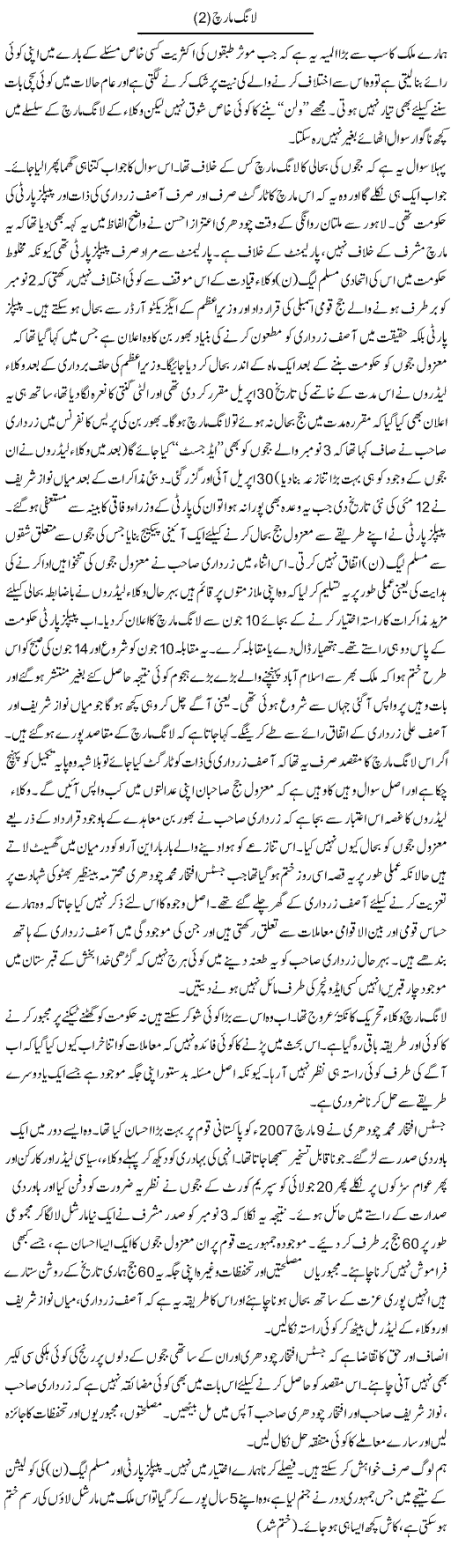


Dharna: illusion or deception? Nazir Naji


Long March? Who was successful? Masood Ashar

..
Marching to disaster —Zahid Hussain
At this stage, when the country faces an economic meltdown and terrorism threatens to tear it apart, the politics of confrontation could have disastrous consequences. What our politicians need to understand is that populism is a double-edged sword and could unleash forces beyond their control
The six-day-long march led by the lawyers that concluded on Saturday morning has left many questions in its wake. It was indeed an impressive show of strength and to a great extent reflected the popular sentiments for the restoration of the judges deposed by President Pervez Musharraf under the state of emergency. But it is not clear how far the rally served its stated objective of pressurising the parliament to reinstate the pre-November 3 judiciary.
The event has intensified political polarisation and left the future of the ruling coalition hanging in the balance. The slogans and the rhetoric witnessed in the rally do not bode well for the future of democracy which has barely taken off the ground and is still in a transition phase. What is more disturbing is the way the vested interests and anti-democratic forces are trying to use the issue to serve their own reactionary agenda. It is not surprising that the march ended on a bitter note, leaving the democratic forces more divided.
It was unprecedented in Pakistan’s history when the lawyers stood up against Musharraf’s March 9 action to sack the chief justice of Pakistan. The lawyers’ movement, aptly described by many as the ‘black coat’ revolution, transformed the country. It galvanised the entire population around the two-point slogan of “democracy” and “rule of law”.
The movement changed the country’s political dynamics and ultimately resulted in a humiliating defeat for Musharraf’s supporters in the February 18 elections. Musharraf’s second coup on November 3, failed to stem the tide. Indeed the restoration of judges was one of key election campaign issues, if not the main one.
It is natural for the lawyers to feel disappointed when the restoration issue dragged on. Both the PPP and the PMLN, the two main coalition partners, agreed on the judges’ restoration, but differed on the approach. The PPP links their reinstatement with a constitutional reform package which is still under process of consultation. Such divergence of views, however, is a part of the democratic process and it is the mandate of the parliament to resolve the issue.
Unfortunately, things have not happened this way. The long march has taken the battle back to the streets. The organisers of the march vowed to besiege the parliament and force the government to concede their demand. That also provided opportunity to rightwing conservative elements, marginalised in the elections, and their allies among retired army officers to reassert themselves. They are least interested in democracy or independence of the judiciary and used the rally as a vehicle to spread their retrogressive message. Their agenda is to turn the wheel of history and return the country to the Ziaist era of Mullacracy.
From the very outset the long march was turned into a PMLN show with the lawyers’ cause taking a back seat. Nawaz Sharif used this platform to vent his anger not only against Musharraf but also launched a veiled attack on the PPP leadership for backtracking on their promise to restore the judges. He made it clear that the ruling coalition could only survive on his condition.
Mr Sharif has smelt blood and wants to avenge his humiliation at the hands of Musharraf and his Generals when they ousted him from power in 1999. “Is hanging only for politicians?” he asked. The crowd responded by chanting “Hang him, hang him.” This kind of confrontationist politics could push the country to civil strife and derail the nascent democratic process. Have we not learnt any lesson from our political history?
At this stage, when the country faces an economic meltdown and terrorism threatens to tear it apart, the politics of confrontation could have disastrous consequences. The country needs statesmanship, not violent rhetoric. What our politicians need to understand is that populism is a double-edged sword and could unleash forces beyond their control. It undermines the parliament when decisions are made on the streets.
Protest is a democratic right of the people, but it cannot override the decision of a democratically elected parliament. A leader of Jama’at-e Islami has given a 48-hour deadline to the government to restore the judges and a group of retired Generals gathered under the dubious banner of Ex-Servicemen Society has vowed to continue the agitation. It is apparent that they do not have any stake in the present system and their main agenda seems to create a situation for another military takeover.
Remember the PNA movement of 1977 and what it led to? Should we allow these elements to repeat the history? (Daily Times)
Zahid Hussain is senior editor Newsline and Pakistan correspondent for The Times, London and The Wall Street Journal. He is also the author of Frontline Pakistan.
Read more...
Saturday, 14 June 2008
The Long March that fell short of its promises...


BBC/Times News/Reuters: With less than 45,000 participants including 1,000 lawyers and their assistants (munshis), 3,000 madrassash students and Mullahs, 3,000 activists of Jamaat Islami and its student wing Jamiat, 500 workers of Imran Khan's PTI, and the remaining participants brought by Pakistan Muslim League-N, the so called Long March proved to be a Short March. It started with humiliatingly low numbers in Karachi, Sukkur and Multan. It created funny scenes such as the Jamiat students beating up the pro-Imran Khan SAC students in Lahore and ended up with an ugly show of noise and indecency by a few thousand activists in Islamabd. Actually the crowd was so uncivilised and unruly that they also tried to beat their own leader Aitzaz Ahsan who was rescued by police. Here is a picture which shows that the total number of participants in the so called Long March was less than 45,000, a figure not even one tenth the claim of 5 lac made by Mr Aitzaz Ahsan.
........
Rally directs anger at Musharraf : BBC
Lawyers hold a rally in front of Islamabad's presidential palace
Pakistani ex-PM Nawaz Sharif has denounced President Pervez Musharraf at a rally demanding the restoration of an independent judiciary.
Arriving during the night at the protest in Islamabad, he told thousands of lawyers and activists that Mr Musharraf must be held "accountable".
President Musharraf sacked the chief justice and about 60 other judges last November under emergency rule.
Hundreds of buses brought protesters close to parliament in the capital.
They arrived at 0200 on Saturday (2000 GMT Friday) and crowds have been milling close to the floodlit building to hear speeches by Mr Sharif and others.
'Hang Musharraf'
Mr Sharif, who is in the new coalition government, has pulled his ministers out of the cabinet in protest at the government's failure to keep its promise to restore them to office.
On Saturday, he turned his anger towards Mr Musharraf as some in the crowd, numbering at least 15,000, chanted "Hang Musharraf!".
......
Some lawyers continue sit-in in Islamabad (The News)
ISLAMABAD: Some of the lawyers have announced to continue sit-in till the restoration of deposed judges despite that lawyers long march has ended in Islamabad. More than twenty lawyers and representatives of civil society staged sit-in outside Parliament House in contrast of the stance of lawyer leader Aitzaz Ahsan. The protesting lawyers said that they would continue sit-in till the restoration of deposed judges.
Read more...
Subscribe to:
Posts (Atom)





