Editor's Choice

--------------------------------------------------------------------------------------------------------------------------
Featured Post
--------------------------------------------------------------------------------------------------------------------------

"Let us build Pakistan" has moved.
30 November 2009

All archives and posts have been transferred to the new location, which is: http://criticalppp.com

We encourage you to visit our new site. Please don't leave your comments here because this site is obsolete. You may also like to update your RSS feeds or Google Friend Connect (Follow the Blog) to the new location. Thank you.


--------------------------------------------------------------------------------------------------------------------------
Showing posts with label Irshad Ahmed Haqqani. Show all posts

Sunday, 8 November 2009

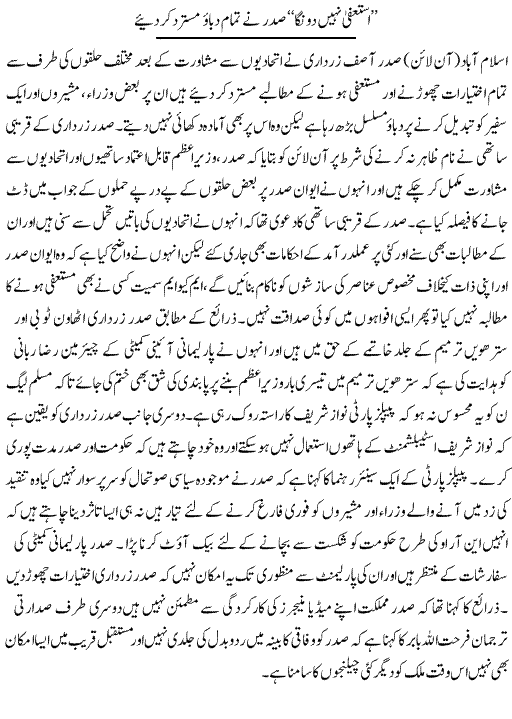
Get rid of your current cronies, President Zardari.


In the words of Hasan Askari Rizvi, the NRO setback can be attributed to President Asif Ali Zardari and his close associates who failed to understand the ground political realities outside the presidency. They appear to be less inclined towards recognising the importance of consultation and accommodation in politics. Instead, they decided over and above the prime minister to send the NRO to the parliament and did not feel the need of consulting the coalition partners on this issue. They were trying to run the 4-party coalition like a single party (PPP) government.

This was not for the first time that the presidency functioned in an autocratic manner. It kept the coalition partners in dark on the restoration of the chief justice and other judges and the Kerry-Lugar bill. The same strategy was adopted on the NRO but, in this case, as the approval of the parliament was needed the partners got the opportunity to express their resentment by refusing to vote in favour.

The presidency’s isolation can also be attributed to its policy of not accommodating the PMLN on the Charter of Democracy and especially on reduction of powers of the presidency. Despite repeated commitments, the presidency refused to take any concrete measure to fulfil its obligation on these issues, ostensibly for not giving any concession to the PMLN. (Source)

‘Zardari’s media advisory team an utter failure’

Islamabad, Sep. 15 (ANI): Pakistan President Asif Ali Zardari’s media advisory team has drastically failed to counter the negative publicity against him.

According to The Nation, the team of politicians looking after the political affairs at the Presidency, including Rukhsana Bangash, Faranaz Isphahani and Senator Faisal Raza Abedi, were rarely seen working for image building of Zardari.

Even the presidential spokesman Farhatullah Babar does not receive calls after 10.00 pm to comment on some of the very important issues or the meetings taking place in the Presidency, the report added.

At the Iftar-dinner at presidency, Zardari’s media handling came under criticism when only a few anchorpersons were allowed near his table. Zardari spoke on many sensitive issues but most journalists could not listen anything.

Some journalists saw this as a failure of Zardari’s media team which should have asked him to keep the event informal and not divulge on sensitive matters like deal with former President Pervez Musharraf.

Manny senior PPP leaders have also expressed displeasure over the way the people around Zardari were handling the affairs – be it his public image or handling of the party affairs.

They were not happy with the way Zardari is isolated from the party leaders and workers in the name of security. (ANI)

Zardari not satisfied with his media managers - Express News


A similar advice was offered by Irshad Ahmed Haqqani in the following op-ed:


Read more...

Sunday, 8 February 2009

Diamer Dam and the rights of people of Gilgit-Baltistan - Irshad Ahmed Haqqani

[col1.gif]


Also read:

http://letusbuildpakistan.blogspot.com/2008/11/diamer-bhasha-dam-controversy-rights-of.html
Read more...

Wednesday, 4 February 2009

In appreciation of Imran Khan, the philantropist - by Irshad Ahmed Haqqani

[col2.gif]
Read more...

Thursday, 8 January 2009

Jinnah, Ayesha Jalal, Safdar Mehmood, Irshad Haqqani, Khurshid Nadeem - an interesting debate

[Irshad+haqqani+8Jan09.gif]

[col4.gif]

[col4a.gif]
[col1.gif]

[col1a.gif]

[1100560067-2.gif]

[l_col2.gif]

[l_col2a.gif]

[col1.gif]

[col1a.gif]

[Safdar+7Jan09.gif]
[col1+3Jan09.gif]

[col1a3Jan09.gif]

[col24Jan09.gif]
[col2a4Jan09.gif]


[col16Jan09.gif]

[col3.gif]

[col3a.gif]
also read:


Read more...

Sunday, 14 December 2008

Remembering Benazir Bhutto. How does her Foreign Secretary Agha Hilali describe her? By Irshad Ahmed Haqqani


Jang, 13-14 December 2008
Read more...

Friday, 14 November 2008

Well done, Chaudhry Nisar Ali Khan! Wake up Zardari.. Enough talking, time for action NOW... by Irshad Haqqani, also another view by Abbas Ather...

By Irshad Haqqani

[col1.gif]


Other side of the picture - by Abbas Ather:


[1100520578-2.gif]

......

Chaudhry Nisar’s fulminations


The PMLN leader of the house in the National Assembly, Chaudhry Nisar Ali Khan, has made a fiery and rhetorical speech against the PPP government and President Asif Ali Zardari. This was supposed to please all the elements pushing Pakistan into extremist postures, but it has not. Fronting his clearly moderate leader Mr Nawaz Sharif, Chaudhry Sahib has forced many people, wrongly we hope, to think that Mr Sharif runs a double-faced policy, reserving reconciliation for himself and letting his hawks destabilise the government he has vowed not to destabilise. But we gather that Mr Sharif’s approval was not obtained for this speech. Chaudhry Nisar needs to realise that this is not the time to play to the galleries or create ripples in the fledgling political system in which the ruling colaition is not yet even one year old. It reinforces the suspicion in PPP circles that the PMLN is gearing up to swallow the PMLQ prior to launching a vote of no-confidence in Islamabad, which perception in turn may precipitate action by the PPP to thwart such a move by trying to get rid of the PMLN government in Punjab, which would bring about the very unstable situation that both want to avoid for the sake of the country. (Daily Times)
Read more...

Sunday, 28 September 2008

Friends of Pakistan Consortium: Zardari's success


By Irshad Ahmed Haqqani
Read more...

Sunday, 22 June 2008

My choice today: Sunday 22 June 2008 - Swat Accord, Peace Deals with Terrorists; Marvi Benazir, The Lawyers Movement

The restoration of judges – Irshad Ahmed Haqqani

Marvi, Benazir – Abbas Mehkari

Swat accord

WHILE every effort ought to be made to salvage the peace deal struck with the Swat militants on May 21, Maulana Fazlullah and his men cannot be allowed to dictate terms. After all, only a month has passed since the accord was signed while Swat has been wracked by militancy for years. The writ of the state is still being established in the district’s more troubled regions and it is naïve to demand that all army troops be pulled out on short notice — by next Tuesday to be exact. What the militants should accept, and the state must concede not an inch more, is a phased withdrawal. If troops left the area en masse, who would ensure that the Swat Taliban are indeed living up to their side of the bargain? The police and local administration? Highly unlikely, given the latent firepower of the militants. At best, local officials can monitor the situation but they are in no position to enforce the terms of the deal: no private militias, no obstruction in the way of girls’ education and polio vaccine campaigns, cessation of attacks on barber shops and music outlets, a ban on the display of weapons and manufacture of explosive devices, dismantling of suicide squads, etc. For these and other reasons, a military presence is essential in the short term. Under no circumstances can the Taliban be allowed to regroup, recruit and otherwise strengthen themselves, which is precisely what happened after the September 2006 deal with militants in North Waziristan.

Enforcement of Sharia law in Swat is also not as straightforward as the Taliban make it out to be. True, the government accepted this demand on May 21 but the modalities of the new legal system need to be worked out and that will naturally take time. Dispensation of justice cannot be summarily handed over to the Taliban — it has to remain within the framework of the state irrespective of the changes being mulled. The release of militants captured by security personnel is a relatively simpler process, but there too a case-by-case review is perhaps in order.

It also needs to be asked why the Swat militants are in such a hurry. Does their urgency have anything to do with the ongoing surge in Taliban activity on the other side of the Durand Line? The militants must realise that laying down arms and making peace with the government is not only in the interest of Pakistan but also their own. If they resort to violence yet again, the military will be left with no option but to launch another crackdown. Worse, outside forces may take on the job without anyone’s permission. (Dawn).


Today’s despot may be tomorrow’s statesman

By Robert Fisk

HOW are the mighty fallen, we used to say. Now we turn it round. How did the fallen become mighty again? Remember the “mad dog of the Middle East” — Reagan’s stupid cliché — the “terrorist” sponsor who even sent a shipload of guns to the IRA?

A certain Moammar Qhazafi — there are 17 different ways of spelling his name in Latin script — was the crazed leader of Libya who wrote a mind-numbingly boring volume of pseudo philosophy called The Green Book and who wanted to mock the White House by calling his own palace the Green House until someone tipped him off that this would mean he would look even more of a cabbage than he already was.

Then suddenly, he gave up some imaginary weapons of mass destruction and Anthony Blair, now the commercial director of World Faith, went out to fawn over him in Tripoli and he was called “statesmanlike” by the absurd Jack Straw and then he was invited to Paris by the even more absurd Nicolas Sarkozy where he right royally made the French president look like a twat by behaving in an extremely unstatesmanlike way.

And now — bingo — Sarkozy has done it again. This time it’s Bashar al-Assad, another presumed “sponsor of world terror” — this twaddle comes from Washington, of course — who will (if he accepts the invitation francaise) be in Paris on Bastille Day to take his place in the reviewing stand at the end of the Champs Elysees. The man whom millions of Lebanese believe plotted the murder of former Lebanese prime minister Rafiq Hariri in Beirut on 14 February 2005 will thus be receiving one of France’s highest honours: to stand beside the French president as he reviews his military forces.

Le Canard Enchaine, my favourite French newspaper, carried a wonderful cartoon this week in which an extremely good likeness of Bashar asks Sarkozy and the gorgeous Carla: “What is it exactly, your 14 July?” And Carla replies: “It’s the end of a tyrant.” And Sarkozy, almost lost for words, then adds: “Er — a king.” Well quite. And both apply to Bashar, whose succession after his father’s death in 2000 did rather suggest that Syria was now a caliphate (as Egypt will become if Uncle Hosni is succeeded by his son Gamal Mubarak). But seriously, how did Bashar, a hate-figure of the United States and an adjunct to Bush’s crazed notion of the “axis of evil”, get on the guest list? Sure he’s been asked to attend France’s spanking new “Union of the Mediterranean” (along with Ehud Olmert), but there’s more to it than that.

For one thing, both he and Sarkozy smell American failure. The American disaster in Iraq — and in Afghanistan (a movie coming to your local cinema soon) — and its total failure to produce a peace between Israel and the Palestinians and the loss of Lebanon as its protege (now that the pro-Syrian Hezbollah can veto America’s friends in the parliamentary majority once there’s a cabinet) means that France can move in among the wreckage for a second crack at le mandat francaise.

The tribunal to judge Hariri’s murderers still does not exist and even Walid Jumblatt, my favourite Druze nihilist, has been in Saudi Arabia to ask the king to keep pushing for the court. He did the same in Washington, chatting to Bush and Gates and the rest along the same lines. But the United States has failed in the Middle East.

Bashar is thus to be allowed back into the civilised West, which Jacques Chirac once encouraged him to visit before feeling betrayed after Syria’s apparent involvement in Hariri’s murder. My own suspicion is that Baath party security was involved in the mass assasination, but not Bashar.

Either way, it’s only 17 months since Chirac’s foreign minister, Philippe Douste-Blazy turned up in Beirut for the funeral of young Pierre Gemayel (assassinated, the usual fingers pointing towards Syria yet again) to announce that Chirac was “the best defender on earth of Lebanon’s sovereignty”. Now, it seems, Sarkozy is the best defender on earth of Syria’s sovereignty. And of Bashar.

Of course, all this is presented in what I call the politics of candlelight. Olmert may meet Bashar al-Assad, the French tell us, and thus further their indirect peace talks. It’s time to bring Syria in from the cold — which is why two of Sarkozy’s top henchmen have been in Damascus, buttering up the Syrian president in the hope he won’t turn down the trip. France will be able to encourage Bashar to behave in Lebanon, open an embassy in Beirut, delineate the Lebanese-Syrian border, blah, blah, blah. It’s a reward, too, for Bashar’s support for the Doha conference which ended — up to a point — Lebanon’s latest bout of sectarian sickness, albeit to the advantage of Sister Syria herself.

Now the Lebanese parliamentary majority is groaning about Bashar’s visit. So is France’s largest Jewish organisation, although not very successfully; last time the Syrian president visited Paris, it symbolically blamed him for the Nazi Holocaust of Europe’s Jews, which ended well over a decade before Bashar was born. Now even that elegant old butterfly from Libya is objecting to the “Union of the Mediterranean”. Yes, the “statesmanlike” panjandrum Qadhafi denounced the whole shebang with the immortal words:

“We are not dogs to whom they throw bones.” Sarkozy should have guessed.

This was, after all, the same Qadhafi who turned up at a non-aligned summit in old Yugoslavia — this from a former Serbian diplomat friend of mine — with a camel and a white horse, the first to provide milk, the second to ride through the streets of Belgrade en route to the conference. He got to keep the camel. The horse was banned.

But that’s how things go when you see yourself as a “guide” — Qadhafi’s description of himself; oddly the very same term used by A Hitler — and there really is no knowing what happens to wayward folk when they climb on our wheel of fortune. We gave Kurt Waldheim an honourary knighthood, then withdrew it when we found out he had a dodgy Second World War past. We took away Ceausescu’s knighthood when he was executed on Christmas Day. We loved Saddam when he tortured and killed all his communists — when mayor of Paris, Chirac fawned over him too — and when he invaded Iran, then hated him when he invaded Kuwait and were happy to see him hanged 17 years later.

Fear not, such a fate will not await Bashar. He will honour the downfall of the tyrant-king and he will no doubt receive economic help from France. And thus his people will not have to eat cake.— © The Independent.
Read more...

Sunday, 15 June 2008

My choice today: Sunday 15 June 2008; Long March: gains and losses,

The long march: gains and losses (no more than 40,000 participants) – Irshad Ahmed Haqqani

Long march ends on bitter note

By Syed Irfan Raza

ISLAMABAD, June 14: The lawyers’ long march ended on a bitter note after a group of lawyers and political activists insisted on staging a sit-in outside the Parliament House and accused Aitzaz Ahsan of striking a ‘deal’ with the government.

About 50 agitated protesters tried to scale the ship containers set up at the D-Chowk and enter the protected area where the Parliament House, President House and Supreme Court are located.

They removed barbed wires and beat up some security personnel. They said they had been promised that their protest would continue until their demands were met.

Aitzaz Ahsan, the president of the Supreme Court Bar Association (SCBA), delivered an emotional speech and said that those who were accusing him of striking a deal should realise that he had once turned down an offer of premiership made by the president.

“The president told me that he could ask the then prime minister, Shaukat Aziz, to step down ‘in 15 minutes’, but first I had to stop supporting the deposed chief justice.”

Mr Ahsan said he had sacrificed a lot for the cause and refused to become a joint PPP-PML-N candidate for two National Assembly seats. “I can assure you that I or my colleagues cannot compromise on the issue of the judiciary,” he told the people who wanted to proceed towards the Parliament House.

Persuading them to disperse peacefully, he said: “One thing which I did not want to say before the full glare of the media is that if we go ahead and stage the sit-in, this huge gathering will dwindle to just 2,000 and the impact of this show of strength will be spoilt.

“We will not relent on the issue until independent judges are reinstated,” he said.

Urging the people to go home, Mr Aitzaz said: “We will fight the war at the right time and at the right place.”

Earlier during the rally, lawyers, representatives of civil society and politicians called for President Pervez Musharraf’s resignation and the reinstatement of deposed judges, including Justice Iftikhar Mohammad Chaudhry, ‘with honour and dignity’.

Participants of the largest demonstration in Islamabad yet criticised the role of Pakistan People’s Party (PPP), especially Asif Ali Zardari, and accused it of delaying the restoration of the judiciary.

They said the time had come for President Musharraf’s impeachment, adding that he should be held accountable for his nine-year-long ‘misrule’.

“President Musharraf will not be given safe passage. He will be impeached and held accountable for his deeds,” chief of the Pakistan Muslim League-N Nawaz Sharif said.

“The president must be held accountable for the killing of innocent children in the Jamia Hafsa and the Lal Masjid, unprecedented price hikes, shortage of flour, the killing of 50 people in Karachi on May 12 last year, military operations in Balochistan and tribal areas and the virtual collapse of the economy,” Mr Sharif said.

The lawyers’ long march turned into a public meeting in Islamabad and was attended by representatives of civil society, ex-servicemen, workers of the PPP, PML-N, Jamaat-i-Islami, Pakistan Tehrik-i-Insaaf, the Khaksar Tehrik, doctors, former diplomats, Madressah students, traders and businessmen and remained at the parade venue for more than 14 hours – from 3pm on Friday to 5am Saturday.

The PML-N chief, who joined the gathering at 3am, urged participants to keep up the pressure. “I can see the country’s destiny changing because of your tremendous resolve.”

Mr Sharif said that he could not understand why the PPP co-chairman was reluctant to honour the Murree Declaration. “Although I am a coalition partner, I will always support the lawyers’ demand … for restoring the pre-Nov 3, 2007, judiciary.”

However, he urged the protesters to avoid staging a sit-in because they had recorded their protest and given a stern message to the circles concerned. “This was the first step. My party is with you. We will come again … but before staging the sit-in (in front of the Parliament House), all stakeholders must agree, otherwise we will leave,” Mr Sharif said.

A timely interference by some lawyers stopped a group of young protestors from proceeding farther into the Red Zone, otherwise an uncontrollable law and order situation could have arisen.

The programme ended at 5am and people dispersed except for some youths who kept their vigil till 3pm on Saturday.

Adviser to the Prime Minister on Interior Rehman Malik, along with senior security officials, visited the venue and expressed satisfaction over the peaceful conclusion of the protest. Terming the lawyers’ protest a success, the adviser estimated that about 20,000 people had attended the event. (Dawn).

Beyond the long march

FRIDAY’S rally in Islamabad by lawyers and their political allies was a significant event by all accounts and one that fairly reflected the public mood. Credit must equally be given to the organisers and the capital’s administration for seeing the event through in a peaceful manner given the numbers that had converged on Islamabad from across the country. Both sides kept their promises: the lawyers and the participating political parties ensured that the crowd did not become unruly or go beyond the designated area; the Islamabad administration facilitated rather than obstructed the event. The decision by the organisers not to stage an indefinite sit-in in front of parliament and instead disperse after they had made their point was a prudent one. This should give the federal government the face-saving it so desperately sought as the crowds swelled through Friday and into Saturday morning. The time for parliament to take up the issue of the judges’ reinstatement is now. Stretching it any further will not benefit anyone, least of all the PPP which is increasingly seen as dragging its feet on the issue despite having made commitments to the contrary.

As for the participants in the long march, their disparate rhetoric made it clear who took part and for what cause. The lawyers want the restoration of the judges first and foremost; the PML-N, the Jamaat-i-Islami and the Pakistan Tehrik-i-Insaf want President Musharraf impeached and brought to book for his extra-constitutional actions; the nationalist and Islamist groups want compensation for the wrongs committed against them and guarantees that they would not be uprooted and their leaders imprisoned or killed; families of the missing persons demand their loved ones back. That’s quite a list, and one that the government cannot easily ignore if it does not wish to see a repeat of Friday’s protest against its policies; the next one may not pass as peacefully.

Mercifully, the stage has not come just yet when ordinary people regardless of whichever party they voted for but reeling as they do under the burden of economic hardship, the energy crisis and so many other issues that affect them everyday, will join anyone out to rock the boat of democracy. The overabundance of piled up issues, many of which the current rulers have inherited as a legacy of bad governance that preceded them, is waiting to be addressed. As parliament takes its time debating the judges’ issue or the president’s impeachment, if at all, there is little justification for not taking on menaces like load shedding, the flour shortage, spiralling crime rate and food price inflation, for instance. Also, the making and breaking of peace deals with extremist elements the US-led Nato forces are chasing inside Pakistan calls for a clearer policy the lack of which has added to the government’s predicament in Fata and elsewhere. (Dawn).

Long march ends without roadmap

* Some young lawyers protest after Nawaz advises Aitzaz, other lawyers’ leaders to take all decisions after consultation

By Rana Qaisar 

ISLAMABAD: The lawyers’ long march ended without any roadmap for future strategy leaving many, who wanted the leadership to announce an indefinite sit-in until the reinstatement of the sacked judges, flabbergasted.

The long march caravan that reached its culmination point in the wee hours of Saturday dispersed early morning with a majority of young lawyers disappointed as Supreme Court Bar Association (SCBA) President Aitzaz Ahsan announced that no decision had been taken to stage a sit-in in front of parliament. 

The long march show, which had already been overshadowed by the workers and supporters of the Pakistan Muslim League-Nawaz (PML-N), became a political event with the arrival of Nawaz Sharif who held parliament responsible for not restoring the judges. Covertly pointing the finger at Asif Zardari, Nawaz Sharif said: “I don’t understand why a resolution, despite an agreement, is not being tabled in parliament.” 

Addressing the participants of the long march, he said President Pervez Musharraf should be hanged. “We asked you (Musharraf) to quit with honour after the election but you didn’t…the people have now again given a judgement and want you to be held accountable,” he said, adding that Musharraf should not be given a safe exit.

“Is hanging only for politicians?” he asked and said: “These blood-sucking dictators must also be held accountable.” When he said Musharraf should be tried for treason, the participants shouted, “go-Musharraf-go”. 

He rejuvenated the lawyers by telling them that he saw in them “the dawn of a new era…your passion will restore the supremacy of the law, restore the judges and punish this dictator”. 

Mutual consultation: But at the same time he gave an unexpected twist to the lawyers struggle by advising Aitzaz Ahsan and other leaders of the movement that after the long march, all decisions should be taken by mutual consultation. 

This created doubts in the minds of the lawyers about the future strategy after the culmination of the long march and they started shouting slogans against Aitzaz Ahsan without naming him. A group of young lawyers and political workers, who had come to stage a sit-in as a follow-up of the long march, felt betrayed and attempted to cross the barbed wires to enter the Red Zone but the administration engaged them to prevent any clash. 

No end: However, angered by the young lawyers’ slogans, Aitzaz could not hide his feelings and told them that he was deeply hurt to see them feeling betrayed. “There will be no closure of this issue until the fearless, independent judges are reinstated,” he repeatedly said.

However, he did not support calls from a group of young lawyers and political workers to announce a sit-in outside parliament to press for restoration of the judges. “We will fight the war at the right time and at the right place,” he said, and referring to Nawaz Sharif’s advice, he told the participants that all future decisions would be taken with mutual consent. 

The lawyers continued demanding him to announce that he should announce the next strategy but he skilfully avoided the issues and at the end of his speech said: “no decision has been taken for sit-in” and with this he ended his speech and the long march that started on June 10 from Karachi came to an abrupt end in Islamabad. (Daily Times).

Who is the movement against?

The impressive gathering in front of the parliament in Islamabad in the early hours of Saturday is supposed to have sent a particular message to certain quarters. What did the message contain? Was there one message or more than one? For whom was it meant? What impact did it have? If there was a message or messages, were they being articulated by one party or many? Who were the people in the big crowd in Islamabad ? Unfortunately, the answers to these questions are not clear. There are as many answers as there are contenders in the movement.

Analysts of the phenomenon are of two kinds: those who support the gathering with a cool and rational head and those who cannot prevent their anger and passion from slipping into their assessments. So there is virtually no impartial observer. 

There are 130 district bars in Pakistan and the total number of lawyers in the country is just over 100,000. The long march and gathering was supposed to be of the lawyers’ movement but it was forcefully strengthened by support from a clutch of political parties and sections of civil society formations. There were men, women and children and babies, too, suggesting that overwhelmingly the mass of the people was from the local population of Islamabad and Rawalpindi. There were political parties too, led by the dominant PMLN which rules in Punjab. The APDM rejectionist group was there too, with the Jamaat-e-Islami of Qazi Hussain Ahmad and Tehreek Insaf of Imran Khan making their presence felt. 

Some political parties were conspicuous by their absence. The largest party, the PPP, was not there although it was claimed, without proof, by some observers that some PPP lawyers from Gujrat had joined the march. From among the religious parties, the peripheral Khaksar Tehreek was there but not the JUI of Maulana Fazlur Rehman; nor was the MQM represented, which actually has been designated by the movement as a “hostile” entity. The PMLQ sitting in the opposition was not there either although its stance is carefully non-hostile to the lawyers, despite the way their leader from Mianwali, Dr Sher Afgan Khan, was treated in Lahore. 

What was the message? The movement had decided that instead of the residence of President Musharraf, it would target the parliament. Although “go Musharraf go” was the collective slogan of the evening, the lawyers said they wanted the deposed PCO-2000 judges reinstated through an executive order and they wanted the PCO-2007 judges ousted. The PMLN, thanks to whom the Long March could gather steam as it passed through Punjab, was clearly asking the president to quit. The party firebrands who addressed the crowd left no ambiguity in their statements that they wanted the president to face impeachment and a trial for high treason. But Mr Ahsan said the march was to pressurise parliament to do the needful.

The people who listened to the speeches included citizens who wanted to hear negative things about a past regime that had given them prices they could not afford and the suffering through loadshedding that was beyond endurance. Among these, most were from the lower middle class who thought the lawyers and the political parties would together bring the prices down, make essential goods easily available, and banish loadshedding. But the message from the leader of the lawyers, Barrister Aitzaz Ahsan, was that the restoration of the judges under the deposed chief justice Iftikhar Muhammad Chaudhry would lead to an economic upturn in the short term which would alleviate the people’s suffering. 

On-the-spot analysis on TV said the gathering was not against the sitting government and one senior editor said that, like the anti-Qadiani movement of the 1970s, it was based on principles desiring change of constitution and policy. Another analyst said that the rally was against the PPP and the show did not belong to the lawyers as much as to the PMLN which was sending a message to its ally the PPP. It was also opined that in the coming days, the gulf in the coalition would widen and the PPP would be required to show as much, if not more, strength or lose the support of the masses. More emotionally, the print media analysts blamed the PPP and its leader Mr Asif Ali Zardari of being “on the wrong side of the people of Pakistan”. 

The PPP thought it could blunt the direction of the onslaught by facilitating the Long March inside Islamabad. It even offered food to the crowd but the lawyers turned it down, clearly indicating their intent to make the PPP change its mind on the methodology of restoring the judges through its constitutional package. Discussions on TV did focus on the matter of the National Reconciliation Ordinance (NRO) which is supposed to balk the PPP, but no one suggested that the lawyers’ movement, instead of pushing the PPP into a suicidal decision, should show it the way out, which of course will have to be the middle way. 

The movement is clearly converging to confrontation with the PPP, which will create undue instability and hurt the economy currently being discussed in the National Assembly. After the PMLN ducked out of it, the PPP emerges as the sole custodian of the budget 2008-09, and the hardship it promises even as it tries to alleviate the suffering of the poor with concessions will weaken Islamabad’s will to fight all the battles facing it. (Daily Times)


Read more...