Editor's Choice

--------------------------------------------------------------------------------------------------------------------------
Featured Post
--------------------------------------------------------------------------------------------------------------------------

"Let us build Pakistan" has moved.
30 November 2009

All archives and posts have been transferred to the new location, which is: http://criticalppp.com

We encourage you to visit our new site. Please don't leave your comments here because this site is obsolete. You may also like to update your RSS feeds or Google Friend Connect (Follow the Blog) to the new location. Thank you.


--------------------------------------------------------------------------------------------------------------------------
Showing posts with label Hazara. Show all posts

Sunday, 8 November 2009

Will the Talibanic journalists and politicians ever speak about it?


On the run


Target killing in Balochistan is rising, with more and more non-Baloch officials and Shia Hazaras seeking safe shelter elsewhere in the country

By Adnan Adil

Following the killing of three Baloch leaders -- Munir Baloch, Ghulam Mohammad and Sher Mohammad -- in Turbat last April, target killings in Balochistan have risen sharply. The main victims are: non-Baloch officials connected to the field of education and Shia-Hazaras of Quetta.

In October, all major incidents of target killings involved teachers or education officials. On Oct 31, 2009, Secretary Balochistan Board of Intermediate and Secondary Education was seriously injured when unknown armed men shot at him in Quetta's Satellite Town. He was on his way from his home to the office. He suffered multiple injuries on his head and other parts of the body. A day earlier, two employees of Cadet College Mastong, Amjad and Munawwer, Punjabi settlers in Balochistan, were shot dead. On Oct 25, the Provincial Education Minister Shafiq Ahmed Khan was shot dead in Quetta near his home. On Aug 7, another Provincial Minister Rustam Jamali was killed in Karachi. Last year, on Oct 19, the house of Province's Information Minister Younus Mullazai was attacked with a hand grenade. The minister was out of town thus escaped the murder attempt.

Earlier, according to reports, the principal of Quetta's Commerce College, the vice-principal of Balochistan Residential College in Khuzdar, the principal of Pilot High School in Mastung, the principal of Sariab Mills High School, a professor of Government Degree College and newly-appointed vice-chancellor of Balochistan University in Quetta, Safdar Kiyani, have been victims of target killing in the province.

Baloch Liberation Army (BLA) and other militant Baloch organisations have taken the responsibility of killing at least 238 citizens in Quetta including professors, teachers, surgeons and lawyers. The day the provincial minister, Shafiq Khan, was shot dead, Shehak Baloch, who identified himself as a member of Baloch Liberation United Front, (BLUF) telephoned a news wire agency in Quetta, claiming the responsibility of the murder. Shehak was reported to have told the news agency that Khan was killed to avenge the murder of three Baloch leaders in Turbat. He also said the slain minister was anti-Baloch.

Most professors in Balochistan University are from Punjab or Karachi, and have received letters threatening them to leave Balochistan. The letters reads: "We are from Balochistan Liberation Army. You should leave this province." Due to fear, 20 university's teachers have got themselves transferred to Sindh or Punjab; 120 university teachers have requested for the transfer out of Balochistan; 10 professors take classes with gun men guarding them. Most of the teachers have shifted their families to Punjab and other parts of the country.

In addition to a sizeable population of Hazara tribe in the Quetta city, there are a large numbers of settlers from Punjab, Sindh and Afghanistan who identify themselves with Balochistan. Many families migrated to and settled in Quetta post-1935 earthquake.

Dr Safdar Kiyani was the most senior professor in the Balochistan University and was shot dead the day he was appointed the VC. His two sons have migrated from Quetta. No Baloch political party or leader condemned his killing and none of them attended his funeral prayer. No Pushtoon or Punjabi teacher wants to conduct examinations in Baloch areas. The government has opened new campuses of the University in Turbat and Loralai so that the teachers can continue their work.

The business community is also feeling the heat of violence. Muhammad Nadeem Khan, a representative from the Chamber of Commerce and Industries, Quetta says, "the law and order situation is so bad in Quetta that businesses close early evening. "
Businessmen say all members of the business community pay extortion money (bhatta) to political groups. A large number of businessmen are migrating from the city for safety reasons.

The Hazara community maintains that it is being forced to leave Quetta -- by selling their businesses and property at throw-away prices. They say pamphlets that threaten them to leave and sell their houses are being distributed. Members of the Hazara community are abducted often and the ransom money varies between one to four million rupees.

Nearly 22,000 government employees have applied for the transfer out of the province. Due to fear, a large number of educational institutions are closed all over the province and only one boys' college is open in the Quetta city. Ratan Chand of the Teachers' Association says for the last couple of years two to three cases of abduction for ransom take place in Quetta every month.

Professor Nawaz Soomro, an office-bearer of the Teachers' Association, says two teachers -- one belonging of the Government Degreee College Saryab Road, Quetta and the other to Government Commerce College Road, Quetta -- were killed but their alleged murderers were not arrested. He said no public official condemned their death.

Hazara community representatives say not one government official has condoled the target killing of Hazara people and no compensation money is offered to victims' families. Dawood Agha, the Senior Vice-President of Balochistan Shia Party, has lost six members of his family including his younger brother in sectarian violence. He says, since 2003 more than 260 Hazaras have been murdered and more than 1000 have suffered injuries in the attacks.

The community leaders are highly suspect of the role of security agencies. Dawood Agha alleges that security agencies and the government are protecting the perpetrators of the crime. As an example, he cites, the escape of two convicted sectarian criminals -- Usman Saifullah Kurd and Shafeeq Rind -- from the well-guarded jail of Anti-Terrorist Force (ATF) in Quetta. They were associated with the anti-Shia organisation, Lashkar-i-Jhangvi. Shafeeq Rind was arrested five months later but Usman is still missing.

"Another accused terrorist, Daud Badini, is in jail but is said to be enjoying the facilities of a five-star hotel," says Agha.

A number of Shia lawyers have been shot dead, including the recent murder of Advocate Wilyata Hussain in Quetta.

The victims of target killings also include five and six year old children. Aghai Akbar Hussain Zahedi, a leader of the Shia Ulema Council, says: "Terrorists have become so daring that they openly swear in the courts that after being released from jail they will target more Shias. The accused are arrested in the morning and released in the afternoon."

Haji Abdul Qayyum, Chairman of Hazara Qaumi Jirga, say that the accused dare the judges to convict them.

A banned sectarian organisation, Sipah-i-Sahaba, is said to have become active with the new name of Jamaat Ahle Sunnat in Balochistan. In Aug 2009, a Shia religious leader, Allama Maqsood Ali Donki, was killed in a grenade attack by two assailants. The police killed two assailants on the spot. Next day, Jamaat Ahle Sunnat brought out a protest demonstration against the killing of the assailants.

The distrust of the government runs deep and its inaction makes its role suspicious. Two tribunals were set up on the killing incidents of 2004 and 2008, but their findings have not been made public to date. The conspiracy theories abound involving India, the US and local security agencies responsible for spreading violence. Many Shia leaders in Quetta allege that the sectarian outfit Lashkar-i-Jhangvi and its sister organisation, Jundullah, comprise of Sunni Baloch militants who are also active in Iran. In their conspiracy theory, Jundullah enjoys the patronage of local security agencies and the CIA, as it has been created to destabilise the neighbouring Iran.

On the other hand, the Pakistan government has officially blamed India for fomenting violence in Balochistan and funding militant Baloch organisations.
For ordinary citizens in Balochistan, affected with the spate of violence since the last six years, with little protection available from the state, survival seems to be the main worry. As a result, an exodus of non-Baloch from the province continues -- for more than 50,000 people have so far left their homes.

The writer was member of the fact-finding mission of Human Rights Commission of Pakistan that visited Balochistan between Oct 3 and 10, 2009.

http://www.jang.com.pk/thenews/nov2009-weekly/nos-08-11-2009/dia.htm#4

Read more...

Monday, 2 March 2009

Quetta: 2 March 2009: 2 more Shia killed by Humayun Jogezai and his associates in Taliban

Quetta Police Chief, Humayun Jogezai has been once again successful in engineering and executing another round of Shia killings.

Innocent people of Quetta demand an honest police officer such as Shoaib Suddle to be appointed in place of terrorist Humayun Jogezai.

Father, son killed in sectarian violence

By Malik Siraj Akbar

A man is evacuated after the mosque attack

In an apparent act of sectarian violence in Quetta, unidentified men murdered a man and his son, both from the Shia sect. The attackers opened fire on the victims at their shop on Quetta’s Double Road. Haji Sakhi and his son, Ghulam Ali, died on the spot. The murderers, who were riding a motorcycle, fled. No one has accepted responsibility for the killing. Separately, a policeman was killed in western Panjgur district in a clash between robbers and the police. The policeman, Mujahid, was killed and another policeman was injured. (Daily Times, 2 March 2009)

کوئٹہ میں فائرنگ دو افراد ہلاک

ہلاک ہونے والوں کے ایک رشتہ دار

کوئٹہ میں ٹارگٹ کلنگ کا سلسلہ جاری ہے اور اتوار کی شام نامعلوم افراد نے فائرنگ کرکے باپ بیٹے کو ہلاک کر دیا ہے جبکہ اقوام متحدہ کے اہلکار کو اغواء کرنے والوں نے اپنے مطالبات کو تسلیم کرنے کے لیے دی جانے والی مدت میں چار دن کی توسیع کر دی ہے۔

پولیس کے مطابق ڈبل روڈ پر اتوار کی شام نامعلوم افراد نے ایک دکان پر کام کرنے والے باپ بیٹے کو فائرنگ کرکے ہلاک کر دیا ہے۔ پولیس اہلکاروں نے بتایا ہے کہ ہلاک ہونے والے افراد کا تعلق اہل تشیع سے تھا۔

اس بارے میں پاکستان عزاداری کونسل کے رہنما رحیم جعفری سے رابطہ کیا تو انہوں نے کہا کہ حکومت ٹارگٹ کلنگ کے واقعات پر قابو پانے میں مکمل طور پر ناکام ہو چکی ہے اور اب بلوچستان میں گورنر راج نافذ کر دیا جائے۔

انہوں نے کہا کہ ان کی ہزارہ برادری اور اہل تشیع کے افراد کو مسلسل نشانہ بنایا جا رہا ہے اور اس بارے میں انہوں نے کور کمانڈر گورنر اور وزیر اعلی بلوچستان کے علاوہ وفاقی مشیر داخلہ سے رابطے کیئے ہیں لیکن ان کی سنوائی نہیں ہو رہی۔

بلوچستان میں ٹارگٹ کلنگ کے واقعات میں سن دو ہزار چار میں شدت آئی اور اب اس وقت ٹارگٹ کلنگ کے واقعات میں خطرناک حد تک اضافہ ہو چکا ہے۔ اس سال کے ان دو ماہ میں اڑتالیس افراد کو ہلاک کیا گیا ہے جن میں ایک بڑی تعداد اہل تشیع کی ہے۔ رحیم جعفری کے مطابق پانچ روز پہلے سریاب روڈ پر ایک باپ اور پانچ بیٹوں کو نشانہ بنایا گیا تھا جن میں سے چار افراد پہلے روز ہلاک ہو گئے تھے باقی دو میں ایک نے دو روز پہلے اور ایک نے آج دم توڑ دیا ہے۔ ان ہلاک ہونے والے افراد کو تعلق افغانستان کے صوبہ کندھار کے اہل تشیع سے بتایا گیا ہے۔

ان ہلاکتوں کے خلاف پشتونخواہ ملی عوامی پارٹی نے بھی احتجاجی مظاہرہ کیا تھا۔

http://www.bbc.co.uk/urdu/pakistan/story/2009/03/090301_quetta_killing_fz.shtml


Human Rights Commission of Pakistan

The Chairperson of the Human Rights Commission of Pakistan, Ms Asma Jahangir, has written to The Friday Times, expressing her concerns of the rising trend of killing Shias in Quetta: “The killing of Shia notables in Quetta has sadly become a frequent occurrence. Some of the killings have been owned by an extremist organisation flying a religious standard. The number of the Shia community members killed there over the recent years has exceeded 300. The government’s failure to track down the culprits has understandably enraged the targeted community, and it has also emboldened the perpetrators to kill with impunity. Besides religious figures, liberal politicians, businessmen and government officials have been targeted”.

http://www.dailytimes.com.pk/default.asp?page=2009\02\28\story_28-2-2009_pg3_1


Also read:

Police Chief Nawabzada Humayun Jogezai , son in law of the Balochistan Chief Minister, is involved in target killing of Hazaras in Quetta.....


SOS from Pakistan - Save Pakistani Shias Petition


Read more...

Wednesday, 11 February 2009

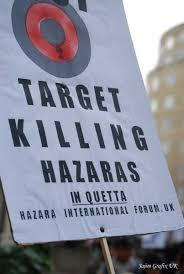
Protest in Britain and Australia: Stop target killing of Hazara community in Pakistan at the hands of Taliban and ISI

Hazara's London protest 2009


Source: http://hazaranewspakistan.wordpress.com

February 08 — Hazara International Forum Great Britain (HIF-GB) held a protest demonstration in front of Pakistan High Commission in London against the consecutive target killing of Hazaras in Quetta Pakistan.

The protersters were holding banners and placards against target killing of Hazaras in Quetta Pakistan. After three hours of chanting slogans in front of Pakistani High Commission in London, the protesters handed over a charter of demands to the 1st Secretary Pakistan High Commission. They demanded that the Government of Pakistan take serious notice of the continuous target killing of Hazaras in Quetta.

According to a statement by HIF-GB Secretary General Barrister Iftikhar Raza Khan, the First Secretary to the High Commissioner in London agreed to discuss the demands with the higher authorities in Pakistan.

He also added that the level of participation in the protest in Britain by Hazaras has been unprecedented.

Hazara communities across Europe are coordinating for protests in more cities. The community in Holland are organizing a protest next Sunday.

Barrister Iftikhar Raza Khan added that a letter conveying Hazara grievances will be issued to the European Commission or the United Nations, to be decided by consensus.

.....

Protest in Australia: Hazara community protests killings

7 February 2009


The Australian Hazara community protested in Canberra on February 3 to strongly condemn the continued killing of Hazara people in Quetta City, Pakistan, by Taliban and al Qaida-backed religious extremists.

The murderers publicly accepted responsibility for the killing of Hazara leader Hussain Ali Yousafi early this week. This was the latest in a string of terrorist acts that have killed, in just 20 days, 12 innocent people from the Hazara community in Quetta.

The protesters rallied outside the Pakistani embassy and demanded that the international community, and especially the Australian government, provide protection for Hazara refugees and pressure the Pakistani government to end the killings.

http://www.greenleft.org.au/2009/782/40305

....

Background Information:

Hazara tribesmen under attack in Quetta


* Hazara MPA says killings of minorities motivated by religion
* Says Quetta has been communally harmonious until recently

By Malik Siraj Akbar

QUETTA: Hazara tribesmen in Balochistan, numbering around 300,000, are currently living under unprecedented terror, uncertainty and insecurity.

The tribe, residing in Balochistan for more than a century, have been subject of discrimination by the majority Balochs and Pashtuns due to their ethnic background and religious affiliations. While a majority of Hazaras is Shia, local Baloch and Pashtun are Sunnis. The Hazaras in Quetta have been targeted by some religious quarters for some time now, with more than two dozen men from the minority tribe having been killed in the last two months. Lashkar-e-Jhangavi (LJ), a banned Sunni organisation has accepted responsibility for most of the killings.

The common notion that the LJ was solely targeting Shia scholars was negated when it claimed responsibility for the January 26 murder of Hussain Ali Yousafi, chairman of the Hazara Democratic Party (HDP) - an accepted and acclaimed secular and democratic leader.

Motivation: Syed Nasir Ali Shah, a Hazara and a member of the National Assembly, told Daily Times that the killings were not Hazara-specific. The slayings were religiously motivated, Shah said, adding the acts were being carried out by forces that wanted to convert Balochistan into a ‘Talibanised’ province.

“Those who are carrying out these assaults are trying to create sectarian disharmony between the Sunni and Shia sects in Quetta,” he said, adding that the target killings were meant to widen the gulf between the Sunnis, Shias and Hazaras against the local Baloch and Pashtuns.

Harmony: Shah said historically, Quetta had been communally harmonious. He said people from all sects used to participate in religious ceremonies of the others until recently.

Attacks on the Hazaras first began during the military regime of General Ziaul Haq. On July 6, 1985, the military government tried to forcibly stop a Shia procession in Quetta, when 30 people, including some policemen, were killed.

In 2001, eight Hazaras were killed when their vehicle was ambushed near the city’s Poodgali Chowk. Another 12 Hazaras, all police cadets, were gunned down on June 8, 2003 when they were on their way to a training centre near Sariab. On 4 July, 2003, in one of the worst acts of sectarian violence in the history of Pakistan, some 58 people, most of them Hazara Shias, were killed, while around 200 were injured when a suicide bomber attacked Imambargah-e-Kalan in Quetta.

Another 38 persons, mostly Hazaras, were killed in an assault on March 2, 2004. The incident left 200 people injured. On July 19, 2008, nine Hazaras were killed in Quetta in a clash between the police and Hazara protesters. HDP Secretary General Abdul Khaliq Hazara said sectarianism in Quetta increased during the regime of former President Gen (r) Pervez Musharraf.

“We are a liberal, secular people. Hazara community, however, entirely comprises of Shias. Now, some invisible forces are trying to target our democratic leaders on the simple grounds that our religious affiliations coincide with Shia Islam,” he said.

In his seminal book ‘War and Migration’, Alessandro Monsutti classifies the Hazara migration to Balochistan in the following phases:

From 1878-1891: Following the second Anglo-Afghan war, the first Hazaras came to Quetta to seek employment in British-run companies under the Raj. They are thought to have worked on the building of roads and the Bolan Pass railway as well as enlisting in the British army of India. At that time, there could have been no more than a few hundred Hazaras in Balochistan. From 1891-1901: The subjugation of Hazarajat by Abdul Rahman, between 1891 and 1893, triggered a mass exodus of Hazaras to Turkestan, Khorasan and Balochistan.

From 1901 to 1933: The situation in Afghanistan returned to normal under Habibullah (1901-1919), the son of Abdul Rahman. He offered amnesty to the Hazaras but this proved to be of little help in improving the lot of the Hazara community in Afghanistan. In 1904, the 106th Pioneers, a separate regiment for the Hazaras formed by the British, offered greater careers prospects, social recognition and economic success.

From 1933-1971: The regiment of Hazara Pioneers was disbanded in 1933. Deprived of this social and professional outlet, Hazaras went to settle in Quetta between the 1930s and 1960s, although the process of migration never completely dried up.

From 1971-1978: Following the 1971 drought, Hazaras then settled in Quetta or went to Iran in search of work. Between 1973 and 1978, tensions over the Pushtunistan issue between the Daud government and Pakistan were an additional factor in the Hazara migration. After 1978: Following the Communist coup in April 1978 and the Soviet Union intervention in December 1979, the migratory movement assumed hitherto unprecedented dimensions.

http://www.dailytimes.com.pk/default.asp?page=2009\02\06\story_6-2-2009_pg7_15

Please consider signing this petition.

SOS from Pakistan - Save Pakistani Shias Petition

http://www.petitiononline.com/ShiaSOS/petition.html

Read more...

Saturday, 31 January 2009

Police Chief Nawabzada Humayun Jogezai , son in law of the Balochistan Chief Minister, is involved in target killing of Hazaras in Quetta.....

The Gang Behind Target Killing of Hazaras

Source: Hazara News Pakistan - http://hazaranewspakistan.wordpress.com/2009/01/28/the-gang-behind-target-killing-of-hazaras/

Quetta January 29: Target killing of Hazaras in Quetta started since 2000 when Sardar Nisar Ali Hazara was attacked by “unknown” gunmen. His driver succumbed to severe injuries and died, while Sardar recovered the injuries.

In February 2001 five other Hazaras died in another terorrist attack on a passanger van.

Later on June 8, 2003 “unidentified” terrorists killed 12 Hazara policemen in Quetta.

Just a month after this tragic incident on July 4 2003, 2 suicide bombers blew themselves up in a Hazara mosque killing about 60 people. It didn’t stop here.

On March 2, 2004 a group of suicide bombers attacked a Muharram procession killing 80 Hazaras and critically injuring another 150.

In 2005, another major suicide attack was foiled when some Hazara policemen, risking their lives, encountered with suicide bombers hiding on the route of the Ashura Procession. The Hazara policement killed all three terrorists.

Though apparently the series of Hazara target killing seemed sectarian, but the real story behind the scene is ethnic. The militant group Lashkar-i-Jhangvi has been claiming responsibility for most of the attacks on Hazaras. After the suicide attacks of 2004, security forces arrested 5 high-profile masterminds of Lashkar. They were involved in all the attacks on Hazars since 2000. Balochistan High Court sentenced them to death; but last year, in 2007, all the five terrorists broke away from a high-security jail in Quetta.

During the series of attacks on Hazaras, the roles of some high-profile security officials have been controversial. Police Chief Nawabzada Humayun Jogezai is prominent among them. Mr. Jogezai, son-in-law to current Chief Minister Nawab Raisani, was the In charge of City Police Station. He ordered policemen to open fire on Hazara protesters on 6th July 1986 killing, about 25 Hazaras. Following this, Mr. Jogezai was transferred out of Quetta city. With his departure from the city, the situation calmed down and business of life got normal.

With the passage of time, Mr. Jogezai was promoted to Deputy Inspector General (DIG) Police. He came back to Quetta in 2003. With his arrival, terrorists once again attacked on Hazara police cadets, killing 12 on June 8, 2003. Mr. Jogezai, being the police chief of Quetta, could not make any success in arresting the culprits. Some Hazaras even suspected Mr. Jogezai was behind the attack on Hazara police cadets. With DIG Jogezai in Quetta, 2003 and 2004 proved the most tragic years in the history of Quetta. Suicide bombers attacked on Hazara Mosque 2003 and Ashura Procession in 2004, killing over 100 Hazaras. During the riots after the Ashura attacks, eyewitnesses claimed Anti Terrorists Forces (ATF) opened fire on Hazaras and, killing than a dozen mourners.

Here another name came on scene. Anti-Terrorist Force SP, Rahim Mandokhel, was said to have ordered ATF forces for targeting Hazara mourners. Later, the Judicial Tribunal Report of Balochistan High Court, probing the attack on Ashura Procession 2004, released on June 29, 2004, clearly said that Anti-Terrorist Force led by Rahim Mandokhel was involved in firing on mourners.

During the Ashura Procession attack riots, ATF forces killed about 40 Hazaras. Later on, after large protests by Hazaras, Humayun Jogezai and Rahim Mandokhel were transferred from Quetta. A new Police Chief, Shoaib Suddle (Now Director General of Intelligence Bureau, IB), played a vital role in breaking the circle of masterminds of target killings of Hazaras. During his appointment in Quetta, five masterminds of Lashkar-i-Jhangvi were arrested and later sentenced to death by a court. Mr. Shoaib Suddle, relative to former President General Musharraf, was transferred from Quetta. Security in Quetta remained calm till 2008.

Once again Nawabzada Jogezai came back to Quetta after the new Chief Minister Nawab Raisani’s government was formed. Right after his arrival, five masterminds of Lashkar-i-Jhangvi, having links with Ramzi Yousaf of Al-Qaeda, broke away from a high-security ATF Jail in Quetta last year. Regardless of the slow and corrupt system that failed to carry out the punishment, the escape was more serious question raising doubt on ATF and its jails. How could high-profile terrorists escape from a high-security Jail where a mosquito can’t fly?

With the beginning of 2009 and just months after Jogezai’s appointment in Quetta, several attacks were carried on Hazaras. In a riot after 2 Hazaras were gunned down in July 2008, police and ATF forces once again opened fire on Hazara protesters, killing 6 people in Hazara Town. Provincial Minister Jan Ali Changazi, talking to media, strongly condemned ATF for killing innocent citizens. The situation got severe when two weeks ago a Hazara Deputy Superintendent Police (DSP) Hassan Ali and 3 others were killed. Despite several target attacks on Hazaras in January, City Police Officer Humayun Jogezai failed to arrest any terrorists. We lost a great leader, Hussain Ali Yousufi, on Junuary 26. Mr. Yousafi had been critical of Police role in arresting the terrorists. Following the riots in which non-Hazaras burnt down private property, Mr. Jogezai warned to deal with with the protesters with iron hands.

This gang is not limited to CCPO Nawabzada Jogezai and SP ATF Mandokhel. Two other names are also taken by some sources. DIG Operations Wazir Khan Nasir and SP Investigation Ismail Lehri are also said be part of the gang. Sectarian elements such as Lashkar-i-Jhangvi are given free hand.

The Hazara Delegation, comprised of Hazara leaders and politicians formed after the martyrdom of Hussain Ali Yusafi, will demand President Zardari and Prime Minister Gilani to appoint honest police officers in Quetta, ones who are committed to keeping the city and its people safe. The Hazara people are peaceful, and demand and deserve a peaceable environment for positive contribution to the society.
Read more...

Wednesday, 28 January 2009

Imran Khan condemns murder of Yousufi


In the following news item, Imran Khan seems to condemn the sectarian killing of the Hazara / Shia leader in Quetta. However, Imran Khan did not care to pinpoint and condemn "the elements [who] are conspiring to split the nation". He also did not explain how "we get united to foil nefarious designs of the miscreant elements."

So much for the rhetoric. How can we expect Imran Khan to condemn the terrorists of Taliban / Sipah-e-Shahaba when he seems to support their stance instead of the Pakistani nation's stance on the war on terror?


Imran condemns murder of Yousufi
Wednesday, January 28, 2009

Islamabad: Pakistan Tehreek-e-Insaf (PTI) Chairman Imran Khan Tuesday strongly condemned the bomb blast in DI Khan and murder of Hazara Democratic Party’s Chairman Hussain Yousufi in Quetta.

He termed the murder of Hussain Yousufi as heinous crime, adding that such elements are conspiring to split the nation. He said that it is high time “we get united to foil nefarious designs of the miscreant elements.”

He expressed his deep grief and sorrow over the loss of lives and sympathy to those injured and prayed for early recovery of the injured.

He said that the whole nation should get united against the elements, which want to destabilise the country.

He urged the government for adopting an effective policy to ensure protection to life and property of citizen and improve law and order in the country.

http://www.thenews.com.pk/print1.asp?id=159528

...
Read more...

Systematic killing of the Hazara community in Balochistan...

Targeting Hazaras
Wednesday, January 28, 2009

The killing of the chairman of the Hazara Democratic Party in Quetta adds to the violence inflicted on the minority community. The murder, for which the Sunni extremist group, the Lashkar-e-Jhangvi, has claimed responsibility, has been labelled a sectarian one. The Hazaras, a distinct ethnic group which make up about 9 per cent of the Afghan population, have lived in the region for centuries. Most are Shias. There are believed to be about 200,000 Hazaras in and around Quetta, with the figure increasing as a significant number fled Taliban rule in Afghanistan. The persecution of the Hazaras by the predominantly Pukhtoon Taliban has been well documented and was another ugly feature of that era in Afghan history.


In July last year six members of the same community were killed in Quetta. This led to days of protests in which over a dozen people died. The HDP, angered over the murder, has issued a new strike call. The incident points to the growth of Talibanization in Quetta, with the LeJ known at least indirectly to be linked to the wide network of militants that has spread throughout our country. But the action against Hazaras also exposes the growing ethnic divides in our society, notably in Balochistan. Nationalist sentiments here sometimes take on ugly ethnic dimensions. Some Baloch nationalist publications attack minority groups living in the province for centuries, including Punjabis, Pathans and Hazaras. Even in Sindh, some groups call for settlers from other parts of the country to be driven out. These developments are dangerous ones. Both ethnic and sectarian tensions have already torn our society apart and created deep fissures that run through it. We need somehow to patch these over and recreate the harmony that once existed in our cities and towns. Quetta, as a place that is among the most volatile, should be a centre where such initiatives are begun without delay, bringing together communities and preventing a descent into a still greater orgy of violence during the months ahead. (The News)

For a detailed account of the sufferings of the Hazara community, visit:

http://hazaranewspakistan.wordpress.com/


....

BBC Urdu dot com report:

http://www.bbc.co.uk/urdu/pakistan/story/2009/01


http://www.bbc.co.uk/urdu/pakistan/story/2009/01/090114_quettafiring_ayub.shtml

http://www.bbc.co.uk/urdu/pakistan/story/2009/01/090126_quetta_killing_nj.shtml/090127_hazara_funeral_strike_zs.shtml

....

Hazara tribesmen under attack in Quetta

* Hazara MPA says killings of minorities motivated by religion
* Says Quetta has been communally harmonious until recently

By Malik Siraj Akbar

QUETTA: Hazara tribesmen in Balochistan, numbering around 300,000, are currently living under unprecedented terror, uncertainty and insecurity.

The tribe, residing in Balochistan for more than a century, have been subject of discrimination by the majority Balochs and Pashtuns due to their ethnic background and religious affiliations. While a majority of Hazaras is Shia, local Baloch and Pashtun are Sunnis. The Hazaras in Quetta have been targeted by some religious quarters for some time now, with more than two dozen men from the minority tribe having been killed in the last two months. Lashkar-e-Jhangavi (LJ), a banned Sunni organisation has accepted responsibility for most of the killings.

The common notion that the LJ was solely targeting Shia scholars was negated when it claimed responsibility for the January 26 murder of Hussain Ali Yousafi, chairman of the Hazara Democratic Party (HDP) - an accepted and acclaimed secular and democratic leader.

Motivation: Syed Nasir Ali Shah, a Hazara and a member of the National Assembly, told Daily Times that the killings were not Hazara-specific. The slayings were religiously motivated, Shah said, adding the acts were being carried out by forces that wanted to convert Balochistan into a ‘Talibanised’ province.

“Those who are carrying out these assaults are trying to create sectarian disharmony between the Sunni and Shia sects in Quetta,” he said, adding that the target killings were meant to widen the gulf between the Sunnis, Shias and Hazaras against the local Baloch and Pashtuns.

Harmony: Shah said historically, Quetta had been communally harmonious. He said people from all sects used to participate in religious ceremonies of the others until recently.

Attacks on the Hazaras first began during the military regime of General Ziaul Haq. On July 6, 1985, the military government tried to forcibly stop a Shia procession in Quetta, when 30 people, including some policemen, were killed.

In 2001, eight Hazaras were killed when their vehicle was ambushed near the city’s Poodgali Chowk. Another 12 Hazaras, all police cadets, were gunned down on June 8, 2003 when they were on their way to a training centre near Sariab. On 4 July, 2003, in one of the worst acts of sectarian violence in the history of Pakistan, some 58 people, most of them Hazara Shias, were killed, while around 200 were injured when a suicide bomber attacked Imambargah-e-Kalan in Quetta.

Another 38 persons, mostly Hazaras, were killed in an assault on March 2, 2004. The incident left 200 people injured. On July 19, 2008, nine Hazaras were killed in Quetta in a clash between the police and Hazara protesters. HDP Secretary General Abdul Khaliq Hazara said sectarianism in Quetta increased during the regime of former President Gen (r) Pervez Musharraf.

“We are a liberal, secular people. Hazara community, however, entirely comprises of Shias. Now, some invisible forces are trying to target our democratic leaders on the simple grounds that our religious affiliations coincide with Shia Islam,” he said.

In his seminal book ‘War and Migration’, Alessandro Monsutti classifies the Hazara migration to Balochistan in the following phases:

From 1878-1891: Following the second Anglo-Afghan war, the first Hazaras came to Quetta to seek employment in British-run companies under the Raj. They are thought to have worked on the building of roads and the Bolan Pass railway as well as enlisting in the British army of India. At that time, there could have been no more than a few hundred Hazaras in Balochistan. From 1891-1901: The subjugation of Hazarajat by Abdul Rahman, between 1891 and 1893, triggered a mass exodus of Hazaras to Turkestan, Khorasan and Balochistan.

From 1901 to 1933: The situation in Afghanistan returned to normal under Habibullah (1901-1919), the son of Abdul Rahman. He offered amnesty to the Hazaras but this proved to be of little help in improving the lot of the Hazara community in Afghanistan. In 1904, the 106th Pioneers, a separate regiment for the Hazaras formed by the British, offered greater careers prospects, social recognition and economic success.

From 1933-1971: The regiment of Hazara Pioneers was disbanded in 1933. Deprived of this social and professional outlet, Hazaras went to settle in Quetta between the 1930s and 1960s, although the process of migration never completely dried up.

From 1971-1978: Following the 1971 drought, Hazaras then settled in Quetta or went to Iran in search of work. Between 1973 and 1978, tensions over the Pushtunistan issue between the Daud government and Pakistan were an additional factor in the Hazara migration. After 1978: Following the Communist coup in April 1978 and the Soviet Union intervention in December 1979, the migratory movement assumed hitherto unprecedented dimensions.

http://www.dailytimes.com.pk/default.asp?page=2009\02\06\story_6-2-2009_pg7_15
Read more...

Monday, 26 January 2009

SOS from Quetta: Systematic killing of Hazaras / Shias by the Taliban/Sipah-e-Sahaba Terrorists...............


Shia leader shot dead in Quetta
Updated at: 1140 PST, Monday, January 26, 2009

QUETTA: A leader of Hazara Democratic Party (HDP) has been shot dead in Quetta on Monday.

According to reports, unknown persons opened fire on HDP leader Hussain Ali Yousfi at Jinnah Road. The body was shifted to hospital.

Terrorists belonging to Sipah-e-Shaba (Taliban) have attacked and killed a number of Shias in Quetta in the past few weeks.

BBC Urdu dot com report:

http://www.bbc.co.uk/urdu/pakistan/story/2009/01/090126_quetta_killing_nj.shtml


....

Shi'a leader's murder sparks violence in Pakistan's Quetta
Jan 26, 2009 (BBC Monitoring via COMTEX) --

As you know, we have been reporting on the killing of the chairman of the Hazara Democratic Party [Shi'a party]. Unknown armed men have killed the Hazara Democratic Party Chairman Hussain Ali Yousufzai.

Police say that armed men sitting in a vehicle fired indiscriminately at the chairman outside his shop on Jinnah Road in Quetta. Hussain Ali Yousufi died on the spot and his body was taken to Civil Hospital in Quetta.

A large number of persons and workers of the Hazara Democratic Party gathered at the hospital. Following this incident shopkeepers, in a state of shock, closed down their shops.

The Lashkar-i-Jhangvi [Sunni militant group] has claimed responsibility for this killing and the Baluchistan Chief Minister Nawab Aslam Raisani has condemned the killing of Yousufi.

The Hazara Democratic Party has announced a 40-day mourning period after Yousufi's killing.

Tension gripped Quetta City and people came out on the roads earlier protesting the killing. Incidents of arson and violence have also been reported in different parts of the city.

Now for more on this let us cross over live to Quetta where our correspondent Syed Ali Shah has been following the story for us the entire morning:

[Begin live relay via telephone, anchor Razeshta Sethna] Thanks for joining us. What is the latest you have from Quetta? Earlier, when I was speaking to you, you told me about incidents of violence and arson in the city.

[Shah] Indeed incidents of arson and violence have been reported from different parts of the city. The situation is still tense. However, all of the injured people, we have reports about five people have been injured in these acts of arson and violence in different parts of the city. All of the injured have been shifted to Civil Hospital Quetta for medical treatment.

However, crowds of people, they can still be seen on Mannan Chowk, Meezan Chowk, Jinnah Road, Liaquat Bazaar, Sattar Road, on different roads of Quetta City. So the situation is indeed very tense. The protesters, they burnt a private bank, two vehicles, they also smashed the glasses of a bank, shops and they have also set on fire vehicles and motorcycles, in order to protest over the killing of Chairman Hazara Democratic Party Hussain Ali Yousufi. So the crowd of people, they are chanting slogans against the killing of Hussain Ali Yousufi, the chairman Hazara Democratic Party. The workers of Hazara Democratic Party, they took out a protest rally which passed through different roads of Quetta City. The protesters were demanding the arrest of killers.

In the meantime, the workers of Pakhtunkhwa Milli Awami Party also took out a protest rally which also passed through different roads of the city. The leaders of Pakhtunkhwa Milli Awami Party they were appealing their workers to be peaceful and calm and not to cause any harm to public and private properties.

[Sethna] Now Ali Shah we also have reports that the Lashkar-e Jhangvi has claimed responsibility for the killing of the Hazara Democratic Party chairman, do you have any more information on that?

[Shah] Indeed, the spokesman for the banned Lashkar-e Jhangvi, he telephoned newsmen in Quetta Press Club he claimed the responsibility for killing the chairman of Hazara Democratic Party Hussain Ali Yousufi. Actually in sectarian-related terrorist incidents since January 1st around nine people have been killed in Quetta City and other towns of Baluchistan.

[Sethna] Thanks very much for that update from Quetta. [end of live relay]

Syed Ali Shah reporting on the killing of the Hazara Democratic Party Chairman Hussain Ali Yousufi.

Source: Dawn News TV, Karachi, in English 0900gmt 26 Jan 09

BBC Mon Alert SA1 SADel dg


BBC Monitoring. Copyright BBC.

http://individual.com/story.php?story=95318770

....


On 14 January, DSP among 4 policemen shot dead in Quetta

Unidentified assailants killed four policemen including a DSP in a shootout in Quetta on Wednesday. Motorcyclists ambushed a police team on Sariab Road at around 11am, police officials told Daily Times. Three of the murdered policemen belonged to Hazara community and were Shia. Banned Lashkar-e-Jhangvi claimed responsibility for the killings, which appear to be part of a recent series of target killing of Shias in the provincial capital that has claimed six lives in a month. Ensuing protests by members of the Shia and Hazara communities paralysed businesses in the provincial capital.


On 9 January 2009:
Shia leader, guard killed in Sibi


QUETTA: Unidentified men killed a central leader of the Fiqah Jafferia along with his guard in Sibi district on Saturday. The assailants opened fire on Saqlain Haider and his guard, Ghulam Ali. They were taken to a hospital in Sibi where they succumbed to their injuries. People staged a sit-in condemning the ‘target killing’ of the Shia leader. They chanted slogans and demanded the culprits should be arrested immediately. No one has claimed responsibility for the killings.

On 5 January 2009:

2 Shias killed in Quetta


QUETTA: Unidentified assailants killed two Shias in the city on Monday despite tight security arrangements due to Muharram.

Police sources said motorcyclists attacked two Hazaragi-speaking members of the Shia community on Kirani Road. Those killed were identified as Muhammad Essa and Muhammad Khan. The assault appeared to be a case of sectarian violence.

The assailants managed to escape. The bodies were handed over to the families after necessary legal and medical formalities were carried out by police and medical staff of the Civil Hospital. No group claimed responsibility for the killings.

Police and other law enforcement agencies have enforced tight security in Quetta to prevent sectarian violence during Muharam. Quetta has been at the centre of sectarian violence for many years. Most recently, on November 21, 2008, two Shias, including leading religious scholar Agha Hassan Zakari, were killed.

AFP reported the men, a rickshaw driver and his friend, were shot multiple times after being stopped on the busy road.

....


Thousands protest killing of policemen

Web posted at: 1/15/2009 0:22:33

Source ::: AFP

Supporters of Jamaat-e-Islami protest against the Israeli offensive on Gaza, in Karachi yesterday. Thousands of schoolchildren took part in the protest.

QUETTA: Thousands of people protested in Pakistan’s southwestern city of Quetta yesterday after four police officers were shot dead in what an official said was a sectarian attack against Shias.

The police were killed when gunmen riding a motorbike sprayed their vehicle with bullets on a main road on the outskirts of Quetta, the capital of restive gas-rich Baluchistan province, which borders Afghanistan and Iran.

The province, which has been in the grips of an insurgency for more than four years, has also been the scene of sectarian attacks between Sunni and Shia extremists. More than 4,000 people carried the bodies of three of the officers, all Shiites, through the streets to the home of a top military official, to demand justice, a photographer at the scene witnessed.

Protesters called for a military probe into the killings before dispersing peacefully.

“Shias have been targeted in the province for quite some time and the latest attack was directed against Shiite officers,” said provincial minister Jan Ali Changezi, who participated in the protest.

The killing was later claimed by Lashkar-e-Jhangvi (LJ), a banned Sunni Muslim extremist group with links to Al Qaeda. “We claim the responsibility for today’s attack,” Ali Haider, identifying himself as a spokesman for the group, said in telephone calls to local media.


Earlier, senior police official Humayun Jogezai said the officers had been shot dead in their vehicle as they were travelling to a training academy.

A high-ranking police official also sustained serious injuries.

LJ is regarded as Pakistan’s fiercest Sunni extremist outfit and is accused of killing hundreds of Shias since its emergence in the early 1990s. Former president Pervez Musharraf banned the group in August 2001. Shias account for about 20 percent of Pakistan’s 160 million-strong, Sunni-majority population. The groups usually coexist peacefully but outbreaks of sectarian violence have claimed more than 4,000 lives since the late 1980s.

Baluchistan has also been wracked by insurgency since 2004, with rebels demanding political autonomy and a greater share of profits from the region’s natural resources. Taliban militants have also been blamed for attacks in the province.

http://www.thepeninsulaqatar.com/Display_news.asp?section=World_News&subsection=Pakistan+%26+Sub-Continent&month=January2009&file=World_News2009011502233.xml


....


Baloch protest against ‘Talibanisation’


The Balochistan National Party (BNP) Information Secretary and former senator Mr Sanaullah Baloch told Daily Times on Sunday that “supporters” of the Taliban had “captured land worth Rs2 billion in the eastern and western parts of Quetta” to “undermine the Baloch nationalist movement”. He accused the government of failure to establish its writ in the city where “Taliban and their supporters were consolidating their grip”. He complained of the emergence of “no-go” areas where these elements had dug themselves in. He came close to explaining the state of divided politics in the province when he said that “the Taliban supporters” enjoyed the support of the government and its intelligence agencies who wish “to pit the religious elements against the Baloch nationalists”. He wondered why the state had not carried out military operations against these elements while it was still attacking Dera Bugti and Sui areas. Dealing with the problem of Afghan refugees, he called them “a burden on the economy of Balochistan and the biggest cause of lawlessness and terrorism in the country’s largest province”.

Mr Baloch has indirectly put his finger on the way a new political map is militating against the old deeds of omission and commission of the Pakistani state. The PPP in power in the centre is a liberal-secular party, supported by another secular party, the MQM, in Sindh. The party in power in the NWFP is ANP, which is traditionally secular-nationalist like the Baloch. It is flouting the pro-Taliban mood in the establishment and asking the army to be more effective against Taliban encroachments. In Balochistan, however, the ethnic-political picture is more complex.

As in the NWFP and the Tribal Areas, the Afghan jihad and its refugees have destabilised the ethnic balance in Balochistan. When Mr Baloch refers to “supporters” of the Taliban he is pointing to the dominant Pashtun party, the JUIF, which also queered the pitch in the NWFP for the ANP when it succeeded it in power in Peshawar. What five years of power in the NWFP by the “supporters” of the Taliban did to the ground realities there is now happening to Balochistan, a fact pointed out by scholars who have studied closely the dubious Musharraf policy of giving safe haven to the absconding Afghan Taliban leaders in Quetta.

The JUIF is a religious party but it is quite clearly an ethnic party capturing the Pashtun vote to the detriment of the secular Pakhtunkhwa Milli Awami Party (PKMAP), the same way it had edged out the secular ANP in the NWFP. The JUIF contrasts sharply with Jama’at-e-Islami which remains a religious party appealing to the Pashtun and non-Pashtun alike. The other factor going against the secular Baloch parties is the JUIF’s deft political footwork in Islamabad, sitting inside the federal coalition with the PPP while strongly supporting the Taliban and opposing the military operations Mr Baloch wants against the Taliban in Balochistan.

Unfortunately, however, the separatism of Baloch nationalism plays into the hands of the Pashtun-dominated JUIF which shies away from any rhetoric of insurgency and separation embraced by sections of the Baloch. Quite meaningfully, the Islamisation or “Talibanisation” it favours for Balochistan and the rest of Pakistan is equally radical in its endgame and cannot be opposed openly and vigorously because it gibes with the religious constitution of Pakistan that welcomes the sharia as the faith of the state. The Taliban terrorism is against the government agencies and the Shia. In contrast, Baloch terrorism, while targeting state functionaries, also kills certain non-Baloch and Punjabi elements and destroys the economic lifeline of Pakistan, the province’s natural gas installations and pipelines.

The ethnic balance has been dangerously upset in Balochistan by the jihad waged by the state for over 20 years. This jihad has transformed Pashtun society all over Pakistan and sidelined the nationalists, but it has damaged the cause of the Baloch more effectively. It is true that state functionaries have become indoctrinated by jihadi culture over time just as they have learnt to “prejudge” the Baloch after long years of treating them as “rebels”. Ironically, in the long run, it is the jihadi culture which will destroy the “modern state” and not Baloch nationalism.

In the days to come, Balochistan will acquire strategic importance as the transit terrain for Iranian gas. One hopes that before the pipeline from Iran is finalised the province will get the kind of autonomy it wants. There is no doubt that gas from Iran will be a crucial asset which the state of Pakistan will go to any length to protect. The Pashtun will not oppose it; but the Baloch might. That means that once again the state will have to choose between the Baloch and the Pashtun and, regrettably, might even rely on the unwise and dangerous policy of pitting the “Taliban” against the Baloch. The JUIF is sure to be more supple politically than the proud and inflexible Baloch. Clearly, there is a lesson to be learnt by the Baloch nationalists.

http://www.dailytimes.com.pk/default.asp?page=2009\01\06\story_6-1-2009_pg3_1

....


For a detailed account of the sufferings of the Hazara community, visit:

http://hazaranewspakistan.wordpress.com/


....


Please consider signing this petition.

SOS from Pakistan - Save Pakistani Shias Petition

http://www.petitiononline.com/ShiaSOS/petition.html

Read more...

Wednesday, 14 January 2009

Sipah-e-Sahaba/Taliban attack and kill a Shia Police Officer in Quetta

(Reuters) - Following are security developments in Pakistan at 1130 GMT (6:30 a.m. EST) Wednesday.

QUETTA - Gunmen on motorcycles killed four policemen, including a senior officer, in an apparent sectarian attack in the southwestern city of Quetta, said senior police officer Wazir Khan Nasir.

The police were Shi'ite Muslims and the attack followed several other suspected sectarian attacks, Nasir said.

DERA BUGTI - A bomb planted on a parked motorcycle wounded 12 people, including four paramilitary soldiers in Dera Bugti district, about 500 km (310 miles) east of Quetta, the capital of Baluchistan province, where Baluch nationalists have been fighting a low level insurgency for years.

(Reporting by Gul Yousafzai; Writing by Kamran Haider; Editing by Robert Birsel)


http://www.reuters.com/article/worldNews/idUSTRE50D2PX20090114


...

DSP among three police officials killed in Quetta firing incident
QUETTA: Jan 14 (APP)‑ At least three police officials including a DSP were killed while one official sustained critical injuries when unknown armed men sprayed bullets at their vehicle here in Sariab, DIG Operations Wazir Khan Nasar told APP Wednesday.

“The officials were going to police training center when their vehicle was targeted” DIG Nasar said, adding that DSP Hassan Ali and two constables were among the dead. Condition of the other DSP Ghulam Muhammad was stated to be stable.

Area police cordoned off the site for investigation.

http://www.app.com.pk/en_/index.php?option=com_content&task=view&id=64830&Itemid=1

...

BBC Urdu Report

http://www.bbc.co.uk/urdu/pakistan/story/2009/01/090114_quettafiring_ayub.shtml

..

Who says the Taliban are not merciful? At times, the prefer cutting ears to slaughtering.

BBC Urdu report

http://www.bbc.co.uk/urdu/pakistan/story/2009/01/090114_taliban_ears_volunteers_rh.shtml


...

DSP among 4 policemen shot dead in Quetta

By Malik Siraj Akbar

QUETTA: Unidentified assailants killed four policemen including a DSP in a shootout in Quetta on Wednesday. Motorcyclists ambushed a police team on Sariab Road at around 11am, police officials told Daily Times. Three of the murdered policemen belonged to Hazara community and were Shia. Banned Lashkar-e-Jhangvi claimed responsibility for the killings, which appear to be part of a recent series of target killing of Shias in the provincial capital that has claimed six lives in a month. Ensuing protests by members of the Shia and Hazara communities paralysed businesses in the provincial capital. (Daily Times)
Read more...
