Editor's Choice

--------------------------------------------------------------------------------------------------------------------------
Featured Post
--------------------------------------------------------------------------------------------------------------------------

"Let us build Pakistan" has moved.
30 November 2009

All archives and posts have been transferred to the new location, which is: http://criticalppp.com

We encourage you to visit our new site. Please don't leave your comments here because this site is obsolete. You may also like to update your RSS feeds or Google Friend Connect (Follow the Blog) to the new location. Thank you.


--------------------------------------------------------------------------------------------------------------------------
Showing posts with label Asma Jahnagir. Show all posts

Sunday, 15 November 2009

Who is next in Ahmed Quarishi and Zaid Hamid's traitors list ?

By: Jarri Mirza
Contribution by guest blogger : Humza Ikram

First they came for the communists, and I did not speak out—because I was not a communist;Then they came for the socialists, and I did not speak out—because I was not a socialist; Then they came for the trade unionists, and I did not speak out—because I was not a trade unionist;Then they came for the Jews, and I did not speakout—because I was not a Jew; Then they came for me—and there was no one left to speak out for me.


This famous quote of German humanist is a reflection of current Pakistan society where conspiracy theorist are coming on main stream television and tabloid and calls anybody traitor and even worse an CIA agent or Jewish spy and nobody is realizing this terrible situation . its a time we should rise to the occasion before we are also called traitor in our own country.

The whole conspiracy theorist game is a very dangerous game which are society is become hostage . and slowly logic, wisdom and facts are made irrelevant.and the most disasters thing is the idea of calling everybody a "Traitor " who wants to research and present a real story .

PPP loyalists have a history of being labeled as the traitor and foreign agent right from the famous Fehmida Riaz (a gifted writer )who was culture advisor to BB and she was actually included in the charge shit against BB's first government.today the whole naming people TRAITOR ,who have opionion dfferent then your opinion is on all time high and the latest victim is Pakistan Ambassador to US Hussain Haqqani and now these conspiracy theorites have gone one step a head . Ahmed Quarishi claims people like Asma jehanghir to be an jews agent which is a cheap and tasteless statement. let us as analyze how these conspiracy theorist works !

HOW TO BE A CONSPIRACY THEORIST

Key to successes

Make as many conspiracy theories as possible as you can, don’t think when at work as they say in Hollywood keep it simple baby!
Call “Traitor” as many people as you can.(it works exponentially)
If possible make it to a music channel so you trap as many young people as possible in your ugly propaganda and nonsense (youth provide cult following).

In case of Zaid Hamid and Ahmed Quarishi both works for a music channel of jang group AAG
(Dunia main bhi aag; aakhirat main bhi aag)

Have a certain mystique appearance. And try to include religion into your debate to get additional legitimacy in your arguments.
Spread hatred, it sells like hot cakes !

The Ultimate achievers: The duo of Zaid Hamid and Ahmed Quarishi


Above is the video of Zaid Hamid and Nadeem Farooq Paracha . Here Paracha is talking about the dangers of conspiracies theories.

AHMED QUARISH HAS RECENT STARTED SERIES OF FLITHY PROPAGANDA AGAINST AMBASSADOR TO US HUSSAIN HAQQANI .JUST LIKE PARACHA SAID WITH LITTLE RESEARCH WE CAN PROVE HIS PROGANDA HAS NO WEIGHT WITH LITTLE RESEARCH.LET US EXAMINE HIS LATEST ARTICLE.

Ahmed Quarishi's recent article against Ambasador to US Hussain Haqqani is a clear case of Yellow Journalism , his article why Hussain Haqqani have only sued Pakistani Newspaper and not the American magazine in my opinion if he had taking his daily dose of sanity he would not had dare to wrote this . to write on diplomatic constraint one has to know diplomatic norms , firstly the question arises can a Ambassador of a guest country can sue a newspaper of a host country . If it can ,the second question arises is that a good precedent.

To analyze this let us examine the recent episode of Shireen Mizari and American embassy in Islamabad.in that eposide shireen Mizari could not provide the grounds on which she wrote the story and thus THENEWS had to apologies . imagine had american embassy had sued the Pakistani newss paper for a reason that they had published something which had no grounds what would happened then?
hussain haqqani is working under a very difficult situation in a US and it was the toughest time of our country's history , just year ago we were about to declared as a brankupt economy. there were hardrly any money left in our foreign reserve to buy fuel for next few months .we have to negotiate witht the west to help our dying economy you like it or not . and all the financial instituation are goes through capitol hill and you like it or not with the creative diplomacy Hussain Haqqani helped the government of Pakistan to reach an agreement with IMF bailout plan. A bailout package which is first of its kind that was presented in the parliment by the ruling party which has a historic significance in our domestic politics also since it was 6th IMF bailout package in our country's history but first to be presented in the parliment..you like or dislike someone way of working is a very subjective matter but by calling someone tratior or writing stories like Hussin Haqqani will public pakistan national secrets is tasteless staements and its shows we as nation are only willing to listen easy answer .
below is the story which was picked by the late Khalid Hasan regarding Hussain Haqqani
.

Haqqani a ‘hero of Pakistan’s struggle for democracy’

By Khalid Hasan

WASHINGTON: “Ambassador Haqqani is a hero of Pakistan’s struggle for democracy,” according to Bruce Riedel, who advises Obama on Pakistan and who is likely to be appointed deputy national security adviser. “Haqqani’s message,” he added, “is one that the senator (Barack Obama) understands very well.” A front page report in the Boston Globe on Monday featuring the Pakistani ambassador, highlights the efforts he has been making to obtain the quick cash injections Pakistan needs to avoid default on its repayments and a possible economic meltdown. Haqqani, notes the report, is charged with the almost impossible task of trying to secure more funding from the already depleted coffers of the US government. “Haqqani has been an Islamic activist, a war correspondent, a savvy politician, a beloved professor, and an aide to two rival Pakistani prime ministers.” Describing him as an optimist who believes that he will get his way against the odds, the report adds that Haqqani “must believe that the newly elected government he represents can clean up corruption, defeat a Taliban insurgency, survive a major financial crisis, and improve relations with the United States.” According to the Boston Globe, “Haqqani faces the task of rebuilding both the Pakistani image in the United States, and the US image in Pakistan, which has been tainted by the Bush administration’s association with Musharraf. ‘I’m the man in the middle,’ Haqqani said, adding that he is frequently criticised in Pakistan for being too close to the United States. ‘It will take a while before the average Pakistani starts trusting the Americans.’ But Haqqani has gone about his work with great enthusiasm, touting Pakistan’s prospects at public speeches across Washington. This summer, he gave gentle reminders to members of Congress that the alleged corruption took place under the previous government … Haqqani is trying to persuade the Americans to fast-track about $1 billion owed to Pakistan for its military operations from April to October, roughly half a percent of Pakistan’s gross domestic product. The money has been held up by new Pentagon rules designed to improve accountability, Pakistani officials say.” The newspaper quotes Haqqani as saying, “If the world is willing to put the resources into Pakistan, there is no reason why Pakistan is not willing to defeat (terrorism) and become a more predictable nation.” The ambassador is also seeking an additional $10 billion loan from the United States at a Friends of Pakistan summit in the United Arab Emirates on Nov. 17. US officials have made no commitments so far. Obama supports a plan to give Pakistan a $1.5 billion “bonus” if it remains a democratic state. But it is unclear when, or if, that money will come through. The report notes that in the US, Haqqani became “one of the most outspoken voices for democracy, arguing passionately that the United States would be safer from terrorism if it let democracy bloom, rather than back military leaders.” As a professor, the newspaper goes on to say, Haqqani cultivated political connections that now served him well. In 2007, President Bush invited him to the White House with other Muslim scholars to give advice on how to improve the US image in the Muslim world. But he also maintained ties with an aide to Obama. This summer, Haqqani attended the Democratic National Convention and joined a meeting between Obama and the new Pakistani prime minister in New York.


AHMED QUARISHI'S TRAITOR LIST

Hussain Haqqani
Asma Jehanghir (HUMAN RIGHT LAWYER)
I.A. Rehman (Head of HRCP)
Aitizaz Ahsan
Imtiaz Alam
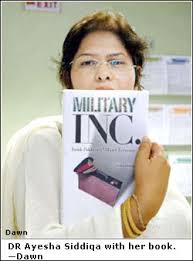
Ayesha Siddiqua
Najam Sethi
Hassan Nisar

We can see his tasteless argument in his article which was published after the tragic Srilankan cricket team attack. where he not only ridiculed almost all thebrillaint brains of our society at large but gone on labeling with Indian loyalist and being not loyal to Pakistan. And the people in the list of "india lovers" includes.

Najam sSethi
Imtiaz Alam
Asma Jahanghir
Ayesha Siddiqua

Source: http://pakalert.wordpress.com/2009/03/06/pakistan-cut-off-all-india-links-pending-lahore-investigations/

If Srilankan team tradegy was not good check this out the briliant Ahmed Quarishi went on writing the the ulimate article "the Business of Asma Jehangirism & liberal Extremsim" which absolutely tasteless and it was even worse than his previous article Safron Crusador on Asma jehhanghir.which can be read from the link below.
source:http://aq-lounge.blogspot.com/2009/04/business-of-asma-jehangirism-liberal.html

Read more...

Wednesday, 3 December 2008

The Mumbai terror attacks: The jingoistic media in India and Pakistan: Time to join hands to fight terrorism in the region. By Asma Jahangir

A turning point — Asma Jahangir

The recent Mumbai terror attacks should be the turning point.
Governments of the region are challenged to support an open and transparent investigation in order to identify and prosecute the masterminds behind such carnage. They must have the moral courage to face the truth

The recent carnage in Mumbai is terrifying. Indians are entitled to be angry, hurt and disgusted. The government of India has alleged that initial evidence indicates that some of the terrorists came from a ‘neighbouring country’. Even though the prime minister of India has so far not accused the government of Pakistan of being directly involved in the attacks, it is apparent who the ‘neighbour’ is. The Pakistani foreign minister and others have so far reacted responsibly. To his credit, he admonished journalists who tried to downplay the tragedy or who shirked away any need for alarm.

Yet the media on both sides is full of jingoistic messages. Some Indians want revenge and even went so far as to urge their government to bomb Pakistan. A few voices in India have cautioned against a call for revenge and have suggested looking deeper into the failure of the security system in India itself. They are pushing for effective diplomacy to be deployed so that Pakistan’s rulers are encouraged to take action against those who are using their country as a launching pad for terrorist activities.

Those in India who want reprisals against Pakistan are falling into the very trap that the terrorists and their allies have set for them. It is no secret that both the terrorists and their patrons within sections of the Pakistani intelligence community want a disengagement of the military against the Taliban and Al Qaeda in north-western Pakistan. But, despite all efforts made through peace deals with the militants, Pakistan’s security forces have neither been able to convince them to de-escalate violence, nor have they been able to persuade the current American administration to loosen the grip on the war on terror. As such, they are caught in a war they are most reluctant to fight. Therefore the Pakistani military is understandably desperate to end the conflict in FATA and Swat.

It also suits the militants to distract the military on all sides, so that they have a free hand to consolidate their power base within Pakistan. Therefore the Indians must take note that the risk of a better organised force of militants will not only endanger the people of Pakistan but may also create havoc in India in time to come.

Some of the reaction in Pakistan is mind-boggling. Several militant organisations have issued public statements rejecting all claims that Pakistan’s territory was in any way used to prepare the Mumbai attacks. Some, like the Tehreek-e Taliban Pakistan, have claimed that the “terror attacks in Mumbai were part of a conspiracy to defame Pakistan and the Mujahideen”. The TTP has warned India against attacking Pakistan and assured Pakistanis that in such an eventuality the Mujahideen would “fight shoulder to shoulder with the armed forces and the people of Pakistan”. Through this statement, they want to appear as having arrogated to themselves the authority to respond on behalf of Pakistan and to appear as the saviours of its people. Ironically the TTP is fighting Pakistan’s military in the tribal areas and is accused of having killed hundreds of Pakistanis in the most inhumane manner.

Senior security officials are widely quoted in the press as warning that the next 24 to 48 hours are crucial. One of them is quoted to have suggested that if India escalates tensions, then the war on terror will no longer be their priority and as such Pakistani troops will have to be moved from the eastern to the western border of Pakistan. Naturally, while that may be the case, it would also be the responsibility of the security forces to keep equal pressure on all borders, so that civilians are protected.

The statement, however, shrugs away any responsibility for protecting people from the militant groups operating in the north of the country. This belies all claims by the present and previous governments that military actions against the militants were being carried out purely in the interests of Pakistan and to protect its citizens, rather than at the behest of the United States. It is deeply worrying to imagine that those who are supposed to protect civilians from the violence of the militants seem reluctant to do so.

Are they not convinced or aware of the urgency? Or are they simply not concerned? Do they have a game plan unknown to the people of Pakistan and their political representatives?

A spokesperson of the PMLN lambasted the government for ‘bowing’ to India by agreeing to send the director-general of the ISI or his representative to India. In the past, the PMLN has itself been severely critical of the role of the ISI and supported calls for reforms within it. Regrettably, at this critical moment, the opposition is dangerously exploiting the situation.

In contrast to the PMLN statement, LK Advani, the hawkish leader of the opposition in India, has for now assured all support to the Indian prime minister. Perhaps we need to learn a few lessons of how the opposition can also be constructive in times of national emergency.
After all it is not the military but the representatives of the people who are entitled to take policy decisions. It must be the politicians rather than the intelligence agencies of both countries that make policies regarding foreign affairs. Surely the head of the ISI or its representatives do not carry a stature beyond that of those representing the people of Pakistan. The PMLN will make a grave mistake by arrogating a grand status to the ISI, as this will undermine the powers of any civilian government. After all, joint dialogues, investigations and actions that resolve tensions should be encouraged rather than be taken as an affront to national dignity.

Most sections of society within Pakistan seem to be in a state of denial regarding the allegations made by the Indian authorities. They are not willing to accept even a remote possibility of any connection between Pakistan and the terrorist attacks that took place in Mumbai last week. At the same time, any attack within Pakistan is treated differently. A large number of people have openly blamed militant groups operating within Pakistan and rogue elements within our intelligence agencies for acts of violence carried out in Pakistan. Yet, we are not willing to grant the same significance to any claims made by neighbours against the very same elements that admittedly are under insufficient control.

A discredited retired Pakistani general took on an aggressive tone on public television against any claims made by the Indians of the involvement of militants operating within Pakistan. Without waiting for any evidence, he emphatically concluded that the attacks in Mumbai were solely carried out by indigenous Indian militants. No doubt, an attack of this nature cannot be carried out without local complicity, but to rule out any link to any of the militant groups operating within Pakistan is unrealistic.

The general explained that militancy was rife in India because of an environment of ‘suffocation’. The same gentleman has on several occasions in the past pleaded for sympathy and understanding for the growth of militants in Pakistan on the justification that the root causes of all this was poverty and neglect. In his view, Indian militancy stems from ‘suffocation’, while the Pakistani one is a result of being victims of economic deprivation.

A balanced and transparent approach is urgently needed. It is clear that India too needs to look into the effectiveness of its own security forces. However, that does not absolve the government of Pakistan from ensuring that its territory is not used as a breeding ground for militants, where they can plan, train and carry out terrorist activities. It is in no one’s interest to let a handful of organised militants keep the entire region hostage and polarise its populations.

The recent Mumbai terror attacks should be the turning point. Governments of the region are challenged to support an open and transparent investigation in order to identify and prosecute the masterminds behind such carnage. They must have the moral courage to face the truth and have the determination to inform the public accordingly. The current and persistent state of insecurity should be a wake-up call for the region. Governments should reinforce their commitment to dismantle all forms of international terrorism growing within the region.

India and Pakistan have both experienced terrorism. It is not new to them. Yet, the implications of recent international terrorism are far more complex and damaging to any society. The jihadi groups that are suspected of having carried out the Mumbai attacks are a well organised and networked with a strategy that is mercilessly used to extend their political agenda in the name of religion. It was apparent that they saw an opportunity to attack now, when the world was involved in a financial crisis and the United States distracted because of a political transition period.

The carnage in Mumbai has several advantages for them: they received international attention, they were able to demoralise those who challenge them, they succeeded in creating a wedge between the improving relationship of India and Pakistan, they brought themselves into a better bargaining position before the Obama administration takes over and created a precarious situation for the fragile civilian government of Pakistan.

The writer is Chairperson of the Human Rights Commission of Pakistan
(Daily Times, 3 Dec 2008)
Read more...