Editor's Choice

--------------------------------------------------------------------------------------------------------------------------
Featured Post
--------------------------------------------------------------------------------------------------------------------------

"Let us build Pakistan" has moved.
30 November 2009

All archives and posts have been transferred to the new location, which is: http://criticalppp.com

We encourage you to visit our new site. Please don't leave your comments here because this site is obsolete. You may also like to update your RSS feeds or Google Friend Connect (Follow the Blog) to the new location. Thank you.


--------------------------------------------------------------------------------------------------------------------------
Showing posts with label Ahmadi. Show all posts

Sunday, 20 September 2009

Religion, Politics and Minorities in Pakistan


Religion and politics
Rubina Saigol

Monday, September 21, 2009
The writer is an independent researcher specialising in social development

In the past few months, there has been a noticeable increase in religiously-motivated violence against minority communities, especially in Punjab. The most recent case is that of 20-year-old Robert Fanish Masih, whose mysterious death in the Sialkot district jail, where he was interned after accusations of defiling the Holy Quran, raises serious suspicions of foul play and murder. According to a press release by the Joint Action Committee, this incident is reminiscent of an earlier one in which Muhammad Yousaf, also accused of committing blasphemy, was found dead in jail and the authorities declared it to be a case of suicide.

Cases of murderous attacks against Christians by frenzied mobs have risen at an alarming rate. In March, a Christian woman was killed in Gujranwala where a church was attacked. On June 30, a mob destroyed more than 50 Christian houses in Bahmaniwala in Kasur district and looted and plundered the village. And on July 30, seven people were brutally murdered in the Gojra carnage.

The typical pattern in many of these cases is an accusation (usually false) of the commission of blasphemy by a rival. This is normally followed by announcements from mosques loudspeakers inciting people who then congregate and turn upon their own neighbours and erstwhile friends. As pointed out by the Human Rights Commission of Pakistan, the local administration and police often collude with the perpetrators or, at best, stand by and do nothing, themselves fearful of the mob. The state becomes an onlooker instead of intervening to protect its powerless citizens against the heinous crimes committed in broad daylight.

As the large number of blasphemy cases in the past have demonstrated, the real motive for instigating the crowd often has nothing to do with blasphemy. Frequently, disputes over money, property or other pecuniary matters lead to false accusations of blasphemy. An accusation of blasphemy is invariably deployed as a weapon to browbeat others into submission. In the famous case of Salamat Masih, a 14-year-old accused of writing blasphemous words on a wall, the quarrel among children started over pigeon fights. Had human rights activists like Asma Jahangir not saved his life, our state was about to send an innocent person – a child – to the gallows. The horrific implications of law cannot be overstated.

What has enabled religion to be used as a weapon to incite raw passions against fellow citizens to murder them with impunity? The immediate cause is the pernicious and widely abused blasphemy law as enunciated in Chapter XV of the Pakistan Penal Code. Sections 295 to 298 of the chapter refer to offences related to religion. Section 295 provides that, “Whoever destroys, damages or defiles any place of worship, or any object held sacred by any class of persons with the intention of thereby insulting the religion of any class of persons is likely to consider such destruction, damage or defilement as an insult to their religion, shall be punished with imprisonment of either description for a term which may extend to two years or with fine or with both.” In 1927, the British government added 295-A which reads that “whoever with deliberate and malicious intention of outraging the religious feelings of any class of His Majesty’s subjects, by words, either spoken or written, or by visible representation, insults or attempts to insult the religion or the religious beliefs of that class, shall be punished with imprisonment of either description for a term which may extend to two years, or with fine, or with both.” In 1991, the imprisonment term was extended from two to 10 years.

In 1982, at the peak of General Zia’s period, 295-B was added to include the desecration of the Holy Quran and to enhance punishment. This section reads as follows: “Whoever wilfully defiles, damages or desecrates a copy of the Holy Quran or of an extract therefrom, or uses it in any derogatory manner or for any unlawful purpose shall be punishable with imprisonment for life.” The Majlis-e-Shoora designed by Zia further added 295-C, which reads: “Whoever by word, either spoken or written, or by visible representation, or by any imputation, innuendo or insinuation, directly or indirectly, defiles the sacred name of the Holy Prophet Muhammad (Peace Be Upon Him) shall be punished with death or imprisonment for life, and shall also be liable to fine.” In 1990, the Federal Shariat Court constituted by Zia hammered the last nail in the coffin of sanity and justice by declaring that Islam provides punishment for hadd which is mandatory, therefore the words “imprisonment for life” should be removed from Section 295-C. Now, the only punishment for blasphemy was death. Section 298 relates to the Ahmadiyya community and institutionalises systemic prejudice against their right to practice their faith.

Before the Federal Shariat Court provided for the mandatory death penalty, no case of blasphemy was registered under Section 295-B or 295-C. This judgment paved the way for murder and created the environment in which vigilantism was encouraged and promoted. Manzoor Masih lost his life in a wanton act of murder outside the Lahore High Court. One of the court’s judges, Justice Arif Bhatti, who overturned the conviction of Salamat and Rehmat Masih by a lower court, was murdered by the purveyors of a grotesquely distorted religion. Niamat Ahmar, a poet and teacher, was butchered in Faisalabad by activists of the Sipah-e-Sahab-e-Pakistan; Bantu Masih and Mukhtar Masih were killed in police custody by fundamentalists while the authorities looked on. In 2008, two Ahmadis were murdered when a television anchor declared their community wajib-ul-qatl (deserving to be killed).

How has the state enabled this travesty of justice, this steady descent into inhumanity? The blasphemy law is only a part of the story; the issue of religious inequality and discrimination is much deeper. The entire problem began with the Objectives Resolution of 1949 when the state began to move in the direction of a theocracy. Its passage, despite the objections of the non-Muslim members of the Constituent Assembly, became possible because Jinnah’s vision, as outlined on August 11, 1947, was overlooked. Subsequently, every Constitution of Pakistan (1956, 1962 and 1973) carried a section on Islamic provisions which mandated that all laws would be enacted in line with religion.

Religious discrimination and inequality are institutionalised within the state structure. Article 2 of the Constitution declares that Islam is the state religion and Article 2-A makes the Objectives Resolution a substantive part of the Constitution. Non-Muslim citizens cannot hold two of the highest offices of the land and Islamic provisions of the Constitution (Articles 227-230) are designed to ensure that all laws conform to the Holy Quran and Sunnah. Citizens belonging to other faiths are systemically excluded and relegated to a secondary position. The increasingly religious character of the Constitution, with General Zia’s Eighth Amendment protecting his draconian vision and measures, violates the principle of equal citizenship on which the entire edifice of democracy rests.

Every provision that reduces the citizenship status of groups of people contradicts Article 25 (1) of the fundamental rights chapter which pronounces that all citizens are equal before the law. Similarly, Article 8 (1) avers that any law, custom or usage that is inconsistent with the rights conferred by this chapter shall be null and void. It follows that all the provisions that create discrimination and inequality among citizens should be removed. As Pakistanis focus on the task of reformulating their basic law and re-imagining their state, it seems prudent to separate religion from politics, as their mixture debases both religion and politics – the former by associating it purely with the attainment of political power and militant activity, the latter by making some more equal than others. Merely repealing the blasphemy law is not sufficient; we need to transform the basic framework from which such laws flow.

Email: rubinasaigol@hotmail.com (The News)

Looking for justice —Syed Mansoor Hussain

The ultimate conundrum is that if a Christian is asked the question, do you believe that the Prophet of Islam (pbuh) was a Prophet and the Quran is the word of God, the believing Christians must say no, and if they say that, under the law are they not guilty of blasphemy and have committed a capital offence

Last week I had hinted that I might write about how Muslim Americans have become discriminated pariahs in the US after 9/11. But then something at home forced me to concentrate on what is happening to minorities in Pakistan. Indeed in comparison it almost made me feel better about how we as Muslims are being treated in the US.

The Gojra carnage that has mysteriously disappeared from public perception and our news channels and newspapers is just one thing. More recently, a young Christian boy arrested for blasphemy died in jail, the ‘authorities’ insisting that it was a suicide. Sure!

And then the story broke about the case of a ‘mentally retarded’ woman who has languished in custody for thirteen years after being accused of blasphemy but was never presented in court. This woman has been officially declared as somebody probably incapable of even understanding the meaning of blasphemy and yet remained incarcerated for all this time without judicial review.

“You are free; you are free to go to your temples, you are free to go to your mosques or to any other place of worship in this State of Pakistan.” That is what Jinnah said sixty-two years ago to the people of Pakistan but today the very same people who shout the loudest about Jinnah and his legacy are the ones that ignore his words.

Almost two decades ago when democracy had just returned to Pakistan after a rather egregious military dictatorship, Pakistani Americans had a series of seminars in New York City to discuss what needed to be done in Pakistan to strengthen democracy. Platitudes galore! However, one almost offhand remark about the state of minorities in Pakistan during one such ‘seminar’ remains stuck in my mind.

Somebody brought up the fact that the Pakistani flag has a white part representing minorities and therefore minorities are an important and protected part of our national heritage. But then an obviously ‘liberal’ cynic pointed out that after all Pakistanis needed some part of the flag to drive the pole through. Of course what he said sounds a lot more ‘descriptive’ in Punjabi.

As I sit here today thinking about how our minorities, especially the Christians are being treated in ‘modern’ Pakistan, that remark reverberates ever so much in my mind. However, historically the Pakistani establishment has never been kind to minorities.

The Ahmadiyya community was targeted during the agitation in 1953 and Zulfikar Ali Bhutto the secularist declared them non-Muslims twenty years later under religious pressure. Even the Shia have been, and still are, under threat. Fortunately for the Shia they are much too large a community and too integrated to be easily separated and targeted except in discrete areas of the country.

Perhaps some of my readers might even remember a time not too long ago when Shia doctors were being killed just because they were Shia. Interestingly, some of them were killed just because they had Shia-sounding names, so much so that Shia doctors and even some with Shia-sounding names began to leave Pakistan.

Of the minorities, most of the Sikhs left Pakistan at the time of partition as did most Hindus with a few staying behind, mostly in Sindh. During the first few decades of Pakistan, the Christian community was an important and fully integrated part of the national fabric. There was a thriving ‘Anglo’ community in Lahore that I remember well and many Christians held important positions as educators, civil servants and members of the armed forces.

But everything started to change after the “enlightened” days of Islamisation. Most, if not all, of those that could afford it among the Christians, the Ahmadis and even the Parsees left Pakistan for western countries. Sadly, of the Christians left behind the majority now belongs to the poorer classes and therefore is most vulnerable.

The recent spate of violence against the Christian community is not entirely about religious extremism and an excess of ‘Islamist’ zeal. I personally believe that after the Taliban and their supporters became isolated and unpopular due to attacks on other Muslims, they have changed tactics. Any radical organisation needs to keep its base involved and fired up and since attacks that killed other Muslims became undesirable, the Christian community has become an easy and obvious target.

Considering the political and bureaucratic indifference to these attacks, this strategy of attacking Christians seems to be paying off. It provides the Taliban types with enough ‘face time’ on TV and in newspapers and keeps their radical base involved and active. Unfortunately many in our bureaucracy, among the politicians as well as in our lower judiciary are either entirely intimidated by, or else agree with, the Islamist types and therefore do not pursue cases against them to bring them to justice.

The ‘apologists’ for the Taliban types keep repeating the mantra that Islam is a tolerant religion and as such the violence aimed at Christians or even against Muslims could not possibly be the work of real Muslims. Who then were the people that burned houses and residents in Gojra or recently blew up a hotel in Kohat? Are they not Muslims and are they not doing whatever they are doing in the name of Islam?

The ultimate conundrum is that if a Christian is asked the question, do you believe that the Prophet of Islam (pbuh) was a Prophet and the Quran is the word of God, the believing Christians must say no, and if they say that, under the law are they not guilty of blasphemy and have committed a capital offence?

And that is my question to the powers that be. What is more important when it comes to the survival of the federation, the price of sugar or the legally sanctioned killing of non-Muslims just because they believe in their faith as we do in ours?

Syed Mansoor Hussain has practised and taught medicine in the US. He can be reached at smhmbbs70@yahoo.com (Daily Times)


Read more...

Thursday, 17 September 2009

For and against Blasphemy Law in Pakistan

The real issues
Dawn Editorial
Friday, 18 Sep, 2009 (Dawn)
Deadly attacks against Christians, in particular, are on the rise in Punjab. —AP Photo

PEOPLE are dying queuing for grain in Pakistan. This is a country where food inflation is forcing parents to pull their children out of school – they can eat sparsely or be educated, not both. Lives are being lost to ailments that are easily curable. Street crime is rampant across a country where human life is worth less than a cellphone. Yet our political leaders appear oblivious to the misery that is everywhere. They seem to have no perspective, no grip on reality. Does a man who can’t feed his children really care whether or not Pervez Musharraf is tried for treason? Is a mother whose child has died of gastroenteritis likely to give much thought to America’s military presence in the region? Will a jobless person be impressed by the president’s much-touted ‘achievements’ during his first year in office? Our leaders have clearly lost sight of the core issues.

This is a country where religious minorities are targeted by Muslim mobs while the law-enforcers look on. Deadly attacks against Christians, in particular, are on the rise in Punjab. As is usually the case in such incidents, the violence has been triggered by unproven allegations of blasphemy. Robert Fanish Masih, who had been arrested last Saturday on blasphemy charges after Muslims went on the rampage in village Jaithikey near Sialkot, was found dead in his cell on Tuesday. The next day his family and community members, who had all been forced to flee Jaithikey, were prevented from burying him in their native village. And this heartless, inhumane act wasn’t the work of Muslim vigilantes alone. The local police also told the mourners to turn back, on the grounds that their presence could fan violence. In short the victims were punished, not the aggressors.

The Punjab government needs to take urgent steps to protect minorities in the province for the situation there is deteriorating. Its stance on minority rights will be gauged by its response. The centre, meanwhile, should start working towards the repeal of the blasphemy laws. For too long they have been used to settle personal scores, grab land – and to kill. These draconian laws must be struck off the books.

...

In the aftermath of the death-in-custody of the blasphemy-accused Fanish Masih in Sialkot, the Governor of Punjab, Mr Salmaan Taseer, has courageously called for the repeal of the infamous law targeting the minorities in general and the Christian community in particular. He was echoing the demand being made by protesters in Lahore reacting to the cruel thrashing Christian protesters were given by the police in Sialkot.


Fanish Masih was found dead in his cell. The police say he committed suicide, but the question for all of us to consider is that Masih was kept in solitary confinement even after the police knew prima facie that the charge against him was concocted. Also, there was confusion all around springing from a conflation of blasphemy with desecration of the Holy Quran. Masih himself must have been sure that he was in a trap where his death was certain.

The sheer negative jurisprudence of the Blasphemy Law shocks the rational person and instils despair in the accused. Yet, the Pakistani mind is divided over details that are accepted by all as shameful to the pride of the nation, equating Pakistanis with backward Nigeria where blasphemy laws have killed hundreds so far, tragically, in imitation of Pakistan. The irrationality of the public attitude came to the fore when the federal minister for religious affairs, Allama Hamid Kazmi, was asked to react to Governor Taseer’s call for the repeal of the law.

Mr Kazmi was grieved by the Sialkot violence against unprotected Christians but was determined to defend the Blasphemy Law. His case was of a piece with the one made by the conservative Urdu press and the clergy. He assumed that blasphemy occurred in Pakistan and that no Muslim could collude with it by removing the deterrence of law. But the facts were ignored by him. The truth is that there is no blasphemy proved in Pakistan so far, except in the lower courts where mobs carrying weapons force the judge to hand down death.

Any society free of extremism would grasp this fact. Why should a law be enforced in a society where no one can actually blaspheme? And what does it mean that after the promulgation of the law, blasphemy actually raises its ugly head? Hundreds of cases have gone up from the grassroots courts to the higher judiciary where the accused has been let off, except for cases such as the one regarding a woman of unsettled mind who is being recommended for mental asylum after a lifetime in jail.

In May this year, 500 clerics stormed a court in Lahore’s Mustafabad when a judge bailed out Munir Masih and his wife for keeping a Holy Quran in their home. The victims insisted they had kept it for spiritual protection and out of devotion; but the accusation was that they were unclean as a community and therefore the Holy Quran was defiled. Later the charge was changed from desecration to blasphemy, after which the court was assaulted.

In April this year, the Supreme Court rejected an appeal against a Federal Shariat Court ruling that death is the only punishment under Islamic law for blasphemy. This is what the victim knows when he is framed and put in solitary confinement in jail: he is going to die either sentenced by a scared sessions judge or killed by the police during the remand.

The Council for Islamic Ideology recommended in 2006 that blasphemy cases be registered with the High Court and that high officials free of local blackmail be appointed as investigators, but nothing has happened. Both the mainstream parties want the law repealed. Prime Minister Yousaf Raza Gilani in his memoir complains that Nawaz Sharif as prime minister wanted to change the Blasphemy Law but Ms Bhutto did not help him in parliament. Later Ms Bhutto returned to power in 1993 and wanted to change the law but this time Nawaz Sharif did not help.

The PPP and the PMLN are busy fighting their other less worthy battles in parliament, but if they had the wellbeing of the country at heart they could have joined hands to repeal the Blasphemy Law and then faced up to the extremist backlash just as the country is finally confronting the terrorism of the Taliban. There is no other way to tell the killers of our Christian community that they have to stop this horrible pastime. (Daily Times)


Read more...

Wednesday, 9 September 2009

Shame on you, Hamid Mir, for fanning anti-Qadiani sectarianism!


Qadianis should be allowed to preach: Altaf

LAHORE: Qadianis should be allowed to preach their ideology in Pakistan, Muttahida Qaumi Movement (MQM) chief Altaf Hussain told a private TV channel on Tuesday. During an interview, he said politics and religion should be kept separate. He said he would establish a mosque, a church, a Hindu temple and a ‘Qadiani mosque’ if the MQM came into power. He also said the country’s name should be ‘Peoples’ Pakistan’ and people should choose whether it should be an Islamic Republic or a Peoples’ Republic. daily times monitor

http://dailytimes.com.pk/default.asp?page=2009\09\09\story_9-9-2009_pg1_5

Now compare Altaf Hussain's bold stance in support of religious tolerance, with the anti-Qadiani prejudice evident in Hamid Mir's column yesterday, in which Mir suggests (quoting an anonymous Wahhabi General) that in fact an Ahmedi low-rank officer of Pakistan Army (Major Nadeem Dar) was responsible for the anti-MQM operation in Sindh. What a joke!

Shame on you, Hamid Mir, for fanning sectarianism in the country. Indeed, you will never dare claim that Musharraf acted against the interests of Pakistan because he is a Sunni or that General Zia-ul-Haq conspired against the people of Pakistan because he was a Deobandi cum Wahhabi.

Shame on you, for spreading disinformation and hatred against minorities in Pakistan. And shame on those who believe you!

http://jang.com.pk/jang/sep2009-daily/07-09-2009/col3.htm


Read more...

Tuesday, 7 April 2009

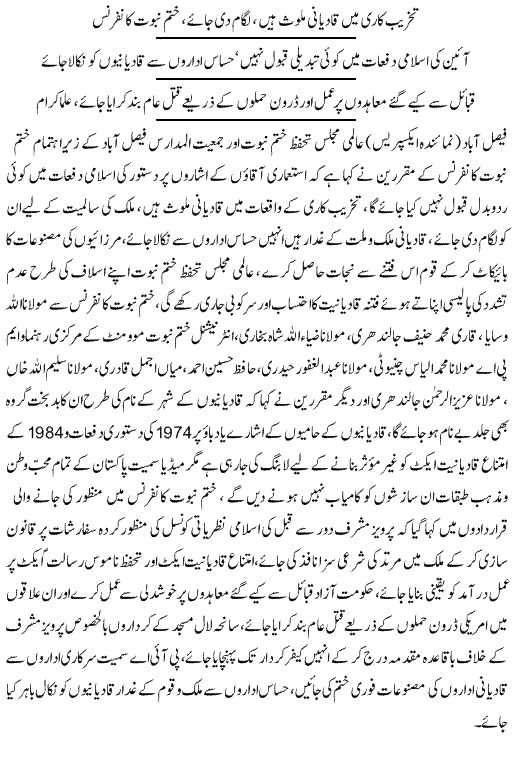
Mullahs blame Ahmadis for terrorist activities. Ahmadis also termed as traitors !


Contrary to facts some Deobandi and Wahabi mullahs have blamed Ahmadi community for the terrorists' activities !!!
The mullahs also called for Ahmadis' boycot and demanded that Ahmadis be expelled from intelligence agencies ! List of speakers of Khatam-e-Nabowat Conference also includes name of Mullah Allah Wasaaya of banned Sipah-e-Sahaba. I'm wondering where were our intelligence agencies sleeping when the mullahs delivered hate speeches in Faisalabad !!!


Source: Daily Express, 7th April, 09
Read more...

Tuesday, 17 March 2009

Ahmadi couple found dead in Multan

http://www.worldreligionsconference.org/images/ahmadiyya_logo.gif

LAHORE: Blindfolded bodies of an Ahmadi couple were found from their house in Multan with hands tied behind their backs. The two were doctors by profession and had been murdered on March 14, a press statement by the Ahmadiyya community said on Monday. According to the statement, Dr Shiraz Ahmad Bajwa (37) and his wife Dr Noreen Bajwa (29) were killed in a brutal attack at their house in WAPDA Colony, Multan. It said the two doctors had been receiving threats for some time due to their religious beliefs. The housekeeper found the body of Dr Shiraz in the bedroom, with visible marks of strangulation, and Dr Noreen in the living room, the statement said. staff report

http://dailytimes.com.pk/default.asp?page=2009\03\17\story_17-3-2009_pg7_10

Ahmadi Physicians Murdered in Pakistan for their Faith

TORONTO, March 17 /CNW/ - On March 14, 2009, in Multan, Pakistan, bodies
of a prominent physician couple Dr. Shiraz Bajwa (37) and Dr. Noreen Bajwa
(29), were found by their housekeeper in their home after they had been
brutally murdered. Both had received numerous death threats lately from
religious extremists because of their faith. Dr. Noreen was also pregnant with
the couple's first child.

Members of the Ahmadiyya Muslim Community are persecuted despite their
unblemished history as peace loving citizens. This spate of violence against
Ahmadis in Pakistan has been unprecedented. Currently, despite condemnation by
Human Rights Organizations, four Ahmadi boys (aged 14 to 16) remain in
custody, for the past seven weeks, due to their having been falsely charged
with blasphemy.

The murders of Dr. Shiraz and Dr. Noreen Bajwa mark the 99th and 100th
assassination of the Ahmadis since 1984, the 3rd and 4th in 2009 so far.

The body of Dr. Shiraz Bajwa was found in his bedroom with his hands tied
behind his back, his mouth gagged and his eyes blindfolded. His body showed
visible signs of strangulation. The body of his wife, Dr. Noreen Bajwa, who
was five month pregnant at the time of her death, was found in their living
room with her hands tied behind her back, her mouth gagged and her eyes
blindfolded. Her nose had been bleeding.

Dr. Shiraz Bajwa was an eye-specialist. He had served at the Fazl-e-Umar
Hospital (a hospital run by the Ahmadiyya Community in Rabwah, Pakistan) and
was working at the local hospital in Wapda Colony, Multan. Dr. Noreen Bajwa
worked at the local children's hospital.

"What occurred in Multan yesterday was an act of such cruelty that it can
never be comprehended by decent and peace loving people. . . . Pakistan is a
country that is currently facing absolute ruin. Amongst this chaos, the
hateful acts of religious extremists are ever-increasing to the extent that
loving, caring and innocent people are being murdered because they belong to a
community whose motto is 'Love for All, Hatred for None'," said Abid Khan,
Spokesperson for the Ahmadiyya Muslim Community.

International media and human rights organizations are urged to call for
the protection of the rights and lives of the members of the Ahmadiyya Muslim
Community in Pakistan.

http://www.newswire.ca/en/releases/archive/March2009/17/c9460.html


Read more...

Sunday, 15 March 2009

A song dedicated to Islamic Brotherhood Week

http://photos.friendster.com/photos/59/30/16770395/1_517070320l.jpg

By peitha

..... what we are missing in all this chatter is a modern version of someone like Tom Lehrer, producing songs like National Brotherhood Week about these conflicts - though I'm not really sure one wants to go down the route of wondering what an Islamic version of "I hold your hand in mine dear" would be like ... ( " ...The night you stole I cut it off ..." ?).

Anyway, tongue in cheek and in the spirit of Mr. Lehrer, perhaps it might just possibly be something like this ...

One week of every year is to be designated Islamic Brotherhood Week. This is just one of many such weeks honoring various worthy causes. One of my favorites is National Make-fun-of-the-headless Week which President Amadasahatter and Abu Zarqawi are in charge of as you know. During Islamic Brotherhood Week various special events are arranged to drive home the message of ummah. I'm sure we all agree that all Muslims ought to love one another and I know there are people in the world that do not love their fellow Muslims and I hate people like that. So here's a song about Islamic Brotherhood Week.

http://www.shiatv.net/chimg/15.jpg

A song dedicated to the unity of Islamic Ummah, moderate and radical Muslims, Muftis and Ayatollahs, Sunnis, Shias, Qadiyanis and Ibadis.

Oh, the Saudi folks hate the Persian folks,
And the Persian folks hate the Saudi folks.
To hate all but the right folks
Is an old established rule.

But during Islamic Brotherhood Week, Islamic Brotherhood Week,
Ayatollahs and Sunni Muftis are dancing cheek to cheek.
It's fun to eulogize
The people you despise,
As long as you don't let 'em in your sect.

Oh, the radical folks hate the moderate folks,
And the moderate folks hate the radical folks.
All of their folks hate all of your folks,
It's Islamic as caliphates.

But during Islamic Brotherhood Week, Islamic Brotherhood Week,
All the Sunnis love the Shias 'cause they're so sincia.
Step up and cut off the head
Of someone not yet dead.
You can kill him if you try.

Oh, the Qadianis hate the Ibadis,
And the Ibadis hate the Qadianis,
And the Wahabi hate the Ahmadiyya,
And everybody hates the Jews.

But during Islamic Brotherhood Week, Islamic Brotherhood Week,
It's Islamic Everyone-just-glare-at-one-another-hood Week.
Be nice to people who
Are inferior to you.
It's only for a week, so have no fear.
Be grateful that it doesn't last all year!

Source

http://cache.daylife.com/imageserve/0ep2gZ16TS39K/610x.jpg

Tom Lehrer - National Brotherhood Week

Read more...

Friday, 13 February 2009

5 Ahmadis detained without proof of blasphemy: HRCP

Stop persecution of minorities in Pakistan. Amend the blasphemy law, a blunt tool to kill in the hands of extremist Islamists in Pakistan

5 Ahmadis detained without proof of blasphemy: HRCP

* Report says relative of local MNA, elements belonging to banned organisations pushed police to register case
* Commission demands prompt, transparent investigation into matter

Staff Report


LAHORE: The five Ahmadis detained on the charges of blasphemy in Layyah district have been held without any proof or witness, the Human Rights Commission (HRCP) said on Thursday.

The commission, which had sent a fact-finding team to Layyah district last week, said its findings concluded that an investigation, mandated by law prior to the registration of a blasphemy case, had not been held.

The HRCP team learned that a prayer leader in the village had allowed Ahmadi students from a nearby tuition centre to offer prayers in the mosque. The students were later threatened by a government schoolteacher, and they never went to the mosque again, the commission said. About a week later, some villagers claimed finding blasphemous writings in the mosque’s toilet.

The complainant said in the first information report (FIR), “Since these Ahmadis are the only non-Muslims coming to the mosque, therefore they must have committed the offence.” The argument was heard time and again during the HRCP team’s interviews with the mosque administration, some villagers and the local police. The police and villagers conceded that there were no witnesses or evidence of the Ahmadis’ involvement.

Involvement: The HRCP team found that elements belonging to banned extremist organisations, and that a relative of a member of National Assembly (MNA) from the area had pressured the police to register a case. “It is clear that a local politician has also used his influence” to book the Ahmadis, the commission’s report said.

HRCP said the complainant and his ‘extremist’ supporters were adamant that the Ahmadis should be punished on the basis of presumption.

Investigation: The HRCP demanded a prompt and transparent investigation into the matter to ensure that innocent people were not victimised. It also demanded the government ensure that the Ahmadiyya community in the village was not harassed or ostracised. The commission asked the government to take prompt measures to rule out misuse of the blasphemy law. The detailed fact-finding report can be accessed at the HRCP website: www.hrcp-web.org


Read more...

Friday, 30 January 2009

Mob tries to burn houses of Ahmadis in Layyah

Shame on extremist Muslims who cannot respect the faith and practices of their fellow Pakistanis.

....

Mob tries to burn houses of Ahmadis in Layyah

* HRCP alarmed over four children’s detention on blasphemy charges
* FIR says local MNA’s uncle ‘probed’ the incident at his outhouse

By Abdul Manan


LAHORE: A mob – led reportedly by members of banned religious organisations – tried to set ablaze houses of Ahmadis in Layyah on Thursday, a day after four children belonging to the minority community were detained on charges of blasphemy, police and residents told Daily Times.

Twenty policemen had been deployed to the village, a police official said.

Police had registered a case (number 46/9) in the Kot Sultan police station against Tahir Imran (16), Tahir Mahmood (14), Naseer Ahmad (14), Muhammad Irfan (14), and Mubashar Ahmad (45) under Section 295-C of the Pakistan Penal Code.

The Ahmadiyya community has denied the charge, the first ever against children since the Section 295-C was introduced in 1986.

Asma Jahangir, the chairwoman of the Human Rights Commission of Pakistan (HRCP), said that it was heinous to use the law against children. The HRCP was finding facts about the incident, she said, and would soon send a team to Layyah.

Religious scholar Javed Ghamidi said the children were safer in police custody.

The children belong to Chak 172/TDA, a village about 25 kilometres from Kot Sultan. Last week, the locals had stopped the Ahmadi children from praying in the central Gulzar-e-Madina mosque, Kot Sultan Station House Officer (SHO) Rauf Khalid told Daily Times.

But they continued to use the latrines, where they have been accused of writing blasphemous material, according to the first information report (FIR).

Noor Elahi Kulachi – a retired schoolteacher, and, as the SHO confirmed, a member of the banned Sipah-e-Sahaba – complained to Iqbal Hussain Shah, the uncle of the local National Assembly member Saqlain Shah. According to the FIR, Iqbal Hussain called the SHO and the people who had seen the writings to his outhouse, where they “probed the incident” to find the Ahmadi children guilty.

But the local leader of the Ahmadiyya community alleged that Kulachi – who was also a member of Jamaatud Dawa – had pressured Iqbal Hussain to direct the police to register the case, and the latter complied because of the Jamaatud Dawa votebank in the constituency.

Saqlain Shah, an MNA from the Pakistan Muslim League-Nawaz, denied his uncle had pressured police. But he said representatives of the Ahmadiyya community should have visited his uncle’s residence for the matter to be resolved in line with local traditions, instead of denying charges.

He also said that Ahmadis had first lodged cases against local Muslims (for violating the Loudspeakers Act and under the Maintenance of Public Order) after being disallowed to hold a religious meeting, and should now “face the truth”. He said he would visit the village on Saturday, and that his uncle was trying to pacify the villagers.

The SHO said he had registered the case after consulting the district police officer and a deputy inspector general of police. The inspector general of police had also been informed, he added. (Daily Times)


Read more...